Unified Framework For Deep Learning Based
Text Classification
Dr Sheelesh Kumar Sharma, Navel Kishor Sharma, Dr Gajendra Singh
Abstract: Deep learning has emerged as a very popular approach for solving large scale pattern recognition problems. In recent times, it has solved various text mining problems with improved accuracy as compared to pre-existing approaches. There are deep learning based AI systems that have been trained to do sentiment analysis on social media or business data, opinion mining, text document classification & clustering etc. The models for deep learning for text classification include convolutional neural networks (CNN), recurrent neural networks (RNN), long short term memory (LSTM) networks, deep belief networks (DBN), fusion approaches etc. This paper presents a unified framework for deep learning based text classification. The framework has 6 layers segmenting basic components of a typical classification system. Here, the review of state-of-the-art deep learning based text classification methods and their applications in different domains has been presented. Moreover, the paper also discusses the limitations of deep learning and throws light on various challenges that may turn to the future research directions in the field. Paper presents a comparative study of different deep learning based text classification approaches based on parameters like approach used, data sets and accuracy.
Index Terms: Text classification, deep learning, text classification approaches, LSTM, RNN, NLP, framework for classification, applications of deep learning
—————————— ——————————
1.
INTRODUCTION
TEXT mining has been an area of research for more than last two decades. Understanding useful insights is important from various perspectives such as business, forensics, social etc [1][2]. With the advent of new age technologies including cloud infrastructures, high speed internet, automation, AI etc, now it is possible to process mammoth size of data. Text data is generated from various channels including web repositories, blogs, news feeds etc. Only around 5% of the data on world wide web is publicly accessible but 95% of the data is access restricted. This access restricted data is very crucial for the organizations and its management and mining is a challenge. Deep learning based approaches have been performing better than other techniques for general pattern recognition tasks such as image classification, face recognition, action recognition, text classification etc. Text classification is an example of supervised machine learning approach, which requires a labeled training data with classes. Text classification has many useful applications including email classifier (in spam and non-spam categories), sentiment analysis, auto labeling of customer reviews or queries of products, categorization of new articles and others. A typical supervised learning approach for text classification works in the following steps:
i. Creation or collection of training data set ii. Pre-processing or cleansing of data ii. Splitting it into training and test sets
iii. Feature extraction from training set (some algorithms require) [optional]
iv. Dimensionality reduction [optional]
v. Applying classification algorithm on training data vi. Validating the results using test data
vii. Estimating the accuracy metrics
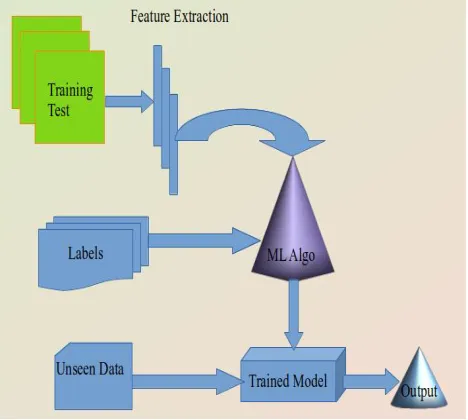
Figure 1 depicts the schematic diagram of a typical machine learning system. There exist many techniques for text classification. Kang et al[3] propose a technique based on
ensemble of hidden Markov model for opinion mining using textual data. In a very recent work of Skrlj et al [4], text classification is achieved with the help of semantics-aware
Fig.1 : Supervised approach for text classification
recurrent neural network. Here, semantic information related to document is converted into learning features which are used for training the classifier. The text classification approaches use various text representations such as term frequency & inverse document frequency (TFIDF), bag of words, n-grams, character level representation etc [3]-[6]. As described in the work of Zhang et al[5], character level convolution networks also perform at par with other conventional representations. Other machine learning approaches such as artificial neural networks (ANN), k- nearest neighbor (KNN), naive Bayes classifier, decision trees, random forests, support vector machines etc [6]-[8]. Support vector machines and decision trees are good for binary text classification tasks such as email spam filtering. A variant of decision tree classifier called as random forest can be used for multi-class text classification problems. Support vector machines can also be extended to work with multi-class text classification problems. In such case, an ensemble of various ————————————————
Dr Sheelesh Kumar Sharma, Professor (Comp. Sc.), IMS Ghaziabad, INDIA. E-mail: [email protected]
Navel Kishor Sharma, Associate Dean, Academic City College, GHANA
binary SVMs is created. For ensemble creation there are two popular strategies one is called bagging and another one is called boosting.
2
DEEP
LEARNING
MODELS
AND
ARCHITECTURES
Deep learning models are based on artificial neural networks, which are inspired by biological brain model made of neurons.
A typical deep learning architecture has three components namely input variables, hidden layers and output layer. At every level of learning, the data is converted into an abstract form. The meaning of term ―deep‖ in deep learning is that there are more multiple hidden layers before the output is performed through output layer. Deep learning started a revolution when a team led by Dahl won the ―Merck Molecular
Activity Challenge‖ in year 2012 and later applications spread in other areas as well. Recently, in March 2019, the prestigious Turing Award has been awarded to Yoshua Bengio, Yann LeCun and Geoffrey Hinton for their works in the area of deep neural networks. Many popular deep learning architectures exist. Some popular deep learning architectures are convolutional neural network (CNN), deep belief networks, recurrent neural networks (RNN), long short term memory (LSTM) etc. These networks have been widely used to solve the problems in the areas like computer vision, speech recognition, text mining, machine translation, bio-informatics, natural language processing etc. In some cases, these models outperform even the human experts. A deep learning system can directly learn from the data without the need of feature extraction system. This is called end-to-end learning. Though, features are extracted internally by the model itself. CNN is a kind of feed forward neural network but it cannot store any previous data. CNN is good for the tasks like image classification but cannot be used for sequential data. CNNs are fully connected in nature. This trait of CNN make them prone to over-fitting. Recurrent neural network (RNN) can hold the previous data and passes it as an input to the next layer. Every RNN has a feedback loop in its recurrent layer. They can hold only a limited amount of data in memory. As the decay of gradient of the loss function is exponential in nature. Therefore, RNN standard memory is not practically sufficient to solve real world problems. To overcome this limitation an advanced variant of RNN exist which is called LSTM (long short term memory) architecture. Apart from the standard
memory units, an LSTM architecture has special memory units called memory cells.
3
DEEP
LEARNING
FOR
TEXT
CLASSIFICATION
Like other fields of computational cognitive studies, deep learning is penetrating to text classification as well. The approaches proposed for deep learning vary on different parameters such as learning model, data sets used, tuning of hyper-parameters, types of features etc. [9]-[22]. In general RNN, LSTM and their variants with a fusion of features have been giving promising results. Abdi et al[9] present a novel fusion approach called RNSA for sentiment classification. They used a fusion approach which employs LSTM. In the work of Heikal et al[10] give a method for sentiment analysis of Arabic language tweets. The reported average accuracy is around 65%. The approach proposed in [11] extracts high level features from low level word vectors. They use RNN and report accuracy of on long documents. Domain and semantic features can be used for training a classifier in deep learning as used by Odeh et al[12]. The approach has been tested on adverse drug events (ADR) tweets/text classification data set. Another text classification approach proposed by Jiang et al[13] use deep belief network and softwmax regression to achieve better accuracy than KNN and SVM. Majumdar et al [14] present their experimental findings for personality trait identification using a deep CNN architecture. They achieve an average accuracy of 62 %, while the test accuracy is reported around 98%.
4
UNIFIED
FRAMEWORK
FOR
DEEP
LEARNING
BASED
TEXT
CLASSIFICATION
A unified framework for deep learning based text classification is presented here. The schematic view of proposed framework is given in figure 2. Framework includes the following 6 layers: i. Infrastructure Layer: This layer includes various deep learning infrastructure service providers. These service providers include Google Cloud, Amazon Cloud, IBM Cloud, and others.
Fig.2: Proposed framework for text classification using deep learning
iii. Data Layer: It includes various data sets available for text classification. There are many traditional to modern data sets that can be used for text classification in this layer. These data sets include CMU, BBC, 20 Newsgroups, Arxiv, IMDB etc data sets.
iv. Model Layer: The model layer in the framework includes various deep learning architectural models. This layer includes CNN, RNN, LSTM etc models.
v. User Management and Billing Layer: Management of users and their billing based on pay per user model can be done through this layer.
5
EVALUATION
OF
STATE-OF-THE-ART
DEEP
LEARNING
METHODS
FOR
TEXT
CLASSIFICATION
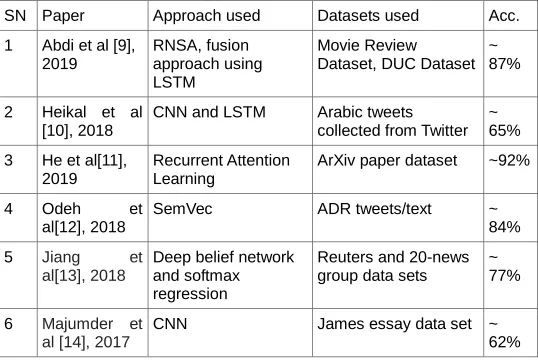
Table 1: Comparative analysis of some state-of-the-art deep learning based approaches for text classification
SN Paper Approach used Datasets used Acc.
1 Abdi et al [9], 2019
RNSA, fusion approach using LSTM
Movie Review Dataset, DUC Dataset
~ 87%
2 Heikal et al [10], 2018
CNN and LSTM Arabic tweets collected from Twitter
~ 65%
3 He et al[11], 2019
Recurrent Attention Learning
ArXiv paper dataset ~92%
4 Odeh et al[12], 2018
SemVec ADR tweets/text ~
84%
5 Jiang et
al[13], 2018
Deep belief network and softmax regression
Reuters and 20-news group data sets
~ 77%
6 Majumder et al [14], 2017
CNN James essay data set ~ 62%
Some state-of-the-art deep learning approaches for text classification have been contrasted based on the three parameters namely approach used, data sets and accuracy of the classifier. These approaches have been taken from the papers published in just last three years (2017-2019). It is evident from the table
6
CHALLENGES
&
FUTURE
RESEARCH
DIRECTIONS:
The area of deep learning is in its infancy state as new developments are underway. There are certain challenges that are to be resolved. Some of the challenges for deep learning are listed as follows:
i. Lack of labeled data: In deep learning, to get more accurate model more parameters need to be trained and therefore it needs copious amount of data. Though new data sets are appearing with the passage of every single day, it is imperative to create authentic large labeled data sets for deep learning. Any deep learning system primarily relies on the variety and volume of the data.
ii. Expensive computing power: Still the computational resources for setting up deep learning architectures are not very affordable. It plays the role of deterrent for wide spread research and development in the field.
iii. Overfitting : The accuracy of a model is judged by its performance on the unseen real world data and not on the sample data used for training. Overfitting occurs when model performs well on the test data but does not give that accurate results with unseen data. This happens due to when model memorizes the training instances instead of generalizing the learning. Neural networks are prone to overfitting and so is deep learning.
iv. Lack of generalization: Every deep learning model is trained to accomplish a specific task only. It means a model for image classification will do image classification only. A model cannot be trained to perform generalized tasks such as doing image
parameters, it is very difficult to explain the underlying process for generating final output. Understanding the inherent process is essential in mission critical applications. Researchers are working on devising new ways to elaborate the underlying process which is a part of ―explainable AI‖.
vi. Butterfly effect: This is another type of limitation that deep learning methods suffer with. Buffer fly effect refers to the instability caused in the deep learning system with slight variation in the input parameters. Even adding a slight amount of input noise can mislead the system to produce completely different insights in the deep learning system. It makes them highly vulnerable for malicious operation and puts a security hazard.
7
CONCLUSION
This paper presents a stock of the work done in the area of text mining using deep learning including various deep learning models, applications, challenges and the future research directions. Deep learning based methods for text classification use a variety of architectural models such as CNN, RNN, LSTM, DBN etc. They have been outperforming from the conventional methods like KNN, ANN, SVM, naive Bayes classifier, decision trees, random forests etc. There comes some challenges and limitations with these methods as well. These challenges include overfitting, butterfly effect, black box nature of models etc. Researchers are motivated to find the solutions of these limitations.
REFERENCES
[1] Berry, M. W. (2004). Survey of text mining. Computing Reviews, 45(9), 548.
[2] Hotho, A., Nürnberger, A., & Paaß, G. (2005, May). A brief survey of text mining. In Ldv Forum (Vol. 20, No. 1, pp. 19-62). [3] Kang, M., Ahn, J., & Lee, K. (2018). Opinion mining using
ensemble text hidden Markov models for text classification. Expert Systems with Applications, 94, 218-227.
[4] Skrlj, B., Kralj, J., Lavrač, N., & Pollak, S. (2019). Towards Robust Text Classification with Semantics-Aware Recurrent Neural Architecture. Machine Learning and Knowledge Extraction, 1(2), 575-589.
[5] Zhang, X., Zhao, J., & LeCun, Y. (2015). Character-level convolutional networks for text classification. In Advances in neural information processing systems (pp. 649-657).
[6] Wang, S. J., Mathew, A., Chen, Y., Xi, L. F., Ma, L., & Lee, J. (2009). Empirical analysis of support vector machine ensemble classifiers. Expert Systems with applications, 36(3), 6466-6476. [7] Akinyelu, A. A., & Adewumi, A. O. (2014). Classification of
phishing email using random forest machine learning technique. Journal of Applied Mathematics,2014.
[8] Aggarwal, C. C., & Zhai, C. (2012). A survey of text classification algorithms. In Mining text data (pp. 163-222). Springer, Boston, MA.
[9] Abdi A., Shamsuddin S.M, Hasan S., & Piran J. (2019): Deep learning based sentiment classification of evaluative text based on multi-feature fusion, Information Processing and Management, 56, 1245-1259.
[10]Heikal M., Torki M., & El-Makky N. (2018) Sentiment Analysis of Arabic Tweets using Deep Learning, Procedia Computer Science, 142, 114-112.
Vectors Based Deep Learning for Improved Text Classification. In: Fagan D., Martín-Vide C., O'Neill M., Vega-Rodríguez M. (eds) Theory and Practice of Natural Computing. TPNC 2018. Lecture Notes in Computer Science, vol 11324. pp. 449-459 Springer
[13]Jiang, M., Liang, Y., Feng, X., Fan, X., Pei, Z., Xue, Y., & Guan, R. (2018). Text classification based on deep belief network and softmax regression. Neural Computing and Applications, 29(1), 61-70
[14]Majumder, N., Poria, S., Gelbukh, A., & Cambria, E. (2017). Deep learning-based document modeling for personality detection from text. IEEE Intelligent Systems,32(2), 74-79. [15]Lai, S., Xu, L., Liu, K., & Zhao, J. (2015, February). Recurrent
convolutional neural networks for text classification. InTwenty-ninth AAAI conference on artificial intelligence.
[16]Iyyer, M., Manjunatha, V., Boyd-Graber, J., & Daumé III, H. (2015). Deep unordered composition rivals syntactic methods for text classification. In Proceedings of the 53rd Annual Meeting of the Association for Computational Linguistics and the 7th International Joint Conference on Natural Language Processing (Volume 1: Long Papers)(Vol. 1, pp. 1681-1691).
[17]Kowsari, K., Brown, D. E., Heidarysafa, M., Meimandi, K. J., Gerber, M. S., & Barnes, L. E. (2017, December). Hdltex: Hierarchical deep learning for text classification. In 2017 16th IEEE International Conference on Machine Learning and Applications (ICMLA) (pp. 364-371). IEEE.
[18]Yang, C., Liu, Z., Zhao, D., Sun, M., & Chang, E. (2015, June). Network representation learning with rich text information. InTwenty-Fourth International Joint Conference on Artificial Intelligence.
[19]Badjatiya, P., Gupta, S., Gupta, M., & Varma, V. (2017, April). Deep learning for hate speech detection in tweets. In Proceedings of the 26th International Conference on World Wide Web Companion (pp. 759-760). International World Wide Web Conferences Steering Committee.
[20]Liu, J., Chang, W. C., Wu, Y., & Yang, Y. (2017, August). Deep learning for extreme multi-label text classification. In Proceedings of the 40th International ACM SIGIR Conference on Research and Development in Information Retrieval (pp. 115-124). ACM.
[21]He, P., Huang, W., Qiao, Y., Loy, C. C., & Tang, X. (2016, March). Reading scene text in deep convolutional sequences. In Thirtieth AAAI Conference on Artificial Intelligence.