SURVEY OF WORKFLOW ANALYSIS
IN PAST AND PRESENT ISSUES
SARAVANAN .M.S
Research Scholar in R & D Centre, Bharathiar University, Coimbatore, Tamil Nadu, INDIA. Asst. Prof. in Dept. of I.T in Vel Tech Dr. RR & Dr. SR Technical University, Chennai, INDIA.
RAMA SREE .R.J
Professor & Head in the Department of Computer Science, Rashtriya Sanskrit Vidyapeetha, Tirupati, Andhra Pradesh, INDIA.
[email protected] Abstract:
This paper surveys the workflow analysis in the view of business process for all organizations. The business can be defined as an organization that provides goods and services to others, who want or need them. The concept of managing business processes is referred to as Business Process Management (BPM). A workflow is the automation of a business process, in whole or part, during which documents, information or tasks are passed from one participant to another for action, according to a set of procedural rules. The process mining aims at extracting useful and meaningful information from event logs, which is a set of real executions of business process at any organizations. Thispaper briefly reviews the state-or-the-art of business processes developed so far and the techniques adopted. Also presents, the survey of workflow analysis in the view of business process can be broadly classified into four major categories, they are Business Process Modeling, Ontology based Business Process Management, Workflow based Business Process Controlling and Business Process Mining.
Keywords: Business Process; BPM; Ontology; Workflow; Process Mining.
1. Introduction
A Business Process is execution of a sequence of related steps in response to an event that leads to a clearly defined outcome. These processes can involve a variety of participants and may include internal and external computer systems or employees. Hence, business process or business method is a collection of related, structured activities or tasks that produce a specific service or product for a particular customer or customers. It can be visualized with a flowchart as a sequence of activities. These processes are critical to any organization as they need to generate good revenue.
The organization goal is time dependent, so the business processes need to improve or require changes with respect to time. Therefore these processes need to identify and verify the new opportunities and changes are required to gain more revenue or avoid loss of every organization. These business processes are based on a flowcharting technique tailored for creating graphical models of business process operations. Hence, business process refers to how an organization has decided upon its flow of activities so as to produce desired results by making optimum use of its resources in the form of raw material, personnel and their skills, and equipments.
The purpose of any business process is production of products. These products may be tangible like a car, as well as intangible like a service. Services include handling of insurance claim, treatment or even assessment of a scientific paper. Therefore, this paper survey the research areas such as process modeling, ontology based business process management, workflow management and process mining in the view of any business process.
2. Related Work
Many efforts were made to develop business process for all organizations. Thispaper briefly reviews the state-or-the-art of business processes developed so far and the techniques adopted.
3. Business Process Modeling
In the IEEE Glossary [1], one of the definitions for process is “a sequence of steps performed for a given purpose; for example, the software development process.”
A business process or business method is a collection of related, structured activities or tasks that produce a specific service or product that is serve a particular goal for a particular customer or customers. It often can be visualized with a flowchart as a sequence of activities. So the business process model plays major role in the business process management, business process modeling, etc.
When people talk about their business they tend to use diagrams. Especially when they want to explain how their business works and what is happening in their companies. Whether it is the management structure, or a description of the flow of goods through the various parts of a warehouse, diagrams are a useful aid in alleviating the complexity problems faced [2].
The reason for using diagrams is simple. The humans are very good at understanding diagrams, especially if they are accompanied by some explanatory texts, or some verbal explanations. The diagram, which is used to discuss processes are called process models and when process models are used for discussion, it is typically used as descriptive models. The process models used in this thesis focus on the control flow aspect of a process, that is they describe in which order activities need to be performed and hence in which way cases flow through the information system. Increasingly, organizations are, either explicitly or implicitly, driven by processes of some sort. Examples of such processes are the handling of insurance claims in an insurance company, or the application for a residence permit in the Immigration Service, but also the flow of patients through a hospital or the delivery of newspapers.
Since in 1970s, process modeling has become more and more popular. The idea behind process modeling is simple. It describes the business in terms of processes and the communication between processes and the environment, such that each description is unambiguous. In this way anybody who knows the same language is capable of understanding the process without any further explanation by just looking at the schematics. Note that process modeling does not decrease the complexity of describing the processes under consideration. However, it helps people in making the problem at hand more insightful. Once the formal languages are defined, all that remains is to make computers understand these process models to some extent, that is programs have to be developed that can interpret these process models.
These models can then be used to enforce a certain model onto the people working in a process, for example when dealing with insurance claims. However, these models can also be used by more flexible systems to support the operational process without enforcing or while only partially enforcing the model onto the operational process [2]. A postal worker for example will have to punch the clock when he leaves for his delivery round and when he comes back. However the order in which he delivers mail is not enforced. Large information systems that can deal with process models in one way or the other are commonly referred to as process-aware information systems.
Business process modeling (BPM) in systems engineering and software engineering is the activity of representing processes of an enterprise, so that the current process may be analyzed and improved in future [3]. BPM is typically performed by business analysts and managers who are seeking to improve process efficiency. The process improvements identified by BPM require Information Technology involvement, although that is a common driver for the need to model a business process, by creating a process master [4].
The Process Modeling is widely used within organizations as a method to increase awareness and knowledge of business processes, and to deconstruct organizational complexity [5]. Beyond that, process modeling is used for a wide range of tasks including [6], Model based identification of process weaknesses, Adapting best business practices, Designing and communicating new business blueprints, End user training, Compliance and risk management and Designing and configuring software systems.
Many studies have shown the relevance of process modeling to BPM initiatives [7]. The Process modeling denotes a requirement for a number of ISO 9000 quality programs and it is the basis of process related IT system implementations, such as Enterprise Systems [8] and Workflow Management Systems [9]. The Literature reports, how process modeling has been employed in workflow management. The increasing interests in the business process modeling capturing and documenting the processes of an organization or information system. In simple terms, process modeling is an approach for visually describing how businesses conduct their work. It typically includes graphical depictions of at least the activities, events or states and control flow logic that constitute a business process [10]. Process modeling was originally incepted in the manufacturing industry as a means of analyzing material flow and activities in order to improve the product quality and to reduce manufacturing cycle time [11]. However, advancements in business process modeling have also been influenced by other domains. These include, for example office automation [12], software engineering [10], requirements specification, conceptual modeling [13] and transaction management [14].
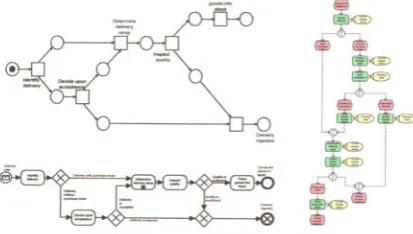
other hand, technical process models can also be used for process automation, which requires their conversion into executable specifications, best example of this is Petri nets, Business Process Execution Language for Web Services (BPEL4WS) [17]. The Figure 1 indicates, there are many ways of representing process models. Accordingly, when considering how to model business processes, an important consideration is the selection of the grammar [18]. This choice can be depends upon the structured analysis grammars or object oriented grammar. The same situation holds in principle, for process modeling. This situation is exemplified in Figure 1, in which one business process, goods receipt, is modeled in three different fashions. The observation of differences between the modeling approaches appears obvious.
The Internet and related technologies have created an interconnected world in which, it can exchange information easily, process tasks collaboratively and form communities among users with similar interests. This allows improved efficiency and performance. Allowing business users to model their needs is a trend of business process modeling. Based on our analysis, a lightweight process modeling approach is proposed. Further efforts are needed before we are able to easily connect existing web resources [19]. The various works done under the Business process modeling can be broadly classified in the following subheads.
Figure 1. Popular process modeling grammars
3.1. Business Process Modeling Notation
The Business Process Modeling Notation is an increasingly important standard for process modeling and has enjoyed high levels of attention in business practice. BPMN is a recently published notation standard for business processes. It was developed by an industry consortium BPMI.org, whose constituents represented a wide range of BPM tool vendors but no end users. Although the ‘official’ release date was only February 2006, BPMN has quickly become a de-facto standard for graphical process modeling. No other notation has seen such an uptake in such a short time as BPMN has. It is widely supported by both free and commercial process modeling tools such as Pega, Sparxsystems, Telelogic, Intalio, itp-commerce, Tibco, IBM Websphere and Sungard and integrated into the curriculum of education providers such as Widener University, Queensland University of Technology and Howe School of Technology Management, and part of the offerings of modeling coaches and consultants such as Object Training, BPM-Training.com and BPMInstitute.org. Even other standardization bodies such as WfMC have revised their standard development efforts to incorporate BPMN (Workflow Management Coalition, 2008).
Business process modeling is getting a lot of attention as a predominant technology to bridge the Business-IT gap. It bridges the gap by describing business processes using a notation understandable by all relevant users from the business analysts to the technical developers. Business Process Modeling Notation (BPMN), defined by Object Management Group (OMG), is a standard notation for describing business processes. One of the distinguishing features of BPMN is support of transactions and compensation in business processes. In BPMN, cancellation of a transaction triggers rollback of the transaction and compensation for specific activities in the transaction. This feature makes it possible to depict down-to-earth business processes. However, the specification of the notation does not include formal semantics. The informal description of the semantics for transactions and compensation makes the specification confusing. In this paper it shows that how Petri net (PN) can give semantics to a transaction and compensation of BPMN and the formal semantics makes the specification clear. In this paper also discussed about that how that it can applied reachability and coverability analysis of PN to verification of business processes with transactions and compensation [20].
comments. Figure 2 provides an example of a BPD. It shows a simple payment process in which customers can pay an invoice by cash, cheque or credit card.
Figure 2. BPMN diagram of payment process
4. Ontology based Business Process Management
Third generation business process management is different in that it provides an integrated view on business processes. It empowers the business expert to define business processes and business rules. While the role of the business expert gains prominence, implementation oriented aspects must not be neglected. The business oriented view as a counter piece in the form of the technical view, that is Information Technology view and both must be on an equal footing.
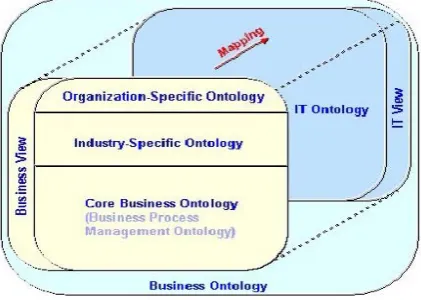
The business view can be segmented into three layers 1. Core business ontology layer
2. Industry specific ontology layer 3. Organization specific ontology layer
The IT view is not segmented into layers and is completely organization specific. The segmentation into views and layers does not mean that an organization has to cope with multiple ontologies, which require permanent synchronization. It rather represents a logical separation of concern. Business experts would see the result of an ontology merge, which means that in their perception there is just ones coherent ontology. At the technical level, ontologies can be nested. As a consequence, an organization would be able to acquire ontology “components” from various sources. For example, an organization would choose to use the Business Process Management Ontology nucleus to represent the core business ontology layer. The organization might want to acquire the industry specific ontology layer from some industry body and develop the organization specific ontology layer in house.
The resulting business ontology represents a three dimensional model, as shown in Figure 3.
Figure 3. Ontology based three dimensional model for business process management
In line with practical experience, the expectation that the core business layer and the industry specific ontology layer together cover more than 80 percentage of an organizations business. In highly regulated industries, such as banking, insurance and aviation, coverage may exceed the 90-95 of percentage of mark.
While the core business ontology layer defined the Business Person Role concept. The organization specific ontology layer extends this concept by defining roles that are specific to that particular organization. Of course, as with object oriented systems, sub classes inherit properties from their respective super classes.
Conceptually, the layered approach has much in common with object-oriented frameworks. The core business ontology layer would represent the base framework. However, unlike object-oriented frameworks, ontology layers are business frameworks, meaning that no coding in some object-oriented programming language is involved. Each ontology is purely declarative, representing architecture and design, but not code.
5. Workflow based Business Process Controlling
A workflow process is a collection of processing steps also termed as tasks or activities organized to accomplish some business processes. In addition to the collection of tasks, a workflow defines the order of task invocation or conditions under which tasks must be invoked that is control flow and data-flow between these tasks. This definition may also express constrains and conditions such as when the activities should be executed, a specification of who can or should perform each activity, and which tools and programs are needed during the activity execution. Management of workflows deals with the automated coordination, control and communication of work as required satisfying workflow processes [21].
In simplest terms, a workflow is the movement of documents and tasks through a business process. A Workflow System provides for the automation of a business process, in whole or part, during which documents, information, or tasks are passed from one participant to another for acting, according to a set of rules. Another definition says, workflows are activities involving the coordinated execution of multiple tasks performed by different processing entities, mostly in distributed heterogeneous environments which are very common in the enterprises of even moderate complexity. These activities could be manual or automated, possibly being already-existing legacy programs. Starting with early 1990s, workflow systems have been an active research and development area with several research prototypes and commercial products in the market. Mean while, when the workflow market started to grow, other market segments started to include some of the workflow capabilities. Enterprise Resource Planning (ERP) started to increasingly support workflow capabilities. Most leading ERP systems e.g., SAP ERP Solutions, BaanERP, and PeopleSoft offer a workflow component. In fact, as predicted in [22], currently, workflow process management functions and technology are absorbed by other technologies. Although there are stand alone workflows management systems on which workflow applications are built, the trend is to have workflow capability in critical enterprise application systems such as Enterprise Resource Planning (ERP) and supply-chain management, and e-commerce solutions. There are many business models used in electronic commerce (EC) like e-shop, e-procurement, e-mall, electronic marketplace, virtual communities, value chain service providers, value chain integrators, collaboration platforms, and information brokerage.
In all of these models the business processes can be modeled as a set of steps that are ordered according to the control and data flow dependencies among them. This corresponds to a workflow process, where the coordination, control and communication of activities are automated, although the activities themselves can either be automated or performed by humans. New technology integration standards such as XML Schema, SOAP, and J2EE enable the convergence of legacy infrastructures toward process-oriented enterprise computing. On the other side, emerging protocols such as ebXML, RosettaNet, and BizTalk support the process level collaboration among business partners. To support enterprise business processes in electronic commerce applications, workflow systems should have certain features that are of critical importance.
5.1 Workflow Management Systems
According to the Workflow Management Coalition, Workflow is:
“The automation of a business process, in whole or part, during which documents, information or tasks are passed from one participant (a participant in this context can be either a human resource, intelligent agent or a computer Application)to another for action, according to a set of procedural rules”.
The primary aim of a Workflow Management System (WfMS) is to utilize information technology to assist, and where appropriate automate, activities involved in a specific process. At a minimum, a WfMS should be able to facilitate, monitor and audit “who" has done, is doing, or is scheduled to do "what", “when" and “why" to “whom". Thus, the WfMS should be able to provide context to any particular activity. They should help to ensure that activities that should be undertaken. Workflow systems are process oriented, where a process represents a set of activities that need to occur in a prescribed sequence to achieve an outcome.
6. Business Process mining
describe three methods for process discovery: one using neural networks, one using a purely algorithmic approach, and one Markovian approach. The authors consider the latter two the most promising approaches. The purely algorithmic approach builds a finite state machine where states are fused if their futures that are in terms of possible behavior in the next k steps are identical. The Markovian approach uses a mixture of algorithmic and statistical methods and is able to deal with noise. Note that the results presented in [23] are limited to sequential behavior. Related, but in a different domain, is the work presented in [35], [36] also using a Markovian approach restricted to sequential processes. Cook and Wolf extend their work to concurrent processes in [25]. They propose specific metrics such as entropy, event type counts, periodicity, and causality and use these metrics to discover models out of event streams. However, they do not provide an approach to generate explicit process models. In [26] Cook and Wolf provide a measure to quantify discrepancies between a process model and the actual behavior as registered using event-based data.
6.1 Process Mining in the context of Workflow Management
The idea of applying process mining in the context of workflow management was first introduced in [23]. This work is based on workflow graphs, which are inspired by workflow products such as IBM MQSeries workflow that is formerly known as Flowmark and InConcert. In this paper, two problems are defined. The first problem is to find a workflow graph generating events appearing in a given workflow log. The second problem is to find the definitions of edge conditions. A concrete algorithm is given for tackling the first problem. The approach is quite different from other approaches: Because the nature of workflow graphs there is no need to identify the nature of AND or OR joins and splits. As shown in [37], workflow graphs use true and false tokens which do not allow for cyclic graphs. Nevertheless, [23] partially deals with iteration by enumerating all occurrences of a given task and then folding the graph. However, the resulting conformal graph is not a complete model. In [38], a tool based on these algorithms is presented. Schimm [33, 34] has developed a mining tool suitable for discovering hierarchically structured workflow processes. This requires all splits and joins to be balanced. Herbst and Karagiannis also address the issue of process mining in the context of workflow management [27], [28], [29], [30] using an inductive approach. The work presented in [29] is limited to sequential models. The approach described in [27], [28], [29] also allows for concurrency. It uses stochastic task graphs as an intermediate representation and it generates a workflow model described in the ADONIS modeling language. In the induction step task nodes are merged and split in order to discover the underlying process. A notable difference with other approaches is that the same task can appear multiple times in the workflow model, that is the approach allows for duplicate tasks. The graph generation technique is similar to the approach of [23], [38]. The nature of splits and joins that is AND or OR is discovered in the transformation step, where the stochastic task graph is transformed into an ADONIS workflow model with block-structured splits and joins. In contrast to the previous papers, the following papers are characterized by the focus on workflow processes with concurrent behavior that is rather than adding ad-hoc mechanisms to capture parallelism. In [39] a heuristic approach using rather simple metrics is used to construct so-called “dependency or frequency tables” and “dependency or frequency graphs”. In [31] another variant of this technique is presented using examples from the health care domain. The preliminary results presented in [31], [39] only provide heuristics and focus on issues such as noise. The approach described in [40] differs from these approaches in the sense that for the α algorithm it is proven that for certain subclasses it is possible to find the right workflow model. In the EMiT tool is presented which uses an extended version of α-algorithm to incorporate timing information. Process mining can be seen as a tool in the context of Business that is Process Intelligence (BPI). In a BPI toolset on top of HP’s Process Manager is described. The BPI tools set include a so called “BPI Process Mining Engine”. However, this engine does not provide any techniques as discussed before. Instead it uses generic mining tools such as SAS Enterprise Miner for the generation of decision trees relating attributes of cases to information about execution paths such as duration.
inference. The comparison with literature in this domain raises interesting questions for process mining, for example how to deal with negative examples that is suppose that besides log W there is a log V of traces that are not possible, for example, added by a domain expert). However, despite the many relations with the work described in [42] there are also many differences, for example, we are mining at the net level rather than sequential or lower level representations for example Markov chains, finite state machines, or regular expressions. There is a long tradition of theoretical work dealing with the problem of inferring grammars out of examples, given a number of sentences such as traces out of a language, find the simplest model that can generate these sentences. There is a strong analogy with the process mining problem given a number of process traces, can we find the simplest process model that can generate these traces. Many issues important in the language-learning domain are also relevant for process mining that is learning from only positive examples, how to deal with noise, measuring the quality of a model, etc. However, an important difference between the grammar inference domain and the process-mining domain is the problem of concurrency in the traces: concurrency seems not relevant in the grammar inference domain. In spite of this important difference, it seems usefully to investigate which theoretical results, measurements, and mining techniques can be used or updated so that they become useful in process mining. A good overview of prominent computational approaches for learning different classes of formal languages is given in [43] and a special issue of the machine learning journal about this subject. Additional related work is the seminal work on regions. This work investigates which transition systems can be represented by compact Petri nets that is the so called synthesis problem. Although the setting is different and our notion of completeness is much weaker than knowing the transition system, there are related problems such as duplicate transitions, etc. For more information on existing research.
6.2 Using Process Mining to Analyze and Improve Process Flexibility
Process-aware information systems, such as WfMs, ERP, CRM and B2B systems, need to be configured based on process models specifying the order in which process steps are to be executed [44].
Creating such models is a complex and time consuming task for which different approaches exist. The most traditional one is to analyze and design the processes explicitly making use of a business process modeling tool. However, this approach has often resulted in discrepancies between the actual business processes and the ones as perceived by designers. Therefore, very often the initial design of a process model is incomplete, subjective, and at a too high level. Instead of starting with an explicit process design, process mining aims at extracting process knowledge from process execution logs".
The ProM framework integrates the functionality of several existing process mining tools and provides much additional process mining plug-ins. The ProM framework supports multiple formats and multiple languages, e.g., Petri nets, EPCs, Social Networks, etc. The plug-ins can be used in several ways and combined to be applied in real-life situations. It encourages developers and researchers to use the ProM framework for implementing new ideas. It is easy to add a new plug-in. For adding new plug-ins it suffices to add a few lines to the configuration files and no changes to the code are necessary that is new mining plug-ins can be added without recompiling the source code.
Process mining techniques such as the alpha algorithm [45] typically assume that it is possible to sequentially record events. The alpha algorithm [45] can construct a Petri net model describing the behavior observed in the log. The Multi-Phase Mining approach can be used to construct an Event Process Chain (EPC) based on similar information. In the meantime there are mature tools such as the ProM framework (cf. Figure 1) to construct different types of models based on real process executions. However, process mining research so far has mainly focused on issues related to control flow mining, i.e., a behavioral and operational perspective. Different algorithms and advanced mining techniques have been developed and implemented in this context (e.g., making use of inductive learning techniques or genetic algorithms). Tackled problems include concurrency and loop backs in process executions, but also issues related to the handling of noise e.g., exceptions. Furthermore, some initial work regarding the mining of other model perspectives e.g., organizational and informational perspectives have been conducted. For example, work on the mining case handling systems puts more emphasis informational perspective while social network mining techniques focus on the organizational perspective.
7. Observations
In every Organization there must be a business process that supplies or consumes workflows typically associated with business process management (BPM), such as purchase, sales, inventory, etc. These BPM faces risky investment decisions that can have major effects on its competitive position. Many examples of emerging BPM innovations have been sold with multi-billion dollar market projections but this BPM is still remain to avoid uncertainty or pestilence to their eventual effectiveness. Therefore one of the key challenges in workflow
The following observations are noted when a thorough literature survey is made.
1. The original development of Business Process Modeling, workflow are biased by rationalistic approach that organizations follow their procedures on a rigid way in order to achieve their goals. However, organizations also require flexibility when performing their daily operations and processes do not necessarily contains all the required information to accomplish the work. This clash between the original objectives of BPM’s and the concrete user and organizational requirements lead to a difficult acceptance of these systems by their target market during the nineties. Therefore, some research effort was invested to overcome this limitation.
2. Process models can also be used for process automation for example Petri Nets, BPEL4WS.
3. The Process modeling does not decrease the complexity of describing the processes under consideration hence it helps people in making the problem at hand more insightful. Therefore the process modeling is widely used within organizations as a method to increase awareness and knowledge of business processes and to deconstruct organizational complexity.
4. A variety of modeling languages exists for the specification of process models.
5. Business Process Modeling Notation (BPMN) is a graphical representation for specifying business processes in a workflow. Business Process Execution Language (BPEL) short for web services business process execution language is an executable language for specifying interactions with web services. Processes in BPEL export and import information by using web service interfaces exclusively.
6. Business process modeling discussed earlier before the workflow technology.
7. The Ontology based Business Process forces the third generation of Business Process Management. It empowers the business expert to define business processes and business rules. So, as a result the organization might want to acquire the industry specific ontology layer from industry body and develop the organization specific ontology layer in house.
8. The workflow was used to control the business process. The management of workflows deals with the automated coordination control and communication and work as required satisfying workflow processes.
9. The Petri net is a popular modeling language for workflow oriented applications. The workflow patterns is a specialized form of a design pattern as defined in the area of software engineering, hence the twenty one patterns are available to describe the bahaviour of the business processes.
10. There are two scenarios are identified to support organizational activities. One is called structured activities and other is called unstructured activities. The structures activities are traditional followed by workflow management systems, so one of the disadvantages of using these systems has been their lack of flexibility to adjust to concrete user demand. Therefore the unstructured activities are very useful to mange any type of activities on demand.
11. The process mining describes the process discovery using algorithmic approach. The idea of applying process mining in the context of workflow management was introduced. The workflow need to be configured based on process models, specifying the order in which process steps are to be executed. 12. The workflow cannot generate the analyzed model with good fitness, so the process mining used to
discover the workflow generated process model effectively with good confidence level and fitness, etc. 13. Note that process mining aims at extracting process knowledge from process execution logs. The
process mining algorithms such as alpha mining, apha++ mining, heuristic mining algorithms are used to construct or design better process models from the observed event logs.
14. The ProM framework has different types of plug-ins to construct different types of process models, based on the real process executions.
15. In process mining research, so far has mainly focused on issues related to control flow mining, that is behavioral and operational perspective, different algorithms and advanced mining techniques have been developed and implemented in this context.
8. Conclusion
study, in the situational and organizational context. In which the workflow analysis in cabinet dyeing unit is done using process mining, potentially it act as moderators. Finally, objective understanding is generated by process modeling using the process mining tools with the clustering techniques for a business process study, which also need to be tested to fit into the technology against process models that is theoretical representation.
References
[1] IEEE standard computer dictionary : a compilation of IEEE standard computer glossaries. IEEE Computer Society Press, New York, NY, USA, January 1991.
[2] J. 2. Validation of Process Models by Construction of Process Nets. In W.M.P. van der Aalst, J. 2, and A. Oberweis, editors, Business Process Management: Models, Techniques, and Empirical Studies, volume 1806 of Lecture Notes in Computer Science, pages 110{128. Springer-Verlag, Berlin, 2000.
[3] Roser, S. & Bauer, B. “A Categorization of Collaborative Business Process Modeling Techniques”, Seventh IEEE International Conference on E-Commerce Technology Workshops, pp. 43-54, 2005.
[4] Narendra, N.C. Badr, Y. Thiran, P. Maamar, Z, ”Towards a Unified Approach for Business Process Modeling Using
Context-Based Artifacts and Web Services”, IEEE International Conference on Services Computing – SCC’09,ISBN:978-1-4244-5183-8, pp. 332-339. Sept. 2009.
[5] Bandara, “Bibliography of Process Modeling: An emerging Research Field”, School of Information systems, Queensland University of Technology, 2005, pg- 11-12.
[6] Ouyang, Chun and van der Aalst, Wil M. P. and Dumas, Marlon and ter Hofstede, Arthur H.M. and La Rosa, Marcello, “ Service-oriented processes : an introduction to BPEL”. In: Cardoso, Jorge, (ed) Semantic Web services : theory, tools, and applications. Information Science Reference (IGI Global), Hershey, PA, 2007, pp. 155-188.
[7] Davenport, T.H, “Process Innovation: Reengineering work through information Technology”, Harvard Business School Pres: Boston, Massachusetts, 1993.
[8] Dreiling. A, Rosemann. M, van der Aalst W.M.P, “Model based Software Configuration: Patterns and Languages”, In European Journal of Information Systems, 2006, pg. 583-600.
[9] Dumas. M, van der Aalst. W.M.P, “Process Aware Information Systems: Bridging People and Software through Process Technology”, John Wiley & Sonc: Hoboken, New Jersey, 2005.
[10] Curtis. B, Kellner. M.I, Over. J, “Process Modeling”, In Communications of the ACM, 1992, pg. 75-90. [11] 11, A.L, “A New Approach to Business Processes”, In IBM Systems Journal, 1992, pp. 80-98.
[12] 12, M.D, “Representation, Specification and Automation of Office Procedures”, PhD Thesis, University of Pennsylvania. Philadelphia, Pennsylvania, 1977.
[13] Brodie. M.L, Mylopoulos. J, Schmidt. J.W, “On Conceptual Modeling: Perspectives from Artificial Intelligence, Databases and Programming Languages”, Springer, New Yord, 1984.
[14] A, Wachter. H, “The Contract Model”, In Data Engineering, 1991, pp 39-43.
[15] Dehnert. J, van der Aalst. W.M.P, ”Bridgin the Gap between Business Models and Workflow Specifications”, In International Journal of Cooperative Information Systems”, 2004, pp. 289-332.
[16] 16.G, Meinhardt. S, “SAP R/3 Analyzer: Business Process Reengineering based on the R/3 Reference Model. SAP North-America”, Philadelphia, Pennsylvania, 1994.
[17] Andrews. T, Curbera.F, Dholakia.H, Goland.Y, Klein.J, Leymann.F, Liu. K, Roller.D, Smith.D, Thatte.S, Trickovic.I, Weerawarana.S, “Business Process Execution Language for Web Services”, Version 1.1, 2003, Available at http:/xml.coverpages.org/BPELv11-May052003Final.pdf
[18] Green.P, Rosemann. M, “Ontological Analysis of Integrated Process Modeling: Some Initial Insights”, In Proceedings of the 11th
Australian Conference on Information Systesm, Brisbane, Australia, 2006.
[19] Li Xie, Li Xu de Vrieze. P. “Lightweight Business Process Modeling”, IEEE International Conference on E-Business and E- Governement (ICEE), pp. 183-186, Sep’ 2010.
[20] Takemura,T. “Formal Semantics and Verification of BPMN Transaction and Compensation”, IEEE International Conference, Asia-Pacific Services Computing Conference, APSCC’ 08, pp. 284-290, Dec’ 2008.
[21] Christoph Bussler, Stefan Jablonski, Hans Schuster, “A new generation of workflow-management-systems: beyond Taylorism with MOBILE”, ACM SIGOIS, Volume 17, Issue 1, ACM New York, USA, April 1996.
[22] Cardoso. J, Bostrom. R.P and Sheth. A. 2004. “Workflow Management Systems and ERP Systems: Differences, Commonalities and Applications”, Information Technology and Management, Issue 5, Volume3-4, pp: 319-338.
[23] R. Agrawal, D. Gunopulos, and F. Leymann. Mining Process Models from Workflow Logs. In Sixth International Conference on Extending Database Technology, pages 469–483, 1998.
[24] J.E. Cook and A.L. Wolf. Discovering Models of Software Processes from Event-Based Data. ACM Transactions on Software Engineering and Methodology, 7(3):215–249, 1998.
[25] J.E. Cook and A.L. Wolf. Event-Based Detection of Concurrency. In Proceedings of the Sixth International Symposium on the Foundations of Software Engineering (FSE-6), pages 35–45, 1998.
[26] J.E. Cook and A.L. Wolf. Software Process Validation: Quantitatively Measuring the Correspondence of a Process to a Model. ACM Transactions on Software Engineering and Methodology, 8(2), pages 147–176, 1999.
[27] J. Herbst. A Machine Learning Approach to Workflow Management. In Proceedings 11th European Conference on Machine Learning, volume 1810 of Lecture Notes in Computer Science, pages 183–194. Springer-Verlag, Berlin, 2000.
[28] J. Herbst. Dealing with Concurrency in Workflow Induction. In U. Baake, R. Zobel, and M. Al-Akaidi, editors, European Concurrent Engineering Conference. SCS Europe, 2000.
[29] J. Herbst and D. Karagiannis. Integrating Machine Learning and Workflow Management to Support Acquisition and Adaptation of Workflow Models. In Proceedings of the Ninth International Workshop on Database and Expert Systems Applications, IEEE, pages 745–752, 1998.
[30] J. Herbst and D. Karagiannis. An Inductive Approach to the Acquisition and Adaptation of Workflow Models. In M. Ibrahim and B. Drabble, editors, Proceedings of the IJCAI’99 Workshop on Intelligent Workflow and Process Management: The New Frontier for AI in Business, pages 52–57, Stockholm, Sweden, August 1999.
[32] L. Maruster, A.J.M.M. Weijters, W.M.P. van der Aalst, and A. van den Bosch. Process Mining: Discovering Direct Successors in Process Logs. In Proceedings of the 5th International Conference on Discovery Science (Discovery Science 2002), volume 2534 of Lecture Notes in Artificial Intelligence, pages 364–373. Springer-Verlag, Berlin, 2002.
[33] G. Schimm. Process Mining. http://www.processmining.de/.
[34] G. Schimm. Generic Linear Business Process Modeling. In S.W. Liddle, H.C. Mayr, and B. Thalheim, editors, Proceedings of the ER 2000 Workshop on Conceptual Approaches for E-Business and The World Wide Web and Conceptual Modeling, volume 1921 of Lecture Notes in Computer Science, pages 31–39. Springer-Verlag, Berlin, 2000.
[35] H. Mannila and D. Rusakov. Decomposing Event Sequences into Independent Components. In V. Kumar and R. Grossman, editors, Proceedings of the First SIAM Conference on Data Mining, SIAM, pages 1–17, 2001.
[36] H. Mannila, H. Toivonen, and A.I. Verkamo. Discovery of Frequent Episodes in Event Sequences. Data Mining and Knowledge Discovery, 1(3), pages 259–289, 1997.
[37] B. Kiepuszewski. Expressiveness and Suitability of Languages for Control Flow Modelling in Workflows (submitted). PhD thesis, Queensland University of Technology, Brisbane, Australia, 2002. Available via http://www.tm.tue.nl/it/research/patterns.
[38] M.K. Maxeiner, K. K¨uspert, and F. Leymann. Data Mining von Workflow- Protokollen zur teilautomatisierten Konstruktion von Prozemodellen. In Proceedings of Datenbanksysteme in B¨uro, Technik und Wissenschaft, pages 75–84. Informatik Aktuell Springer, Berlin, Germany, 2001.
[39] A.J.M.M. Weijters and W.M.P. van der Aalst. Workflow Mining: Discovering Workflow Models from Event-Based Data. In C. Dousson, F. H¨oppner, and R. Quiniou, editors, Proceedings of the ECAI Workshop on Knowledge Discovery and Spatial Data, pages 78–84, 2002.
[40] W.M.P. van der Aalst, A.J.M.M. Weijters, and L. Maruster. Workflow Mining: Which Processes can be Rediscovered? BETA Working Paper Series, WP 74, Eindhoven University of Technology, Eindhoven, 2002.
[41] M. zur M¨uhlen and M. Rosemann. Workflow-based Process Monitoring and Controlling - Technical and Organizational Issues. In R. Sprague, editor, Proceedings of the 33rd Hawaii International Conference on System Science (HICSS-33), pages 1–10. IEEE Computer Society Press, Los Alamitos, California, 2000.
[42] E.M. Gold. Complexity of Automaton Identification from Given Data. Information and Control, 37(3):302–320, 1978.
[43] R. Parekh and V. Honavar. Automata Induction, Grammar Inference, and Language Acquisition. In Dale, Moisl, and Somers, editors, Handbook of Natural Language Processing. New York: Marcel Dekker, 2000.
[44] van der Aalst, W.M.P., van Hee, K.M. 2004. Workflow Management: Models, Methods, and Systems. MIT Press, Cambridge, Massachusets.
[45] van der Aalst, W.M.P., Weijters, A.J.M.M., Maruster, L. 2004. Workflow Mining: Discovering Process Models from Event Logs. IEEE Transactions on Knowledge and Data Engineering 16 pp: 1128-1142, 2004.
Authors
Saravanan. M.S received B.Sc degree in computer science from Madras University in 1996, the MCA degree from Bharathidasan University in 2001, the M.Phil degree from Madurai Kamaraj University in 2004, M.Tech degree from IASE University in 2005. And now pursuing PhD degree in Bharathiar University. His current research interests include Process Mining, Business Process modeling, Workflow management systems and Exception handling etc. He is an Assistant professor in the Department of Information Technology in VEL TECH Dr, RR & Dr. SR Technical University, Avadi, Chennai, India. M.S. Saravanan has published eleven international publications and presented ten research papers in international and national conferences, having 11 years of teaching experience in various institutions in India.