Volume 8, Issue 6, June 2019, ISSN: 2278 -7798
249
Implementation of Menu Ordering System Using
Zigbee Technology
Yamin Nyein, Than Htike Aung
Abstract–This paper describes design of automatic menuordering system. Technologies are greatly improving so it is replaced in manual work to update the field of hotels and restaurants. The customers face the problems in restaurant because they have to wait for the waiters to order what they want. Conventional method can have disadvantages due to poor waiting service and orders error. To solve these problems, automatic menu ordering system can be used. LCD is used to display menu item and its cost. As wireless communication link zigbee module is used between restaurant tables and computer display of kitchen. The menu bar is provided using LCD, switches and zigbee module. The proposed system provides the customers to put desired menus through LCD using switches and the order is sent to computer display in kitchen via zigbee without any interaction of waiters. This system reduces manpower and ordering error in restaurants.
Keywords–LCD, Menu bar, Restaurant, Zigbee module I. INTRODUCTION
Restaurant is a public place which opens to all to sell food and beverage to peoples. Restaurant business is one of the most profitable businesses. Therefore, the importance of food serving is of great significance. Over the years, food and the relative job of serving have grown so much that need for facilitation and automation has been increased [1]. With the advancement of automation restaurants are needed to update with automatic system for saving time in running a restaurant. In recent restaurant systems, the waiters keep the record of customers’ orders and then order goes to kitchen for preparation. The proposed system is the restaurant menu ordering system based on Zigbee. Automatic menu ordering system through an electronic system interface can be a perfect solution to improve the fields of restaurant. In traditional restaurants the orders are taken from the customers by the waiters. Paper menu needs more human efforts to get the orders from the customers. The menu cards are placed on their tables. Therefore, traditional restaurant system needs human efforts and it consumes the time. The proposed system can save time and reduce manpower. The aim of this automatic menu ordering system is to reduce order errors, waiting time and human efforts. LCD and switches are used for placing order as customer interface. As wireless communication interface zigbee is used for a faster and accurate data transmission. The menu items and the switches are displayed on LCD. The customer can view the menu together with prices and make an order through LCD by pressing the switches. The orders are sent to the computer display in kitchen with table numbers which will have the connection with zigbee module to receive the incoming orders. This proposed system aims to not only reduce the human interaction and save time but also to improve restaurant business.
II. LITERATUREREVIEW
Harshada S Wabale presented Automatic Menu Ordering System using Zigbee and Arm Processor. All the information of meals and account firstly recorded in this system and manager can get all the information from this system. The customer is track by 15693 RFID TAG as ID card. They get table number and meals information from this tag. The counter uses this system to take orders of customer, and then at kitchen side all this meal information is received. When the customers enter into the restaurant they get E-tag from the counter. They can choose any seat from this E-tag and then put that E-tag on sensing module on the table. This module will give all the information to system by Zigbee. From this tag system identify the position of the customer. Then waiter will serve the food according to the priorities [2].
B. Shabari, B. Ashok Nayak, August 2015, proposed Zigbee based E-menu ordering system. The 802.15 Zigbee technology is used as wireless communication standard. The system will consist of two sections, one is a hand held device placed on every table in the restaurant and another section should be placed at billing section and supply section. The paper describes about the algorithm used in implementation of advanced menu ordering system by with a wireless communication technology zigbee and the steps involved in its protocol stack. The system also has a touch screen and graphical LCD interface for providing a smarter user interface menu ordering [3].
Prof.Dr. Usman Ali Shah, Faraz Ali, Sana Sohail, Haris Khan, May 2016, presented Intelligent Robotic Waiter with Menu ordering System. The menu card is provided using android application. The order will be sent to the counter consisting of laptop through Wi-Fi link and the details will be saved in the database of the counter. It anticipates Graphical User Interface (GUI) advanced touch screen module is utilized as menu ordering system. Customer can arrange through this touch screen gadget put on every table in restaurant. HTML is utilized for designing web pages of restaurant [4].
Kunal P. Gundle, Anuja A. Harshe, Kahol B. kinage, Niraj L. Ghanawat, December 2016, proposed Digital Smart System for Restaurants Using Wireless Technology. A touch based digital ordering system consists of an Android, Bluetooth and GSM. Android supports automation of routine tasks in wireless environment. This work aims to give fine dining experience to the customer. This paper describes the development of digital smart system using wireless technology for communication with centralized database for record and an android application for placing order with no more waiting for waiter [5].
Mayur D. Jakhete, Piyush C. Mankar, June 2015, proposed Implementation of Smart Restaurant with e-menu Card. This paper highlights some of the limitations of the conventional paper based and PDA-based food ordering
Volume 8, Issue 6, June 2019, ISSN: 2278 -7798 system and proposed the low cost touch screen based
Restaurant Management System using an android smartphone or tablet as a solution. The system consists of a smartphone/tablet at the customer table contains the android application with all the menu details. The customer tablet and kitchen display connect directly with each other through Wi-Fi. Orders made by the customers will be instantly reached the kitchen module [6].
III. BLOCKDIAGRAMOFTHESYSTEM
The proposed system is divided into two sections, customer section and kitchen section.
Fig. 1 Block diagram of customer section
Fig. 2 Block diagram of kitchen section
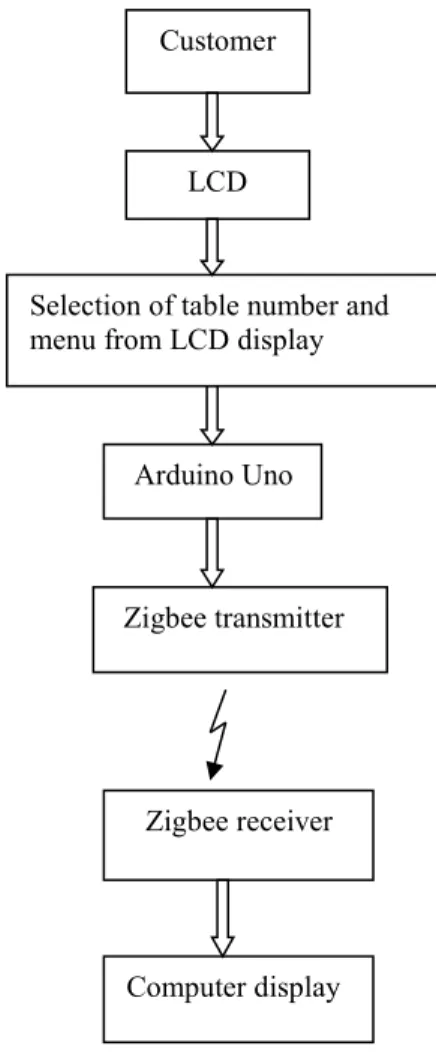
The customer section comprises of Arduino Uno, LCD, switches and Zigbee transmitter. The table number cards are placed at every table in restaurant. In the customer section the menu items, their costs and the table numbers are displayed on the LCD connected to microcontroller. And the corresponding instructions about the menu order system are displayed on LCD for the customer. This section shall have the switches for selection of menu items and table numbers.
LCD will act as a menu card which will display all the items available in the restaurant. The available menus are programmed in microcontroller. The customers will scroll the menu list using switches. They will firstly need to select the table number on LCD. After selecting the table number the customers can order foods or drinks through LCD using switches. The orders placed and table numbers are sent to the computer display in kitchen through zigbee transmitter.
In the kitchen section Graphical User Interface (GUI) is created at computer display in kitchen which includes four tables to receive the transmitted data from the customer section.
The transmitted table number and order from the customer section will be received by zigbee receiver in the kitchen. The table number and order placed will be displayed in the corresponding table on GUI for the chef in kitchen. After the chef had prepared for the orders according to the data in GUI, the orders data in GUI can be deleted by pressing clear button for the next incoming orders. A visual basic 6.0 developed GUI system displays the order menu. It is used to design the GUI of the project in this paper.
IV. DEVELOPMENTOFTHESYSTEM
Fig. 3 Flow diagram of the system
This is the flow diagram of the system. The proposed system is the automatic menu ordering system using wireless technology. When the customers get at the restaurant, they make an order on LCD using switches whatever they want. The customers need to select table number on LCD which they seat using switches before the menus are ordered. The switches are used to make the selection of table number and menu items. The customer can order the desired menu via LCD using switches without any interaction of waiters. The orders are sent to the computer display in kitchen using zigbee transmitter. The transmitted table number and the orders are received in kitchen via zigbee receiver. In this system, the chief in kitchen can easily view the order of the customers in computer display.
V. HARDWARECOMPONENTS A. Zigbee Technology Arduino Uno Switches Power supply LCD display Zigbee tranmitter Computer interface Zigbee receiver
PC
Zigbee transmitter Customer LCDSelection of table number and menu from LCD display
Arduino Uno
Zigbee receiver
Volume 8, Issue 6, June 2019, ISSN: 2278 -7798 Zigbee communication is specially built for control and
sensor networks on IEEE 802.15.4 standard for wireless personal area networks (WPANs). This communication standard defines physical and Media Access Control (MAC) layers to handle many devices at low-data rates. These Zigbee’s WPANs operate at 868 MHz, 902-928MHz and 2.4 GHz frequencies. The data rate of 250 kbps is best suited for periodic as well as intermediate two way transmission of data between sensors and controllers.
Zigbee is low-cost and low-powered mesh network widely deployed for controlling and monitoring applications where it covers 10-100 meters within the range. Zigbee devices can transmit data over long distances by passing data through a mesh network of intermediate devices to reach more distant ones. Zigbee is typically used in low data rate applications that require long battery life and secure networking (Zigbee networks are secured by 128 bit symmetric encryption keys). This communication system is less expensive and simpler than the other proprietary short-range wireless sensor networks as Bluetooth and Wi-Fi. Applications of zigbee technology are industrial automation, home automation, smart grid monitoring and smart metering. The system is divided into three modules: bus module, bus stop module, and server module.
Zigbee system structure consists of three different types of devices such as Zigbee coordinator, Router and End device. Every Zigbee network must consist of at least one coordinator which acts as a root and bridge of the network. The coordinator is responsible for handling and storing the information while performing receiving and transmitting data operations. Zigbee routers act as intermediary devices that permit data to pass to and fro through them to other devices. End devices have limited functionality to communicate with the parent nodes such that the battery power is saved. The number of routers, coordinators and end devices depends on the type of network such as star, tree and mesh networks [7].
The proposed system uses XBee S2C as a wireless communication link. It is used to transfer the data from customer section to kitchen in this proposed system. XBee S2C is a RF module designed for wireless communication or data exchange and it works on ZigBee mesh communication protocols that sit on top of IEEE 802.15.4 PHY. The module provides wireless connectivity to end-point devices in any ZigBee mesh networks including devices from other vendors [8].
Fig. 4 XBee S2C module
B. Arduino Uno Microcontroller
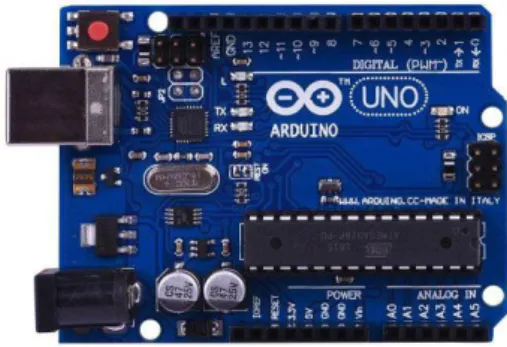
Arduino Uno is a microcontroller board based on the ATmega328. It has 14 digital input/output pins (of which 6 can be used as PWM outputs), 6 analog inputs, a 16 MHz quartz crystal, a USB connection, a power jack, an ICSP header and a reset button. It contains everything needed to support the microcontroller; simply connect it to a computer with a USB
cable or power it with a AC-to-DC adapter or battery to get started [9].
Fig. 5 Arduino Uno Microcontroller
C. 20×4 Liquid Crystal Display
A liquid-crystal display is a flat panel display, electronic visual display, or video display that uses the light modulating properties of liquid crystals. Liquid crystals do not emit light directly. 20×4 means that 20 characters can be displayed in each of the 4 rows of the 20×4 LCD, thus a total of 80 characters can be displayed at any instance of time [10]. In this system LCD is used to display the menu items, the costs and the table number. The corresponding instructions about the menu ordering system are displayed on LCD for customer. It is used as a menu card for the user.
Fig. 6 20×4 Liquid Crystal Display
VI. TESTANDRESULTS
Fig. 7 Customer section
Fig. 7 is the customer section. The customer section consists of LCD, switches, Arduino Uno and zigbee transmitter. LCD is used as a menu card in this proposed system.
Volume 8, Issue 6, June 2019, ISSN: 2278 -7798
Fig. 8 Kitchen section
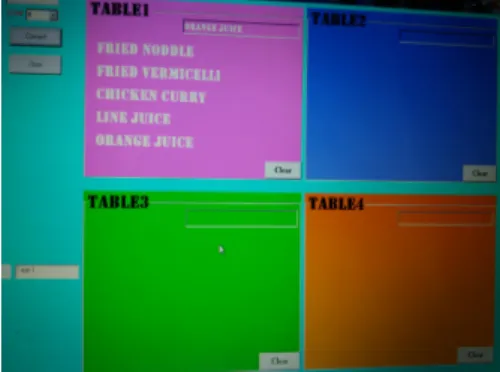
In the kitchen section GUI is created which has four tables for displaying the menu items from the customer section in fig. 8. The transmitted order and table numbers from the customer section are displayed on GUI in kitchen using zigbee receiver.
Fig. 9 Menu lists on LCD
The menu items are displayed on LCD in fig. 9. The switches are used for the selection of menus.
Fig. 10 Table number on LCD
The table number displayed on LCD is shown in fig. 10. The customer can select the table nuber on LCD display by pressing the switches.
Fig. 11 Receiving table number on GUI in kitchen
Fig. 11 shows the receiving table number in kitchen section. The table number which is sent from the customer section is received in GUI in kitchen.
Fig. 12 Receiving the orders on GUI in kitchen
In fig. 12, five menu items are displayed in table number 1 on GUI because they are ordered from table number 1 of customer section. If the orders want to clear, the user has to press clear button on GUI to receive next orders.
VII. CONCLUSION
The implemented system of menu ordering system using zigbee technology can change the methods in restaurant from manual system to an automated system with a lot of facilities to customers. It is very fast processing for serving food to the customers. The orders data are transmitted within 10 meter distance in this system. There are no data losses and it takes about 1 second within that range. The system will reduce man power and order errors. The proposed menu ordering system through an electronic system interface will get good response from the customers because of saving time and good quality of service. The customer does not need to wait for the waiter to take an order. When the customers get at the restaurant, they can take an order whatever they want. This system provides customer satisfaction and saves customer waiting time. The proposed system benefits for both the customers and the owner.
ACKNOWLEDGMENT
F.A.Author thanks to Dr.Than Htike Aung, Associate Professor, Department of Electronic Engineering for kind permission to prepare for this paper, for his close supervision, helpful advice, encouragement and numerous invaluable guidance. The author would also thank to all teachers and friends who willingly helped the author throughout the preparation of the paper.
REFERENCES
[1] Aamir Nawaz, Faiz Jalil, “Touch Panel Based Modern Restaurants Automation using Zigbee Technology”, Fourth International Conference on Aerospace Science & Engineering (JCASE), September 2-4, 2015 [2] Harshada S Wabale , “Automatic Menu Ordering System using Zigbee
and Arm Processor”, Journal of Electrical and Electronic Systems, 2017 [3] B. Shabari, B. Ashok Nayak, “ZIGBEE BASED E-MENU ORDERING
SYSTEM”, International Journal of Advanced Technology in Engineering and Science, Vol. 3, Issue 08, August 2015
[4] Prof.Dr. Usman Ali Shah, Faraz Ali, Sana Sohail, Haris Khan, “Intelligent Robotic Waiter with Menu ordering System”, 1st
International Electrical Engineering Congress (IEEC 2016), May 13-14, 2016
[5] Kunal P. Gundle, Anuja A. Harshe, Kahol B. kinage, Niraj L. Ghanawat,, “Digital Smart System for Restaurants Using Wireless Technology”, International Research Journal of Engineering and Technology (IRJET), Vol. 3, Issue 12, Dec-2016
[6] Mayur D. Jakhete, Piyush C. Mankar, “Implementation of Smart Restaurant with e-menu Card”, International Journal of Computer Applications (0975 –8887), Vol. 119, June 2015
Volume 8, Issue 6, June 2019, ISSN: 2278 -7798 [7] https://www.elprocus.com/what-is-zigbee-technology-architecture-and-its-applications/ [8] https://components 101.com [9] https://store.arduino.cc/usa/arduino-uno-rev3 [10] https://www.instructables.com