Analysis of Network Coverage and Performance
Evaluation in Aeronautical Communication
Network Using HTCF
Parameswaran.T 1, Dr.C.Palanisamy2, Abirami.S3
Teaching Fellow, Department of CSE, Anna University Regional Campus, Coimbatore, India 1 Professor & Head of the Dept of IT, Bannari Amman Institute of Technology, Sathyamangalam, Erode, India 2
PG Scholar, Department of CSE, Anna University Regional Campus, Coimbatore, India 3
Abstract: A Mobile Ad-hoc Network (MANET) does not have any centralized infrastructure. For wireless connectivity,
Aeronautical communication network is a new concept. In Aeronautical communication network (ACN), aeronautical station (AS) is to be considered as a part of multi-tier network that can be helicopter, commercial plane or any low orbit station (i.e. unmanned air vehicle). The topology of UAV is presented as a mobile ad-hoc network and connectivity analysis is provided. The statistics is obtained from connectivity using communication model (i.e., multi-hop model). The multi-hop communication model can extend the network coverage, enable higher throughput than single hop and two hop. To propose a hybrid topology controlled framework (HTCF) for measuring the performance of ACN during communication. The use of proposed framework is to measure the performance of aeronautical communication network such as packet delay, security and noisy data, network congestion by using of routing protocols. The aim is to analyse both the network coverage and performance even if there is any link or node failure.
Keywords: MANET, Aeronautical communication network, Aeronautical Station, Communication models, Routing
Protocols.
I INTRODUCTION
In recent years the widespread accessibility of wireless communication and hand-held devices has stimulated analysis on self-organizing networks that don't need re-established infrastructure. These ad hoc networks are usually referred to autonomous nodes that collaborate as to move data. Usually, these nodes act as finish systems and routers at the constant time.
A Mobile Ad-hoc Network (MANET) does not have any centralized infrastructure or administration control. The nodes are connected without the use of wire in the mobile ad-hoc network. Each device in a MANET is able to move freely in any direction and change its links to other devices easily. Each should send traffic to its own use, and to the router. The primary challenges in building a MANET is equipping each device to frequently update the information required to properly route traffic. Such networks can employ by themselves or can be connected to the larger Internet [1][3].
MANET’s is a kind of wireless ad hoc networks that has a routable networking environment on top of ad hoc network. A mobile ad hoc network is a autonomous system of multi hop communication model, wireless mobility nodes that need not require base stations or any fixed infrastructure support. It is distinguished by dynamic topologies, high frequency constrained, variable links, energy consumption and limited security in network. The lack of infrastructure support, in Combination with multi - Hop connections and uniformly changing topology that produce difficult challenges on the routing protocol [4].
Security in MANET
Security has become the main trouble and network congestion for widely deployed wireless applications. Security is an important role in performance (network throughput) degradation to adaptive. The goal is to achieve security according to the available resource without performance degradation in the network. The serious activities involved in self-organization are neighbour discovery and topology organization control and it is an important issue in MANETs where topologies are changing over time as nodes.
Topology Control in MANET
Topology control is commonly used by the wireless ad hoc and sensor networks. The main aim of topology control in this domain is to save energy, reduce intrusion between nodes and extend the lifetime of the network [10].
Hybrid Topology
A hybrid topology may be a type of network topology that uses additional network topologies such as
bus topology, mesh topology, ring topology, star topology,
tree topology and fully connected.
II AERONAUTICAL COMMUNICATION NETWORK
ACN consists of aeronautical station (AS) that is considered as a part of multi tier network for the future wireless communication model. An AS can be a commercial plane, helicopter or any other low orbit station
that is unmanned air vehicle. The ACN is to provide high throughput and cost effective communication network for aeronautical applications such as, air traffic control, air traffic management, and commercial in-flight internet activities [1]. Communication model during which supply AS is act with its destination like or while not the assistance of intermediate relay AS severally.
Communication Models:
Single hop is a communication model in which source AS is communicating with its destination directly
Two hop network model is a communication model where each packet makes two hops, one from the source AS to relay AS and one from the relay AS to the destination AS.
Multi-hop hop is a communication model in which source AS is communicating with its destination using many relay.
Network Coverage
In order to extend the coverage area and to reduce the energy consumed by the networks. The k-coverage case is an efficient algorithm that is randomised algorithm and it is used to attain the low power consumption.
Probabilistic Coverage Protocol (PCP)
The PCP is used to activate a set of deployed sensors to associate approximate triangular lattice on top of the area to be coated. By activating any sensor within the space, PCP will begin. This sensor is understood as associate substance. This sensor activates six other sensors situated at vertices of the hexagon centred at activator sensor. Each sensor network activates other sensors at its vertices of its private hexagon. This method continues until all the activated sensors kind a virtual triangular lattice over the total area.
Coverage Configuration Protocol (CCP)
Coverage Configuration Protocol makes an attempts to maximize the quantity of nodes that may be place into sleep mode whereas guaranteeing k-coverage and network connectivity. The nodes in CCP consist of three states: SLEEP, LISTEN, or ACTIVE. Each node will periodically send out HELLO packets with its location and status. From this the nodes will compile a list of each of its neighbours when it is in the LISTEN state. If its entire sensing area is covered by its neighbours then it will transition into SLEEP mode. They will remain there until the sleep timer expires and then they will re-evaluate coverage. Three algorithms have been proposed for data routing tree recovery. The proposed algorithms aim to recover the transmission of packets.
1. Link Failure Recovery Algorithm
2. Node Failure Recovery Algorithm 3. Link Congestion Mitigation Algorithm
Link Failure Recovery Algorithm
In this section, an algorithm that aims at determining a backup path is described, which is feasible to accommodate the rerouted traffic result from a link failure. The backup path is pre-computed before a failure occurred. A primary port used to forward data through routing tree or downstream tree for any node.
Node Failure Recovery Algorithm
In this section introduces an algorithm that aims at determining a backup path. A path is feasible to accommodate the rerouted traffic result from a node failure. The node recovery is different from link recovery as this is more complex than link failure recovery.
Link congestion mitigation algorithm
The aim of this algorithm is to estimate a backup feasible path to accommodate the redirected traffic results from link congestion. The backup path is additionally pre-determined before any link congestion occurs and link congestion is a different phenomenon from the two previous proposed algorithms in the following characteristics:
1. All traffic has to be redirected in the link recovery algorithm, but in link congestion, only part of the congesting traffic can be redirected.
2. Other links in the congestion is to mitigate the currently congested ones has to be avoided.
III ROUTING
Routing is the process of finding the best paths in a network. In the past, the terminology routing is the forwarding network traffic among networks. A routing protocol defines how routers communicate with each other, propagate information that display them to select routes between any two nodes or links on a computer network. In packet switching networks, routing send their packet through intermediate nodes [18].The routing process usually directs sending packets on the basis of routing tables, which update a database of the routes to various network destinations.
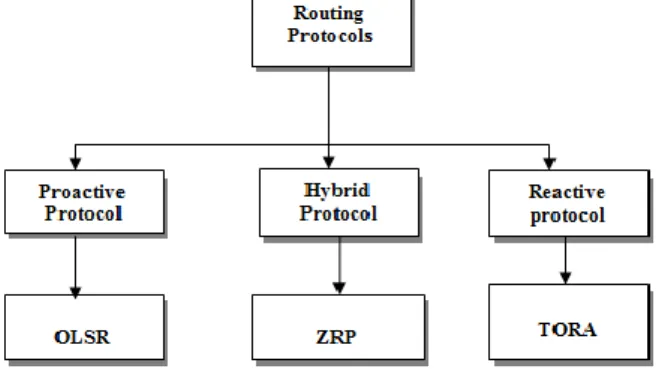
Fig 3: Classification of Routing Protocols
Mobile ad hoc networks are determined by a multi-hop network topology that can change frequently due to mobile Nodes. The routing protocols are needed to create a communication paths between nodes and links without causing excessive traffic network overhead or computational burden on the power and energy constrained devices. Routing protocols for ad hoc networks are generally divided into reactive or proactive. Reactive protocols are also called on-demand protocols and it discovers routes only when they are needed. Route determination process is invoked on demand. Proactive routing protocols accumulate a table with routes to all the
Nodes in the network at each node. Hybrid routing protocol is the combination of the both proactive and reactive routing protocols.
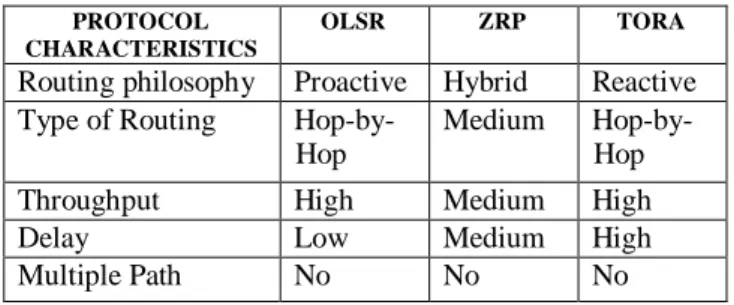
Table 3: Characteristics of Routing Protocols
PROTOCOL CHARACTERISTICS
OLSR ZRP TORA
Routing philosophy Proactive Hybrid Reactive Type of Routing
Hop-by-Hop
Medium Hop-by-Hop
Throughput High Medium High
Delay Low Medium High
Multiple Path No No No
IV RELATED WORKS
In this work [1], The goal is to provide high throughput and cost effective data. An aeronautical station (AS) could be plane, a helicopter, or any other low orbit station. In this paper, to study an aeronautical broadband wireless access strategy to provide throughput and delay analysis for ADN [1].Then to finding the maximum number of concurrent successful. Closed-form end to-end delay expression is also derived in terms of throughput and delay
This work [3] studies the throughput laws of ad hoc wireless networks in the limit of a large number of nodes. This work has focused on the throughput scaling in the limit of a large number of nodes. To characterized the architectural differences between various communication protocols from the throughput.
To investigate the area coverage and connectivity of an autonomous, for unmanned aerial vehicle (UAV) network. The goal is to is to monitor and sense a given area of interest in an efficient manner [6]. At the end, to propose a connectivity-based mobility model that aims to occupy connectivity between the UAVs and the ground station. To compare the coverage and connectivity performance of the proposed scheme with coverage- based mobility scheme in several scenarios.
IV SYSTEM ANALYSIS
In this paper, the system performance of such a communication network is discussed in terms of system throughput and average delay. To consider two communications models with single-hop and two-hop in a mobile ad hoc network (MANET) as the models for ACN. The objective is to introduce the concepts and methodologies developed from MANET into ACN and present the performance of such networks. We derive the ACN throughput upper-bound for the two models, with or without the help of intermediate relay AS. We show that the two-hop model achieves larger throughput than the single-hop model. Since the delay issue is more salient in two-hop communications, in which the data from a source AS has to be buffered in the relay AS until transmitted to
the destination AS, we can derive the closed-form end-to-end average delay expression analytically.
Disadvantage
Multi-hop models cannot achieve better throughput scaling than two-hop model
Performance losses due to high error rate Network congestion
Connection failure
Topology of ACN is presented as a mobile ad-hoc network (MANET) and connectivity analysis is provided. Then, the information is obtained from connectivity using communication model (i.e. multi-hop model). The proposed system is to conclude that the multi-hop communication model for ACN can extend the network coverage, enable higher throughput than single hop and two hop. To propose a hybrid topology controlled framework (HTCF) for network coverage, link and node failure of ACN during communication. The use of HTCF, to analyse the performance of ACN such as packet delay, security and noisy data by using of network coverage and routing protocols. The goal is to compensate both the network coverage and performance even if there is any link or node failure.
Coverage Configuration Protocol protocol attempts to maximize the number of nodes. Three algorithms have been proposed for data routing tree recovery. The proposed algorithms aim to recover the transmission of packets quickly and effectively from link failure, node failure, and link congestion.
Advantage
Extend the coverage of a network Improve connectivity
Enable higher data rates results in higher throughput
More efficient use of the wireless medium. Increase robustness of the network
Avoid wide deployment of cables and can be deployed in a cost-efficient way
V SYSTEM ARCHITECTURE
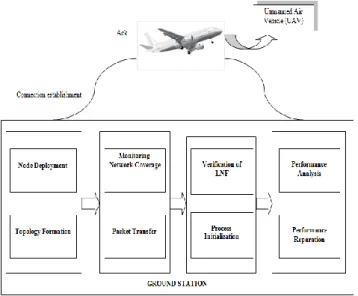
The architecture fig 5 depicts the communication between ground station and unmanned air vehicle.
Node deployment
Node uses to represent a host or a router in NS2.A nodes function in NS2 is to send or receive information. An NS2 simulation scenario is formed of collection of node. The simulation work has been done with the Network Simulator ns-2. In the simulation scenario, 100 nodes are randomly distributed within the network field of size 1000m*1000m.
Topology formation
A network topology must first be created while run a simulation scenario. In ns2, the topology is a collection of links and nodes. Before the topology can be set up, a new simulator object can be created at the beginning of the script with the command is set ns [new Simulator].
Fig 5: Architecture Diagram Network coverage scrutiny
It deals with checking network coverage using protocols such as PCP, CCP. In order to increase the coverage area and reduce energy consumed by the sensor networks. The protocols maintaining the area covered are referred to as network coverage protocols.
Packet Transmission
A network packet is a unit of data carried by a
packet-switched network. After network coverage
checking the packets are transferred from source to destination by the use of routing protocols like OLSR, ZRP AND TORA.
LNF checking
To verify the number of links and fails or broken in UAV while data transferring
Performance analysis of UAV
Several ways to measure the performance of a network and design. Performance can also be modelled and simulated instead of measured. Performance has been analysed for UAV for parameters are Network overhead, security, noisy data, network congestion, bandwidth ,error rate and delay time.
Performance Reparation of UAV
Finally, Performance has been compensated for UAV for parameters are Network overhead, security, noisy data and delay time.
VI RESULT AND DISCUSSIONS
A random network with 100 nodes is generated and these nodes are placed uniformly at random in a rectangular region of 1000m*1000m. A simulation model based Qualex Simulator version 5.02 on was developed for the comparative performance evaluation of OLSR, TORA and ZRP and network coverage protocols. The following shows that the performance such as security, packet delay, delay time of UAV and also shows the mobility nodes movements in various manner.
The NS2 is discrete event packet level machine and it covers a large amount of protocols of various network types consisting of various network components and traffic models. Network simulator may be package of tools that simulates behavior of networks such as making network topologies, log events that happen below any load, analyze the events and perceive the network.
(a) Data Transmission versus Time(ms) for UAV using OLSR,ZRP and TORA
(b) Packet Delivery Ratio versus Mobility(sec) for UAV using OLSR,ZRP and TORA
(c) Packet Latency versus Time(sec) in UAV OLSR,ZRP and TORA 0 0.2 0.4 0.6 0.8 1 1.2 10 20 30 40 50 60 70 OLSR ZRP TORA D ata Tr an sm is si o n R ate Time (ms) 0 0.2 0.4 0.6 0.8 1 1.2 1 2 3 4 5 6 OLSR ZRP TORA P ac k e t D e li v e r y R ati o Mobility (sec) 0 0.2 0.4 0.6 0.8 1 1.2 10 20 30 40 50 OLSR ZRP TORA P ac k e t Late n c y Time (sec)
(d) Network Congestion versus Security(sec) in UAV using PCP and CCP
(e) SecurityData Flow versus Time(ms) in UAV using OLSR,ZRP and TORA
VII CONCLUSION AND FUTURE WORK
In this work, to investigate a simple ACN architecture by modelling the ACN as a multi-hop model MANET. The desire is to provide a cost effective data communication comparing with the traditional satellite communications, and to present the corresponding network coverage and performance of ACN such as link, node failure, delay, security, packet delay and noisy data. The ACN system is economically worthwhile and feasible, by considering that the number of flight ASs will keep increasing in the long run.
To proposed a hybrid topology controlled framework (HTCF) for network coverage, LNF failure and delay time of ACN during communication. The goal is to analyse both the network coverage and performance even if there is any link or node failure. In this work, to analysed the network coverage, delay time and also formed a hybrid topology controlled framework. The numerical results confirm the analysis of ACN such as network coverage and performance evaluation is provided.
VII REFERENCES
1. Yawing et al, ”Throughput Analysis In Aeronautical Data Networks, “in Proc. IEEE WAMICON, Apr.2011.
2. Qiming Qiu et al, "Study on Key Techniques of Aeronautical Ad Hoc Network MAC and Network Layer” in Elsevier APISAT, 2014. 3. Sheng Shan Cui et al, “Throughput Scaling of
Wireless Networks with Random Connections” in Proc. IEEE, Aug.2010.
4. Chao Gao et al, “Two-hop Two-slot CDMA Uplink-Multi-Cell Considerations” in Pro. IEEE, Jun.2006.
5. Eli Winjum et al, ”A Performance Evaluation Of Security Schemes Proposed For The OLSR Protocol”.
6. Evsen Yanmaz,”connectivity versus area coverage in unmanned aerial vehicle networks”,Proc. IEEE,June 2012.
7. C.I Vimalarani et al, “Energy Efficient Pcp Protocol For K-Coverage In Sensor Networks” In Proc IEEE,2010.
8. Raymond mulligan, “Coverage In Wireless Sensor Networks:A Survey” in ISSN,2010. 9. H.Tu and S. Shimamoto, “ A Proposal For High
Air Traffic Oceanic Flight Routes Employing Ad-Hoc Networks”, in Proc. IEEE wireless Commun. And Net. Cong. (WCNC),Apr.2009.
10. D.Medina, F. Hoffmann, S. Ayaz, and C.-H. Rokitansky, Topology characterization of high density airspace aeronautical ad hoc networks,” in Proc. IEEE Int. Conf. on Mobile Ad Hoc and Sens. Sys. (MASS),Oct.2008.
11. Future aeronautical communication infrastructure technology investigation.NASA- ACAST. [Online]. Available: http://acast.grc.nasa.-gov/main/projects/
12. M. Schnell and S. Scalise, “NEWSKY - Concept for networking the SKY for civil aeronautical communications,” IEEE Aero. and Elect. Sys. Mag.,vol. 22, no. 5, pp. 25–29, May 2007. 13. J. Lai, “Broadband wireless communication
systems provided by commercial airplanes,” U.S. Patents 6 285 878, Sept. 4, 2001.
14. E. Sakhaee and A. Jamalipour, “The global in-flight Internet,” IEEE J. Sel. Areas in Commun., vol. 24, pp. 1748–1757, Sept. 2006.
15. D. Medina et al., “Feasibility of an aeronautical mobile ad hoc network over the north atlantic corridor,” in Proc. IEEE SECON, June 2008, pp. 109–116.
16. “Wireless telecommunications system having airborne base station,” Lucent Technologies Inc.,1996.
17. S. Plass et al., “The SANDRA communications concept - future aeronautical communications by 0 0.2 0.4 0.6 0.8 1 1.2 5 10 15 PCP CCP N e tw o r k C o n ge si o n Security (sec) 0 0.2 0.4 0.6 0.8 1 1.2 10 20 30 40 OLSR ZRP TORA S e c u r ity D ata F lo w Time (ms)
seamless networking,” in Proc. PSATS, Feb. 2011.
18. M. Iordanakis et al., “Ad-hoc routing protocol for aeronautical mobile,” in Proc. CSNDSP, vol. 6, July 2006.
19. M. Grossglauser and D. N. C. Tse, “Mobility increases the capacity of ad hoc wireless networks,” IEEE Trans. Net., vol. 10, no. 4, pp. 477–486,Aug. 2002.
20. M. J. Neely and E. Modiano, “Capacity and delay tradeoffs for ad hoc mobile networks,” IEEE Trans. Inf. Theory, vol. 51, no. 6, pp. 1917–1937, June 2005.
21. G. Sharma, R.Mazumdar, and B. Shroff, “Delay and capacity trade-offs in mobile ad hoc networks: A global perspective,” IEEE Trans. Net., vol. 15, no. 5, pp. 981–992, Oct. 2007. 22. Y. Wang et al., “Delay-throughput trade-off with
opportunistic relaying in wireless networks,” in Proc. IEEE GLOBECOM, Dec. 2011.
23. Y. Wang, R. Sankar, and S. Morgera, “Adaptive rate transmission with opportunistic scheduling in wireless networks,” IEEE Trans. Veh. Technol., vol. 62, no. 3, Mar. 2013.
24. Y. Wang et al., “Buffer-aware adaptive scheduling for downlink multiuser systems,” in Proc. IEEE PIMRC, Sept. 2013.
25. Y. Wang et al., “Throughput analysis in aeronautical data networks,” in Proc. IEEE WAMICON, Apr. 2011
Authors Biography
Parameswaran.T has received his
B.E degree in Electronics and Communication Engineering from Velalar College of Engineering and Technology, Erode and M.E degree in Software Engineering from college of Engineering Guindy, Anna University Chennai in 2005 and 2008 respectively. He is currently pursuing his Ph.D Anna University Chennai. He is currently working as Teaching fellow in the Department of Computer Science and Engineering Anna University Regional Campus, Coimbatore. He is currently working as Teaching Fellow in the Department of Computer Science and Engineering, Anna University Regional Campus, Coimbatore, Tamilnadu, India.
Palanisamy.C has received his B.E
degree in Electronics and Communication Engineering from University of Madras, Chennai and M.E degree (Gold Medalist) in Communication Systems from Thiagarajar College of Engineering, Madurai, Madurai Kamaraj University in 1998 and 2000 respectively. He has received his Ph.D from the faculty of Information and Communication Engineering, Anna University, Chennai in 2009. He has more than 15 years of academic and research experience and currently he holds the post of Professor and Head of the Department of Information Technology, Bannari Amman Institute of Technology, Sathyamangalam, Tamilnadu, India. He has published more than 40 research papers in various journals and conferences. He has organized more than 15 workshops and holds 2 funded projects. He is a lifetime member of ISTE. He Won Best M.E Thesis Award at Thiagarajar College of Engineering, Madurai and best paper award titled, "A Neural Network Based Classification Model Using Fourier and Wavelet Features,” Proceedings of the 2nd Int. Conf. on Cognition and Recognition 2008, (ICCR 2008), Organised by P. E. S. College of Engineering, Mandaya, Karnataka, India, pp. 664-670, 2008. His research interests include Data mining, image processing, and mobile networks.
Abirami S received the Bachelor Degree
in Computer Science and Engineering from Rajalakshmi Engineering College, Chennai in 2014. She is currently pursuing her Master Degree in Computer Science and Engineering specialization in Software Engineering from Anna University Regional Campus, Coimbatore, Tamilnadu, India. Her area of interest is Networking.