ABSTRACT
The value of fitness of a solution in basic genetic algorithm is certain and unchanging. This formulation is insufficient for two classes of problem, first is concerned with non-stationary environments and the second is concerned with problems related with noise. The first class consists of ongoing search in a non-stationary environment, where the expected fitness of a solution changes in an unpredictable way with time. In the second class, the fitness evaluations are corrupted with noise. Therefore, for both these classes the fitness of a solution will be uncertain.
Uncertainty due to environmental changes and noisy evaluation can be reduced temporarily through re-evaluation of the existing solutions. A well-developed formal mechanism for treating uncertainty within the genetic algorithm and fuzzy interference system is provided by Kalman formulations. When a new solution is generated and evaluated for the first time, Kalman formulations provides the mechanics for determining the estimated fitness and uncertainty. It also updates the previously determined estimated fitness and uncertainty after re-evaluation of an existing solution and it also increases uncertainty with the passage of time. This algorithm helps to determine the correct tie to generate a new individual and to re-evaluate and existing individual and also which one to re-evaluate.
INTRODUCTION
The Kalman filter provides an effective means of estimating the state of a system from noisy measurements given that the system parameters are completely specified. The innovations sequence for a properly specified Kalman filter will be a zero-mean
white noise process. However, when the system parameters change with time the Kalman filter will need to be adapted to compensate for the changes. Traditionally this has been accomplished by using nonlinear filtering, parallel Kalman filtering and covariance matching techniques. These methods have produced good results at the expense of large amounts of computational time
.
The Kalman filter is known to be an optimal estimator for the linear dynamic system with white process and measurement noise. The kalman filter is extended for nonlinear dynamic systems with colored noise by linearizing the system around the estimated current parameter.
However, the initial values of the parameters and their online adjustment are both very important to the Kalman filter, especially the measurement noise covariance matrix R. So in this paper, we proposed a new adaptive Kalman filter by combining evolutionary algorithm and fuzzy inference system. In this new adaptive Kalman filter, we utilized the evolutionary algorithm to determine the initial value of parameter R. Furthermore, the fuzzy inference system is used to adjust the value of R with time based on the filter performance.
A development of an adaptive Kalman filter through a genetic algorithm and fuzzy inference system (FIS) is outlined. The adaptation is concerned with the nuisance of conditions under which the filter measurement noise covariance matrix R or the process noise covariance matrix Q are estimated. The adaptive modification is carried out using GA and FIS based on the whiteness of the filter innovation sequence (IS) and employing the covariance-matching technique.The value of R offline adjusted through genetic algorithm to optimize the value of R
Hybrid Kalman Filter by Fuzzy Interference
System and Evolutionary Algorithm
Janvi Verma,Anirudh Mudaliar
Department of Electronics and Telecommunications Engineering, Shri Shankarachary Group of Institutions,Bhilai ,Chhattisgarh, India.
then optimum value of R that are obtained from GA are then online adjusted using FIS. The FIS adjusts a factor through which the matrices R or Q are estimated. This adaptive Kalman filter is tested on a numerical example. The results are compared with these obtained using a conventional . The genetic fuzzy-adapted Kalman filter showed better results than its traditional counterparts.
The paper is structured as follows, section 2 contains pronlem statement and, section 3 explains in brief the used techniques, the implementation is given in section 4 with the results in section 5, section 6 contains the result and the conclusion concludes the paper
Kalman Filter
A method which uses time sequence of a set of observations to estimate the values of the underlying quantities is called Kalman filter. It is based on a view that the true world which is unknowable can be approximately built through observations. Kalman filter was originally built to estimate the parameters of orbits for the satellites, by using the given sequence from the ground sites.
It is supposed that every phenomena in the environment is quantified by a set of quantities of events. A linear model consisting of a deterministic part and a stochastic specifies the dynamics of these quantities of interest. The vector of variance of these random increments is called the process noise vector. A set of measurement is obtained by an observation process. The observation process is linear. When we multiple the vector of quantities of interest by an observation matrix and then add a random increment to each measurement value then the vector of measurement values is obtained. The observation noise vector is the vector of the variance of the random increment that adds up to the measurement vector. The current best estimate of the values of the quantities of interest is hold by another vector. There is a matrix known as the covariance matrix, whose elements hold the expected values of the pairwise products of the error between the estimated value and the true value of the quantities of interest, while the information regarding the correlation of errors on different quantities is present in the off-diagonal elements. The information regarding the vector of estimate and the covariance matrix is specified by
kalman filter. The vector of estimate and the covariance are updated with the passage of time and after the observation
Therefore the Kalman filter consists of two steps: 1. The prediction
2. The correction
In the first step the state is predicted with the dynamic model. In the second step, it is corrected with the observation model, so that the error covariance of the estimator is minimized. In this sense it is an optimal estimator.
Figure 1 Kalman filter steps
The filter is extremely powerful in many aspects. It are often suitably used to either of KF smoothening, estimating or predicting severally the past, this and therefore the future states The KF algorithm can be seen as a form of feedback estimation. The set of the KF equation can be separated in two groups:
1. Time update equations 2. Measurement update equation
The time update equations project the present state and also the error covariance estimates forward within the time to get a priori estimates for following time step. The measurement update equations handle the feedback. In different words, it incorporates a replacement measurement into the a priori estimate to get a corrected a posterior estimate. so the time update equations are predicator equations, and also the measurement update equations are corrector equations. That is, the KF could be a
predictor-corrector formula to supply a recursive solution to the distinct time linear system, as shown in Fig.2
Figure 2 Kalman filter Algorithm
The variance of the observation noise characterizes the uncertainty of a new individual which is created and evaluated. Its uncertainty grows as the evaluated solution ages. The uncertainty of value Pprior at the
start of an evaluation cycle increases according to
This is the scalar version of the kalman time-update equation for the covariance matrix.
Problem Statement
The Kalman filter formulation as described earlier assumes complete a priori knowledge of the process and measurement noise statistics, matrices Q and R. However, in the majority practical applications these statistics are initially estimated or in reality are unknown. The problem now is that the optimality of the estimation algorithm in the Kalman filter setting is strongly connected to the quality of these a priori process noise and measurement noise statistics . It has been shown that in adequate initial statistics of the filter will decrease the precision of the estimated states or will initiate biases to the estimates. In fact, wrong a priori information possibly will cause practical divergence of the filter . Additionally, inadequate a priori information and a frequently changing estimation environment will change the accuracy of the Kalman filter. From the aforementioned it may be argued that using a fixed Kalman filter considered by conventional methods in a changing dynamic environment is a major
drawback. From this point of view it can be likely that an adaptive estimation formulation of the Kalman filter will result in a better performance or will avoid filter divergence
In the navigation system, one very important application of Kalman filter, once the external environment of the target which is being navigated has changed, the value of R will change immediately. So in the HydGeFuzKF we proposed, evolutionary algorithm and fuzzy inference system is used to estimate the value of R, both before the filter starts to work and when it is working.
Fuzzy Logic Control
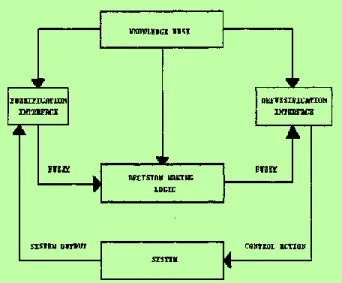
Lofti A. Zadeh proposed the idea of fuzzy sets in July 1964. A non-linear process can be controlled by the fuzzy logic. Through fuzzy logic control, engineers can implement control strategies easily which can also be used by human operator. The core technique of fuzzy logic control is based on four basic concepts, they are linguistic variables, fuzzy sets, possibility distribution and fuzzy if-then rule. Various control systems use fuzzy logic. Figure 1. Shows the block diagram of a fuzzy logic controller generalized. It is composed of the following four components:
1. A set of if-then rules consisting of fuzzy logic quantification of the expert`s linguistic description of how to achieve good control.
2. An inference mechanism, also called as fuzzy inference module or inference engine, it emulates the experts decision making in interpreting and applying knowledge in order to control the plant in the best way.
3. An interface which converts controller inputs into information which can be easily used by the interference mechanism to activate and apply rules. This interface is called as fuzzification interface.
4. An interface which produces actual inputs from the conclusion of the inference mechanism. This
interface is called as defuzzification interface.
Figure 3 Block diagram of fuzzy logic controller Genetic Algorithm
The uncertainty associated with each individual can be used in a straight-forward way by extending the basic genetic algorithm. Before starting a new fitness cycle, it is must to evaluate if it is necessary to generate a new individual or to re-evaluate the existing individual. For generating and evaluating new individuals, a specified fraction Fnew is allocated to the evaluation cycle. The decision of allocation is made by generating a random number, rand, which is distributed uniformly in the interval between zeros to one. A new individual is created and evaluated if rand is less than Fnew, otherwise an existing individual is evaluated. An appropriate allocation is accomplished by following a prescribed pattern, if Fnew is a ratio of small intergers. The algorithm alternates between generating a new individual and re-evaluating an existing individual, when the valve of Fnew is 0.5.
The kalman extended genetic algorithm specifies which individual to re-evaluate when and evaluation cycle is given over to re-evaluating an existing individual. When we re-evaluate an existing individual, more knowledge per individual can be generated and re-evaluating fitter individual is more likely to generate useful knowledge. The individual having a poor fitness value should not be re-evaluated or those individuals which already have a poor uncertainty should not be evaluated. A simple selection criteria is employed by kalman based genetic algorithm, the individual having the highest
uncertainty is selected among the selected population minus the population standard deviation. The individual which is selected is the re-evaluated and has its estimated fitness and uncertainty updated with the kalman mechanics.
Proposed System Implementatiom
This section of the paper briefly describes the implementation of the proposed system. Since the proposed system focuses on enhancing the kalman so that the results from the kalman filter should be more optimized. To do this the kalman is joined with the Genetic Algorithm and the Fuzzy Logic Controller. The detailed description of the system is as follows: The system is divided into four major modules. The first is the generation of the kalman filter, then the second module is the Generation of the Genetic Algorithm block, third is the FLC block and last is the output block which contains the results.
Kalman Filter: it is also known as the linear quadratic estimation, it uses a series of measurements observed overtime. These measurements contains noise, inaccuracies which makes the data impure and the result difficult to judge. There are two stages in the kalman filter, the first is the prediction and the second is the correction.
To Prediction part is as follows: X = Ax + Bu
P = A + A’ + Q
In the above equation the u is the True Value, P is the Predicted Value and A, B, A’, and Q are the constants. With the help of the prediction the calculation of the kalman gain, it can be calculated as follows:
K = PH’ [H * P * H’ + R]
Since K is required to optimize the correlation, the genetic and FLC are applied on it. The correlation can be calculated by:
Y = X + K * [Z – H * x] P = P – K * H * P;
Genetic Algorithm on Kalman Filter:
the GA can be extended in a very straight way, it makes use of the uncertainty associated with each individual. Since the major work of the system is to find the fitness of the K to optimize the result, so before each fitness evaluation cycle it is important to decide whether to generate a new individual/result or to re-evaluate the current individual/result. In the simplest form of the system. A specified fraction Fnew
of evaluation cycles is allocated for generating and evaluating new results. This allocation decision is given by generating a random number termed as rand which is uniformly distributed in the interval between 0 and 1. If the calculated rand is less then Fnew then a
new individual will be generated and will be evaluated. When Fnew is a ratio of small integers, the
appropriate allocation can be accomplished by following a prescribed pattern: To implement Fnew =
0.5, the algorithm alternates between creating a new individual and re-evaluating an existing result. The algorithm used in this system is as follows:
Step 1: Define R – Variance in error; Step 2: Randomly select a value:
2.1 input that value to system and produce output; 2.2 Again input the system with its output;
2.3 repeat until fitness is computed;
Step 3: Repeat step 2 for all the items of the population to find the fitness value.
Step 4: Mean Filter: if fs < mf then discard and find new solution.
Step 5: Get the value and send it to FLC as R. Since the genetic algorithm is well known for calculating the fitness here the fitness or the variance is termed as the R, from the set of inputs the process is done and the temporary fitness is checked with the mean fitness if the fitness is low then the input is discarded oif the fitness is better then the output is sent for further processing.
Fuzzy Logic Controller to evaluate K:
Since finding the fitness using GA gives a good boost to the kalman filter but when the K is again re-evaluated by the FLC the result is more optimized and can be applied to multiple other application. The fuzzy logic is used for controlling process which is
not linear and the main advantage of the technique is that it enables the controller to get full power of the control strategy. The FLC stands on four pillars, which are fuzzy sets, linguistic variables, possibility distributions and fuzzy if-then rule.
The value of K is optimized using the following four elements:
a. A rule base, here it contains a logic qualification of the expert linguistic description to optimize.
b. Interface mechanism: it emulated the expert decision making in interpreting and applying knowledge to get the optimized result. c. Fuzzification Interface: it converts the input
into information that the interference mechanism can easily use to apply rules. d. Defuzzication interface: here it converts the
conclusion into actual inputs that is the K is lastly optimized and is ready for the correct.
Figure 4 Block diagram of fuzzy controller The above figure shows the block of Fuzzy Controller. Here the R value is send as the input, the R value is given out by the GA. The RValue is then processed and the output is given, the output is then given to the kalman filter, the filter process the value with different input and the error is found, the value with minimum error is selected. The block of the proposed system is explained as follows:
Figure 5: Block Diagram of proposed system Fuzzy contr oller RBes(i /p) o/p array i/p array RValu e(o/p) Adapti ve kalma n i/p R=1 tto 8 o/PR=1 to10 in Gene tic algori th Fuzzy logic contr oller Predi ctor Gain Corre ctor op
The above figure shows the block of the system, as observed from the block diagram we can see that the input is given to the genetic algorithm block, there the genetic algorithm calculates the fitness and is sent for further processing. The fitness calculated is now given to the FLC to evaluate the inputs, these inputs are then send to the kalman filter for the calculation of the Prediction, gain and the corrector, this processes is repeated for all the inputs and the best input is given as the output. The result of the system is shown in the following section.
RESULTS:
In this section the results of the proposed system are shown. i/p Samples Normal Adp Kalman Proposed Method Improvement 10 49.88 31.22 18.66 20 52.65 33.59 18.76 50 55.12 36.31 18.81 100 56.73 37.85 18.88 120 59.11 40.15 18.96 150 62.36 42.97 19.39 200 64.93 45.13 19.8
Table 1: Improvement of kalman Filter
The above table shows the improvement of the proposed system. As seen in the table the more the numbers of the samples more is the improvement of the system. This is very well stated in the graph below.
As seen in the above graph, the number of the samples tested are increasing and therefore the system is improved about 20% when the samples are 100 the improvement is nearly 19.8. Which is a great
percentage, as it can solve many problems while using the results of kalman features.
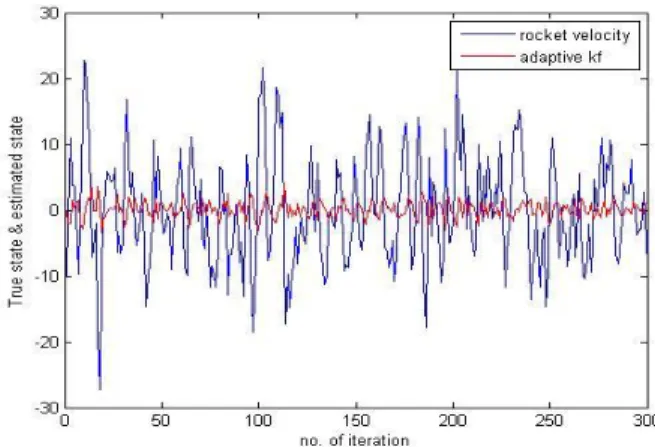
Figure 6 plot of adaptive KF for estimation of rockt velocity
Fig shows the plot of normal adaptive KF for estimation of rocket velocity .Blue line shows the rocket velocity and red line shows the adaptive kalman filter to track the rocket. From result it is clear that filter will not properly track rocket.
Figure 7 plot of propsed HydgenfuzKF for estimation of rocket velocity
The above figure shows the improvement of the system. Here also the blue line shows the rocket veocity and the red lines shows the proposed HydgenfuzKF filter values. As observed the difference between both line is less and hence the lower the value of the gain. The correction is more optimized. 18.5 19 19.5 20 0 50 100 150 200 250
Improvement
From result its clear that when we using the adaptive kalman filter by using genetic algorithm to optimize the value of R and fuzzy interference system to adjust online optimum value of R get from genetic algorithm covariance error will be minimize and filter correctly track the rocket.
CONCLUSION:
To enhance the output of the kalman filter, introduction of the fuzzy logic controller and the genetic algorithm. The output is enhanced by nearly 20%, which we can observed in the result section. Since the output is increased the output of the real time system in which the kalman can be attached can be increased saving the resources of the system. FUTURE SCOPE:
The adaptive kalman filter that we proposed can be attached to any real time system like tracking objects, Navigations, feature tracking, cluster tracking etc.The systems algorithm can be changed on the basis of need and cost of the application system.
REFERENCES:
[1]. Tibor Digaňa, “Kalman filtering in multi-sensor fusion” in control engineering laboratory.
[2]. Yudan Huo, Zhihua Cai, Wenyin Gong and Qin Liu “A New Adaptive Kalman Filter by Combining Evolutionary Algorithm and Fuzzy Inference System” 2014 IEEE Congress on Evolutionary Computation (CEC) July 6-11, 2014, Beijing, China. [3].RerngwutChoomuang& Nitin Afzulpurkar, “Hybrid Kalman Filter/Fuzzy Logic based Position Control of Autonomous Mobile Robot” in Choomuang, R. &Afzulpurkar, N. / Hybrid Kalman Filter/Fuzzy Logic based Position Control of Autonomous Mobile Robot, pp. 197 - 208, International Journal of Advanced Robotic Systems, Volume 2, Number 3 (2005), ISSN 17298806 [4]. Dah-Jing Jwo ,Fong-Chi Chung “Fuzzy Adaptive Unscented Kalman Filter for Ultra-Tight GPS/INS Integration” International Symposium on Computational Intelligence and Design 2010 Department of Communications, Navigation and Control Engineering National Taiwan Ocean University Keelung 20224, TAIWAN.
[5].Phillip D. Stroud,“Kalman-extended Genetic Algorithm for Search in Nonstationary Environments with Noisy Fitness Evaluations” IEEE Transactions on Evolutionary Computation, vol. 5, no. 1, pp. 66-77, Feb 2001. Los Alamos National Laboratory unrestricted release LAUR-00-150
[6].Ali Hussein Hasan,Aleksandr N. Grachev, “Target Tracking By Adaptive EKF Using Fast Genetic Algorithm”International Journal of Information Engineering (IJIE).
[7].DanSimon, “Training fuzzy systems with the extended Kalman %lter”Fuzzy Sets and Systems 132 (2002) 189–199 www.elsevier.com/locate/fss. [8]. M. R. MosaviP P, M. SadeghianPPand S. Saeidi, “Increasing DGPS Navigation Accuracy using Kalman Filter Tuned by Genetic Algorithm”IJCSI International Journal of Computer Science Issues, Vol. 8, Issue 6, No 3, November 2011 ISSN (Online): 1694-0814.
[9].M. J. Er, F. Liu, and M. B. Li, “Self-constructing Fuzzy Neural Networks with Extended Kalman Filter”International Journal of Fuzzy Systems, Vol. 12, No. 1, March 2010.
[10] Ravi Kumar Jatoth, D.Nagarjuna Rao, K.Sumanth Kumar “Particle Swarm Optimization Aided Unscented Kalman Filter for Ballistic Target Tracking” Department of Electronics and Communications Engineering National Institute of Technology, Warangal India ICCCCT 10.
[11] N. Yadaiah, T. Srikanth, and V. S. Rao, “Fuzzy kalman filter based trajectory estmation,” in 11th International Conference on Hybrid Intelligent Systems (ICHIS 2011), pp. 566–571, 2011.
[12] E. Shi, “An improved real-time adaptive kalman filter for low-cost integrated gps/ins navigation,” in International Conference on Mea- surement, Information and Control (ICMIC 2012), vol. 2, pp. 1093– 1098, 2012.
[13] Veerpal kaur, Gurwi R. Mehra, “Approaches to adaptive filtering,” IEEE Transactions on Automatic Control, vol. 17, no. 5, pp. 693–698, 1972. 7, September 2012 .
[14] Harmandeep Congwei Hu, Wu Chen, Yongqi Chen and Dajie Liu, ―Adaptive Kalman filtering for
vehicle navigation‖, Journal of Global Positioning Systems, vol. 2, No. 1, pp: 42-47, 2003.
[15] Zhanlue Zhao,Huimin Chen ,Genshe Chen Chiman Kwan X. Rong Li “Comparison of Several Ballistic Target Tracking Filters” Proceedings of the 2006 American Control Conference Minneapolis, Minnesota, USA, June 14-16, 2006
[16] Congwei Hu1,2, Wu Chen1,Yongqi Chen1 and Dajie Liu2” Adaptive Kalman Filtering for Vehicle Navigation” Journal of Global Positioning Systems (2003) Vol. 2, No. 1 : 42-47.
[17] Vahid Fathabadi, Mehdi Shahbazian, Karim Salahshour, Lotfollah Jargani” Comparison of Adaptive Kalman Filter Methods in State Estimation of a Nonlinear System Using Asynchronous Measurements” WCECS 2009, October 20-22, 2009, San Francisco, USA