Open Access
Research article
Genomic screen for loci associated with tobacco usage in Mission
Indians
Cindy L Ehlers*
1and Kirk C Wilhelmsen
2Address: 1Departments of Molecular and Experimental Medicine, and Neuropharmacology, The Scripps Research Institute, La Jolla California, USA
and 2Departments of Genetics and Neurology, The Carolina Center for Genome Sciences and the Bowles Center for Alcohol Studies, University of
North Carolina, North Carolina, USA
Email: Cindy L Ehlers* - [email protected]; Kirk C Wilhelmsen - [email protected] * Corresponding author
Abstract
Background: The prevalence of tobacco usage in Native American adults and adolescents is
higher than any other racial or ethnic group, yet biological risk and protective factors underlying tobacco use in this ethnic group remain unknown. A genome scan for loci associated with tobacco use phenotypes was performed with data collected from a community sample of Mission Indians residing in Southwest California.
Methods: A structured diagnostic interview was used to define two tobacco use phenotypes: 1)
any regular tobacco usage (smoked daily for one month or more) and 2) persistent tobacco usage (smoked at least 10 cigarettes a day for more than one year). Heritability was determined and a linkage analysis was performed, using genotypes for a panel 791 microsatellite polymorphisms, for the two phenotypes using variance component methods implemented in SOLAR.
Results: Analyses of multipoint variance component LOD scores for the two tobacco use
phenotypes revealed two scores that exceeded 2.0 for the regular use phenotype: one on chromosomes 6 and one on 8. Four other loci on chromosomes 1,7,13, and 22 were found with LOD scores between 1.0 and 1.5. Two loci of interest were found on chromosomes 1 and 4 for the persistent use phenotype with LOD scores between 1.3–1.5. Bivariate linkage analysis was conducted at the site on chromosome 4 for persistent tobacco use and an alcohol drinking severity phenotype previously identified at this site. The maximum LOD score for the bivariate analysis for the region was 3.4, however, there was insufficient power to exclude coincident linkage.
Conclusion: While not providing evidence for linkage to specific chromosomal regions these
results identify regions of interest in the genome in this Mission Indian population, for tobacco usage, some of which were identified in previous genome scans of non-native populations. Additionally, these data lend support for the hypothesis that cigarette smoking, alcohol dependence and other consumptive behaviors may share some common risk and/or protective factors in this Mission Indian population.
Published: 10 February 2006
BMC Medical Genetics 2006, 7:9 doi:10.1186/1471-2350-7-9
Received: 21 July 2005 Accepted: 10 February 2006 This article is available from: http://www.biomedcentral.com/1471-2350/7/9
© 2006 Ehlers and Wilhelmsen; licensee BioMed Central Ltd.
This is an Open Access article distributed under the terms of the Creative Commons Attribution License (http://creativecommons.org/licenses/by/2.0), which permits unrestricted use, distribution, and reproduction in any medium, provided the original work is properly cited.
Background
Tobacco use by North American Indians was documented by the first European explorers to the continent who described it as being consumed by smoking, chewing or in salves [1,2]. Early Indian tobacco usage appeared to be primarily for ceremonial purposes, and it has been sug-gested that older forms of tobacco were more potent and may have contained other psychoactive substances [3]. Currently, smoking rates among North American Indians are higher than any other racial or ethnic group, despite significant variation across tribes and regions of Canada and the US [4-8].
Smoking has been described as particularly prevalent in Native American youth. No differences have been found between rural and urban Native American adolescents in one study of smoking prevalence, and in that study Native American youth reported more exposure to peers who smoked and greater access to cigarettes than other racial and ethnic groups [9]. American Indian middle school students report initiating smoking with family, friends and/or peers and also report no links between the initia-tion of recreainitia-tional smoking and the use of tobacco in tra-ditional ceremonies [10].
Psychosocial variables such as death, loss, and other stressful life events have been demonstrated to be risk fac-tors for American Indian adolescents initiating smoking [11], however, such variables do not account for all of the variance associated with increased risk in this ethnic group. Studies of smoking behavior in non-native popu-lations have revealed that smoking-related traits are com-plex and that genetic variables significantly influence smoking behaviors [12-14]. There also appears to be some shared use liability between tobacco and others drugs [15-18]. Several studies have identified regions in the genome that are associated with tobacco related phenotypes [19-26]. Most of the studies have published on one of four population cohorts: the Collaborative Study on the Genetics of Alcoholism, the Christchurch New Zealand sample, a family study of panic disorder, and the Framing-ham Heart Study. The phenotypes in these studies have varied and the linkage analyses have not appreciably con-verged on any single genetic loci. No linkage analyses have as yet been published in a North American Indian population. American Indians are a unique population to study tobacco use phenotypes because of the presumption of relative genetic homogeneity and possibly more uni-form exposure to environmental factors that could improve power in linkage analyses.
The present report is part of a larger study exploring risk factors for substance dependence among Native American Mission Indians [27-34]. The lifetime prevalence of alco-hol and illicit drug dependence in this Indian population
is high, and evidence for heritability of substance depend-ence has been demonstrated [31,35]. The purpose of the present set of analyses was to determine the heritability of tobacco use phenotypes in Mission Indian families and to identify genetic loci associated with those phenotypes. These data are also discussed in the context of previously published genome scans for tobacco use phenotypes in non-Indian populations as well as data demonstrating linkage to alcohol use disorder phenotypes in this popu-lation of Mission Indians [31,36].
Methods
Participants, known collectively as Mission Indians, were recruited using a combination of a venue-based method [37,38] and a respondent-driven procedure [39] from eight geographically contiguous reservations in Southwest California as described previously [30,31]. Approval for the study was obtained from both The Scripps Research Institute Internal Review Board, and The Indian Health Council Board. Potential participants first met individu-ally with research staff to have the study explained, give written informed consent, and respond to a screening questionnaire that was used to gather information on demographics, personal medical history, ethnicity and detailed measures of substance abuse history [40]. Each participant also completed an interview with the Semi-Structured Assessment for the Genetics of Alcoholism (SSAGA) [41] which was used to make drug dependence diagnoses [42]. The SSAGA is a fully structured, poly-diag-nostic psychiatric interview that has undergone both reli-ability and validity testing [41,43]. It has been successfully used in Native American populations previously [44,45]. The interview retrospectively asks about the initial and regular use and problems associated with the use of drugs. The SSAGA I interview also allows for the diagnoses of drug abuse and dependence, but not for tobacco. There-fore, two tobacco use phenotypes were constructed based on individual SSAGA items. The first was regular tobacco use defined as: smoking daily for a month or more; and the second was persistent smoking defined as: smoking 10 or more cigarettes a day for more than a year.
One hundred pedigrees containing 885 individuals were used in the analyses. Of these, 244 individuals have both genotype and phenotype data and 222 additional individ-uals have only phenotypic data (total of 466). Fifty-nine families have only a single individual with phenotype data. These individuals were included within some analy-ses to the extent that they contribute information about trait means and variance and the impact of co-variants. The family sizes for the remaining families ranged between 4 and 38 subjects (average 13.5 ± 10) with between 2 and 15 individuals having both genotype and phenotype data (average 5.4 ± 4.2). Forty-one families were genetically informative. The data includes: 77
par-ent-child, 212 sibling, 26 half sibling, 8 grandparent-grandchild, 151 avuncular, and 245 cousin relative pairs where both genotype and phenotype data were available for both pair members. These data analyses have been described previously [31,36].
DNA was isolated from whole blood using an automated DNA extraction procedure, genotyping was done as previ-ously described [46]. Genotypes were determined for a panel 791 autosomal microsatellite polymorphisms [47] using fluorescently labeled PCR primers under conditions recommended by the manufacturer (HD5 version 2.0; Applied Biosystems). The HD5 panel set has an average marker-to-marker distance of 4.6 cM, and an average het-erozygosity of greater than 77% in a Caucasian popula-tion. Allele frequencies were estimated from genotype data for the entire population.
Genotypes were ultimately determined for 243 subjects. The total additive genetic heritability (H2) and its stand-ard error were estimated for the regular and persistent tobacco use phenotypes using SOLAR. Variance compo-nent estimate methods were used to calculate LOD scores using SOLAR v2.0.4 [48,49] Genhunter 2 [50] and Merlin [51] with similar results. Simulation analysis was used to estimate empirical LOD scores and make appropriate genome wide adjustments for non-normality when the trait was modeled as normally distributed trait [52]. Gen-der was not a significant covariate for either phenotype. Age accounted for 1% of the phenotypic variance for per-sistent tobacco usage. Linkage analysis results were not significantly affected by exclusion of age as a covariate. Two variance component analytic approaches were used for the traits. In the first approach the trait was modeled as a latent normally distributed variable with a threshold above which an individual is considered "affected". Using a second approach, the trait was modeled as a normally distributed variable with a correction for non-normality
based on simulation. For these traits the LOD score was higher throughout the genome for the latent threshold model. The figures show the slightly lower LOD analysis treating the traits as continuous variable with simulations to correct for normality. These methods can occasionally give very dissimilar results presumably because of factors related to convergence. In this analysis it was required that both methodologies provide support for linkage. All results presented were derived from the use of SOLAR. Bivariate analyses were conducted with data on chromo-some 4 for persistent tobacco use where a loci was identi-fied in a location at @102 cM where we had previously identified a linkage signal for alcohol drinking severity [31]. Drinking severity was defined using items in the SSAGA. Briefly, the SSAGA groups individual interview response items into nine categories that correspond to the nine DSMIII-R criteria used for making an alcohol dependence diagnosis. These items include: alcohol use severity items, legal, family, work and medical problems, tolerance, wanting/unable to quit and withdrawal. Of these potential phenotypes, alcohol use severity and alco-hol withdrawal were found to be highly heritable. The alcohol severity phenotype grouped responses on four alcohol use severity items: 1) drank more than intended/ more days in a row or when promised self wouldn't for three or more times, 2) drunk when didn't want to three or more times, 3) during drinking or recovering from the effects of drinking had little time for anything else, and 4) given up or greatly reduced important activities to drink. Each subject was scored as having 0–4 alcohol severity symptoms. The bivariate analysis using the persistent smoking phenotype and the alcohol use severity pheno-type was performed using SOLAR (2.1.4)[49]. To test for pleiotropy, by excluding coincident linkage, the method proposed by Almasy [53] and as elaborated by North [54], was used. Briefly, the likelihood for the linkage model in which pq was estimated was compared to the likelihood for the linkage model in which pq was constrained to 1 (or
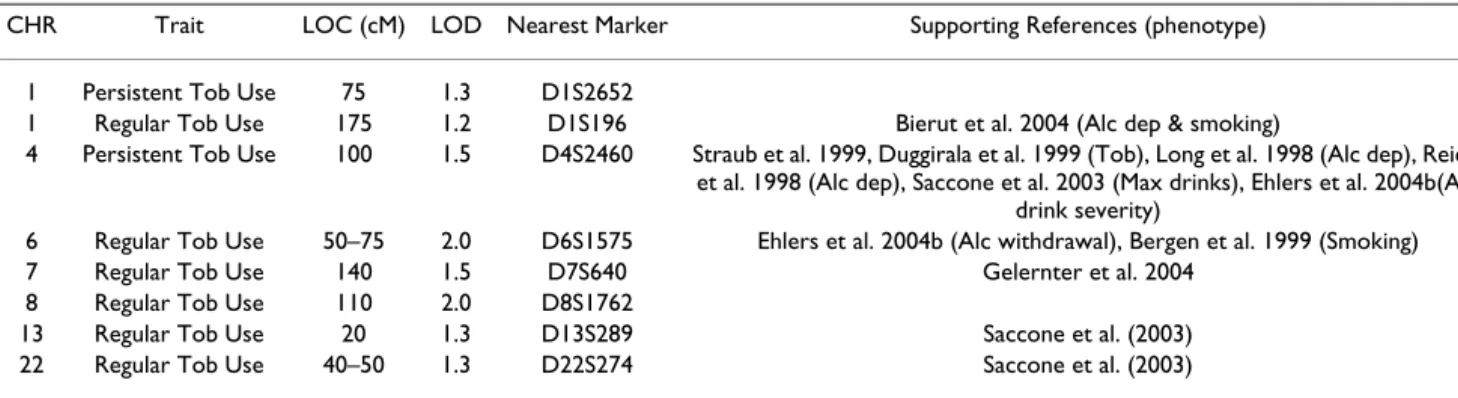
Table 1: Chromosome Locations
CHR Trait LOC (cM) LOD Nearest Marker Supporting References (phenotype) 1 Persistent Tob Use 75 1.3 D1S2652
1 Regular Tob Use 175 1.2 D1S196 Bierut et al. 2004 (Alc dep & smoking)
4 Persistent Tob Use 100 1.5 D4S2460 Straub et al. 1999, Duggirala et al. 1999 (Tob), Long et al. 1998 (Alc dep), Reich et al. 1998 (Alc dep), Saccone et al. 2003 (Max drinks), Ehlers et al. 2004b(Alc
drink severity)
6 Regular Tob Use 50–75 2.0 D6S1575 Ehlers et al. 2004b (Alc withdrawal), Bergen et al. 1999 (Smoking) 7 Regular Tob Use 140 1.5 D7S640 Gelernter et al. 2004
8 Regular Tob Use 110 2.0 D8S1762
13 Regular Tob Use 20 1.3 D13S289 Saccone et al. (2003) 22 Regular Tob Use 40–50 1.3 D22S274 Saccone et al. (2003)
Abbreviations: CHR (chromosome number), LOC (location), Tob Use (tobacco usage), Alc dep (Alcohol dependence), Tob (Tobacco use phenotypes), Max drinks (maximum number of drinks consumed in a 24 hr period), Alc withdrawal (alcohol withdrawal severity phenotype) Alc drink severity (severity of drinking symptoms from DSM-III-R alcohol dependence).
-1 complete pleiotropy) or 0 (complete coincident link-age).
Results
The demographic characteristics of the sample are virtu-ally equivalent to the U.S. census data for the tribe, and have been presented previously [31]. Participants in the study were between 18 and 60 yrs with a mean age of 30 yrs (0.54), 58% were female, they had a mean education level of 11 (0.12) yrs and their income was $27,000 (0.11). The number of individuals with a Native American heritage of greater than 50% was 53% in the larger sample and 55% in the linkage sample. Indian heritage was based on their federal Indian blood quantum. The self-reported racial/ethnic admixture was primarily: Hispanic, Spanish, and other European. The linkage sample did not differ from the larger sample on any demographic or pheno-typic variables.
Two hundred seventy-one out of a larger sample of 466 participants (58%) met the criteria for regular tobacco usage and (30%) met criteria for persistent usage. Men were not significantly more likely to be regular users or persistent users. Nor were those participants having a native heritage of 50% or greater likely to be regular or persistent users compared to those with lesser degrees of Native heritage. The mean age of onset of regular use was 17 yrs and the mean quantity and frequency of usage was 12 cigarettes a day for 9 years. Persistent and regular smokers did not differ from each other or non-smokers on age, education or income. The prevalence of alcohol dependence in the larger sample was 60% and in the
link-age sample it was 61%. Alcohol dependence was co-mor-bid with both the persistent (Chi square = 12.67; df = 1; p < 0.0001) and regular (Chi square = 22.60; df = 1; p < 0.00001) smoking phenotypes.
The first aim of the study was to determine the heritability of the two tobacco phenotypes. The estimated heritability (h2) for the regular tobacco usage, treating the phenotype as a continuous variable, was 0.37 ± 0.11 and persistent tobacco usage, 0.34 ± 0.12. Estimated heritability nomi-nally increased to 0.53 ± 0.17 and 0.46 ± 0.18 when a latent threshold model was used.
The second aim of the study was to identify loci linked with the two tobacco use phenotypes. As seen in Figure 1 and table 1, loci associated with regular tobacco usage were found on chromosome 6 at 75 cM (between D6S257 and D6S460, LOD = 2.0) and on chromosome 8 at 115 cM (at D8S1784, LOD = 2.0). Additional "loci of interest" were found on chromosomes 1 at 175 cM (at D1S2878, LOD = 1.2) chromosome 7 at 181 cM (at D7S2465, LOD = 1.7) chromosome 13 at 15 cM (D13S217 LOD = 1.3) and chromosome 22 at 45 cM (between D22S423 and D22S274, LOD = 1.3). As seen in figure 2 and table 1, only two "loci of interest" were found for the persistent tobacco use phenotype, one on chromosome 1 at 40 cm (near D1S199, LOD = 1.3) and one on chromosome 4 at 102 cM (near D4S414, LOD = 1.5). No overlaps were found between loci identified for the regular use phenotype and those found for the persistent use phenotype.
Multipoint Linkage Analysis for the "persistent tobacco use" phenotype for the entire genome
Figure 2
Multipoint Linkage Analysis for the "persistent tobacco use" phenotype for the entire genome. Results for each chromo-some are aligned end to end with the p terminus on the left. Vertical lines indicate the boundaries between the chromo-somes. The numbers above on the X-axis indicate the chro-mosome number.
Multipoint Linkage Analysis for the "regular tobacco use" phenotype for the entire genome
Figure 1
Multipoint Linkage Analysis for the "regular tobacco use" phenotype for the entire genome. Results for each chromo-some are aligned end to end with the p terminus on the left. Vertical lines indicate the boundaries between the chromo-somes. The numbers above on the X-axis indicate the chro-mosome number.
The peak LOD score observed for persistent tobacco use at 102 cM on chromosome 4 coincides with LOD score peak previously reported in this Mission Indian sample for a drinking severity phenotype [31] (LOD score 2.9). The region near 100 cM where the peak LOD score was observed is notable because it contains a cluster of genes that code for alcohol dehydrogenases (ADH) and has been implicated in several studies of alcohol and tobacco use. Table 1 lists the loci identified in the current study and also provides reference to findings from previously published studies in this Mission Indian population and other population samples. In order to test whether the current findings for drinking severity and persistent smok-ing are coincident on chromosome 4, bivariate linkage analysis was conducted (see Figure 3). The maximum LOD score for the bivariate analysis for the region is 3.4 compared to a maximum of 2.8 for drinking severity score and 1.7 for persistent tobacco use. Although there was insufficient power to exclude coincident linkage (p = 0.26), complete pleiotropy could be excluded (p = 0.02).
Discussion
A variety of genetically influenced characteristics most likely contribute to the increased risk for tobacco usage seen in Mission Indians. A number of psychosocial
varia-bles have been associated with tobacco usage in Native Americans teens including life events and availability [9-11]. However, this is the first study to determine heritabil-ity of tobacco usage and to conduct a linkage analysis to tobacco related phenotypes in Native Americans. Regular and persistent tobacco use were both found to be moder-ately heritable as measured by h2. Additionally, several chromosomal loci were identified as regions of interest that may harbor tobacco usage genes.
There were two loci identified on chromosome 1, one for persistent tobacco usage at 75 cM, and one for regular tobacco usage at 175 cM. Both of these loci were identified in a genome scan conducted using the Collaborative Study of the Genetics of Alcoholism (COGA) dataset for habitual smoking and alcohol dependence [19]. Loci on chromosome 1 have been identified previously for alco-hol dependence phenotypes in a number of studies [55-60]. However, using the COGA dataset, Bierut [23] dem-onstrated the combined phenotype of alcohol depend-ence and habitual smoking had allele sharing among sibling pairs that was similar to results for alcohol dependence alone. Additionally, no evidence for linkage to alcohol dependence has been found at that location on chromosome 1 in this Mission Indian population [31]. Taken together these results suggest that there may be spe-cific genetic factors impacting tobacco usage that do not impact alcohol dependence within this support interval on chromosome 1.
One of the most consistent findings between several genetic linkage studies conducted in Native American and other mixed heritage populations is evidence for a protec-tive association for alcohol dependence and related behaviors in a region on chromosome 4 near the Alcohol dehydrogenase gene cluster. In a genetic linkage study evaluating large families who were members of a South-west Indian tribe, three loci in this region on chromosome 4q showed evidence for linkage [61]. Evidence for linkage at this site, in Mission Indians, was also identified in a genome scan for a severity of alcohol drinking phenotype [31]. A protective association has also been found between polymorphisms in ADH1B3, alcohol depend-ence, and tobacco usage in this population [34]. Addition-ally both the "unaffected by alcoholism" [55] and "maximum drinks ever consumed in a 24 hour period" [62], phenotypes, were found to give evidence for linkage on chromosome 4 in the region of the ADH gene cluster in the COGA study. Evidence for linkage to tobacco dependence at this same general region of the genome on chromosome 4 has also been demonstrated in both the Richmond and Christchurch samples described in the publications by Straub [22], and by Duggirala [63]. The linkage analysis for persistent tobacco use in Mission Indi-ans also supports these observations. The detection of a Multipoint, univariate and bivariate analysis for chromosome
4
Figure 3
Multipoint, univariate and bivariate analysis for chromosome 4. Univariate analysis of the "persistent tobacco use" pheno-type is shown in the heavy dark line and univariate analysis for the "drinking severity" phenotype in the thin line. The bivariate analysis of the "persistent tobacco usage and drink-ing severity" is shown in the dark line. The analysis assumes a latent normally distributed variable with a threshold above which an individual is affected. The maximum LOD score for the bivariate analysis for the region is 3.4 compared to a maximum of 2.8 for drinking severity score and 1.7 for per-sistent tobacco use. Although there was insufficient power to exclude coincident linkage (p = 0.26), complete pleiotropy could be excluded (p = 0.02).
linkage signal for drinking severity using the same cohort in this same region suggests that there may be a sequence variant that affects substance abuse in general or that there are at least two tightly linked variants that affect different aspects of substance abuse behavior. The bivariate analy-sis done in these studies is not sufficiently powered to dis-tinguish between these possibilities.
There is one additional locus of interest in this Mission Indian study that was also identified in previous linkage analyses for alcohol-related phenotypes. Evidence for linkage was found on chromosome 6 for the regular tobacco use phenotype in a support interval previously identified for an alcohol withdrawal severity phenotype in this Mission Indian population [31]. Additionally, evi-dence for an epidemiological measure of smoking was also found at this site using the COGA dataset [64]. Additional loci of interest were found on chromosome 7, 13 and 22 for regular smoking that have been identified in other studies [19,25]. Only a few findings appear to be replicated between studies. This is most likely related to a number of factors. Some of the studies utilized partici-pants recruited from clinical populations enriched for psychiatric disorders whereas some were population based samples using mixed ethnicities. Also, differing def-initions of smoking and tobacco dependence were used. More replications and additional studies in different eth-nic groups are needed to further evaluate the linkage results [24].
The results of this study should be interpreted in the con-text of several limitations. First, the findings may not gen-eralize to other Native Americans or represent all Mission Indians. Second, comparisons of linkage findings to non-Indian populations of drug abusers may be limited by dif-ferences in a host of potential genetic and environmental variables. Third, the underlying assumption that these phenotypes are normally distributed, an assumption of variance component analyses, may not be warranted. Finally, because this population has significant admixture estimates of allele frequencies may produce biased LOD scores. The linkage analyses do not give us any informa-tion on whether the genes within the loci identified are coding for protective or risk factors. Despite these limita-tions, this report represents an important first step in an ongoing investigation to understand the genetic determi-nants associated with the development of substance use disorders in this high risk and understudied ethnic group.
Conclusion
These data represent the first family-based genome-wide chromosome segregation analyses for tobacco use pheno-types in Native Americans. The results corroborated the possible importance of several chromosomal regions
highlighted in prior linkage studies for substance abuse phenotypes and identify new regions of the genome for this ethnic group and/or Mission Indians. A replicate study is underway to test the reliability of the findings. Additionally, these data lend support for the hypothesis that cigarette smoking, alcohol dependence and other consumptive behaviors may share some common risk and/or protective factors in this Mission Indian popula-tion.
List of abbreviations
SSAGA, Semi-Structured Assessment for the Genetics of Alcoholism; H2 total additive genetic heritability; LOD, log of the odds; COGA, collaborative study genetics of alcoholism; ADH, Alcohol Dehydrogenase.
Competing interests
The author(s) declare that they have no competing inter-ests.
Authors' contributions
Cindy L Ehlers contributed to the recruitment, collection and analysis of the clinical and genetic data on the sub-jects. Kirk C. Wilhelmsen contributed to the analyses of family structures, genome scan, linkage and heritability analyses.
Acknowledgements
This study was supported by grants DA 019333 and AA10201, The NIH center for health disparities, the Stein Endowment fund, and by funds pro-vided by the State of California for medical research on alcohol and sub-stance abuse through the University of California, San Francisco, and a General Clinical Research Center grant, RR00833. The authors wish to acknowledge the technical support of Heidi Feiler, Evie Phillips, David Gilder, Linda Corey, James Lee, Samantha Segal, Michelle Dixon, Lilach Har-ris, and Philip Lau.
References
1. Jaffe JH: Drug addiction and drug abuse. In The Pharmacological
Basis of Therapeutics Edited by: Gilman AG, Rall TW, Nies TW, Taylor
P. New York: McGraw-Hill; 1990:522-573.
2. Schuckit MA: Drug and alcohol abuse: a clinical guide to diagnosis and
treatment 4th edition. New York: Plenum Medical Book Co; 1995.
3. Janiger O, de Rios MD: Suggestive hallucinogenic properties of
tobacco. Med Anthropol Newsl 1973, 4:6-11.
4. Wallace JM Jr, Bachman JG, O'Malley PM, Johnston LD, Schulenberg JE, Cooper SM: Tobacco, alcohol, and illicit drug use: racial and
ethnic differences among U.S. high school seniors, 1976-2000. Public Health Rep 2002, 117:S67-S75.
5. Denny CH, Holtzman D, Cobb N: Surveillance for health
behav-iors of American Indians and Alaska Natives: findings from the Behavioral Risk Factor Surveillance System, 1997-2000.
MMWR Surveill Summ 2003, 52:1-13.
6. Center for Disease Control and Prevention (CDC): Tobacco,
alco-hol, and other drug use among high school students in Bureau of Indian Affairs-funded schools--United States, 2001. MMWR Morb Mortal Wkly Rep 2003, 52:1070-1072.
7. Bursac Z, Campbell JE: From risky behaviors to chronic
out-comes: current status and healthy people 2010 goals for American Indians in Oklahoma. J Okla State Med Assoc 2003, 96:569-573.
8. Wardman AE, Khan NA: Smoking-attributable mortality
among British Columbia's first nations populations. Int J
Cir-cumpolar Health 2004, 63:81-92.
9. Unger JB, Shakib S, Cruz TB, Hoffman BR, Pitney BH, Rohrbach LA:
Smoking behavior among urban and rural Native American adolescents in California. Am J Prev Med 2003, 25:251-254.
10. Kegler M, Cleaver V, Kingsley B: The social context of
experi-menting with cigarettes: American Indian "start stories". Am
J Health Promot 2000, 15:89-92.
11. LeMaster PL, Connell CM, Mitchell CM, Manson SM: Tobacco use
among American Indian adolescents: protective and risk fac-tors. J Adolesc Health 2002, 30:426-432.
12. Heath AC, Madden PAF: Genetic influences on smoking
behav-ior. In Behavior genetic approaches in behavioral medicine New York:
Plenum Press; 1995:45-66.
13. Kendler KS, Karkowski LM, Neale MC, Prescott CA: Illicit
psycho-active substance use, heavy use, abuse, and dependence in a US population-based sample of male twins. Arch Gen Psychiatry
2000, 57:261-269.
14. Li MD: The genetics of smoking related behavior: a brief
review. Am J Med Sci 2003, 326:168-173.
15. Hettema JM, Corey LA, Kendler KS: A multivariate genetic
anal-ysis of the use of tobacco, alcohol, and caffeine in a popula-tion based sample of male and female twins. Drug Alcohol
Depend 1999, 57:69-78.
16. True WR, Xian H, Scherrer JF, Madden PA, Bucholz KK, Heath AC, Eisen SA, Lyons MJ, Goldberg J, Tsuang M: Common genetic
vul-nerability for nicotine and alcohol dependence in men. Arch
Gen Psychiatry 1999, 56:655-661.
17. Madden PA, Bucholz KK, Martin NG, Heath AC: Smoking and the
genetic contribution to alcohol-dependence risk. Alcohol Res
Health 2000, 24:209-214.
18. Swan GE, Carmelli D, Cardon LR: Heavy consumption of
ciga-rettes, alcohol and coffee in male twins. J Stud Alcohol 1997, 58:182-190.
19. Saccone NL, Neuman RJ, Saccone SF, Rice JP: Genetic analysis of
maximum cigarette-use phenotypes. BMC Genet 2003, 4:S105.
20. Swan GE, Benowitz NL, Lessov CN, Jacob P, Jacob P III, Tyndale RF, Wilhelmsen K: Nicotine metabolism: the impact of CYP2A6
on estimates of additive genetic influence. Pharmacogenet
Genomics 2005, 15:115-125.
21. Vink JM, Beem AL, Posthuma D, Neale MC, Willemsen G, Kendler KS, Slagboom PE, Boomsma DI: Linkage analysis of smoking
ini-tiation and quantity in Dutch sibling pairs. Pharmacogenomics J
2004, 4:274-282.
22. Straub RE, Sullivan PF, Ma Y, Myakishev MV, Harris-Kerr C, Wormley B, Kadambi B, Sadek H, Silverman MA, Webb BT, Neale MC, Bulik CM, Joyce PR, Kendler KS: Susceptibility genes for nicotine
dependence: a genome scan and followup in an independent sample suggest that regions on chromosomes 2, 4, 10, 16, 17 and 18 merit further study. Mol Psychiatry 1999, 4:129-144.
23. Bierut LJ, Rice JP, Goate A, Hinrichs AL, Saccone NL, Foroud T, Eden-berg HJ, Cloninger CR, Begleiter H, Conneally PM, Crowe RR, Hes-selbrock V, Li TK, Nurnberger JI Jr, Porjesz B, Schuckit MA, Reich T:
A genomic scan for habitual smoking in families of alcoholics: common and specific genetic factors in substance depend-ence. Am J Med Genet 2004, 124A:19-27.
24. Li MD, Ma JZ, Cheng R, Dupont RT, Williams NJ, Crews KM, Payne TJ, Elston RC, Framingham Heart Study: A genome-wide scan to
identify loci for smoking rate in the Framingham Heart Study population. BMC Genet 2003, 4:S103.
25. Gelernter J, Liu X, Hesselbrock V, Page GP, Goddard A, Zhang H:
Results of a genomewide linkage scan: support for chromo-somes 9 and 11 loci increasing risk for cigarette smoking. Am
J Med Genet B Neuropsychiatr Genet 2004, 128B:94-101.
26. Sullivan PF, Neale BM, van den OE, Miles MF, Neale MC, Bulik CM, Joyce PR, Straub RE, Kendler KS: Candidate genes for nicotine
dependence via linkage, epistasis, and bioinformatics. Am J
Med Genet B Neuropsychiatr Genet 2004, 126B:23-36.
27. Ehlers CL, Garcia-Andrade C, Wall TL, Sobel DF, Phillips E:
Deter-minants of P3 amplitude and response to alcohol in Native American Mission Indians. Neuropsychopharmacology 1998, 18:282-292.
28. Ehlers CL, Garcia-Andrade C, Wall TL, Cloutier D, Phillips E:
Elec-troencephalographic responses to alcohol challenge in
Native American Mission Indians. Biol Psychiatry 1999, 45:776-787.
29. Ehlers CL, Gilder DA, Harris L, Carr L: Association of the
ADH2*3 allele with a negative family history of alcoholism in African American young adults. Alcohol Clin Exp Res 2001, 25:1773-1777.
30. Ehlers CL, Wall TL, Betancourt M, Gilder DA: The clinical course
of alcoholism in 243 Mission Indians. Am J Psychiatry 2004, 161:1204-1210.
31. Ehlers CL, Gilder DA, Wall TL, Phillips E, Feiler H, Wilhelmsen KC:
Genomic screen for loci associated with alcohol dependence in Mission Indians. Am J Med Genet B Neuropsychiatr Genet 2004, 129B:110-115.
32. Garcia-Andrade C, Wall TL, Ehlers CL: The firewater myth and
response to alcohol in Mission Indians. Am J Psychiatry 1997, 154:983-988.
33. Wall TL, Garcia-Andrade C, Thomasson HR, Carr LG, Ehlers CL:
Alcohol dehydrogenase polymorphisms in Native Ameri-cans: identification of the ADH2*3 allele. Alcohol Alcohol 1997, 32:129-132.
34. Wall TL, Carr LG, Ehlers CL: Protective association of genetic
variation in alcohol dehydrogenase with alcohol dependence in Native American Mission Indians. Am J Psychiatry 2003, 160:41-46.
35. Wilhelmsen KC, Ehlers C: Heritability of substance dependence
in a native American population. Psychiatr Genet 2005, 15:101-107.
36. Ehlers CL, Wilhelmsen KC: Genomic scan for alcohol craving in
Mission Indians. Psychiatr Genet 2005, 15:71-75.
37. Kalton G, Anderson DW: Sampling rare popoulations. J Roy Stat
Soc Series A 1986, 149:65-82.
38. Muhib FB, Lin LS, Stueve A, Miller RL, Ford WL, Johnson WD, Smith PJ, Community Intervention Trial for Youth Study Team: A
venue-based method for sampling hard-to-reach populations. Public
Health Rep 2001, 116(Suppl 1):216-222.
39. Heckathorn DD: Respondent-driven sampling: a new approach
to the study of hidden populations. Soc Probl 1997, 44:174-199.
40. Schuckit MA: Genetics and the risk for alcoholism. JAMA 1985,
254:2614-2617.
41. Bucholz KK, Cadoret R, Cloninger CR, Dinwiddie SH, Hesselbrock VM, Nurnberger JI Jr, Reich T, Schmidt I, Schuckit MA: A new,
semi-structured psychiatric interview for use in genetic linkage studies: a report on the reliability of the SSAGA. J Stud Alcohol
1994, 55:149-158.
42. American Psychiatric Association, Task Force on DSM-IV: Diagnostic
and statistical manual of mental disorders (DSM-IV) 4th edition.
Wash-ington, DC: American Psychiatric Association; 2005.
43. Hesselbrock M, Easton C, Bucholz KK, Schuckit M, Hesselbrock V: A
validity study of the SSAGA--a comparison with the SCAN.
Addiction 1999, 94:1361-1370.
44. Gilder DA, Wall TL, Ehlers CL: Comorbidity of select anxiety
and affective disorders with alcohol dependence in south-west California Indians. Alcohol Clin Exp Res 2004, 28:1805-1813.
45. Hesselbrock VM, Segal B, Hesselbrock MN: Alcohol dependence
among Alaska Natives entering alcoholism treatment: a gender comparison. J Stud Alcohol 2000, 61:150-156.
46. Wilhelmsen KC, Schuckit M, Smith TL, Lee JV, Segall SK, Feiler HS, Kalmijn J: The search for genes related to a low-level response
to alcohol determined by alcohol challenges. Alcohol Clin Exp
Res 2003, 27:1041-1047.
47. Weber JL, May PE: Abundant class of human DNA
polymor-phisms which can be typed using the polymerase chain reac-tion. Am J Hum Genet 1989, 44:388-396.
48. Almasy L, Blangero J: Multipoint quantitative-trait linkage
anal-ysis in general pedigrees. Am J Hum Genet 1998, 62:1198-1211.
49. Sequential Oligogenic Linkage Analysis (SOLAR): Southwest Foundation
for Biomedical Research [http://www.sfbr.org/solar].
50. Kruglyak L, Daly MJ, Reeve-Daly MP, Lander ES: Parametric and
nonparametric linkage analysis: a unified multipoint approach. Am J Hum Genet 1996, 58:1347-1363.
51. Merlin: [http://csg.sph.umich.edu]. Center for Statistical Genetics, University of Michigan
52. Blangero J, Williams JT, Almasy L: Robust LOD scores for
vari-ance component-based linkage analysis. Genet Epidemiol 2000, 19(Suppl 1):S8-s14.
Publish with BioMed Central and every scientist can read your work free of charge "BioMed Central will be the most significant development for disseminating the results of biomedical researc h in our lifetime."
Sir Paul Nurse, Cancer Research UK Your research papers will be:
available free of charge to the entire biomedical community peer reviewed and published immediately upon acceptance cited in PubMed and archived on PubMed Central yours — you keep the copyright
Submit your manuscript here:
http://www.biomedcentral.com/info/publishing_adv.asp
BioMedcentral
53. Almasy L, Dyer TD, Blangero J: Bivariate quantitative trait
link-age analysis: pleiotropy versus co-incident linklink-ages. Genet
Epi-demiol 1997, 14:953-958.
54. North KE, Miller MB, Coon H, Martin LJ, Peacock JM, Arnett D, Zhang B, Province M, Oberman A, Blangero J, Almasy L, Ellison RC, Heiss G: Evidence for a gene influencing fasting LDL
choles-terol and triglyceride levels on chromosome 21q.
Atheroscle-rosis 2005, 179:119-125.
55. Reich T, Edenberg HJ, Goate A, Williams JT, Rice JP, Van Eerdewegh P, Foroud T, Hesselbrock V, Schuckit MA, Bucholz K, Porjesz B, Li TK, Conneally PM, Nurnberger JI Jr, Tischfield JA, Crowe RR, Clon-inger CR, Wu W, Shears S, Carr K, Crose C, Willig C, Begleiter H:
Genome-wide search for genes affecting the risk for alcohol dependence. Am J Med Genet 1998, 81:207-215.
56. Hill SY, Shen S, Zezza N, Hoffman EK, Perlin M, Allan W: A genome
wide search for alcoholism susceptibility genes. Am J Med
Genet B Neuropsychiatr Genet 2004, 128B:102-113.
57. Guerrini I, Cook CC, Kest W, Devitgh A, McQuillin A, Curtis D, Gurling HM: Genetic linkage analysis supports the presence of
two susceptibility loci for alcoholism and heavy drinking on chromosome 1p22.1-11.2 and 1q21.3-24.2. BMC Genet 2005, 6:11.
58. Dick DM, Nurnberger J Jr, Edenberg HJ, Goate A, Crowe R, Rice J, Bucholz KK, Kramer J, Schuckit MA, Smith TL, Porjesz B, Begleiter H, Hesselbrock V, Foroud T: Suggestive linkage on chromosome 1
for a quantitative alcohol-related phenotype. Alcohol Clin Exp
Res 2002, 26:1453-1460.
59. Nurnberger JI Jr, Foroud T, Flury L, Su J, Meyer ET, Hu K, Crowe R, Edenberg H, Goate A, Bierut L, Reich T, Schuckit M, Reich W:
Evi-dence for a locus on chromosome 1 that influences vulnera-bility to alcoholism and affective disorder. Am J Psychiatry 2001, 158:718-724.
60. Foroud T, Edenberg HJ, Goate A, Rice J, Flury L, Koller DL, Bierut LJ, Conneally PM, Nurnberger JI, Bucholz KK, Li TK, Hesselbrock V, Crowe R, Schuckit M, Porjesz B, Begleiter H, Reich T: Alcoholism
susceptibility loci: confirmation studies in a replicate sample and further mapping. Alcohol Clin Exp Res 2000, 24:933-945.
61. Long JC, Knowler WC, Hanson RL, Robin RW, Urbanek M, Moore E, Bennett PH, Goldman D: Evidence for genetic linkage to alcohol
dependence on chromosomes 4 and 11 from an autosome-wide scan in an American Indian population. Am J Med Genet
1998, 81:216-221.
62. Saccone NL, Rochberg N, Neuman RJ, Rice JP: Covariates in
link-age analysis using sibling and cousin pairs. Genet Epidemiol
2001, 21(Suppl 1):S540-S545.
63. Duggirala R, Almasy L, Blangero J: Smoking behavior is under the
influence of a major quantitative trait locus on human chro-mosome 5q. Genet Epidemiol 1999, 17(Suppl 1):S139-S144.
64. Bergen AW, Korczak JF, Weissbecker KA, Goldstein AM: A
genome-wide search for loci contributing to smoking and alcoholism. Genet Epidemiol 1999, 17(Suppl 1):S55-S60.
Pre-publication history
The pre-publication history for this paper can be accessed here: