Please cite this article as: S. E. Rezaei, S. K. Sadrnezhaad, Fluoride Precipitation of Cu Over Fe in a Selected pH Window, International Journal of Engineering (IJE), IJE TRANSACTIONS C: Aspects Vol. 32, No. 3, (March 2019) 424-429
International Journal of Engineering
J o u r n a l H o m e p a g e : w w w . i j e . i rFluoride Precipitation of Cu Over Fe in a Selected pH Window
S. E. Rezaei, S. K. Sadrnezhaad*
Departments of Materials Science and Engineering, Sharif University of Technology, Azadi Avenue, Tehran, Iran
P A P E R I N F O
Paper history:
Received 21 August 2018
Received in revised form 05 November 2018 Accepted 07 March 2019
Keywords:
Chalcopyrite Chloride Leaching Copper-Iron Separation CuF2 Deposition
Reaction Mechanism
A B S T R A C T
Fe is an impurity in most leach liquors. Its coexistence with copper in leaching solution of chalcopyrite (CuFeS2) which is the most important mineral of copper creates major extraction problems. Hydrochloric acid dissolves both copper and iron during chloride leaching of this mineral. Separation of Fe from Cu is thus necessary to obtain pure copper. This paper presents a novel method for precipitation of Cu over Fe from mixed chloride acidic liquors. Hydrofluoric acid is used as the major unraveling agent. Kinetic studies show that a second-order CuCl2 precipitation reaction with a chemical rate constant of k = 0.416 L/mol prevails the process at the room temperature. For validation of the results, precipitate characterization by x-ray fluorescence (XRF) and x-ray diffraction (XRD) and solution analysis by atomic absorption spectrometry (ABS) are performed. Nitrogen presence is shown to help separation of iron from copper. The optimum value of pH (1.09) is achieved when nitrogen helps parting of 99 % iron II ions in the solution and sole deposition of copper II chloride precipitate.
doi: 10.5829/ije.2019.32.03c.10
1. INTRODUCTION1
Copper as a much-demanded metal [1] can be extracted by both pyrometallurgical [2-4] and hydrometallurgical ways [5, 6]. Within 30 years, the demand for copper production is predicted to raise three times more than the current amount [7]. Due to the environmental and energy limitations [8, 9], hydrometallurgy of copper has attracted much attention. It is also more economical and applicable to the units with lower capability [10]. Although traditional leaching is of much interest yet, biological and chemical processes have been given full consideration during recent years [11, 12]. Chalcopyrite chemical dissolution is a widely performed process utilizing sulfuric, nitric and hydrochloric acids. Oxidative dissolution of chalcopyrite at ambient temperature is slow [13] and subject to passivation [14], posing a challenge for development of leaching application. Chloride is, however, a well-known chemical enhancer for leaching of the most sulfidic substances [15].
Chloride leaching is both simple and economically feasible. However, safety precautions must be taken into consideration. Many works have been done to obtain the appropriate conditions [16-23]. Kinnunen et al. [24] have
*Corresponding Author Email: [email protected] (S. K. Sadrnezhaad)
studied the effect of chloride ions on chalcopyrite in biologically-produced ferric sulfate solutions. Sato et al. [11] have studied the effect of silver chloride on the bioleaching of chalcopyrite concentrate. Leaching of chalcopyrite in acidic ferric chloride has been reported by Al-Harahsheh et al. [18]. Sodium chloride has shown a positive effect on chalcopyrite dissolution resulting enhancement of copper extraction [25-27]. It has been shown that chalcopyrite leaching rates are faster with Fe (III)-chloride than with Fe (III)-sulfate [28]. Formation of a highly porous sulfur layer adjacent to the chloride solution has caused this faster rate [29, 30]. Previous authors have studied the mechanism of chalcopyrite leaching in hydrochloric acid solution [27]. They have analyzed solid residues by SEM, EPMA, Raman spectroscopy and XRD [27]. O’Malley et al. [31] have studied the leaching of CuFeS2 by aqueous FeCl3, HCl,
and NaCl. Habashi et al. [32] have compared oxidation behaviors of chalcopyrite in HCl and H2SO4.
Leaching of chalcopyrite results in the entrance of unwanted Fe2+ ions into the dissolution product; because,
expensive process requiring costly organic solutions. LIX 64N has been used in copper L/SX/EW technology, as is reported in the literature [36]. Finding a simple, inexpensive and fast way for the selective separation of Fe from Cu is still a desirable achievement that deserves extended research. This work is devoted to this purpose by looking through kinetics of precipitation of copper II chloride over Fe in a selected pH window by HF. Iron ions remain in the solution in the form of iron (II) fluoride. Copper (II) fluoride can then be used to synthesize fluoroaromatics substances [37]. Fluoride-based copper (II) catalysts are also usable in enantioselective hydrosilylation of ketones in aerobic conditions. Stainless steel cathode and platinum anode can be used for electrowinning of iron from fluoride solution through an autonomous process, such as the one studied by Mostad et al. [7]. The result can be thought of as an alternative to the well-established method of SX with LIX reagents [38], or even the old-fashioned copper cementation process.
2. MATERIALS METHOD
Analytical grade copper (II) and iron (II) chlorides were purchased from Merck, Germany. Hydrofluoric acid was purchased from Osloub Sanat Co., Iran. Nitrogen gas was also purchased from Sepehr Gas Nitrogen Co., Iran. Commercial chalcopyrite of Sarcheshme Copper Complex, Kerman, Iran was used to prepare industrial leaching solution.
As fluoride ion reacts with silica, PVC beakers were used for holding and transfer of HF. The solutions were diluted to levels acceptable for the atomic absorption spectrometer. Copper (II) and iron (II) chlorides were used to prepare synthetic chloride solutions.
Mixtures of copper (II) chloride and iron (II) chloride were stirred for 2 min. HF was then added and stirred until precipitation occurred. The deposits were then filtered and the pH of the solution was measured. The deposit was dried and then weighed. For phase detection, x-ray fluorescence and x-ray diffraction were performed. Concentrations of both copper and iron ions in the solution were measured by atomic absorption. Optimum pH for fastest precipitation and thus separation was obtained.
Experiments were repeated in the presence of nitrogen to find out the effect on N2 on oxidation of iron
(II) to iron (III). Effect of time on the proceeding of the reactions was studied by sampling at t = 2, 5, 10, 12, 15, 20, 25, 30, 35, 40 s after the start of the reaction. Kinetics of deposition of copper (II) fluoride was investigated. Liquid samples taken from the leaching solution were analyzed by atomic absorption spectrometer. Precipitates were characterized by x-ray fluorescence and x-ray diffraction. Thermodynamics and kinetics of the
reactions were studied by the standard free energy evaluations and conversion-time curve fitting to the established kinetic models available [39, 40].
3. RESULTS AND DISCUSSION
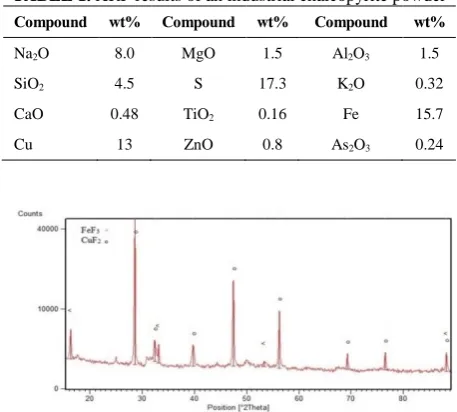
Table 1 shows the x-ray fluorescence results of the chalcopyrite powder used in this research. The data shows that the iron content of the sample is even higher than its copper concentration. The x-ray diffraction pattern of the precipitated powder is illustrated in Figure 1. The x-ray pattern indicates that a large amount of copper (II) fluoride together with a small amount of iron (III) fluoride with cubic crystal structure are present in the deposited solid phase.
Deposition of copper (II) fluoride can be projected according to the following reaction:
CuCl2(aq) + 2 HF(aq)↔ CuF2(s) + 2 HCl(aq) (1)
As iron (III) fluoride is insoluble, it would precipitate due to oxidation of Fe2+ to Fe3+ according to the following
unfavorable reaction:
Fe2+↔Fe3++e- (2)
Because of the acidic environment, cathodic H+ reduction
may facilitate the above reaction:
2H+ +2e- ↔H
2(g) (3)
Combination of reactions (2) and (3) resulted in the deposition of the iron (III) fluoride out of the solution:
FeCl2(aq)+3HF(aq)→FeF3(s)+2HCl(aq)+ 0.5H2(g) (4)
TABLE 1. XRF results of an industrial chalcopyrite powder
Compound wt% Compound wt% Compound wt%
Na2O 8.0 MgO 1.5 Al2O3 1.5
SiO2 4.5 S 17.3 K2O 0.32
CaO 0.48 TiO2 0.16 Fe 15.7
Cu 13 ZnO 0.8 As2O3 0.24
High H2 partial pressure, of course, can reverse the above
unfavorable reaction. Utilization of hydrogen is, however, economically and practically unfeasible. Slow dissociation of HF is a simply done favorable phenomenon helping to succeed in the ionic separation. Based on literature, hydrofluoric dissociation and release of H+ in water is not a fast process [41]. For iron ions to
remain in the solution, the following is the favorable helpful reaction:
FeCl2(aq) + 2HF(aq) →FeF2(aq) + 2HCl(aq) (5) For the best separation of copper from iron, we try to minimize reaction (4) and maximize reactions (1) and (5) by controlling the pH of the solution.
Increasing H+ ions causes progress of reaction (4). On
the other hand, lack of H+ ions inhibits the progress of
reactions (1) and (5). Lack of H+ ions means lack of
hydrofluoric acid. Therefore, there is an optimun pH for the process.
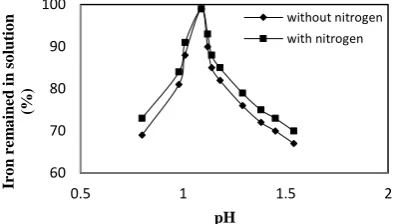
Figure 2 shows the presence of copper and iron ions in the solution. Optimum pH is that which maximizes iron presence in the solution with heaviest copper precipitate. From Figure 2, the optimum pH is 1.09. In this pH, 99.9% of iron remains in the solution with 88.8% of copper going to the solid precipitate. Nitrogen gas can keep Fe2+ ions far from the hydrogen ions. It, therefore,
inhibits reaction (4) from quick occurrence. Figure 3 shows that nitrogen increases remaining of iron ions in the solution. Nitrogen atmosphere enhances efficiency up to 8%, although near to the optimized pH, the effect of nitrogen gas is negligible due to the higher stability of Fe2+ ions in the solution.
Figure 4 explains the changes of the copper (II) fluoride content of the solution with time. As it is seen, it takes 12 s to reach the highest precipitation with the lowest remained copper in the leaching solution. Fractional conversion X of the reactants of reaction (5) is defined as follows:
XA = (C0A-CA)/C0A (6)
In which C0
A is the initial concentration and CA is the
concentration of the reactant at time t. Table 2 indicates partial conversions of copper II and HF in the solution.
Figure 2. Solution ions content as a function of pH
Figure 3. Effect of nitrogen on iron ions remained in the solution
Figure 4. Changes of copper (II) chloride content in the solution for pH = 1.09 at 298 K with time
Applying kinetic model calculations [40], one can prove that the reaction (5) is a complex reaction with a total order of 2 as approved by the following procedure:
CCuCl2 = C0CuCl2(1-XCuCl2) (7)
Definition of the rate equation based on an assumed second order mechanism is:
-d(CCuCl2)/dt = k C0CuCl2(1-XCuCl2)×(C0HF - C0HF XHF) (8)
In which k is the rate constant and M is defined as follows:
M= C0
HF/C0CuCl2 (9)
The value of M in this study is selected to be equal to 2.266.
TABLE 2. Changes of concentration and fractional conversion for CuCl2 and HF with the reaction time
t (s) CCuCl2 CHF XCuCl2 XHF 𝐥𝐧 (𝐌−𝟐𝑿𝐂𝐮𝐂𝐥𝟐 𝐌(𝟏−𝑿𝐂𝐮𝐂𝐥𝟐))
0 0.5 1.133 0 0 0
2 0.28996 0.84304 0.42009 0.37077 0.42134
5 0.13688 0.99612 0.72624 0.64099 1.071228
10 0.06507 1.06794 0.86987 0.76776 1.76394
12 0.05697 1.07604 0.88607 0.78206 1.89096 0
20 40 60 80 100
0.5 1 1.5 2
Io
n
s
re
m
a
in
ed
i
n
t
h
e
so
lu
ti
o
n
(
%
)
pH
copper ions iron ions
60 70 80 90 100
0.5 1 1.5 2
Iro
n
r
em
a
in
ed
i
n
so
lu
ti
o
n
(%
)
pH
without nitrogen with nitrogen
0 20 40 60 80 100 120
0 10 20 30 40 50
C
u
r
em
a
in
ed
i
n
so
lu
ti
o
n
(%
)
As consumption of copper (II) chloride is half the consumption of hydrofluoric acid, we can write:
C0
HF XHF = 2C0CuCl2 XCuCl2 (10)
Substituting Equations (7), (9) and (10) into Equation (8), one can obtain:
dXCuCl2/dt = k C0CuCl2(1-XCuCl2)(M - 2XCuCl2) (11)
Equation (11) is the regularized of Equation (7) by the following equation:
d𝑋CuCl2
(1−𝑋CuCl2)(M−2𝑋CuCl2)= 𝑘 𝐶CuCl2
0 𝑑𝑡
(12)
Integration of Equation (12) yields [38]:
ln [M−2𝑋CuCl2
M(1−𝑋CuCl2)] = 𝑘 𝐶CuCl2
0 (𝑀 − 2) 𝑡 (13)
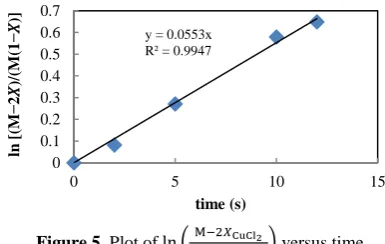
In order to assess fitness of the proposed mechanism, we
can plot ln (M−2𝑋CuCl2
M(1−𝑋CuCl2)) versus t. The result is shown in
Figure 5 which shows a good fitness with a straight line of constant slope, as expected.
The slope of the straight line of Figure 5 is as follows:
k C0
CuCl2 (M – 2) = 0.0553 (14)
From the slope, the rate constant of the reaction (5) is obtained. Inserting M=2.266 and C0
CuCl2 = 0.5 mol/L into
Equation (14), the value of the rate constant for the reaction (5) is obtained:
k = 0.4158 L/mol. s (15)
4. SAFETY PRECAUTIONS
Both HF and HCl have corrosive effects on human tissue, potentially damaging respiratory organs, eyes, skin, and intestines. HF is a contact poison with un-noticed short-time effects. Skin burns may appear long-short-time after physical contact with HF. All leaching/separation practices must thus be done under a well-ventilated hood or inside well-controlled ventilated chambers with hands, eyes and other body parts protected with anti-acid safety
Figure 5. Plot of ln (M−2𝑋CuCl2
M(1−𝑋CuCl2)) versus time
covers. Safety regulations and measures are well established and fully documented for these acids because they are widely used in the production of organic or inorganic fluorine compounds, in the treatment of metals (aluminum, steel), glass and crystal (etching and polishing), in the petroleum industry (refining), in the electronics industry for the surface treatment of electronic components and in biological staining.
5. CONCLUSIONS
Iron is the major impurity of copper almost in all natural resources. To fulfill the environmental limitations, reduction of energy consumption, and improving the economics of the production, the hydrometallurgical route was chosen in this research to part copper from iron. A simple, straightforward procedure was adopted to successfully attain separation of copper ions from chalcopyrite leaching solution through deposition of copper (II) fluoride. The separation reaction was found to be 1st order with respect to both CuCl
2 and HF. The
overall order of the separation reaction was two with a rate constant of 0.4158 L.mol-1.s-1. An optimum value of
pH for the highest departing of copper from ion was 1.09 when nitrogen gas was used to shield iron from precipitation with copper. Careful usage of HCl and HF was crucial for the safe operation of the devised new process.
6. ACKNOWLEDGEMENTS
The authors appreciate Advanced Bio-Nano Laboratory in Department of Materials Science and Engineering of Sharif University of Technology, and Iran National Science Foundation for their support of the research.
7. REFERENCES
1. Elshkaki, A., Graedel, T., Ciacci, L. and Reck, B.K., "Resource demand scenarios for the major metals", Environmental Science & Technology, Vol. 52, No. 5, (2018), 2491-2497.
2. Moskalyk ,R.R., Alfantazi, A.M., “Review of copper pyrometallurgical practice: today and tomorrow”, Minerals Engineering, Vol. 16, No. 10, (2003), 893-919.
3. Taskinen, P., Akdogan, G., Kojo, I., Lahtinen, M., Markku, I., Jokilaakso, A., “Matte converting in copper smelting”, Mineral Processing and Extractive Metallurgy, Transactions of the Institutions of Mining and Metallurgy, Vol. 128, No. 1-2, (2019), 58-73.
4. Forsén, O., Aroma, J., Lundström, M., “Primary Copper Smelter and Refinery as a Recycling Plant—A System Integrated Approach to Estimate Secondary Raw Material Tolerance”,
Recycling, Vol. 2, No. 4, (2017), 19.
5. Tuncuk, A., Stazi, V., Akcil, A., Yazici, E.Y. and Deveci, H., "Aqueous metal recovery techniques from e-scrap: y = 0.0553x
R² = 0.9947
0 0.1 0.2 0.3 0.4 0.5 0.6 0.7
0 5 10 15
ln
[(M
−
2
𝑋
)/
(M
(1
−
𝑋
)]
Hydrometallurgy in recycling", Minerals Engineering, Vol. 25, No. 1, (2012), 28-37.
6. Kim, E.-y., Kim, M.-s., Lee, J.-c., Jeong, J. and Pandey, B., "Leaching kinetics of copper from waste printed circuit boards by electro-generated chlorine in hcl solution", Hydrometallurgy, Vol. 107, No. 3-4, (2011), 124-132.
7. Mostad, E., Rolseth, S. and Thonstad, J., "Electrowinning of iron from sulphate solutions", Hydrometallurgy, Vol. 90, No. 2-4, (2008), 213-220.
8. Kordosky, G., "Copper recovery using leach/solvent extraction/electrowinning technology: Forty years of innovation, 2.2 million tonnes of copper annually", Journal of the Southern African Institute of Mining and Metallurgy, Vol. 102, No. 8, (2002), 445-450.
9. Nayaka, G., Zhang, Y., Dong, P., Wang, D., Zhou, Z., Duan, J., Li, X., Lin, Y., Meng, Q. and Pai, K., "An environmental friendly attempt to recycle the spent li-ion battery cathode through organic acid leaching", Journal of Environmental Chemical Engineering, Vol. 7, No. 1, (2019), 102854.
10. Alguacil, F.J., Garcia-Diaz, I., Lopez, F. and Rodriguez, O., "Recycling of copper flue dust via leaching-solvent extraction processing", Desalination and Water Treatment, Vol. 56, No. 5, (2015), 1202-1207.
11. Sato, H., Nakazawa, H. and Kudo, Y., "Effect of silver chloride on the bioleaching of chalcopyrite concentrate", International Journal of Mineral Processing, Vol. 59, No. 1, (2000), 17-24. 12. Shang, H., Wu, B., Wen, J.K. and Cui, X.L., "Analysis of
microbial community in heap bioleaching of low-grade copper sulfide ores", in Key Engineering Materials, Trans Tech Publ. Vol. 777, (2018), 277-281.
13. Yoon, H.-S., Kim, C.-J., Chung, K.W., Lee, J.-Y., Shin, S.M., Kim, S.-R., Jang, M.-H., Kim, J.-H., Lee, S.-I. and Yoo, S.-J., "Ultrasonic-assisted leaching kinetics in aqueous fecl 3-hcl solution for the recovery of copper by hydrometallurgy from poorly soluble chalcopyrite", Korean Journal of Chemical Engineering, Vol. 34, No. 6, (2017), 1748-1755.
13. Cruz-Robles, I., Vaamonde, A.J.V., Alonso, E., Pérez-Rábago, C.A. and Estrada, C.A., "Potential of solar central tower systems for thermal applications in the production chain of copper by pyrometallurgical route", in AIP Conference Proceedings, AIP Publishing. Vol. 2033, (2018), 020002.
14. Córdoba, E., Muñoz, J., Blázquez, M., González, F. and Ballester, A., "Leaching of chalcopyrite with ferric ion. Part i: General aspects", Hydrometallurgy, Vol. 93, No. 3-4, (2008), 81-87. 15. Turan, M.D., Boyrazli, M., Altundoğan, H.S., “Improving of
copper extraction from chalcopyrite by using NaCl”, Journal of Central South University, Vol. 25, No. 1, (2018), 21–28. 16. Rocchetti, L., Vegliò, F., Kopacek, B. and Beolchini, F.,
"Environmental impact assessment of hydrometallurgical processes for metal recovery from weee residues using a portable prototype plant", Environmental Science & Technology, Vol. 47, No. 3, (2013), 1581-1588.
17. Subramanian, M. and Manzer, L., "A" greener" synthetic route for fluoroaromatics via copper (II) fluoride", Science, Vol. 297, No. 5587, (2002), 1665-1665.
18. Al-Harahsheh, M., Kingman, S. and Al-Harahsheh, A., "Ferric chloride leaching of chalcopyrite: Synergetic effect of cucl2",
Hydrometallurgy, Vol. 91, No. 1-4, (2008), 89-97.
19. Shahrina, S., Lau, W., Goha, P., Jaafara, J. and Ismaila, A., "Adsorptive removal of Cr (VI) and Cu (II) ions from water solution using graphene oxide–manganese ferrite (GMF) nanomaterials", International Journal of Engineering, Vol. 31, No. 8, (2018), 1341-1346.
20. Ruiz, M., Montes, K. and Padilla, R., "Chalcopyrite leaching in sulfate–chloride media at ambient pressure", Hydrometallurgy, Vol. 109, No. 1-2, (2011), 37-42.
21. Carneiro, M.F.C. and Leão, V.A., "The role of sodium chloride on surface properties of chalcopyrite leached with ferric sulphate", Hydrometallurgy, Vol. 87, No. 3-4, (2007), 73-82. 22. Ayotte, P., Hébert, M. and Marchand, P., "Why is hydrofluoric
acid a weak acid?", The Journal of Chemical Physics, Vol. 123, No. 18, (2005), 184501.
23. Wang, H., Zhang, S., Li, B., Pan, D.a., Wu, Y. and Zuo, T., "Recovery of waste printed circuit boards through pyrometallurgical processing: A review", Resources, Conservation and Recycling, Vol. 126, (2017), 209-218. 24. Kinnunen, P.H.M. and Puhakka, J.A., "Chloride‐promoted
leaching of chalcopyrite concentrate by biologically‐produced ferric sulfate", Journal of Chemical Technology & Biotechnology: International Research in Process, Environmental & Clean Technology, Vol. 79, No. 8, (2004), 830-834.
25. Jafari M., G. Karimi, R. Ahmadi, "Improvement of chalcopyrite atmospheric leaching using controlled slurry potential and additive treatments", Physicochem. Probl. Miner. Process, Vol. 53, No. 2, (2017), 1228−1240.
23. Valenta, R., Kemp, D., Owen, J., Corder, G. and Lèbre, É., "Re-thinking complex orebodies: Consequences for the future world supply of copper", Journal of Cleaner Production, Vol. 220, (2019), 816-826.
26. Dreisinger, D., "Copper leaching from primary sulfides: Options for biological and chemical extraction of copper",
Hydrometallurgy, Vol. 83, No. 1-4, (2006), 10-20.
27. Chang-Li, L., Jin-Lan, X., Zhen-Yuan, N., Yi, Y. and Chen-Yan, M., "Effect of sodium chloride on sulfur speciation of chalcopyrite bioleached by the extreme thermophile acidianus manzaensis", Bioresource Technology, Vol. 110, (2012), 462-467.
28. Lu, Z., Jeffrey, M. and Lawson, F., "The effect of chloride ions on the dissolution of chalcopyrite in acidic solutions",
Hydrometallurgy, Vol. 56, No. 2, (2000), 189-202.
29. Jorjani, E., Ghahreman, A., “Challenges with elemental sulfur removal during the leaching of copper and zinc sulfides, and from the residues; a review”, Hydrometallurgy, Vol. 171, (2017), 333-343.
30. Cai, Y., Chen, X., Ding, J. and Zhou, D., "Leaching mechanism for chalcopyrite in hydrochloric acid", Hydrometallurgy, Vol. 113, (2012), 109-118.
31. O’malley, M. and Liddell, K., "Leaching of cufes 2 by aqueous fecl 3, hcl, and nacl: Effects of solution composition and limited oxidant", Metallurgical Transactions B, Vol. 18, No. 3, (1987), 505-510.
32. Habashi, F. and Toor, T., "Aqueous oxidation of chalcopyrite in hydrochloric acid", Metallurgical Transactions B, Vol. 10, No. 1, (1979), 49-56.
33. Mohanty, U., Rintala, L., Halli, P., Taskinen, P. and Lundström, M., "Hydrometallurgical approach for leaching of metals from copper rich side stream originating from base metal production",
Metals, Vol. 8, No. 1, (2018), 40.
34. Hao, X.-d., Liu, X.-d., Qin, Y., Liu, H.-w., Yin, H.-q., Qiu, G.-z. and Liang, Y.-l., "Comparative study on bioleaching of two different types of low-grade copper tailings by mixed moderate thermophiles", Transactions of Nonferrous Metals Society of China, Vol. 28, No. 9, (2018), 1847-1853.
pyrite", Geochimica Et Cosmochimica Acta, Vol. 212, (2017), 33-47.
36. Turkmen, Y. and Kaya, E., "Acidified ferric chloride leaching of a chalcopyrite concentrate", Journal of Ore Dressing, Vol. 11, No. 22, (2009), 16-24.
37. Valenta, R.K., Kemp, D., Owen, J.R., Corder, G.D., Lèbre, É., "Re-thinking complex orebodies: Consequences for the future world supply of copper", Journal of Cleaner Production, Vol. 220, (2018), 816-826.
38. Sadrnezhaad, S.K., Alamdari, E., "Thermodynamics of Extraction of Zn2+ from Sulfuric Acid Media with a Mixture of Dehpa and
Mehpa", International Journal of Engineering, Transactions B: Applications, Vol. 17, No. 2, (2004), 191-200.
39. Sadrnezhad, K., Gharavi, A. and Namazi, A., "Software for kinetic process simulation", International Journal of Engineering, Vol. 16, No. 1, (2003), 71-79.
40. Sadrnezhaad, S.K., "Kinetic Processes in Metallurgy and Materials Engineering", 5th Ed., Amirkabir Publishing Corp., Tehran, (2017).
41. Zhu, Z., Zhang, W. and Cheng, C.Y., "A synergistic solvent extraction system for separating copper from iron in high chloride concentration solutions", Hydrometallurgy, Vol. 113, No., (2012), 155-159.
Fluoride Precipitation of Cu Over Fe in a Selected pH Window
S. E. Rezaei, S. K. Sadrnezhaad
Departments of Materials Science and Engineering, Sharif University of Technology, Azadi Avenue, Tehran, Iran
P A P E R I N F O
Paper history:
Received 21 August 2018
Received in revised form 05 November 2018 Accepted 07 March 2019
Keywords:
Chalcopyrite Chloride Leaching Copper-Iron Separation CuF2 Deposition
Reaction Mechanism
هدیکچ
تیارپوکلاک گنیچیل لولحم رد سم اب نهآ یتسیزمه .دراد دوجو گنیچیل یاهلولحم زا یرایسب رد نهآ
(CuFeS2)
هک
هدیدع تلاکشم داجیا ثعاب ،تسا سم یندعم هدام نیرتمهم یم جارختسا دنیارف رد یا
دروم کیرلکوردیه دیسا اریز .دوش
م رصنع ود ره ،تیارپوکلاک یدیرلک گنیچیل رد هدافتسا یم لح ار نهآ و س
مزلا ،صلاخ سم هیهت یارب نیاربانب .دنک
تسا
Fe
زا
Cu
نداد بوسر یارب یدیدج شور هلاقم نیا .دوش ادج
Cu
ربارب رد
Fe
اهدیرلک یواح یدیسا لولحم زا
یم هئارا قیقحت نیا رد .دهد
،
رارق هدافتسا دروم سم زا نهآ یزاسادج یلصا لماع ناونع هب کیروئولفوردیه دیسا یم
.دریگ
یم ناشن یکیتنیس تاعلاطم ندش بسار هک دهد
2
CuCl
تعرس تباث اب ود هجرد شنکاو کی قبط
mol / L 6 0.41 k =
رد
قاتا یامد یم قافتا .دتفا شفنب ءاروام هعشا طسوت بوسر هصخشم ،جیاتن یجنس رابتعا یارب
(XRF)
هعشا شارپ و
سکیا
(XRD)
متا بذج رتمورتکپسا اب لیلحت و هیزجت و ی
(ABS)
یم ناشن هک هدش ماجنا نژورتین روضح هک دهد
،
یم لیهست ار سم زا نهآ یزاسادج رادقم .دنک
pH
هنیهب
(1.09)
هب یعقوم یم تسد شیادج اب نژورتین هک دیآ 99
٪
نوی
نهآ
II
سم دیرلک همه بوسر ثعاب ،لولحم رد دوجوم
II
ابیرقت شیادج بیترت نیدب و
"
یم رصنع ود لماک دوش
.