(www.rdmodernresearch.com) Volume I, Issue I, 2016
518
COST EFFECTIVE DEADLINE SCHEDULING
USING BEE LIFE ALGORITHM
K. Priya* & K. Ramamoorthy**
* PG Scholar, Department of Master of Computer Applications, Dhanalakshmi Srinivasan Engineering College, Perambalur, Tamilnadu
**Assistant Professor, Department of Master of Computer Applications, Dhanalakshmi Srinivasan Engineering College, Perambalur, Tamilnadu
Abstract:
Today cloud computing is becoming an important platform for IT professional’s. Here Scheduling is the most inevitable one, which has a great effect on task execution. A pricing model and a truthful mechanism is used for scheduling single tasks considering two objectives: monetary cost and completion time. Here, bi-objective scheduling strategy implemented. In this paper we propose a Bee Swarm optimization algorithm called Bee Life Algorithm (BLA) applied to efficiently schedule computation jobs among processing jobs on to the cloud datacenters.
Index Terms: Cloud, Monetary, Cost Completion Time & Bee Life Algorithm 1. Introduction:
Scientists in different research domains such as physics, bio-informatics, earth science and astronomy run increasingly complex large scale scientific applications for simulation and analysis of the real-world activities. Many of such large scale applications are usually constructed as workflows. A workflow is a loosely coupled coarse-grained parallel application that consists of a set of computational tasks linked through control and data dependencies. Scientific workflows may vary in size from a few tasks with limited resource needs to millions of tasks requiring tens of thousands of processing hours, terabytes of storage and high bandwidth network resources. Such complex workflows demand a high-performance computing environment and often it is desirable to distribute its tasks amongst multiple computing nodes in order to complete the work in a reasonable time. Traditionally, developers of scientific applications have used local workstations, super computers, clusters and grids platforms for running such workflows. Each of these platforms offers various trade-offs in terms of usability, performance and cost. Many Grid projects such as Pegasus, ASKALON and GrADS have designed workflow management systems to define.
(www.rdmodernresearch.com) Volume I, Issue I, 2016
519 Works. Section 3, describes the Proposed Work. Section 4, describes the Experimental Evaluation and Results. Section 5 summarizes the Conclusion and Future Enhancement. 2. Related Works:
The most common types of programs written in the Java programming language are applets and applications. If you’ve surfed the Web, you’re probably already familiar with applets. An applet is a program that adheres to certain conventions that allow it to run within a Java-enabled browser.
However, the Java programming language is not just for writing cute, entertaining applets for the Web. The general-purpose, high-level Java programming language is also a powerful software platform. Using the generous API, you can write many types of programs.
An application is a standalone program that runs directly on the Java platform. A special kind of application known as a server serves and supports clients on a network. Examples of servers are Web servers, proxy servers, mail servers, and print servers. Another specialized program is a servlet. A servlet can almost be thought of as an applet that runs on the server side. Java Servlets are a popular choice for building interactive web applications, replacing the use of CGI scripts. Servlets are similar to applets in that they are runtime extensions of applications.
3. Proposed Work:
The major play in grid or cloud computing is scheduling job to the right resource. Bee Life Algorithm (BLA) is used for scheduling to reduce the cost and to increase the efficiency of scheduling of jobs. In our project the key role players are user/consumer, provider/service provider and Auctioneer/Broker.
The provider will send the ask to the auctioneer and the auctioneer will play a major role and forward the ask requirement to the users. The user will bid to the respective ask and the whole process are monitored by the auctioneer. The update of ask can be only done by auctioneer. The auctioneer will have some part of brokerage on top of the fixed price of the provider. If the bid and the ask price matched the auctioneer will allow the user to enable the resources. The user will have the job queue and the single job from that queue is allowed to process by the resource in the resource queue. The Bee Life Algorithm (BLA) is used to find out which resource is sitting ideal and what are all processing the job and the time taken to complete particular job. With the graphical analysis we will show how efficiency the algorithm works and who dynamic scheduling works.
The provider will send the ask to the auctioneer and the auctioneer will play a major role and forward the ask requirement to the users. The user will bid to the respective ask and the whole process are monitored by the auctioneer. The update of ask can be only done by auctioneer. The auctioneer will have some part of brokerage on top of the fixed price of the provider. If the bid and the ask price matched the auctioneer will allow the user to enable the resources. The user will have the job queue and the single job from that queue is allowed to process by the resource in the resource queue. The Bee Life Algorithm (BLA) is used to find out which resource is sitting ideal and what are all processing the job and the time taken to complete particular job. With the graphical analysis we will show how efficiency the algorithm works and who dynamic scheduling works.
Advantages:
(www.rdmodernresearch.com) Volume I, Issue I, 2016
520 The list of spamming bots is reported to the network administrators in the
computer center for them to investigate and crack down the hosts.
It aims at an optimal job scheduling by assigning end-user tasks to the relevant cloud storage in an optimal way.
Module:
Users (Consumers/Buyers) Auctioneers (Mediators) Resource Provider (Seller) Resource Allocation
Users (Consumers/Buyers): Each and every user has a login and he can view the list of connected auctioneers and providers for this respective user. The user can get all bids from auctioneers those are posted by the providers. In Continuous Double Auction the user can post asks and bids depending upon their requirement. After purchasing the bid the provider will allocate the resource and the user can use it.
Auctioneers (Mediators): Each and every user has a login and he can view the list of users and provider those who are connected to them. The Auctioneers can by itself can update their bids. Price and time are essential condition for updating the bids when a provider requests to update their bids. Updating bids can only do by the auctioneer. Each and every auctioneer will have its own local database. Most probably the auctioneer plays a most important role between the users and providers. Centralized server to maintain the auctioneer’s users and providers details.
Resource Allocation: The resource can be memory, bandwidth software, processor &
licenses. After the user (buyer) accepts the bid the provider will allow sharing their resource. The respective user will use the desired purchased space. Dynamic scheduling will take place when user allocated job to the purchased resource. The dynamic scheduling of the resource can be done using Bee life Algorithm.
4. Experimental Analysis and Results:
The user can get all bids from auctioneers those are posted by the providers. In Continuous Double Auction theusercan post asks and bids depending upon their requirement. After purchasing the bid the provider will allocate the resource and the user can use it.
Each and every user has a login and he can view the list of users and provider those who are connected to them. The Auctioneers can by itself can update their bids. Price and time are essential condition for updating the bids when a provider requests to update their bids. Updating bids can only do by the auctioneer. Each and every auctioneer will have its own local database. Most probably the auctioneer plays a most important role between the users and providers.
Each and every user has a login and he can view the list of connected auctioneers and users for this respective user. The provider is responsible to post the bids and asks depending upon their current requirement. The provider can only able to request the auctioneer to update the bid issued by them providing the essential condition price and time needed. The resource can be memory, bandwidth software, processor & licenses. After the user (buyer) accepts the bid the provider will allow sharing their resource. The respective user will use the desired purchased space. Dynamic scheduling will take place when user allocated job to the purchased resource. The dynamic scheduling of the resource can be done using Bee life Algorithm.
(www.rdmodernresearch.com) Volume I, Issue I, 2016
521 specification, the computer system and its environment is tested to the satisfaction of the user.
The system that has been developed is accepted and proved to be satisfactory for the user and so the system is going to be implemented very soon. A simple operating procedure is included so that the user can understand the different functions clearly and quickly. The final stage is to document the entire system which provides components and the operating procedures of the system.
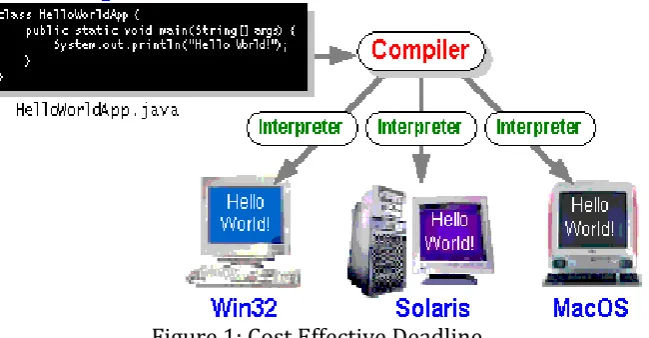
Figure 1: Cost Effective Deadline
The most important step in software development process. Before developing the tool it is necessary to determine the time factor, economy n company strength. Once these things r satisfied, ten next steps are to determine which operating system and language can be used for developing the tool. Once the programmers start building the tool the programmers need lot of external support. This support can be obtained from senior programmers, from book or from websites. Before building the system the above consideration are taken into account for developing the proposed system.
Software Environment:
The most programming languages, you either compile or interpret a program so that you can run it on your computer. The Java programming language is unusual in that a program is both compiled and interpreted. With the compiler, first you. Every full implementation of the Java platform gives you the following features:
The Essentials: Objects, strings, threads, numbers, input and output, data structures, system properties, date and time, and so on.
Applets: The set of conventions used by applets. Networking: URLs, TCP (Transmission Control Protocol), UDP (User Data gram Protocol) sockets, and IP (Internet Protocol) add
Internationalization: Help for writing programs that can be localized for users worldwide. Programs can automatically adapt to specific locales and be displayed in the appropriate language. Security: Both low level and high level, including electronic signatures, public and private key management, access control, and certificates.
Software Components: Known as Java Beans TM, can plug into existing component architectures.
Object Serialization: Allows lightweight persistence and communication via Remote Method Invocation (RMI).
Java Database Connectivity (JDBCTM): Provides uniform access to a wide range of relational databases. Translate a program into an intermediate language called Java byte
(www.rdmodernresearch.com) Volume I, Issue I, 2016
522 platform. The interpreter parses and runs each Java byte code instruction on the computer
5. Conclusion:
Dynamic scheduling is one of the key issues in the management of workflow execution in cloud environment. In this paper, we have surveyed the various existing workflow scheduling algorithms in cloud computing and tabulated their various parameters along with tools and so on. Existing workflow scheduling algorithms does not consider reliability and availability it schedules job in an efficient way. The BLA algorithm shows up to 90% efficiency while dynamically scheduling jobs; we had proved it using stimulation
6. Future Enhancement:
The experiments showed that the result of our monetary model and completion time model is close to the simulations. For the future work, there are also some problems needed to be solved, such as the independent assumption between users in the cost effective deadline scheduling users.
7. References:
1. Amazon Elastic Compute Cloud (amazon EC2).
2. Bharathi, S. Chervenak, A., Deelman, E., Bharathi, (2013) Characterizing and profile scientific workflows. Future generation computer system
3. Buyun, E. K. Kee, Y. S. Kim, J.S., & Maeng S. “Cost effective optimized scientific workflows. Future generation system,29(3),682-692.
4. Smith foster, I & Taylor V, (1998), January). Predicting application run times using historical information.In Job scheduling strategies for parrellel processing (pp. 122-1142).