1. Introduction
For several years the production and harvesting of the biomass of fast-growing species has been advo-cated as a new direction for agricultural production. However, the development of this new agricultural activity is largely determined by economic aspects (Faber et al. 2009, Günther 2005, Stolarski 2006). One of the barriers to the production of biomass from en-ergy plants on a large scale is the large cost of that production. The processes of biomass production from perennial energy plants can be divided into the follow-ing stages: establishment of a plantation, use (runnfollow-ing a plantation) and liquidation of a plantation (Grzybek 2010, Tworkowski et al. 2010). The costs of the estab-lishment and liquidation of a plantation when related to its duration of use will enable an estimation of the average annual cost of running the plantation. De-pending on the type of land on which it is planned to
establish a long-term plantation, several different types of technological activities must be performed. All operations and associated activities are carriers of costs. The costs of production of biomass for energy purposes depend on: the yield size and its price, the area of a field, harvesting technology and organization of work, especially using multi-operational forestry machinery (Di Fulvio 2012, Spinelli et al. 2008, 2009). So far, various authors have described in detail the many aspects of willow plantation establishment costs which, according to various sources, amount to € 1224–2164 per ha (Kwaśniewski 2010, Matyka 2008, McKendry 2002, Szczukowski et al. 2004, 2012). Thus, the costs calculated per year, assuming that a planta-tion will be used for 25 years, will amount to € 49–87. This accounts for approximately 50% of the costs in-curred in Nordic countries (Ericsson et al. 2006). Near-ly 30% of the costs are accounted for by the
prepara-Root Biomass and Morphological
Characterization of Energy Willow Stumps
Paweł Tylek, Marcin Pietrzykowski, Józef Walczyk, Tadeusz Juliszewski,
Dariusz Kwaśniewski
Abstract
The estimated total area of plantations of energy willow in Poland is currently approx. 10–12 thousand hectares (Dubas 2010). These are plantations of varied areas: from small area ones (less than 1 ha) to large scale ones (several dozen hectares). Any long term crop cultivation must be liquidated and renewed or converted to another crop. The decision on liquidation depends on many factors. The most important of these are: the demand for a given raw material, the selling price, the yield per unit area and consequently, above all, the profits. In addition, plantation liquidation is also carried out due to the natural aging of the plants. In the literature, there is little information on the re-sults of studies related to the liquidation of long term energy crop plantations. The information published on this subject in Poland consists of theoretical analy-ses unsupported by fieldwork. This is due to the fact that the vast majority of established plantations are relatively young (present only for a few years) and do not yet require liquidation (Kwaśniewski et al. 2010).
Plantations of energy willow have been in use for 20–25 years (Dubas et al. 2004, Larsson 2006, Lisowski 2010, Szczukowski et al. 2004). The optimum period of cultivation on a given site seems to be 22 years: the first year being an initial one, followed by seven three-year rotations (Szulc and Dach 2014). After that period, or earlier, a plantation should be liquidated. In the case of agricultural land, stump removal also means resto-ration of the original properties of the soil. In particu-lar, this is done by:
Þ permanent removal of the possibility of plant regrowth from the above-ground parts of the rootstocks and the root systems
Þ fragmentation of the above-ground parts of the rootstocks and the roots.
One of the stump removal methods consists of full-surface grinding of rootstocks. Generally, this involves the use of soil cutters, with a working width of 2–2.5 m and a working depth of up to 0.3–0.45 m, mounted on and powered by a tractor with the power of 200–300 kW. The volume of soil which is ground and mixed with
lower energy consumption than the methods used so far. These conditions are as follows:
Þ Limitation of the regrowth of willow stems is generally associated with the destruction of above-ground parts of rootstocks and the part that is directly below it – therefore, mechanical grinding of the root system throughout the sur-face of the field (aimed at reducing the possibil-ity of shoot regrowth) is not necessary
Þ Part of the field remaining after the plantation (where grinding the rootstock and the root sys-tem located underneath was performed only in strips) may be used for growing and mechanical harvesting of some plants (e.g. maize)
Þ Leaving the unground root system (outside the strip of the ground rootstocks) for a few years is enough to weaken it (due to biodegradation) so as to allow for further liquidation with the use of less energy-intensive technologies, e.g. by us-ing disk harrows.
Thus, it appears possible to reduce the energy in-puts for the reclamation of plantation fields after cul-tivation of willow through the use of machines with a smaller working width, which will grind and mix with the soil only such strips of the field whose width cor-responds to the main part of the willow root system. In contrast, those parts of the field where the root sys-tem is too underdeveloped to produce plant ssys-tems may be left intact. The aim of the study was to iden-tify the morphology of the willow root system, which would be the basis for a determination of which part should be ground and which can remain intact. Allo-cation of the biomass of energy willow roots from the viewpoint of the future development of a machine for plantation restoration will constitute key information for design engineers.
2. Materials and methods
situ-ated along the Vistula river in Kaniów (Silesian Voivodeship). Cuttings had been planted at every 0.5 m, with a spacing width of 0.75 m, with no separate tramline system; the planting amounted to approx. 26,600 plants/ha. The plantation was cultivated exten-sively: in subsequent years no treatments related to management and fertilization were performed, except for mechanical harvesting every 3 years. The current density is approx. 20,000 plants/ha.
After cutting the willow shoots using a saw, each item was labeled separately for later identification when measuring the amount of shoots and specify-ing their biomass. The willow rootstocks were col-lected together with lumps of soil by means of the hydraulic head of an OPTIMAL 1100, aggregated with a front loader, used for transplanting large trees (Fig. 1). The device has 4 hydraulic shovels moving along a curved trajectory, which enable complete separation of the root system from undisturbed soil (Tylek 2008). The applied head allowed for the extrac-tion of root balls with repeated geometrical features, i.e. a volume of 0.34 m3, a width of the upper part of
1.14 m and a depth of the blade range of 0.75 m. Then,
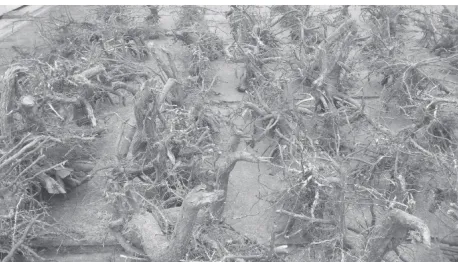
after wrapping in burlap and a steel mesh (Fig. 2), the root balls were transported to a storage area where the root systems were cleaned using a pressure wash-er (Figs. 3 and 4). This allowed for detwash-ermination of their mass in fresh state and their geometric param-eters characterizing the distribution of willow roots in the soil.
Root biomass and allocation were measured by dividing the following fractions into diameters: fine roots bellow 2.0 mm, medium at 2–8 mm and coarse roots at 8–30 mm. Coarse roots were dug up and ex-tracted by machine, washed, measured and weighed. In order to identify the biomass of fine roots, thirty soil monoliths distributed regularly across the ex-perimental plot were collected using steel cylinders to the depth of 40 cm (Böhm 1985, Pietrzykowski et al. 2010, Pietrzykowski and Woś 2010). The collected monoliths were washed in the laboratory, and roots were extracted. Appropriate root fractions were se-lected by measuring with calipers to obtain fine root fractions, and then roots were weighed in fresh state, and reweighed after drying at 65°C to determine bio-mass.
Fig. 1 Root ball of an energy willow extracted using a head for transplanting large trees
Fig. 4 Cleaned root systems of energy willow
Fig. 3 Washing the soil off the root system using a pressure washer
very balanced, but the average height of 3 year old shrubs was relatively small: below 4.3 meters, which was caused by the very high surface density of the shrubs. With more than 20 thousand shrubs planted on one hectare, the dry biomass harvested had a weight of approx. 49 Mg ha−1 (16.3 Mg ha−1y−1). The
obtained crops are slightly more abundant in relation to experimental results obtained in Denmark, Finland, Sweden, Lithuania, Latvia and Estonia, considering the number of shrubs per unit area of the plantation, and are comparable with experiments conducted in the USA (Wang and MacFarlane 2012, Mola-Yudego 2010, Sevel et al. 2012). In turn, the crops were slightly less abundant in Hungary when subjected to intensive mineral and organic fertilization (Mikó et al. 2014). In the above mentioned experiments, a close association was demonstrated between yields and soil properties,
access to water and the type of maple willow. Differ-ences may exceed 30% in extreme cases. In turn, ap-propriate fertilization may increase the abundance of crops even more than twofold. It should be empha-sized that this plantation was carried out extensively and the location of the plantation along a large river ensured proper moisture conditions. The lack of treat-ments and chemical protection could have a signifi-cant impact on the height of shrubs and the number of shoots, which is usually directly translated into the amount of the yield (Schulz et al. 2016).
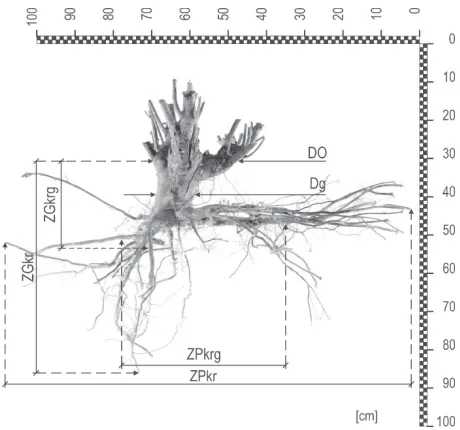
Small variation also characterized the rootstock diameter at the root collar, measured at the ground level, and the main root diameter measured at its thickest point. The coefficients of variation of these morphological parameters amounted to 33% and 22%, respectively. This is important information with re-spect to the choice or design of machines for plantation reclamation, as it is these fragments of the rootstock that should be ground the most precisely, while the demand for power to drive the working tools must be Fig. 5 Morphological parameters of the root system of energy
wil-low, identified during the research; D0 –rootstock diameter at the root collar at ground level, Dg – main root diameter at its thickest point, ZGkrg – vertical range of thick roots, ZGkr – vertical range of roots, ZPkrg – horizontal range of thick roots, ZPkr – horizontal range of roots
Vertical range of thick roots, cm 26.32 16.50 61.50 30.7
Vertical range of roots, cm 48.59 22.50 83.00 24.6
Horizontal range of thick roots, cm 27.82 5.25 53.50 42.4
Horizontal range of roots, cm 71.24 48.75 90.25 14.5
Biomass of the above-ground part
(shoots), kg 2.51 0.99 8.69 64,4
Biomass of the basal part
(after cutting the shoots), kg 0.98 0.18 2.84 60.6
Biomass of very thick roots
(diameter above 30 mm), kg 1.29 0.41 4.22 61.3
Biomass of thick roots
(diameter of 8–30 mm), kg 0.36 0.10 1.35 62.4
Biomass of medium-sized roots
(diameter above 2–8 mm), kg 0.36 0.13 0.66 39.1
Biomass of fine roots
adapted so as to destroy the structure of these very fragments. It is true that the recorded maximum di-ameters of rootstocks and main roots were approx. 70% greater than the average, but this applied only to individual items, growing only on the edge of the plantation or in gaps.
The vertical range of thick roots (with a diameter of 30 mm) averaged approx. 26 cm, and in an extreme case maximally 62 cm. Analogous values for the hori-zontal range are 28 cm and 54 cm, respectively. The results regarding the horizontal range of thick roots were similar to the results obtained from the experi-ment performed using the same method for age-equal plantations, but established on sandy soil. In turn, the vertical range of thick roots was almost 2-fold lower (Juliszewski et al. 2015).
This allows for the assumption that the idea pre-sented in the project concerning the applicability of reclamation of strips of land after cultivation of energy willow may be correct. Although the average range of roots with a diameter of less than 8 mm is approx. 2–2.5 times greater, leaving them unground deep in the soil should not result in reduced efficiency of land reclamation.
Although the height of the plantation crops was regular, the number of offshoots of individual shrubs varied considerably and ranged from 4 to 28. Large variability in the number of shoots could result from the lack of treatments and protective actions (Schulz et al. 2016).
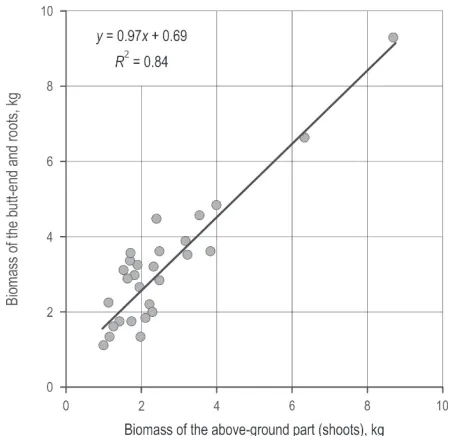
The coefficient of variation of the shoot biomass was very high: over 64%. Only a slightly lower degree of variation characterized the biomass of the under-ground parts of the shrubs. Despite the large variation, a high correlation was noted between the biomass of the above-ground and underground parts of the en-ergy willow shrubs (Fig. 7).
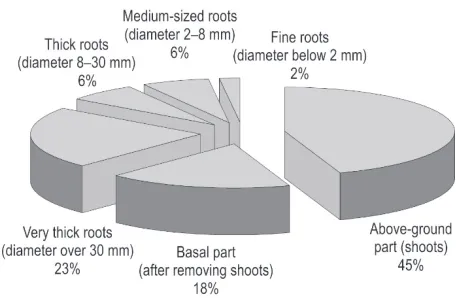
The average biomass (in dry state) of the root sys-tem of an energy willow shrub with a butt-end of ap-prox. 10 cm in height was 3.1 kg, of which over 73% was the basal part and roots with a diameter greater than 30 mm. Fig. 8 shows the allocation of biomass in different parts of the plant. In the case of wood har-vesting after three growing seasons, shoots accounted for 45% of the biomass. Butt-ends accounted for as much as 18% of the biomass. It should be noted that cutting the plantation lower to the ground, i.e. leaving a butt-end of a height not greater than 5 cm, can in-crease the yield per hectare by up to approx. 10%. It should also be noted that such a shallow cut of shrubs requires the use of an appropriate tool, which is resis-tant to blunting in consequence of contact with inor-Fig. 6 Illustration of the root division into thickness fractions; a) up to 2 mm, b) 2–8 mm, c) 8–30 mm
ganic contaminants, e.g. a beater system. However, in this case, the danger of damage to a part of the below-ground rootstock should be taken into account (Sto-larski et al. 2015).
The biomass remaining in the soil after harvest is approx. 58 Mg ha−1; and the mass that should be
ground during plantation reclamation (basal parts as well as thick and very thick roots) amounts to approx. 49 Mg ha−1.
Mechanical liquidation of a plantation may consist of extracting the whole rootstocks from the ground. However, this raises another problem: how to deal with rootstocks largely covered with soil debris, at a rate of 10–15 thousand pieces per 1 ha. Experimental elimination of a 15-year old plantation was carried out based on a field experiment over an area of 0.4 hectares on the Kwidzyńska Plain in the Vistula glacial valley (Stolarski 2006, Stolarski 2009, Stolarski et al. 2008). The experiment had the following stages of work: har-vesting energy willow in January (shoots were mowed close to the ground surface); spraying young plants with Roundup in the amount of 7 dm3 ha−1 in the third
decade of May; rootstock extraction using a plow in the third decade of July; double harrowing of the plowed field and manual removal of rootstock pieces from the field and their transportation. Harrowing was performed twice, in order to facilitate manual col-lection of rootstocks and their more precise removal. A similar process has been designed for technology based on spraying with Randap in the amount of 5 dm3 ha−1 and the use of a heavy forestry mulcher,
followed by a return to the production of grass plants after waiting at least one growing season (Caslin et al. 2015).
However, the chemical-mechanical technology re-quires multiple agrotechnical treatments, hard
manu-tural production.
4. Conclusions
The use of a head for transplanting large trees for the purpose of collecting energy willow rootstocks enabled standardized samples to be obtained contain-ing complete butt-ends and thick roots, appropriate for the selection of the technology and equipment for plantation reclamation;
Due to the different number of offshoots (4–28), shrub biomass is characterized by high variability. The biomass of offshoots is strongly correlated with the biomass of the root system;
The mean rootstock diameter, when measured on the surface of the soil, amounts to 18 cm and this is three times greater than the diameter of the thickest
root;
The vertical and horizontal ranges of thick roots (ones with a diameter of more than 8 mm), which should be ground during plantation liquidation, are small and amount to approx. 26 and 29 cm, respec-tively. This justifies the use of machines that work along strips of land during plantation reclamation;
The use of machines that leave lower basal parts (5 instead of 10 cm in height) for the harvesting of energy willow results in an approx. 10% increase in yield per hectare of plantation.
Acknowledgments
The present study was conducted within the framework of research project No. PBS2/A8/26/2014 entitled »Developing a new technology and a func-tional model of a machine for reclamation of land after cultivation of energy willow«, funded by the National Research and Development Center (Poland) within the area of the Applied Research Program. We kindly thanks to Bartłomiej Woś, PhD. from Department of Forest Ecology and Reclamation for field investigation and Justyna Likus-Cieślik, MSc. for laboratory work and graphical working on the figures.
5. References
Bergante, S., Manzone, M., Facciotto, G., 2016: Alternative planting method for short rotation coppice with poplar and willow. Biomass and Bioenergy 87: 39–45.
Böhm, W., 1985: Metody badania systemów korzeniowych. PWRiL Warszawa, 248 p.
Caslin, B., Finnan, J., Johnston, C., McCracken, A., Walsh, L., 2015: Short rotation coppice willow – Best practice guide-lines. Agriculture and Food Development Authority, 126 p. Di Fulvio, F., Bergstrom, D., Kons, K., Nordfjell, T., 2012: Productivity and profitability of forest machines in the har-vesting of normal and overgrown willow plantations. Croa-tian Journal of Forest Engineering 33(1): 25–37.
Dubas, J.W., 2010: Stan i kierunki rozwoju biomasy dla potr-zeb elektroenergetyki polskiej. [W:] Odnawialne źródła en-ergii w świetle globalnego kryzysu energetycznego. Wybrane problemy. Wyd. Difin S.A. Warszawa.
Dubas, J.W., Grzybek, A., Kotowski, W., Tomczyk, A., 2004: Wierzba energetyczna – uprawa i technologie przetwarzania. Wyższa Szkoła Ekonomii i Administracji w Bytomiu, 35 p. Ericsson, K., Rosenqvist, H., Ganko, E., Pisarek, M., Nilsson, L., 2006: An agro-economic analysis of willow cultivation in Poland. Biomass and Bioenergy 30(5): 16–27.
Faber, A., Kuś, J., Matyka, M., 2009: Uprawa roślin na cele energetyczne. Poradnik. Wyd. W i B Wiesław Drzewiecki. Warszawa.
Grzybek, A., 2010: Modelowanie energetycznego wykorzystania biomasy. Wyd. Instytut Technologiczno-Przyrodniczy. Falenty–Warszawa, 230 p.
Günther, F., Sylvia, P., van Velthuizen, H., 2005: Biomass po-tentials of miscanthus, willow and poplar: results and policy implications for Eastern Europe, Northern and Central Asia. Biomass and Bioenergy 28(2): 119–132.
Juliszewski, T., Kwaśniewski, D., Pietrzykowski, M., Tylek, P., Walczyk, J., Woś, B., Likus, J., 2015: Root biomass distribu-tion in an energy willow plantadistribu-tion. Agricultural Engineer-ing 4(156): 43–49.
Kwaśniewski, D., 2010: Koszty produkcji biomasy z upraw polowych. [W:] Produkcja biomasy na cele energetyczne. Wyd. PTIR. Kraków.
Kwaśniewski, D., Mudryk, K., Wróbel, M., 2010: Zbiór i lik-widacja plantacji energetycznych. [W:] Produkcja biomasy na cele energetyczne. Wyd. PTIR. Kraków.
Larsson, S., 2006: Od A do Z o wierzbie energetycznej. Czy-sta Energia 1: 18–19.
Lisowski, A., 2010: Technologie zbioru roślin energetyczny-ch. Wydawnictwo SGGW, Warszawa, 148 p.
Matyka, M., 2008: Opłacalność i konkurencyjność produkcji wybranych roślin energetycznych. Studia i raporty IUNG– PIB. Zeszyt 11. Wyd. Dział Upowszechniania i Wydawnictw IUNG-PIB w Puławach, 113–123.
McKendry, P., 2002: Energy production from biomass (part 1): overview of biomass. Bioresource Technology 83(1): 37–46. Mikó, P., Kovács, G.P., Alexa, L., Balla, I., Póti, P., Gyuricza, C.S., 2014: Biomass production of energy willow under un-favorable field conditions. Applied Ecology and Environ-mental Research 12(1): 1–11.
Mola-Yudego, B., 2010: Regional potential yields of short rotation willow plantations on agricultural land in Northern Europe. Silva Fennica 44(1): 63–76.
Pietrzykowski, M., Socha, J., Woś, B., 2010: Biomasa i przekształcenia systemów korzeniowych sosny zwyczajnej
(Pinus sylvestris L.) w warunkach siedliskowych
zrekulty-wowanego wyrobiska i zwałowiska górnictwa odkry-wkowego. Sylwan 154 (2): 107–116.
Pietrzykowski, M., Woś, B., 2010: The biomass and distribu-tion of pine forest phytocenosis fine roots in the sandy soil and sandy clay loam soil on the reclaimed spoil heap of the Piaseczno Sulphur Mine. Teka Kom. Ochr. Kszt. Środ. Przyr. OL PAN 7: 319–327.
Schulz, V., Gauder, M., Seidl, F., Nerlich, K., Claupein, W., Graeff-Hönninger, S., 2016: Impact of different establish-ment methods in terms of tillage and weed manageestablish-ment systems on biomass production of willow grown as short rotation coppice. Biomass and Bioenergy 85: 327–334. Sevel, L., Nord-Larsen, T., Raulund-Rasmussen, K., 2012: Biomass production of four willow clones grown as short rotation coppice on two soil types in Denmark. Biomass and Bioenergy 46: 664–672.
Spinelli, R., Nati, C., Magagnotti, N., 2008: Harvesting short-rotation poplar plantations for biomass production. Croatian Journal of Forest Engineering 29(2): 129–139.
Spinelli, R., Nati, C., Magagnotti, N., 2009: Using modified foragers to harvest short rotation poplar plantations. Bio-mass and Bioenergy 33(5): 817–821.
Stolarski, M., 2006: Opłacalność uprawy na cele energetyc-zne. Wyd. 2. Regionalne Forum Energetyki Odnawialnej. Przysiek, 46–48.
Stolarski, M., 2009: Agrotechniczne i ekonomiczne aspekty produkcji biomasy wierzby krzewiastej (Salix spp.) jako su-rowca energetycznego. Rozprawa habilitacyjna. Wyd. UWM w Olsztynie.
Stolarski, M., Kisiel, R., Szczukowski, S., Tworkowski, J., 2008: Koszty likwidacji plantacji wierzby krzewiastej. Roc-zniki Nauk Rolniczych 92: 172–177.
Stolarski, M.J., Krzyżaniak, M., Szczukowski, S., Tworkows-ki, J., Grygutis, J., 2015: Changes of the quality of willow biomass as renewable energy feedstock harvested with bio-baler. Journal of Elementology 20(3): 717–730.
Szczukowski, S., Tworkowski, J., Stolarski, M., 2004: Wier-zba energetyczna. Plantpress, Kraków, 46 p.
Received: February 29, 2016 Accepted: May 16, 2016
Authors‘ addresses: Paweł Tylek, PhD.*
e-mail: [email protected] Prof. Józef Walczyk, PhD. e-mail: [email protected] University of Agriculture in Krakow
Institute of Forest Utilization and Forest Technology Al. 29-Listopada 46
31-425 Krakow POLAND
Prof. Marcin Pietrzykowski, PhD. e-mail: [email protected] University of Agriculture in Krakow Institute of Forest Ecology and Silviculture Al. 29-Listopada 46
31-425 Krakow POLAND
Prof. Tadeusz Juliszewski, PhD.
e-mail: [email protected] University of Agriculture in Krakow
Institute of Machinery Management, Ergonomics and Production Processes
Ul. Balicka 116B 30-149 Krakow POLAND
Dariusz Kwaśniewski, PhD.
e-mail: [email protected] University of Agriculture in Krakow
Institute of Agricultural Engineering and Informatics Ul. Balicka 116B
30-149 Krakow POLAND