Spinal Tuberculosis among Yemeni Patients Admitted to
Two Major Hospitals in Sana’a: Neurosurgey Experience
Majed A. Amer
1,*, Monya A. Y. El-Zine
21 Neurosurgery Department, Faculty of Medicine and Health Sciences, Sana’a University, Sana’a, Yemen 2 Pathology Department, Faculty of Medicine and Health Sciences, Sana’a University, Sana’a, Yemen
* Corresponding author:M. A. Amer ([email protected])
C
ASE SERIESO
PENA
CCESSABSTRACT
Objective: To analyze the outcomes of neurosurgical treatment of dorsal spinal tuberculosis (TB) among Yemeni patients.
Methods: Forty-three patients with histopathology-confirmed dorsal spinal TB, who had been admitted to Kuwait University Hospital of Sana’a University and the University of Science and Technology Hospital, Sa-na’a, were followed up for the outcomes of neurosurgical treatment in the period from Ott. 2009 to Oct. 2005. Data about the clinical presentation, radiologic findings and the outcomes of surgical treatment were recorded and analyzed.
Results: Of patients undergoing neurosurgical treatment of dorsal spinal TB, 28 were males and 15 were females, with a mean age of 41.3 years (range: 18–70). Nearly a half of patients (50.6%) were farmers and 80% of patients were admitted to hospitals three months after the disease onset. All patients presented with back pain, while paraplegia/paraparesis and sensory impairment were reported in 81.4% and 87.4% of patients at presentation, respectively. Four patients (9.2 %) had cold abscesses and were treated by ab-scess drainage, while 90.8% of patients were treated by surgical decompression, debridement and posteri-or transpedicular fixation by screws and rods.
Conclusions: The posterior approach for the treatment of spinal TB, with bilateral transpedicular access to anterior decompression together with posterior transpedicular fixation, has satisfactory outcomes re-garding the clinical improvement and spinal stabilization among Yemeni patients.
1. Introduction
Although the spinal involvement occurs in less than 1% of patient with tuberculosis (TB), its increasing incidence poses a health challenge to both developed and developing countries (1) Spinal TB (Pott’s disease) is the most common form of skeletal TB, which accounts for about 50% of cases and predominantly in-volves the thoracolumbar junction. However, it can also affect any part of the spine and the in-cidence of its neurologic complications varies from 10% to 43% (2, 3).
The basic pathology in spinal TB is a com-bination of osteomyelitis and arthritis, usually affecting more than one vertebra and involving the anterior aspect of the vertebral body adja-cent to the subchondral plate (4, 5). Vertebral collapse and kyphosis result from progressive bone destruction. Spinal cord compression and neurological deficits are caused by the con-striction of the spinal canal as a result of cold abscess formation (5). It can be difficult to dif-ferentiate spinal TB from pyogenic and fungal vertebral osteomyelitis or primary and meta-static spinal tumors based on clinical and radi-ologic findings only (6). Therefore, histo-pathology can confirm diagnosis by revealing the classic necrotizing caseous granulomas with surrounding astrogliosis and congested blood vessels (7).
Simple abscess aspiration or drainage and lesion removal through the confined posterior route were the first, even though not promis-ing enough, surgical approaches introduced for treating spinal TB (8, 9). The anterolateral extrapleural approach was then introduced and modified for debridement of affected
tis-quently used for the management of spinal TB (10-13). In 1946, lateral decompression was per-formed to preserve the spinal stability by stabiliz-ing the laminae and posterior intervertebral joints (14). Thereafter, posterolateral or transpedicular approaches have been used extensively for the management of spinal TB as safe surgical options for ventral decompression of the thoracic spine TB when followed by anti-TB treatment for 18 months and immobilization for three months (15). Pedicle screw fixation has also been advocated (16).
The present study aimed to prospectively ana-lyze the outcomes of neurosurgical treatment of dorsal spinal TB among Yemeni patients admitted to two major hospitals in Sana’a city over a six-year period.
2. Methods
This prospective study analyzed 43 patients with histopathology-confirmed TB of the dorsal spine and subjected to neurosurgeries in Kuwait Univer-sity Hospital of Sana’a UniverUniver-sity and the Universi-ty of Science and Technology Hospital in Sana’a city in the period from Oct. 2009 to Oct. 2015. All patients were clinically and radiologically exam-ined, and diagnosis was confirmed using histo-pathologic examinations on all patients’ biopsies. Surgeries were done for those with evidence of neurologic and/or mechanical instability. Follow-up radiologic evaluation was also done early after surgery and on frequent intervals later on.
3. Results
Table 1.Demographic and clinical characteristics of patients with histopathology-confirmed spinal TB subjected to neurosur-geries in two hospitals in Sana’a, Yemen (2009–2015)*
Characteristic n (%)
Gender
Male 28 (65.1)
Female 15 (34.9)
Age (years)
Mean age: 41.3 Range: 18–70
Occupation
Farmer 22 (50.6)
Housewife 15 (34.5)
Other 6 (13.9)
Back pain 43 (100.0)
Paraplegia/paraparesis 35 (81.4)
Loss of sensation 20 (46.0)
Fever 30 (69.0)
Cough 10 (23.0)
Weight loss 15 (34.5)
Back swelling (gibbous) 10 (23.0)
Past treatment of pulmonary TB 4 (9.2)
* Total number of patients was 43.
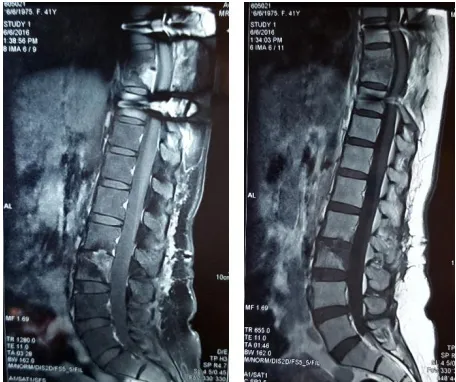
Clinically, 81.4% of patients were present-ed with paraparesis or paraplegia and 46.0% of patients had sensory deficits. However, all patients had back pain on presentation (Table 1). Even with such serious complications, more than 80.0% of patients were admitted to hos-pitals three months after their first complaints (Figures1 & 2). Surgical drainage of cold ab-scesses was done for four (9.3%) patients with spinal cord compression and/or nerve root compression without mechanical instability.
Figure 1. MRI sagittal section showing the destruction of the bodies of T8 and T9 by spinal TB with backward compression of the spinal cord as well as the destruction of L3 body.
Figure 2. Axial sections of the same patient in Figure (1) showing an-terior spinal cord compression
Figure 3. Plain X-ray anteroposterior and lateral views after surgical decompression and fixation
Surgical procedures and follow-up of pa-tients showed that the posterior bilateral transpedicular approach has the best out-comes in the treatment of spinal TB as it re-sulted in complete neurologic decompression and a strong (three-column) transpedicular spinal fixation (Figure 4).
Figure 4. Complete release of the compression at the affected levels one year post surgery
4. Discussion
tributed to inadequate education and difficulties in seeking medical services among females. On the other hand, the peak percentage (58. 1%) of spinal TB was observed among patients in the age group of 40–60 years. This is in contrast to the situation in other developing countries, where spinal TB usually occurs in children and young adults as
re-ported from southeast Iran (18).
Although back pain was present in all patients with spinal TB, such a manifestation is not specific. However, a considerable proportion (81.4%) of the patients in the present study complained of paraplegia/paraparesis. This finding is consistent with that by Obajimi et al. (20), who reported the presentation of paraplegia/paraparesis among 60% of patients in Accra, Ghana.
According to the management of spinal TB, 9.3% of patients underwent simple drainage of cold abscesses compared to 90.7% of patients sub-jected to surgical decompression and fixation 90.7%. In this respect, Djientchen et al. (21) sug-gested that surgery definitely plays a major role in the diagnosis and treatment of spinal TB, particu-larly in countries where patients are admitted to hospitals in the late stages and complications of the disease. On the other hand, all patients in the present study were found to receive anti-TB chemotherapy post-operatively during the follow-up intervals. It is noteworthy that Turgut et al. (1) found that decompressing surgery plus anti-TB chemotherapy remains the best approach to the treatment of spinal TB.
tive and easy to apply besides being less inva-sive for ventral dural compresinva-sive lesions.
5. Conclusions
The posterior approach to the treatment of spinal TB, with bilateral transpedicular access to anterior decompression together with pos-terior transpedicular fixation, has satisfactory outcomes regarding the clinical improvement and spinal stabilization among Yemeni pa-tients.
Acknowledgments
The authors thank all the participants and health staff at the hospitals where this study was conducted for their cooperation during the study.
Authors’ contributions
MAA contributed to study design, data collection, inter-pretation of results and manuscript drafting. MAE con-tributed to study design and histopathologic examina-tions. All authors revised the manuscript and approved the final draft.
Competing interests
The authors declare that they have no competing inter-ests associated with this article.
Ethical approval
This study protocol was approved by the Ethics Com-mittee of the Faculty of Medicine and Health Sciences , Sana’a University, Sana’a Yemen. Written consent was obtained from each patient before participation.
References
1. Turgut M. Spinal tuberculosis (Pott’s disease): its clinical presentation, surgical management, and outcome. A sur-vey study on 694 patients. Neurosurg Rev 2001; 24: 8– 13. DOI● PubMed● Google Scholar
2. Shanley DJ. Tuberculosis of spine: imaging features. AJR Am J Roentgenol 1995; 164: 659–64. DOI● PubMed●
Google Scholar
3. Sia Kiran NA, Vaishya S, Kale SS, Sharma-BS, Maha-patra AK. Surgical results in patients w ith tuberculosis of the spine and severe low er-extremity motor deficits: a ret-rospective study of 48 patients. J Neurosurg Spine 2007; 6: 320–6. DOI● PubMed● Google Scholar
4. Pertuiset E, Beaudreuil J, Liote F, Horusitzky A, Kemiche F, Richette P, et al. Spinal tuberculosis in adults. A study of 103 cases in a developed country, 1980-1994. Medi-cine (Baltimore) 1999;78: 309–20. PubMed ● Google
Scholar
5. Hidalgo JA, Alangden G. Pott disease (tuberculous [TB] spon-dylitis) [Internet]. New York: WebMD LLC. 2008 [cited 2010,
Oct. 15]. Available from:
https://emedicine.medscape.com/article/226141-overview 6. Nussbaum ES, Rocksw old GL, Bregman TA, Erickson DL,
Sel-jeskog EL. Spinal tuberculosis: a diagnostic and management challenge. J Neurosurg 1995; 83: 243–7. DOI ● PubMed●
Google Scholar
7. Bayindir C, Mete O, Bilgic B. Retrospective study of 23 patho-logically proven cases of central nervous system tuberculomas. Clin Neurol Neurosurg 2006; 108: 3537. DOI ● PubMed ●
Google Scholar
8. Tuli SM. Tuberculosis of the spine: a historical review . Clinic Orthop Relat Res 2007; 460: 29–38. DOI ● PubMed ● Google Scholar
9. Ito HM, Tsuchiya J, Asami G. A new radical operation for Pott's disease: report of ten cases. J Bone Joint Surg Am 1934; 16: 499–515. Google Scholar
10. Kirkaldy-Willis WH, Thomas TG. Anterior approaches in the di-agnosis and treatment of infection of the vertebral bodies. J Bone Joint Surg Am 1965; 47: 78–110. PubMed ● Google Scholar
11. Hodgson AR, Stock FE, Anterior spinal fusion for the treatment of tuberculosis of spine:the operative findings and results of treatment in the first one hundred cases. J Bone Joint Surg 1960; 42: 295–310. Google Scholar
12. Albee FH. Transplantation of a portion of the tibia into the spine for Pott’s disease: a preliminary report 1911. 2007; 460: 14–6.
DOI● PubMed ● Google Scholar
13. Hibbs RA. An operation for Pott’s disease of the spine. JAMA 1912; 59: 433–6. Google Scholar
14. Kohli SB. Radical surgical approach to spinal tuberculosis. J Bone Joint Surg Br 1967; 49: 668–73. PubMed ● Google Scholar
15. Chacko AG, Moorthy RK, Chandy MJ. The transpedicular ap-proach in the management of thoracic spine TB: a short-term follow up study. Spine (Phila Pa 1976) 2004; 29: E363–7. DOI
● PubMed ● Google Scholar
16. Jin D, Qu D, Chen J, Zhang H. One-stage anterior interbody autografting and instrumentation in primary surgical manage-ment of thoracolumbar spinal tuberculosis. Eur Spine J 2004; 13: 114–21. DOI ● PubMed● Google Scholar
17. Njoku CH, Makusidi MA, Ezunu EO. Experiences in manage-ment of Pott’s paraplegia and paraparesis in medical w ards of Usmanu Danfodiyo University Teaching Hospital, Sokoto, Nige-ria. Ann Afr Med 2007; 6: 22–5. DOI ● PubMed● Google Scholar
18. Moghtaderi A, Alavi-Naini R, Rahimi-Movaghar V. Tuberculous myelopathy: current aspects of neurologic sequels in southeast of Iran. Acta Neurol Scand 2006;113: 267-72. DOI ● PubMed ●
Google Scholar
19. Ikem IC, Bamgboye EA, Olasinde AA. Spinal tuberculosis: a 15 year review at OAUTHC lIe-Ife. Niger Postgrad Med J 2001; 8: 225. PubMed ● Google Scholar
20. Obajimi MO, Jumah KB, Ogoe E, Asiama S, Kaminta A, Brakohiappa E. Computed tomographic evaluation of Pott’s disease in Accra. West Afr J Med 2004; 23: 50–2. DOI ● Pub-Med● Google Scholar
21. Djientcheu VP, Mouafo Tambo FF, Ndougsa IS, Eloundou NJ, Kouna Tsala IN,Ngow e Ngow e M, et al. The role of surgery in the management of Pott’s disease in Yaoundé. a review of 43 cases. Orthop Traumatol Surg Res 2013; 99: 419–23. DOI●
PubMed● Google Scholar