Journal of Multidisciplinary Research in Healthcare Vol. 1, No. 1 October 2014 pp. 53–62
©2014 by Chitkara University. All Rights Reserved. DOI: 10.15415/jmrh.2014.11005
Employee Empowerment
PREETHI PRADHAN,1 TJ KAMLANABHAN,2 RD THULASIRAJ,3 AND VR MURALEEDHARAN4
1Dean, Chitkara School of Health Sciences Chitkara University, Punjab 2Professor, Department of Management Studies, IIT, Madras
3Executive Director, Aravind Eye Care System
4Professor, Department of Humanities and Social Sciences, IIT, Madras Email:[email protected]; Email: [email protected];
Email: [email protected]; Email: [email protected]
Received: August 08, 2014 | Revised: August 30, 2014 | Accepted: September 16, 2014 Published online: October 15, 2014
The Author(s) 2014. This article is published with open access at www.chitkara.edu.in/publications
Abstract The work done by the human resource in healthcare are the key to bringing about patient healing. As the tasks that each of the different human resource healthcare professionals have to do is quite enormous and varied and differs from patient to patient depending upon their unique needs it is also equally challenging to train the staff. The concept of employee empowerment is therefore extremely critical for staff to do what requires to be done for patients in a timely manner keeping the best interest of the patient in the mind. This article takes a thorough look at this concept as well as how it is measured. Its application is also discussed taking the example of the Aravind Eye Hospital.
Keywords: employee empowerment, hospital, human resource practices, healthcare human resource management, staffing, motivation, patient satisfaction
1. IntroductIon
Considering that healthcare organisations are service oriented and knowledge based, the human resource that make up the organisation will be likely to play an even more significant role in healthcare organisations than it will in other organisations (Khatri, 2006). Employee empowerment is key for employee satisfaction in the Indian hospital sector has already been well established by John, P et al (2011). An empowered organization should emphasize a “bottom up” management approach or a two-way communication system which allows managers at all levels to make suggestions to a receptive senior management to create the work way (Budhwar and Debrah, 2001). 1.1 understanding what is employee empowerment
Pradhan, P Kamlanabhan, TJ Thulasiraj, RD Muraleedharan, VR
concept. They defined it after a thorough research as increased task motivation and manifested in a set of four conditions: Meaning, competence, self determination and impact (Spreitzer, G M, 1995).
Meaning is the value of a work goal or purpose, judged in relation to an individual’s own ideal or standards (Thomas and Velthouse, 1990). Meaning involves a fit between the requirements of a work role and beliefs, values, and behaviours (Brief and Nord, 1990; Hackman and Oldham, 1980). Competence or self efficacy is an individual’s belief in his or her capability to perform activities with skill (Gist, 1987). Competence is analogous to agency beliefs, personal mastery, or effort performance expectancy (Bandura, 1989). Self determination is an individual sense of choice in initiating and regulating actions (Deci, Connell and Ryan, 1989). Self determination reflects autonomy in the initiation and continuation of work behaviours and processes; examples are making decisions about work methods, pace and effort (Bell and Straw, 1989; Spector, 1986). Impact is the degree to which an individual can influence strategic, administrative or operating outcomes at work (Ashforth, 1989). The four dimensions combine additively to create an overall construct of psychological empowerment. The lack of any single dimension will deflate, though not completely eliminate, the overall degree of felt empowerment.
Empowerment is thus seen to be not an enduring personality trait generalisable across situations but rather a set of cognitions shaped by work environment (Thomas and Velthouse, 1990). Empowerment, thus reflects the ongoing ebb and flow of people’s perceptions about themselves in relation to their work environments (Bandura, 1989). Empowerment is a continuous variable which means that people can be viewed as more or less empowered rather than empowered or not empowered. Employee empowerment is not a global construct generalisable across life situations and roles but rather, specific to the work domain.
“The act of providing employees at all levels with the authority and responsibility
to make decisions on their own” is defined as employee empowerment (Delaney J.T. and Huselid M.A., 1996). These decisions refer to activities which can smoothen their work life and therefore improve customer or patient experience.
2. Why do WE nEEd EmployEE EmpoWErmEnt In thE hospItAl?
Employee Empowerment card is considered by patients to be a staff even though in realty it could be a new
staff, or old staff. The patient will not be able to differentiate whether the person is trained or not. It would be taken for granted by the patients that the staffs are fully trained.
Consider the following scenarios:
Scenario 1: Mr. Kumar has completed his cataract surgery and is about to be discharged. He has only stayed for a night in the hospital. As he goes to complete his discharge process he finds that they have billed him for staying in an AC room. But he explains that the AC never worked so he will not pay for the AC.
What will the frontline staff do? In most of the cases the response will be
Whatever happens, collect the money as otherwise it will result in lot of explaining A.
perhaps a lot of scolding for her from her boss who is anyway under a lot of pressure from his own boss
Make the patient wait while she tries to juggle between leaving her seat and B.
going and meeting her higher levels for permission repeating the same scenario to multiple people or on the phone talking to clarify (a conversation which the patient will overhear while she tries to communicate without the patient hearing) and go through a long process of finding out from various sources what should be done
However an empowered staff who will respond in the following manner
Call up ward sister (a single short telephone call) to verify the patient account C.
and then if true tell the patient to pay the non AC room charge and apologise for inconvenience caused and after patient goes inform the housekeeping department to look into the problem. Following the incident when she is questioned by higher authorities she is supported and recognized for the correct action taken and not yelled at.
Scenario 2: Ramachandran, the janitor is mopping the busy OPD. He notices a person sitting in a wheelchair who from facial expressions seems to be very uncomfortable. What should Ramachandran do?
Just continue with his work, there are many patients with problem and it is not his A.
job to look after it
Ask the patient and identify the problem and facilitate in solving it. In this B.
particular case the patient needed to use the toilet, the attender had gone to make the payments and would be coming back after some time.
Pradhan, P Kamlanabhan, TJ Thulasiraj, RD Muraleedharan, VR
“Where has that janitor disappeared, must be loafing somewhere. I need to find him and really give him a piece of my mind.” There would hardly be time for the janitor to give any explanation from his side. The net result would be, the system would have converted a patient centered employee into one who has learned from his/her experience that you just quietly do your job, then your life atleast will be smooth. The two scenarios given above depict not only what is the expected behavior of an empowered employee but also it highlights the enabling environment that is required to sustain it especially the key role of the management in establishing it.
3. WhAt Is EmployEE EmpoWErmEnt In thE hospItAl sEctor?
Employee empowerment does not exist in a vacuum. The framework in which it exists, is the purpose of the organisation, which is providing patient care. Hence employee empowerment is viewed as building up employees to be extremely patient centric. It means the employee is able to take the right decision, keep the right priority, do the right action all in the interest of the patient without the need for the employee to be told about it at that point in time and without extra supervision. The organizational culture is to provide an enabling environment for this to happen. Managerial interest in employee empowerment in the service industry has been associated with gaining competitive advantage through improvements in service quality (Hubrecht & Teare, 1993). Fulford and Enz (1995) suggested that different subject groups in the service industry should be studied to learn more about the concept and practice of empowerment.
A study was done in the hospital sector which provided eye care services to determine the dimensions of employee empowerment from the employee perspective.
table 1: Sample for Data Collection
Cadre Ophthalmologists MLOP Administrative Staff Total
No of employees interviewed
(percentage to total) 69 (21%) 179 (53%) 88(26%) 336 (100%)
The sample was drawn from independent eye hospitals. That is, they were not part of a multi specialty hospital. The patients of the hospital represented different economic strata of society. Namely the paying clientele who were willing to pay the full amount for their health services, subsidised patients who were willing to pay a nominal rate and the free patients who could not afford to pay anything.
Employee Empowerment
of the hospital who are enrolled as full time employees in the organisation and represented all shifts.
The employees were provided with a hard copy of the questionnaire and requested to complete and give it back. Where the employees were illiterate or requested for help, trained interviewers did the data collection. The data collection occurred during the time period June 2009 to Aug 2009 among 33 eye hospitals.
CFA was done using the LISREL statistical package. Confirmatory Factor Analysis (CFA) was done to refine and validate the questionnaire. It was assumed that the observed variables were reliable indicators of a particular factor and that they would explain inter-correlation among the measured variables. To establish the validity of the questionnaire, uni dimensionality of each factor was determined through the Comparative Fit Index (CFI) given by CFA. Convergent validity was established through Bentler-Bonnet coefficient.
This study showed that factors for employee empowerment in the hospital set up the employees needed to feel that they had “considerable opportunity for independence and
table 2: Demographic Profile of Employees
Demographic
Variable Details Data Collection
Hospital 348(100%)
Gender Male 150 (43%)
Female 178 (57%)
Marital Status Married 215 (62%)
Unmarried and
Others 111(38%)
Age <=25 82 (27%)
26-40 176 (58%)
>40 45 (15%)
Prior Working Experience
No previous working experience
99(33%)
Upto 5 years 138 (46%)
>5 years 62(21%)
Current Working
Experience Upto 5 years 212 (66%)
Pradhan, P Kamlanabhan, TJ Thulasiraj, RD Muraleedharan, VR
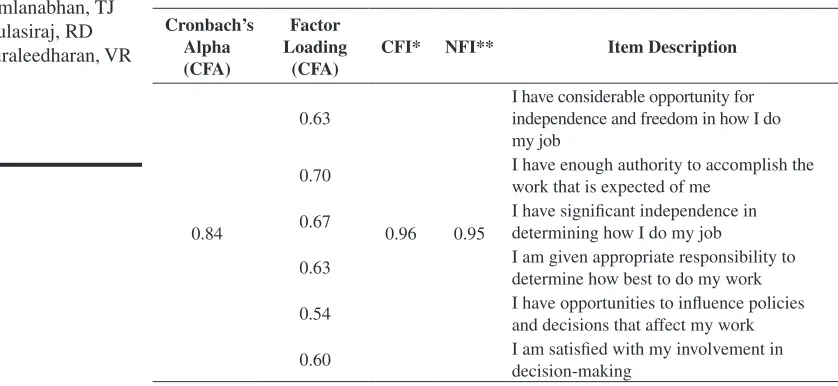
freedom ‘in how I do my job’. The employees wanted to be given appropriate responsibility so that they could determine how best to do their work. Related to their work they wanted to “influence policies and decisions that affect my work” and the feeling was they should perceive to feel satisfied about their involvement in decision making.
4. ImpAct for hr prActIcE
Define the job well in terms of the job description then orient and train the staff well. Then allow the employee to execute his/her work. The very nature of service industry with its high degree of variability of experience demands that empowerment be a key HR practice. Employee empowerment in one sense can be viewed as an outcome. At the same time strategies to make it happen needs to be implemented by the hospital leadership. 5. cAsE study for BuIldIng An EmpoWErEd WorKforcE: ArAvInd EyE hospItAl
Aravind Eye Hospital considered as a model in delivering eye care to the masses is implementing strategies to empower its employees.
6. EmpoWErIng IndIvIduAl stAff
At Aravind, there are various ways adopted to empower the employees right from the time they join. The particular focus is on empowering the MLOP (mid level ophthalmic personnel) group.
table : Factor Analysis of Employee Empowerment in Hospitals:6 items
cronbach’s Alpha (cfA)
factor loading
(cfA)
cfI* nfI** Item description
0.84
0.63
0.96 0.95
I have considerable opportunity for independence and freedom in how I do my job
0.70 I have enough authority to accomplish the
work that is expected of me 0.67 I have significant independence in determining how I do my job
0.63 I am given appropriate responsibility to
determine how best to do my work 0.54 I have opportunities to influence policies and decisions that affect my work
0.60 I am satisfied with my involvement in decision-making
Employee Empowerment observation of role models: The new employees tend to be surrounded by the senior
employees who are exhibiting the right behavior. As they are assigned to shadow a senior MLOP they observe and see how the seniors are dealing with different types of patients as well as addressing various types of patient issues. They learn the culture through an osmosis process and understand the way the Aravind environment expects them to behave.
sharing stories in training: During the initial training, various ‘stories’ are shared of employees who have exhibited “empowered” behavior. This is shared so that the role model gets imprinted in their mind of what is accepted behaviour and discussed in terms of the benefits and consequences both to the patient and to the employee. Infact the Director of MLOP training at Aravind shared how she was surprised with the amount of patient centred behavior that the new employee arrives with. She mentioned that it is imperative to recognize and foster it early on.
structured induction process: There is a very strong structured induction process. The staff are exposed early on to interacting with patients. There is a strong focus on imbibing Aravind culture. It is “practical doing” versus “passive observation”. The regularity of the training helps in instilling and internalizing the activities as well as provide a greater exposure.
7. EmpoWErIng A tEAm
The synergy of empowered individuals when brought to a team allows the group to achieve much greater heights. This is a continuous process and there are various activities that can be done to get this in place. Some of the key activities are outlined below:
regular communication is a vital activity. A good way to structure it formally is through meetings. The presence of the different members who can make a change is a very important aspect of this process. Unless people find a value for the meeting people will not attend it. An empowered team has inherent in it a team leader which regular attends the meeting and has enough decision making authority to guide the teams suggestions forward. Even if the team leader is not present the team is enabled to take forward and continue the activities.
Pradhan, P Kamlanabhan, TJ Thulasiraj, RD Muraleedharan, VR
patient with visual outcome less than 5/60 and whether any complication happened to nay patient due to anaesthesia. This in depth and open sharing of information on such an important area helps to keep the patient safety at a very high level even though large numbers of patients are being operated. The transparency also helps the staff to maintain honesty as well as different issues that arose in the operation theatre the previous week concerning the patients is brought to the table and the group decides what needs to be done. Some of the issues can be settled by the group themselves whereas for the others they need to contact the others who are not present in the meeting. But in the week that elapses between one meetings to the next the group will try to implement what the group has agreed on during the meeting. The high accountability of the team members towards this process contributes to its success. Some may seem like insignificant changes but it is each of that which adds up to the greater whole. Some of the issues may be repetitive, in this case the trends warrants that some other measures need to be taken to address the issue as somehow the current system is not supporting the changes. In this case a workshop maybe done to bring a greater discussion to address the issue. Resource persons may be brought in to bring wider and newer perspective.
An empowered team is characterised by their openness to learn, unlearn, relearn, and willingness to share, be honest and support each other. The group is also very thorough with their performance which in this case is the total number of surgeries performed, the infection rate, the complication rate, what the trends are like and the forecast for the next week in terms of number of surgeries expected as well as their resource requirement. They know when exactly doctors are fully available and when they operate on a lean staff like when staff goes for conferences. Access to information is very critical for their smooth functioning. The activities of the group have shown them that their suggestions are heard, discussed and where relevant implemented. This instils in them a sense of confidence that their voice matters and they will continue to bring to the table different ways to constantly refine the system. continuous training is also part of the process. The accountability for smooth functioning of the operation theatre rests with ophthalmic technicians rather than with the Doctors giving them greater ownership over the outcome, as well as smooth running of the system.
8. BEnEfIts of An EmpoWErEd orgAnIsAtIon
Employee Empowerment as they know what to do. The employee get much greater ownership over their work
in this way.
9. conclusIon
Empowerment in addition to all that is mentioned also requires a broad framework that the staff understands. Empowerment is about making a decision when there is no explicit system or rule and acting on it. A broad framework could be “addressing the need of a patient is a priority”. This will need to be considered and factored in as one takes this concept towards implementation.
It is in the patient interest for a healthcare organisation to develop an empowered organisation. In order for this to happen it needs to take place at multiple levels-the individual, team and the organisation. Employee empowerment can be nurtured with the right enabling environment. It is seen to result not only in patient satisfaction but also in increased employee retention. Empowerment becomes a necessity especially for fast tracking the healthcare organisation’s growth.
rEfErEncE
[1] Ashforth, BE (1989). The experience of powerlessness in organisations. Organisation Behaviour and Human Decision Processes, 43: 207–242.
http://dx.doi.org/10.1016/0749-5978(89)90051-4
[2] Bandura, A (1989). Human Agency in Social Cognitive Theory. American Psychologist.
44:1175-1184. http://dx.doi.org/10.1037/0003-066X.44.9.1175
[3] Bell, NE, and Straw, BM (1989). People as sculptors versus sculpture. In M B Arthur, DT Hall, & BS Lawrence (Eds.), Handbook of Career Theory: 232-251. New York: Cambridge University Press.
[4] Blau, JR, and Alba, RD (1982). Empowering nets of participation. Administrative Science Quarterly, 27:363 – 379. http://dx.doi.org/10.2307/2392317
[5] Bowen, D, and Lawler, E (1992). The empowerment of service workers: What, why, how, and when? Sloan Management Review, 33:31-39.
[6] Brief, AP, and Nord, WR (1990).Meaning of Occupational Work. Lexington, MA: Lexington Books.
[7] Budhwar, PS, and YA Debrah (2001)Rethinking comparative and cross-national human resource management research. International Journal of Human Resource Management,
12(3), 497-515. http://dx.doi.org/10.1080/713769629
[8] Deci, EL Connell, JP, & Ryan, RM (1989). Self determination in a work organisation. Journal of Applied Psychology, 74:580-590.
http://dx.doi.org/10.1037/0021-9010.74.4.580
[9] Delaney, JT, and MA Huselid(1996) The impact of human resource management practices on perceptions of organizational performance. Academy of Management Journal, 39, 949-969. http://dx.doi.org/10.2307/256718
[10] Fulford, MD, & Enz, CA (1995). The impact of empowerment on service employees.
Pradhan, P Kamlanabhan, TJ Thulasiraj, RD Muraleedharan, VR
[11] Gist, M (1987). Self efficacy: Implications for organisational behaviour and human
resource management, Academy of Management review, 12:472-485.
[12] Hackman, JR, and Oldham, GR (1980). Work Redesign. Reading, MA: Addison Wesley.
[13] Hubrecht, J, & Teare, R (1993). A strategy for partnership in total quality service.
International Journal of Contemporary Service Management, 5(3), 1-5.
[14] Khatri, N (2006) Building HR capability in health care organizations. Health Care
Management Review, 31(1), 45-54.
http://dx.doi.org/10.1097/00004010-200601000-00007
[15] Mainiero, LA (1986). Coping with powerlessness: The relationship of gender and job
dependency to empowerment to empowerment strategy usage. Administrative Science Quarterly, 31: 633-653. http://dx.doi.org/10.2307/2392967
[16] Neilsen, EH (1986). Empowerment strategies: Balancing authority and responsibility.
In S. Srivastava & Associates (Eds.). Executive Power: 78-110. San Francisco: Jossey – Bass.
[17] Spector, PE (1986). Perceived control by employees: A meta analysis of studies concerning
autonomy and participation at work. Human Relations, 39: 1005 -1016.
http://dx.doi.org/10.1177/001872678603901104
[18] Spreitzer, GM (1995). Psychological Empowerment in the workplace: Dimensions ,
Measurement, and validation. Academy of Management Journal. 38, 5, 1442-1465.
http://dx.doi.org/10.2307/256865
[19] Thomas, KW and Velthouse, BA (1990). Cognitive elements of empowerment. Academy