modulations of reward expectation on implicit facial emotion processing: ERP
evidence. Psychophysiology 56 (3), e13304. ISSN 0048-5772.
Downloaded from:
Usage Guidelines:
Please refer to usage guidelines at or alternatively
RUNNING HEAD: Reward and Emotional Face Processing
Differential modulations of reward expectation on implicit facial
emotion processing: ERP evidence
Lulu Wu 1,2, Hermann J. Müller 3, Xiaolin Zhou 4,5, Ping Wei 1,6
1Beijing Key Laboratory of Learning and Cognition and School of Psychology, Capital Normal University, Beijing 100048, China, 2State Key Laboratory of Cognitive Neuroscience and Learning and IDG/McGovern Institute for Brain Research, Beijing Normal University, Beijing 100875, China, 3General & Experimental Psychology, Department of Psychology, LMU München, D-80802 München, Germany, 4School of Psychological and Cognitive Sciences, Peking University, Beijing 100871, China, 5Beijing Key Laboratory of Behavior and Mental Health, Peking University, Beijing 100871, China, 6Beijing Advanced Innovation Center for Imaging Technology, Capital Normal University, Beijing, China
Address for correspondence
Dr. Ping Wei
China
Abstract
Implicit emotional processing refers to the preferential processing of emotional content even if it is task-irrelevant. Given that motivation enhances executive control by biasing attentional resources towards target stimuli, here we investigated the effects of reward expectation on implicit facial emotional processing in two experiments using event-related potentials (ERPs). A precue signaling additional monetary reward for fast and accurate response for the upcoming trial (the ‘incentive’ condition; relative to a cue indicating no such additional reward, i.e., the ‘nonincentive’ condition) was followed by the presentation of a happy, angry, or neutral face. Participants had to determine the gender of the face in Experiment 1, and decide whether a number superimposed on the face was even or odd in Experiment 2. In both experiments, incentive cues elicited larger P3 and CNV responses, and the targets following incentive cues elicited more positive-going ERPs (200-700 ms), compared with the nonincentive condition. Importantly, the N2 responses (200-280 ms) to the target exhibited differential patterns of Reward × Emotion interaction: relative to the nonincentive condition, the N2 amplitude differences between emotional (i.e., happy and/or angry) and neutral faces increased in the incentive condition in Experiment 1, but diminished in Experiment 2. These results indicate that reward expectation can
differentially modulate implicit processing of facial expressions, with increased sensitivity to emotions when the processing of whole faces is required, but with reduced sensitivity when the processing of faces is distractive. This study enriches the evidence for
1. INTRODUCTION
It is well documented that human cognitive processing is affected by both motivation and emotion (see Pessoa, 2009, for a review). A growing body of literature has indicated that motivation driven via reward expectation enhances executive control by facilitating the concentration of limited attentional resources on target stimuli in emotionally-neutral contexts (e.g., Baines, Ruz, Rao, Denison, & Nobre, 2011; Padmala & Pessoa, 2011). In monetary incentive delay (MID) paradigms (Knutson & Cooper, 2005; Knutson, Westdorp, Kaiser, & Hommer, 2000), reward expectation is typically signaled by a prior cue which indicates the monetary reward condition (incentive vs. nonincentive) for the upcoming trial: participants are informed that they could gain additional monetary reward for fast and accurate response in the incentive condition, whereas no reward is offered in the nonincentive condition. Findings from these studies suggest that reward expectation facilitates the allocation of attention to target stimuli and inhibits attention to distractors, leading to improved behavioral performance (see Chelazzi, Perlato, Santandrea, & Della Libera, 2013, and Krebs & Woldorff, 2017, for reviews). At the same time, owing to the biological significance of emotional content, attention is usually biased towards emotional stimuli (Carretié, Hinojosa, Martín-Loeches, Mercado, & Tapia, 2004; Smith, Weinberg, Moran, & Hajcak, 2013) in both explicit and implicit emotional processing. In the explicit condition, emotional content is task-relevant, ‘target’ information, with participants being asked to directly discriminate the emotionality of the target stimuli; in the implicit
emotional stimuli along a nonemotional dimension (e.g., to discriminate the gender of emotional faces; Wronka & Walentowska, 2011) or to perform tasks with emotional stimuli as distractors (e.g., Pessoa, Padmala, & Morland, 2005). Studies have demonstrated prioritized processing of emotional content irrespective of task-relevance (Frühholz, Jellinghaus, & Herrmann, 2011; Rellecke, Sommer, & Schacht, 2012).
On the background of the aforementioned effects of reward expectation and emotional processing on attention and executive control, recently several studies have attempted to directly examine the relationship between reward expectation and explicit and/or implicit emotional processing (Kaltwasser, Ries, Sommer, Knight, & Willems, 2013; Padmala & Pessoa, 2014; Padmala, Sirbu, & Pessoa, 2017; Wei & Kang, 2014; Wei, Wang, & Ji, 2016). When participants were instructed to discriminate the emotional valence of
emotional stimuli (i.e., explicit emotional processing) following incentive or nonincentive cues, behavioral and electrophysiological evidence revealed that reward expectation in the incentive (vs. the nonincentive) condition amplifies emotional effects – that is, the
preferential processing of negative and positive emotional stimuli versus neutral stimuli (Kang, Zhou, & Wei, 2015; Wei & Kang, 2014; Wei, Kang, Ding, & Guo, 2014; Wei et al., 2016).
(task-irrelevant) emotional processing have produced inconsistent and inconclusive findings. For example, Kaltwasser and colleagues (2013) asked participants to judge the concreteness of emotionally positive, negative, or neutral target words that were presented after an incentive or a nonincentive cue. They found that the emotion-related and
reward-related effects were independent from each other. In contrast, using a similar design but asking participants to judge the color of negative and neutral words, Wei et al. (2016, Experiment 2) observed reduced differential amplitudes between negative and neutral words in the P3a time window (300-380 ms poststimulus onset) in the incentive, as compared to the nonincentive, condition, thus demonstrating an interactive effect between incentive motivation and implicit emotional processing. In a recent neuroimaging study, Padmala et al. (2017) instructed participants to identify the orientation of peripheral bars while ignoring a centrally presented negative or neutral picture. They observedsignificant interactions in the anterior insula and dorsal anterior cingulate cortex (dACC): compared with the nonincentive condition, reward expectation in the incentive condition reduced the brain responses to negative (vs. neutral) distractors.
used in the aforementioned studies, facial emotions are believed to be evolutionarily more important to everyday interactions. It is widely acknowledged that facial emotions can be processed outside awareness and trigger preattentive capture of attention (Frühholz,
Jellinghaus, & Herrmann, 2011; Rellecke, Sommer, & Schacht, 2012). Given this, it would be of particular interest to investigate the neurocognitive mechanisms underlying the modulatory role of reward expectation with regard to the processing of task-irrelevant facial emotions.
To examine these questions using maximally comparable designs and stimuli, in the
current study we presented participants with the same set of face stimuli with happy, angry, or neutral expressions following incentive or nonincentive cues (adopted from Wei & Kang, 2014), and asked them to either judge the gender of the presented face (Experiment 1) or the even-/oddness of an Arabic numeral superimposed on the center of the face (Experiment 2). In Experiment 1, with faces as the to-be-processed targets, identifying the gender of the presented face may require participants to extract global structural
information and specific details of the face to accomplish the task. Previous
numeral superimposed on a face as even or odd, as required in Experiment 2, does not necessitate processing of the emotional face; accordingly, the face serves as an irrelevant background distractor in this task. Given that the incentive motivation fine-tunes executive control so as to prioritize the processing of targets and inhibit that of distractors (for reviews, see Botvinick & Braver, 2015; Chelazzi et al., 2013; Krebs & Woldorff, 2017), we expected increased attention to the facial emotional information in the incentive (vs. the nonincentive) condition in Experiment 1, but reduced attention to the exact same
information in Experiment 2.
Importantly, we adopted the event-related potential (ERP) technique, which offers excellent temporal resolution and provides a suitable tool for investigating the neural dynamics of the interactions between reward expectation and implicit emotional processing. For the period of cue presentation, previous studies (Schevernels, Krebs, Santens, Woldorff, & Boehler, 2014; van den Berg, Krebs, Lorist, & Woldorff, 2014) revealed that, compared with nonincentive cues, incentive cues elicited larger P3 (300-600 ms; fronto-parietal) amplitudes, reflecting more elaborative processing of the incentive information. Moreover, the contingent negative variation (CNV; 800-1600 ms;
fronto-parietal) was found to exhibit enhanced negativity for incentive (vs. nonincentive) cues, indicating superior preparation for the processing of the subsequent target
increased P3 and CNV amplitudes.
For facial targets, the anterior N2 component (or N300) was of particular interest. The N2 (200-300 ms; fronto-parietal) is known to be generated in anterior cingulate cortex (ACC), reflecting conflict detection (van Veen & Carter, 2002), reward-related executive control (Kang, Chang, Wang, Wei, Zhou, 2018; Pessoa, 2009; Zhan et al., 2016), and nonconscious executive control in emotional processing (Carretié et al., 2004; Zhang & Lu, 2012). Previous studies have observed modulations of reward-related executive control on
emotional processing in the N2 time range or in ACC. For example, in Wei et al. (2014) in which participants were asked to explicitly discriminate the emotionality of facial targets, reward expectation was found to enhance sensitivity to emotional faces in terms of the N2 component, with increased N2 amplitude differences between emotional and neutral faces in the incentive (vs. the nonincentive) condition. The recent fMRI study of Padmala et al. (2017) demonstrated that the potential reward reduces the aversive impact of negative distractors in dorsal ACC, with a diminished activation difference between negative and neutral pictures in the incentive (vs. the nonincentive) condition. Motivation has been proposed to optimize the allocation of attentional resources available to executive control by engaging ACC (Pessoa, 2009). On these grounds, for the current ERP study, we
hypothesized that the N2 would reveal differential modulations of reward-related executive control on processing the task-irrelevant emotional facial expressions between
emotional and neutral faces to be increased by reward expectation when the emotional faces were target stimuli in Experiment 1, whereas the N2 amplitude difference was expected to be reduced when the emotional faces were distractor stimuli in Experiment 2.
Albeit of secondary interest, we also examined a number of other, typical ERP components related to the processing of faces to examine whether these components would reveal persistent effects of implicit emotional processing, reward processing, and/or a Reward × Emotion interaction. Both the N170 (130-200 ms; tempro-occipital) and the vertex positive potential (VPP; 130-200 ms; fronto-parietal) have been linked to precategorical structural encoding of faces (Bentin, Allison, Puce, Perez, & McCarthy, 1996; Joyce & Rossion, 2005; Rossion & Jacques, 2012). However, there is evidence that, while the N170 is insensitive to implicit emotional processing (Eimer & Holmes, 2002; Eimer, Holmes, & McGlone,2003; but see Williams, Palmer, Liddell, Song, & Gordon, 2006; see Eimer & Holmes, 2007; Rellecke, Sommer, & Schacht, 2013 for reviews), the VPP exhibits an enhanced positivity for emotional (vs. neutral) faces during implicit emotion tasks,
Moreover, the early posterior negativity (EPN; 240-340 ms; temporo-occipital) is known to reflect enhanced sensory encoding of emotional faces (Schacht & Sommer, 2009a; Schupp et al., 2004). There is no consensus, though, as to whether the EPN reflects automatic attentional orientation towards emotional stimuli (Kissler, Herbert, Winkler, & Junghöfer, 2009; Schacht & Sommer, 2009b) or whether it is sensitive to emotional content only when sufficient attention is allocated to the stimuli (Bayer, Sommer, & Schacht, 2012; Frühholz et al., 2011). In our recent study (Wei et al., 2016, Experiment 1), the EPN exhibited a larger difference between negative and neutral words in the incentive (vs. the nonincentive) condition in an explicit emotional (word) categorization task, demonstrating an interaction between reward expectation and emotion at an early processing stage. However, to our knowledge, there are no studies in the literature that reported a modulatory effect of reward on the EPN in implicit emotional tasks.
Furthermore, the late positive complex/ potential (LPC/LPP; 400-700 ms; fronto-parietal) is known to reflect elaborative categorization of emotional stimuli (Calvo & Beltrán, 2013; Rellecke et al., 2012), which is sensitive to voluntary attentional modulation. Prior studies proposed that the LPC differentiates emotional expressions from neutral ones in terms of an enlarged positivity (Frühholz et al., 2011; Smith et al., 2013). It is interesting to examine whether reward expectation interacts this differential effect in an implicit task.
how deeply emotional content is processed (Frühholz et al., 2011; Rellecke et al., 2012; Wei et al., 2016; see Eimer & Holmes, 2007 for a review). Accordingly, we expected that emotional (vs. neutral) facial expressions would engender stronger brain responses, in a large number of the aforementioned ERP components, when the faces were targets (as in Experiment 1), rather than distractors (as in Experiment 2), even though the emotionality of the faces was irrelevant in both cases. Moreover, considering the effects of incentive motivation on executive control, reward expectation would facilitate the biasing of
attention towards the target stimuli in two experiments (i.e., the faces in Experiment 1 and the numbers in Experiment 2). Accordingly, we expected that the face-specific components (e.g., N170 and VPP) would reveal stronger responses in incentive (vs. nonincentive) conditions in Experiment 1, but not in Experiment 2. Furthermore, previous studies showed that target stimuli in the incentive (vs. the nonincentive) condition elicited more positive-going N2, EPN, and LPC amplitudes, indicating enhanced allocation of attention to rewarded stimuli (Potts, 2011; Schevernels et al., 2014; van den Berg et al., 2014; Wei et al., 2016). We hence expected that incentive (vs. nonincentive) trials would elicit more positive-going ERP responses for the N2, EPN, and LPC components in both experiments, whereas the differential extent of reward modulation on these components between the two experiments was also of interests to examine.
2. METHOD
Two groups of 24 undergraduate and graduate students participated in Experiments 1 and 2, respectively. We discarded data from 3 participants in Experiment 1, and of 4 participants in Experiment 2, who exhibited excessive eyeblinks or muscle artifacts. The data of one additional participant in Experiment 1 had to be discarded owing to a technical problem with the recording of behavioral performance. In Experiment 1, the remaining participants included 11 females and 9 males, and they aged between 20 and 24 years; in Experiment 2, there were 13 female and 7 male participants, aged between 19 and 26 years. Participants in both experiments were exclusively right-handed, had normal or corrected-to-normal vision, and had no known cognitive or neurological disorder. The study was approved by the Ethics Committee of the School of Psychology at Capital Normal University, and all participants gave informed consent (in writing) prior to the experiments, in accordance with the Declaration of Helsinki.
2.2 Design and materials
arousal level [mean (M) ± standard deviation (SD): happy = 6.2 ± 0.75; angry = 6.0 ± 1.10], and the three categories of facial pictures differed significantly from one another in their normative valence rating [happy = 6.6 ± 0.47; angry = 2.9 ± 0.39; neutral = 4.6 ± 0.21, p < .001]. On the display screen, each picture occupied a visual angle of 4.93° (horizontally) × 5.99° (vertically), viewed at a distance of 65 cm.
2.3 Procedures
Our experimental procedures were adopted from Wei and Kang (2014). Presentation of the stimuli and recording of reaction times (RTs) and error rates was controlled using
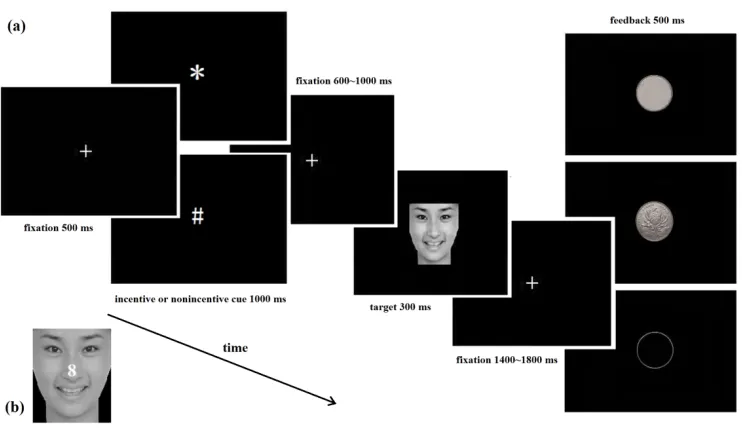
Presentation software (http://nbs.neuro-bs.com/). Participants were seated in a dimly lit and sound-attenuated room. At the start of each trial (Figure 1), a white fixation cross (size: 0.4° × 0.4° of visual angle) appeared at the center of a black screen for 500 ms, followed by a visual cue (size: 2.3° × 2.3°) displayed for 1000 ms. For half the participants, an asterisk symbol (‘*’) indicated an incentive condition and a hash symbol (‘#’) a
expectations about target onset.
Each block consisted of 36 trials (with each condition having 6 trials). In total, each experiment consisted of 10 blocks, with each experimental condition having 60 trials.
Participants underwent 24 practice trials before each experiment. During practice, participants were informed that the cue signs as such were irrelevant and so should be ignored (this applied only to the practice trials); they should just respond as quickly and accurately as possible to the respective target stimulus. Participants received only ‘correct response’ and ‘incorrect response’ feedback (i.e., no coin feedback) while practicing the task: filled and empty gray circles indicating correct and incorrect responses, respectively. The average (correct) RT achieved by each participant during the practice phase was then introduced as that participant’s baseline RT in the main experiment.
INSERT FIGURE 1 ABOUT HERE
---2.4 ERP recordings and analyses
ERP recordings were obtained from 62 scalp sites using Ag/AgCI electrodes embedded in an elastic cap at locations from the extended International 10-20 System (NeuroScan; Compumedics, EI Paso, TX, USA). These electrodes were referenced to the right mastoid during recording and re-referenced to the average of the right and left mastoid potentials offline. Two additional channels were used for recording the horizontal and vertical electrooculogram (EOG). Impedance was reduced below 5 KΩ, and
electroencephalographic signals were filtered with a band-pass of 0.05-40 Hz and sampled at a rate of 500 Hz. The averaging epochs for cue processing and target processing were 1600 ms and 1000 ms, respectively, with an additional 100 ms recorded prior to stimulus onset. Error trials were excluded from the analyses. Also, trials with a voltage, relative to the 100-ms baseline, exceeding ±75 μV at any electrode were excluded from the analysis, as were trials with artifacts in the EOG channels.
We averaged the remaining trials for each condition (i.e., the nonincentive happy,
Moreover, we performed comparisons between experiments for particular components by including experiment as a between-participant factor, with the within-participant factors including the reward condition, emotional content, and electrode topography.
For all ANOVAs, the significance level was set to alpha = 0.05, and ANOVAs were supplemented by either Bonferroni pairwise or simple main-effects comparisons where appropriate. Greenhouse-Geisser correction was used for all effects with two or more degrees of freedom in the numerator. Note that all repeated-measures ANOVA results are reported with uncorrected degrees of freedom, but with corrected p values.
3. RESULTS
3.1 Behavioral results
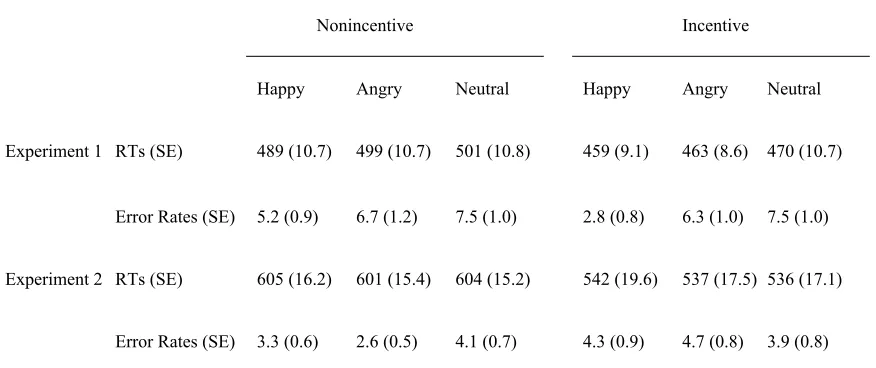
We excluded incorrect responses and RTs more than three standard deviations above or below the mean in each experimental condition for each participant. Table 1 lists the mean RTs and response error rates for each experimental condition, for both experiments.
We conducted an ANOVA on the RTs for each experiment, with reward condition (incentive vs. nonincentive) and emotionality of the face (happy, angry or neutral) as
within-participant factors. Experiment 1 revealed a main effect for reward, F(1,19) = 43.88, p < 0.001, η2
p = 0.70, with faster RTs in the incentive condition (M = 464 ms) than in the
emotionality, F(2, 38) = 6.39, p = 0.004, η2
p = 0.25. Bonferroni-corrected pairwise
comparisons revealed RTs to be faster to happy faces (M = 474 ms) than to neutral faces (M = 485 ms; p = 0.005); RTs to angry faces were intermediate, but did not differ significantly from the other two conditions (M = 481 ms). The interaction was not significant, F(2, 38) < 1.
Experiment 2 revealed only a main effect for reward, F(1, 19) = 57.84, p < 0.001, η2
p =
0.75, with faster RTs in the incentive condition (538 ms) than in the nonincentive condition (604 ms). There were no significant effects involving target emotional content (interaction reward x target emotional content, Fs(2, 38) < 1).
The same ANOVA were used to analyze error rates in both experiments. Experiment 1 revealed a main effect for emotionality, F(2, 38) =11.38, p < 0.001, η2
p = 0.38.
Bonferroni-corrected pairwise comparisons showed that participants made fewer errors in the happy-face condition (4.0 %) than in the angry-face (6.5 %; p = 0.007) and neutral-face conditions (7.5 %; p = 0.001). No other effects or interactions reached significance. The results of Experiment 2 revealed no significant effects or interactions.
We performed cross-experiment ANOVAs on the behavioral data, with experiment as a between-participant factor. For RTs, the results revealed a main effect of experiment, F(1, 38) = 23.56, p < 0.001, η2
Experiment 2 (480 vs. 571 ms), and a main effect of reward, F(1, 38) = 97.61, p < 0.001,
η2
p = 0.72, with overall faster RTs in the incentive condition than in the nonincentive
condition (501 vs. 550 ms). Moreover, reward significantly interacted with experiment, F(1, 38) = 11.31, p = 0.002, η2
p = 0.23, with a larger difference in RTs between the
incentive and nonincentive conditions in Experiment 2 than in Experiment 1 (66 vs. 32 ms). No other effects or interactions reached significance.
For the error rates, the cross-experiment ANOVA yielded a main effect of experiment, F(1, 38) = 6.44, p = 0.015, η2
p = 0.15, with fewer errors in Experiment 2 than in Experiment 1
(3.8 vs. 6.0%), and a main effect of emotionality, F(2, 76) = 7.30, p = 0.001, η2
p = 0.16.
Bonferroni-corrected pairwise comparisons revealed error rates to be fewer with happy faces (3.9%) than with both angry faces (5.1%; p = 0.032) and neutral faces (5.7%; p = 0.007). Moreover, emotionality significantly interacted with experiment, F(2, 76) = 6.36, p = 0.003, η2
p = 0.14. Specifically, as reported in the separate analysis of each experiment
above, participants made fewer errors in the happy-face condition than in either the angry-face or neutral-face condition in Experiment 1, whereas there was no main effect of emotionality in Experiment 2. Thus, the results of the cross-experimental ANOVAs statistically support our prior hypothesis that task-set determines how deeply emotional content is processed.
---3.2 ERP Results
3.2.1Experiment 1
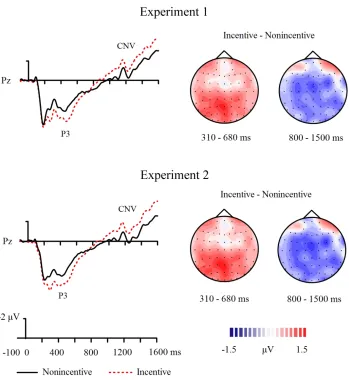
The upper panel of Figure 2 depicts ERP responses time-locked to cue onset from the selected exemplar electrode in Experiment 1. Compared to the nonincentive cues, the incentive cues elicited larger P3 responses (3.35 vs. 2.38 μV), F(1, 19) = 15.64, p = 0.001,
η2
p = 0.45, and larger CNV components (-1.52 vs. -0.79 μV), F(1, 19) = 6.52, p = 0.019,
η2
p = 0.26.
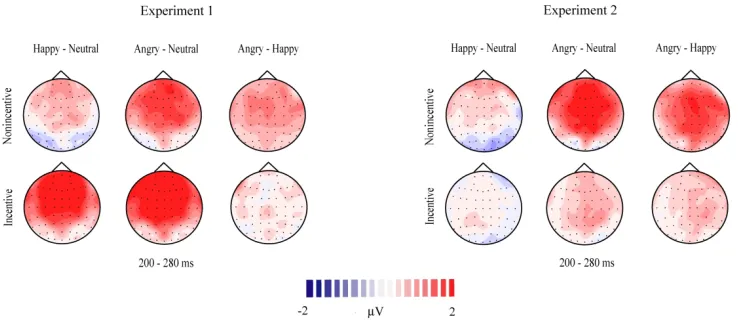
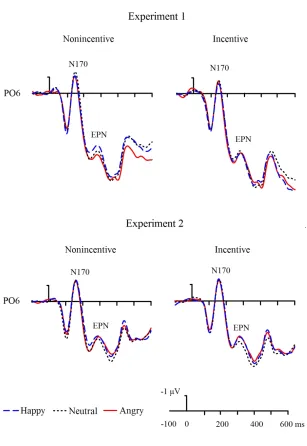
Figures 3 (left panel) and 5 (upper panel) depict ERP responses time-locked to target onset for selected, exemplar electrodes, and Figure 4 (left panel) depicts the topography of the N2 potential. Overall, compared to nonincentive trials, incentive trials elicited more positive-going ERP responses for the N170, VPP, N2, EPN, and LPC components.
Moreover, happy and angry faces elicited more positive-going ERP responses compared to the neutral faces for the VPP, N2, and LPC components. Furthermore, for the N2
component, the differences between the ERP responses for emotional faces and neutral faces in the incentive condition were greater than those in the nonincentive condition. The upper panel of Table 2 lists the significant results of the ANOVAs of the mean amplitudes of the N170, VPP, N2, EPN, and LPC components in Experiment 1.
---For the main effects of emotionality on the VPP, N2 and LPC, further
Bonferroni-corrected pairwise comparisons for each component showed that happy and angry faces elicited more positive-going ERP responses compared to the neutral faces (VPP: 6.36 vs. 5.48 μV, p = 0.008, and 6.28 vs. 5.48 μV, p = 0.001; N2: 2.98 vs. 1.93 μV,
p = 0.001, and 3.54 vs. 1.93 μV, p < 0.001; and LPC: 10.02 vs. 9.38 μV, p = 0.049, and 10.29 vs. 9.38 μV, p = 0.001).
We performed separate ANOVAs for the N2 components for the incentive and
nonincentive conditions because the Reward × Emotion interaction was significant, F(2, 38) = 8.96, p = 0.001, η2
p = 0.32. Results revealed significant main effects of emotionality
in the nonincentive condition, F(2, 38) = 9.24, p = 0.001, η2
p = 0.33, with a more
positive-going N2 for angry faces (2.97 μV) than for happy and neutral faces (2.08 μV,
1.73 μV; p = 0.008, p = 0.002, respectively). The main effects of emotionality were also significant in the incentive condition, F(2, 38) = 36.76, p < 0.001, η2
p = 0.70, and exhibited
a pattern different from the nonincentive condition, with more positive-going N2 for angry (4.11 μV) and happy faces (3.89 μV) than for neutral faces (2.13 μV; ps < 0.001).
condition (1.76 μV) were also greater than the differences in the nonincentive condition (0.35 μV), t(19) = 4.78, p < 0.001.
INSERT FIGURE 2 ABOUT HERE
---3.2.2Experiment 2
The lower panel of Figure 2 depicts ERP responses time-locked to cue onset from the selected exemplar electrode in Experiment 2. Consistent with the results in Experiment 1, the incentive cues elicited larger P3 responses (3.72 vs. 2.38 μV), F(1, 19) = 12.83, p = 0.002, η2
p = 0.40, and larger CNV (-1.81 vs. -0.79 μV), F(1, 19) = 7.02, p = 0.016, η2p =
0.27, relative to the nonincentive cues.
Figure 3 (right panel) and 5 (lower panel) depict ERP responses time-locked to target onset from selected, exemplar electrodes, and Figure 4 (right panel) depicts the topography of the N2 potential. Compared to nonincentive trials, incentive trials elicited more
(lower panel).
For the N2 main effect of emotionality, further Bonferroni-corrected pairwise comparisons showed that angry faces elicited more positive-going ERP responses compared to the happy and neutral faces (3.02 vs. 1.88 μV, p = 0.001, and 3.02 vs. 2.04 μV, p < 0.001). Because the N2 component exhibited a significant interaction between reward and emotionality, F(2, 38) = 4.53, p = 0.017, η2
p = 0.19, we performed further, simple-effects
analyses to explore this interaction. These tests showed that the main effect of emotionality was significant in the nonincentive condition, F(2, 38) = 20.21, p < 0.001, η2
p = 0.52, with
a more positive-going N2 for angry faces (2.90 μV) than for happy and neutral faces (1.44
μV, 1.22 μV; ps < 0.001); but this effect was not significant in the incentive condition, F(2, 38) = 2.41, p > 0.1.
INSERT FIGURE 3 AND FIGURE 4 ABOUT HERE
---3.2.3Overall analysis of experiments 1 and 2
resulted from distinctive processing of the incentive cues.
For the target-elicited responses, cross-experiment ANOVAs were performed on the N170, VPP, EPN, N2, and LPC responses, respectively. For the N170, a significant Reward × Experiment interaction was observed, F(1, 38) = 7.99, p = 0.007, η2
p = 0.17, with a larger
amplitude difference between the incentive and nonincentive conditions in Experiment 1 than in Experiment 2 (0.35 vs. -0.36 μV), statistically confirming the differential patterns of reward effects between the two experiments. No other effects reached significance.
For the VPP responses, there was a significant main effect of emotionality, F(2, 76) = 7.48, p = 0.001, η2
p = 0.16, with more positive-going amplitudes for happy (6.21 μV) and angry
faces (6.18 μV) than for neutral faces (5.71 μV), p = 0.014 and p = 0.001, respectively. Importantly, reward significantly interacted with experiment, F(1, 38) = 10.50, p = 0.002,
η2
p = 0.22, with a larger amplitude difference between the incentive and nonincentive
conditions in Experiment 1 than in Experiment 2 (0.71 vs. - 0.18 μV), confirming the differential patterns of reward effects between the two experiments. Furthermore, emotionality significantly interacted with experiment, F(2, 76) = 4.21, p = 0.018, η2
p =
reached significance.
For the N2 responses, the cross-experimental ANOVA revealed a main effect of reward, F(2, 38) = 19.83, p < 0.001, η2
p = 0.34, with more positive-going amplitudes for the
incentive conditions than for the nonincentive conditions. Moreover, there was a significant main effect of emotionality, F(2, 76) = 40.20, p < 0.001, η2
p = 0.51, with more
positive-going amplitudes for angry faces (3.28 μV) than for happy (2.51 μV) and neutral faces (1.91 μV; ps < 0.001), and more positive-going amplitudes for happy faces than for neutral faces (p = 0.002). Furthermore, emotionality significantly interacted with
experiment, F(2, 76) = 4.29, p = 0.017, η2
p = 0.10, with a greater difference in amplitudes
between the happy and neutral faces in Experiment 1 than in Experiment 2 (1.1 vs. 0.2 μV).
Importantly, the interaction between reward and emotionality also interacted with experiment, F(2, 76) = 7.26, p = 0.001, η2
p = 0.16, statistically confirming the differential
patterns of Reward × Emotion interaction between the two experiments.
The cross-experimental ANOVA on the EPN only revealed a main effect of reward, F(1, 38) = 9.75, p = 0.003, η2
p = 0.20, with more positive-going amplitudes for the incentive
condition than for the nonincentive condition (4.21 vs. 3.65 μV). No other effects reached significance.
reward, F(1, 38) = 26.21, p < 0.001, η2
p = 0.41, with more positive-going amplitudes for
the incentive condition than for the nonincentive condition (11.16 vs. 9.01 μV),
and a main effect of emotionality, F(2, 76) = 5.30, p = 0.007, η2
p = 0.12, with more
positive-going amplitudes for angry faces (10.29 μV) than for neutral faces (9.79 μV; Bonferroni-corrected p = 0.004). Moreover, emotionality significantly interacted with experiment, F(2, 76) = 3.34, p = 0.041, η2
p = 0.08, with a larger amplitude difference
between happy and neutral faces in Experiment 1 than in Experiment 2 (0.63 vs. 0.13 μV),
and a larger difference between angry and neutral faces in Experiment 1 than in Experiment 2 (0.90 vs. 0.09 μV), statistically confirming the differential patterns of emotional effects between the two experiments. No other effects reached significance.
INSERT FIGURE 5 ABOUT HERE
---4. DISCUSSION
We investigated whether reward expectation modulates implicit facial emotion processing in two electrophysiological experiments, one in which the face stimuli (though not their emotional expressions) were target stimuli (Experiment 1), and one in which they were distractors (Experiment 2). For the cue period, both experiments revealed larger P3 and CNV responses to the incentive cue than to the nonincentive cue; and for the target period, both experiments revealed more positive-going ERPs and improved behavioral
manipulated reward expectation (Baines et al., 2011; Padmala & Pessoa, 2011;
Schevernels et al., 2014; Small et al., 2005; van den Berg et al., 2014; Wei et al., 2014, 2016). Importantly, the N2 component (200-280 ms posttarget onset) exhibited differential patterns between the two experiments, depending on the task-set.
The N2 was the crucial component regarding reward-based modulations of the processing of emotional facial information: reward expectation enhanced sensitivity to emotional information in Experiment 1, but reduced sensitivity in Experiment 2. In the nonincentive conditions of both experiments, N2 amplitudes were less negative-going for angry faces than for happy and neutral faces, consistent with previous reports of reduced N2
negativities for emotional versus neutral faces (Calvo & Beltrán, 2013; Williams et al., 2006; Zhang & Lu, 2012), or emotional versus neutral pictures (Carretié et al., 2004; Olofsson & Polich, 2007). Of note, the less negative N2s have been interpreted as reflecting facilitated processing of emotionally salient stimuli (Zhang & Lu, 2012; see Eimer & Holmes, 2007, for a review). In the present study, angry faces may have had the highest priority in attracting attention relative to happy and neutral faces, owing to the biological salience of threatening information – thus replicating the intrinsic negativity
Importantly, though, the negativity superiority effect was amplified in the incentive condition of Experiment 1, whereas it was diminished in Experiment 2. This pattern suggests that reward expectation enhances executive control over implicit emotional processing by biasing the allocation of limited processing capacity towards the respective target stimuli. As reviewed in the Introduction, performing a gender discrimination task on emotional faces (as in the current Experiment 1) elicits brain responses similar to
performing an explicit emotional categorization task (Rellecke et al., 2012; Wronka & Walentowska, 2011). Moreover, the Reward × Emotion interaction obtained in the current gender task (Experiment 1) corresponds well with Wei et al. (2014): implementing a similar manipulation of reward expectation in an explicit facial emotional categorization task, they found enhanced N2 differences between emotional and neutral faces in the incentive (vs. the nonincentive) condition. Together, the results of the present Experiment 1 and of Wei et al. (2014) demonstrate that reward expectation enhances emotional facial processing in the gender task (in which the processing of the facial expressions is implicit, that is, not necessary for deciding on the response), as well as in the facial emotional categorization task (in which the facial expressions must be explicitly discerned to decide on the response).
Padmala et al. (2017) observed that, relative to the nonincentive condition, reward expectation diminished brain responses to negative distractors in the anterior insula and dorsal ACC, suggesting that reward expectation reduces attention to emotional distractors so as to ensure uncompromised target processing. Intriguingly, ACC, where the Reward × Emotion interaction was observed in Padmala et al. (2017), is thought to be the neural source of the N2 component (Carretié et al., 2004; van Veen & Carter, 2002; Zhang & Lu, 2012). Moreover, ACC receives neural input from brain structures such as the nucleus accumbens and the amygdala (which are crucial in processing reward and emotional
information, respectively), and sends signals to prefrontal cortex (Padmala & Pessoa, 2011; Pessoa, 2009). In this way, in Experiment 2, incentive motivation signals may have been integrated to influence executive control processes in the prefrontal cortex, enhancing the allocation of attention to the target – the numeral (superimposed on the background face) – associated with stronger inhibition of the irrelevant emotional face.
reward expectation enhanced attentional allocation towards facial targets in Experiment 1, whereas this attentional bias was no longer operative when the faces were made
background objects (distractors) in Experiment 2. This again supports the notion that incentive motivation enhances executive control, biasing visual attention towards the task-relevant stimuli, especially at early processing stages.
Although we did not observe Reward × Emotion interaction in the N170, VPP, EPN, and LPC components, the emotional effects revealed in these components may augment our understanding of implicit facial emotion processing. The N170 did not reveal any emotion effects in either experiment, supporting the idea that N170 is insensitive to implicit facial emotion processing (Eimer & Holmes, 2002; Eimer, Holmes, & McGlone,2003; see Calvo & Beltrán, 2013; Luo et al., 2010; Williams et al., 2006; see Eimer & Holmes, 2007; Rellecke et al., 2013 for reviews). Moreover, when the faces were targets in Experiment 1, both the VPP and the LPC exhibited larger amplitudes for emotional than for neutral faces, but these two components showed no emotional modulation when the emotional stimuli were background distractors in Experiment 2. There is evidence that the VPP reflects rapid extraction of facial emotions at early stages (Williams et al., 2006; Smith et al., 2013; see Eimer & Holmes, 2007, for a review), and that the LPC reflects elaborate categorization of the emotional content at late stages of processing (Calvo & Beltrán, 2013; Rellecke et al., 2012). Thus, the present findings suggest that implicit facial emotion processing is
EPN did not reveal any emotional effects in either experiment, at variance with recent arguments that the EPN reflects automatic attentional orientation towards emotional information unaffected by the task relevance of the emotional content (Kissler et al., 2009; Schacht & Sommer, 2009b). Instead, the EPN may reflect enhanced sensory processing of emotion only when explicit attention is allocated to the emotional content (Bayer et al., 2012; Frühholz et al., 2011; Kaltwasser et al., 2013; Wei et al., 2016).
Finally, a comparison of Experiment 2 of Wei et al. (2016) and the current Experiment 1 is of interest: the emotional valence was task-irrelevant and the emotional stimuli were the processing targets in both experiments, but reward expectation reduced emotional
processing in the former experiment, while enhancing it in the latter. We propose that the category of the target emotional stimuli and the processing depth of the emotional stimuli may account for these inconsistent results. In Experiment 2 of Wei et al. (2016),
target words), which might be a potential source of response interference. Unlike words, emotional faces signal the emotional valence from facial structural features, and
identifying facial gender requires perceptual analysis of the facial structure, as outlined in the Introduction. Thus, to maximize behavioral outcome in the gender discrimination task and gain the extra reward, participants would have mobilized more attentional resources to enhance perceptual analysis of the facial structural features in the incentive condition, as compared to the nonincentive condition (as indicated by the reward effects on the
face-sensitive N170 and VPP in the current Experiment 1). Enhanced perceptual analysis of faces in turn facilitates the extraction of facial emotions (Gorno-Tempini et al., 2001; Wronka & Walentowska, 2014). In this way, reward expectation enhances the processing of facial emotions in the gender task, even though the facial emotions are task-irrelevant.
To conclude, by asking participants to perform tasks in which emotional faces were targets or, respectively, distractors, the current findings suggest that reward expectation
differentially modulates implicit emotional effects, with increased sensitivity to emotions when the processing of whole faces is required, but with reduced sensitivity when
Acknowledgments
REFERENCES
Baines, S., Ruz, M., Rao, A., Denison, R., & Nobre, A. C. (2011). Modulation of neural activity by motivational and spatial biases. Neuropsychologia, 49(9), 2489–2497. https://dx.doi.org/10.1016/j.neuropsychologia.2011.04.029
Baxter, M. G., & Murray, E. A. (2002). The amygdala and reward. Nature Reviews Neuroscience, 3(7), 563–573. https://doi.org/10.1038/nrn875
Bayer, M., Sommer, W., & Schacht, A. (2012). P1 and beyond: functional separation of multiple emotion effects in word recognition. Psychophysiology, 49(7), 959–969. https://doi.org/10.1111/j.1469-8986.2012.01381.x
Bentin, S., Allison, T., Puce, A., Perez, E., & McCarthy, G. (1996). Electrophysiological studies of face perception in humans. Journal of Cognitive Neuroscience, 8(6), 551–565. https://dx.doi.org/10.1162/jocn.1996.8.6.551
Botvinick, M., & Braver, T. (2015). Motivation and cognitive control: from behavior to neural mechanism. Annual review of psychology, 66(1), 83–113.
https://dx.doi.org/10.1146/annurev-psych-010814-015044
Calvo, M. G., & Beltrán, D. (2013). Recognition advantage of happy faces: tracing the neurocognitive processes. Neuropsychologia, 51(11), 2051–2061.
https://doi.org/10.1016/j.neuropsychologia.2013.07.010
Chelazzi, L., Perlato, A., Santandrea, E., & Della Libera, C. (2013). Rewards teach visual selective attention. Vision Research, 85, 58–72.
https://dx.doi.org/10.1016/j.visres.2012.12.005
Eimer, M., & Holmes, A. (2002). An ERP study on the time course of emotional face processing. Neuroreport, 13(4), 427–431.
https://doi.org/10.1097/00001756-200203250-00013
Eimer, M., & Holmes, A. (2007). Event-related brain potential correlates of emotional face processing. Neuropsychologia, 45(1), 15–31.
https://doi.org/10.1016/j.neuropsychologia.2006.04.022
Eimer, M., Holmes, A., & McGlone, F. P. (2003). The role of spatial attention in the processing of facial expression: an ERP study of rapid brain responses to six basic emotions. Cognitive, Affective, & Behavioral Neuroscience, 3(2), 97–110.
https://dx.doi.org/10.3758/CABN.3.2.97
Frühholz, S., Jellinghaus, A., & Herrmann, M. (2011). Time course of implicit processing and explicit processing of emotional faces and emotional words. Biological
Psychology, 87(2), 265–274. https://doi.org/10.1016/j.biopsycho.2011.03.008
Joyce, C., & Rossion, B. (2005). The face-sensitive N170 and VPP components manifest the same brain processes: the effect of reference electrode site. Clinical
Neurophysiology, 116(11), 2613–2631. https://doi.org/10.1016/j.clinph.2005.07.005
Kaltwasser, L., Ries, S., Sommer, W., Knight, R., & Willems, R. M. (2013). Independence of valence and reward in emotional word processing: electrophysiological evidence. Frontiers in Psychology, 4, 168. https://doi.org/10.3389/fpsyg.2013.00168
Kang, G., Chang, W., Wang, L., Wei, P., Zhou, X. (2018). Reward enhances cross-modal conflict control in object categorization: Electrophysiological evidence.
Psychophysiology. Advance online publication. https://doi.org/10.1111/psyp.13214
Kang, G., Zhou, X., Wei, P. (2015). Independent effects of reward expectation and spatial orienting on the processing of emotional facial expressions. Experimental Brain Research, 233(9), 2571–2580. https://doi.org/10.1007/s00221-015-4328-3
Kissler, J., Herbert, C., Winkler, I., & Junghöfer, M. (2009). Emotion and attention in visual word processing–An ERP study. Biological psychology, 80(1), 75–83. https://doi.org/10.1016/j.biopsycho.2008.03.004
Knutson, B., & Cooper, J. C. (2005). Functional magnetic resonance imaging of reward prediction. Current Opinion in Neurology, 18, 411–417.
https://dx.doi.org/10.1097/01.wco.0000173463.24758.f6
Knutson, B., Westdorp, A., Kaiser, E., & Hommer, D. (2000). FMRI visualization of brain activity during a monetary incentive delay task. Neuroimage, 12(1), 20–27.
Krebs, R. M., & Woldorff, M. G. (2017). Cognitive control and reward. In T. Egner (Ed.), The Wiley Handbook of Cognitive Control (pp. 422–439). UK: Wiley Blackwell.
https://dx.doi.org/10.1002/9781118920497.ch24
Luo, W., Feng, W., He, W., Wang, N. Y., & Luo, Y. J. (2010). Three stages of facial expression processing: ERP study with rapid serial visual presentation. Neuroimage, 49(2), 1857–1867. https://dx.doi.org/10.1016/j.neuroimage.2009.09.018
Marini, F., Marzi, T., & Viggiano, M. P. (2011). “Wanted!” The effects of reward on face recognition: electrophysiological correlates. Cognitive, Affective, & Behavioral Neuroscience, 11(4), 627–643. https://dx.doi.org/10.3758/s13415-011-0057-7
Olofsson, J. K., & Polich, J. (2007). Affective visual event-related potentials: arousal, repetition, and time-on-task. Biological Psychology, 75(1), 101–108.
https://dx.doi.org/10.1016/j.biopsycho.2006.12.006
Padmala, S., & Pessoa, L. (2014). Motivation versus aversive processing during perception. Emotion, 14(3), 450–454. https://dx.doi.org/10.1037/a0036112
Padmala, S., & Pessoa, L. (2011). Reward reduces conflict by enhancing attentional control and biasing visual cortical processing. Journal of Cognitive Neuroscience, 23(11), 3419–3432. https://dx.doi.org/10.1162/jocn_a_00011
Padmala, S., Sirbu, M., & Pessoa, L. (2017). Potential reward reduces the adverse impact of negative distractor stimuli. Social cognitive and affective neuroscience, 12(9), 1402–1413. https://dx.doi.org/10.1093/scan/nsx067
Pessoa, L. (2009). How do emotion and motivation direct executive control?. Trends in Cognitive Sciences, 13(4), 160–166. https://dx.doi.org/10.1016/j.tics.2009.01.006
Rellecke, J., Sommer, W., & Schacht, A. (2012). Does processing of emotional facial expressions depend on intention? Time-resolved evidence from event-related brain potentials. Biological Psychology, 90(1), 23–32.
https://dx.doi.org/10.1016/j.biopsycho.2012.02.002
Rellecke, J., Sommer, W., & Schacht, A. (2013). Emotion effects on the N170: A question of reference? Brain Topography, 26, 62–71.
https://dx.doi.org/10.1007/s10548-012-0261-y
Rossion, B., & Jacques, C. (2012). N170: Understanding the time course of face
perception in the human brain. In S. J. Luck, & E. S. Kappenman (Eds.), The Oxford handbook of event-related potential components (pp. 115–142). New York: Oxford
University Press. https://dx.doi.org/10.1093/oxfordhb/9780195374148.013.0064 Schacht, A., & Sommer, W. (2009a). Emotions in word and face processing: early and late
Schacht, A., & Sommer, W. (2009b). Time course and task dependence of emotion effects in word processing. Cognitive, Affective, & Behavioral Neuroscience, 9(1), 28–43. https://dx.doi.org/10.3758/CABN.9.1.28
Schevernels, H., Krebs, R. M., Santens, P., Woldorff, M. G., & Boehler, C. N. (2014). Task preparation processes related to reward prediction precede those related to task-difficulty expectation. Neuroimage, 84, 639–647.
https://dx.doi.org/10.1016/j.neuroimage.2013.09.039
Schupp, H. T., Öhman, A., Junghöfer, M., Weike, A. I., Stockburger, J., & Hamm, A. O. (2004). The facilitated processing of threatening faces: an ERP analysis. Emotion, 4(2), 189–200. https://dx.doi.org/10.1037/1528-3542.4.2.189
Small, D. M., Gitelman, D., Simmons, K., Bloise, S. M., Parrish, T., & Mesulam, M. M. (2005). Monetary incentives enhance processing in brain regions mediating top-down control of attention. Cerebral Cortex, 15(12), 1855–1865.
https://dx.doi.org/10.1093/cercor/bhi063
Smith, E., Weinberg, A., Moran, T., & Hajcak, G. (2013). Electrocortical responses to NIMSTIM facial expressions of emotion. International Journal of Psychophysiology, 88(1), 17–25. https://dx.doi.org/10.1016/j.ijpsycho.2012.12.004
van den Berg, B., Krebs, R. M., Lorist, M. M., & Woldorff, M. G. (2014). Utilization of reward-prospect enhances preparatory attention and reduces stimulus conflict. Cognitive, Affective, & Behavioral Neuroscience, 14(2), 561–577.
van Veen, V., & Carter, C. S. (2002). The anterior cingulate as a conflict monitor: fMRI and ERP studies. Physiology and Behavior, 77, 477–482.
https://doi.org/10.1016/S0031-9384(02)00930-7
Wei, P., & Kang, G. (2014). Task relevance regulates the interaction between reward expectation and emotion. Experimental Brain Research, 232(6), 1783–1791. https://dx.doi.org/10.1007/s00221-014-3870-8
Wei, P., Kang, G., Ding, J., & Guo, C. (2014). Monetary incentives modulate the
processing of emotional facial expressions: an ERP study. Acta Psychologica Sinica, 46(4), 437–449. https://dx.doi.org/10.3724/SP.J.1041.2014.00437
Wei, P., Wang, D., & Ji, L. (2016). Reward expectation regulates brain responses to task-relevant and task-irrelevant emotional words: ERP evidence. Social Cognitive and Affective Neuroscience, 11(2), 191–203. https://dx.doi.org/10.1093/scan/nsv097
Williams, L. M., Palmer, D., Liddell, B. J., Song, L., & Gordon, E. (2006). The ‘when’and ‘where’of perceiving signals of threat versus non-threat. Neuroimage, 31(1), 458–467. https://doi.org/10.1016/j.neuroimage.2005.12.009
Wronka, E., & Walentowska, W. (2011). Attention modulates emotional expression processing. Psychophysiology, 48, 1047–1056.
https://dx.doi.org/10.1111/j.1469-8986.2011.01180.x
Wronka, E., & Walentowska, W. (2014). Attentional modulation of the emotional expression processing studied with ERPs and sLORETA. Journal of
Zhan, Y., Chen, J., Xiao, X., Li, J., Yang, Z., Fan, W., & Zhong, Y. (2016). Reward promotes self-face processing: an event-related potential study. Frontiers in psychology, 7, 735. https://dx.doi.org/10.3389/fpsyg.2016.00735
Zhang, W., & Lu, J. (2012). Time course of automatic emotion regulation during a facial Go/Nogo task. Biological Psychology, 89(2), 444–449.
Table 1. Mean RT (ms) and error rates (%) for the various experimental conditions, separately for Experiments 1 and 2.
Note: The SEs (standard errors) are listed in parentheses.
Nonincentive Incentive
Happy Angry Neutral Happy Angry Neutral
RTs (SE) 489 (10.7) 499 (10.7) 501 (10.8) 459 (9.1) 463 (8.6) 470 (10.7)
Experiment 1
Error Rates (SE) 5.2 (0.9) 6.7 (1.2) 7.5 (1.0) 2.8 (0.8) 6.3 (1.0) 7.5 (1.0)
RTs (SE) 605 (16.2) 601 (15.4) 604 (15.2) 542 (19.6) 537 (17.5) 536 (17.1)
Experiment 2
N170 VPP N2 EPN LPC
(140–200 ms) (140–200 ms) (200–280 ms) (240–320 ms) (500–700 ms)
Experiment 1 Reward F 5.47 8.66 17.59 7.22 26.82
p 0.03 0.008 <0.001 0.015 <0.001
η2
p 0.22 0.31 0.48 0.28 0.59
Emotion F 11.79 27.76 8.32
p <0.001 <0.001 0.001
η2
p 0.38 0.59 0.30
Reward × Emotion F 8.96
p 0.001
η2
p 0.32
Reward × Electrodes F 3.58
p <0.001
η2
p 0.16
Emotion × Electrodes F 8.64
p <0.001
η2
p 0.31
Reward × Emotion × Electrodes F 1.99
p 0.002
η2
p 0.10
Experiment 2 Reward F 6.14 4.38 29.27
p 0.023 0.05 <0.001
η2
p 0.24 0.19 0.61
Emotion F 16.50
p <0.001
η2
p 0.47
Reward × Emotion F 4.53
p 0.017
η2
p 0.19
Reward × Electrodes F
p
η2 p
Emotion × Electrodes F 2.20
p <0.001
η2
p 0.10
Reward × Emotion × Electrodes F
p
Figure Captions
Figure 1. Example of the trial sequence in Experiments 1 and 2. Participants were asked to classify the gender of the face in Experiment 1, and to determine whether a number superimposed on the face was even or odd in Experiment 2.
Figure 2. Grand average waveforms at Pz showing the potentials produced in response to the presentation of the cues in Experiments 1 and 2.The incentive cues elicited larger P3 and CNV responses compared with nonincentive cues in both experiments. The
topographies of the P3 and CNVpotentials are shown on the right. Positive voltage is plotted downwards. For all waveforms, nonincentive conditions are plotted in solid lines and incentive conditions in dotted lines.
Figure 3. Grand average waveforms at representative electrodes showing the VPP、N2 and LPC potentials produced in response to the presentation of the target stimulus in Experiments 1 and 2. Critically, the N2 responses (200-280 ms) exhibited differential patterns of Reward × Emotion interaction between the two experiments. Positive voltage is plotted downwards. For all waveforms, neutral conditions are plotted in dotted lines, happy conditions in dashed lines, and angry conditions in solid lines.
and/or angry) and neutral faces increased in the incentive condition in Experiment 1, but diminished in Experiment 2.
Figure 5. Grand average waveforms at the PO6 electrode showing the N170 and EPN components in response to the target stimuli in Experiment 1 (left) and Experiment 2 (right). Compared with the nonincentive trials, incentive trials elicited more
Figure 1. Example of the trial sequence in Experiments 1 and 2. Participants were asked to classify the gender of the face in Experiment 1, and to determine whether a number superimposed on the face was even
or odd in Experiment 2.
Figure 2. Grand average waveforms at Pz showing the potentials produced in response to the presentation of the cues in Experiments 1 and 2. The incentive cues elicited larger P3 and CNV responses compared with
nonincentive cues in both experiments. The topographies of the P3 and CNV potentials are shown on the right. Positive voltage is plotted downwards. For all waveforms, nonincentive conditions are plotted in solid
lines and incentive conditions in dotted lines.
Figure 3. Grand average waveforms at representative electrodes showing the VPP、N2 and LPC potentials produced in response to the presentation of the target stimulus in Experiments 1 and 2. Critically, the N2 responses (200-280 ms) exhibited differential patterns of Reward × Emotion interaction between the two experiments. Positive voltage is plotted downwards. For all waveforms, neutral conditions are plotted in
dotted lines, happy conditions in dashed lines, and angry conditions in solid lines.
Figure 4. The topographies of the N2 potential in Experiments 1 and 2. Relative to the nonincentive condition, the N2 amplitude differences between emotional (i.e., happy and/or angry) and neutral faces
increased in the incentive condition in Experiment 1, but diminished in Experiment 2.
Figure 5. Grand average waveforms at the PO6 electrode showing the N170 and EPN components in response to the target stimuli in Experiment 1 (left) and Experiment 2 (right). Compared with the nonincentive trials, incentive trials elicited more positive-going N170 in Experiment 1 but not in Experiement
2, and incentive trials elicited more positive-going EPN in both experiments. Positive voltage is plotted downwards.