Please cite this article as: A. Lashkar Ara, H. Bagheri Tolabi,R. Hosseini, Dynamic Modeling and Controller Design of Distribution Static Compensator in a Microgrid Based on Combination of Fuzzy Set and Galaxy-based Search Algorithm , International Journal of Engineering (IJE), TRANSACTIONS A: Basics Vol. 29, No. 10, (October 2016) 1392-1400
International Journal of Engineering
J o u r n a l H o m e p a g e : w w w . i j e . i rDynamic Modeling and Controller Design of Distribution Static Compensator in a
Microgrid Based on Combination of Fuzzy Set and Galaxy-based Search Algorithm
A. Lashkar Araa, H. Bagheri Tolabi*b,R. Hosseinic
a Department of Electrical Engineering, Dezful Branch, Islamic Azad University, Dezful, Iran
b Department of Electrical Engineering, Khorramabad Branch, Islamic Azad University, Khorramabad, Iran c
Department of Computer Engineering, Shahr-e-Qods Branch, Islamic Azad University, Tehran, Iran
P A P E R I N F O
Paper history: Received 08 April 2016
Received in revised form 01 August 2016 Accepted 25 August 2016
Keywords: Distribution System
Distribution Static Compensator Galaxy-based Search Algorithm (GbSA) Fuzzy Sets
Optimization
A B S T R A C T
This paper presents a nonlinear controller for a Distribution Static Compensator (DSTATCOM) of a microgrid incorporating the Distributed Generation (DG) units. The nonlinear control has been designed based on partial feedback linearization theory and Proportional-Integral-Derivative (PID) controllers try to adjust the voltage and trace the output. This paper has proposed a combination of a fuzzy system and Galaxy-based Search Algorithm (GbSA) to optimize the parameters of the PID controllers. The results confirm that the characteristics of the response of the proposed controller (i.e. settling and rise times, the maximum overshoot and the steady-state error of the voltage step response of the DSTATCOM) is significantly improved by finding a high-quality solution. The proposed hybrid tuning method for the Partial Feedback Linearizing (PFL) controller concluded a better DC voltage regulation for the capacitor within the DSTATCOM. Furthermore, in the event of fault the proposed controller tuned by the fuzzy-GbSA method has shown a better performance in comparison with the conventional controller or controllers tuned by Genetic Algorithm (GA) or Particle Swarm Optimization (PSO) methods on both fault duration and after clearing times.
doi: 10.5829/idosi.ije.2016.29.10a.10
1. INTRODUCTION1
Distribution networks are enhanced through the upgrade of the recent achivements in distributed generations and Flexible AC Transmission Systems (DFACTS) [1, 2]. DFACT devices includes the DSTATCOM, the Unified Power Flow Controller (UPFC), and the Dynamic Voltage Restorer (DVR) [3]. For optimal design of a controlling strategy the use of the DG and the DFACT units, are important tasks. Controlling the reactive power of the DG or the DFACT units is necessary to keep the voltage profile in the distribution network’s buses within the desirable limit [4]. Gao and Irvani presented a voltage control plan for an interfaced DG unit. They used a Voltage Source Converter (VSC) as the interface medium [5]. Their strategy has the following advantages: 1) enables operation of a DG unit
1*Corresponding Author’s Email: [email protected] (H.
Bagheri Tolabi)
in both grid-connected and islanded (autonomous) modes, 2) caters current limit ability for the VSC during fault, 3) and enables smooth transmission capability betwixt grid connected and islanded modes.
and rise times or the steady state error have not been investigated.
Mahmud et al. proposed a nonlinear controller model for the DSTATCOM in a distribution network with the DG units [8]. The controller can regulate the bus voltage at various operating conditions and has a better performance compared to the conventional PI controller. The controller was designed using the PFL theory. After linearization, two PI controllers were employed to track the reference output. The PI controllers have a static relation with the reference value, thus there is no guarantee to get to an optimal set of parameters for the PI controller.
The main objective of this paper is to design a PFL controller for the DSTATCOM considering the nonlinear and dynamic modeling of the DSTATCOM along with tuning the parameters of the designed controller using the combination of fuzzy set and galaxy based search algorithm in order to improve the controller response of the voltage profile at the Point of Common Coupling (PCC).
The rest of the paper is organized as follows: the DSTATCOM modelling and controlling basis is presented in Section 2. Section 3 explains the fuzzy-galaxy-based search algorithm and optimal tuning of the DSTATCOM controller parameters based on this algorithm. The simulation results are presented in Section 4 and the paper has been concluded in Section 5.
2. Nonlinear Modelling and Control of the DSTATCOM
2. 1. The DSTATCOM A DSTATCOM connected to a distribution network [8] is illustrated in Figure 1. Equation (1) can be concluded from Figure 1 as follows:
) ( 1 ) ( 1 ) ( 1 c c c c b b b b a a a a e v L i L R i e v L i L R i e v L i L R i (1)
where: ia,b,c:The AC currents of DSTATCOM, L:The filter and transformer inductances, R:The inverter and transformer resistances, va,b,c:The voltages of the line,
: , ,bc a
e The inverter output voltages.
Figure 1. The circuit diagram of a six pulses DSTATCOM [8]
If the angular velocity of the AC voltage and current vectors are
and considering the direct–quadrature (dq) reference system is rotating in a similar speed, Equation (1) can be rewritten in the dq reference frame as follows: ) ( 1 ) ( 1 q q d q q d d q d d e v L i i L R i e v L i i L R i (2)The voltage equations in the dq reference frame can be presented as follows:
cos . sin . dc q dc d mv e mv e (3)
where: m: The modulation indicator, and
: The firing angle of the Pulse Width Modulation (PWM) used in the DSTATCOM.According to equations (2) and (3), the DSTATCOM equation in the dq reference form has been extracted as follows:
] cos sin [ 1 ) sin ( 1 ) cos . ( 1 d q dc dc q d q q dc d q d d i m i m C v m v v L i i L R i v m v L i i L R i (4)
where
v
dcis the voltage of the capacitor and C Cdc2 3
which Cdc is the capacitor’s capacitance.
In a three phases-balanced circuit, the quadrature part of the voltage is equal to zero [9]. Therefore, vq 0 and Q vdiq
2 3
and by controlling the current
q
i
, the reactive power has been controlled. Also, a suitable compensation of reactive power can be obtained by regulating thev
dc properly.2. 2. The Controller Design The State-Space (SS) model of the DSTATCOM in Equation (4) can be formulated as follows:
This equation describes a nonlinear system with two inputs and outputs.
2. 2. 1. Linearization of the DSTATCOM Equations In this section, the PFL theory is implemented using Equation (5) to linearize the nonlinear system.
Feedback linearization theory is a multi-variable control technique based on a mathematical model of the procedure to be controlled. This method converts the nonlinear system into a linear system through varying the variables and selecting a suitable control input. If the following form is presented for a system in the steady state: ) ( ) ( ) ( z h y u z n z m z (6)
where z, m(z), n(z), u and y (h(z)) are the state variables, state matrix, inputs coefficients, inputs variables and the outputs vectors, respectively, then the main purpose of using the feedback linearization theory is to design a controllable input which it can offer a linear relation between the new controller input and the old system input as follows:
i z b z a
u ( ) ( ) (7)
This equation represents a feedback scheme between the new controller input (i) and old system input (u). This theory is used for linearizing the system of Equation (5). By applying the PFL theory, the DSTATCOM system is transformed into two linear equations and all the nonlinearities would be removed. Both linear equations have the stable dynamics [8]. If the nonlinear DSTATCOM system in Equation (5) with vector z transforms into the system with the new state vector m in Equation (8) [8, 10]:
Di Cm
m (8)
(where C is the state matrix and D is the input vector of the system), then the new DSTATCOM equations are as follows: 2 1 2 2 1 1 1 u i C u i C m u L v i L R i m q d dc q d (9)
The system in above equation can be linearized as follows: 2 2 1 1 i m i m (10)
where, i1 and i2 are the new linear inputs as described using Equation (11):
2 1 2 2 1 1 1 u i C u i C i u L v i L R i i q d dc q d (11)
Thus, based on the above equation and Equation (7), the control law can be delivered as:
] [ ] [ 1 2 1 2 1 q d dc dc d q dc dc d q d i L R i i v L u v i Ri v L i v i L i i i C u (12)
Two new controllers (i1 and i2) must be properly designed for precise tracking of reference outputs (iq(r)
and vdc(r)). For this purpose, in this paper, the two PID controllers are proposed as follows:
dt de k dt e k e k i dt de k dt e k e k i d t i p d t i p 2 2 2 1 1 1 2 0 2 2 2 1 0 1 1 1
(13)where, e iq iq
r
) (
1 and e2vdc(r) vdc
are the pursuit error values of the iq and vdc respectively.
3. PROPOSED METHOD FOR TUNING THE CONTROLLER PARAMETERS
This section describes the Galaxy-based Search Algorithm (GbSA) followed by a description of the tuning of DSTATCOM by fuzzy-GbSA-PFL-PID method.
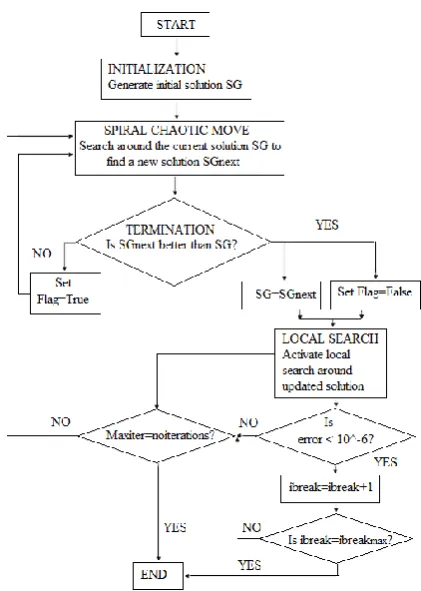
3. 1. Galaxy-based Search Algorithm (GbSA) The Galaxy-based Search Algorithm (GbSA) was first proposed by Hamed Shah-Hosseini [11, 12]. It is an optimization technique that tries to mimic the arms of spiral-based galaxies moving to avoid the local optima. The flowchart of the GbSA is given in Figure 2. In general the GbSA is comprised of two main components, namely the Spiral Chaotic Move and Local Search.
In normal working state, the Spiral Chaotic Move is iterated for MaxRe p number of times. For searching better solution, the Spiral Chaotic Move uses a spiral movement enhanced by a chaotic variable generated by Next Chaos.
The chaotic sequence is generated by the logistic map: ,... 2 , 1 , 0 ) 1 (
1
x x n
xn n n (14)
In this paper, λ= 4 and x0 = 0.2.
Figure 2. The flowchart of GbSA
Once a better solution compared to the current solution is obtained, the function is terminated and the control function is transferred to the local search. 3. 2. Fuzzy-GbSA-PFL-PID Controller The gains of the suggested PID controllers are chosen in such a way to minimize the observed pursuit errors (e1 and e2). Equation (13) shows the gains of the PID controllers are affected by the reference values of the current and voltage, which in turn these values depend on the amount of the predicted reactive power to improve the voltage stability. The prediction technique for the reactive power has been discussed in reference [13]. According to the predicted reactive power (Qr), the reference current (iq(r)) is evaluated as follows [8]:
d q
e Q
i r
r 3
2
)
( (15)
Based on the obtained iq(r), the DC voltage reference (vdc(r)) is evaluated by Equation (16).
) ( ) ( )
(r d qr qr
dc v Ri Li
v (16)
By calculating the reference values of iq(r) andvdc(r), the
gains of the controllers should be chosen in such a way
to minimize the observed pursuit errors. In this paper, a galaxy-based search algorithm has been employed for tuning the PID controllers gains in such a way that the step response characteristics including the maximum overshoot (Mp), the SS error (Ess), the settling time (ts) and the rising time (tr)to be improved. Improvement of both rise and settling times increase the speed of the system response, but given that by reducing the rise time, initial speed response of the controller will improve and by reducing the settling time, the final part of the response experiences the steady state in a shorter time, so in order to enhance the speed of the controller's response (from beginning to end), both rise time and settling time have been considered in the objective function. According to above explanations, a multi objective function is defined for the optimization problem as follows:
s r ss
P a E at a t
M a
F 1 2 3 4 (17)
where, a1,a2,a3 anda4 are the weighting coefficients of the objectives.
When there are various objectives to be considered simultaneously, a comparison is needed to get the best answer. Since various options of the objective function are in different ranges, all the objectives are normalized in the same range to prevent the convergence problem [3]. A fuzzy system is used for homogenization the objectives. Since the different parts of the objective function are in different rates, all the values should be normalized in the similar range [14-16]. Each objective has a membership function (μ) that indicates the efficacy of its objective as Equation (18):
min max
max min max max
min
) (
) ( ,
0
, ) ( ) ( , 1
)
( i ij i
ij i
i i
ij i
i ij
fij f f X f
X f f
f f
X f f
f X f
X
(18)
where fij is the obtained value for the ith part of the objective function in the jth answer, min
i
f is the best answer of in the single objective optimization for the ith objective function and fimax is the worst answer which of the single objective optimization for the ith objective function.
The fuzzified objective functions are gathered into a fuzzy objective function as follows:
4
1 ) ( . ) (
i fij i X
a X
F (19)
which the four objectives are considered to have equal importance.
The combination of fuzzy systems and GbSA that were described in previous sections is used to find an optimal tuning of the controller in the following steps:
Step 1: Read all required data of distribution network; set the GbSA parameters. Produce an initial solution randomly.
Step 2: For each GbSA iteration process, run the power flow program [3], compute the fuzzy objective degree (i.e. Mp, ts, tr, and Ess). Compute the fitness value of the fuzzified objective function and store the current solution as the best answer.
Step 3: Update the GbSA parameters and consider it as a new solution. For the new solution, run the process in Step 2.
Step 4: If the fitness value of the new solution is better than the best solution, then replace it.
Step 5: If the stopping criteria is reached, go to Step 6, otherwise go to Step 3 and repeat the process.
Step 6: Defuzzify the best solution to obtain the optimum PID gains for the controller.
Step 7: Terminate the algorithm.
4. SIMULATION RESULTS AND DISCUSSION
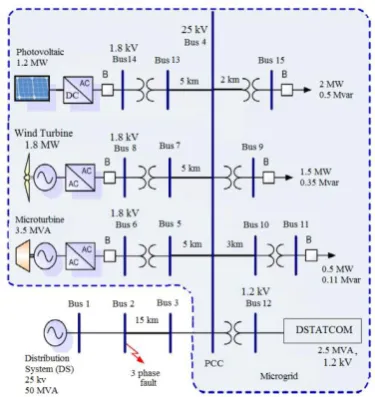
The performance of the proposed controller has been investigated on a modified test power system with the proposed microgrid [17]. This power distribution system operates at 25 kV and 50 Hz and includes a different of DG Resources units (DG based on fossil and renewable fuels) and variety types of loads. The test system presented in literature [17] has been modified by adding three new buses with a Photovoltaic (PV) array at bus 14, 7 kilometer additional transmission line between buses 13 and 15. Also a new load (2MW + 0.5 Mvar) was assumed at bus 15 and at bus 12, the capacity of DSTATCOM is considered as 2.5 Mvar. This test system has been shown in Figure 3. As shown in this figure, bus 4 is point of common coupling (PCC). For this test system with microgrid, three types of the DG units including wind turbine, PV and micro-turbine are connected to bus 8, bus 14 and bus 6 respectively, to supply the loads of buses 9, 15 and 11 and the over plus power was injected to the Distribution System (DS).
Two different cases have been assumed to analysis the step response characteristics of the voltage at bus 12 (PCC) as follows:
Case (a): The voltage response at bus 12 to a sudden voltage step of 2% in
v
dc while the DSTATCOM has been equipped with the PFL-PID controller without optimization by the fuzzy-GbSAtechnique.In this case, the gains should be selected such that the output follows the reference values to minimize the error.
In this study, the gains are selected as follows:
r
p iq
k1 2 , k1i iqr2 and k1d 2/3iqr3 and k2p2vdcr , k2i vdcr2 and k2d 2/3vdcr3.
As it is seen, the gains of the controllers depend on the reference values (i.e., vdcr and iqr). These reference values are calculated by Equations (15) and (16).
Case (b): The voltage response at bus 12 to a sudden voltage step of 2% in
v
dc while the DSTATCOM uses the PFL-PID controller tuned by the fuzzy-GbSA technique.The optimized gains of two PID controllers (k1p, k1i , k1d, k2p, k2i, k2d) have been given in Table 1 for two cases (a) and (b). The calculated ts, tr, Mp and Ess values have been presented in Table 2.
For case (a), from Table 1 it can be realized that by using the controller without applying optimization, the first PID gains are computed as k1p0.7375,
3846 . 0 1i
k and k1d 0.0963 and the second PID gains are calculated as k2p0.4629, k2i0.5126 and
1975 . 0 2d
k . Also for this case from Table 2, tr, ts, Mp and Ess values are obtained as 0.4128 (s), 2.0316 (s), 0.0386 %, and 2.5102
respectively.
For case (b), as shown in Table 1, the first PID gains are obtained as k1p0.6835, k1i0.2194 and k1d 0.1509
and the second PID gains are calculated as k2p0.8453,
3138 . 0 2i
k and k2d 0.1871. For this case, from Table 2, tr, ts, Mp and Ess values are obtained as 0.4094 (s), 0.6390 (s) 0.0136 % and 2.03104
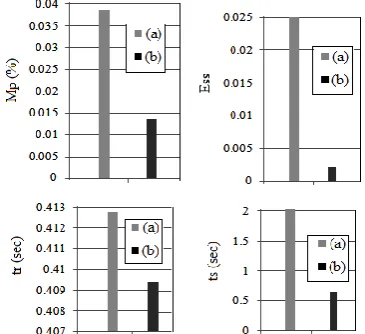
respectively. Figure 4 shows a graphical comparison between the step response parameters for the both cases (a) and (b).
From this figure and Table II it can be understood that the controller parameters tuned by the proposed method significantly improve the four step response characteristics i.e. Mp, ts, tr and Ess values.
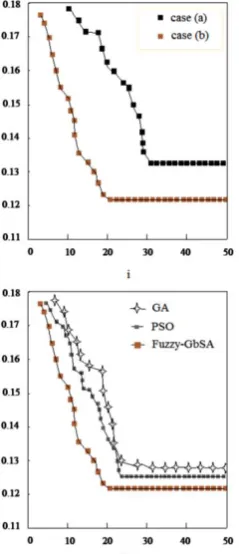
The convergence behavior of the fitness function is presented in Figure 5 i) for both case (a) and case (b). As seen in this figure, the final fitness value is 0.1319 and 0.1210 for case (a) and case (b) respectively. Also, from this figure, it can be comprehended that case (b) is converged to a better optimal fitness value compared to case (a).
The GbSA parameters have been heuristically chosen through a trial and error process as follows:
0 ,01,0.001,r0.001,L70,
120
kMAX and MaxRep=120. In this case, the total CPU time (in seconds) spent for running the proposed algorithm in Matlab (2013b) software was 32.19 s.
It should be mentioned that the experiments are performed on a laptop with a Pentium IV CPU running Microsoft Windows 7 operating system.
Case (b) is simulated using GA [18] and PSO [19] methods, to compare with the results obtained by proposed fuzzy-GbSA technique.
Table 3 represents a comparison between the obtained step response characteristics using GA, PSO and proposed fuzzy-GbSA for case (b). From this table, it is observed that the performance of the fuzzy-GbSA is better compared to GA and PSO, in improving of all terms of the settling time, the maximum overshoot, the rise time and the steady-state error of the step response.
The convergence behavior of the fitness function using GA, PSO and proposed method (fuzzy-GbSA) has
TABLE 1. The computed gains for the PID controllers based
on cases (a) and (b)
Case (b) Case (a)
0.6835, 0.8453 0.7375, 0.4629
p
k1 ,k2p
0.2194, 0.3138 0.3846, 0.5126
i
k1 ,k2i
0.1509, 0.1871 0.0963, 0.1975
d
k1 ,
d
k2
TABLE 2. The step response parameters (Mp, ts, tr and Ess
values) for cases (a) and (b)
Case (b) Case (a)
0.0136 0.0386
Mp
0.4094 0.4128
tr
0.6390 2.0316
ts
4 10 03 .
2
2 10 5 . 2
Ess
Figure 4. Comparison of the four step response characteristics
for the two cases (a) and (b)
been compared in Figure 5ii).
As shown in this figure, for GA technique the final fitness value is 0.1275and for the PSO method it was equal to 0.1252 while the corresponding obtained value for the proposed method is equal to 0.1210. Therefore, it can be concluded that proposed technique has a better optimal fitness value compared to the GA and PSO methods.
Furthermore, the effectiveness of the proposed controller can be investigated at the time of occurrence of fault within the distribution system. If the fault remains for a long time, it may lead to voltage instability within the network.
In this condition, it is vital to preserve the voltage profile of the PCC to arrest voltage instability. This task can be achieved by interchange adequate energy between the DSTATCOM and distribution system whenever needed. To investigate the effectiveness of the proposed controller in the time of occurrence of fault within the distribution system, it was assumed a fault is happened at bus 2 at t=1 sec and will be disappeared at t=1.2 s.
TABLE 3. Comparison of the obtained step response
characteristics using GA, PSO and proposed fuzzy-GbSA methods for case (b)
GA, PSO and Fuzzy-GbSA results Item
0.0259, 0.0179, 0.0136 Mp
0.4293, 0.41521, 0.4094 tr
0.6453, 0.6407, 0.6390 ts
, 10 2 . 4 4 , 10 7 . 3 4
4 10 03 .
2
Figure 5. The convergence process of the objective function (i: for both cases (a) and (b) based on proposed method, and (ii: using GA, PSO and fuzzy-GbSA methods for case (b)
Three various cases are proposed to evaluate the performance of the proposed tuned controller in the event of the fault as follows:
Case (I): using a conventional controller for controlling the DSTATCOM [12].
Case (II): using the PFL-PID controller for controlling the DSTATCOM without optimization by the fuzzy-GbSA.
Case (III): using the PFL-PID controller tuned by proposed fuzzy-GbSA method for controlling the DSTATCOM.
For the three cases, the voltage profile of the PCC has been shown in Figure 6. As can be seen in Figure 6, for case (I), the distribution system cannot return to the pre-fault condition after disappearance of fault.
For case (II), the network observes a better voltage profile. Although the voltage profile is returned to the pre-fault condition but this process takes about a few tenths of a second.
For case (III), the distribution system experiences a better voltage profile compared to case 2 at the fault duration time and the voltage profile can return to the pre-fault condition without delay. Therefore, on both fault and clearing times, the PFL-PID controller tuned by the fuzzy-GbSA technique has a better performance compared to the conventional or the PFL-PID controller without optimization by the fuzzy-GbSA method.
Figure 6. PCC voltage profile for three cases I, II and III
5. CONCLUSION
This paper presents a nonlinear PFL-PID controller for the DSTATCOM tuned by a combination of fuzzy system and GbSA approach. Two various cases were assumed to analysis the step response characteristics of the voltage at PCC and three different cases were considered to evaluate the performance of the proposed controller in the event of the fault within the network. The performance of the proposed controller was evaluated by testing it on a modified test power system with the proposed microgrid. Analyzing the step response of the voltage of the DSTATCOM indicates that tuning the PFL-PID controller parameters using the fuzzy-GbSA method, can significantly improve the rise time, maximum overshoot, settling time and steady state error values compared to the controller without optimization with the fuzzy-GbSA. Without tuning the parameters of the controller, the obtained fitness value was 0.1319 while the fitness value 0.1210 achieved when the parameters of the controller were tuned using the proposed technique.
It can be concluded the proposed method with the fitness value equal to 0.1210 has a better performance compared with the GA and the PSO algorithms with the fitness equal to 0.1275 and 0.1252 respectively.
Furthermore, the controller was evaluated in the event of fault within the system. In this condition, the PFL-PID controller tuned by fuzzy-GbSA method provides better results compared to the conventional controller or the PFL-PID controller without optimization by the fuzzy-GbSA method on both fault duration and after clearing times.
7. REFERENCES
2. Jamila, E. and Abdelmjid, S., "Comparative study of the performance of static synchronous compensator, series compensator and compensator /battery integrated to a fixed wind turbine", International Journal of Engineering, Transactions A, Vol. 29, No. 4, (2016), 581-589.
3. Tolabi, H.B., Ali, M.H. and Rizwan, M., "Simultaneous reconfiguration, optimal placement of dstatcom, and photovoltaic array in a distribution system based on fuzzy-aco approach", IEEE Transactions on Sustainable Energy, Vol. 6, No. 1, (2015), 210-218.
4. Zendehdel, N., "Robust agent based distribution system restoration with uncertainty in loads in smart grids", Journal of Operation and Automation in Power Engineering, Vol. 3, No. 1, (2015), 1-22.
5. Gao, F. and Iravani, M.R., "A control strategy for a distributed generation unit in grid-connected and autonomous modes of operation", IEEE Transactions on Power Delivery, Vol. 23, No. 2, (2008), 850-859.
6. Kumar, C. and Mishra, M.K., "A voltage-controlled dstatcom for power-quality improvement", IEEE Transactions on Power Delivery, Vol. 29, No. 3, (2014), 1499-1507.
7. Singh, B., Dube, S.K. and Arya, S.R., "An improved control algorithm of dstatcom for power quality improvement", International Journal of Electrical Power & Energy Systems, Vol. 64, No., (2015), 493-504.
8. Mahmud, M., Pota, H. and Hossain, M., "Nonlinear dstatcom controller design for distribution network with distributed generation to enhance voltage stability", International Journal of Electrical Power & Energy Systems, Vol. 53, (2013), 974-979.
9. Kumar, D., Jejurikar, N. and Chaturvedi, P., "Modeling and simulation of d-statcom for voltage regulation imparting various control strategies", in Proceedings of the 2014 National Conference on Trends & Challenges in Applied Science and Engineering (NCASE), SATI Vidisha, January., (2014), 1-5. 10. Isidori, A., "Nonlinear control systems, Springer Science &
Business Media, (2013).
11. Qi, L., Jiang, D. and Wang, Z., "A modified discreet particle swarm optimization for a multi-level emergency supplies distribution network", (2016).
12. Sahu, D.J. and Dalai, R.P., "A comparative analysis for conventional pid controller with fuzzy logic controller and genetic algorithm based controller", International Journal of Multidisciplinary Research and Development, Vol. 2, No. 4, (2015), 483-486.
13. Mahmud, M., Hossain, M., Pota, H. and Nasiruzzaman, A., "Voltage control of distribution networks with distributed generation using reactive power compensation", Industrial Electronics Society, IEEE., (2011), 985-990.
14. Li, D. and Ranjitkar, P., "A fuzzy logic‐based variable speed limit controller", Journal of Advanced Transportation, Vol. 49, No. 8, (2015), 913-927.
15. Moghadam, G., Raissi Ardali, G. and Amirzadeh, V., "Developing new methods to monitor phase ii fuzzy linear profiles", Iranian Journal of Fuzzy Systems, Vol. 12, No. 4, (2015), 59-77.
16. Sedighizadeh, M., "Optimal reconfiguration and capacitor allocation in radial distribution systems using the hybrid shuffled frog leaping algorithm in the fuzzy framework", Journal of Operation and Automation in Power Engineering, Vol. 3, No. 1, (2015), 56-70.
17. Molina, M.G. and Mercado, P.E., "Control of tie-line power flow of microgrid including wind generation by dstatcom-smes controller", Energy Conversion Congress and Exposition, IEEE., (2009), 2014-2021.
18. Yusoff, T.A.F.K., Atan, M.F., Rahman, N.A., Salleh, S.F. and Wahab, N.A., "Optimization of pid tuning using genetic algorithm", Journal of Applied Science & Process Engineering, Vol. 2, No. 2, (2015), 97-106.
Dynamic Modeling and Controller Design of Distribution Static Compensator in a
Microgrid Based on Combination of Fuzzy Set and Galaxy-based Search Algorithm
A. Lashkar Araa, H. Bagheri Tolabib,R. Hosseinic
a Department of Electrical Engineering, Dezful Branch, Islamic Azad University, Dezful, Iran
b Department of Electrical Engineering, Khorramabad Branch, Islamic Azad University, Khorramabad, Iran c Department of Computer Engineering, Shahr-e-Qods Branch, Islamic Azad University, Tehran, Iran
P A P E R I N F O
Paper history: Received 08 April 2016
Received in revised form 01 August 2016 Accepted 25 August 2016
Keywords: Distribution System
Distribution Static Compensator Galaxy-based Search Algorithm (GbSA) Fuzzy Sets
Optimization
ديكچ ه
کی ِلبقه يیا ُدٌٌک لرتٌک
کی یارب دیدج یطخ ریغ DSTATCOM
ُدٌکارپ دیلَت یبّدحاٍ لهبؼ ِکبؼ سیر کی رد
(DG) .دّد یه ِئارا دحاٍ کبدیف یزبظ یطخ یرَئت ضبظا رب یدبٌْؽیپ غٍر
(FLT) رتٌک زا ٍ ُدؼ یحارط ُدٌٌک ل
یبّ PID .درب یه ُرْب غجره شبتلٍ ٍ ىبیرج یببیدر ٍ نیظٌت یارب یبضف رد َجتعج نتیرَگلا ٍ یزبف نتعیظ بیکرت زا
ىبؽکْک (GbSA) یبّ ُدٌٌک لرتٌک یبّرتهاربپ یزبظ ٌِیْب رَظٌه ِب PID
.تظا ُدؼ ُدبفتظا ىبؽً ُدهآ تظد ِب جیبتً
ه یبّ یگصیٍ دٌّد ی ُدٌٌک لرتٌک ِلپ خظبپ
تلبح یبطخ ٍ ػْج ِفبضا رثکادح ،تعؽً ىبهز ،سیخ ىبهز( یدبٌْؽیپ
.تظا ِتفبی دَبْب یْجَت لببق رَط ِب )ربگدًبه دَؼ یه ُدّبؽه ٍُلاػ ِب
ُدٌٌک لرتٌک نیظٌت یارب یدبٌْؽیپ غٍر ، یحارط
ِب رجٌه ُدؼ شبتلٍ رتْب نیظٌت
DC رد دَجَه ىزبخ DSTATCOM
سیً ٍ ُدؼ ُدٌٌک لرتٌک بب ِعیبقه رد یرتْب درکلوػ
کیظلاک PID ُدٌٌک لرتٌک بی ٍ کیتًش نتیرَگلا بب ُدؼ نیظٌت
(GA) تارذ مبحدزا یزبظ ٌِیْب نتیرَگلا بی ٍ (PSO)
.دراد بطخ یزبظ فرطرب زا طپ سیً ٍ بطخ عَقٍ تلبح ٍد رّ رد
![Figure 1. The circuit diagram of a six pulses DSTATCOM [8]](https://thumb-us.123doks.com/thumbv2/123dok_us/213882.2015809/2.595.107.235.667.737/figure-circuit-diagram-pulses-dstatcom.webp)