Over Expression of Biologically Active Interferon Beta
Using Synthetic Gene in E. coli
M. Ghane,
1,*B. Yakhchali,
2and M. Khodabandeh
21Depaptment of Biology, Faculty of Science, Islamic Azad University, Islamshahr
Branch, Tehran, Islamic Repablic of Iran
2Fermentation Group, National Institute of Genetic Engineering and
Biotechnology (NIGEB), Tehran, Islamic Repablic of Iran
Abstract
In this study, our previously reported novel synthetic gene encoding 166
residues of interferon-
b
was used for an efficient expression of IFN-
b
. The
synthetic gene was cloned into pET21a expression vector and transferred into E.
coli. Recombinant protein was over-expressed in the
E. coli.
Identity of the
recombinant protein was confirmed by western blot analysis. The recombinant
protein was biologically active as evaluated by inhibition of cytopathic effect
(CPE) formation of Vesicular stomatitis virus (VSV) on the HeLa cells. The effect
of three factors including inducer concentration, induction time based on optical
density of the culture and induction duration on the expression of rIFN-β was
investigated by Taguchi method. Analysis of variance presented that IPTG of 0.5
mM and induction duration of 4 h and induction time of OD
600=1 had more effect
on IFN-β production. Recombinant IFN-
b
expression with the above condition
yielded 28% of the total
E. coli
proteins.
Keywords: Synthetic gene; Interferon-β; Expression; Taguchi method
*Corresponding author, Tel.: 09125133815, Fax: +98(228)2363074, E-mail: [email protected] Introduction
Human interferon beta (IFN-β) is an antiproliferative, antiviral and immunomodulatory glycoprotein that is typically produced by fibroblasts and has already been used to treat viral hepatitis, glioma, melanoma and recently multiple sclerosis (MS) [14,15]. First line production of the IFN-β was mainly limited to human cell sources, by exposing fibroblasts to double-stranded RNA [18]. Besides the low production, there are also various problems in the purification of this biomolecule. With the development of recombinant DNA technology,
In our previous work a novel synthetic gene was constructed according to E. coli codon usage and expressed as fusion protein with T7 gene 10[4]. Besides the low expression, there are also various problems in the separating of the rIFN-β from the T7 gene 10 protein. In this work, attempt was carried out to produce high level of rIFN-β as single protein. To do this, the RNA secondary structure of the synthetic gene in different expression systems was analyzed and the best one was chosen. This paper describes high level expression of IFN-β from the novel synthetic gene in the T7 promoter/ RNA polymerase system.
Materials and Methods
Bacterial Strains and Plasmids
Plasmids pGEM-5Zf from Promega (Australia) and pET21a (Novagene USA) were used for cloning and expression of INF-β gene respectively.Escherichia coli K12 DH5α and BL21 DE3 strains were also used as host for cloning and expression experiments respectively. All chemicals were from Merck.
Cloning of the Synthetic Gene
The previously synthesized IFN-β gene [4], was amplified using primers Intb1: 5′GGAATTC CATATGAGCTACAACCTGCTGG3′ with aNdeI site in its 5′ end and Reverse M13/PUC: 5′CAG GAA ACA GCT ATG AC3′ and Pfu DNA polymerase. PCR amplification was performed in the following conditions: Initial 5 min at 94°C followed by 30 cycles of 30s at 94°C, 30 s at 52°C and 30s at 72°C and 10 min at 72°C for final extension using thermal cycler (Techne, Flexigene). The PCR product was extracted from a 1% agarose gel (Merck) using high pure plasmid purification kit (Roche, Germany) according to manufacturerُs instruction. The eluted DNA was then cloned into EcoRV digested pGEM5Zf cloning vector using T4 DNA ligase (Roche, Germany) according to routine protocols [21]. The recombinant plasmid containing the expected size insert was sequenced by dideoxy chain termination method. The inserted gene was excised by restriction digestion using NdeI and HindIII (Roche, Germany) and subcloned into pET21a, an expression vector (Novagen, USA) which was previously linearized via digestion with the same enzymes. Identity of the subcloned gene in pET21a was confirmed through colony PCR and restriction enzyme analysis [21].
Expression of Recombinant Protein in E. coli
In order to study the expression of synthetic IFN-β gene, BL21 strain ofE. coli K12 containing interferon beta gene was grown in LB medium with ampicillin (Roche, Germany) with the final concentration of 100 μg/ml at 37°C and the expression was analyzed as previously reported [4]. SDS-PAGE gels were scanned by densitometric gel scanner (Pharmacia Ultra scan XL) and the ratio of each protein was determined by calculating the area under the peaks.
Over-Expression Condition
Taguchi method was used for optimization of expression condition. This method possesses the advantage that many factors can be examined simultaneously and much quantitative information can be obtained by only a few experimental trials[6, 23].
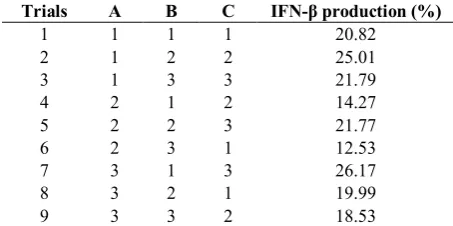
According to Taguchi’s orthogonal array, nine experiments were used to evaluate the effect of three variables: concentration of IPTG, induction time and induction duration which assumed to have significant influence on the recombinant protein expression in E. coli. In this experimental design theL9 orthogonal array was used to examine three factors in three levels (Tables 1 and 2). All the experiments were carried out as duplicate. Calculations were performed using Design Expert software (Version 6.0.10, Stat-Ease Inc., Minneapolis, MN, USA).
Table 1. Variables and their levels employed in the Taguchi’s robust design method for optimal IFN-β production byE. coli
Factors Level 1 Level 2 Level 3 A: IPTG concentration (mM) 0.5 0.75 1
B: induction time (OD600) 0.5 1 1.5
C: induction duration (hours) 4 6 8
Table 2. L9 orthogonal array of Taguchi experimental design and corresponding IFN-β productions
Trials A B C IFN-β production (%)
1 1 1 1 20.82
2 1 2 2 25.01
3 1 3 3 21.79
4 2 1 2 14.27
5 2 2 3 21.77
6 2 3 1 12.53
7 3 1 3 26.17
8 3 2 1 19.99
9 3 3 2 18.53
Purification of Recombinant IFN-β
The induced cells were harvested by centrifugation (BEKMAN J-6M) at 11800g for 10 min at 4°C and then resuspended in lysis buffer (50 mM EDTA, 50 mM tris, 0.1% triton X-100) and disrupted twice with a homogenizer (Niro Soavi S.P.A,Italy) at 6000 psi, in order to release the inclusion bodies and make them available for recovery by centrifugation at 11800g for 30 min at 4°C. The inclusion bodies were dissolved in denaturating solution (50mM Tris-base, pH=10.5) and stirred for 1 hour at room temperature. The resulting suspension was then centrifuged at 11800g for 30 min at 4°C, and the supernatant was used for further purification. Refolding was conducted by decreasing the pH to 9 and stirring overnight at room temperature. After refolding, HCl (1N) was added slowly to the solution to decrease the pH to 8. The precipitation of the rIFN-β was measured in the pHs 8-9 (the isoelectric point (PI) of IFN-β is 8.9[25]. The suspension was then centrifuged at 11800 g for 30 min at 4°C and the pellet was dissolved in Tris-base (pH 7.5) .The concentration of protein was determined by the Bradford method [3].
Antiviral Activity of Recombinant Human IFN-β Antiviral activity of rhIFN-β was tested by cytopathic effect (CPE) inhibition method on HeLa cells (gift from Dr Shafyi, Razi Institute, Iran) which exposed to Vesicular stomatitis virus (gift from Dr Shafyi, Razi Institute, Iran) according to protocol described earlier [11]. HeLa cells were seeded in 96 well plate at a density of 1.5×10⁴cells/well/100μl Dulbeccos modified Eagles minimum essential medium (DMEM) (GIBCO,USA) supplemented with 5% fetal calf serum (FCS) (GIBCO,USA) and kanamycin/neomycine (50μg/ml) (Roche, Germany) and incubated at 37°C. The following day serial dilution of rhIFN-β test samples and commercial IFNB-1b (Betaseron, Shering, Germany) were added and incubated at 37°C for 24 hours. In the next day 50 μl of VSV virus (100 CCID50) was added to each well except cell control wells. CPE was investigated 2 days after viral challenge in compare with control cell and control virus using an inverted microscope.
Results
Cloning and Expression of IFN -β Synthetic Gene A previously constructed optimized synthetic gene with preferred codon usage ofE. coli [4] was used for production of rhIFN-β. RNA secondary structure of the
synthetic gene in different expression system was analyzed with RNA structure software (www.genebee.msu.su/services/rna2_reduced.html). The analysis of RNA structure in different expression systems revealed that the synthetic gene in the pET21a had theoretically most suitable structure for expression (data not shown). The full length gene was amplified from plasmid pYG81 [4] using Intb1 and M13 Rev primers with Pfu DNA polymerase and sub-cloned into pGEM-5Zf cloning vector to produce plasmid pYG86. The sequencing results of the plasmids from white colonies revealed the authenticity of the cloned gene.
To construct the expression plasmid, the NdeI/HindIII DNA fragment (~510 bp) containing IFN-β gene from pYG86, was inserted into NdeI/HindIII sites of the pET21a expression vector down stream of the T7 promoter to produce recombinant plasmid pYG87. The recombinant plasmid was then transferred into DH5α strain ofE. coli K12. The transformants were screened by colony-PCR technique. One of the selected clones was digested with NdeI and HindIII restriction enzymes which a fragment of the correct size (~510 bp) was obtained. SDS-PAGE analysis of total lysate of inducedE. coli BL21(DE3) (pYG87) showed a band in the desired range, with a MW of ~20KDa and parallel to standard rIFN-β (Fig. 1). The protein identity was verified by Western blot analysis (Fig. 2). The assay revealed that the recombinant E. coli BL21(DE3) (pYG87) produced a protein that was strongly and specifically recognized by the antibody against IFN-β. The rIFN-β produced led the formation of cytoplasmic inclusion bodies. Then studies for recovering, re-folding and purifying were further considered.
Optimization of Expression Condition
Figure 1. SDS-PAGE analysis of total cell lysate of BL21 strain ofE. coli harboring pYG87. Lane 1: Protein molecular weight marker (14.4, 21.5, 26.6, 39.2, 66.2, KD respectively), lane 2 commercial IFN-β (positive control) , lane 3-5: BL21 strains of E. coli harboring pYG87 after induction, lane 6 BL21 strain ofE. coli harboring pYG87 before induction.
Figure 2. Western blot analysis of the expressed human IFN-β inE. coli using rabbit anti human IFN-β antibody. Lane 1 commercial IFN-β (positive control), lane 2-4: BL21 strains of
E. coli harboring pYG87 after induction, lane5 BL21 strain of
E. coli harboring pYG87 before induction.
10 20 30
0 1 2 3 4
Levels
M
ai
n
E
ffe
cts
Figure 3. Main effects of three factors IPTG (¨), induction time according to optical density (¡), induction duration () in three levels on the expression of hrIFN-β.
mg/L with assumption that the OD600 = 1 of theE. coli culture contains about 109 cell/ml and considering the dry weight of 2.8*10-13 gr/cell with 55% total dry weight of protein forE. coli [12].
Purification of Recombinant IFN-β
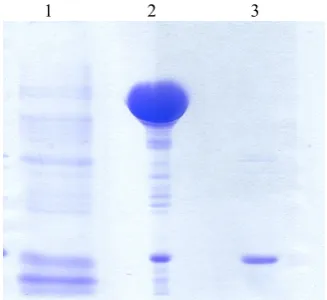
A purification procedure based on the acid precipitation of the rIFN-β at its PI was used for purification of the rhIFN-β. Based on the PI, a series of experiments were conducted to evaluate the effect of the pH on the removal of the host derived proteins. The inclusion bodies were dissolved and the proteins in the solution were refolded at pH 9 overnight. Decreasing the pH of the solution to 8.1 resulted in the highest precipitation of the rIFN-β. It is important to note here that the resultant precipitate must be redissolved prior to chromatography or any further purification procedures. The purification efficiency arising from such solubilization is 30%. The optimization of redissolving condition will increase the yield of the product. The electrophoretic pattern and western blot analysis of partial purified rIFN-β is shown in Figures 4 and 5 respectively.
Biological Activity of r-IFNβ
Biological activity of partially purified rhIFN-β was tested by cytopathic effect (CPE) inhibition method on HeLa cells exposed to Vesicular stomatitis virus (VSV virus). As shown in Figure 6, rhIFNβ inhibited CPE formation of VSV virus on Hela cells in compare with negative control as observed for standard Interferon (positive control).
Figure 4. SDS-PAGE analysis of the partial purified rhIFN-β based on pH precipitation according to PI of IFN-β. Lane 1 supernatant in pH 8.1, lane 2 standard IFN-β, lane 3 pellet in pH 8.1 (partially purified rhIFN-β).
1 2 3 4 5 6
1 2 3 4 5
Figure 5. Western blot analysis of purified rhIFN-β. Lane 1 partial purified rIFN-β, lane 2 standard rhIFN-β.
Discussion
IFN-β is primarily known for its antiviral activity [2], but it also exerts antiproliferative and immuno-modulatory effects. Its beneficial effects on the frequency and severity of clinical exacerbations as well as on disease activity of patients suffering from relapsing-remitting MS were demonstrated [15,17]. Two types of recombinant IFN-β produced in eukaryotic cell (glycosylated) and E. coli (nonglycosylated) are biologically active and have been used for therapeutic purposes [1, 19]. Goeddel and co-workers (1980) were the first who reported expression of the recombinant IFN-β. Since then, various expression systems have been used in order to express the recombinant IFN-β in E. coli [7,10 and 20].In this study over expression of recombinant IFN-β in E. coli using a novel synthetic gene with preferred codon usage of E. coli under the control of T7 promoter was considered.
The constructed IFN-β gene [4] was expressed under the control of T7 promoter. The extracted protein from E. coli lysate reacted positively with rabbit IFN-β antisera. By optimization of the expression condition, the maximum concentration of rIFN-β (146 mg/L) was attained at 0.5 mM of IPTG, induction duration of 4 hours and induction of the culture at OD600=1 . As reported in previous works with native genes, the amount of rIFN-β production was always low. The amount of IFN-β production under the control of trp promoter was about 2-4% of total cell protein [7]. Warne et al. (1986) reported 7-9.1% and with modified trp promoter the yield of IFN-β production was about 11-14 %. Goeddel et al (1980) reported a maximum hINF-β production of 0.2 mg/L using the wild type gene cloned inE. coli while we produced 146 mg/L of rIFN-β. Skoko et al (2003) reported a maximum rhINF-β
A)
B)
C)
D)
production of 12 mg/L in Pichia pastorisculture while we produced 12 times more hINF-β. Recently Luz et al (2007) produced 61 mg/L of rIFN-β in E. coli using a synthetic gene and optimized culture conditions which are less than half of our production. The high level expression of IFN-β in this study as compared with previous works may be not only as a result of strong promoter but also because of the optimized synthetic gene with preferred codon usage ofE. coli. However the constructed synthetic gene with preferred codon usage of E. coli by Porter and coworker has shown no expression [20].The lack of expression in their construct was as a result of inappropriate mRNA secondary structure and inaccessibility of ribosome binding site and ATG start codon. As previously reported [9], the presence of ribosome binding site and ATG start codon in stem affects the efficiency of translation. The analysis of the mRNA of our designed synthetic gene with RNA secondary structure prediction software revealed that the ribosome binding site and ATG start codon was not in stem and had an appropriate structure, thus the third reason for high level expression might be suitable mRNA secondary structure. Our work has the highest level of rhINF-β expression reported in literature. Production level from this genetic structure could be increased with optimization of the culture medium and fermentation process condition as is in progress in our lab.
Purification of the rIFN-β was carried out based on the precipitation of the rIFN-β at its PI. Precipitation was occurred in a range of the pHs from 8.9 ( isoelectric point of the rIFN-β) to 8 which indicates the precipitation of the protein in the pHs other than its PI too. The highest level of precipitation was obtained in the pH= 8.1 which is different from PI reported for IFN-β [25].This procedure was used for purification of large quantities of rIFN-β. The partially purified recombinant protein was biologically active and inhibited the formation of the CPE in HeLa cells exposed to the VSV virus. These results indicate that the novel synthetic gene in pET21a expression vector provides an appropriate structure for the production of biologically active IFN-β that can be used for therapeutic application in the future.
Acknowledgement
This work was financially supported by grant number 204 from National Institute of Genetic Engineering and Biotechnology (NIGEB), Tehran, Iran. We would like to thank Dr Tabandeh for great help in statistic study, Dr sadigh for biological activity assay and Mrs Salek and Mr habib ghomi for their technical assistance.
References
1. Antonetti F., Finocchiaro O., Mascia M., Terlizzese M.G, Jaber A. A comparison of biological activity of two recombinant IFN beta preparations used in the treatment of relapsing-remitting multiple sclerosis. J Interferon Cytokine Res.22(12):1181-1184 (2002).
2. Balkwill F.R. Interferons. The Lancet. 333:1060-1063 (1989).
3. Bradford M.M. A rapid and sensitive for the quantization of microgram quantities of protein utilizing the principle of protein-dye binding. An analytical Biochemistry. 72: 248- 254 (1979).
4. Ghane M., yakhchali B., Khodabandeh M., Malekzadeh F. Design, construction and expression of a synthetic β-Interferon gene inE. coli.Pakistan Journal of Biological Sciences.9(15): 2922-2926 (2006).
5. Goeddel D.V., Shepard H.M., Yelverton E., Leung D., Crea R. Synthesis of human fibroblast interferon byE. coli .Nucleic Acid Research.8(18):4057-4073 (1980). 6. Houng J.Y., Liao L.H., Wu J.Y., Shen S.C., Hsu H.F.
Enhancement of asymmetric bioreduction of ethyl 4-chloro acetoacetate by the design of composition of culture medium and reaction conditions. Process Biochemistry,42, (1): 1-7 (2007).
7. Itoh S., Mizukimi T., Matsumoto T., Tatsunari N., Satto A. Efficient expression in E. coli of a mature and modified human Interferon-β.DNA3(2):157-165 (1984). 8. Luz M.T.,Paz M., Victor E., Balderas H., Emilio M.R.
Optimization of culture conditions for a synthetic gene expression in Escheria coli using response surface methodology: The case of human interferon beta.
Biomolecular Engineering.24(2):217-222 (2007). 9. Maarten H., Duin V.J . Control of translation by mRNA
secondary structure in E. coli. J.Mol.Biol. 244:144-150 (1994).
10. Mashko S.V., Veikjo V.P., Lapidus A.L., Lebedeva M.I. TGATG vector: A new expression system for cloned foreign genes inE. coli cells.Gene.88:121-126 (1990). 11. Meager A . Biological assays for Interferons.Journal of
Immunological Methods.261:21-36 (2002).
12. Neidhardt C.F.EscherichiaandSalmonella,cellular and molecular biology. Second edition. ASM press (1996). 13. Nishi T., Sato M., Saito A., Itoh S., Takaoka C.,
Taniguchi T. Construction and application of a novel plasmid ATG Vector for direct expression of foreign gene inE. coli. DNA.2(4): 265-273 (1983).
14. Noronha A., Toscas A., Jensen MA. IFN beta decrease T-cell activation and IFNγ production in multiple sclerosis.
J Neuroimmunol.46: 1605- 1621 (1993).
15. Ossage L.M., Sindern E., Patzold T. Immunomodulatory effects of IFN-β 1bin vivo: induction of the expression of transforming growth factor-β1 and its receptor type II.
Journal of Neuroimmunology.91: 73-81 (1998).
16. Ossage L.M., Sindern E., Patzol T. Immunomodulatory effects of IFN-β 1b in patient with multiple sclerosis.
International Immunopharmacology. 1(6): 1085-1100 (2001).
controlled trial.Neurology.43: 662-667 (1993).
18. Pestka S., Langer J.A., Zoon K.C., Samuel C.E. 1987, Interferons and their actions. Ann.Rev.Biochem. 56:727-77 (1987).
19. Piani D., Malkowski J.P. Recombinant hCG (OVIDREL) and recombinant Interferon-B1a (REBIF) (No 13. in a series of articles to promote a better understanding of the use of genetic engineering).Journal of Biotechnology.87: 279-284 (2001).
20. Porter A.G., Bell L.D., Adair J. Novel modified β-Interferons: gene cloning, expression, and biological activity in bacterial extracts.DNA.5(2)137-148 (1986). 21. Sambrok J., Russell D.W . Molecular cloning a
laboratory manual. Cold Spring Harbor Laboratory Press, NewYork, USA (2000).
22. Skoko N., Argamanta B., Kovacevic N., Tisminetzky S.G., Glisin V., Ljubijankic G . Expression and
characterization of human interferon –β1 in the methlotrophic yeast Pichia pastoris. Biotechnol. Appl. Biochem.38: 257-265 (2003).
23. Stone R.A., Veevers A. The Taguchi influence on designed experiments.J Chemometrics. 8: 103-10 (1994). 24. Taniguchi T., Kuryama Y.F., Muramatsu M. Molecular cloning of human Interferon cDNA.Proc. Natl. A. Sci. USA.77(7) 4003-4006 (1980).
25. Utsumi J, Yamazaki S, Kimora S, Hannda K, Shimazu T. Characterization ofE. coli- derived recombinant human interferon-beta as compared with fibroblast human interferon beta. J Biochem(Tokyo). 101(5) 1199-208 (1987).