Please cite this article as:A. Feizi, A. Aghagolzadeh, H. Seyedarabi,Using Combined Local Object Based Features and Cluster Fusion for The Behaviors Recognition and Detection of Abnormal Behaviors, International Journal of Engineering (IJE), TRANSACTIONS B: Applications Vol. 28, No. 11, (November2015) 1597-1604
International Journal of Engineering
J o u r n a l H o m e p a g e : w w w . i j e . i rA. Feizia*, A. Aghagolzadehb, H. Seyedarabia
aFaculty of Electrical and Computer Engineering, University of Tabriz, Tabriz, Iran
bFaculty of Electrical and Computer Engineering, Babol University of Technology, Babol, Iran
P A P E R I N F O
Paper history:
Received 16 August 2015
Received in revised form 11September 2015 Accepted 16October 2015
Keywords: Computer vision Behavior modeling Anomaly detection Spectral clustering Cluster fusion
A B S T R A C T
In this paper, we propose a novel framework for behaviors recognition and detection of certain types of abnormal behaviors, capable of achieving high detection rates on a variety of real-life scenes. The new proposed approach here is a combination of the location based methods and the object based ones. First, a novel approach is formulated to use optical flow and binary motion video as the location based feature. Next, the spectral clustering is implicated to categorize the similar behavioral features, and a new cluster fusion method which combines the obtained results of the clustering with the two lateral features is also proposed here. Then, in each cluster, the velocity and the trajectory are used as the object based features. In addition, the hidden Markov model is used as the behavior model. The most important outcome of this paper is that with the help of the mentioned object based features, we can detect the abnormal behaviors which cannot be identified using the previously reported location based features. Finally, a framework that performs abnormal behavior detection via statistical methods is presented.
doi: 10.5829/idosi.ije.2015.28.11b.07
1. INTRODUCTION1
In many public places a large number of surveillance cameras have been installed. Installing a large number of cameras has produced a huge surveillance video data. Unfortunately, many behaviors are not discovered in such a manual system due to intrinsic constraint from utilizing solely human operators eyeballing CCTV screens. To fulfill such a need, video content analysis paradigm is shifting from a fully human operator model to a machine-assisted and automated model. Recently, there is an increasing interest in automatic analysis of a video data. The field of activity recognition has obtained an increasing level of demand driven by applications in health monitoring and assistance, manufacturing and entertainment. Detecting anomalous behaviors and recognizing the normal ones is one of the basic tasks of deploying an intelligent video surveillance system. Generally, an anomalous pattern is one that is rare and
1*Corresponding Author’s Email: [email protected](A. Feizi)
dissimilar from the regular instances or behavior pattern which is not represented by sufficient samples in a training dataset but satisfies constraint of abnormal pattern.
1. 1. Related Work This section discusses and compares some existing approaches for behavior recognition and anomalous behavior detection.
To the best of our knowledge, many of the works which have been published are only object based or only location based. Object based methods are according to the detection and tracking of viewed objects [1]. In these methods, moving objects are detected and detected objects are classified and tracked over a certain number of frames. After the object tracking, the resulting paths are used to identify normal and anomaly behaviors. Since the features of interest are generally related to specific objects, we call these methods as the object based. In [2] a system that uses multi-feature object trajectory clustering algorithm, estimates normal behavior and detects anomalous
Application of
Combined Local Object Based Features and Cluster Fusion for the
behavior has been introduced. The proposed approach is based on clustering. The main problem of most methods is that they are not adapted to different environments. Predefining all normal and anomalous behaviors is not practical. Decomposition of the modeling task into a number of sub-tasks is one way to detect abnormal behavior in complex environments. The proposed algorithm in [3] uses behavior-based decomposition for modeling a complex behavior. A normal behavior pattern follows a typical order of atomic actions with certain duration. In [3] deviation from either one or both of these temporal characteristics is considered as an anomaly. This reference decomposes a complex
behavior pattern according to its temporal
characteristics and then the decomposed behavior is modeled using a cascade of dynamic Bayesian networks (CasDBNs). Instead of relying solely on trajectories, reference [4] proposes a hierarchical representation of video events. This reference defines video events at different semantic levels. The events deviating from rules are detected as anomalies. Analyzing human crowds is the purpose of [5]. In this paper, at first, optical flows are estimated using Lucas–Kanade (LK) algorithm [6] and then used for a clue to cluster human crowds into groups. Reference [7] proposes a method to model and learn the scene activities, observed by a static camera. This method uses a unified Markov chain Monte Carlo (MCMC)-based framework for generating the most likely paths in the scene and deciding whether a given trajectory represents an anomaly to the observed motion patterns. The proposed method in [8] by using only local motions as features, avoids tracking in the crowded scenes. This reference proposes three novel hierarchical Bayesian models. These models are more advanced than the existing topic models, such as LDA [9] and HDP [10].
However, the location based approaches utilize the features that describe the behavior patterns observed at a particular location. These methods, firstly, generate behavior models for each location and detect anomalies in the behavior patterns exhibited in different locations. Then, identify and track objects that generate the anomalous patterns. The proposed methods in [11-13] presents a new feature that is obtained from the activity observed in the video frame. This behavior feature has certain geometry independence properties. Using this simple feature, these references demonstrate the utility of geometry in multi-camera information processing by presenting its applications to two problems. This method is based on pixels of data, and so the computational complexity is high. Reference [14] presents an instant action recognition method, which is able to recognize an action in real-time from only two continuous video frames. This reference uses optical flow as feature. In [15] two measures to detect anomalous behaviors in an ensemble of classifiers are proposed by monitoring their decisions. This reference
finds a model of classifier coherence from the training set and, then determines how much each classifier deviates from this model. Whenever this deviation exceeds a predefined threshold value, the classifier is considered as anomalous.
1. 2. Our Contributions The object based methods due to the tracking of all the objects in the scene, are impractical for environments that the number of objects are large. On the other hand, in some environments the behavioral features associated with the object such as velocity are the reason for the abnormality. In the location based methods and those kinds of the lateral environments due to the lack of the mentioned features, detection of the abnormal behaviors is impractical.
The main contribution of this work is twofold; first, to tackle the problems mentioned above, we propose a novel algorithm to combine both object based and location based approaches. Second, a new cluster fusion algorithm is proposed to combine the results of the clustering.
introduction to the tracking based on particle filter is described in section 2. 6. Section 3 presents our approach in distinguishing anomalous behaviors. Tests and results are shown in section 4. Finally, conclusions are given in section 5.
2. MATERIALS AND METHODS
2. 1. Detection of Moving Pixels The simplest method to extract the foreground pixels is to find the difference between the current frame and the background model. However, this method is more sensitive to changes in brightness for surveillance applications and causes noise and undesirable effects in behavior modeling [18]. To eliminate this problem, a robust background modeling method presented in [19] is used. The purpose of the model is to obtain very recent information about the scene, continuously up dating this information to obtain the fast changes in the scene background. Let x x1, 2,...,xN be the N recent
samples of the intensity value for a given pixel in N sequent frames. Using these samples, the probability density function of the intensity value xt at time t for
this pixel, can be non-parametrically estimated using the Kernel estimator K as
1 1
( ) ( )
N
t t i
i
pr x k x x
N
(1)Kernel estimator function, K, is chosen to be a Normal functionN(0, ) , where represents the Kernel function bandwidth. Using this Kernel estimator function, the density will be estimated as
1
1 2
1
1 2
2
1 1
( ) ( ) ( )
(2 )
N
T
t d t i t i
i
pr x e x x x x
N
(2)Ifpr x( )t th, where th is a threshold value, then pixel
with value xt will be considered as a foreground pixel.
2. 2. Feature Extraction In this section, first, the binary motion video and the optical flow are described and then the method of obtaining behavior feature is presented.
2. 2. 1. Binary Motion Video Briefly, binary motion videos are the occupancy durations of the block of pixels by foreground objects. We utilize the background subtraction and extract the binary motion video in each frame. For binary motion video in each frame of the video, the blocks of pixels that observe moving objects are assigned a value of 1, and the blocks of pixels that observe the background are assigned a value of 0. Once the motion detection is performed, we obtain a binary motion video V (-, •), where V (i, r) denotes the binary value of block ‘i’ in frame number ‘r’. Here, V (i, r) =1 if block ‘i’ undergoes a motion at time ‘r’ and V (i, r) = 0, otherwise.
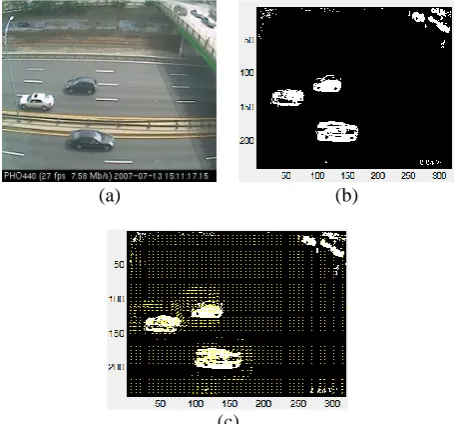
2. 2. 2. Optical Flow Optical flow is a feature that has many applications in behavior recognition. The goal of optical flow estimation is to compute an approximation to the motion vector from time-varying image intensity. In this paper, we use optical flow as feature. We compute optical flow vectors using the method proposed in literature [6]. There is high computational complexity for estimation of the optical flow for the total pixels in the frame. Therefore, to reduce the computation complexity, we use background subtraction method for detection of the moving pixels and compute the optical flow only for these moving pixels. Optical flow for sample frame is shown in Figure 1.
2. 3. Behavior Feature We now propose behavior feature of each pixel using binary motion video and optical flow.
2. 3. 1. Behavior Definition Using Binary Motion Video Consider the proposed activity features for block‘i’, a sequence of ones and zeros:
( ( ,1), ( ,2),..., ( , )
i
V V i V i V i T (3)
Let i n
B (busy rate) denotes the length of nth set of
consecutive ones in Vi and i n
I (idle rate) denotes the length of the nth set of consecutive zeros inVi. For
each block ‘i’, ( i, i) n n
B I tuples are samples of a 2-dimensional distribution. In this work, the fundamental distribution that produces the defined (B Ini, ni) tuples is considered as the behavior observed at block ‘i’.
(a) (b)
(c)
Figure 1. Optical flow for sample frame. (a) Sample frame (b)
2. 3. 2.Behavior Definition Using Optical Flow
Behavior feature of each pixel using optical flow is proposed. For several frames in training video, optical flow vectors are obtained and the average of all optical flow vectors in a pixel is considered as the behavior feature. The optical flow vectors are split into the horizontal channel (Fx) and the vertical channel (Fy). Fx
is the average of all optical flow vectors in a pixel in the horizontal direction and Fy is the average of all optical
flow vectors in a pixel in the vertical direction. Therefore, for each pixel there is a vector F= (Fx, Fy).
The proposed behavior feature in this paper is a location-based feature.
2. 4. Clustering For anomalous behavior detection, first we need to learn behavior models. There are many blocks of pixels in a frame, so we need to learn a large number of behavior models. Learning these many models poses computational challenges. To reduce the number of models that need to be learned and thus reduce the computation complexity, we use behavior clustering in which the blocks of pixels that exhibit similar behavior models are clustered together. In this paper, two feature spaces are used for clustering.
In optical flow feature space, the features F= (Fx, Fy)
for each block of pixels is used for clustering. However, in the binary motion video feature space, first the coordinates of block of pixels i in the busy-idle space,
(B Ii, i), is obtained.
Let
1 , si
i i n n n
B I
be the set of busy-idle samples for block of pixels i. Define
1 1
1
1
,
i i
s s
i i i i
n n
n n
i i
B
B
I
I
s
s
(4)as the mean busy and idle rates for block of pixels i.
2. 4. 1. Affinity Matrix In order to make spectral clustering, we must measure the affinity among block of pixels. Affinity matrix is defined as
(1,1) (1, 2) ... (1, ) (2, 2) ... (2, )
( , )
A A A N
A A N
A
A N N
(5)
In this matrix, ∗ shows symmetric values; N displays the full number of block of pixels. Any entry of this matrix is calculated as:
2 max{ ( , ), ( , )} 2
( , )
d FS FSi j d FSj FSiA i j
e
(6)where,FSi is F= (F
x, Fy) tuples in the optical flow
space or ( , )B I tuples in the busy-idle space for block of pixels ‘i’. We use Hausdorff distance to calculate the distanced FS FS( i, j), defined as:
(
,
)
max min
j ii j
b BI a BI
d BI BI
a b
(7)2. 4. 2. Spectral Clustering After computing the affinity matrix, we use spectral clustering to obtain the behavior clusters [20, 21] in each feature space.
2. 4. 3. Cluster Fusion In this part, we present the novel method of cluster fusion. In proposed approach, the final segmentation of block of pixels is gained after analyzing the refined clustering results from any feature area. The mixture of the clusters includes three stages, namely, the estimation of the final number of clusters, the creation of the communication between clusters in different feature spaces, and the attribution of each block of pixels to a final cluster.
Let
1
{
m}
Mm
be the set comprising the numberof clusters for any feature space
of, bmv
m m
. The finalnumber of clusters
is chosen as the minimum amount of the set.In order to create the formation of each cluster, the
procedure is started by a feature space
,
k
d of bmv
k m m
such thatk . The primaryparameters of the ultimate clusters
Cjf; j1, 2,...,
are those described by dkk
. To improve the parameters pursuant to the outcomes of the other feature spaces, the correspondence between dk
k
and all other feature spaces is found. Let be the index of the cluster in
n d n
that has the maximum correspondence (maximum number of overlapping elements) with the cluster i th of
k d k
arg max
k ni j
j
C
C
(8)where,i1,...,and j1,...,n. Also, k i
C and n
j
C
illustrate the i th and j thclusters in dk k
and dn n
, respectively. Then f
i
C is updated by taking the overlapping elements,Cif
Cif Cn
. This processcontinues for all feature spaces. These results in clusters consist of all the blocks of pixels that are consistent with all feature spaces and are, therefore, considered to represent a reliable structure for each cluster. After clustering, some of the blocks of pixels are not associated with any cluster. To this end, these blocks of pixels are associated with a cluster where distance from the cluster center is closer than other clusters.
system being modeled is supposed to be a Markov process with unobserved (hidden) states [22, 23]. The purpose of this model is that hidden states are estimated using the observation Sequence.
Here, the notation ( , , )A B is used to display the parameter set of the model. In this notation, A is the transition probabilities; B is the observation symbol probability distribution and is the initial state distribution
In determining the hidden Markov model as a behavioral model for each cluster, the problem is to specify a method to formulate the model parameters
( , , )A B
to maximize the probability of the observation sequence given the model [ (p O)]. In addition, we also use the Baum-Welch algorithm to estimate the model parameters [24].
According to the above mentioned points, this paper trains an HMM model using the block of pixels as the training data after initializing the state transition and prior probability matrices with random variables. It should be noted that, here the hidden Markov model is a model with two states. In addition, behavior model of blocks of pixels i.e. (B Ini, ni) tuples and (Fx, Fy) tuples
are considered as observation sequences for using in hidden Markov model. Statistical distribution of each observation sequence is considered as normal distribution.
2. 6. Tracking Tracking is the problem of generating an inference about the motion of an object given a sequence of images. In this section, at the first step, the aforementioned proposed background subtraction algorithm is used to extract foreground regions corresponding to the moving objects. Then, a particle filter is used to track the objects. The particle filter predicts the states of “tracked objects” in the current frame according to the states of the “tracked objects” in previous frames (P X Z
t t
). This method models the object in such a way that has some internal states; the state of the object at the t’th frame is typically written as (Xt). The measurements obtained in the t’th frame are written as(Zt). In particle filtering, the conditional state density P X Z
t t
at time t is represented by a set of samples
( )n : 1,...,
t
s n N
(particles) with weights t( )n (sampling probability). The weights define the importance of a sample, i.e., its observation frequency. To decrease computational complexity, for each tuple
sn,n
, a cumulative weightn
c
is also stored, wherecN 1. The new samples at time t are drawn from
1 ( n1, n1, n1): 1,...,
t t t t
S s c n N at the previous time t-1 step based on different sampling
schemes. The most common sampling scheme is importance sampling. Using the new samplesSt, one can estimate the new object position [25, 26]. The tracking result in sample frames by the used algorithm in this paper is shown in Figure 2.
3. ANOMALY DETECTION
In the previous parts and through the training phase, a location based behavioral feature was extracted for each location. Then, the locations with similar behavioral features have been putted in a cluster and for each cluster a behavioral model based on location has been obtained (Location). Afterward, in each cluster we have extracted the object trajectory and the velocity. And, by employing this features, an object based behavioral model for that cluster has also been introduced (
Object Location
). We develop a framework that learns the behavior model at various regions of the video frames, and performs abnormal behavior detection via statistical methods. It is assumed that during the training phase, model is trained using only normal class of instances or dataset dominated by normal behavior. Therefore, the behavior models are normal ones. In the testing phase, the objective is to detect abnormal behavior using the normal models, i.e. detection of behaviors that statistically deviate from the learnt normal profile. Now, in the testing phase to distinguish the abnormality of the behaviors, we simultaneously implicate the two models. This means that the probability of the behavior can be extracted according to the obtained models in the training phase. (p o
i ). In case the multiplication of the probabilities,( ) ( location location). ( object object location)
p O p o p o ,
is lower than a threshold value (this threshold value could be obtained from experiment), the mentioned behavior in that location should be considered as an anomaly. From a location based behavior point of view, some behaviors could be considered as an anomaly and the others might be regarded as the anomaly when an object based style is concerned. Using the method proposed in this paper, it is possible to examine the
behaviors by considering both of features.
Figure 2. The tracking result in sample frames
4. TESTs AND RESULTS
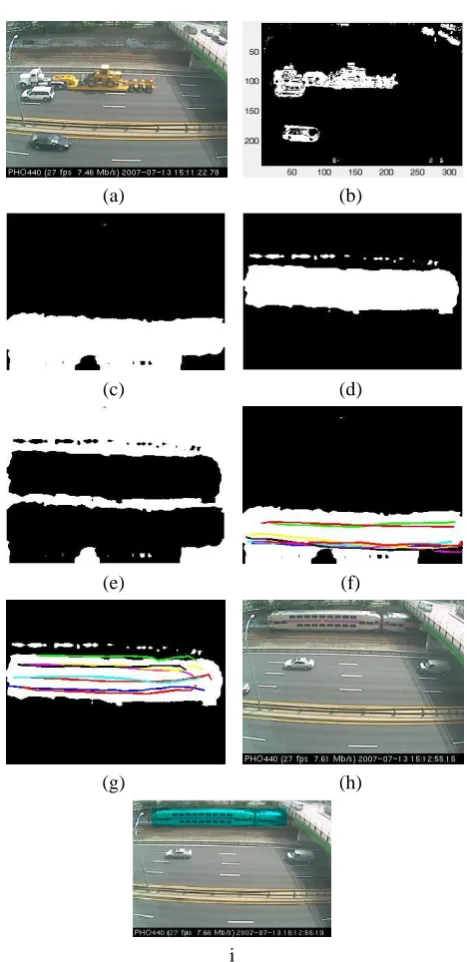
The proposed algorithm has been tested using the dataset in [11]. In this dataset, the frame size and the frame rate are 240×320 pixels and 25 fps, respectively. Figure 3 shows the results for this dataset. In this dataset, a highway is monitored by a network of the cameras. In this highway vehicles are moving in the opposite directions and so, the optical flows are different. Figure 3(a) shows a sample frame. In Figure 3(b), the result of detection using background subtraction method is indicated. Moving vehicles from the highway is considered as normal behavior in this dataset, three normal behaviors using clustering are obtained. Three normal behaviors are showed in Figure 3(c)-(e). In these three clusters and through the training phase, the object trajectory is extracted (Figure 3(f)-(g)) and their velocity is also calculated. The obtained trajectory and velocity are considered as the object based features. In this dataset, it is possible to determine this abnormal behavior, the train pass (Figure 3(h)-(i)), according to considering only the location based features. And, there is no need to extract the trajectory and the object based detection.
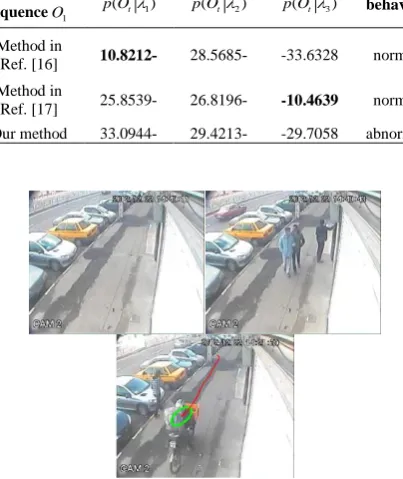
In order to clarify the feasible advantage of the proposed method in this paper, it is worthwhile to compare our method with ones presented in [16,17]. To this end, we have prepared a dataset from an outdoor environment using surveillance cameras. The frame size and the frame rate are 240×320 pixels and 25 fps, respectively. In this dataset, the pedestrians and vehicles are passing through the appropriate paths. From a location based features point of view, the mentioned dataset is cluster by three regions. These regions are described as following: The first region is the background in which there is no motion observed. The second one is the street, the path the vehicles are passing. And, the path the pedestrian are crossing is the third region. When a motorcycle passes through the sidewalk, this happening is an example of an abnormal behavior. The cause of the abnormality is the difference between the trajectory and the velocity of this abnormal behavior and those of the normal ones, which are obtained in the training phase in this region. This abnormal behavior cannot be recognized by the location based methods, while using the proposed method in this paper and extraction of both the trajectory and the
estimated velocity, it is possible to concisely detect this abnormal behavior (Figure 4). As mentioned above, it should be emphasized that the difference between the trajectory and the velocity of the pedestrians and those of the motorcycle is the key factor in recognizing the anomaly. Using the aforementioned dataset and implicating the proposed method and ones presented in [16,17], the numerical results are presented in the Table 1.
(a) (b)
(c) (d)
(e) (f)
(g) (h)
i
Figure 3. Pets2006 dataset. (a) Sample frame (b) Moving
TABLE 1. Probability of the observation sequence obtained in testing phase given the normal behavior model
behavior
3 ( t ) p O 2
( t ) p O 1
( t ) p O
Observation sequenceO1
normal -33.6328
28.5685-
10.8212-
Method in Ref. [16]
normal
-10.4639
26.8196- 25.8539-
Method in Ref. [17]
abnormal -29.7058
29.4213- 33.0944-
Our method
Figure 4.The abnormal behavior detection result in sample
frames
TABLE 2.The precise rate for abnormal behavior detection
Method Total abnormal behaviors
Detection as abnormal behaviors
using method
Precise rate
Method in Ref. [27]
50 31 0.62
Our method 50 43 0.86
In addition, for 50 abnormal behaviors in different videos, Table 2 shows the precise rate for abnormal behavior detection for the method used in [27] which recognizes the abnormal behaviors using a combination of size and speed features (almost an object based method). These abnormal behaviors are randomly sampled from the different testing videos to build the abnormal behavior datasets. It can be concluded that the results obtained by our proposed approach are more acceptable, as compared with ones achieved for the method in [27].
5. CONCLUSIONS
We have proposed a location based approach which uses block of pixels for anomalous behavior detection. We have presented busy-idle rates and optical flow vectors as the behavior features to obtain a behavior model for a block of pixels. To reduce the
computational cost, we have used a method of detection to separate motion regions and background before computing optical flow and busy-idle rates. In addition, spectral clustering has been used for classifying the behavior models and the pixels exhibited similar behavior have been clustered together. Furthermore, in cluster fusion phase, we have mixed clusters to obtain the final segmentation of the block of pixels. We have used the hidden Markov model as the behavior model for each cluster. Finally, we have introduced a framework which performs abnormal behavior detection via statistical methods. The experimental results show the robustness and less computational complexity of the proposed method.
6. REFERENCES
1. Hu, W., Tan, T., Wang, L. and Maybank, S., "A survey on visual surveillance of object motion and behaviors", Systems, Man, and Cybernetics, Part C: Applications and Reviews, IEEE Transactions on, Vol. 34, No. 3, (2004), 334-352.
2. Anjum, N. and Cavallaro, A., "Multifeature object trajectory clustering for video analysis", Circuits and Systems for Video Technology, IEEE Transactions on, Vol. 18, No. 11, (2008), 1555-1564.
3. Loy, C.C., Xiang, T. and Gong, S., "Detecting and discriminating behavioural anomalies", Pattern Recognition, Vol. 44, No. 1, (2011), 117-132.
4. Jiang, F., Yuan, J., Tsaftaris, S.A. and Katsaggelos, A.K., "Anomalous video event detection using spatiotemporal context", Computer Vision and Image Understanding, Vol. 115, No. 3, (2011), 323-333.
5. Chen, D.-Y. and Huang, P.-C., "Motion-based unusual event detection in human crowds", Journal of Visual Communication and Image Representation, Vol. 22, No. 2, (2011), 178-186. 6. Lucas, B.D. and Kanade, T., "An iterative image registration
technique with an application to stereo vision", in IJCAI. Vol. 81, (1981), 674-679.
7. Saleemi, I., Shafique, K. and Shah, M., "Probabilistic modeling of scene dynamics for applications in visual surveillance",
Pattern Analysis and Machine Intelligence, IEEE Transactions on, Vol. 31, No. 8, (2009), 1472-1485.
8. Wang, X., Ma, X. and Grimson, W.E.L., "Unsupervised activity perception in crowded and complicated scenes using hierarchical bayesian models", Pattern Analysis and Machine Intelligence, IEEE Transactions on, Vol. 31, No. 3, (2009), 539-555. 9. Blei, D.M., Ng, A.Y. and Jordan, M.I., "Latent dirichlet
allocation", the Journal of Machine Learning Research, Vol. 3, No., (2003), 993-1022.
10. Teh, Y.W., Jordan, M.I., Beal, M.J. and Blei, D.M., "Hierarchical dirichlet processes", Journal of the American Statistical Association, Vol. 101, No. 476, (2006), 1566 – 1581. 11. Ermis, E.B., Clarot, P., Jodoin, P.-M. and Saligrama, V., "Activity based matching in distributed camera networks",
Image Processing, IEEE Transactions on, Vol. 19, No. 10, (2010), 2595-2613.
13. Jodoin, P.-M., Saligrama, V. and Konrad, J., "Behavior subtraction", Image Processing, IEEE Transactions on, Vol. 21, No. 9, (2012), 4244-4255.
14. Wang, L., Wang, Y., Jiang, T., Zhao, D. and Gao, W., "Learning discriminative features for fast frame-based action recognition",
Pattern Recognition, Vol. 46, No. 7, (2013), 1832-1840. 15. Sagha, H., Bayati, H., Millán, J.d.R. and Chavarriaga, R.,
"On-line anomaly detection and resilience in classifier ensembles",
Pattern Recognition Letters, Vol. 34, No. 15, (2013), 1916-1927.
16. Feizi, A., Aghagolzadeh, A. and Seyedarabi, H., "Behavior recognition and anomaly behavior detection using clustering", in Telecommunications (IST), Sixth International Symposium on, IEEE, (2012), 892-896.
17. Feizi, A., Aghagolzadeh, A. and Seyedarabi, H., "Using optical flow and spectral clustering for behavior recognition and detection of anomalous behaviors", in Machine Vision and Image Processing (MVIP), 8th Iranian Conference on, IEEE. (2013), 210-213.
18. Piccardi, M., "Background subtraction techniques: A review", in Systems, man and cybernetics, IEEE international conference on, IEEE. Vol. 4, (2004), 3099-3104.
19. Elgammal, A., Duraiswami, R., Harwood, D. and Davis, L.S., "Background and foreground modeling using nonparametric kernel density estimation for visual surveillance", Proceedings of the IEEE, Vol. 90, No. 7, (2002), 1151-1163.
20. Zelnik-Manor, L. and Perona, P., "Self-tuning spectral clustering", in Advances in neural information processing systems, (2004), 1601-1608.
21. Von Luxburg, U., "A tutorial on spectral clustering", Statistics and Computing, Vol. 17, No. 4, (2007), 395-416.
22. Rabiner, L.R., "A tutorial on hidden markov models and selected applications in speech recognition", Proceedings of the IEEE, Vol. 77, No. 2, (1989), 257-286.
23. Ghahramani, Z., "An introduction to hidden markov models and bayesian networks", International Journal of Pattern Recognition and Artificial Intelligence, Vol. 15, No. 01, (2001), 9-42.
24. Baum, L.E., Petrie, T., Soules, G. and Weiss, N., "A maximization technique occurring in the statistical analysis of probabilistic functions of markov chains", The Annals of Mathematical Statistics, Vol., No., (1970), 164-171.
25. Arulampalam, M.S., Maskell, S., Gordon, N. and Clapp, T., "A tutorial on particle filters for online nonlinear/non-gaussian bayesian tracking", Signal Processing, IEEE Transactions on, Vol. 50, No. 2, (2002), 174-188.
26. Nummiaro, K., Koller-Meier, E. and Van Gool, L., Object tracking with an adaptive color-based particle filter, in Pattern recognition. 2002, Springer. p. 353-360.
27. Basharat, A., Gritai, A. and Shah, M., "Learning object motion patterns for anomaly detection and improved object detection", in Computer Vision and Pattern Recognition,. CVPR. IEEE Conference on, IEEE. (2008), 1-8.
A. Feizia, A. Aghagolzadehb, H. Seyedarabia
aFaculty of Electrical and Computer Engineering, University of Tabriz, Tabriz, Iran
bFaculty of Electrical and Computer Engineering, Babol University of Technology, Babol, Iran
P A P E R I N F O
Paper history:
Received 16August 2015
Received in revised form 11September 2015 Accepted 16October 2015
Keywords: Computer vision Behavior modeling Anomaly detection Spectral clustering Cluster fusion
هديكچ
خرن ییاناوت اب لومعمریغ یاهراتفر زا ینیعم عاونا یزاسراکشآ و اهراتفر ییاسانش یارب دیدج شور کی هلاقم نیا رد
یم هیارا لااب یزاسراکشآ شور زا یبیکرت یداهنشیپ تفایهر .دوش
شور و لحم ساسا رب یاه یم فده ساسا رب یاه
.دشاب
م نیا رد یگژیو هک دیدج شور کی ادتبا هلاق و یرون راش یاه
binary motion video
یم هدافتسا ار یم داهنشیپ ،دنک
.دوش
هتسد شور سپس هتسد یارب یفیط یدنب
یم هیارا هباشم یاهراتفر یدنب جیاتن هک دیدج رتسلاک بیکرت شور کی و دوش
هتسد زا لصاح اب ار لااب یگژیو ود زا هدافتسا اب یدنب
یم بیکرت مه یم داهنشیپ ،دنک
طخ و تعرس یدعب هلحرم رد .دوش
یگژیو ناونع هب ریس یم جارختسا فده ساسا رب یاه
یراتفر لدم ناونع هب یفخم فوکرام لدم هلاقم نیا رد .دنوش
یم هدافتسا مهم .دوش یم فده ساسا رب ییاه یگژیو کمک اب هک تسا نیا هلاقم نیا هجیتن نیرت یاهراتفر ناوت
یلومعمریغ
یگژیو اب هک درک یزاسراکشآ ار نآ یزاسراکشآ هب رداق لحم ساسا رب ییاه
یارب یرامآ شور کی تیاهن رد .میتسین اه
یم هیارا لومعم ریغ یاهراتفر یزاسراکشآ .دوش
doi:10.5829/idosi.ije.2015.28.11b.07
Application of
Combined Local Object Based Features and Cluster Fusion for The