Ames Laboratory Accepted Manuscripts
Ames Laboratory
7-8-2019
Tuning phase-stability and short-range order
through AI-doping in (CoCrFeMn)100-xAIx high
entropy alloys
Prashant Singh
Ames LaboratoryAmalraj Marshal
RWTH Aachen UniversityA. V. Smirnov
Ames Laboratory, [email protected]
Aayush Sharma
Ames LaboratoryGanesh Balasubramanian
Lehigh UniversitySee next page for additional authors
Follow this and additional works at:
https://lib.dr.iastate.edu/ameslab_manuscripts
Part of the
Condensed Matter Physics Commons
This Article is brought to you for free and open access by the Ames Laboratory at Iowa State University Digital Repository. It has been accepted for inclusion in Ames Laboratory Accepted Manuscripts by an authorized administrator of Iowa State University Digital Repository. For more information, please [email protected].
Recommended Citation
Singh, Prashant; Marshal, Amalraj; Smirnov, A. V.; Sharma, Aayush; Balasubramanian, Ganesh; Pradeep, K. G.; and Johnson, Duane D., "Tuning phase-stability and short-range order through AI-doping in (CoCrFeMn)100-xAIx high entropy alloys" (2019).Ames Laboratory Accepted Manuscripts. 378.
Tuning phase-stability and short-range order through AI-doping in
(CoCrFeMn)100-xAIx high entropy alloys
Abstract
For (CoCrFeMn)100−xAlx high-entropy alloys, we investigate the phase evolution with increasing Al content
(0≤x≤20 at.%). From first-principles theory, aluminum doping drives the alloy structurally from fcc to bcc
separated by a narrow two-phase region (fcc+bcc), which is well supported by our experiments. Using
KKR-CPA electronic-structure calculations, we highlight the effect of Al doping on the formation enthalpy (alloy
stability) and electronic dispersion of (CoCrFeMn)100−xAlx alloys. As chemical short-range order indicates
the nascent local order, and entropy changes, as well as expected low-temperature ordering behavior, we use
KKR-CPA-based thermodynamic linear response to predict the chemical ordering behavior of arbitrary
complex solid-solution alloys—an ideal approach for predictive design of high-entropy alloys. The predictions
agree with our present experimental findings and other reported ones.
Disciplines
Condensed Matter Physics
Authors
Prashant Singh, Amalraj Marshal, A. V. Smirnov, Aayush Sharma, Ganesh Balasubramanian, K. G. Pradeep,
and Duane D. Johnson
PHYSICAL REVIEW MATERIALS
3
, 075002 (2019)
Tuning phase stability and short-range order through Al doping in (CoCrFeMn)
100-xAl
xhigh-entropy alloys
Prashant Singh,1,*Amalraj Marshal,2A. V. Smirnov,1Aayush Sharma,1Ganesh Balasubramanian,3
K. G. Pradeep,2,4and Duane D. Johnson1,5,†
1Ames Laboratory, United States Department of Energy, Ames, Iowa 50011, USA
2Materials Chemistry, RWTH Aachen University, 52074 Aachen, Germany
3Department of Mechanical Engineering & Mechanics, Lehigh University, Bethlehem, Pennsylvania 18015, USA
4Department of Metallurgical and Materials Engineering, Indian Institute of Technology Madras, Chennai 600036, India
5Department of Materials Science & Engineering, Iowa State University, Ames, Iowa 50011, USA
(Received 11 February 2019; revised manuscript received 22 May 2019; published 8 July 2019)
For (CoCrFeMn)100-xAlx high-entropy alloys, we investigate the phase evolution with increasing Al content
(0x20 at.%). From first-principles theory, aluminum doping drives the alloy structurally from fcc to bcc separated by a narrow two-phase region (fcc+bcc), which is well supported by our experiments. Using KKR-CPA electronic-structure calculations, we highlight the effect of Al doping on the formation enthalpy (alloy stability) and electronic dispersion of (CoCrFeMn)100-xAlxalloys. As chemical short-range order indicates the
nascent local order, and entropy changes, as well as expected low-temperature ordering behavior, we use KKR-CPA-based thermodynamic linear response to predict the chemical ordering behavior of arbitrary complex solid-solution alloys—an ideal approach for predictive design of high-entropy alloys. The predictions agree with our present experimental findings and other reported ones.
DOI:10.1103/PhysRevMaterials.3.075002
I. INTRODUCTION
High-entropy alloys (HEAs) [1–3] continue to draw in-terest from the simple structures and novel properties that can appear [1,2] (mostly considered at near-equiatomic com-positions) from a high configurational entropy opposing a smaller (positive or negative) formation enthalpy. So far, HEAs have been reported with body-centered cubic (bcc), face-centered cubic (fcc), and hexagonal closed-packed (hcp) [4–6] structures. With simple ground-state structures, HEAs offer a new class of materials with technologically promising properties potentially tunable using alloy design strategies, including high hardness [7], outstanding wear resistance [8], good fatigue lifetimes [9], excellent high-temperature strength [10], good thermal stability [11], and good oxidation re-sistance [12]. With superior radiation resistance, transition-metal-based HEAs, as compared to conventional single-phase Fe-Cr-Ni austenitic stainless steels, have attracted signifi-cant attention as high-temperature materials candidates for nuclear-energy applications [13].
Chemical complexity is a key feature of concentrated or near-equiatomic HEAs. Several studies have shown that ad-ditions of certain elements into transition-metal (TM) based HEAs can have a strong effect on the microstructure and mechanical properties [14]. With Al additions, for example, the as-cast structure tends to evolve from single fcc phase to a mixture of fcc+bcc (duplex) phase to a single bcc phase [15,16]. In particular, the effect of Al content on the struc-tural and tensile properties of the CrMnFeCoNi system was
*[email protected] †[email protected]; [email protected]
carefully scrutinized [17], indicating that there is a structural phase transition from fcc to bcc with increasing Al content. Similar structural transitions in AlxCrCoFeNi were found
experimentally [15,16] and theoretically [18,19]. Unlike con-ventional Fe-based alloys, alloying becomes more complex and pivotal in designing novel HEAs with desired properties. For example, phase stability and short-ranged order (SRO) in such alloys is crucial and arises from the complexity from competing pair correlations [18].
Here we present a systematic study of phase formation, structural, and magnetic stability of (CoCrFeMn)100-xAlx
HEAs resulting from variation of the% Al. For selected alloys, i.e.,x=0, 5, and 20 at.% Al, we predict global (formation enthalpies) and local stability (SRO) using the KKR-CPA electronic-structure method, which historically handles chem-ical and magnetic disorder effects well [20,21], including quantum criticality [22]. We also predict the magnetic transi-tion temperature (CoCrFeMn)100-xAlxHEA using mean-field
estimates. The valence-electron composition (VEC) range for stable alloy phases might overlap and the range vary depend-ing on the specific alloy. We calculate the VEC directly from the electronic structure and use it as a physical parameter controlling the fcc/bcc phase stability for solid solutions. In addition, we validate predictions with experimental results for these HEAs.
II. METHODS
A. KKR-CPA calculations
The KKR electronic-structure method is an all-electron Green’s function method implemented within a scalar-relativistic approximation, i.e., spin-orbit is ignored beyond
PRASHANT SINGHet al. PHYSICAL REVIEW MATERIALS3, 075002 (2019)
the core electrons. KKR is combined with the coherent-potential approximation (CPA) to address chemical disorder [20,23]. The screened CPA is used to address Friedel screen-ing from configurational charge correlations [24]. Formally configurational averaging of the Green’s function in KKR-CPA requires only 1 atom (2 atom) per cell for disorder alloys with fcc/bcc (hcp) structures for any arbitrary com-position. Green’s function integration uses a complex-energy contour on a 20-point Gauss-Legendre semicircular contour, taking advantage of analytic continuation to decrease dra-matically solution times [25]. The generalized gradient ap-proximation to exchange correlation within density functional theory (DFT) was included through use of libXC libraries [26]. Formation energies (Ef), electronic density of states (DOS), and electronic dispersion (Bloch spectral functions) are calculated within the atomic sphere approximation (ASA) with periodic boundary conditions (PBC) to incorporate in-terstitial electron contributions to Coulomb energy from all atomic Voronoi polyhedra. Brillouin zone (BZ) integrations for self-consistent charge iterations were performed with a 20×20×20 Monkhorst-Packk-point mesh [27], whereas a 50×50 ×50 mesh was used for the physical density of states (DOS) calculations. For Bloch-spectral-function (BSF), we use 300k points along high-symmetry lines in the irre-ducible fcc/bcc BZ to visualize the electronic dispersion. As needed, we investigate HEAs with 3d magnetic elements in the paramagnetic state using the DLM (disordered local mo-ment) approximation [28]. The DLM state, representing the state above the magnetic transition temperature (e.g., Curie temperature for ferromagnet), may have finite local moments on an atomic site that is randomly oriented (4π sr), which give zero magnetization on average over orientations. Notably, the DLM state is distinct from a nonmagnetic state (zero magnetization per site) or from an ordered configuration with collinear moments on a site that sums to zero in a supercell, which is an antiferromagnetic or ferrimagnetic, rather than a paramagnet, state.
B. Chemical SRO
From KKR-CPA thermodynamic linear response we calculate the Warren-Cowley SRO parameters for μ
-ν pairs: [αμν(k;T)]−1 = [cμ(δμν − cν)]−1[(δμνcμ−1+c−N1)
−(kBT)−1S(2)
μν(k;T)]. TheSμν(2)(k;T) is the second variation of
the alloy free energy (F) with respect to composition (cμ;cν) fluctuations [δcδ2F
μδcν|0] evaluated in the high-Tdisordered phase
[18,29]. The free energy (F) of the solid-solution encom-passes electronic effects such as hybridization, band filling, and Fermi-surface nesting [28]. For a specific wave-vector instability (ko) at the spinodal temperatureTsp,αμν−1(ko;Tsp) vanishes, signifying an absolute instability to this chemical fluctuation and estimates the order-disorder or miscibility gap temperature [18,29–32]. The dominant SRO pairs are identi-fied aboveTsp from the stability matrixSμν(2)(k;T) and reveals the unstable (Fourier) modes with ordering wave vector ko,
or phase separation (clustering) atko=(000). Hence, we can
determine from the stability matrix which wave vector first goes unstable and what pair(s) drive this instability. AtTsp, the phase change is driven by one of the pairs in chemical stability
matrix “S(2)
μν(k;T).” Such information is crucial in predicting
SRO in solid-solution alloys. ForN>2, pairs driving ordering (clustering) will not necessarily be the same pairs that peak in the SRO parametersαμν(k) due to the abeyance of the optical theorem (or particle conservation) [32].
Currently, the SRO is coded in the approximate ASA formalism, so the KKR-CPA-ASA is used for allS(2)μν(k; T) calculations. This ASA-only formalism neglects differences in interstitial Coulomb energy that vary with crystal structure and is a source of discrepancy for SRO temperature scale. As the pairwise chemical interchange energiesS(2)
μν(k; T) do
not give direct spatial pair correlations, we inverse Fourier transformS(2)μν(k)[=Sμν,(2)0+n
μνSμν,(2)ne
ik.Rn] to real space
to further evaluate the real-space Warren-Cowley SRO.
C. Curie temperature estimate
In ordering systems, energy difference mainly determines the transition temperature [33]. Thus, to assess the Curie temperature (magnetic ordering), we consider a Heisenberg-like model in mean-field theory [34] and find that Tc=
2
3[EDLM−EFM]/kB, proportional to the energy difference be-tween PM (DLM) and FM states. Sometimes, as in a dilute magnetic semiconductor [34], it is appropriate to consider a nonmagnetic element with concentrationcand, as such, the relation is slightly modified toTc=23[1−1c][EDLM−EFM]/kB, which serves here as an upper bound.
D. Materials preparation and characterization
CoCrFeMnAl-based HEAs with Al concentrations (0, 5, and 20 at.% Al) were synthesized by arc melting of high purity (3N) metal powders of Co, Cr, Fe, Mn, and Al, under an Ar atmosphere. To ensure homogeneity, the alloys were remelted five times prior to casting in copper molds. The crystal structure of each sample was determined by x-ray diffraction (XRD) using Cu-Kα radiation. A Siemens D5000 diffrac-tometer operating in Bragg Brentano geometry at 40 kV was used to obtain the diffractograms. Alloy microstructure and the corresponding surface chemical distribution were mapped using a Zeiss SIGMATM field-emission scanning electron microscope (FE-SEM) equipped with an Oxford X-maxNTM energy-dispersive x-ray spectroscopy (EDX) detector. An electron accelerating voltage of 20 kV was used, and the chemical quantification was performed considering only the
Kαx rays. Electron back scattered diffraction (EBSD) was performed to further verify phase formation and to visual-ize the microstructure along with their grain orientations. A Zeiss LEO 1530 FE-SEM with an EBSD detector was used for this purpose and the analysis of EBSD data was performed with AZtecHKL software. The thermal stability of the HEAs was investigated using a NETZSCH STA 449C differential scanning calorimeter (DSC). The heating and cooling curves were recorded at a reduced rate of 5 K/min until 1500 °C in an Ar atmosphere. A local electrode atom probe (LEAP 4000X HRTM) was used to study the three-dimensional elemental distribution on a near-atomic scale. The samples for atom probe tomography (APT) were prepared using a FEI Helios Nanolab 660 dual beam workstation. APT measurements were performed at the set temperature
TUNING PHASE STABILITY AND SHORT-RANGE ORDER … PHYSICAL REVIEW MATERIALS3, 075002 (2019)
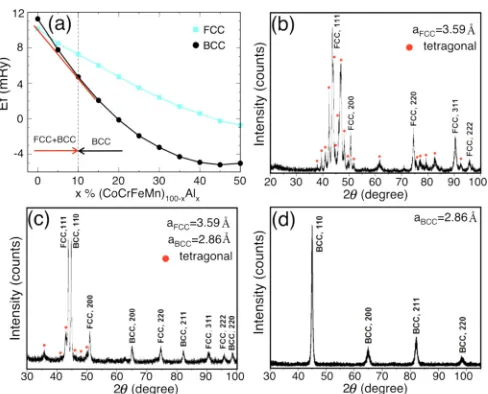
FIG. 1. (a) Formation energy (mRy/atom) versus at.% Al in fcc and bcc (CoCrFeMn)100-xAlx. Common tangent line (red line)
highlights mixed (fcc + bcc) phase for x<10 at.% Al. Adding more Al stabilizes the bcc phase. XRD pattern of the as-cast (CoCrFeMn)100-xAlx for (b)x=0, (c)x=5, and (d)x=20 at.%
Al.
of 60 K in the laser pulsing mode, with an applied pulse energy and frequency of 30 pJ and 250 kHz, respectively. APT data reconstruction and analysis were carried out using IVAS 3.6.10a software provided by Cameca Instruments.
III. RESULTS AND DISCUSSION
A. Phase formation and structural stability
We predict phase stability of (CoCrFeMn)100-xAlx HEAs
from the total-energy calculations of potential ground-state structures and find the minimum via the formation enthalpies. Previous theoretical and experimental observations show that small Al doping to TM-HEAs promotes the formation of stable fcc/bcc/duplex phases [3,18]. The Al addition is also found to increase the equilibrium volume of the solid solution, consistent with the fact that atomic radii of Al is larger than those of the other elemental components.
We show phase stability in Fig.1(a)for the fcc/bcc phase of (CoCrFeMn)100-xAlx at 0 K. We find that the fcc phase
is stable atx=0 at.% Al, a two-phase region (fcc+bcc) is lowest in enthalpy for 0<x10 at.% Al (“Al-poor” region), and bcc is stable for x>10 at.% Al (“Al-rich” region). In Fig. 1(a) it is clear that the structural energy difference between ideal fcc and bcc lattices vanishes at x≈4 at.% Al. However, the common tangent to the formation enthalpy curves establishes that there is a two-phase (fcc+bcc) region (x<10 at.% Al) that lowers the overall enthalpy of the homogenous system into a weighted mixture of two phases, where (fcc+bcc) equilibria may occur when the chemical po-tentials of the two phases become equal. These predictions are compared to experimental results of (CoCrFeMn)100-xAlxat 0,
5, 20 at.% Al, see Figs.1(b)–1(d)XRD pattern. We observe predominant peaks in Fig.1(b) for 0% Al corresponding to fcc. A tetragonal phase (Cr-based, as per ICDD JCP2 database
PDF 09-0052, 05-0708) was also identified. In Fig.1(c) for 5 at.% Al, similar to CoCrFeMn, multiple phases including fcc and a tetragonal phase (Cr-based, as per ICDD JCP2 database) were observed along with a secondary bcc phase. However, the XRD pattern [Fig. 1(d)] of equiatomic CoCr-FeMnAl (i.e., 20 at.% Al) clearly shows single bcc phase. The role of Al in stabilizing the bcc phase was similar to the many reports for Al-containing HEA, where bcc is stabilized with increasing% Al [28,35–40].
Focusing on (CoCrFeMn)100-xAlx at x=0 at.% Al with
single fcc phase, atx=5 at.% Al (Al-poor region) exhibt-ing two-phase (fcc+bcc), and at x=20 at.% Al (Al-rich region) with single bcc phase, we calculate each alloy’s electronic structure and short-range order, and compared with our experimental results. The calculated lattice constants for (CoCrFeMn)100-xAlx are 3.54 Å (fcc) at 0 at.% Al, 3.55 Å
(fcc) and 2.83 Å (bcc) at 5 at.% Al, and 2.84 Å (bcc) at 20 at.% Al, which agree well with our experimental findings of 3.59 Å (0 at.% Al, fcc), 3.58 Å (5 at.% Al, fcc), 2.86 Å (5 at.% Al, bcc), and 2.86 Å (20 at.% Al, bcc), respectively. Although changing Al concentration shows very little effect on lattice constants (either calculated or experiment), the calculated bulk modulus reduces significantly from 247.1 GPa at 0 at.% Al, to 218.3 (fcc)/209.1 (bcc) at 5% Al, and to 169.5 GPa at 20% Al. This happens because Al additions reduce the alloy’s interstitial electron number (electronic density) [41], which controls the moduli. The calculations at 0 K are helpful to understand, characterize, and predict mechanical properties [18] and enables selection of materials for further studies.
B. Magnetic stability
For (CoCrFeMn)100-xAlx we address nonmagnetic (NM),
paramagnetic (PM) within the DLM approximation [26], and ferromagnetic (FM) states. For 0% Al, fcc CoCrFeMn has a NM ground state that is energetically more stable than DLM and FM. Alloying with at.% Al, CoCrFeMn HEA becomes magnetic and DLM or FM phase is lower in energy than NM phase. For 5% Al, DLM phase is energetically more stable than NM or FM phase. In DLM phase, Fe/Mn/Co possess nonzero site moments. Increasing from 0 to 5 at.% Al [Fig.1(a)], the alloy shows a mixed (fcc+bcc) phase, so we analyze magnetic behavior of both fcc and bcc phases. In fcc phase, only Fe possesses small DLM moment of 0.52
μB, while in bcc phase Fe/Mn/Co shows DLM moment
of 2.02/0.92/1.00 μB. For 20 at.% Al (equiatomic case),
the alloy forms single bcc phase, with DLM moment on Fe/Mn/Co reduced slightly to 1.91/0.98/0.79μBrelative to 5
at.% Al bcc phase, and average total local moment of 0.74μB
at 0 K, with net zero magnetization. The experimentally measured total magnetization of the equiatomic CoCrFeMnAl BCC-stabilized HEA is 0.58μB at 50 K (0.45μB at 300 K).
With increasing at.% Al, (CoCrFeMn)100-xAlx undergoes a
transition from NM-fcc to DLM/FM-(fcc+bcc) to FM-bcc state. The at.% Al has a strong impact on the magnetic behavior of the HEA.
To assess the Curie temperature (Tc) we consider differ-ences in the total energy/atom for DLMEDLM and FMEFM states. In contrast to segregating systems [42], the transition
[image:5.608.52.296.67.264.2]PRASHANT SINGHet al. PHYSICAL REVIEW MATERIALS3, 075002 (2019)
FIG. 2. Curie temperatures versus at.% Al for bcc (CoCrFeMn)100-xAlx estimated from mean-field approximation
[30–32], see Sec.II.
temperature in ordering systems (with negative formation enthalpies) are dictated mainly by energy differences [33]. Thus, for magnetic ordering, mean-field theory gives an es-timated Tc=23[EDLM−EFM]/kB, where kB is Boltzmann’s constant. For equiatomic bcc-CoCrFeMnAl, the calculated
EDLM−EFM is 3.61 mRy, giving Tc=380 K(107◦C). In Fig.2for bcc (CoCrFeMn)100-xAlxwe plot the estimatedTc
versus x% Al (x=5–30% Al) [34] and include an upper bound (see Sec.II).
C. Valence electron count (VEC)
The VEC is found self-consistently in our electronic-structure calculations and obtained by integrating the density of states (DOS) of the valence states over occupied states (up to the Fermi energy EF). VEC is correlated directly to the stability of fcc or bcc phases. To best of our knowledge, in solid-solution HEAs, there are no exceptions to the trend that a higher VEC favors the fcc and a lower VEC favors the bcc. This can be justified as follows: bcc forms for 4<VEC<6 [3,29], as stability increases when bonding d states fill and maximal when half-filled (VEC∼6); antibonding states fill roughly when VEC > 6 and stability decreases. For 6.8 < VEC<8 other phases compete (e.g.,σ phase), and fcc be-comes stable for VEC>8 [3,29]. The threshold VEC values of 6.87 and 8.0 is a reasonable guide to stabilize fcc or bcc HEAs. In the (CoCrFeMn)100-xAlx, fcc HEA is more stable
than bcc at a VEC∼7.5 (x=0 at.% Al), while bcc stabilizes at VEC=6.6 (x=20 at.%), see Fig.1(a). Hence, an fcc+bcc phase exists at an intermediate VEC (e.g., 7.275 atx=5 at.% Al), although the formation enthalpy is still positive. Thus, we see roughly the same VEC limit for (CoCrFeMn)100-xAlx
as the empirically defined solid-solution phase limit, with exceptions already noted for Mn-containing HEAs [3]. We also plot the VEC for (CoCrFeMn)100-xAlx [x(Al)=0 to
40%) in Fig.3. For (CoCrFeMn)100-xAlx, empirical and
[image:6.608.67.275.70.256.2]first-principles analysis correlate well in predicting relative phase
FIG. 3. Relationship between valence electron composition (VEC) and phase stability of the fcc and bcc phases of (CoCrFeMn)100-xAlxHEA.
stability, which is not always the case, as in refractory alloys [29].
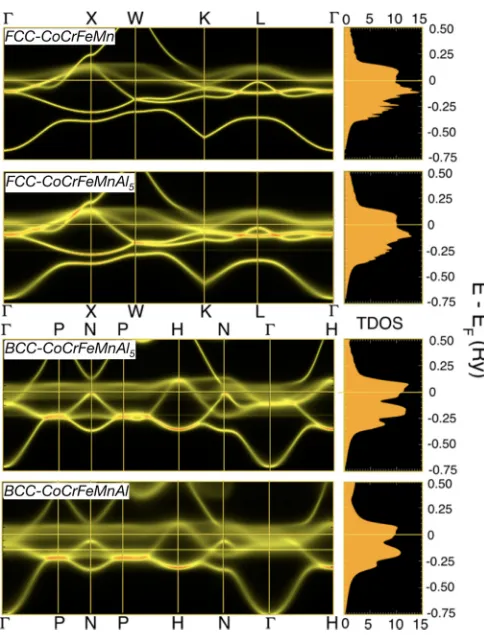
To shed more light on the effect of Al doping on electronic structure in an alloy (Fig. 4), we show configurationally averaged DOS and electronic dispersion (BSF) for fcc and bcc (CoCrFeMn)100-xAlx at 0, 5, and 20 at.% Al. For fcc
FIG. 4. For (CoCrFeMn)100-xAlx at x=0, 5, 20 at.% Al, the
electronic dispersion (left) from the Bloch-spectral function along high-symmetry directions of fcc and bcc Brillouin zone, and (right) total density of states [states/(Ry atom spin)].
[image:6.608.314.556.387.705.2]TUNING PHASE STABILITY AND SHORT-RANGE ORDER … PHYSICAL REVIEW MATERIALS3, 075002 (2019)
FIG. 5. (I) For equiatomic fcc CoCrFeMn, (top) Warren-Cowley SROαμν(k; 1.15Tsp) withTsp=315 K (42 °C) and (bottom) pair
interchange energies,S(2)
μν(k; 1.15Tsp) plotted along high-symmetry
directions of the Brillouin zone (-X-W-K-L-). SRO ordering instability atW =(1,1/2,0) is driven by Co-Cr in S(2)
Co-Cr(W),
however, closely competing pairs (Fe-Co; Mn-Cr) peak in the ob-servable αμν(). The SRO peak at Windicates a low-temperature (belowTsp=315 K) tetragonal phase (DO22), also observed in our
experiments, see Fig. 1(b). (II) (a) BSE microstructure and (b) corresponding EDX maps of CoCrFeMn. Composition of selected spots (1 and 2) in the microstructure is in the inset table.
CoCrFeMn, the DOS and BSF exhibit sharp structure at lower (filled) energies, similar to that of a pure metal. For 5 and 20 at.% Al, the alloys show disorder broadening both near and far from the EF due to chemical and magnetic disorder for enhanced scattering accompanied with increased% Al, where DOS shows less structure. Clearly, in Fig. 4, the deep lying states move with increased at.% Al, which shows hybridiza-tion between Al s states and Fe/Co/Cr bonding 3d states. The shift in dispersion well below EF (easily seen in the low-energy sstates) also indicates enhanced stability of the alloy due to lowering states in energy from hybridization with Al. In (CoCrFeMn)100-xAlx, Al works as a bcc stabilizer by
hybridization/band filling that enhances disorder and lowers bonding states [18]. For equiatomic HEA (20 at.% Al), see Fig.1(a), the negative formation energy indicates the favora-bility for elements to mix, in contrast to the alloys with lower Al concentration (0 and 5 at.% Al), which shows segregation.
D. Short-range order
For fcc-CoCrFeMn (0 at.% Al), in Fig. 5(I), we plot the chemical interchange energies [S(2)
[image:7.608.309.558.64.274.2]μν(k;T)] and
FIG. 6. DSC trace of (CoCrFeMn)100-xAlxforx: (I) 0, (II) 5, and
(III) 20 at.% Al (from Ref. [35]).
Warren-Cowley SRO parameters [αμν(k;T)] at 1.15Tspof the calculated spinodal temperature [Tsp=315 K (42 °C)]. AtTsp for a specific ordering instability, the inverse pair correlation ([αμν(k)]−1) first vanishes [i.e.,αμν(k) diverges]. The maxi-mal SRO peaks ofαμν(k)in Fig.5(I) atk= {1,1/2,0}(W
points) indicates the type of ordering in CoCrFeMn HEA. At
Tsp, particular elements ofαμν(k)become unstable (diverge) and indicate instability to long-range order [18]. S(2)
μν(k; T)
at Tsp, in Fig. 5(I) determines the wave-vector instability, i.e., the pair(s) driving the instability, andTsp at which the instability occurs. This instability in αμν(k) is related to the peak in the stability matrix Sμν(2)(k; T) in select pairs, which characterizes the SRO in any arbitrary, complex solid solution. In Fig. 5(I) the S(2)
μν(k; T) shows a very weak
Co-Cr peak atk0=W = {1,1/2,0}in the fcc Brillouin zone, which indicates a very low-temperature (belowTsp=315 K) tetragonal phase (DO22). The tetragonal phase is observed as secondary phase in XRD measurements [Fig.1(b)]. The peaks inαμν(k) at (000) has a dominant competing segregation peaks in Fe-Co and Mn-Cr pairs. Furthermore, Fe-Mn, Fe-Cr, and Mn-Co pairs show flat weights, indicating tendency of equal probability of mixing. The Co-Cr SRO with peak at
W =(1 1/2 0) indicates the tendency of Cr to enrich over Co, i.e., Cr-Co pair shows ordering tendency and Cr preferably occupies sites around Co in the low-Ttetragonal phase. Ex-periments [Fig. 5(II)] indicate the presence of a secondary tetragonal phase due to phase decomposition.
In Fig.5(II)(a)we show the BSE image of the 0 at.% Al al-loy representing the phase-separated microstructure. The pres-ence of two-phase regions (inferred from the phase contrast) is consistent with the XRD results in Fig.1(b). EDX mapping of the corresponding area, Fig.5(II)(a), reveal regions (1 and 2) with different chemical concentration, where region 1 has larger% Cr than the region 2. The quantification of these two chemically distinct regions is given in inset of Fig. 5. The Cr-rich region (1) has ∼33 at.% Cr, with constant Mn and Fe concentrations (∼24 at.% each), and was found to be depleted in Co. In contrast, region 2 (∼23 at.% Cr) was richer
[image:7.608.53.293.65.356.2]PRASHANT SINGHet al. PHYSICAL REVIEW MATERIALS3, 075002 (2019)
FIG. 7. (I) For bcc (CoCrFeMn)95Al5, (top) Warren-Cowley
SROαμν(k; 1.15Tsp) withTsp=1410 K (1137 °C) and (bottom) pair
interchange energies, S(2)
μν(k; 1.15Tsp) along high-symmetry
direc-tions of Brillouin zone (-P-N--H). The-mode (000) clustering instability is driven by Cr-Al inSCr(2)−Al (), and manifested by Co-Al peak inαCo-Al(). The probability sum rule [32] shows Co-Al
as the dominant SRO pair in αCo-Al(), while chemical stability
matrix SCr-Al(2) () shows Cr-Al as driving pair at Tsp. (II) (a) BSE
microstructure and (b) corresponding EDX maps of the 5 at.% Al HEA. Composition of selected regions (1 and 2) in the microstructure is shown in the inset table. Dark spots in (a) correspond to (Al) oxide inclusions.
in Mn, Fe, and Co. Similar separation of the Cr-based phase has been widely reported in other Cr-containing transition-metal-based HEAs [17,35,43]. The observed phase separation phenomenon is in good agreement with calculated SRO, see Fig.5(I). The SRO peak atWindicates the possibility of low-temperature tetragonal phase [also see Fig.1(b)]. The thermal stability analysis of the multiphase CoCrFeMn HEA is shown in Fig.6(I). An endothermic peak (at 1130 °C) in addition to the solid-liquid phase transition (peak at 1317 °C) potentially corresponds to the decomposition of the observed Cr-rich phase (spinodal decomposition). Our mean-field estimate of the miscibility gapTMG=Ef/Sconf∼10.3 mRy/kBln4∼ 1174 K (901 °C) is similar to DSC measurements (1130 °C).
Notably, however, the SRO-predictedTspof 315 K (42 °C) for fcc CoCrFeMn deviates from that found directly from the enthalpy estimate 1174 K (901 °C) (where they should agree). We have tracked this discrepancy partly to the variations of the ASA-only free energy used to estimate the SRO response functions (which will be corrected in the future by including
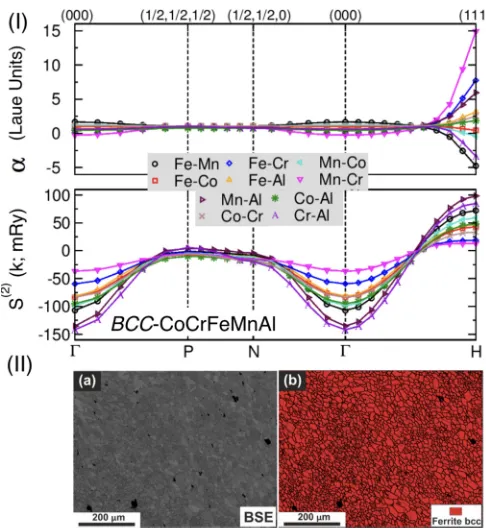
FIG. 8. (I) For equiatomic bcc CoCrFeMnAl, (top) Warren-Cowley SROαμν(k; 1.15Tsp) withTsp=1360 K (1087 °C), and
(bot-tom) pair interchange energies,S(2)
μν(k; 1.15Tsp) along high-symmetry
directions of Brillouin zone (-P-N--H).H-mode [111] ordering instability is driven by Mn-Al in S(2)
Mn-Al(H), and manifested by
Cr-Mn peak inαCr-Mn(H). (II) For CoCrFeMnAl, (a) BSE
microstruc-ture and (b) EBSD phase map.
contributions from interstitial Coulomb energy with cell shape and periodicity). Along with the ASA, the complex nature of Mn-3d bands also contributes in the underestimation of transition temperature. For equiatomic FeMnCoCr HEA, see Fig.3, the VEC (7.5) from integrated density of states, slightly lower than actual VEC (8) [3]. The discrepancy mostly results in a decrease of the spinodal temperature in the fcc phase, and fortunately has less effect on the bcc phase. In short, the competing phase separating (clustering) () and weak ordering (W) seen in SRO in Fig. 5(I) shows qualitative agreement with experiments.
For bcc (CoCrFeMn)95Al5 in Fig. 7(I), Sμν(2)(k; T) and
αμν(k) have peaks at k0==[000] in the bcc Brillouin zone, indicative of phase separation (infinite wavelength fluctuation). αμν() has a dominant SRO peak in Cr-Al (followed by Co-Cr and Fe-Cr); however, the phase sepa-ration is actually driven by the Co-Al pair in S(2)
μν(k; T).
Figure7(II)(a)shows the multiphase microstructure of the 5% Al HEA, which consists of a lamellar grain morphology. The corresponding elemental mapping by EDX of the same region reveals Cr-rich and Cr-depleted regions, see Fig. 6(II)(b), similar to the CoCrFeMn. The Cr-rich region had∼29 at.% Cr, with constant% Mn, Fe, and Co of ∼22 at.%. The Cr-depleted region had ∼20 at.% Cr with ∼25 at.% Mn, Fe, and Co, slightly higher than the Cr-rich region. Whereas the maximum% Al was partitioned to the Cr-rich region. The observed instability to phase separation at the 5 at.% Al is in good agreement with our predictions. The thermal stability
[image:8.608.51.298.63.375.2] [image:8.608.313.556.66.331.2]TUNING PHASE STABILITY AND SHORT-RANGE ORDER … PHYSICAL REVIEW MATERIALS3, 075002 (2019)
FIG. 9. For CoCrFeMnAl, APT analysis showing (a) three-dimensional reconstruction of Co, Cr, Fe, Mn, and Al atom positions. (b) One-dimensional concentration profile of the alloying elements taken along a cylinder (shown in the inset) of 10 nm diameter with 1 nm bin width.
evaluation of the phase separated 5 at.% Al HEA is shown in Fig. 7(II). The measured DSC curve shows a prominent endothermic peak along with the melting peak, similar to one observed for CoCrFeMn HEA in Fig.6(I). The phase trans-formation could be due to decomposition into the observed Cr-rich and Cr-poor regions. In contrast to 0 and 5% Al cases, equiatomic bcc CoCrFeMnAl shows peak in S(2)
μν(k; T) and
αμν(k) at k0=H=[111], see Fig. 8(I). Clearly the Mn-Al pair drives the instability as shown inS(2)
μν(k;T), however, the
SRO has dominant peak in Mn-Cr. The apparent oddity (but correct) in different chemical pairs inSμν(2)(k;T) and the SRO in multicomponent alloys arises from the probability sum rule (or optical theorem for particle conservation) [32].
The microstructure of the equiatomic HEA is displayed in Fig. 8(II)(a). Equiaxed grains with an average grain size of ∼10 μm were observed. The EBSD phase mapping in Fig.8(II)(b)of the corresponding area indicates the presence of single bcc phase. This further affirms calculated phase stability predictions and XRD observations in Figs.1(a)and
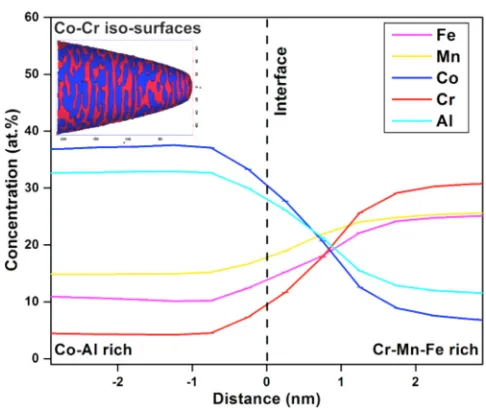
1(d). No indication of phase separation was observed in the EDX mapping (not shown here). However, atomic-scale investigation by APT reveals nanoscale chemical separation in the analyzed volume of 145×147×212 nm3[see Fig.9(a)], where Co- and Cr-rich regions were seen. Corresponding one-dimensional concentration profile taken along a cylin-drical region of interest, 10×10×180 nm3 along the tip length, shows anticorrelated fluctuations between Cr-Mn-Fe and Co-Al elements [Fig. 9(b)]. Even though anticorrelated fluctuations are characteristics of spinodal decomposition [36], DSC curves reported for equiatomic CoCrFeMnAl in
FIG. 10. APT analysis of CoCrFeMnAl showing isosurfaces highlighting the 30 at.% Co and 20 at.% Cr regions (inset), and the corresponding proximity histogram of 0.5 nm bin width across the separating phases.
Fig.6(III) had no signs of phase transition until the melting point. Figure 10 (inset) shows isoconcentration surfaces of Co and Cr, an intertwined morphology was observed between the Cr- and Co-enriched regions. Proxigram extending from Co-rich to Cr-rich region across the interface was plotted (Fig.10) to determine the actual chemical composition of the separating phases. The Cr-rich region had a composition of Co7Cr31Fe25Mn25Al12, while the concentration of the Co-rich region was Co38Cr4Fe25Mn25Al33.
The SRO in Fig. 8(I) shows peak at H [111] with Cr-Mn as dominant pair in CoCrFeCr-MnAl. The peak atHpoint indicates the possibility of B2-type ordering. While no B2 ordering was observed in our XRD data [Fig.1(d)], a recent work on an equiatomic single crystal reportsB2-type ordering [37]. The synthesis of a single crystal involved extremely low cooling rates and resulted in the formation of nearly equilibrium phase; the Cr-rich region was disordered bcc and the Co-Al-rich precipitates were orderedB2, embedded in the disordered bcc matrix [37]. The two-phase structure is thus similar to that found in equiatomic AlCoCrFeNi [36]. The bcc/B2 coherent morphology is closely related to the lattice misfit between these two phases, which is induced by the spinodal decomposition at higher Al content. The calculated SRO shows spinodal decomposition driven by the strongest SRO pair Mn-Cr, see Fig.8(I), giving phase decomposition at
[image:9.608.50.295.69.211.2]Tsp. The Mn-Cr-rich phase observed by experiments, further
TABLE I. Summary of phase stability and SRO predictions by KKR-CPA and experimental observations for the (CoCrFeMn)100-xAlx.
HEA→ 0 at.% Al 5 at.% Al 20 at.% Al
Calculated phase stability fcc fcc+bcc bcc (withB2-type SRO)
Thermodynamic linear response SRO driven by Co-Cr pair SRO driven by Cr-Al pair SRO driven by Cr -Mn pair
prediction [very weak tetragonal]
Phase formation (experiment) fcc+tetragonal fcc+bcc+tetragonal bcc
Chemical distribution (experiment) Cr-rich phase separation Cr-rich phase separation Cr-Mn-Fe and Co-Al based separation
[image:9.608.49.562.669.751.2]PRASHANT SINGHet al. PHYSICAL REVIEW MATERIALS3, 075002 (2019)
affirm our SRO predictions. For (CoCrFeMn)100-xAlx, a
sum-mary of phase stability and SRO predictions from calculations and experiments are listed in the TableI.
IV. CONCLUSION
From first-principles alloy theory, we have predicted the phase stability (formation enthalpy), magnetic stability, and short-range order (SRO) properties of (CoCrFeMn)100-xAlx
(x20%) high-entropy alloys. The theoretical results agree well with our current and other reported experimental data. The (CoCrFeMn)100-xAlx shows% Al-dependent phase
sta-bility as the HEA transforms from fcc (x=0 at.% Al) to bcc (x>10 at.% Al) with two-phase (fcc+bcc) region in between. Al (s-p orbitals) hybridizing with the transition metals (d orbitals) plays a crucial role in structural stability and magnetic, elastic, and chemical properties. The calculated SRO indicate the presence of complex phase at 0 at.% Al, phase separation at 5 at.% Al, and a partially orderedB2 phase at 20 at.% Al, in agreement with the experimental data.
KKR-CPA electronic structure and SRO offers a quantitative theory-guided design strategy to tailor the structural, chemical, mag-netic, and mechanical properties of novel multicomponent alloys by tuning the elements and their alloying. For future design purposes, the global stability (formation energy) and local stability (SRO) can be combined for accelerated alloy design and provide a robust guide to the experimentalist to narrow the search space for desired chemical and mechanical behavior.
ACKNOWLEDGMENTS
Work was supported by the US Department of Energy (DOE), Office of Science, Basic Energy Sciences, Mate-rials Science & Engineering Division. Research was per-formed at Iowa State University and Ames Laboratory, which is operated by ISU for the US DOE under Con-tract DE-AC02-07CH11358. Work by A.S. and G.B. was supported by the Office of Naval Research under Grant N00014-16-1-2548.
[1] J. W. Yeh et al., Nanostructured high-entropy alloys with multiple principal elements: Novel alloy design concepts and outcomes,Adv. Eng. Mater.6,299(2004).
[2] Y. Zhanget al., Microstructures and properties of high-entropy alloys,Progr. Mater. Sci.61,1(2014).
[3] M. C. Gao, J.-W. Yeh, P. K. Liaw, and Y. Zhang, High-Entropy Alloys: Fundamentals and Applications (Springer, Berlin, 2016).
[4] B. Gludovatzet al., A fracture-resistant high-entropy alloy for cryogenic applications,Science345,1153(2014).
[5] O. N. Senkov, J. M. Scott, S. V. Senkova, D. B. Miracle, and C. F. Woodward, Microstructure and room temperature properties of a high-entropy TaNbHfZrTi alloy, J. Alloy. Compd.509, 6043(2011).
[6] M. Feuerbacher, M. Heidelmann, and C. Thomas, Hexagonal high-entropy alloys,Mater. Res. Lett.3,1(2014).
[7] P. F. Yuet al., The high-entropy alloys with high hardness and soft magnetic property prepared by mechanical alloying and high-pressure sintering,Intermetallics70,82(2016).
[8] M. G. Poletti, G. Fiore, F. Gili, D. Mangherini, and L. Battezzati, Development of a new high entropy alloy for wear resistance: FeCoCrNiW0.3 and FeCoCrNiW0.3+5 at.% of C,
Mater. Design115,247(2017).
[9] M. A. Hemphillet al., Fatigue behavior of Al0.5CoCrCuFeNi
high entropy alloys,Acta Mater.60,5723(2012).
[10] Y. Zou, J. M. Wheeler, H. Ma, P. Okle, and R. Spolenak, Nanocrystalline entropy alloys: A new paradigm in high-temperature strength and stability,Nano Lett.17,1569(2017). [11] F. Otto, Y. Yang, H. Bei, and E. P. George, Relative effects of
enthalpy and entropy on the phase stability of equiatomic high-entropy alloys,Acta Mater.61,2628(2013).
[12] G. R. Holcommb, J. Tylczak, and C. Carney, Oxidation of CoFeMnCrNi high entropy alloys,JOM67,2326(2015). [13] F. Granberg, K. Nordlund, M. W. Ullah, K. Jin, C. Lu, H.
Bei, L. M. Wang, F. Djurabekova, W. J. Weber, and Y. Zhang, Mechanism of Radiation Damage Reduction in Equiatomic
Multicomponent Single-Phase Alloys, Phys. Rev. Lett. 116, 135504(2016).
[14] K. B. Zhang and Z. Y. Fu, Effects of annealing treatment on phase composition and microstructure of CoCrFeNiTiAlx
high-entropy alloys,Intermetallics22,24(2012).
[15] L. J. Santodonatoet al., Deviation from high-entropy configu-rations in the atomic distributions of a multi-principal-element alloy,Nat. Commun.6,5964(2015).
[16] H.-P. Chou, Y.-S. Chang, S.-K. Chen, and J.-W. Yeh, Microstructure, thermophysical and electrical properties in AlxCoCrFeNi (0x2) high-entropy alloys, Mater. Sci.
Eng. B163,184(2009).
[17] F. Ottoet al., Decomposition of the single-phase high-entropy alloy CrMnFeCoNi after prolonged anneals at intermediate temperatures,Acta Mater.112,40(2016).
[18] P. Singh, A. V. Smirnov, and D. D. Johnson, Atomic short-range order and incipient long-range order in high-entropy alloys, Phys. Rev. B91,224204(2015).
[19] A. Sharma, P. Singh, P. K. Liaw, and D. D. Johnson, and G. Balakrishnan, Atomistic clustering-ordering and high-strain deformation of an Al0.1CrCoFeNi high-entropy alloy,Sci. Rep.
6,31028(2016).
[20] D. D. Johnson, D. M. Nicholson, F. J. Pinski, B. L. Gyorffy, and G. M. Stocks, Density-Functional Theory for Random Alloys: Total Energy within the Coherent-Potential Approximation, Phys. Rev. Lett.56,2088(1986).
[21] P. Singh, A. V. Smirnov, and D. D. Johnson, Ta-Nb-Mo-W refractory high-entropy alloys: Anomalous ordering behavior and its intriguing electronic origin,Phys. Rev. Mater.2,055004 (2018).
[22] A. Alam and D. D. Johnson, Chemically Mediated Quantum Criticality in NbFe2,Phys. Rev. Lett.107,206401(2011).
[23] D. D. Johnson, A. V. Smirnov, and S. N. Khan, MECCA: Multiple-scattering Electronic-structure Calculations for Complex Alloys (KKR-CPA Program, ver. 2.0) (Iowa State University and Ames Laboratory, Ames, 2015).
TUNING PHASE STABILITY AND SHORT-RANGE ORDER … PHYSICAL REVIEW MATERIALS3, 075002 (2019)
[24] D. D. Johnson and F. J. Pinski, Inclusion of charge correlations in calculations of the energetics and electronic structure for random substitutional alloys,Phys. Rev. B48,11553(1993). [25] D. D. Johnson, F. J. Pinski, and G. M. Stocks, Self-consistent
electronic structure of disordered Fe0.65Ni0.35,J. Appl. Phys.57,
3018(1985).
[26] A. L. Marques, M. J. T. Oliveira, and T. Burnus, Libxc: A li-brary of exchange-correlation functionals for density functional theory,Comp. Phys. Commun.183,2272(2012).
[27] H. J. Monkhorst and J. D. Pack, Special points for Brillouin-zone integrations,Phys. Rev. B13,5188(1976).
[28] B. L. Györffy, A. J. Pindor, G. M. Stocks, J. Staunton, and H. Winter, A first-principles theory of ferromagnetic phase transitions in metals,J. Phys. F. Met. Phys.15,1337(1985). [29] P. Singh et al., Design of high-strength refractory complex
solid-solution alloys,npj Comp. Mater.4,16(2018).
[30] J. B. Staunton, D. D. Johnson, and F. J. Pinski, Compositional short-range ordering in metallic alloys: Band-filling, charge-transfer, and size effects from a first-principles all-electron Landau-type theory,Phys. Rev. B50,1450(1994).
[31] D. D. Johnson, J. B. Staunton, and F. J. Pinski, First-principles all-electron theory of atomic short-range ordering in metallic alloys: D022- versus L12-like correlations, Phys. Rev. B 50,
1473(1994).
[32] D. D. Johnson, Computation of diffuse intensities in alloys, in Characterization of Materials, edited by E. N. Kaufmann (Wiley, New York, 2012), pp. 1–31.
[33] A. Alam, B. Kraczek, and D. D. Johnson, Structural, magnetic, and defect properties of Co-Pt-type magnetic-storage alloys: Density-functional theory study of thermal processing effects, Phys. Rev. B82,024435(2010).
[34] K. Satoet al., First-principles theory of dilute magnetic semi-conductors,Rev. Mod. Phys.82,1633(2010).
[35] A. Manzoniet al., Phase separation in equiatomic AlCoCrFeNi high-entropy alloy,Ultramicroscopy132,212(2013).
[36] M. Feuerbacher, E. Wurtz, and C. Thomas, Single-crystal growth of a FeCoCrMnAl high-entropy alloy,Mater. Res. Lett. 5,128(2017).
[37] J. Y. Heet al., Effects of Al addition on structural evolution and tensile properties of the FeCoNiCrMn high-entropy alloy system,Acta Mater.62,105(2014).
[38] A. Marshal, K. G. Pradeep, D. Music, S. Zaefferer, P. S. De, and J. M. Schneider, Combinatorial synthesis of high entropy alloys: Introduction of a novel, single phase, body-centered-cubic FeMnCoCrAl solid solution,J. Alloys Compound 691, 683(2017).
[39] T. Yang, Effects of Al addition on microstructure and mechan-ical properties of AlxCoCrFeNi high-entropy alloy,Mater. Sci. Eng. A648,15(2015).
[40] B. Cantor, I. T. H. Chang, P. Knight, and A. J. B. Vincent, Microstructural development in equiatomic multicomponent alloys,Mat. Sci. Eng A375–377,213(2004).
[41] V. L. Moruzzi, J. F. Janak, and A. R. Williams,Calculated Elec-tronic Properties of Materials(Pergamon, New York, 1978). [42] N. A. Zarkevich, T. L. Tan, and D. D. Johnson, First-principles
prediction of phase-segregating alloy phase diagrams and a rapid design estimate of their transition temperatures, Phys. Rev. B75,104203(2007).
[43] K. G. Pradeep, N. Wanderka, P. Choi, J. Banhart, B. S. Murty, and D. Raabe, Atomic-scale compositional characterization of a nanocrystalline AlCrCuFeNiZn high-entropy alloy using atom probe tomography,Acta Mater.61,4696(2013).