Notre Dame Journal of Law, Ethics & Public Policy
Volume 3
Issue 4
Symposium on Values in Education
Article 2
1-1-2012
Parent-Centered Education
John S. Baker Jr.
Follow this and additional works at:
http://scholarship.law.nd.edu/ndjlepp
This Article is brought to you for free and open access by the Notre Dame Journal of Law, Ethics & Public Policy at NDLScholarship. It has been accepted for inclusion in Notre Dame Journal of Law, Ethics & Public Policy by an authorized administrator of NDLScholarship. For more information, please [email protected].
Recommended Citation
ARTICLES
PARENT-CENTERED EDUCATIONt
JOHN S. BAKER, JR.*
INTRODUCTION
Americans have traditionally viewed education as an
es-sential adjunct to democratic government. Exploiting this
at-titude, the educational establishment has equated itself with
the defense of democracy, even though those controlling
ed-ucation have deliberately distanced themselves from the
elec-torate.' Through a system built on compulsory
government-controlled schooling, professional educators have expanded
their role in the shaping of children as the role of parents has
diminished. Is this trend inevitable or reversible?
During the formative period, some would say the golden
age, of our democracy, education centered around the
par-ents. The state did not consolidate control over education
un-til the twentieth century, just as literacy in the United States
peaked.
2State control made education more democratic by
allowing local majorities to control the education of religious
and racial minorities through compulsory inclusion in or
ex-clusion from the state system.
3Although the Supreme Court
t Copyright 1988 by John S. Baker, Jr.
* Professor of Law, Paul M. Hebert Law Center, Louisiana State University.
1. See D. TYACK, T. JAMES, AND A. BENAVOT, LAW AND THE SHAPING OF
PUBLIC EDUCATION: 1785-1954 111 (1987) [hereinafter LAW & PUBLIC
EDUCATION].
2. Pitman, Home Schooling: A Review of the Literature, 21 J. THOUGHT 10, 11 (1986); Moore, It Depends on Your Aim, 67 PHI DELTA KAPPAN 62, 63 (1985).
3. Increasing state control over education in Massachusetts during the nineteenth century reflected anti-Catholic bias. See infra notes 23-28 and accompanying text. I am indebted to William Ball, Esq., a well-known constitutional litigator in the field of education, for material garnered from his brief in a Massachusetts case. For centuries before the Jim Crow era, which was given constitutional blessing in Plessy v. Ferguson, 163 U.S. 537 (1896), black Americans were precluded from receiving formal education.
JOURNAL OF LAW, ETHICS & PUBLIC POLICY
eventually limited majoritarian control over matters of race and religion, the principle of control through compulsory at-tendance laws has continued. The current system, consisting of a variety of governmental controls (state and federal, legis-lative, judicial, and administrative), has produced unprece-dented academic failure and social strife, all at great expense. Not surprisingly, a prestigious panel of educators has com-pared the current status of education to the devastation re-sulting from an enemy military attack." As a result, a rage for educational reform has swept the country. Unfortunately, al-most all of these well-intended efforts have been directed at repairing the existing system; the myth that the present struc-ture is a venerable democratic institution has insulated it from fundamental reform.
This paper discusses the centrality of parents to educa-tion by focusing on the ultimate, albeit unusual, form of pa-rental involvement known as home schooling and suggests ways to promote the primacy of parents in education. The discussion questions the widespread blind faith in the demo-cratic character of the current system-a system which in fact inhibits parental options in education. As one of its pur-poses, this paper distinguishes between the current system of government control and compulsion and other ways of pro-viding universal education. It is not, however, the purpose of this paper to advocate the general substitution of home schooling for the current system. Rather, the point about home schooling is simply this: if "unprofessional teachers," such as parents teaching in the home, can consistently achieve better academic results than government schools, we should study what those parents are doing and why they are doing it. The successes of home schooling make it apparent that: (1) the current level of government control over educa-tion is neither essential nor beneficial to democratic govern-ment and (2) parental involvegovern-ment in the education of chil-dren is not only beneficial but essential to correct the seemingly intractable problems plaguing our schools.
4. "If an unfriendly foreign power had attempted to impose on America the mediocre educational performance that exists today, we might well have viewed it as an act of war." THE NAT'L COMM'N ON EXCELLENCE IN EDUC., A NATION AT RISK: THE IMPERATIVE FOR EDUCATIONAL REFORM 5 (1983).
PARENT-CENTERED EDUCATION
I. CONTROL OVER EDUCATION
A. The Transition from Parental to Governmental Control
Lacking historical perspective, Americans have forgotten that in the United States "universal compulsory schooling is a very recent social invention."' In early American history, ed-ucation in the home was customary and widespread. Children were educated by parents or tutors at home, in religious schools or apprenticeships, or not at all. As formal schooling in state-controlled institutions became the rule rather than the exception, education at home continued to exist in the unusual form of complete home schooling and in the more common form of parents supplementing or supporting for-mal schooling. Only gradually has state involvement in educa-tion evolved from facilitating and, where necessary, enforcing the obligation of parents to the point of displacing parental control over the education of children.
In 1642 the Colony of Massachusetts Bay enacted the first compulsory education act-a precedent to be followed by other colonies in New England.6 The "1642 statute made
no provision for school or teachers. The parents or masters were the sole agents for the education of their children."', Massachusetts enacted a compulsory school act in 1647, which established schools and payment for teachers. Neither act, however, made attendance compulsory. The responsibil-ity for the choice of education remained with the parents. Government acted only to ensure that parents complied with their general obligation for education. During the late seven-teenth century, all compulsory education laws in New Eng-land were repealed.8 After the United States gained indepen-dence, interest in education increased. Massachusetts was again first, expressly providing in its 1780 constitution power for the legislature to compel public support of education in the established Protestant religion9 and enacting in 1789 the
5. Pitman, supra note 2, at 10.
6. See L. KOTIN & W. AIKMAN, LEGAL FOUNDATIONS OF COMPULSORY
SCHOOL ATTENDANCE 11, 14 (1980). 7. Id. at 11.
8. Id. at 20-21.
9. The Massachusetts Declaration of Rights provides:
As the happiness of a people, and the good order and preserva-tion of civil government, essentially depend upon piety, religion, and morality; and as these cannot be generally diffused through a Community but by the institution of the public Worship of God, and of public instructions in piety, religion, and morality:
JOURNAL OF LAW, ETHICS & PUBLIC POLICY
first state statute to require the establishment and financing of schools.10
It often has been asserted that the Founding Fathers ei-ther did not concern themselves with or did not foresee the problems of public education-in particular those related to religion." In fact, Congress created the very foundation for the public school system from 1787 to 1789. Moreover, Con-gress did so because it considered religion, morality, and edu-cation intertwined. Beginning under the Articles of Confed-eration and continuing under the Constitution, Congress provided for public financing of education for the Northwest
fore, to promote their happiness, and to secure the good order and preservation of their government, the people of this Com-monwealth have a right to invest their legislature with power to authorize and require, and the Legislature shall, from time to time, authorize and require, the several Towns, Parishes, pre-cincts, and other bodies politic, or religious societies, to make suit-able provision, at their own Expense, for the institution of the Public worship of GOD, and for the support and maintenance of public protestant teachers of piety, religion, and morality, in all cases where such provision shall not be made Voluntarily.
And the people of this Commonwealth have also a right to, and do, invest their legislature with authority to enjoin upon all the Subjects an attendance upon the instructions of the public teach-ers aforesaid, at stated times and seasons, if there be any on whose instructions they can Conscientiously and conveniently attend.
Provided notwithstanding, that the several towns, parishes, pre-cincts, and other bodies politic, or religious societies, shall, at all times, have the exclusive right of electing their public Teachers, and of contracting with them for their support and maintenance. And all monies paid by the Subject to the Support of public worship, and of the public teachers aforesaid, shall, if he require it, be uniformly applied to the support of the public teacher or teachers of his own religious sect or denomination, provided there be any on whose instructions he attends; otherwise it may be paid towards the support of the teacher or teachers of the parish or precinct in which the said monies are raised.
And every denomination of Christians, demeaning themselves peaceably, and as.good Subjects of the Commonwealth, shall be equally under the protection of the Law: And no subordination of any one sect or denomination to another shall ever be established by law.
MASS. CONST. part I, art. III (1780), 3 THE FEDERAL AND STATE
CONSTITU-TIONS 1889-90 (F. Thorpe ed. 1909). 10. 1789 Mass. Acts ch. 19.
11. "[I]t is unlikely that the persons who drafted the First Amend-ment, or the state legislators who ratified it, anticipated the problems of interaction of church and state in public schools." Wallace v. Jaffree, 472 U.S. 38, 80 (1985) (O'Connor, J., concurring). See also L. TRIBE, AMERICAN
CONSTITUTIONAL LAW § 14-3, at 1163 (2d ed. 1988).
PARENT-CENTERED EDUCATION
Territory and later in other territories. The Northwest
Ordi-nance, written by men from Massachusetts, followed both the
system of school financing and the philosophy of education
contained in the Massachusetts Constitution."' In acts related
to the Northwest Ordinance, Congress set aside land for
pub-lic schools and also other land "for purposes of religion."
18As in Massachusetts, religion and education were bound
to-gether. The Northwest Ordinance made this explicit:
"[R]eligion, morality, and knowledge, being necessary to
good government and for the happiness of mankind, schools
and the means of education shall forever be encouraged.""
'In the early years of the Republic, Congress encouraged
religion and education,
8but, unlike Massachusetts, did so in
the spirit of pluralism. Congress provided for full religious
freedom in the Northwest Ordinance, whereas Massachusetts
limited freedom to Christians.'
Congress gave money to
schools operated by various religious sects for the purpose of
educating Indians.'
7In the land acts, Congress prevented
12. See LAW & PUBLIC EDUCATION, supra note 1, at 27, 32. Compare
the provision in the 1780 Massachusetts Constitution (quoted supra in note 9) which was written by John Adams with the language from the Northwest Ordinance, infra note 14.
13. The Land Ordinance of 1785 "reserved the lot No. 16, of every township, for the maintenance of public schools .... " Ordinance of May 20, 1785, 1 LAWS OF THE UNITED STATES 563, 565 (J. Bioren & W. Duane ed. 1815). An earlier draft specified the section adjoining section 16 in each township be reserved "for the support of religion . . .to be applied forever according to the will of the majority of male residents .. " 28 J.
CON-TINENTAL CONG. 254-55 (Library of Congress ed. 1933) (emphasis added). Although the Land Ordinance as enacted did not contain that provision, subsequent acts pursuant to the Act did reserve lot No. 29 "for purposes of religion," but without reference to the majority.
14. Ordinance of July 13, 1787, art. 3, 1 LAWS OF THE UNITED
STATES, supra note 13, at 479.
15. Contrary to current belief, Congress did "encourage" religion. Supreme Court Justice Joseph Story wrote that the Northwest Ordinance "provides for the encouragement of religion, and education, and schools
.... " 2 J. STORY, COMMENTARIES ON THE CONSTITUTION § 1318, at 192 (3d
ed.).
16. Art. 1 provided: "No person, demeaning himself in a peaceable and orderly manner, shall ever be molested on account of his mode of wor-ship or religious sentiments, in the said territory." Ordinance of July 13, 1787, art. 1, 1 LAWS OF THE UNITED STATES, supra note 14, at 478. Compare
this statement with the last part of art. III from the Massachusetts
Declara-tion of Rights, supra note 9, which refers to "every denominaDeclara-tion of
Christians."
17. R. CORD, SEPARATION OF CHURCH AND STATE. HISTORICAL FACT
AND CURRENT FICTION 57-82 (1982).
JOURNAL OF LAW, ETHICS & PUBLIC POLICY
funds for religion from being controlled by religious majori-ties, leaving them to be shared equally among different reli-gious groups.8 It was not until after the Civil War that Con-gress began to depart from the principle of pluralism in religion and education. 9
In the second and third generations under the Constitu-tion, Congress and the states encouraged educaConstitu-tion, while ex-ercising little control over it. Despite the absence of compul-sory education laws, noncompulsory schooling became widespread before the Civil War. This non-system produced high levels of literacy and attendance.2 0 Devotion to demo-cratic principles led to the concept of the common school for all (whites) without the component of compulsion.2 Even
18. See supra note 13. For a discussion of section 16 and 29 lands in Ohio, see Chase, A Preliminary Sketch of the History of Ohio, in 1 STATUTES OF
OHIO AND THE NORTHWEST TERRITORY 2, 20, 28, 32 (S. Chase ed. 1833). 19. In 1876 President Grant called on Congress to propose a consti-tutional amendment which would make the contents of the first amend-ment applicable to the states, with the addition of barring public funds for religious schools. The Blaine Amendment, named after Representative James G. Blaine, later Speaker of the House and Republican candidate for the presidency, was passed by the House of Representatives, but failed to get the required two-thirds vote in the Senate. Starting in 1876, Congress required all newly admitted states to incorporate a provision barring funds for religious schools in their constitutions.
There were several versions of the "Blaine Amendment," one of which provided:
No State shall make any law respecting an establishment of reli-gion, or prohibiting the free exercise thereof; and no religious test shall ever be required as a qualification to any office or public trust under any State. No public property, and no public revenue of, nor any loan of credit by or under the authority of, the United States, or any State, Territory, District, or municipal corporation, shall be appropriated to, or made or used for, the support of any school, educational or other institution, under the control of any religious or anti-religious sect, organization or denomination, or wherein the particular creed or tenets of any religious or anti-reli-gious sect, organization, or denomination shall be taught. And no such particular creed or tenets shall be read or taught in any school or institution supported in whole or in part by such reve-nue or loan of credit; and no such appropriation or loan of credit shall be made to any religious or anti-religious sect, organization, or denomination, or to promote its interests or tenets. This article
shall not be construed to prohibit the reading of the Bible in any school or institution; and it shall not have the effect to impair rights of
property already vested . . ..
McCollum v. Board of Educ., 333 U.S. 203, 219 n.6 (1948) (Frankfurter, J., concurring) (emphasis added).
20. See LAW & PUBLIC EDUCATION, supra note 1, at 26.
21. See LAW & PUBLIC EDUCATION, supra note 1, at 13-126.
PARENT-CENTERED EDUCATION
though Massachusetts adopted the first compulsory attend-ance law in 1852, it was not until the 1920s that compulsory attendance laws were generally enforced.2" By then, even the southern states, which had prevented education for blacks before the Civil War, had enacted compulsory attendance laws.
The tightening of state control in Massachusetts resulted from religious bigotry. In 1852, Massachusetts passed the first compulsory attendance requirement.2" The development of such laws has been characterized as representing a concern for "Americanizing" the wave of new immigrants coming into the country.24 Behind such fine-sounding democratic rhetoric, however, stood the anti-Catholic attacks of the Know-Nothing party. In Massachusetts, where resentment against Irish-Catholic residents was strong, the party cap-tured almost complete control over the government of the state in 1854.26 The year before, this sentiment was evident in the state constitutional convention debates over a proposal to bar funds for sectarian schools. Along with the no-aid view was the expectation that Catholics would convert to Protes-tantism by attending public schools.26 Although generally poor, the Irish and other Catholics established their own schools in Massachusetts and elsewhere as a matter of pro-moting Catholicism and resisting the Protestant indoctrina-tion of the public schools. The response of Massachusetts in 1853, followed by a number of other states, was to bar any state aid to sectarian, i.e. Catholic, schools. A national hyste-ria concerning Catholic schools spread to Congress, which came close to passing a constitutional amendment to the same effect, while retaining the Protestant character of public schools.2 Beginning in 1876, Congress did require newly ad-mitted states to bar aid to sectarian schools. One state (Ore-gon) went so far as to require attendance at public schools-an action overturned by the famous case, Pierce v.
22. L. KOTIN & W. AIKMAN, supra note 6, at 31.
23. 1852 Mass. Acts ch. 240, §§ 1, 2, 4.
24. L. KOTIN & W. AIKMAN, supra note 6, at 26-27.
25. R. BILLINGTON, THE PROTESTANT CRUSADE, 1800-1860, at 388 (1938).
26. 3 DEBATES IN THE MASSACHUSETTS CONVENTION, 613-26 (1853).
As part of an extensive debate, for example, Mr. Ball of Upton stated, "Open your doors wide to all, and banish sectarianism from your schools, and Catholics will become Protestants through the influence of these schools." Id. at 622.
JOURNAL OF LAW, ETHICS & PUBLIC POLICY
Society of Sisters.8
The purpose of compulsory, state-controlled schooling was to homogenize the population in the name of democracy. In Massachusetts, Catholics were not the only "problem" for this process; during this period the Massachusetts Supreme Court also upheld the segregation of blacks in a case relied on by the U.S. Supreme Court in Plessy v. Ferguson.9 In the north as well as in the south, blacks, like Catholics, ended up in separate schools, but not by their choice. Those who would not or could not be homogenized were ex-cluded-with or without their consent. In the 1920s the en-forcement of compulsory attendance laws coincided with white Protestantism reasserting its dominance over public schools. The breakdown of this control during the 1950s and 1960s as a result of Brown v. Board of Educations' and the "prayer decisions" 1
has not pacified public schools; they have remained a battleground, with more groups vying for cultural control. 2
Among the most independent individuals attempting to escape from external controls are home schoolers. Since the 1970s, the number of home schools has grown dramatically." While this growth is a relatively recent phenomenon, rural students, students living abroad, unwed mothers, and others with special needs have been regularly schooled at home. These special cases have been based on necessity, not resis-tance to state control. Since the 1970s, however, the growing home-schooling movement has reflected a conscious rejection of state control.
28. 268 U.S. 510 (1925).
29. Plessy v. Ferguson, 163 U.S. 537, 544 (1896) (citing Roberts v. City of Boston, 59 Mass. (5 Cush.) 198 (1849)).
30. 347 U.S. 483 (1954).
31. School Dist. of Abington Township v. Schempp, 374 U.S. 203 (1963) (Bible reading in public school violates establishment clause); Engel v. Vitale, 370 U.S. 421 (1962) (non-denominational school prayer violates the establishment clause).
32. For a summary of the types and volume of litigation and regula-tion affecting schools for the last thirty years, see LAW & PUBLIC
EDUCA-TION, supra note 1, at 193-204. See also Glenn, Religion, Textbooks, and the Common School, 88 PUB. INTEREST 28-47 (1987).
33. Lines, An Overview of Home Instruction, 68 PHI DELTA KAPPAN 510, 511 (1987).
PARENT-CENTERED EDUCATION
B. The Consolidation of Governmental Control Through Compulsory Attendance
In taking aim at government control over education, this paper distinguishes that target from a system of government-financed schooling made available to all without compulsion. The core of the current system is not equal opportunity but state control. The combination of compulsory attendance laws; state financing of public, but not private, schools; and state regulation of most private religious and home schools are the means to the government's consolidation of power over education.
Of those three factors, compulsory attendance laws re-present the key to control. While compulsory attendance laws have been ineffectual at times for lack of enforcement, 4 po-tential criminal penalties for the parents and possible institu-tionalization for the child as a truant constitute a potent threat to would-be violators.5 The public may not object
generally to the state exercising such control, probably be-cause they identify compulsory attendance with education for all. Compulsory attendance, however, does not guarantee uni-versal education, as the failures of the current system certainly demonstrate. On the other hand, a state may provide, and even compel, education without compelling attendance, as in colonial Massachusetts. Compulsory attendance laws are at best a means to the desired end of universal education. As the educational day has lengthened and academic perform-ance has declined, it is evident that compulsory attendperform-ance is no longer a means reasonably related to the end of universal education. Compulsory attendance laws have been an effec-tive means to two other ends: control over financing of edu-cation and regulation of private, religious, and home schools.
1. Compulsory Attendance and School Finance
Virtually every state requires young persons to receive schooling during certain years of their life, typically from six through sixteen." By compelling attendance in school, the state must somehow provide, and therefore finance, the
op-34. See LAW & PUBLIC EDUCATION, supra note 1, at 97-100.
35. See Lines, State Regulation of Private Education, 64 PHI DELTA KAP-PAN 119 (1982).
36. See L. KOTIN & W. AIKMAN, supra note 6, at app. A for a summary
of state laws as of 1980.
JOURNAL OF LAW, ETHICS & PUBLIC POLICY
portunity to comply with this requirement." It does not fol-low from this, however, that the state must own and operate its own schools. The state could make grants available, at least to nonreligious private schools, to students, or to par-ents, or could utilize tax credits or some combination of these. Common sense and experience, however, suggest a strong relationship between financing and control.
Compulsory attendance forms the foundation for financ-ing under the current system. As suppliers of the money, the state wants control which it can best accomplish through its own schools. The amount of funding, in turn, depends on the number of children in attendance. Public school personnel predictably oppose proposals to decrease funding, and they support measures to increase attendance, including compul-sory attendance laws. Among the proposals most opposed by public school personnel are ones which would alter the cur-rent system of financing to include tuition-vouchers or tax-credits for parents whose children attend nonpublic schools. The amount of governmental control which would follow funding of nonpublic schooling remains uncertain. 8 The control might not be greater than that which the state cur-rently has over many private schools due to the compulsory attendance laws.
Compulsory attendance laws skew the debate over school financing. It has been said that families who opt to put their children in private schools have exercised their freedom of choice to pay tuition on top of taxes. The state, however, has created the conflict which leaves parents little choice under the compulsory attendance laws. Originally, compulsory at-tendance laws allowed Protestant majorities to force choices on Catholics. With the exclusion of prayer from public schools, the conflict has continued along religious lines, with some Protestant sects opposed to other religious and nonreli-gious persons. The solution for many Protestant parents has
37. "[We] need not belabor the fact that requiring parents to see that their children attend school under pain of criminal penalties presupposes that an educational opportunity will be made available to the children."
Mills v. Board of Educ., 348 F. Supp. 866, 874 (D.D.C. 1972).
38. See Grove City College v. Bell, 465 U.S. 555 (1984) (which deter-mined that even though a college refused all direct federal assistance, it was not entirely free from coverage under Title IX of the Education Amendments Act of 1972 because it enrolled students who themselves re-ceived federal education aid). But see the Civil Rights Restoration Act of
1987, Pub. L. No. 100-259, 102 Stat. 28 (1988) (effectively reversing Grove City).
PARENT-CENTERED EDUCATION
been to avoid sending their children to public schools, just as many Catholics have traditionally done. In forcing this choice, government has made parents pay not only for the religious aspect of their education but also for a type of aca-demic instruction which, due to regulation by the state, is similar to, even if somewhat better than, that provided by the state. In other words, even those who choose to pay twice are prevented from getting an education substantially different from that of the public schools.
Compulsory attendance laws have created, therefore, a second conflict for parents by increasing the costs of educa-tional alternatives. While almost all parents would want their children educated regardless of compulsory attendance laws, they could do so in a variety of ways other than through the 180-day year of formal schooling. As discussed below, the amount of learning that actually occurs in conventional schools can be accomplished in a much shorter time in an informal setting. Indeed, literacy is not as high now as it was when the school year lasted but a few weeks.39 But for
com-pulsory attendance laws that determine the length of the school day and year, more experimentation would be possi-ble. As parents learned of successful alternatives, the state would find it more difficult to justify current levels of taxing for education. Beyond financing for those who could not af-ford education even with lower taxes, the state would have to satisfy voters of the cost-effectiveness and the equity of taxing and spending on education. Proposals for tax credits in re-turn for educating children in other than state-financed and -controlled schools would likely draw greater support.
2. Compulsory Attendance and the Regulation of Nonpublic Schools
Even without controlling schools financially, the state has frequently used compulsory attendance laws to exercise con-trol over private schools. Although state regulation of pri-vate, religious, and home schools has been limited by consti-tutional decisions, these decisions have recognized the states' "compelling interest" in requiring schooling and reasonably regulating many aspects of private education.' The compel-ling interest is the achievement of universal education in a
39. Moore, supra note 2, at 63.
40. Pierce v. Society of Sisters, 268 U.S. 510 (1925), is a landmark decision for the rights of parents to control the education of their children. Even in that case, however, "[n]o question is raised concerning the power
JOURNAL OF LAW, ETHICS & PUBLIC POLICY
democratic society. Of course, 'that end could be reached by compelling educational achievement, as measured by stan-dardized testing. The repeal of compulsory attendance laws would leave state education bureaucracies without a plausible basis for much of the regulation of private educational insti-tutions. Moreover, if the state simply required educational achievement, the results might well discredit the current sys-tem of state-financed schools.
In order to survive, the current system must limit compe-tition and control the limited compecompe-tition that does exist. The current system obviously limits competition from private schools by raising the cost to parents, who must pay tuition over and above the taxes they pay for government schools. If not for the religious motivation to start schools, the competi-tion from private schools would be even less than it now is. Not so obviously, the religious aspect of the alternatives fur-ther limits competition, because religious schools serve only particular segments of the market. That is, families who de-sire religious schooling for their children are not likely to consider all of the available religious schools as potential al-ternatives because religious schools generally exist to serve particular religious denominations. Moreover, religious schools may represent an alternative only insofar as religious study and prayer are concerned. Some schools which exist primarily to provide religious education may not be con-cerned with providing a distinguished academic curriculum. Thus, some religious schools differ from good public schools only with regard to religion itself.
On the other hand, both religious and nonreligious pri-vate schools pursuing academic excellence are hindered by state regulations. Requirements regarding teacher certifica-tion, the length of the school year, course credits, and the like are geared toward the minimum level of competence. College professors may be "unqualified" to teach in an ele-mentary or secondary school because they have not taken the required methods courses offered in our schools of educa-tion. While the state should be free to impose such require-ments on its own schools, how compelling is the rationale for imposing them on private schools? The effect is to raise costs and inhibit the operation of private and religious schools.
Even though private and religious schools existed before government-controlled schools, they are portrayed today as
of the State . . .to require that all children of a proper age attend some school." Id. at 534.
PARENT-CENTERED EDUCATION
strange exceptions to what has become the accepted Ameri-can model for education. This has been possible because the Protestant schools evolved into nonsectarian Protestant pub-lic schools, while their largest competitor, the Cathopub-lic sys-tem, arose as a minority school. Like Catholic schools, the recent rise of Fundamentalist Protestant schools represents a religious minority choosing religious schools over a secular-ized public education. Due to the religious character or the cost of many private schools, or both, defenders of the educa-tional establishment have been able to dismiss these schools as bastions of religious indoctrination or elitism.
Home schooling poses a more serious challenge to the educational establishment because it cannot be identified with religious indoctrination or elitism. Many parents choose home schooling partly for religious reasons, but others do so for a range of other reasons. What unites home-school par-ents is a loss of faith in the powers of formal schooling. In addition, home schools do not enjoy the status of elite private schools. "Odd" would be a better description of the opinion many seem to have about home schools. Despite their image of peculiarity, home schools highlight the problems of the status quo better than either private or religious schools be-cause the latter are forms of conventional schooling. Al-though the existence of private and religious schools assumes the right of parents to control the education of their chil-dren, private-school parents may be no more involved in their children's education than the parents of children in public schools. The parents of children schooled at home are necessarily involved in the education of their children. Home-school parents often resist state control because they realize how it has displaced parents in the education of chil-dren. Home schooling, therefore, offers one the opportunity to examine parental control over education in practice as well as in theory.
II. EDUCATION BY PARENTS IN THE HOME
As this paper uses the terms, "parent-centered" educa-tion is broader than "home schooling." Home schooling re-fers to "a learning-teaching situation wherein children spend the majority of the conventional day in or near their home in lieu of attendance at a conventional institution of education. Parents or guardians are the primary educators of the
JOURNAL OF LAW, ETHICS & PUBLIC POLICY
dren."'4 1 Home schooling is an alternative to conventional schooling, whether public or private. Parent-centered educa-tion, on the other hand, refers to the primacy of parents in the education of their children. It involves parents taking re-sponsibility for the teaching of their children, whether or not they do the formal teaching. Parents must at least teach their children informally, by conveying concepts of right and wrong, if they are actually to exercise their responsibility. Parent-centered education is perfectly consistent with those modes of formal schooling that do not attempt to displace parents.
Although home schooling is a rare phenomenon, parent-centered education need not be so rare. The amount of edu-cating done by a parent varies from family to family, but it is undisputed that the parents' role in their child's education is strongly related to success in formal schooling.4 2 As the time spent in formal schooling has increased, the opportunities for education at home have decreased. Moreover, the increase in single-parent families and in the number of mothers of two-parent families working outside the home has reduced the time available for education in the home. There are nonethe-less possibilities for increasing parent-centered education.
A. Who Home Schools and Why?
Estimates on the number of children in home schools range from ten thousand to one million. Although its growth since 1970 has been dramatic, the numbers do not exceed 1 percent of the school-age population and are unlikely to con-tinue at the same rate of growth."3 Home schools will con-tinue to be an alternative only for those who are willing to be considered social nonconformists. Nevertheless, the concerns of parents who choose home schooling are similar to the con-cerns of those parents who do not choose home schooling, but who wish for some alternative to those currently available.
41. B. Ray, A Comparison of Home Schooling and Conventional Schooling: With a Focus on Learner Outcomes 4 (doctoral dissertation, Or-egon State University, 1986) (available through Educational Resource In-formation Center (ERIC)).
42. See D. RAVITCH & C. FINN, WHAT Do OUR 17-YEAR-OLDs KNOW, A REPORT ON THE FIRST NATIONAL ASSESSMENT OF HISTORY AND LITERATURE 235-237 (1987).
43. Lines, supra note 33, at 510-11.
PARENT-CENTERED EDUCATION
Existing studies indicate that parents choose home
schooling for a variety of reasons. The common concern of
such parents is the lack of influence they seem to have over
their children's formal schooling. Many parents who home
school do so at least in part for religious reasons. A number
of Mormons, Seventh-Day Adventists, and Amish tradition-ally have opted for home schooling." The more recent movement has been among Fundamentalist and Evangelical Protestants who have lost the loyalty that they once felt for the public school system which they believe to have become infected with secular humanism."5 After breaking with public education, many parents opt for private religious schools, which now represent the largest growth sector among private schools, with others deciding to teach their children at home. 6
Not all parents who educate their children at home do so for religious reasons. As noted earlier, some parents choose home schooling instead of private schools for financial rea-sons. Others are opposed to state compulsion on nonreligous, philosophic grounds."" The latter are also likely to be troub-led by the low academic standards of public schools. These parents are often lumped together and labeled as ideologi-cally "left," while religious families are placed on the ideolog-ical "right."" In fact, there is no clear distinction between persons whose concerns are religious and those whose con-cerns are academic. Studies show parents are often motivated by several factors and may fall into both categories.
Unfortunately, there is not a large body of literature re-lated to home schooling,49 and most of the available
litera-44. Id. at 510. 45. Id.
46. Maeroff, Private Schools Look to Bright Future, N.Y. Times, Jan. 4, 1981, § 12, at 1.
47. See J. HOLT, THE UNDERACHIEVING SCHOOL (1969); J. HOLT, How CHILDREN FAIL (1970).
48. According to the classifications Pitman has created from review-ing the literature, "Home Schoolers tend to fall into three broad catego-ries: religious, progressive, and academic, or, alternatively, Fundamental Christians, New Agers, and the Harvard-bounds." Pitman, supra note 2, at
12.
49. Ray reports that "[a]bout 85% of the literature closely related to [his] investigation was published in the 80s." B. Ray, supra note 41, at 3. Ray also publishes a quarterly newsletter, HOME SCHOOL RESEARCHER, which reviews the literature, much of which is in unpublished dissertations.
Pitman reports, "The majority of the data-based research on home schooling consist [sic] either of self-report survey data which characterized
JOURNAL OF LAW, ETHICS & PUBLIC POLICY
ture is relatively recent and not easily accessible. After re-viewing the most recent studies, one researcher provided the following summary of the characteristics of home-school par-ents found in the various studies:
1. Both parents are actively involved; with the mother/
homemaker as the teacher most of the time. 2. Parents have attended or graduated from college.
3. Total household income is $20,000-$30,000.
4. Over 60% regularly attend religious services.
5. Three children are in the family.
6. The learning program is flexible and highly
individu-alized, involving both homemade and purchased cur-riculum materials.
7. Children are formally "schooled" 3-4 hours per day, and often spend extra time in individual learning endeavors.
8. They study a wide range of conventional subjects, with an emphasis on math, reading, and science.
9. The home school is operated for more than two years.
10. Home school is chosen for various reasons, including both cognitive and affective ones."0
B. How Do Home Schoolers Perform Academically?
Brian Ray reviewed eleven empirical studies measuring the achievement levels of children schooled at home. All of these studies have been published since 1979 and "represent most of what has been done in terms of critical analysis of the
home schooling parents' views, procedures, motivations and soci-odemographic variables, or case studies of one or more home school fami-lies." Pitman, supra note 2, at 16. Only a "few ... provide measurement data from tests and other instruments administered to children who are being home schooled." Id. Summaries of the development of and data on home schooling have been regularly reported on in PHI DELTA KAPPAN. See
generally Bumstead, Educating Your Child at Home: The Perchemlides Case,
61 PHI DELTA KAPPAN 97 (1979); Gordon, Home Tutoring Programs Gain Respectability, 64 PHI DELTA KAPPAN 398 (1983); Holt, School and Home Schoolers: A Fruitful Partnership, 64 PHI DELTA KAPPAN 391 (1983); Lines,
An Overview of Home Instruction, 68 PHI DELTA KAPPAN 510 (1987); Lines,
State Regulation of Private Education, 64 PHI DELTA KAPPAN 119 (1982); Moore, It Depends on Your Aim, 67 PHI DELTA KAPPAN 62 (1985); Smith, Gregory, & Pugh, Meeting Student Needs: Evidence for the Superiority of
Alter-native Schools, 62 PHI DELTA KAPPAN 561 (1981); Weaver, Negri, & Wal-lace, Home Tutorials v. the Public Schools in Los Angeles, 62 PHI DELTA
KAP-PAN 251 (1980).
50. B. Ray, supra note 41, at 40-41.
PARENT-CENTERED EDUCATION
cognitive achievement of home school youth."
51The
individ-ual studies showed that "those youth educated in the home
school environment will generally do as well or better than
their conventional school peers. The vast majority of home
school people score well above average on achievement
tests."
'2Other studies have come to the same conclusion
re-garding the academic performance of home schoolers.5
While "the research to date cannot be said to come close
to proving . . .that the home school treatment is a causal
factor of apparently elevated achievement,"" several reasons
have been cited to explain why home schooling might be
re-sponsible for greater achievement.5 Parental involvement
seems to be the single greatest factor accounting for the
higher achievement of children schooled in the home. Such
involvement involves greater contact between parent and
child, rather than mere parental interest in the child. In
home schooling, the student-teacher ratio is very favorable,
usually 3:1. The home-schooling program allows for
individu-alization and flexibility around the family schedule. Home
schooling is also more efficient, often requiring no more than
three to four hours of formal or planned learning activities.
Therefore, the home school leaves "four or five more hours
of the conventional school day to engage in a great variety of
cognitive, affective, and psychomotor learning activities
Professional educators, who seem overwhelmingly
op-posed to the home-schooling of children,
57claim that parents
are incapable of educating their children properly at home.
These educators apparently assume that unless a parent is a
certified teacher, he or she is not qualified to educate his or
her children. Since so much depends upon the parents in
home schooling, it might seem that they would have to be
extraordinarily well-trained. According to Ray, however,
par-ents tend to be good teachers of their own children.
Profes-sor Pitman supports this finding:
Parents at home frequently exhibit behaviors that have
con-sistently appeared in the literature on teacher effectiveness.
51. Id. at 36.
52. Id. at 43.
53. Pitman, supra note 2, at 17. 54. B. Ray, supra note 41, at 44. 55. Id. at 44-47.
56. Id. at 46 (citation omitted). 57. Pitman, supra note 2, at 16.
JOURNAL OF LAW, ETHICS & PUBLIC POLICY
Among these characteristics of effective teachers are (a) teacher variability, viz. the parents use many different methods to teach their children, (b) enthusiasm, (c) task ori-entation, viz. once the learner is on a task, they have him or her take the time to complete it; which is what many home schoolers find they are able to do with their flexible sched-ules, and (d) clarity and organization in instruction to the student; which is perhaps easier for home school teachers since they have so few students . . ..
Very few parents, however, have formal teacher training. Many parents may be deterred from home schooling on the assumption that they are insufficiently knowledgeable to teach their children. The fact is, however, that many parents who teach their children at home quite effectively have not completed college.5 9 Even those parents who teach at home out of sheer necessity and who feel quite inadequate about their teaching often produce better results than conventional schools.6" Indeed, recurrent observation in articles about home schooling is that it is parental involvement that is the crucial component in the excellence that they achieve.6 1
Although subject to state regulation, home schools have greater freedom than conventional private schools. Parents schooling their children at home generally are required to create or use a curriculum equivalent to that of a public school. If the curriculum requirements are made reasonably specific (which often is not the case), parents should have lit-tle difficulty in complying. The typical curriculum of public schools is not demanding 2 and much of the time in the con-ventional school day is wasted. It is estimated that children in conventional schools spend as little as 18 percent of the school day on substantive course work." Even if time in the classroom was efficiently used, and it is not, changing classes, taking attendance, discipline problems, recess, and lunch
58. B. Ray, supra note 41, at 46 (citations omitted).
59. In one study drawn from Christian home schoolers, "[plarents typically had between 1 and 3 years of college." Pitman, supra note 2, at 17. In another study, "[p]arents typically had no more than a high school education." Id.
60. 1 HOME SCHOOL RESEARCHER 3 (Dec. 1985); 2 id. at 7 (June 1986).
61. See B. Ray, supra note 41, at 15-16.
62. See E. HIRSCH, CULTURAL LITERACY: WHAT EVERY AMERICAN
SHOULD KNOW 20-21 (1987).
63. 3 HOME SCHOOL COURT REPORT 3 (Mar.-June 1987) (published by the Home School Legal Defense Association, Great Falls, Va.) (citing study by Taylor).
PARENT-CENTERED EDUCATION
breaks take time out of the day. Not surprisingly, groups of three to four children can accomplish more work at home than they could at almost any conventional school, whether public or private. The parent and child are still left with much of the day for informal education.
In comparison, children attending formal schools have relatively little time to spend with their parents during the school week. Travel time to and from school, along with six to seven hours of classes, leaves little time at home. Extracur-ricular activities further reduce time spent at home. If a par-ent is at home when the child returns from school, after-school play in the neighborhood and homework also limit contact between the parent and child. The most likely con-tact between parents and children is discussions about school and monitoring of homework. Given these limited opportuni-ties, it should not be surprising if the amount of education in the home, whether formal or informal, is limited under the best of conditions.
C. Are Home Schoolers Socially Deprived?
The most frequently-asked questions about home school-ing involve "socialization." Do children schooled at home suffer from a lack of interaction with other children? For many, the idea of children being separated from other chil-dren during the conventional school day is unsettling. In a society so steeped in mass culture, such individualism seems to be more threatening than the lack of learning in the classroom.
On the other hand, many parents decide to home school primarily because of the negative socialization at school. These parents object to the value structure of public schools or the type of socialization pejoratively referred to as "peer pressure."64 When parents, teachers, and other adults coun-sel young people to avoid drugs, alcohol, or sex, they are struggling against some of the side-effects of socialization or peer pressure. Some parents who decide to home school con-clude that less socialization with peers and more contact with parents may be the solution to many of the problems facing children today.
The issue of socialization poses the question of primary control over education. Dr. Raymond Moore of the Hewitt
64. See S. ARONS, COMPELLING BELIEF: THE CULTURE OF AMERICAN
SCHOOLING 99-103 (1986).
JOURNAL OF LAW, ETHICS & PUBLIC POLICY
Foundation, a home-schooling support group, urges that chil-dren be kept out of formal schools until at least eight years of age.5 He contends that by spending the early years of child-hood predominantly with parents rather than with peers, children will fix their values more firmly and become better able to withstand peer pressure. Critics of home schooling, on the other hand, assert that the home cannot provide ade-quately for all of a child's needs. Beyond the basics of read-ing, writread-ing, and math, little agreement exists regarding a child's educational needs. Ultimately, the question is whether the parents or the state should decide what kind of education a child needs beyond academic competence in specific subjects.
Even if a consensus existed as to what constitutes ade-quate socialization, there would remain the further question: how does one test for it? In fact, not much testing has been done. The Ray and Pitman research summaries cited only one test, a recent study by John Wesley Taylor, which "sought to determine if there is a difference in the self-con-cept of home-schooled children . "..."66 Using a random sampling, Taylor examined student scores on a test known at
the Piers-Harris Children's Self-Concept Scale (PHSCS). He
found that "the self-concept of home-school children was sig-nificantly higher than that of conventionally schooled chil-dren . . . ."' Pitman commented that "[i]nsofar as
self-con-cept as measured by the PHSCS is an indicator of social development, it would appear that home-schooled children are not socially deprived."'6 After reviewing this study and
the literature, Ray concluded that
the available empirical data suggest that home schooled youth are doing at least as well as those in conventional schools in terms of affective outcomes. Although very lim-ited measured evidence exists regarding the values, atti-tudes, and socialization of home youth, no tangible evi-dence was identified that they are inferior to conventional school youth in these areas."'
In addition to self-concept, cognition is also a factor in the social development of children; and, according to very
re-65. R. MOORE & D. MOORE, BETTER LATE THAN EARLY 27 (1975). 66. Pitman, supra note 2, at 19.
67. Id.
68. Id.
69. B. Ray, supra note 41, at 43.
PARENT-CENTERED EDUCATION
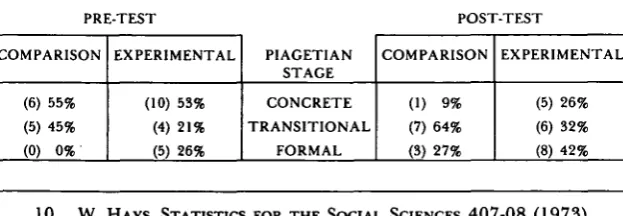
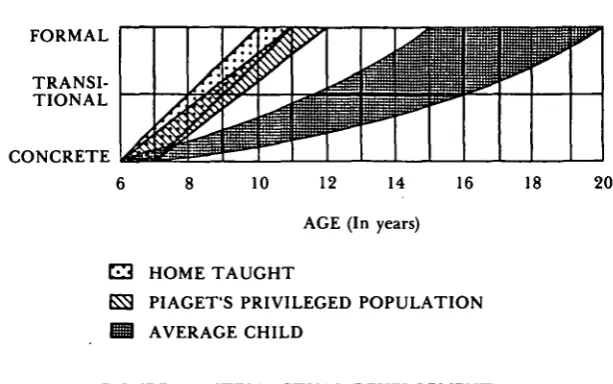
cent research published as an appendix to this article,
infor-mal teaching by parents in an atmosphere where the child is
free to explore and create accelerates the achievement of
adult-level reasoning. Professor Ed Marek and Headmaster
David Quine have found home-schooled children reach
adult-level cognition between ages ten and eleven or twelve versus
ages fifteen to twenty for conventionally-schooled children.
0Less formal studies examine the outside activities of
chil-dren schooled at home. In some instances home schoolers
have formed various local support groups in which children
join others being schooled at home. In some school districts,
home schoolers may be partially enrolled in a public or
pri-vate school. Many after-school sporting and social activities
are open to home schoolers. Thus, while home schoolers may
not interact with other children in the environment of a
con-ventional school, they have many opportunities for
socializa-tion. How much socialization particular children get depends
on what their parents decide they want for their children.
III. THE LAW AND PARENT-CENTERED EDUCATION
In the opinion of this writer, legislative initiatives
consti-tute a more effective manner of promoting parental rights in
education than do litigative approaches.
1While litigation is
important for protecting individual families and for
establish-ing legal principles, litigation can only precipitate the
funda-mental policy changes necessary to promote parent-centered
education; it cannot implement them. The following discussion
consequently focuses on legislative concerns, first examining
existing regulations affecting home schooling, then
sug-gesting policy considerations designed to expand
parent-cen-tered education.
A. Regulation of Home Schooling
Defacto, home schooling occurs in every state. The states
differ, however, in how they respond to this phenomenon.
Three responsive patterns have emerged.
72In thirty states,
70. D. Quine & E. Marek, Reasoning Abilities of Home-Educated Children (1988) (unpublished study). The text of the study is printed herein; see Appendix infra pp. 562-68.
71. See Lines, supra note 35, at 122. Even the Home School Legal
Defense Association, the primary litigating organization in the field, de-votes a good deal of effort to legislative change.
72. The most up-to-date catalog of state legislation is an unpublished 50-page summary available through the Home School Legal Defense Asso-ciation. The information in this paragraph comes from that report.
JOURNAL OF LAW, ETHICS & PUBLIC POLICY
home schools are recognized by statute or regulation as a
permissible option. In eleven additional states, they have
been construed by administrators or courts to come within
the term "private school." In the remaining states, home
schools have been legitimated by earning administrative
ap-proval as "equivalent" to public schools. Most conflicts occur
regarding the second and third categories. What is a "private
school" or "equivalent instruction," and who makes decisions
as to categories?
Within each of these three categories, the position of
parents will vary from state to state depending on the
alloca-tion of authority over educaalloca-tion under the state constitualloca-tion,
the language employed by state education statutes, and the
opinions of administrators and of the courts. In some states,
state or local boards of education have ruled that home
schools are "private schools" or the "equivalent of public
schools." Where the approval of local school boards is
re-quired, these boards may impose additional conditions. If the
appropriate administrators withhold approval, the issue may
be decided by state administrative process or by the courts.
In litigating whether home schools are "private schools"
or the "equivalent" of public schools, home schoolers have
met mixed results." There have been a number of
constitu-tional challenges under the due process clause of the
four-teenth amendment and the free exercise clause of the first
amendment regarding the definition of a "private school."
The "equivalency" statutes especially lend themselves to
vagueness challenges under the fourteenth amendment due
process clause. If the statute does not specify what constitutes
equivalency but leaves the question to the relevant board of
education, the statute may provide inadequate notice and
al-low excessive discretion. The parental liberty argument
found in Pierce v. Society of Sisters has been raised, often in
conjunction with a free exercise claim, but these challenges
have met with only limited success.
The legislative situation regarding home schools is
con-tinuously changing. With publicity, research on academic
performance, and lobbying, opposition to home schooling has
been softening. In recent years, states have made it easier to
choose home schooling but not without a struggle. While not
officially opposing home schooling, the National Education
73. See Tobak & Zirkel, Home Instruction: An Analysis of the Statutes and Case Law, 8 U. DAYTON L. REV. 1, 28-50 (1982).
PARENT-CENTERED EDUCATION
Association has recommended that teachers meet special re-quirements approved by the state and that state laws "contain annual approval of home school, monitoring by the local
pub-lic school, instruction comparable to the pubpub-lic schools, man-dated testing, and records of progress, attendance, and in-structional time."' 74 The principal legal requirements for home schools are:
1. Teacher Certification: Only three states (Michigan, Iowa, North Dakota) currently require parents who educate their children in the home to receive teacher certifica-tion-a decline over the last few years.75
In Michigan and Iowa, the certification requirements currently are not being enforced. Alaska has certified teachers super-vising parents. Some local districts may condition ap-proval on the certification or other qualifications of the parents;
2. Local Approval: Eighteen states and the District of Co-lumbia require approval of home schooling programs by the local school board.7' This requirement involves a degree of discretion which might make it difficult for parents to home school;
3. Testing: Twenty states currently require testing, up from only two in 1980;7
4. Attendance: Generally, the states require the same num-ber of days of instruction for home school as for public-school students. Some states have special requirements on the number of hours of class instruction per day. In-creasingly since 1980, states have been requiring par-ents to keep records of attendance;78 and
5. Curriculum and Textbooks: Curriculum and textbook re-quirements are various. They may be stated specifically in a statute or part of the decision process by which the school board or superintendent approves home schools or determines the proposed instruction to be the equivalent of that of public schools. Some states have
74. 3 HOME SCHOOL COURT REPORT, supra note 63, at 10 (quoting and summarizing Report on Home Schooling by NEA Standing Committee on Instruction and Professional Development, October 11, 1984).
75. Id. at 5. Compare the situation as of 1980, L. KOTIN & W. AIKMAN,
supra note 6, at 119.
76. See Home School Legal Defense Ass'n report, supra note 72. In Pennsylvania the local-approval statute has been declared unconstitutional. Jeffrey v. O'Donnell, Civ. No. 86-1560 (C.D. Pa. Aug. 24, 1988).
77. Id. See also L. KOTIN & W. AIKMAN, supra note 6, at 120. 78. See Home School Legal Defense Ass'n report, supra note 72.
JOURNAL OF LAW, ETHICS & PUBLIC POLICY
required parents to keep a portfolio of work by the student.7 9
The discretion and ambiguity inherent in some of these standards sometimes results in controversies between home schoolers and superintendents of local school boards opposed to home schooling.8 0 Administrators may have concerns about home schooling which range from educational quality to their own workload in approving home-school programs. The Home School Court Report contends that a number of states have imposed attendance requirements and other mon-itoring activities as a way of justifying or increasing the amount of money allocated to public school districts in which home schoolers reside.8 1 If school districts are receiving
money for the home schoolers, school administrators may feel obliged to justify the funding through increased regula-tion. School authorities have a strong financial incentive to bring home schoolers into the public schools or to attain enough control to justify receiving equivalent sums of money. In some school districts, the conflicts have been worked out by allowing home schoolers partial enrollment in public
schools.
B. The Future of Regulation over Education
Compulsory attendance laws have been obstacles to par-ents who want to teach their children at home in those states which did not explicitly provide for that option. Parents who decline to send their children to an approved public or pri-vate school and are unable to get approval of home schooling may face criminal penalties. With nineteen states enacting legislation permitting home schooling during the years 1982-87, the law has been acknowledging the prerogative of par-ents to exercise greater control over the education of their
children, thereby limiting the coercive force of compulsory attendance laws.
What do the legislative victories for home schooling mean? Despite the relaxation of barriers, home schooling is not likely to be an option chosen by many parents. While
79. See L. KOTIN & W. AIKMAN, supra note 6, at 116-18.
80. A particularly well-detailed account of such a conflict appears in S. ARONS, supra note 64, at 77-86. See also L. KOTIN & W. AIKMAN, supra
note 6, at 104-17, 124-34 for a description of the administrative and trial processes.
81. 3 HOME SCHOOL COURT REPORT, supra note 63, at 10.