Open Access
Research article
Hydroxyethyl starch versus Ringer solution in cardiopulmonary
bypass prime solutions (a randomized controlled trial)
Osman Tiryakio
ğ
lu*
1, Gürdeniz Y
ı
ld
ı
z
2, Hakan Vural
1, Tugrul Goncu
1,
Ahmet Ozyaz
ı
c
ı
oglu
1and
Ş
enol Yavuz
1Address: 1Department of Cardiovascular Surgery, Bursa Yuksek Ihtisas Education and Research Hospital, Bursa, Turkey and 2Department of Cardiovascular Surgery, Adana Numune Education and Research Hospital, Adana, Turkey
Email: Osman Tiryakioğlu* - [email protected]; Gürdeniz Yıldız - [email protected]; Hakan Vural - [email protected]; Tugrul Goncu - [email protected]; Ahmet Ozyazıcıoglu - [email protected]; Şenol Yavuz - [email protected]
* Corresponding author
Abstract
Background: In our study we compared the Ringer solution, which is the standard prime solution of our department, with the HES (Hydroxyethyl starch) 130-0.4 solution, which can be a potential alternative prime solution with an indispensable material for the cardio-pulmonary bypass applications.
Methods: 140 patients undergoing to CABG (Coronary Artery Bypass Graft surgery) were electively enrolled to the study. 1500 ml Ringer solution + 200 ml mannitol + 60 ml sodium bicarbonate + 150 U/kg heparin was used as a prime solution to start cardiopulmonary by-pass in 70 patients which was defined as group 1. On the other hand, 1500 ml HES 130 - 0.4 + 200 ml mannitol + 60 ml sodium bicarbonate + 150 U/kg heparin was used as a prime solution in 70 patients in group 2.
Results: INR (International Normalized Ratio), urea levels and blood platelet counts were significantly different between the groups. INR level was higher in group 1, while blood urea and creatinine levels and platelet count were higher in group 2 at the end of the 12th and 24nd hours postoperatively (p = 0.001).
In this study, it was shown that the usage of HES 130-0.4 as a prime solution did not have negative effect on postoperative INR level, platelet count, the need for transfusion and the amount of drainage, despite the negative opinions that similar solutions caused coagulation disorders. Another interesting result of the study was that blood platelet count at 24th hour was statistically significantly higher in group 2 (p = 0.001).
Conclusion: HES 130-0.4 solution is an alternative colloidal solution which can be used as the prime solution or as a mixture with the crystalloids in cardio-pulmonary bypass applications.
Introduction
The heart-lung machine and the corresponding lines must be prepared before beginning the cardiopulmonary
bypass procedure. To fill the venous reservoir and the lines with fluid and to sweep away the air particles in the lines from the system, approximately 1500–2000 ml fluid
Published: 12 July 2008
Journal of Cardiothoracic Surgery 2008, 3:45 doi:10.1186/1749-8090-3-45
Received: 31 October 2007 Accepted: 12 July 2008
This article is available from: http://www.cardiothoracicsurgery.org/content/3/1/45
© 2008 Tiryakioğlu et al; licensee BioMed Central Ltd.
is needed. Balanced electrolyte solutions, starch solutions, gelatin or mixtures of these solutions with predetermined ratios are used [1].
Prime solutions are solutions which are used to prepare the extracorporeal perfusion line in cardiopulmonary bypass applications. It is prepared with balanced electro-lyte solutions with pH and ionic distribution similar to those of the plasma, and sometimes starch solutions, which generally do not contain erythrocytes, are added. In adults, the amount of prime solution is approximately two liters. Blood is not used in prime solutions, except for those used in anemic patients or the infants. Initial expe-riences with prime solutions which were prepared only with blood were unsuccessful and caused homologous blood syndrome characterized with accumulation of blood in splenic bed and a shock scene [1-4].
30% reduction in the renal blood flow accompanies the renal vascular resistance during the cardiopulmonary bypass. Ischemia caused by this condition disturbs the glomerular and tubular functions. Hemodilution has con-siderable beneficial effects on this situation. It enhances renal blood and plasma flow, free water and creatine clearance, glomerular filtration and the urine volume. It causes significant restoration in the blood flow of renal outer cortex [4].
Disadvantage of the haemodilution is that it reduces the intravascular osmotic pressure and subsequently, intersti-tial edema develops. The excessive expansion of the inter-stitial fluid can have some drawbacks. The foremost drawbacks are the disturbance of the lymphatic drainage and the increase of the interstitial fluid volume. Conse-quently, malfunctioning of many organs, especially lungs, decrease in pulmonary compliance, hypoxia, peripheral edema, edema in muscles and gastrointestinal system and disturbance of the tissue oxygenation can occur [1].
This study is aimed to evaluate the effects of the excessive expansion of the interstitial fluid through administering the colloidal HES 130-0,4 instead of the classic method of crystalloid Ringer solution as the prime solution and its leading to interstitial edema and to interrogate the con-cepts of the increase in bleeding tendency by utilizing sim-ilar starch solutions and the unfavorable effects on renal functions.
Methods
140 patients have been studied, who were subjected to elective CPB interventions at our Department between February and December 2006. Written informed consent for participation was obtained, and the hospital ethics committee approved the protocol.
Patients with renal insufficiency preoperatively were excluded from this study. The study of 140 subjects with no demographic differences was arranged by separating them as Group 1 consisting of 70 subjects (Ringer solu-tion) and Group 2 consisting of 70 subjects (HES 130-0.4).
To begin the cardiopulmonary bypasses on 70 subjects of Group 1, 1500 ml Ringer solution + 200 ml mannitol + 60 ml sodium bicarbonate + 150 IU/kg heparin was used as the prime solution. On the other hand, to begin the cardi-opulmonary bypasses on 70 subjects of Group 2, 1500 ml HES 130-0,4 (Voluven®; Fresenius Kabi Deutschland GmbH, Bad Homburg, Germany) + 200 ml mannitol + 60 ml sodium bicarbonate + 150 IU/kg heparin was used as the prime solution.
Subjects were introduced to the cardiopulmonary bypass by applying 2.2 l/min/m2 total systemic blood flow at moderate hypothermia of 26–31°C. The hematocrite value of the subjects was kept at 20–25 during the process of cardiopulmonary bypass.
To ensure standardization between the groups, subjects were classified according to age, sex, cross-clamp time, cardiopulmonary bypass duration, coronary bypass number, diabetes, chronic obstructive pulmonary disease, hypertension, hypercholesterolemia, preoperative coro-nary lesions, executed corocoro-nary bypass number and LIMA (Left Internal Mammary Artery) usage. In the morning of the operation day, 12 derivation electrocardiograms of the subjects were executed.
Surgical procedure
All patients underwent standard median sternotomy. Car-diopulmonary bypass was introduced by arterial cannula-tion from the ascending aorta and by two stage venous cannulation from the auricle of the right atrium. Cardio-plegia cannula was positioned into the root of the aorta and cardioplegia was given to all the patients through antegrade way.
The prepared LIMA graft was anastomized in all patients to the descending left anterior coronary artery (LAD). Membrane oxygenator was used in all patients. Hemat-ocrite was kept at 20%–25% throughout the CPB. Pump flow of 2–2.2 l/min/m2 and nonpulsatile and median arterial pressure through the cross-clamp was kept at 50– 60 mmHg. Following the cross clamp, the warming proce-dure was continued until the bladder temperature reached the 36°C.
calcium levels were measured in all patients and medians in the two groups and statistical analysis were evaluated. Medians in two groups and statistical analysis of the amount of the used prime solution, the amount of the fluid added to the pump during the CPB, net balance at the pump output, postoperative drainage, the amounts of postoperative blood and FFP (fresh frozen plasma) trans-fusion, extubation time, the duration of intensive care and discharge time were evaluated.
At the 72nd hour postoperatively, the creatine clearances of all the subjects were obtained and their statistical anal-ysis were evaluated.
Statistical Method
For the analysis of the demographic, preoperative, opera-tive, and postoperative data and the results of each group with the method of median +/- t standard deviation and with the utilization of SPSS 11.0 statistics software to get the categorical data X2 (chi-square) and to get the multiple variables, the One-Way Anova and the Independent-Sam-ples-T Test methods were utilized. Values lower than 0.05 for p value were considered as significant.
Results
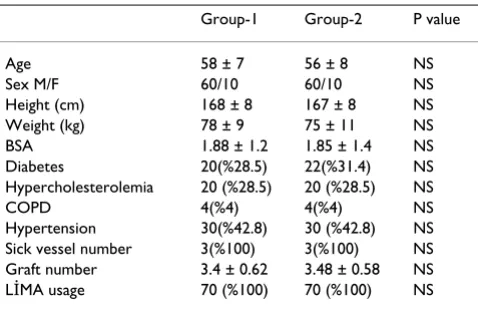
There is no significant difference between the risk factors including the demographic and preoperative specifica-tions of both groups (Table 1, Table 2).
Median data and statistical analysis of the parameters which were compared at the 12th and 24th hours postop-eratively are documented in Table 3 and 4.
There were no significant difference regarding the hemat-ocrite, platelet, SGOT, SGPT, creatine, sodium, potassium, chloride and calcium values at postoperative 24th hour between two groups. However, there is a significant
differ-ence regarding the INR, urea and creatine values at post-operative 24th hour (p = 0.001). The INR values of Group 1 were found to be higher at postoperative 24th hour. On the contrary, platelet count, serum urea and creatinine val-ues were higher in Group 2.
Consequently, it can be suggested that the utilization of HES 130 - 0.4 as the prime solution has a negative effect on renal functions. Although the serum urea and creatine values were higher than the Ringer group, they were still within the normal range and it was demonstrated that they do not cause any serious renal damage and renal insufficiency. On the other hand, HES 130-04 solution has to be utilized very carefully on subjects with disturbed renal function and on borderline patients, taking into account the benefit/harm relationship.
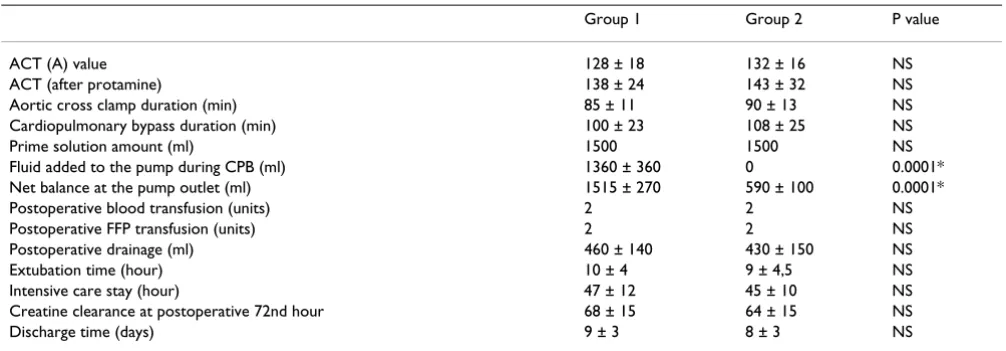
Some operative and postoperative data are given in Table 5. No significant difference could be established between the postoperative blood and FFP utilization,
postopera-Table 1: Demographic Specifications.
Group-1 Group-2 P value
Age 58 ± 7 56 ± 8 NS
Sex M/F 60/10 60/10 NS
Height (cm) 168 ± 8 167 ± 8 NS
Weight (kg) 78 ± 9 75 ± 11 NS
BSA 1.88 ± 1.2 1.85 ± 1.4 NS
Diabetes 20(%28.5) 22(%31.4) NS
Hypercholesterolemia 20 (%28.5) 20 (%28.5) NS
COPD 4(%4) 4(%4) NS
Hypertension 30(%42.8) 30 (%42.8) NS
Sick vessel number 3(%100) 3(%100) NS
Graft number 3.4 ± 0.62 3.48 ± 0.58 NS
LİMA usage 70 (%100) 70 (%100) NS
(COPD: Chronic Obstructive Pulmonary Disease. BSA: Body Surface Area. LİMA: Left internal mammarian artery. NS: Not significant (p > 0.05)).
Table 2: Preoperative Specifications.
Group 1 Group 2 P value
Hematocrite(%) 42 ± 3 41 ± 4 NS
Hemoglobin(gr/dL) 14 ± 1 14 ± 1 NS
Platelet(103/μl) 240 ± 80 272 ± 60 NS
INR 1.07 ± 0.12 1.04 ± 0.15 NS
SGOT(U/L) 20 ± 2 26 ± 4 NS
SGPT(U/L) 44 ± 10 43 ± 8 NS
Urea(mg/dL) 37 ± 10 38 ± 11 NS
Creatine(mg/dL) 1 ± 0.2 1.1 ± 0.1 NS
Creatinine clearance 76 ± 8 82 ± 6 NS
Na (meq/L) 139 ± 8 140 ± 4 NS
K (meq/L) 4.6 ± 0.2 4.4 ± 0.3 NS
Cl (meq/L) 101 ± 5 102 ± 4 NS
Ca (mg/dl) 8.8 ± 0.5 9.1 ± 0.1 NS
NS: Not significant (p > 0.05).
Table 3: Data of postoperative 12th hours.
Group 1 Group 2 P value
Hematocrite(%) 29 ± 4 29 ± 3.5 NS
Hemoglobin(gr/dL) 10 ± 1 10 ± 1 NS
Platelet(103/μl) 155 ± 25 175 ± 30 NS
INR 1.39 ± 15 1.05 ± 9 0.0001*
SGOT(U/L) 73 ± 16 85 ± 20 NS
SGPT(U/L) 40 ± 15 42 ± 18 NS
Urea(mg/dL) 30 ± 12 41 ± 15 0.0001*
Creatine(mg/dL) 1.1 ± 0.3 1.3 ± 0.3 NS
Na (meq/L) 137 ± 6 138 ± 6 NS
K (meq/L) 4.1 ± 0.2 4.1 ± 0.3 NS
Cl (meq/L) 103 ± 5 102 ± 4 NS
Ca (mg/dl) 7.4 ± 0.5 7.4 ± 0.6 NS
tive drainage, extubation time, intensive care duration and discharge time.
There is a significant difference in the used prime solution volume during the CPB regarding the fluid volume added to the pump and the net balance at the pump outlet (p = 0.001).
The prime solution volume and the net balance at the pump outlet of the group of HES 130-0.4 were signifi-cantly lower. Approximately 1360 ml of fluid was added to the pump of the patients with Ringer solution group during the CPB. In the HES 130-0.4 group, there was no need for feeding any additional fluid to the pump.
Although the fluid loading and the interstitial edema were significantly lower in the HES 130-04 group, there was no statistically significant difference regarding to the
extuba-tion, intensive care stay and discharge time, which can be considered as criteria basic for the evaluation of the sub-jects. Nevertheless, it is evident that the medians of these intervals are shorter than that of the Ringer solution group. We thought that, by comparing groups with more subjects, a statistically significant conclusion can be reached for these parameters.
No significant difference could be established regarding the creatine clearance of both groups at the 72nd hour. Nevertheless, by scrutinizing the creatine clearance of both groups after CPB, it can be seen that there is a decrease in the median values of both groups; this decrease is more marked for the HES 130-0.4 group. By comparing the creatine clearance of both groups at the 72nd hour, it can be seen that the creatine clearance is numerically lower for the HES 130-0.4 group. As we emphasized while evaluating the former results, it can be thought that the HES 130-0.4 solution gives more adverse effect on the renal functions.
With respect to the postoperative INR, platelet count, transfusion need and drainage amount, it can be seen that there is no increase in the bleeding tendency and no dis-turbance of the coagulation functions with the usage of HES 130-0.4 solution as the prime solution, as it was before with similar starch solutions. Interestingly, it was found out that the platelet count at the 24th hour postop-eratively was statistically significantly higher for the HES 130-0.4 group.
Discussion
The Ringer solution which is used as the prime solution during CPB causes edema through decreasing the colloi-dal osmotic pressure. As a result of edema, which affects many tissues, various organ dysfunctions occur after CPB. It is still disputed whether to use crystalloid or colloidal
Table 4: Postoperative data at the 24th hour.
Group 1 Group 2 P value
Hematocrite(%) 28 ± 4 29 ± 3.5 NS
Hemoglobin(gr/dL) 9 ± 1.5 10 ± 1.3 NS
Platelet(103/μl) 148 ± 36 189 ± 66 0.001*
INR 1.38 ± 0.19 1.12 ± 0.09 0.001*
SGOT(U/L) 71 ± 13 99 ± 17 NS
SGPT(U/L) 43 ± 11 44 ± 12 NS
Urea(mg/dL) 32 ± 10.3 46 ± 12.3 0.001*
Creatine(mg/dL) 1,1 ± 0.22 1,4 ± 0.24 0.001*
Na (meq/L) 133 ± 6 135 ± 8 NS
K (meq/L) 4 ± 0.9 4.1 ± 0.8 NS
Cl (meq/L) 100 ± 6 101 ± 6 NS
Ca (mg/dl) 7.5 ± 1.2 7.5 ± 1.3 NS
SGOT; Serum glutamic oxaloacetic transaminase, SGPT; Serum glutamic pyruvic transaminase. NS: Not significant (p > 0.05).
Table 5: Operative and postoperative data.
Group 1 Group 2 P value
ACT (A) value 128 ± 18 132 ± 16 NS
ACT (after protamine) 138 ± 24 143 ± 32 NS
Aortic cross clamp duration (min) 85 ± 11 90 ± 13 NS
Cardiopulmonary bypass duration (min) 100 ± 23 108 ± 25 NS
Prime solution amount (ml) 1500 1500 NS
Fluid added to the pump during CPB (ml) 1360 ± 360 0 0.0001*
Net balance at the pump outlet (ml) 1515 ± 270 590 ± 100 0.0001*
Postoperative blood transfusion (units) 2 2 NS
Postoperative FFP transfusion (units) 2 2 NS
Postoperative drainage (ml) 460 ± 140 430 ± 150 NS
Extubation time (hour) 10 ± 4 9 ± 4,5 NS
Intensive care stay (hour) 47 ± 12 45 ± 10 NS
Creatine clearance at postoperative 72nd hour 68 ± 15 64 ± 15 NS
Discharge time (days) 9 ± 3 8 ± 3 NS
solution as the prime solution. Many studies are both for and against one or the other [2].
HES controls the transition of the fluid into the intersti-tium through CPB. Laubenthal and Messmer were able to demonstrate by their study that the HES colloidal solution possesses a higher oncotic effect than albumin. Colloidal particles show their effect through the semipermeable membrane of the capillaries. This effect diminishes the transition of the fluid to the interstitium [3].
In our study, it was found out that the net balance was +1515 ml for the Ringer group and +590 ml for the HES group. This result has shown that the net balance was sta-tistically significantly lowered down for the HES group.
Extubation time was determined as approximately 232 minutes for the Ringer group and 173 minutes for the HES group. It was determined that maximum edema forma-tion was in the group where only Ringer was used as the prime solution. They found out that there was a signifi-cant shortening of the ventilation time in favor of the HES group [2].
In our study, no statistically significant difference could be established between the two groups regarding the extuba-tion times, intensive care duraextuba-tion and discharge time.
Nevertheless, it was established that the mean values of these criteria were shorter in the HES group. By compari-son of groups with bore subjects, it can be possible to establish a statistically significant result for these parame-ters.
The potential relationship between the intraoperative HES utilization and the postoperative bleeding is a con-cept which is still being discussed without any undivided opinion yet.
Complications of bleeding after open heart surgeries are often encountered. Previous studies have shown that 0.6%–15% of the patients have to be revised because of bleeding. In less severe cases, the bleeding has been treated with blood transfusions and with the methods of regulating the coagulation pattern. Clinical and economi-cal effects of the bleeding complications after CPB are very extensive. Consequently, attempts to reduce postoperative bleeding are gaining importance. Two of the determined risk factors are age and female sex.
One of the risk factors which can be manipulated is the utilization of perioperative HES [3-7].
In the patients of HES 130-0.4, the increase in the von Willebrand factor were more pronounced while the blood loss and the usage of erythrocyte concentrate were less [8].
In our study, the postoperative drainage volume was approximately 460 ml for the group of Ringer solution as the prime solution and approximately 430 ml for the group of HES 130-0.4; no statistical difference between the two groups could be established.
The increase of renal vascular resistance during the CPB is accompanied by the 30% decrease of the renal blood flow. The resulting ischemia disturbs the glomerular and tubular functions.
Besides, it is well known that diuretics, aprotinine, preop-erative opaque material intake and many medications used during the CPB have unfavorable effects on the renal functions. When haemodilution is not used, CPB will decrease the free water and creatinine clearance in con-junction with urine volume. Haemodilution has consider-able benefits on this subject. It increases the renal blood and plasma flow, free water, creatinine clearance, glomer-ular filtration rate and urine volume; it particglomer-ularly causes considerable improvement on the blood flow of renal outer cortex [4].
Some case reports and clinical information claim that the utilization of hydroxyethyl starch can destroy the renal functions, but this assertion was investigated only in a small number of studies and the results are controversial.
In their study of patients who underwent CPB, Winkel-mayer et al. have determined that HES utilization was related with the independent decrease in the glomerular filtration velocity at the 3rd and 5th days after surgery. They pointed out that the intraoperative HES utilization in patients of coronary artery bypass surgery will cause a slight disturbance of renal functions [9].
In another study of Boldt et al. of patients older than 70 years, gelatin was compared with HES 130-0.4 and they could not establish any difference between the two vol-ume replacement applications regarding the renal integ-rity [10].
In the study of Maha et al. for the determination of opti-mal amount of HES to use as the prime solution in CPB patients, mean urine volume was 2003 ml in the Ringer group and 1710 ml in the HES group. Although there was a decrease in the HES group, there was no statistically sig-nificant difference between the two groups [2].
Publish with BioMed Central and every scientist can read your work free of charge "BioMed Central will be the most significant development for disseminating the results of biomedical researc h in our lifetime."
Sir Paul Nurse, Cancer Research UK
Your research papers will be:
available free of charge to the entire biomedical community
peer reviewed and published immediately upon acceptance
cited in PubMed and archived on PubMed Central
yours — you keep the copyright
Submit your manuscript here:
http://www.biomedcentral.com/info/publishing_adv.asp
BioMedcentral HES group. These results are statistically significant and
show that the urea values are higher in the HES group. Creatine values at the 12th hour postoperatively were 1.1 mg/dl for the Ringer and 1.3 mg/dl for the HES group. There is no statistically significant difference between the two groups.
Urea value at the 24th hour was mean 32 ± 10.3 mg/dl for the Ringer group and mean 46 ± 12.3 mg/dl for the HES group. Creatine value was 1.1 mg/dl for the Ringer group and 1.4 mg/dl for the HES group. These values show the statistically significant difference between the two groups.
Creatinine clearance which was investigated at the post-operative 72nd hour was mean 68 ± 14 in the Ringer group and 64 ± 14 in the HES group. By comparison, it comes out that there is no statistical difference between the two groups.
Consequently, it can be suggested that the utilization of HES 130-0.4 as the prime solution has unfavorable effects on the renal functions. Although the serum urea and cre-atine values were higher than those of the Ringer group, these values were within the normal range and it was seen that they did not cause any serious renal damage and renal insufficiency.
In conclusion, HES 130-0.4 solution is an alternative col-loidal solution which can be used as the prime solution in cardio-pulmonary bypass applications.
Authors' contributions
OT conceived of the study, design of the study and per-formed the statistical analysis. GY conceived of the study, and participated in its design and coordination. HV par-ticipated in the study design and coordination. TG design of the study and performed the statistical analysis. AO par-ticipated in the study design and coordination. ŞY partic-ipated in the study design and coordination. All authors read and approved the final manuscript.
References
1. Hessel EA II, Edmunds LH Jr: Extracorporeal Circulation: Per-fusion Systems. In Cardiac Surgery in the Adult Edited by: Cohn LH, Edmunds LH Jr. New York: McGraw-Hill; 2003:317-338.
2. Maha AA, Mohamed S: Selection of optimal quantity of hydrox-yethyl starch in the cardiopulmonary bypass prime. Perfusion
2004, 19(1):41-45.
3. Laubenthal H, Messmer K: Pharmacology of dextrans. In Plasma volume expansion Edited by: Baron J. Paris: Arnette; 1992:75-83. 4. Kirklin/Barratt-Boyes: Cardiac Surgery 3rd edition. Philadelphia,
Penn-sylvania, Elsevier Science; 2003:66-131.
5. Avorn J, Patel M, Levin R, VVinkelmayer WC: Hetastarch and bleeding complications after coronary artery surgery. Chest J
2003, 124:1437-42.
6. Haisch G, Boldt J, Krebs C, Suttner S, Lehmann A, Isgro F: Influence of a new hydroxyethylstarch preparation (HES 130/0.4) on coagulation in cardiac surgical patients. J Cardiothorac Vasc Anesth 2001, 15:316-21.
7. Kasper SM, Meinert P, Kampe S, Görg C, Geissen C, Mehlhorn U, Diefenbach C: Large-dose HES130/0.4 does not increase blood loss and transfusion requirements in coronary artery bypass surgery compared with HES 200/0.5 at recommended doses.
Anesth 2003, 99:42-7.
8. Gallandat Huet RCG, Sicmons AW, Bauss D, Rooyen-Butijn WT, Heaagnaars JAM, Van Oeveren W, Bepperling F: A novel HES for effective perioperative plasma volume substitution in car-diac surgery. Can J Anesth 2000, 47:12:1207-15.
9. Winkelmayer WC, Glynn RJ, Levin R, Avorn J: HES and change in renal function in patients undergoing coronary artery bypass graft surgery. Kidney Intern 2003, 64:1046-49.