R E G U L A R A R T I C L E
Metallomics study using hair mineral analysis and multiple
logistic regression analysis: relationship between cancer
and minerals
Hiroshi YasudaÆKazuya YoshidaÆ Mitsuru SegawaÆ
Ryoichi TokudaÆ Toyoharu TsutsuiÆYuichi Yasuda Æ
Shunichi Magara
Received: 25 December 2008 / Accepted: 14 May 2009 / Published online: 26 June 2009 ÓThe Japanese Society for Hygiene 2009
Abstract
Objectives The objective of this metallomics study is to investigate comprehensively some relationships between cancer risk and minerals, including essential and toxic metals.
Methods Twenty-four minerals including essential and toxic metals in scalp hair samples from 124 solid-cancer patients and 86 control subjects were measured with inductively coupled plasma mass spectrometry (ICP-MS), and the association of cancer with minerals was statistically analyzed with multiple logistic regression analysis. Results Multiple logistic regression analysis demon-strated that several minerals are significantly correlated to cancer, positively or inversely. The most cancer-correlated mineral was iodine (I) with the highest correlation coeffi-cient of r=0.301, followed by arsenic (As; r=0.267), zinc (Zn; r=0.261), and sodium (Na; r=0.190), with p\0.01 for each case. In contrast, selenium (Se) was
inversely correlated to cancer (r= -0.161, p\0.05), followed by vanadium (V) (r= -0.128). Multiple linear regression value was highly significantly correlated with probability of cancer (R2=0.437, p\0.0001), and the area under the receiver-operating characteristic (ROC) curve was calculated to be 0.918. In addition, using con-tingency table analysis and the chi-square test, the preci-sion of discrimination for cancer was estimated to be 0.871 (chi-square =99.1,p\0.0001).
Conclusions These findings suggest that some minerals such as arsenic, selenium, and probably iodine, zinc, sodium, and vanadium contribute to regulation of cancer and also that metallomics study using multiple logistic regression analysis is a useful tool for estimating cancer risk. Keywords Cancer MetallomicsArsenic Selenium
Multiple logistic regression analysis
Introduction
Cancer has been the first cause of death in developed countries, and worldwide there are more than 10 million new cancer cases each year [1, 2]. Therefore, a large number of experimental and epidemiological studies have been undertaken to identify potential risk factors for can-cer, among which the association with some carcinogenic metals such as cadmium, nickel, beryllium or arsenic has been reported [2–5]. However, there is no metallomics study comprehensively examining the relationship between cancer risk and multiple biometals.
For the last few years, we have measured scalp hair minerals in over 60,000 subjects, ranging from infant to elderly, in order to assess exposure to toxic metals, defi-ciency/excess profile of essential minerals, and some ‘‘Metallomics,’’ as well as genomics, transcriptomics, proteomics,
metabolomics, and so on, is one of the ‘‘omics’’ sciences investigating metals and metalloids comprehensively; this term was coined by Prof. Haraguchi in 2001. A new international journal namedMetallomics has been published since 2008 by the Royal Society of Chemistry.
H. Yasuda (&)K. YoshidaM. SegawaR. Tokuda T. Tsutsui
Research Laboratory, La Belle Vie Inc., 8-4 Nihonbashi-Tomizawacho, Chuo-ku, Tokyo 103-0006, Japan
e-mail: [email protected]
Y. Yasuda
Health Science Laboratory, Nishitokyo 202-0001, Japan
S. Magara
relationships between minerals and physical or mental disorders [6–8].
The purpose of this study is to examine comprehen-sively some roles of toxic and essential minerals in cancer risk. Twenty-four kinds of minerals in hair samples were measured for cancer and control subjects aged 20– 80 years, and the association between cancer and these multiple minerals was examined with multiple logistic regression analysis.
Materials and methods
Materials
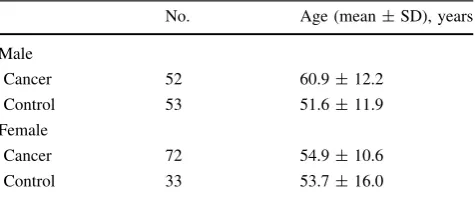
On the basis of informed consent, scalp hair samples (about 0.2 g) were collected from 124 solid-cancer patients suffering from breast (n=28), stomach (n=22), lung (n=11), colon (n=10), prostate (n=9), liver (n =7), pancreas (n=5), uterus (n =5), ovary (n=4), esophagus (n=4), malignant lymphoma (n=4), kidney (n =3), thyroid (n =2) or other tumors who had been cared for and treated in Somon Hachioji Clinic (Table1). In addition, control hair samples from healthy subjects aged 20– 80 years old from the Tokyo metropolitan district were collected. The study protocol was approved by the ethical committee of this laboratory. All of the data obtained are held securely in such a form as to ensure anonymity. Hair mineral analysis
Hair sample of 75 mg was weighed into 50 ml plastic tube, and washed twice with acetone and then with 0.01% Triton solution, in accordance with the procedures recommended by the Hair Analysis Standardization Board [9]. The washed hair sample was mixed with 10 ml 6.25% tetra-methylammonium hydroxide (TMAH, Tama Chemical) and 50ll 0.1% gold solution (SPEX Certi Prep.), and then dissolved at 75°C with shaking for 2 h. After cooling of the solution to room temperature, internal standard (Sc, Ga, and In) solution was added and, adjusting its volume gravimetric, the obtained solution was used for mineral analysis. The mineral concentrations were measured with
inductively coupled plasma mass spectrometry (ICP-MS; Agilent-7500ce) by the internal standard method [6–8,10], and are expressed as ng/g hair (ppb). For quality control of the mineral analysis, the human hair certified reference material supplied from the National Institute for Environ-mental Studies of Japan (NIES CRM no. 13) [11] was used. Statistical analysis
The hair mineral concentrations were log-normal distrib-uted, and geometric rather than arithmetic means were used as representative of hair mineral levels. For statistical analysis, the values of mineral levels were converted to logarithms. The relation between cancer risk and 24 min-erals was investigated with multiple logistic regression analysis (JMP6; SAS Institute).
Results
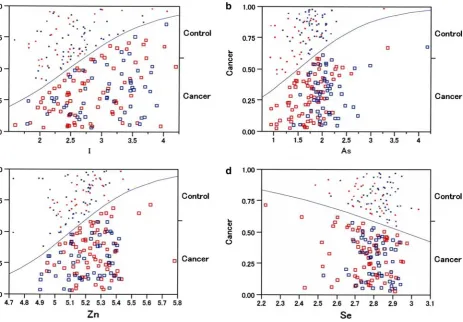
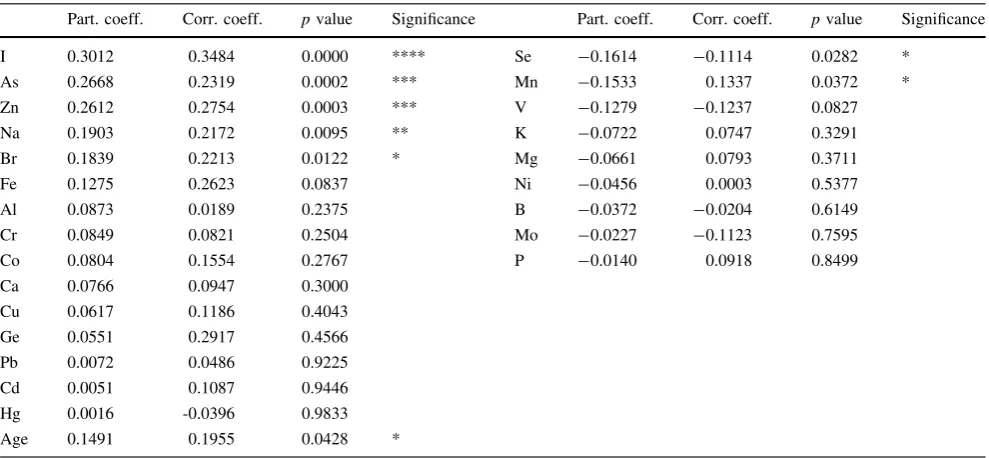
Twenty-four kinds of mineral concentrations in the scalp hair of 124 solid-cancer patients and 86 control subjects were measured, and the association between cancer and each mineral was statistically examined with multiple logistic regression analysis. Some minerals were found to be significantly correlated to cancer, positively or inversely, and the multiple coefficient of determination (R2) for esti-mating the probability of cancer risk was estimated to be 0.465 (Table2). The most cancer-correlated mineral with the highest partial correlation coefficient was iodine (I; r=0.301), followed by arsenic (As;r=0.267), zinc (Zn; r=0.261), and sodium (Na;r=0.190), withp\0.01 for each element. These correlation coefficients were higher than that of ageing, a well-known risk factor of cancer. Regression charts for the best three minerals exhibiting significantly high positive correlation with cancer are shown in Fig.1a–c. In contrast, the most inverse-correlated mineral to cancer was selenium (Se;r= -0.161) (Fig.1d), followed by manganese (Mn) and vanadium (V) (Table2). Figure2 exhibits a significantly high correlation of cancer with multiple linear regression value obtained by the following equation (R2=0.447,p\0.0001):
Multiple linear regression¼ 0:70 Sexð Þ þ0:023Age
þ1:75Log Iþ3:59Log As
þ5:38Log Znþ6:67Log Fe
þ2:04Log Na6:47Log Se
1:48Log K1:47Log Mn
50:88
Thus, the area under the receiver-operating characteristic (ROC) curve for discriminating cancer was Table 1 Tested subjects (n=210)
No. Age (mean±SD), years
Male
Cancer 52 60.9±12.2
Control 53 51.6±11.9
Female
Cancer 72 54.9±10.6
estimated as 0.918 for multiple linear regression, and significantly greater than 0.704 for iodine, 0.647 for arsenic, and 0.662 for zinc. The accuracy of the discrimination of cancer was also assessed using contingency table analysis and the chi-square test (Table3). From the contingency table, the precision of discriminating cancer patients was estimated to be 0.871 (108/124=87.1%; chi-square =99.1,p\0.0001).
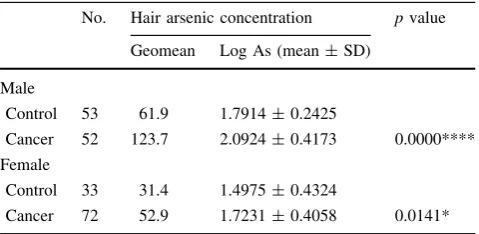
The mean hair arsenic level in the patient group was significantly higher than that in the control group, in both sexes, and gender difference was observed (Table4).
Discussion
Hair mineral analysis has been used in forensic medicine, in screening populations for toxic metal poisoning, and in monitoring environmental pollutants [6, 12–14]. Further-more, its clinical use has been tried for diagnosis of some diseases and symptoms [7,8], but reliability remained to be confirmed [15,16]. Our previous studies demonstrated that
hair levels of some toxic metals such as lead, cadmium, and aluminum are extraordinarily high in infants and children [6,17]. In addition, we reported that autistic children are suffered from global mineral deficiency of various essential trace elements and also that, in autistic children, there are some subgroups with high accumulation of mercury, cad-mium, and lead, or aluminum and iron [7].
In the present metallomics study for cancer patients, the multiple logistic regression analysis exhibited a significant association between some minerals and cancer. In partic-ular, carcinogenic arsenic and its antagonistic element, selenium, was confirmed to correlate to cancer risk posi-tively and inversely, respecposi-tively (Fig.1b, d, Table2).
A significantly high close relationship between proba-bility of cancer and multiple linear regression value was demonstrated (R2=0.447, p\0.0001) (Fig.2), and the corresponding area under the receiver-operating charac-teristic (ROC) curve for diagnosis of cancer was estimated to be 0.918. Furthermore, this close relationship was con-firmed by the results of contingency table analysis: the precision of discrimination for cancer patients was Fig. 1 Positive or inverse relationship between cancer and minerals
in multiple logistic regression analysis (aiodine, barsenic,czinc, dselenium). The relationship between minerals and probability of cancer was obtained by logistic multiple regression analysis of data for 24 minerals from 124 cancer (open square) and 86 control (dots)
estimated to be 0.871 (108/124=87.1%) and the accu-racy to be 0.838 [(108?68)/210 (chi-square=99.1, p\0.0001)] (Table3).
These findings suggest that there is a significantly high close relationship between probability of cancer and trace bioelements, including toxic and essential minerals.
The multiple coefficient of determination (= R2) for estimating the probability of cancer risk was calculated to be 0.465 (p\0.0001). This means that the cancer risk of an individual case can be evaluated with 46.5% probability by using hair mineral analysis and multiple logistic regression analysis.
From the regression curve shown in Fig.1b, the prob-ability of cancer in a subject with a logarithmic arsenic value of 2.5 was estimated to be about 80%, and about 30% increment of the probability was estimated to be associated with a tenfold increase in hair arsenic level from 10 to 100 ppb (odds ratio 36.2; 95% CI 7.1–234). Arsenic has been known to be toxic and induce chromosomal aberra-tions and carcinogenesis via various cellular changes including alterations in cell differentiation and proliferation
[4,18,19]. Cells exposed to arsenic have been shown to
increase cellular tyrosine phosphorylation, which is related to the aberrant cell signaling and uncontrolled cell growth associated with cancer development. Some ecologic studies in areas known for high levels of arsenic in drinking water have suggested that this element is associated with increased risks of lung and bladder cancer [4, 20–23]. In Table 2 Relationship between cancer risk and minerals (multiple logistic regression analysis)
Part. coeff. Corr. coeff. pvalue Significance Part. coeff. Corr. coeff. pvalue Significance
I 0.3012 0.3484 0.0000 **** Se -0.1614 -0.1114 0.0282 *
As 0.2668 0.2319 0.0002 *** Mn -0.1533 0.1337 0.0372 *
Zn 0.2612 0.2754 0.0003 *** V -0.1279 -0.1237 0.0827
Na 0.1903 0.2172 0.0095 ** K -0.0722 0.0747 0.3291
Br 0.1839 0.2213 0.0122 * Mg -0.0661 0.0793 0.3711
Fe 0.1275 0.2623 0.0837 Ni -0.0456 0.0003 0.5377
Al 0.0873 0.0189 0.2375 B -0.0372 -0.0204 0.6149
Cr 0.0849 0.0821 0.2504 Mo -0.0227 -0.1123 0.7595
Co 0.0804 0.1554 0.2767 P -0.0140 0.0918 0.8499
Ca 0.0766 0.0947 0.3000
Cu 0.0617 0.1186 0.4043
Ge 0.0551 0.2917 0.4566
Pb 0.0072 0.0486 0.9225
Cd 0.0051 0.1087 0.9446
Hg 0.0016 -0.0396 0.9833
Age 0.1491 0.1955 0.0428 *
Determination coefficient: 0.465
The relationship between cancer and minerals was analyzed with multiple logistic regression analysis of data for 24 minerals from 124 cancer patients and 86 control subjects
Part. coeff.partial correlation coefficient by logistic multiple regression analysis,Corr. coeff.simple correlation coefficient by simple regression analysis
Statistically significant association is shown with asterisk marks: *p\0.05, **p\0.01, ***p\0.001, and ****p\0.0001
Japan, much of the arsenic accumulated in the human body is known to derive from dietary intake of arsenic-contain-ing foods, such as seaweeds and shellfishes, and also from environmental exposure.
The most strongly correlated mineral, iodine, possibly makes some contribution to cancer pathogenesis, although its association with cancer remains to be studied further.
Zinc has an important role in cell-mediated immune functions, and zinc deficiency was reported to be associated with increased risk of cancer [24–26]. However, in this metallomics study, zinc level in hair was found to be positively correlated with cancer risk (Table2; Fig.1c). This discrepancy may be explained by the hypothesis that hair zinc level behaves paradoxically when deficient in the human body. Further studies are needed for clarifying the role of zinc in cancer risk.
Selenium, a representative competitive mineral against arsenic, correlated inversely with cancer risk; the higher the level of this element, the lower the probability of cancer
risk (Fig. 1d; Table2). This finding is consistent with the hypothesis of anticancer activity of selenium. Selenium is the key element of glutathione peroxidase and other sele-nium proteins, and is essential for counteracting reactive oxygen species, protecting from oxidative stress, and reg-ulating the redox status in cells [2]. This essential mineral also appears to correlate with stimulation of metabolic detoxification and excretion of arsenic [27, 28]. Thus, selenium is expected to reduce the toxicity and cancer risk of arsenic [29,30], although high body burden of selenium is toxic. Furthermore, selenium is known to have an ability to compete with other toxic metals such as mercury, cad-mium, and lead.
The present study suggests that some minerals such as not only arsenic and selenium but also iodine, zinc, sodium, and vanadium play a pivotal role in cancer path-ogenesis, indicating that metallomics analysis using mul-tiple logistic regression analysis seems to be a good tool for estimating cancer risk. Further studies for each type/nature of solid cancer are needed for certifying the usefulness of this analysis.
Hair mineral analysis can provide global information for human metallomics study, i.e., the deficiency/excess profile of multiple trace bioelements that contribute to various physiological and/or adverse events, and therefore will be useful as a biomarker for monitoring health and risk assessment.
Conclusion
This metallomics study for cancer patients demonstrated that there is a close relationship between cancer risk and trace bioelements including toxic and essential minerals, and that many patients have some mineral imbalance in their body. These findings suggest the possibility that me-tallomics study using hair mineral analysis and multiple logistic regression analysis will be a useful tool for esti-mating cancer risk and also for cancer prevention. Acknowledgments The authors sincerely appreciate Emeritus Prof. Toshiro Haga for his useful advice regarding the statistical analysis based on multiple logistic regression analysis in this study.
References
1. Parkin DM, Bray F, Ferlay J, Pisani P. Global cancer statistics, 2002. CA Cancer J Clin. 2005;55:74–108.
2. Silvera SAN, Rohan TE. Trace elements and cancer risk: a review of the epidemiologic evidence. Cancer Causes Control. 2007;18:7–27.
3. Drasch G, Schopfer J, Schrauzer GN. Selenium/cadmium ratios in human prostates: Indicators of prostate cancer risk of smokers Table 3 Contingency table
No. Judgment
Negative Positive
Cancer 124
Count 16 108
Row % 0.129 0.871
Control 86
Count 68 18
Row % 0.791 0.209
210 84 126
Using contingency table analysis and the chi-square test, the accuracy and precision of discrimination of cancer patients was assessed
chi-square=99.1 (p\0.0001)
Table 4 High arsenic concentrations in cancer patients
No. Hair arsenic concentration pvalue
Geomean Log As (mean±SD)
Male
Control 53 61.9 1.7914±0.2425
Cancer 52 123.7 2.0924±0.4173 0.0000****
Female
Control 33 31.4 1.4975±0.4324
Cancer 72 52.9 1.7231±0.4058 0.0141*
The hair arsenic concentrations in the 124 cancer patients are com-pared with those in the 86 control subjects. Each value of arsenic concentration was converted to its logarithm, and the geometric mean was used as the average hair arsenic level. Statistical significance was determined using Welch’sttest
and nonsmokers, and relevance to the cancer protective effects of selenium. Biol Trace Elem Res. 2005;103:103–7.
4. Cantor KP, Lubin JH. Arsenic, internal cancers, and issues in inference from studies of low-level exposures in human popula-tions. Toxicol Appl Pharmacol. 2007;222:252–7.
5. Boffetta P. Carcinogenicity of trace elements with reference to evaluations made by the International Agency for Research on Cancer. Scand J Work Environ Health. 1993;19(Suppl 1):67–70. 6. Yasuda H, Yonashiro T, Yoshida K, Ishii T, Tsutsui T. High toxic metal levels in scalp hairs of infants and children. Biomed Res Trace Elem. 2005;16:39–45.
7. Yasuda H, Yonashiro T, Yoshida K, Ishii T, Tsutsui T. Mineral imbalance in children with autistic disorders. Biomed Res Trace Elem. 2005;16:285–91.
8. Yasuda H, Yonashiro T, Yoshida K, Ishii T, Tsutsui T. Rela-tionship between body mass index and minerals in male Japanese adults. Biomed Res Trace Elem. 2006;17:316–21.
9. Cranton EM, Bland JS, Chatt A, Krakovitz R, Wright JV. Stan-dardization and interpretation of human hair for elemental con-centrations. J Holistic Med. 1982;4:10–20.
10. Yasuda H, Yoshida K, Fukuchi K, Tokuda R, Tsutsui T, Yonei Y. Association between aging and minerals in male Japanese adults. Anti Aging Med. 2007;4:38–42.
11. Yoshinaga J, Morita M, Okamoto K. New human hair certified reference material for methylmercury and trace elements. Fresenius J Anal Chem. 1997;357:279–83.
12. Batzevich VA. Hair trace element analysis in human ecology studies. Sci Total Environ. 1995;164:89–98.
13. Chlopicka J, Zachwieja Z, Zagrodzki P, Frydrych J, Slota P, Krosniak M. Lead and cadmium in the hair and blood of children from a highly industrial area in Poland. Biol Trace Elem Res. 1998;62:229–34.
14. Samanta G, Sharma R, Roychowdhury T, Chakraborti D. Arsenic and other elements in hair, nails, and skin-scales of arsenic vic-tims in West Bengal, India. Sci Total Environ. 2004;326:33–47. 15. Wang CT, Chang WT, Zeng WF, Lin CH. Concentrations of calcium, copper, iron, magnesium, potassium, sodium, and zinc in adult female hair with different body mass indexes in Taiwan. Clin Chem Lab Med. 2005;43:389–93.
16. Seidel S, Kreutzer R, Smith D, McNeel S, Gilliss D. Assessment of commercial laboratories performing hair mineral analysis. J Am Med Assoc. 2001;285:67–72.
17. Yasuda H, Yoshida K, Segawa M, Tokuda R, Yasuda Y, Tsutsui T. High accumulation of aluminum in hairs of infants and chil-dren. Biomed Res Trace Elem. 2008;19:57–62.
18. Bates MN, Smith AH, Hopenhayn-Rich C. Arsenic ingestion and internal cancers: a review. Am J Epidemiol. 1992;135:462–76. 19. Hayes RB. The carcinogenicity of metals in humans. Cancer
Causes Control. 1997;8:371–85.
20. Chen CJ, Chuang YC, You SL, Lin HY. A retrospective study on malignant neoplasms of bladder, lung and liver in black foot disease endemic area in Taiwan. Br J Cancer. 1986;53:399–405. 21. Chiou HY, Hsueh YM, Liaw KF, Horng SF, Chiang MH, Pu YS, et al. Incidence of internal cancers and ingested inorganic arsenic: a seven-year follow-up study in Taiwan. Cancer Res. 1995;55: 1296–300.
22. Ferreccio C, Gonzalez PC, Milosavjlevic SV, Marshall GG, Sancha AM, Smith AH. Lung cancer and arsenic concentrations in drinking water in Chile. Epidemiology. 2000;11:673–9. 23. Chen Y, Ahsan H. Cancer burden from arsenic in drinking water
in Bangladesh. Am J Public Health. 2004;94:741–4.
24. Prasad AS. Zinc: mechanisms of host defense. J Nutr. 2007; 137:1345–9.
25. Yan M, Song Y, Wong CP, Hardin K, Ho E. Zinc deficiency alters DNA damage response genes in normal human prostate epithelial cells. J Nutr. 2008;138:667–73.
26. Memon AU, Kazi TG, Afridi HI, Jamali MK, Arain MB, Jalbani N, et al. Evaluation of zinc status in whole blood and scalp hair of female cancer patients. Clin Chim Acta. 2007;379:66–70. 27. Christian WJ, Hopenhayn C, Centeno JA, Todorov T.
Distribu-tion of urinary selenium and arsenic among pregnant women exposed to arsenic in drinking water. Environ Res. 2006;100: 115–22.
28. Chen Y, Hall M, Graziano JH, Slavkovich V, Geen A, Parvez F, et al. A prospective study of blood selenium levels and the risk of arsenic-related premalignant skin lesions. Cancer Epidemiol Biomark Prev. 2007;16:207–13.
29. Reid ME, Duffield-Lillico AJ, Garland L, Turnbull BW, Clark LC, Marshall JR. Selenium supplementation and lung cancer incidence: an update of the nutritional prevention of cancer trial. Cancer Epidemiol Biomark Prev. 2002;11:1285–91.