Available Online at www.ijpret.com
407
INTERNATIONAL JOURNAL OF PURE AND
APPLIED RESEARCH IN ENGINEERING AND
TECHNOLOGY
A PATH FOR HORIZING YOUR INNOVATIVE WORK
SMALL SCALE INDUSTRY AUTOMIZATION USING ETHERNET
PROF . N. U. CHIPDE, PROF. A. S. DUDHE, PROF. S. S. AYANE
Assistant Professor, Department of Information Technology, Babasaheb Naik College of Engineering , Pusad
Accepted Date: 15/02/2014 ; Published Date: 01/04/2014
\
Abstract: Today computer communication systems are playing a vital role in our day to day life. Using these systems many applications can be developed like home automation, appliances control, security systems can be implemented easily. Using LAN technology, web access functionality is embedded in a device to enable low cost, widely accessible and enhanced user interface functions for the device. A web server can be embedded into any device and connected to the LAN so the device can be monitored and controlled from remote places through the browser on a desktop. Conventional industrial parameter monitoring and control systems do not provide plug and play facility and also have limitation of distance. They also require manual operators for monitoring and control of the process parameters which may involve human error. Ethernet interface will overcome these limitations of conventional industrial parameter monitoring and control systems. There are compelling reasons behind considering Ethernet for remote communication. Ethernet is the most widely deployed network in offices and industrial buildings. Ethernet's infrastructure, interoperability and scalability ensure the ease of development. Once equipment is connected to Ethernet network, it can be monitored or controlled through the LAN removing any distance barrier that may have inhibited remote communication previously.
Keywords: ENC 28J60, Ethernet, ARM
Corresponding Author: PROF . N. U. CHIPDE
Access Online On:
www.ijpret.com
How to Cite This Article:
Available Online at www.ijpret.com
408
INTRODUCTION
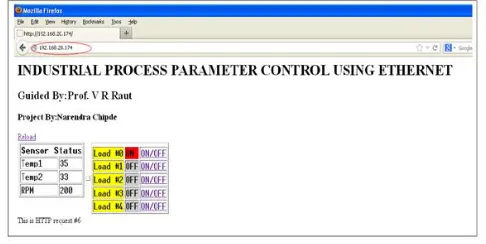
Automation or automatic control, is the use of various control systems for operating equipment such as machinery, processes in factories, boilers , heat treating ovens etc using automatic equipment or operate equipments using networking, The designed system is used to control the devices or equipments from the remote place through a web page. Here all the devices, which are to be controlled, are connected to the ARM 7 board. The Ethernet control module is connected to LAN. The client or a person on the PC is also connected to same LAN. By typing the IP address of Embedded Ethernet in the web browser, the user gets a web page on screen. This page contains all the information about the status of the devices to be monitored. The user can also control these devices by pressing a button provided in the web page. This project presents approach to monitor and control the industrial process parameter by using Ethernet.
I. Designed System.
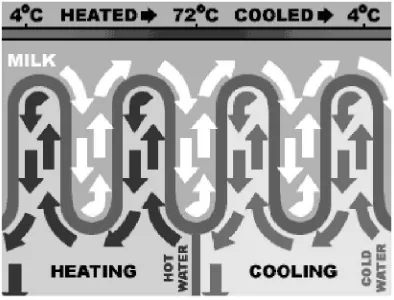
Designed system helps in the automation of small scale milk processing industry to monitor the required parameters of Pasteurization with the help of Ethernet.
Pasteurization is the process of heating the milk for the purpose of eliminating bacteria, protozoa, molds, and yeasts. It eliminates most of the disease producing organisms and limits fermentation in milk. The pasteurization process heats milk to 161 degrees Fahrenheit (63 degrees centigrade) for 15 seconds, inactivating or killing organisms that grow rapidly in milk. Pasteurization does not destroy organisms that grow slowly or produce spores.
Figure 1 Pasteurization process.
Available Online at www.ijpret.com
409 Sensors are used to collect the data form actual industrial field. Sensor is the device which converts the one form of energy in to another form. It is used to sense verious parameters like Teperature, Pressure, Force, RPM etc. In this system we are provide controlling ovar temperature range 40 ºC to 50 ºC and 50ºC to 60ºC and controling RPM of motor at 200[1].
1.1 TEMPERATURE Sensor used
LM35
The LM35 series are precision integrated-circuit temperature sensors, whose output voltage is linearly proportional to the Celsius (Centigrade) temperature. The LM35 thus has an advantage over linear temperature sensors calibrated in ° Kelvin, as the user is not required to subtract a large constant voltage from its output to obtain convenient Centigrade scaling. The LM35 does not require any external calibration or trimming to provide typical accuracies of ±1⁄4°C at room temperature and ±3⁄4°C over a full −55 to +150°C temperature range. Figure 6.1 shows physical appearance of LM 35 and table 3 gives pin no. and its function
Temperature Probe using 'K'-Thermocouple - Digital Interface
This board shown in figure 6.2 includes a 'K' type of thermocouple probe with digital interface, Measures temperature from 0 to +1024 °C with 0.25 °C resolution. Output is simple serial SPI interface to be used with any microcontroller. The board performs cold-junction compensation and digitizes the signal from a type-K thermocouple as shown in figure 6.2. SPI-compatible read-only format. This converter resolves temperatures to 0.25°C, allows readings as high as +1024°C.
1.2 Speed Measurment Sensor.
Transmitter: IR 333 A (Infrared LED)
It is a high intensity diode, molded in blue transparent plastic package.The device is spectrally matched with Photo transistor, Photo diode and infrared receiver module.
Receiver PT 333-3C (Photo Transistor)
Available Online at www.ijpret.com
410
Figure 2 RPM Interfacing.
2.0 Processer
LPC2148 16/32-bit RISC microprocessor is designed to provide a cost-effective and high performance micro-controller solution for hand-held devices and general applications. To reduce total system cost, LPC2148 also provides the following: optional internal SRAM, LCD controller, SPI interface, one duplex DMA channel serves all endpoints, A 32-bit Timers/Counter with a programmable 32-bit Prescaler, I/O ports, RTC, 14-channel 10-bit ADC. [3,4].
So analog data gathered from sensor are given to ADC of LPC 2148 where this data is processed and given to the PC and LCD for monotoring. So selection of proper sensor and smart processor will greatly optimize the system performance.[6,7]
3.0 Ethernet controller
The concept of embedded ethernet is nothing but the microcontroller is able to communicate with the network. As now a day’s microcontroller is widely used in the industrial field, as most of the devices used in industries are not able to transmit the data over the network. This system mainly consist of SPI communication module, Control module and ethernet module. Because of this ethernet module it is possible to monitor and control the parameters form longer distance.
Available Online at www.ijpret.com
411 technology that introduces 28 pin stand alone ethernet controller. All other ethernet controllers available in market are more than 80 pins so 28 pins ENC 28J60 will provide good functionality and simplicity.[8]
Figure 3 Pin diagram of ENC 28J60
3.1 SPI interface: It serves as a primary controller and act as communication channel between
ENC28J60.
3.2 Control register: Are used to control and monitor the ENC28J60.
3.3 Dual port RAM buffer: It acts as an arbiter to control the access to RAM buffer, when
requirement is made from DMA to transmit and receive the blocks.
3.4 Bus interface: It interprets data and commands received via SPI
3.5 MAC module: It implements IEEE 802.3 compliant MAC logic.
3.6 PHY module: It encodes and decodes data obtained from the twisted pair.
The controller communicates with Ethernet controller via its ADC lines, to initialize the chip, Poll it for packet status and send/receive the data. [9]
4. Serial Peripheral Interface (SPI)
Available Online at www.ijpret.com
412 mode. In which master device initiates the data frame. This is a full duplex mode of point to point communication. The serial clock, SCLK generated by the master device which is used by the slave. The SS is the Slave Select signal. It is required in active low state for the slave to have communication with master. This is a four wire communication as shown in Figure 2. The SDO or Serial Data Output signal send by the master and after receiving the clock pulse, the slave device responds back with SDI or Serial Data Input signal.
Figure 4 SPI Interface
When SPI protocol is used between the two devices, the Ethernet Controller generates the data frame and acts as the master while the Arm processor acts as the slave device. [10]
Available Online at www.ijpret.com
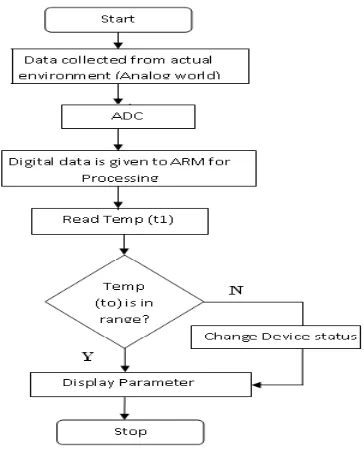
413 The system work start with data collection with the help of sensor. This collected data is analog from which is converted in to digital with the help of inbuilt 10-Bit ADC in LPC2148, then this digital data is given to ARM for processing where measured temperature is compaired with referance range, if temperature is in range then just display it on LCD and PC terminal through Ethernet. If temperature is out of range then devices ststus is changed to get the required range of parameter.
Figure 6 Control window
III. Result
This system is used to monitor and control the industrial process parameter on real time basis using Ethernet. ENC 28J60 Embedded Ethernet Controller for the remote control within LAN. This system has advantages like it is has small size, Realiability, and low power consumption.
IV. Conclusion
This is small, simple and low-cost system improves industrial parameter monitoring and controlling process.
Flexible Embedded network system with Ethernet controller.
A web server in the system provides access to the parameters under the control of system through a device web page. A web server can be embedded into any appliance and connected to the LAN. So the appliance can be monitored and controlled from remote places through the browser on a desktop.
REFERANCES
1. www.facsstaff.bucknell.edu/mastascu/elessonsHTML/sensors/TempR.html.
Available Online at www.ijpret.com
414 3. Sunrom technology, Temperature Probe using ‘K’-Thermocouple – Digital Interface, June 2010.
4. Everlight Electronics Co-Ltd, Technical data sheet, Photo transistror and LED
5. The 8051 Microcontroller and Embedded Systems Using Assembly and C Second Edition Muhammad Ali Mazidi, Janice Gillispie Mazidi, Rolin D. McKinlay
6. Philips semiconductor, “LPC 2142/2146/2138”, prelimnary datasheet,rev.0.1,JUNE2005.
7. www.microbuilder.edu/tutorials/LPC 2148.
8. Microchip Technology Inc. “ENC 28J60 Data Sheet”’ 2008.
9. Bin Tan, Bo Yuan and Bing Zhu, “ The Design of ethernet controller interface circuit based on ENC28J60” Proceding of second International Symposium on networking and network security(ISNNS’10) 2-4 April 2010.
10.Florin ravigan, Niculae boteanu, Adrian mircea drighiciu, “Ethernet interface for a system of automation with microcontroller”, Annals of the university of Craiova Electrical Engineering series No 35, 2011, ISSN 1842- 4805
11.Dhananjay patil ,”Industrial Parameter control and monitoring using LAN “,IRNET explore ,7th Oct.2012
12.Alen Rajan, Aby K. Thomas, Rejin Mathew “A Comparative Performance Analysis of ARM based Web Servers with Integrated and External Ethernet Interfaces for Industrial Applications of paper with only first word capitalized,” International Journal of Computer Applications (0975 – 8887) Volume 44– No.21, April Page N0 28-35.
13.S.A.N. Sandeep, P. Malyadri, “ARM-based Embedded Ethernet Interface Design Using DAC System, International Journal of Engineering and Advanced Technology (IJEAT) ISSN: 2249 – 8958, Volume-1, Issue-6, August 2012 .
14.Kumbhar trupti sambhaji, Prof S.B. Patil, “Design of PIC based Ethernet interface to control the industrial parameter”, International journa of engineering reasurch and application(IJERA), ISSN: 2248-9622 Vol. 2 Issue 4, July-n Aug 2012 PP 977-979
Available Online at www.ijpret.com
415 16.Mr M.R. Gaikar, Prof S.G.Galande, Prof. D.B.Rane “Ethernet Controller ARM Processor” International journal of Electronics communication and soft computing science and engineering volume 2 issue 1.