Available Online at www.ijpret.com 128
INTERNATIONAL JOURNAL OF PURE AND
APPLIED RESEARCH IN ENGINEERING AND
TECHNOLOGY
A PATH FOR HORIZING YOUR INNOVATIVE WORK
IMAGE-BASED FACE RECOGNITION
INGALE SUJIT S., DR. A. M. PATIL
Accepted Date: 24/07/2015; Published Date: 01/08/2015
\
Abstract: - Face Recognition is an application of Image Processing. Face recognition grabs a huge attention of many researches in the field of computer vision. The main reason behind this attention is the fact that, the face is a conventional way which we use to identify each other. The recent interest in face recognition can be attributed to the increase of commercial interest and the development of feasible technologies to support the development of face recognition. Major areas of commercial interest include biometrics, law enforcement and surveillance, smart cards, and access control. In this paper Image-Based Face Recognition has been proposed. Here we are using two dimensional principal component analysis and single level two dimensional discrete wavelet transform technique. The proposed method is tested on ATT and real time database. The test result gave 99.67% accuracy for 2DPCA and 100% accuracy for single level two dimensional discrete wavelet transform.
Keywords: Face Recognition, PCA, Wavelet Transform
Corresponding Author: MR. INGALE SUJIT S
Access Online On:
www.ijpret.com
How to Cite This Article:
Available Online at www.ijpret.com 129
INTRODUCTION
As one of the most successful applications of image analysis and understanding, face recognition has recently received significant attention, especially during the past few years. The problem of machine recognition of human faces endures to attract researchers from disciplines such as image processing, pattern recognition, neural networks, computer vision, computer graphics, computer art and psychology. The strong need for user-friendly systems that can secure our assets and protect our privacy without losing our identity in dozens of passwords and PINs is obvious. One of the advantages of the personal identification system based on analysis of frontal images of the face regard on other biometric analysis is that it is effective without the participant’s cooperation or knowledge. The recognition of faces is very important for many applications such as: video surveillance, retrieval of an identity from a data base for criminal investigations and forensic applications. For face recognition there are two types of comparisons, the first is verification, where the system compares the given individual with who that individual says they are and gives a yes or no decision. The second is identification, where the system compares the given individual to all the other individuals in the database and gives a ranked list of matches. Image based face recognition is divided into two main categories, appearance based face recognition and model based face recognition.
II RELATED WORKS AND BACKGROUND
Two-dimensional principal component analysis (2DPCA)[1] has been proposed and been widely applied in face recognition. Different from the classical PCA, 2DPCA takes a 2D-matrix-based representation model rather than simply the 1D-vector-based one. And image covariance matrix is constructed directly from the 2D image matrices. Since the size of image covariance matrix is much smaller, 2DPCA can evaluate the matrix accurately and computational more efficiently than PCA[2].
Bui T.T.T proposed a complex algorithm based on Viola-Jones method, wavelet transform and Principle component analysis for multiple face detection and recognition in video sequence [3]. Mohod approach [4] rate the face recognition problem as an fundamentally two dimensional (2D) recognition problem rather than requiring recovery of 3D geometry, proceeds advantage of the fact that faces are normally upright and thus may be described by a small set of 2D characteristic views.
Available Online at www.ijpret.com 130 datum without memorizing all of the previous trained data. In addition, robustness to illumination variations is addressed by introducing the modified census transform (MCT)which is a local normalization method useful for real-world application and implementation in an embedded system because of not only the MCT as local calculation but also small memory requirement and computation.
Dhiraj K. Das [6] proposed Two Dimensional Principal Component Analysis (2DPCA) to reduce the computational cost of PCA. Unlike PCA treats images as vectors, 2DPCA views an image as a matrix. To analysis the effectiveness of the PCA and 2DPCA, a number of Eigen values were obtained and then compared. The combination of largest Eigen values gives higher accuracy in face detection. The feature projection vectors obtained through the PCA and 2DPCA methods and these vectors are applied to test image. PCA and 2DPCA face recognition systems that use Euclidean Distance based classifier. Additionally, the recognition performance of 2DPCA is higher than the PCA.
Shilpi Soni and Raj Kumar Sahu [7] put forward Face Recognition using 2D Principal Component Analysis based dimension reduction technique. There is a fusion of two stages, Feature extraction using 2D principle component analysis and recognition using classifiers. The projection vectors based on eigen values are compared by Euclidean distance, City Block distance, Mahalanobis and Covariance Similarity measures. Face recognition is performed for unique identification. ORL Face database is used. 2DPCA with City Block distance is giving best result.
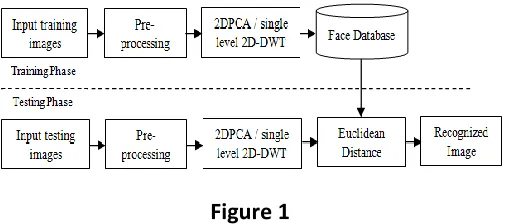
III BLOCK DIAGRAM AND TECHNIQUES USED
Figure 1
Available Online at www.ijpret.com 131 2DPCA
As opposed to PCA, 2DPCA is based on 2D image matrices rather than 1D vector so the image matrix does not need to be transformed into a vector prior to feature extraction. Instead, an image covariance matrix is constructed directly using the original image matrices and its eigenvectors are derived for image feature extraction. 2DPCA has many advantages over conventional PCA. The recognition rate was higher using 2DPCA than PCA. Also the extraction of image features is computationally more efficient using 2DPCA than PCA.
Wavelet Transform
Here we are using single level two dimensional discrete wavelet transform. In numerical analysis and functional analysis, a discrete wavelet transform (DWT) is any wavelet transform for which the wavelets are discretely sampled. As with other wavelet transforms, a key advantage it has over Fourier transforms is temporal resolution: it captures both frequency and location information. Here single-level two-dimensional wavelet decomposition can be performed with respect to Haar Wavelet.
The Haar wavelet transform method separates high frequency and low frequency bands of the image by high-pass and low-pass filters from the horizontal direction and so does the vertical direction of the image. In the Haar wavelet transformation method, low-pass filtering is conducted by averaging two adjacent pixel values, whereas the difference between two adjacent pixel values is figured out for high-pass filtering. The Haar wavelet applies a pair of low-pass and high-pass filters to image decomposition first in image columns and then in image rows independently.
IV PROPOSED METHOD
2DPCA
Stage 1- Training phase
1. Training image: All the training facial images which are under training database are resized into 280×180 pixels.
2. Calculating the mean image:
a) Computing the average face image.
Available Online at www.ijpret.com 132 c) Computing the difference image for each image in the training set.
d) Merging all centered images.
3. Calculating eigenvalues.
4. Sorting and eliminating eigenvalues: All eigenvalues of matrix L are sorted and those who are less than a specified threshold are eliminated.
5. Calculating the eigenvectors of covariance matrix 'C'.
Stage 2- Testing Phase
1. Testing image: Facial images which are under test are also resized into 280×180 pixels.
2. The cropped test face image is subtracted from mean image of database,
3. Projected Test image is calculated from eigen face matrix.
Stage 3- Classification
Testing image can be classified with training images by calculating the distance or similarity measures between the projected train matrix and projected test matrix. Test image is supposed to have minimum distance with its corresponding image in the training database. Here we are using euclidean distance classifier for the classification purpose.
Stage 4- Recognition
At this stage the test image is recognized with training image.
Single level 2D-DWT
The method of wavelet that used in this research is Haar wavelet. We use single level of Haar wavelet decomposition.
1. Training facial images which are under training database and testing images are resized into 280×180 pixels.
2. Using 2D wavelet decomposition with respect to a haar wavelet computes the approximation coefficients matrix CA and detail coefficient matrixes CH, CV, CD (horizontal, vertical & diagonal respectively) which is obtained by wavelet decomposition of the input matrix X.
Available Online at www.ijpret.com 133 Where,
Lo_D is the decomposition low-pass filter and,
Hi_D is the decomposition high-pass filter.
Lo_D and Hi_D must be the same length.
(When X represents an indexed image, then X as well as the output arrays CA, CH, CV, CD are m-by-n matrices. When X represents a truecolor image, then they become m-by-n-by-3 arrays. These arrays consist of three m-by-n matrices (representing the red, green, and blue color planes) concatenated along the third dimension.)
4. Using euclidean distance classifier testing image can be classified with training images by calculating the distance or similarity measures. Test image is supposed to have minimum distance with its corresponding image in the training database.
V. EXPERMENTAL RESULT
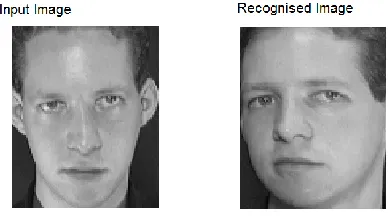
Fig 4.1:Input image and Recognised image for ATT Database for PCA
Available Online at www.ijpret.com 134
Fig 4.3:Input image and Recognised image for Real Time Database for PCA
Fig 4.4: Input image and Recognised image for Real Time Database for Single level 2D-DWT
Table 4.1: Comparision of Accuracy on ATT database
Technique NO of Training Accuracy
2D PCA 400 99.67%
Wavelet 400 100%
Table 4.2: Comparision of Accuracy on Real time Database
Technique NO of Training Accuracy
2D PCA 50 90%
Available Online at www.ijpret.com 135
VI. CONCLUSION
In this paper face recognition has been done using 2DPCA and single level 2D-DWT. Using ATT database accuracy of 2DPCA is 99.67 % and of single level 2D-DWT is 100%.
REFERENCES
1. Vo Dinh Minh Nhat, Sungyoung Lee. Improvement On PCA and 2DPCA algorithms for face recognition [C].CIVR 2005, LNCS 3568, Pp:568-577.
2. D.Q. Zhang, Z. H. Zhou.(2D)2PCA,Two-directional two dimensional. PCA for efficient face representation and recognition. Nerocomputig.
3. Bui T.T.T., Phan N.H. and Spitsyn V.G., “Face and hand gesture recognition algorithm based on wavelet transforms and principle component analysis”, 2013.
4. Manisha Satone et. al, “Face Recognition Technique Using PCA, Wavelet and SVM” International Journal on Computer Science and Engineering (IJCSE), Vol. 6, No. 01, Jan 2014.
5. Biho Kim, Hyung-Min Park, “Efficient Face Recognition Based on MCT and I(2D)2PCA”, IEEE International Conference on Systems, Man, and Cybernetics, COEX, Seoul, Korea, pp. 2585-2590, 2012.
6. Dhiraj K. Das, “Comparative Analysis of PCA and 2DPCA in Face Recognition”, International Journal of Emerging Technology and Advanced Engineering Website: www.ijetae.com ISSN, Volume 2, Issue 1, pp. 330-336, January 2012.