-
Available Online at www.ijpret.com
576
INTERNATIONAL JOURNAL OF PURE AND
APPLIED RESEARCH IN ENGINEERING AND
TECHNOLOGY
A PATH FOR HORIZING YOUR INNOVATIVE WORK
A ROBUST MESH WATERMARKING SCHEME BASED ON PCA
NILESH R. GODE, NEERAJ K. SHUKLADept of EXC, ACE Malad west, Mumbai.
Accepted Date: 27/02/2014 ; Published Date: 01/05/2014
p
\
Abstract:This paper proposed a novel robust oblivious watermarking scheme in the spatial domain suitable for 3-D mesh object, which combines the principal component analysis (PCA) method with the construction of cone bins. Firstly, PCA is used to calculate the eigenvectors of covariance matrix of vertex coordinates. Then the object is rotated and translated so that its center of mass and the three eigenvectors coincide with the origin and the three axes of the Cartesian coordinate system. Subsequently, many cone bins are constructed, each bin center according to two angle parameters of spherical coordinate produced by pseudorandom number generators and the vertices are classified into the appropriate cone bins. Each cone bin is divided into a number of sub-bins in order to embed the watermark bit, and the size of sub-bin can make tradeoff between invisible and robustness. Experiment results show the remarkable ability of the proposed mechanism to resist against various attacks such as adding noise, clipping, similarity transform and vertex re-ordering.
Keywords: Digital Image Processing, Obstacle Detection, Monocular Ranging, Leading Vehicle Distance.
Corresponding Author: MR. NILESH R. GODE
Access Online On:
www.ijpret.com
How to Cite This Article:
Nilesh Gode, IJPRET, 2014; Volume 2 (9): 576-588
-
Available Online at www.ijpret.com
577 INTRODUCTION
In the last decades, with the increasing growth of 3-D hardware technology, it allows the widespread use of 3-D models from CAM/CAD industry into 3-D games and 3-D animation applications. These models have commercial value and the process of generating them is a time consuming effort, while it is easy to copy and distribute the 3-D models. As a result, it has become an emergency issue to research schemes for copyright protection for 3-D models. One approach to resolve this problem resorts to watermarking technology, in which the watermark carrying information about the data owner is embedded inside host digital data and extracted to prove ownership as needed.
Unlike image data and other traditional digital content, 3-D model has no unique representation, i.e., there are 3-D mesh objects, 3-D objects represented using parametric surfaces such as NURBS (Nonuniform Rational B-Spline) surfaces and point sampled geometry [1]. If the types of host objects are different, the watermarking schemes are also different.
In general, 3-D watermarking schemes take the 3-D mesh as host data. However, there is a problem that the 3D mesh objects have no implicit order and connectivity of vertices. Many attacks can remove the watermark. These attacks include vertex re-ordering, similarity transform, noise addition, clipping, remeshing, smoothing and so on. One of the goals of the 3-D watermarking technique is to satisfy the property of robustness against the aforementioned attacks.
-
Available Online at www.ijpret.com
578
There are also many methods implemented in spectral domain [5,6]. All of the spectral algorithms are non-blind until Yang Liu in [5] success to detect watermark in a blind method. His idea is to transform the original mesh into frequency domain using the Fourier-Like Manifold Harmonics Transform, and his method is immune to uniform affine attack and robust against noise addition and simplification attacks.
In this paper, we propose a new robust spatial blind three-dimensional mesh algorithm. In proposed scheme, using the PCA method, the watermarked 3-D model is transformed so that its center and the three normalize eigenvectors coincide with the origin and the three axis of the Cartesian coordinate system. This process will be repeated in the detection step, and that ensure the watermark can be extracted by a blind method. Subsequently, many cone bins will be constructed by pseudorandom number generators and the vertices are classified into the appropriate bins. Watermark is embedded by modifying the angle between vertex coordinate and the cone bin center vector. The proposed scheme is robust against similarity transform, vertex re-ordering, and noise addition as well as clipping.
The rest of the paper is organized as follows. In Section 2 we present our novel 3-D watermarking scheme including embedding and detecting algorithms. Experimental results and discussion are presented in Section 3. Finally, conclusions are drawn in Section 4.
2. Scheme Design
Resisting synchronization attack is a challenge for robust watermarking. So, looking for the method to make synchronization between watermark embedding and watermark extraction is very important work. In [4], Stefanos first use the PCA method to calculate the great eigenvector for sake of aligning the vector to the axis z, and then construct blind watermarking based on synchronization information. However, the 3-D model must be converted to the spherical coordinates, which may increases computational complexity and bit error rate. To resolve this question, the new idea is to make the three eigenvectors of covariance matrix be the new x, y and z axes. As a result, transforming the 3 -D model into spherical coordinates is not necessary. In addition, aligning three axes can afford more embedding primitives than [4]. Moreover, the proposed scheme can be applied to point sampled geometry because we only use the vertex data.
2.1. The 3-D Model Transformation
First, we calculate the center of the model as follows
-
Available Online at www.ijpret.com
579
Where VC is the centre of model, represent ith vertex of model, N is the number of vertices.
Then we transform the model so that its centre is the centre of coordinate system axes. After that we calculate covariance matrix, that is ,
Where (x, y, z) is the coordinate of vertex Vi ,and C represent a covariance matrix .what we
need the eigenvectors of C. after normalized, the three vectors are,
The three new vectors will be the new axis of model. The vertex coordinate is changed by
2.2 Bins constructions
In this section we will construct lots of cone bins that are used to comprise the collection of the vertices of mesh. In our scheme, each bean is embedded with one bit. so the number of bins should be not less than the number of bits.
Vector according to θ andφ, which are bin center vectors. One scheme is only embed Nw bits,
which means each bit is repeatedly embedded in m bins, in other words, the bins with the same
θ carry the same bit (Figure 1-b). The other scheme can embed m*Nw bits. That is to say each
bin carries one bit. The first scheme has better robustness, while the second has larger capacity.
-
Available Online at www.ijpret.com
580 (b) Bins with the same θ carry the same bit
Figure 1
To avoid the crossing of different bins, we elaborately design the method to generate θ of each
bin so that there is a gap between any two different adjacent bins. The max value of the gap angle is
The purpose of setting upper boundary of the gap angle is to make sure that there is enough space to divide 3-D model into Nw number unoverlapped bins. The gap angle is a rand number
θiD (Figure 2) satisfies the formula (6)
In Figure 2, θ (i) (i=1, 2,……, Nw) represents the beginning degree when constructing the ith
bin
so the angle of ith bin center is
So far, the second component of Nw of bin centers vector is constructed and it ensures different
-
Available Online at www.ijpret.com
581
Figure 2 Construction of bin
The generation of φ is also by pseudorandom number generators, similar to the generation of
θ. So here we do not repeat again.
Now the vectors of m* Nw of bin centers is
uic (sinθic
cosφic
, sinθic
sin φic
, cosθic )
After the cone bins have been constructed, all the vertices are classified into the corresponding bin.
2.3. Embedding Scheme
-
Available Online at www.ijpret.com
582
(a) Bin is divided into sub-bins with status 0 or 1.
(b) Watermark embedding process
Figure 3 The subspaces of a bin
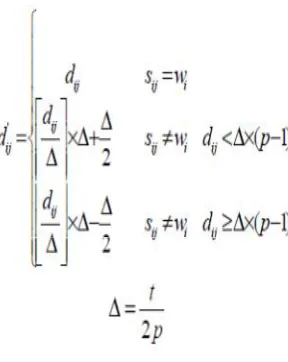
Where sij is the status of that vertex, is the width of each subspace, and p is the number of subspaces.
To ensure that the status of each vertex in ith bin is identical to the watermark bit, the vector of vertex is rotated with the angle dij’- dij. The rotating axis is the cross product between the vertex vector and the bin center (Figure 3-b), and the changed vertex vector is computed as equation (12):
uij' uij cos(dij'− dij ) (uic uij )sin(dij'− dij ) uic (uic⋅ uij )[1− cos(dij'− dij )]
2.4. Detection Scheme
The detection process is described as following steps:
-
Available Online at www.ijpret.com
583
2) Constructing cone bins according to method described in section 2.2. The key generating the pseudorandom sequence in the embedding phase and quantization step p must be given to
a) Armadillo (b) Dragon
Figure 4 Two 3-D mesh models
Experiment The experiment is carried out on many 3 -D models such as Armadillo (Figure 4-a)
and Dragon (Figure 4)
b). One of them is triangular mesh model called Stanford Bunny (Figure 5-a). The model has 35947 vertices and 69451 cells. Here we take the Bunny for example.
3.1. Distortion Analysis
The imperceptible of watermark in 3-D watermarking field has no standard until now. Some researchers measure the distortion by signal to noise ratio (SNR) [4][1], see formula (14) [4].
Where xi, yi, zi and xi , yi , zi are the coordinates of ith vertex before and after the watermark
embedding respectively, and the N is the number of vertices of model.
-
Available Online at www.ijpret.com
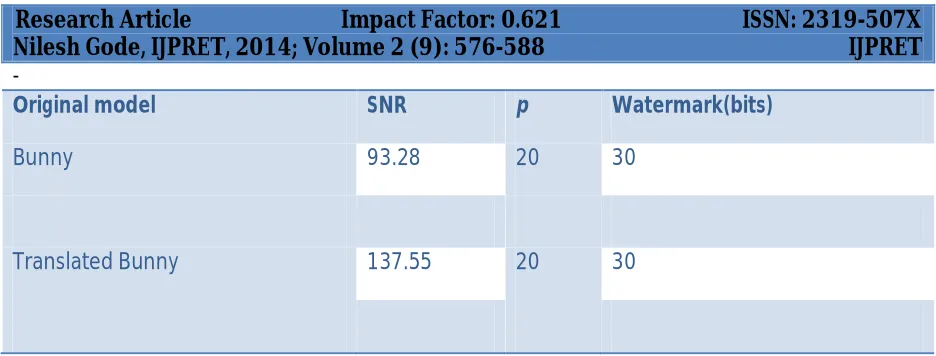
584 Original model SNR p Watermark(bits)
Bunny 93.28 20 30
Translated Bunny 137.55 20 30
Table1 The results of SNR
Corsini in [8] proposed a kind of objective metrics to assess distortions produced by watermarking 3 -D meshes. The distortions are measured by increment of roughness between the original and the watermarked model:
Where ρ (M ) is the total roughness of the original model and ρ(Mω) is the total roughness of the watermarked model. The k is a parameter to control the outputs of increment. The smaller value of ℜ M , M ω indicates the less amount of distortion. If the
increment is equal to zero, that means there is no distortion happed to the original 3-D model. More detail content can be found in [8]. The Table 2 is the result of distortions made by watermarking 3-D meshes by means of the method proposed by [8]. We embed 30 bits into original model.
Table 2 Result of distortion test
p ℜM , M ω DR
10 2.53 100%
8 2.83 100%
4 4.9 100%
-
Available Online at www.ijpret.com
585
(a) Original model (b)The watermarked
model(p=2)
(c)The
watermarked
(d) The model with noise
model(p=10) attack (p=2)
Figure 5 Stanford Bunny
In experiment, the bound of increment is from 0 to 12. From the table 2 we can find when the p is greater than 4, the distortion is very imperceptible.
3.2. Robustness Analysis
For the performance of robustness, the evaluations are as follows. In the first experiment, p is set to 2. This means there are only two subspaces in each bin space, and the two subspaces represent different status. The other important parameter t is 0.05 here (Figure 5-b). Here we embed 30 bits of watermark. When no attack comes, the DR is 100%, which means we can completely retrieve the watermark in our scheme.
Because the PCA method is used in our algorithm, and the PCA method implements the mesh alignment, our scheme is remarkably robust against the rotating, transforming and scaling attacks. For the same reason, this scheme is also remarkably robust against the vertex reordering described in Table3.
-
Available Online at www.ijpret.com
586
Table 3 Robustness to various attacks with p=2
Attacks DR
Similarity transform 100%
Vertex reordering 100%
Adding random noise (0.5%) 100%
Adding random noise (1%) 100%
Clipping (0.2%) 100%
Clipping (1%) 87%
In the experiment, the result of robust against adding random noise is wonderful. We can detect all the watermark bits completely either in the condition of 0.5% or in the condition of 1%. In the case of clipping attacks, the results are also good . But you can find that the percentage of clipping is very small, the results will become worse when the percentage of clipping increases
Table 4 Robustness to various attacks with p=10
Attacks DR
Similarity transform 100%
Vertex reordering 100%
Adding random noise(0.5%) 97%
Adding random noise(1%) 84%
Clipping (0.1%) 83%
Clipping (0.2%) 70%
-
Available Online at www.ijpret.com
587
The second experiment has a different p which is 10 now (Figure 5-c). We can see that the quality of model is better than the results when p is 2.While the robust against attacks (Table 4) is worse than the experiment 1. So the imperceptible of watermark and robust are contradictory.
From Table 4, we can see in the case of adding random noise attack the robust of watermark is still strong.
CONCLUSION
In this paper, we propose a new blind 3-D mesh watermarking algorithm based on PCA. The scheme aligns the mesh through three eigenvectors of covariance matrix of vertex coordinate. The watermark is embedded into cone bins constructed by the key of user. Every bin is quantized into some subspaces so that the distortion of the watermarked mesh model is invisible. Experiment results demonstrate that the proposed method has perfect performance in attacks of similarity transform and vertex imperceptible of watermark is very good
Reordering . Moreover, the results in the case In future research, we will make more efforts to improve our scheme in order to achieve a better performance for both imperceptible and robustness of water. of adding random noise attacks are good when the p is 2. While the performance is not very satisfying when the p is 10, the imperceptible of watermark is very good . In future research. we will make more options to improve our schemes in order to achieve better performance for both imperceptible and robustness of water.
REFERENCE
1. Parag Agarwal, and Balakrishnan Prabhakaran. Robust Blind Watermarking Mechanism For Point Sampled Geometry. The Ninth ACM Multimedia and Security Workshop, pp.175-186, 2007.
2. Ohbuchi R, Masuda H, and Aono M. Watermarking Three-Dimensional Polygonal Models. Proceedings of the fifth ACM international conference on Multimedia, pp.261-272, 1997.
3. O. Benedens. Geometry-Based Watermarking of 3D Models. IEEE Computer Graphics and Applications, pp.46-55, 1999.
-
Available Online at www.ijpret.com
588
5. Yang Liu, Balakrishnan Prabhakaran, and Xiaohu Guo. A Robust Spectral Approach for Blind Watermarking of Manifold Surfaces. The 10th ACM Workshop on Multimedia and Security, pp.43-52, 2008.
6. John M. Konstantinides, Athanasios Mademlis, and Petros Daras. Blind Robust 3-D Mesh Watermarking Basedon Oblate Spheroidal Harmonics. IEEE Transactions on Multimedia, 11(1):23-38, 2009.
7. Jae-Won Cho, and Min-Su Kim. Robust Watermarking on Polygonal Meshes Using Distribution of Vertex Norms. International Workshop on Digital Watermarking 2004, pp.283-293, 2004.