PROBLEMATIC OF THE IMPLEMENTATION OF THE BALANCE
CLASS SEQUENCE OF THE THIRD FORM IN THE MIDDLE SCHOOL
AND HIGH SCHOOL OF PORTO-NOVO
Basile AGBODJOGBE
1, Bachard OGUEBOULE
2, Kossivi ATTIKLEME
3and DAWEKPE Germain
1 Doctor in Science of Education, Didactician, Auxiliary Master of CAMES, University of Abomey-Calavi (Benin), National Institute of Youth, Physical Education and Sport, Laboratory of Didactics of Disciplines,
E-mail: [email protected]
2 Doctor in Science of the Education, Auxiliary Master of CAMES, University of Abomey-Calavi (Benin), National Youth Institute of the Physical Education and the Sport, Laboratory of Didactics of Disciplines,
3 Doctor in Science and Technology of Physical and Sports Activities, Professor, University of Abomey-Calavi (Benin), National Institute of Youth, Physical Education and Sport, Laboratory of the Social and Human Sciences. 4 Certified teacher of Physical Education, University of Abomey-Calavi (Benin), National Institute of Youth, Physical
Education and Sport, Laboratory of the Social and Human Sciences.
1. INTRODUCTION:
In the wake of the adoption of the Competence-Based Approach (CPA) in the context of education in Benin, the operationalization of the requirements of this program with regard to its teaching-learning approach and its training contents is problematic. Indeed, it will be necessary to wait until the 2000s, to see an application not quite followed in the colleges and high schools of the country because the teachers have difficulties to put this curriculum into practice (Attiklemé and Kpazaï, 2011). The problem is especially loud when it comes to implementing the balance sheet in colleges and high schools.
In fact, according to the requirements of the prescribed curriculum, the balance sheet is the sequence 10 of the teaching-learning-evaluation approach. For this purpose, it allows to start from what the student masters, to share knowledge, to cooperate to progress and progress. In other words, it is a revision sequence which according to the legislator is upstream of the evaluation sequences (sequence 11 and 12). It is therefore in this perspective that the objectives of the balance sheet recommended by Benin's official texts based on competency-based programs seem to fit. But alas, on the ground; a bitter finding is made, that of the non-implementation of the sequence balance by most teachers of Physical Education (PE) high schools and colleges of Porto-Novo (Benin). It is to understand the fundamental reasons that our study has focused on this issue in the 4th grade, for lack of its inadequacy in the teaching context, its unequivocal interpretation and its very complex nature. Hence the need to make an in-depth study on the issue related to its implementation in 4th grade in the high schools and colleges of Porto-Novo.
Context of the study
1.1 The framework of the study
As part of our study, we will dwell on the implementation of the so-called "balance sheet" class sequence in the 4th class of secondary schools in Porto-Novo in general and in particular in the High School of Djassin, of Application and the high schools Béhanzin and Toffa the 1st. Almost all of these institutions share the common denominator of lack of space, infrastructure and equipment, as well as the plethora of class sizes.
Abstract: In this work, Sensevy's theory of joint action (2007) enabled us to identify the difficulties and even the shortcomings in the progress of the 4th grade assessment sequence by the teachers of high schools and high schools of Porto-Novo.
For this, three (03) investigation techniques were the subject of our methodology: the documentary analysis, the questionnaire and the instrumented observation. The results from the data analysis of these three (03) techniques reveal the existence of the differences between the teaching-learning approach as well as the objects to be remedied provided by the official texts and those adopted by the investigated teachers. In addition, teachers encounter difficulties in implementing the balance sheet. These difficulties are: the development by themselves of the reinvesting activities and the formatting of these in real classroom situation, the difficulties related to time management, the group class without forgetting the lack or absence equipment and infrastructure.
1.2. The flow context of the balance sheet
With a remedial aim, the balance sheet is a class sequence whose main objective is to make a big return on learning in order to correct the persistent deficiencies of students in terms of skills, techniques and knowledge (learning objects). Thus according to the guides and programs of the 4th grade, this sequence is governed by the teaching-learning approach presented in the following table:
Table 1: Summary of the teaching-learning approach of the balance sheet
Steps of the process
Characteristics of contents
Introduction
statement of the purpose of the meeting
Implementation of capacities: objectification and self-evaluation
Production
Evaluation of learning
Formation of 2 groups: one for consolidation and the other for enrichment
Bring back the activities used for learning by trying to reinforce the skills or abilities that still cause difficulties for students in the consolidation.
Propose complex and advanced exercises to enrichment.
Projection phase
Focused on the implementation of new objectification capabilities and the implementation of short-term reinvestment activities
As we can see, this sequence is a revision session and is essentially based on the implementation of metacognitive abilities (objectification and self-evaluation). What is the point of view of some authors on the question?
1.3 Importance of the review (review) sequence according to the authors
In the field of education, several studies have focused on how to assess the level of development of the student's academic competencies during a learning cycle, as this would help to identify learners' difficulties and shortcomings to provide adequate solutions for improvement.
Indeed, according to Scallon (2001), the development of autonomy, learning to learn, the acquisition of critical sense, accountability, among others, are at the forefront of the major goals of our education system. It is in this sense that evaluation should gradually become a task carried out also by the learner and not only by the teacher. And in Legendre (2001) to specify that as the student evaluates himself, he feels even more involved in his learning. For him, self-evaluation is "a process by which a subject is brought to make a judgment on the quality of his or her progress, of his work or of his achievements with regard to predefined objectives and while being inspired by precise criteria of 'appreciation'. The student must take his steps and his work as an object of evaluation and, to use one of the objectives of our educational system, to take a critical look at it in order to highlight the positive and negative aspects in order to progress. It is therefore important for the student to take his or her mistakes and difficulties as a way to move forward and always have in mind the desire to improve his / her work. In this respect, George (1983) states that: "There is no learning without knowledge of the results". In other words, progress implies instruments to capitalize on one's experiences (to identify the permanence of success and failure = "to know if I have succeeded or failed" and to know "why I have succeeded or failed"); that is to say, it is necessary to know the results of its action and to relate these results to the desired effects. To do this, self-assessment instruments are needed. Among these Forgette-Giroux and Scallon (1997) propose the realization of the portfolio or in French "pedagogical file".
According to them, the portfolio is "a continuous and systematic collection of a variety of data that reflect the student's progress in mastering a skill judged from a descriptive scale". The portfolio would therefore be a collection that includes pieces that must serve as witnesses or indicators according to three categories of phenomena:
achievements of the student that testify to his mastery of certain knowledge, know-how or certain strategies up to the targeted competence itself;
short descriptions of the steps taken to accomplish a task or set of tasks, the goal or objectives that he or she has set, the difficulties encountered and the means taken to improve (regulation);
It is interesting to note that these different points that Scallon (1997) has drawn closer to what Simon and Forgette-Giroux (1994) can say about the portfolio. Indeed, they insist that this instrument of self-evaluation allows the student to become aware of the stages of his learning process, the difficulties experienced, improvements made and finally the progress made in his learning. Finally, Scallon (2003) draws our attention to the fact that, to ensure the success of such a project, it is necessary to take into account certain actions that must be carried out at specific moments of it:
at first, the goal must be clear for the teacher and his students. It should be noted that the portfolio is "a tool to stimulate and develop the pupil's ability to self-evaluate and the ability to become aware of his difficulties, his successes, his learning and his progress";
at the same time, a guide must also be put in place, a sort of aide-memoire that will follow the students throughout the process. In addition, it is necessary to dedicate moments to the portfolio during school hours;
finally, the objectives as well as the evaluation criteria of certain portfolio documents must be determined and made transparent in order to facilitate the pupils' self-assessment because, as we have seen previously, Campanale (2001) insists on the need for have a referent grouping the objectives as well as the criteria of the various activities, to make the self-evaluation of the students possible.
As a result, self-assessment can be a waste of time for teachers who have not yet perceived their usefulness or their obligation in learning. Proposed before the action in a non-calculated way, it can indeed cause blockages or tensions. But, the forms and temporalities of self-evaluation are multiple, so the teacher has the choice. Encouraging students to self-evaluation is to give them the opportunity to reflect on actions that open to objective self-knowledge. By allowing the causes and consequences to be brought to light, these reflections contribute to the structuring of reflective and motor thinking and intelligences because action occupies a central place in it and the actions it proposes are realized in environments diversified physical and human. Physical Education therefore opens up to objectified self-evaluation and self-knowledge. It is then a formative self-evaluation practice (Evain, 2013).
In Benin, in the teaching-learning-evaluation approach, a return projection phase focuses on objectification, improvement and reinvestment. This phase in the sense of Attikleme (2009) is a stage of verbalization, because it takes stock of learning and makes it possible to think about the future. It is therefore more discursive than practical. Based on this review of the literature, a theoretical framework seems necessary to support our research results.
1.4 Theoretical and problematic framework
The mobilization of the Sensevy Joint Action theory 2007 as a model of analysis seemed necessary because it makes possible an analysis of the activity of the teacher and students jointly involved in teaching and learning interactions in relation to the requirements of the training contents defined by the new study programs during the implementation of the balance sheet. Indeed, in the context of teaching-learning, studies have shown that the teacher and the pupil maintain links of synergy with one another regarding the didactic issue to the point where the action of one cannot be understand without that of the other (Sensevy, Amade-Escot, 2007). Thus, in the implementation of programs designed according to the APC, research conducted in perspectives close to didactics have highlighted a number of difficulties in teaching-learning-evaluation (Audigier, Crahay and Dolz, 2006). Audigier and Tutiaux-Guillon, 2008, Boutin and Julien, 2000, Dolz and Ollagnier, 2000, Agbodjobgé, 2007). These difficulties become more significant when it comes to the implementation of the so-called "balance sheet" sequence. This leads some teachers of high schools and colleges of Porto-Novo not to implement it.
To highlight these reasons, it seemed to us essential to raise the questions: is the balance sheet relevant? What are the reasons that prevent most teachers from implementing it and what are the difficulties encountered by teachers when it is implemented?
2. METHODOLOGY:
In order to find answers to our questions, we set up a methodology oriented towards two types of studies: one of qualitative type and the other of quantitative type.
2.1 The subjects of study: teachers
They are of two (02) categories: those invested for the survey questionnaire and those observed in the course of the session itself.
Teachers for the survey questionnaire: the survey sampleOur investigations focus on PSE teachers working in the Porto-Novo Teaching Basin. For this purpose, the reasoned choice method led us to determine our survey sample.
= 95 confidence interval (z = 1.96); p = estimated proportion of the population with the characteristic studied in the study. As this proportion is ignored as well as the absence of a pre-study, we retain the default proportion which is p = 0.5; q = 1 p; d = level of confidence usually set at 5. So, we have:
Sample size :
nf = n / [1 + (n / N)]; Or n = [(z2 × pq) / d2] p = 0.5 q = 1 - p q = 1- 0.5 q = 0.05
So, n = [(1.95) 2 × (0.5 × 0.5)] / (0.05) 2 n = (3.8416 × 0.25) / 0.0025 n = 384, 16. So n = 385 PSE teachers by excess.
Therefore ; nf = 385 [+ (385) / 247] nf = 150;
Hence the number of PSE teachers to be questioned is 150.
Teachers for the observation of class sessions properIt should be noted that for our study, we chose two expert teachers and two beginners given the relevance of our theme. This requires some explanation. In the sense of Piéron (1993), the beginner is "a teacher in training or recently entered service". Tochon (1993), the expert teacher, "is the one who has acquired a high level of competence in the subject he teaches". So expertise is only related to experience. It therefore seems that the beginning teacher cannot be an expert teacher since he has no experience. It is based on these clarifications that we chose the teachers observed in class practice. It is the teacher (E1) of High school of Djassin who has more than 20 years of seniority, that of the High school Toffa the first (E2) who has more than 10 years of seniority in the field of education. E3 and E4 teachers are all new to teaching.
2.2 Students
It was necessary for the education system to abandon its previous matero-centrist and demiurgic approaches (Meirieu, 1985), and finally place the child at the center of the educational act, thus operating its "Copernican revolution" (Parlebas, 1967). We therefore deduce that "it is the pupil who learns and he alone. He learns with his story, starting from what he knows and what he is "(Meirieu, ibid). For this purpose, for the choice of students, we allowed the teacher to choose 36 students who were contrasted from the point of view of their mastery of the APSA of the SA. These subjects are therefore identified through their delivery during the teaching / learning sequences. This prerequisite allowed us to have 18 students '' said strong '' and 18 others '' said weak ''. Numbering 36, they attended all the class sessions.
2.3 Investigation techniques
Four (04) main techniques were used: document analysis, questionnaire survey, interview and observation.
The documentary analysisIt is the first investigative technique of our work. Its interest is to highlight the learning objects and the teaching / learning / evaluation approach recommended in the framework of the so-called "balance sheet" sequence, in order to make a comparison with those taught by the teachers observed.
The questionnaire surveyIt is the second technique of collecting information from our research. It allowed us to collect quantitative data on why some teachers do not run the balance sheet in their classes. For this, it took into account EPS teachers working in 4th year classes, including students’ trainees in training at National Youth Institute of the Physical Education and the Sport, because we believe that the status of teachers can influence teachers' choice of intervention.
InterviewsThird technique used for this research, they are exclusively granted to teachers before and after the course of their course: these are pre- and post-session interviews:
the pre-session interview with the teachers is done at the beginning of each session. It aims to specify: what they did before the balance sheet, the teacher's perception of the balance sheet, the didactic intentions of the teacher, the enrichment and / or consolidation activities to be offered to students, without forgetting the strategies to be implemented to solve the problems encountered by learners;
the post-session interview: it is carried out at the end of each session in order to know if the objectives are achieved, to collect information on the indices of improvement and / or consolidation of the pupils' level, the difficulties encountered in the accomplishment of the tasks and the adaptations realized.In all (08) interviews are carried out including 4 ante-sessions and 4 post-sessions.
Observation of the sessions2.4 Treatment of data
Processing of data from documentary research
The documentary analysis enabled us to analyze the contents of the various documents (guides and programs), with particular interest to the data relating to the three phases of the knowledge building approach (Introduction-Realization- and New objectification) and learning objects planned as part of the balance sheet. This prerequisite was used to first identify the discrepancies between the prescribed approach and the approach adopted by the teachers, and then, in a second step, the differences between the prescribed contents and those taught.
Processing the data from the questionnaire
The information collected was processed by computer. The software used is EXCEL. Thus, for the counting of the questionnaires, we grouped by item and by modality the answers of the subjects invested relative to the variables selected. These data are finally presented as graphs.
Treatment of data from interviews and filmed sessions
As for the interviews, they gave rise to transcripts and qualitative analyzes to enumerate the difficulties related to the implementation of the evaluation sequence and the suggestions of the teachers for a reduction of these. To carry out the analysis of the interviews (with the teachers), they were treated from a qualitative point of view.
The content analysis of the data collected from the filmed sessions was carried out in three (03) steps:
- the first step was to transcribe all filmed sessions;
- the second step consisted in making synopses to condense the data of the observation of the sessions;
- the third step consists first of all in analyzing the different transformations made with regard to the teaching-learning approach. The evaluation is recommended by the guides and programs in the framework of the balance sheet in order to highlight any difficulties in the course. The didactic interactions transcribed in episode form are related to the posterior observation and maintenance data.
Table 2: Summary of investigation techniques and tools
Nature Techniques Tools Subjects
Quantitative Investigation Questionnaire 150 PE teachers
Qualitative Literature search Guide and Program
First and third forms Instrumented observation
and interviews
Camcorders and maintenance guides
4 PE teachers
3. RESULTS:
It is important to remember here that the objective of our study is to analyze the way in which the teachers implement the balance sheet sequence in order to highlight the difficulties it raises on the one hand and to enumerate the reasons for which it is not done by most teachers of the educational basin of the city of Porto-Novo. For this, the results of our work are presented in the form of tables and graphs followed by an analysis of the data.
3.1 Comparison of the approach and capacities provided by the programs and guides to steps taken and capacities developed by the teachers during the implementation of the balance sheet
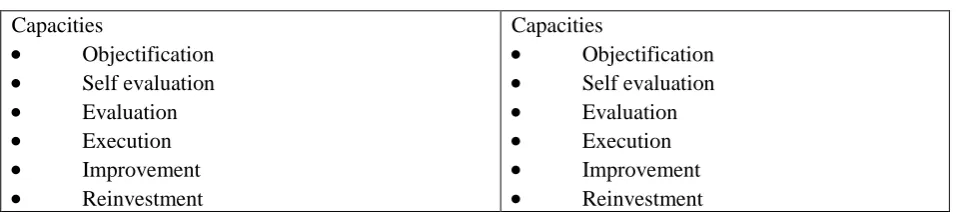
Table 3: Summary of the prescribed procedure and the approach followed Approach and capacities envisaged by the programs
and guides
Follow-up and capacities developed by teachers during the implementation of the balance sheet
Approach
Introduction: (Statement of the objective of the session and implementation of the capacities: objectification and self-evaluation) -Realization: (Evaluation of the learning which allows the formation of 2 groups: one with the consolidation and the other with the 'enrichment)
Execution of tasks
Return phase and projection: Focused on the implementation of new objectification andreinvestment capabilities.
Approach
Introduction: statement of the purpose of the session and implementation of the self-evaluation capacity.
Production - Formative evaluation- Formation of 2 groups of students (the group of so-called "strong" to enrichment and that of the so-called "weak" to the consolidation). - Return phase and projection: Implementation of objectivation and self-evaluation capacities.
Capacities
Objectification
Self evaluation
Evaluation
Execution
Improvement
Reinvestment
Capacities
Objectification
Self evaluation
Evaluation
Execution
Improvement
ReinvestmentFrom Table 3, it can be seen that according to the recommendations of the guide, the introductory phase of the balance sheet must be marked by the implementation of metacognitive capacities, namely objectification and evaluation. But, according to this same table, the finding is that teachers stop only at the implementation of the self-evaluation capacity. At the level of implementation, they all comply with the recommendations of the guide by proceeding with the formatting of the evaluation capacity. This allows them to identify 2 groups: the group of students "strong" and that of the "weak" students before moving on to the implementation of the execution capacity. Finally, in the return and projection phase, teachers manifest a certain freedom. While the guide advocates the implementation of new objectification and reinvestment abilities, invested teachers only implement two (02) abilities, that is to say objectification and self-evaluation abilities. In other words, teachers distort this phase of the teaching-learning-evaluation approach, which etymologically, should make it possible to take stock of learning and think about the future. What are the differences observed in the execution of learning activities (tasks) according to whether one moves from the actual curriculum to the formal curriculum?
Table 4: Summary of AAs provided by the guides and those implemented by the teachers Learning activities planned by the guides for
the balance sheet
Learning activities carried out by the teachers in real classroom session
Gymnastics: Realize the correct sequence of gymnastic elements imposed by integrating one or two elements of his choice.
Relay race : Walk the 100 m hurdles in a fast and coordinated way.
High jump: Realize the ventral roller in its global form
Gymnastic :
- take at least one item per family and design a web,
- design his sequence based on complex elements like ATR force, tripod whipped to the ATR;
- make a free sequence by using more complex gymnastic elements and 2 spectacular elements.
Relay race:
- start, cross the hurdles while respecting the 4 strides between the hurdles on a distance of 60m men and 50m ladies; - to cross the hedges with the tense leg extended and the dodge leg bent over a distance of 60m men and 50m ladies.
High jump :
- realize the overall shape of the ventral roll jump on a chest-level rope;
- ascend and rotate after a straight run; - receive on 3 supports after are jump.
is deduced that teachers sub-divide the AAs provided for in the guide into subtaches that can achieve the prescribed objectives. Consequently, the knowledge to be taught does not escape the transformations when the teachers want to transmit it to their pupils: it is the internal didactic transposition. This observation is supported by Marsenach (1991) when he asserts that the transition from a cultural object to an object of instruction does not escape the transposive phenomenon. What happens then in real class situation? Before answering this question, the opinions of EPS teachers on the implementation of the balance sheet sequence are essential.
3.2. Opinions of the teachers on the implementation of the balance sheet
Percentages 60
50
40
30
20
10
0
Always Sometimes Never Total Always Sometimes Never Total Always Sometimes Never Total
Students Certified teachers (4 to 6 years old) Certified teachers (7 to 25 years
old)
Graph 1: State of play on the implementation of the balance sheet
Graph 1 shows that 74% of students in training are performing the balance sheet and that only 20% of certified teachers fresh out of the INJEPS roll it out. The finding is especially significant among certified teachers who have 7 to 25 years of experience in teaching. In fact, only 8% of them carry out the balance sheet with their pupils (see graph 1).
Graph 2: Relevance of the balance sheet
According to data collected from our survey population, 90% of trainees recognize the importance of the balance sheet. This explains the fact that many of them do so in their respective classes. As for certified teachers, only 32% of them do the balance sheet.
90%
10%
100%
32%
68%
100%
20%
80%
100%
0% 20% 40% 60% 80% 100% 120%
Yes No Total
Students in training Certified teachers (4 to 6 years old)
Graph 3: Reasons for not implementing the balance sheet
This graph shows that students in training and new certified students find that the balance sheet is very difficult to implement. Similarly, 92.5% of certified teachers (7 to 25 years of experience) admit this reality (see graph 3).
Table 5: Summary of the difficulties encountered by each teacher
Teachers Phases Difficulties or limitations in respecting the process
E1 Introduction No control of the process
Achievement Lack of equipment
Lack of infrastructure
Failure to meet PCA requirements by letting students compose their own sequence
Inadequate amount of work because too much speech
New projection Did not realize this phase of the teaching-learning
E2 Introduction Nothingness
Achievement Institutional report to the subject of knowledge in failing gymnastics;
Inadequate amount of work because too much speech
New projection Did not ask all the questions relating to the new objectification.
He just asked, "What did we learn? ". No reinvestment activity
E3 Introduction Nothingness
Achievement Poor management of the class-group
No mastery of the teaching-learning approach during this phase
New projection He just asked the students what they learned and how it will help them
in life.
No reinvestment activity
E4 introduction Non-respect of the approach
Achievement Poor group-class management
Failure to meet PCA requirements by letting students compose their own sequence
No mastery of the teaching-learning approach during this phase
New projection He just asked the students what they learned and how it will help them
in life.
No reinvestment activity 100%
0% 0%
91.17%
26% 0%
92.50%
25%
62.50%
A= VERY DIFFICULT TO IMPLEMENT
B= WASTE OF TIME C= NO SPECIFIC TRAINING
ON BALANCE SHEET
Students in training Certified teachers (4 to 6 years old)
4. DISCUSSION:
From the analysis of the data in Table 5, we note that the difficulties are diverse and vary from one teacher to another. Several causes can explain this situation. Despite the fact that these PE teachers have made the same vocational school (NIYPES), they maintain a different relationship to knowledge about the implementation of the balance sheet sequence. Moreover, the discourses supporting didactical transactions reveal some of the difficulties inherent in the didactic treatment of APSA, especially in gymnastics and hurdles. This is the case of the beginner E3 teacher who says "in the future, I will do research, especially in gymnastics before coming to the field".
It should also be noted that teachers face many other difficulties. Among these, we can list the management difficulties of the class-group. Approached by the post-session interview, teachers E3 and E4 state respectively: "I had a little trouble managing both groups because I gave instructions on the other side and I come back give instructions to the other group too. So it is managing two groups simultaneously in initiation and the displacement which posed me problems ". "During the class, when you give instructions to a group and let them go to work with the second group, the students sit down or start having fun."
For teachers E1 and E2, the difficulties are mainly of a material and infrastructural nature because of the lack of adequate infrastructures for the hurdles race. Indeed, the distance prescribed by the guide to the hedge race is 100 m and over this distance, they must place 10 hurdles. But because of the lack of space to plot the 100 m, they place 5 lanes 7 hurdles. Teacher E1 placed 10 hurdles but did not respect the inter-hurdle distance, which made it difficult for students to clear hurdles. The height of the hedges is not respected because teachers use tires instead of hedges. According to the academic epistemology of the activity, the distance from the start to the first hedge is 13 to 14 m; but these teachers limit this distance to 8 m and between hedges, instead of 8 m to 8.5 m they reduce it to 5 lanes 6 m for lack of space. In view of this, it follows that the nature of the obstacles (tires) influences the learning of hurdles. Failing to propose tasks that can make middle in the sense of Schubauer-Léoni (2008), teachers adapt and ultimately denature activity. This poses the problem of the adaptation of content to their teaching context because some students jump, spread their legs, or sometimes bypass the tires instead of crossing them.
The balance sheet in the New Study Programs-PE designed to help teachers to objectify Co-constructed knowledge is met with reluctance on the part of teachers. As shown by the results obtained, this reluctance seems to be linked to several factors, in particular a very unfavorable report of the teachers to the implementation process and the mastery of metacognitive capacities and the infrastructure deficit.
Regarding the unfavorable reports of teachers, the implementation process, although it is true that the target of teachers invested is of disparate status, we must also recognize that the operationalization of this approach suffers from an absence of reinforcement during zone educational activities that are part of a local training. In general, the capacities seem to be difficult to evaluate (Roegiers, 2000). Better, those relating to metacognition (objectification) are more. In this perspective, the difficulties resulting from this implementation belong to all the protagonists of the didactic action (teachers and students). The few didactic episodes analyzed show this easily and reflect these difficulties in terms of a difficult chronogenesis (see extract 1). So teachers struggling with these difficulties are obliged to make a differentiated temporal management by adapting the descriptors of the action of the teacher (define, devolve, regulate, institutionalize) and those of the didactic action (mesogenesis, topogenesis and chronogenesis) in the context of remediation. This seems to explain the different transposive choices made by each of them. These choices are largely related not only to their relationship to knowledge (Chevallard, 1989) but also to their institutional relationship to knowledge (Chevallard, 1992) and also to the infrastructural environment.
On the other hand, this environment, however fluctuating from one teacher to another, impacts the progress of this balance sheet to the point where the latter are sometimes obliged to make choices of APSA remediation objects which is related to a didactic treatment (process constant in choosing the content to be taught according to the needs of the learners (Amade-Escot, 2007), which is not the case in the sense that since the teaching-learning stage it should take place. Most of the teachers involved made this readjustment during the implementation of the balance sheet.
The other aspect of the implementation of this sequence is the implementation of the different capacities of the approach advocated by the official texts. In reality, one of the capacities that justifies the quintessence of this phase is objectification. The success of this capacity depends on the objectifications made during the previous teaching sequences / But the results showed that the teachers give little importance to the implementation of the latter. As a result, this pedagogical and didactic neglect influences the implementation of this sequence and is also a source of difficulties encountered by teachers. At first it seems that the weight of the experiment could be put to contribution for the success of this sequence balance. But the results obtained all but invalidate it (see graph 1 and 2) However, students in continuous training do so (see graph 1, 75%).
5. CONCLUSION:
It is initially a documentary analysis whose role is to allow us to highlight the gaps between the prescribed knowledge and the knowledge actually taught in a real classroom situation during the balance sheet. In a second step, a questionnaire allowed us to make an inventory of the implementation of the sequence and to identify the difficulties related to it before ending with the instrumented observation of 4 teachers in a classroom situation. . This last means enabled us to highlight the gaps and the shortcomings observed in the teaching practice of the 4 teachers invested. As a result, the results of our research reveal several shortcomings both in the teaching / learning / evaluation approach and in the attitude of teachers towards the requirements of the PCA.
Indeed, our results reveal that many teachers do not implement the metacognitive abilities (objectification and self-evaluation) as recommended by the official texts because they confuse this introductory phase of the approach to that of an ordinary sequence.
With regard to the completion phase of the balance sheet, the difficulties encountered by the teachers are of several kinds. This is particularly the case for teachers at the beginning of their career, problems related to the internal didactic transposition of the reinvestment activities to be adopted during this class sequence. In other words, beginning teachers find it difficult to develop on their own the improvement activities that can be used to remedy the difficulties of their students. Moreover, even if they did manage to do so, some of them fail to adapt it to the students' level of practice. As for experienced teachers, they were not limited to conducting reinvestment activities at the implementation phase, but to the lack or absence of infrastructure and equipment. In addition to these difficulties specific to each category of teachers, the problem of class management is a major difficulty that justifies to a certain extent the lack of implementation of the balance sheet.
In addition, planned to take stock of new knowledge learned before ending with a reinvestment phase in the short term where the student must bring into play all the knowledge built during the SA, some teachers do not cut important in the phase of the new objectification. And those who do it do so only in the form of return and projection, which is contrary to the requirements of the official texts. In view of these results obtained after analysis of the data, it is safe to say that the teaching-learning-evaluation approach advocated by Approaches by Skills programs remains problematic at the level of ordinary sequences (Agbodjogbé, 2007) at the level of the balance sheet.
REFERENCES:
1.
Agbodjogbé, B. (2007). Problem of implementation of the approach teaching / learning / evaluation in PSE according to the competency-based programs in Benin. Master's thesis 2, unpublished, INJEPS, University of Abomey Calavi, PortoNovo2.
Attikleme, K. (2009) "Contents of new curriculum in scholastic PE, defines in terms of skills in Benin: Problems in intervention in secondary school", Staps 4 / (n ° 86): 93-93 URL: www.cairn. info / journal-staps-2009-4-page 93.htm. DOI: 10.3917 / sta.086.0093 seen on Jun 15, 20143.
Attikleme, K. and Kpazai, G. (2011). Analysis of the evolution of the curricula of the teaching of physical education and sports (EPS) in Republic of Benin from the colonial period to the present day. Research in Education, 164: 83-99.4.
Audigier, A., Crahay, M., & Dolz, J. (2006). Curriculum, teaching and piloting. Bruselles: From Booek University.5.
Audigier, F. and Tutiaux-Guillon, N. (2008). Introduction. In Skills and Content: 15-25. Brussels: De Boeck.6.
Boutin, G. and Julien, l. (2000). The obsession with skills. Montreal: AMS News Publishing.7.
Campanale, F. (2001). Some basic elements on evaluation. [Web page]. Access: http://www.grenoble.iufm.fr/departe/shs/campeval/campeval.pdf [26.08.2008], accessed from 20/08/2014.8.
Dolz, J & Ollagnier, E. (2000). The enigma of the competence in education. Brussels: De Boeck University,Educational Reasons.
9.
Evain D. (2013). The pilot evaluation, e-novEPS Review n ° 4, Jan 201310.
Forgette-Giroux, R. & Scallon. (1997). Applying the learning record to the university. Measurement and Evaluation in Education: 20, 85-103.11.
George C. (1983). Learning by doing How to conceptualize learning in RFP No. 72, 1985.12.
Legendre M. (2001); "Encourage the emergence of changes in the evaluation of learning". Teaching Life, no. 120: 15-19.13.
Meirieu P. (1985). The school instruction manual, Paris ESF.14.
MESFTP (2007). Guide and programs of study EPS of the 4th class; Directorate of Pedagogical Inspection, Porto-Novo / Benin.16.
Parlebas P. (1967). Physical Education in Crumbs, in Revue EPS n ° 85.17.
Piéron M. (1993). Analyze teaching to better teach. Paris: Ed. EPS Review18.
Scallon G (2001). "Why evaluate ... What a question!" Teaching Life, no120: 20-23.19.
Scallon, G. (1997). Self-evaluation: a serious trend in evaluation. Educational life, 103, 27-31.20.
Scallon, G. (2003). The portfolio or learning record: short guide. [Web page]. Access: http: //www.fse.ulaval.ca/Gerard.Scallon/valise_BEP/portfolioguide.pdf [24.08.2008]. Accessed February 29, 2014.21.
Schubauer-Leoni, M-L (2008). The co-construction of reference in the joint action teacher and student. In WallianN., Poggi M. & Musard M. (Eds), Co-build knowledge: the professions of intervention in APSA (: 67-86). Besançon: Press