Available Online at www.ijpret.com
850
INTERNATIONAL JOURNAL OF PURE AND
APPLIED RESEARCH IN ENGINEERING AND
TECHNOLOGY
A PATH FOR HORIZING YOUR INNOVATIVE WORK
A REVIEW ON A MAC PROTOCOL FOR UNDERWATER A COUSTIC NETWORK
APEKSHA A. KHANORKAR, PROF. DR H. R DESHMUKH, MR. R. G. ANANT WAR,MS. R. N. GADBAIL
Asst. Prof, Department of Computer Science & Engineering, IBSS College of Engineering, Amravati.
Accepted Date: 27/02/2014 ; Published Date: 01/05/2014
\
Abstract:Underwater acoustic networks have recently emerged as a promising approach for
oceanic applications such as exploration and surveillance. This new type of networks differs from terrestrial wireless sensor networks in that the network nodes are powerful and well equipped with many resources for diverse applications in challenging environments. This paper deals with a new MAC protocol for underwater acoustic networks. The proposed MAC protocol has a cluster structure with a master node and multiple slave nodes. In addition the proposed MAC protocol consist of a hybrid network structure that combines acontention free period based on TDMA (Time Division Multiple Access) with a contention period.
Keywords: Underwater Acoustic Network; MAC Protocol
Corresponding Author: MS. APEKSHA A. KHANORKAR
Access Online On:
www.ijpret.com
How to Cite This Article:
Available Online at www.ijpret.com
851 INTRODUCTION
Underwater acoustic networks are generally characterized by long propagation delays, acoustic channels and low available bandwidth, which impose significant challenges for underwater
communications. Effective and reliable communications under water require two critical components, namely an efficient acoustic communication link and a well-designed underwater network protocol stack. A medium access control (MAC) protocol allows the nodes in a network to share the common broadcast channel. The main task of a MAC protocol is to prevent simultaneous transmissions that lead to packet collisions. Selection of a suitable MAC protocol has a great impact on the system efficiency, and is especially important for channels with low
quality and high latency, such as the underwater acoustic channel.
Many MAC protocols have been proposed since the first. In this work, we use the high-speed OFDM modem prototype developed by the Underwater Sensor Network (UWSN) Lab at University of Connecticut [1], [2] for physical communication. Aqua-Net has been tested on various existing acoust modems, including Teledyne Benthos Modems [3]
Many MAC protocols have been proposed different protocol like Aloha [4] protocol, Carrier sensing multiple access (CSMA) [5] and its variations have been widely used to prevent collisions between two or more stations transmitting at the same time. CSMA is efficient when
used in fully connected networks with propagation delays that are small compared to the packet duration. As the delay increases, the efficiency is rapidly lost. A medium access control
(MAC) protocol allows the nodes in a network to share the common broadcast channel. The main task of a MAC protocol is to prevent simultaneous transmissions that lead to packet collisions.
LITERATURE REVIEW:
HISTORY:
Over the past two decades, there emerge several underwater acoustic modem products, notably [3], [6], [7], [8]. There are also many research work proposing experimental acoustic modems [9], [10], [11],[12].Among these modem systems, both non-coherent frequency-shift-keying (FSK) based ap-proaches [3], [11], [12] and spread spectrum based approaches[6], [7], [10] are inherently low in data rate. The reconfigurable On the front of network system
development, Seaweb[12]is a decade-long effort combining modem and networking development by Teledyne Benthos and the US Navy. It provide sone realization of an undersea acoustic network. Codiga et. elconducted field tests of networked acoustic modems in [1],[11].
Available Online at www.ijpret.com
852 underwater environments is subject to restriction because the underwater channel is characterized by long propagation delay and it reduces the throughput of the networks. Long propagation delays and low bit rates of underwater acoustic networks make these systems fundamentally different from the packet radio networks. The former enables high-speed acoustic communication while the latter pushes the envelope of underwater network performance to a higher standard.
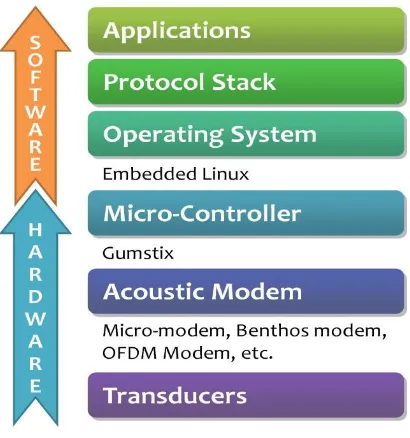
Fig 1.NAMS SYSTEM
Modem Systems Under Acoustic Network With MAC Protocol:
THE NAMS SYSTEM:
NAMS integrates the latest underwater acoustic communication device and the protocol stack designed for underwater networks. It uses the OFDM modem for high performance underwater communications and Aqua-Net to provide network capabilities on top of it.The OFDM modem operates at the physical layer and handles point-to-point communication in underwater environments, while Aqua-Net hosts a range of protocols that provide different functionalities to construct an underwater network. Aqua-Net is a network architecture for underwater networks. It takes the characteristics of underwater networks into
Available Online at www.ijpret.com
853 Orthogonal frequency division multiplexing (OFDM) is an efficient multi-carrier modulation scheme. It is capable of
providing high speed underwater acoustic communications.
THE OFDM MODEM:
The OFDM modem has a built-in UART which can be used to connect a host machine or micro-controller. When receiving a packet from the host machine, the UART posts an interrupt. In the interrupt, a call back function provided by the command interpreter is invoked to process the packet. When sending a packet to a remote modem, a command interpreter
calls the send function provided by the OFDM modem to complete the packet transmission. When receiving a packet from a remote modem, OFDM modem will decode it and call another callback function provided by the command interpreter to process the incoming packet.
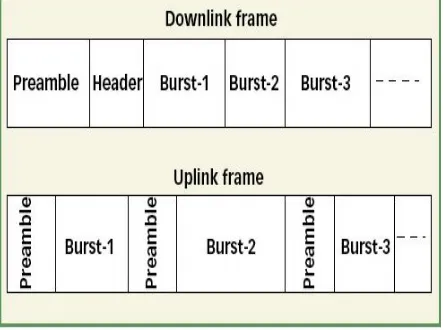
Fig 2.OPDM DATA BRUST SYSTEM
THE AQUA NET SYSTEM:
Available Online at www.ijpret.com
854 PDU, blocks of memory space are allocated to different protocol modules to store the protocol specified information. And a scheduler in the protocol stack is responsible for moving the PDU around based on a pre defined state machine.
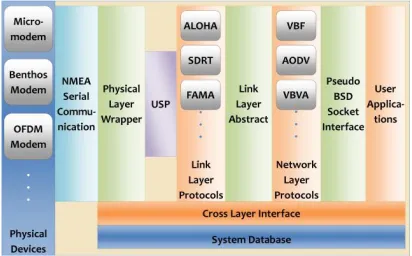
Fig 3. AQUA NET MODEM DESIGN
For the Medium Access Control (MAC) layer, among other protocols, we implemented a random access based UW-Aloha [4], which takes account of characteristics of underwater communications. With NAMS, we conducted experiments in our laboratory. We tested a medium access control (MAC) protocol, UWA Aloha, in order to study the performance of NAMS for the underwater network. As result stated, NAMS can achieve an effective application layer throughput of around 636 bps. These experiment results show that, NAMS is capable of delivering relatively high throughput for underwater networks.
LIMITATIONS WITH THE MAC PROTOCOL:
As stated in introduction, CSMA is efficient when used in fully connected networks with
Available Online at www.ijpret.com
855 communication channel resources to users, all nodes of network must manually assign channel resources to each node during initial installation before establishment. Modification of network configuration like as entering of a new node, leaving of a node in network will be difficult. Contention-based network offers flexible network management and operation, but it’s the performance will be terribly degrade in contrast with terrestrial wireless network. propose a new hybrid MAC protocol.
A NEW MAC PROTOCOL DESIGN OF UNDERWATER ACOUSTIC NETWORK :
Underwater network delivers the acquired real-time data to land station through a gateway, cellular or satellite. So, most of the underwater network consists of master node which has function of gathering data and delivering it to gateway, and slave nodes for measuring of ocean In MAC protocols such as FDMA, TDMA, and CDMA that allocate communication channel resources to users, all nodes of network must manually assign channel resources to each node during initial installation before establishment. Modification of network configuration like as entering of a new node, leaving of a node in network will be difficult. Contention-based network offers flexible network management and operation, but it’s the performance will be terribly degrade in contrast with terrestrial wireless network. environments periodically. Therefore, in this paper, I propose a new hybrid MAC protocol which combines contention-free MAC scheme based on TDMA with contention-based MAC scheme for underwater acoustic network. In the proposed MAC protocol, the master node and the slave nodes communicate each other using assigned time slot in the contention-free mode, while the nodes transmit data only when the channel is ideal in the contention based mode. So the important data from the slave nodes can be transmitted reliably to the master nodes using the contention free mode.
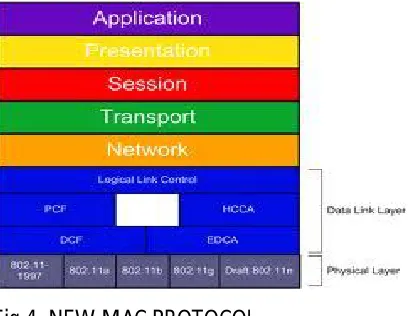
Fig 4. NEW MAC PROTOCOL
Available Online at www.ijpret.com
856 of DGPS equipment. Also we assumed that the nodes know the sending period of a beacon packet and the sending period of a beacon packet can be adjusted by the number of nodes, that is, the beacon period becomes longer with a large number of nodes and shorter with a small number of nodes in the network. I suggest the guard period time (GP) among time slots in contention free mode for prevention of the packet collision that is induced by the delay depending on the status of communication channel. All nodes can be extract variable information that includes a period of a beacon packet, contention-free mode, contention-based mode, information of assigned time slots, interval of time slot and GP, maximum propagation delay, order information of time slots, etc., from a beacon packet which is periodically sent by a master node.
Oprations In Contention free Mode:
In contention-free mode, each node transmits periodic data (node ID, time, position, status, measured data, etc.) to the master node in assigned time slot by the master node at current beacon packet. Master node send a beacon packet to all slave nodes, and wait maximum propagation delay time that all nodes in network can receive the beacon packet. Master node receives periodic data from all nodes in network during assigned time slots to each node and updates latest measured information After each node receive the beacon packet which is periodically sent by the master node, each node compares a reference time in the beacon packet of the master node with own time information, and calculates the propagation time between the master node and own node. We denotes calculated time and the start time of
assigned slot are α and β. If the node send the data at β time, the master node lately receive data packet of the node as α time. So, all nodes must send the data prior to calculated time (α)
Available Online at www.ijpret.com
857 Operation In Contention Based Mode:
Contention based MAC protocols in terrestrial network is ALOH slotted ALOHA, CSMA/CA (Carrier Sense Multiple Access wit Collision Avoidance), and IEEE 802.11 with DCF function. In thi paper, we carry out data communication among nodes, an occasional data (image, text, file, etc.) communication between the master nod and slave nodes, entrance of network, monitoring of node status, etc. I assume a new node want to enter the existing network and time I synchronized before establishment. This node monitors communication channel until receiving the beacon packet from master node. A new node can know network information from beacon packet such as a period of beacon/contention-free mode/contention-based mode, time interval of assigned slot, GP time the order of assigned slots, etc. A new node only listen the channel for contention-free mode because this node is not yet a member of existing network. In contention-based mode, a new node request to enter the network to the master node using the request packet including own time information and ID. If the master node receives the request packet from a new node, it sends the reply packet for permitting a new node to join the network. Master node reschedules the information about reassigned time slots, sends the beacon packet including information of a new node to all nodes. Now, a new node can transmit periodic data to the master node in contention-free mode. If the master node can’t receive the data from a specific node during a several times in contention-free mode, master node regards the specific node is in emergence status or leaving status from the network boundary, and send the hello packet for verifying the activity of the specific node. If master node doesn’t receive the response about it during several times, master node secede this node from the network, and reschedules the allocation of time slots. In underwater communication environments, DIFS and random back-off mechanism used in CSMA/CA and IEEE 802.11 critically drop the network performance about the throughput and delay. I recommend slotted ALOHA MAC protocol as contention-based mode because time synchronization about all nodes is assumed.
Design Example Of A New MAC Protocol:
Available Online at www.ijpret.com
858 corresponds to a acoustic propagation time about it. It takes the time difference with propogation delay.
CONCLUSION:
In this paper, a MAC protocol for UWA networks has been presented and studied. I also present NAMS, a networked acoustic modem system, which integrates the OFDM modem and the underwater network protocol stack framework, Aqua-Net, also looks into the limitations and features for designing an underwater acoustic network, and proposes a new MAC protocol. I apply the newly designed MAC protocol to an AUV network, which is the representative mobile network in underwater environments. In the future implementation, we can plan to focus on the modeling and analysis of network performance with our proposed MAC protocol, and verify the results of the protocol with experiments at the MOERI ocean basin.
REFERENCES:
1. H. Yan, S. Zhou, Z. Shi, and B. Li, “A DSP implementation of OFDM acoustic modem,” in Proc. of the ACM Intl. Workshop on Under Water Networks (WUWNet), Montr´eal, Qu´ ebec, Canada, Sept. 2007.
2. S. Mason, R. Anstett, N. Anicette, and S. Zhou, “A broadband underwater acoustic modem implementation using coherent OFDM,” in Proc. Of National Conference for Undergraduate Research (NCUR), April 2007.
3. Teledyne-Benthos, “ACOUSTIC MODEMS,” 1999. [Online]. Available:
http://www.benthos.com
4. N. Abramson, “The aloha system,” in Computer-Communication Networks, N. Abramson and
F. Kuo, Eds. Englewood Cliffs, New Jersey: Prentice-Hall, 1973, pp. 501–518
5. L. Kleinrock and F. A. Tobagi, “Packet switching in radio channels: part I carrier sense multiple-access modes and their throughput-delay characteristics,” IEEE trans. on commun., vol. COM-23, pp. 1400–1416,1975.
6. LinkQuest, “SoundLink High Speed Acoustic Modems,” 1998. [Online]Available:
http://www.linkquest.com
7. DSPCOMM, “Underwater Wireless Modem,” 2000. [Online]. Available:
http://www.dspcomm.com
Available Online at www.ijpret.com
859 9. J. Wills, W. Ye, and J. Heidemann, “Low-Power Acoustic Modem for Dense Underwater Sensor Networks,” in Proc. of the 1st ACM Intl. Workshop on Underwater Networks, Sept. 2006, pp. 79–85.
10.E. M. Sozer and M. Stojanovic, “Reconfigurable Acoustic Modem for Underwater Sensor
Networks,” in Proc. of the 1st ACM International Workshop on Underwater Networks, Sept. 2006.
11.T. Fu, D. Doonan, C. Utley, R. Iltis, R. Kastner, and H. Lee, “Design and Development of a Software defined Underwater Acoustic Modem for Sensor Networks for Environmental and
Ecological Research,” in Proc. of MTS/IEEE OCEANS Conference, Boston, MA, 2006.
12.B. Benson, G. Chang, D. Manov, B. Graham, and R. Kastner, “Design of a Low-cost Acoustic Modem for Moored Oceanographic Applications,”in The 1st ACM Intl. Workshop on Underwater Networks, Los Angeles,CA, Sept. 2006.
13.Chirdchoo, N, Soh, WS, and Chua, KC (2007). "Aloha-based MAC Protocols with Collision Avoidance for Underwater Acoustic Networks," INFOCOM 2007-26th IEEE International Conf. on Computer Communications, pp.2271-2275.