The Use of Environmental Research in
America’s Capital
David Harary
1
1University of Toronto, Institute for Management and Innovation, 3359 Mississauga Road,
Mississauga, ON L5L 1C6
Corresponding author: [email protected]
Keywords: research uptake, evidence-‐based policymaking, research impact
Executive Summary: Research provides evidence of climate change and its effects to the U.S. economy, environment, and national security. Comprehensive legislation reducing its impact, however, has not been passed by Congress. This paper conducts two separate surveys on two small groups of Congressional staffers in order to investigate the use of environmental research on Capitol Hill. The first survey (n=20) provides general information on staffers’ satisfaction with available research, their ability to balance economic and environmental goals, their use of peer-‐review research, and their engagement with academics. The second survey (n=14) gathers information on staffers’ sources of environmental policy, their knowledge of the social cost of carbon, and their ability to discern information from scholarly and non-‐scholarly abstracts. Results suggest policymakers believe they are able to make reasoned decisions yet aren’t highly engaged with high-‐quality research. As such, further results suggest policymakers have a poor understanding of environmental research and evidence is unlikely to impact their decision-‐ making. The paper ends by suggesting further investigation be conducted on policymakers and their relationship with scholarly environmental research by using a greater sample size.
I. Introduction
Scientists and scholars conduct research across a spectrum of fields in order to better understand the natural and social world humans live in. Environmental research, in particular, provides the general public with a specified awareness of ecosystems, natural resources and their relationship with human society. Decision-‐ makers in government can use this information to create evidence-‐based policies that help sustain economic vitality as well as vibrant ecosystems. The provision of this information may assist legislative decision-‐ makers and their staff (hereafter policymakers) manage and mitigate environmental issues.
In the case of one of the most communicated environmental issues in the modern era, climate change has become a focal point of debate among policymakers (Skolnikoff, 1999). Concerns about climate change are contributed to by an increasing scientific consensus that the Earth’s climate system is warming and that it is extremely likely this warming is predominantly caused by humans (IPCC, 2014; Oreskes, 2004; Maibach et al., 2014; Cook et al., 2016).
American opinion on climate change as a phenomenon caused by human activity remained relatively stagnant between 2001−2015 (Saad and Jones, 2016). Between
2015−2016, however, opinions that agreed
on climate change as a human-‐induced phenomenon spiked by 10 percent compared to the previous year (Saad and Jones, 2016). This spike is currently unexplained, although the 2016 Presidential election may have played a role in the issue’s saliency with the general public. While nearly all climate scientists are sure that modern-‐day climate change is largely induced by human activity (Maibach et al., 2014), 64 percent of Americans are now worried about its consequences (Saad and Jones, 2016). This shift represents a significant milestone in the long history of political debates concerning climate change. Given the democratic theory, U.S. policymakers would now be expected to be supportive of strategies that tackle and/or manage the risks climate change pose.
Despite both warnings from scientists and a majority of Americans being concerned about climate change, both legislative branches of the U.S. Government have not reflected this in their decision-‐making (Brinkmann and Garren, 2011). Congress has yet to pass comprehensive legislation that effectively addresses climate change (Percival, 2014). Lobbying efforts on behalf of ample evidence of human-‐induced climate change have not been successful in swaying Congress to take action. Meanwhile, however, the use, understanding, and effects of such research on Capitol Hill has not been investigated.
This paper uses the results of two survey instruments conducted with Congressional staffers to better understand why Congress has not passed legislation on climate change. Staffers were chosen for these surveys due to their trust as research brokers to legislators (Kovenock, 1973; Pierce and Lovrich 1983; Jeffreys et al., 2007). Staffers are generally either unpaid volunteer interns or full-‐time, paid employees of the Federal government’s legislative branch. They are often tasked to assist Congressmen, committees, and help manage day-‐to-‐day work flow, as well as decision-‐making. Four main questions were answered to better understand the effectiveness of efforts to inform Congress on environmental research: (1) are policymakers able to make reasoned decisions based on high-‐quality information? (2) do policymakers engage themselves with high-‐quality research? (3) do policymakers understand available information on remedies to curb climate change? (4) how impactful is environmental research on a legislator’s decision-‐making?
A series of questions pertaining to staffers’ ability to tackle issues, their satisfaction with currently available information, and their ability to discern information from scholarly journals and think tanks were answered by two small groups from both sides of the aisle. Responses to the surveys help answer the paper’s four questions while providing broad insight on the legislative decision-‐making process.
The next section provides an overview of prior research that has investigated similar areas in scope. These studies and papers have provided important insights for academics, research brokers, and policymakers. The section thereafter provides a basic methodology and reasoning behind the paper’s two independent studies. Results of the two surveys are then explained while a general discussion is provided bearing in mind relevant research. Lastly, a conclusion is made along with a set of implications this paper may have on academia, government, and non-‐governmental organizations (NGOs).
II. Literature Review
According to Dunlap et al. (2016) and Osofsky (2016), political polarization between the Democratic and Republican parties is a driver of legislators’ refusal to pass far-‐reaching legislation on climate change mitigation. Such political polarization constrains policymakers’ willingness to act on the consequences that are posed to the U.S. This is also despite a majority of Americans that support action (Marlon et al., 2017). Thus, classic democratic theory does not appear to apply with respect to this issue. Instead, party sorting theory, which is the notion that key issues have been neatly sorted into each respective party’s base, is perhaps a stronger predictor of the lack of action taken by U.S. Congress (McCright et al., 2014).
The political stance by which scientific consensus on climate change aligns itself with becomes more cemented as the political divide between Democrats and Republicans grows (McCright and Dunlap, 2011). However, scientists and scholars also serve as key informants to policymakers. The role these experts have on pressing matters, particularly when in the process of deciding on new legislation, has been a cornerstone of the American democracy. Universities, think tanks, and research institutions have thus served as guidance mechanisms for the U.S. Government to fulfill its goal to ensure a
prosperous and healthy society. The Congressional Research Service (CRS) in particular, has served as a well-‐regarded and objective ‘government think tank’ (Ungar, 2012). As an agency under the U.S. Government’s Legislative branch, CRS has regularly consulted Congressmen on the expected impacts, costs, and effects of legislation for the last 100 years. However, the agency’s reports are generally not available to the public due to restrictions mandated by Congress. Regardless, this ‘knowledge’ economy in Washington, D.C. has boomed over the last century, whereby mediators of research and policy have been recognized as key stakeholders during the legislative process (Rich, 2005). These mediators are seen by academics and advocates as a vital component of the effort to induce action on climate change through legislative channels.
Many well-‐known think tanks and research institutions in Washington, D.C. have thus developed programs that provide research on ways the U.S. can mitigate and adapt to climate change. However, Lawton (2007) notes there are many reasons why policymakers outright ignore this research and cease to act, reduce, halt, or reverse environmental degradation. They range from the deficit model, which places blame on researchers’ ability to effectively communicate highly complex information (Rayner, 2004; Owens, 2005), to outright corruption.
over legislation in any democratic country. Balancing the values and goals of different stakeholders is thus a constant obstacle policymakers have to overcome. As the political parties in the U.S. further divide, however, the influence bi-‐partisan research brokers have on the legislative process can erode (Andres and Hernnson, 2015).
In addition to countering other stakeholders, scientists and research brokers also have to face an information gap when dealing with policymakers (Sutherland et al., 2011). The subjects of interest scientists investigate are not always aligned with the needs of policymakers. Additionally, matching both researchers’ interests and policymakers’ needs is made more difficult depending on the time at which these two processes occur. As a result of this long-‐standing gap between what environmental researchers investigate and what policymakers desire, there have been several calls for enhanced communication, explanation, and negotiation between the two (Lawton, 2007; Griffiths, 2004).
Studies that investigate the use, understanding, and effects of research by policymakers can help fill this need. Early investigation on the use of research by U.S. Federal legislators largely occurred in the 1970s–1980s as a response to Congress increasing its analytic capabilities (Jones, 1976; Weiss, 1989; Whiteman, 1985). However, the overwhelming majority of available literature that investigates the efficacy and role of research for policymaking purposes has been focused on either state legislators (Mooney, 1991; Sabatier and Whiteman, 1985), the executive branch of government (Caplan, 1975; Sutherland et al., 2012; Rudd and Fleishman, 2014) or academia (Ackman, 2013). As Ackman (2013) notes, there are generally few empirical surveys and literature available to draw from in this area overall, especially in recent years. Moreover, because Congress’s foremost provider of research, CRS, is restricted to make its reports available to the public, the
use and effects of its reports are generally unknown.
Following a broad survey of literature, this paper determined there is an extremely limited amount of investigation on the role of environmental research in policymaking. Additionally, scholarly investigation has yet to be conducted on the use of environmental research by U.S. Federal legislative policymakers or their staff. Nevertheless, prior literature has provided some key insights on the uptake of research and its influence on legislative decision-‐ making in the United States.
1. The Effect of Research on Policy
Rigby (2005) provides considerable insight towards the use of academic research by those who are directly involved in the policymaking process. Traditionally, academics view their research as a rational key informant that drives policymaking. Rigby therefore asserts that advancing research should enable this process to be more streamlined, more effective, and less contentious. However, despite the growth of the research-‐based industry in Washington, D.C., Rigby argues that policymaking today is no more efficient than it was before. The author blames this inefficiency on the information gap between the distinct worlds of research and policy. In order to investigate the real-‐world research-‐to-‐policy connections that occur in Washington, D.C., Rigby set up a panel of 14 individuals who work as research brokers to discuss the linkages between research and policy.
due to the increasing availability of research. This finding fits well with Carol Weiss’ political model, whereby research is utilized mainly as a tool that gives confidence while reducing uncertainties for proposed policy decisions (Weiss, 1979).
2. Factors that Affect Research Uptake
Rigby also investigated the research tactics that can be used to sway policy decisions. Results found that while policymakers largely depend on statistical and verifiable evidence, they are also strongly influenced by constituent stories, testimony, and anecdotes. Additionally, factors that affected the perceived credibility and objectivity of a piece of research were found to be highly important in the decision to use it in policy decisions. These factors included the prestige of organizational affiliation, the author’s name, publisher, and the source of funding. Other elements and factors that were found to influence the decision to use a piece of research included its methodological rigor, whether it was Congressionally mandated or requested, timing of the study, and the presence of a clear, saleable finding that can be used for an action.
Sorian and Baugh (2002) surveyed 292 state legislators and their staff on their research reading habits, utility of various sources of information on health policy, and top trusted sources of information. The study found that on average, policymakers receive a large volume of information and therefore have to resort to skimming and limiting their research intake. Additionally, policy briefs that succinctly outlined such research were deemed to be more useful than lengthy reports. In terms of research brokers, professional associations were viewed as the most trustful sources due to their objective nature and tendency to provide state-‐to-‐state comparative information. Think tanks and universities were cited much less frequently.
Results from a systematic review of literature in the United Kingdom conducted by Oliver et al. (2014) found that the most
frequently reported barriers to the use of evidence for policy, also focused on the healthcare sector; were the lack of relevant research, having limited time or opportunities to use research evidence, policymakers’ lack of skill in research methods, and lastly costs. Additional reported barriers to the use of research were its lack of access and poor dissemination. The characteristics of evidence were also often reported to affect the uptake of research. These included its clarity, relevance, and reliability.
Oliver et al. also found that researchers were valued more when policymakers trusted their objectivity and level of expertise. The authors found that contact and relationships between researchers and policymakers were reported to be important factors in the use of evidence. Proper timing and opportunity, as well as trust and mutual respect, were reported as consistent factors that lead to research being utilized.
3. Researcher-‐to-‐Policymaker Connections
academics that are objective yet relevant to current policy debates. This is contrary to Rigby’s (2005) other results that suggest policymakers often seek out research that helps confirm pre-‐existing opinions on proposed legislation, per Weiss’ (1979) political model. The degree to which these two phenomena exist empirically has not been born out from other studies.
Aside from the effort policymakers make to seek out academic researchers, Ackman (2013) found there was an extremely limited corps of university research brokers that pursue connections with policymakers. This was attributed by the lack of reward given for any such work they do alongside policymakers. The majority of research brokers in universities were also found to be affiliated with a policy-‐focused center of some type. Similar to Oliver et al. (2014) and Rigby (2005), timing and relationship-‐building were found to be important determinants in whether a university researcher would act as a broker. Ackman (2013) also acknowledges the eagerness for universities to hold these academics in high regard to the public as exemplars of public service. With this in mind, many academics voiced their ambition to demonstrate how their work has an impact on society.
4. Conservation Research Use by Government Decision-‐Makers
Other literature has contributed to a discussion of the connections between conservation science and decision-‐makers in the executive branch of U.S. Government. One of the foremost questions raised by academics has been on the priority ranking of environmental issues between those who study or use such research from an academic versus government standpoint (Rudd, 2011; Sutherland et al., 2011). Rudd and Fleischman (2014) provide evidence that executive branch decision-‐makers and researchers have no straightforward priority differences concerning environmental issues. However, the same study found that academic
scientists’ self-‐reported level of awareness of the types of scientific information needed by policymakers was found to be significantly greater than the policymakers’ self-‐reported level of awareness of research on the management of natural resources (Rudd and Fleischman, 2014).
5. Summary
Findings from these studies have a variety of implications for researchers hoping to advance policies that mitigate environmental issues such as climate change. First, these results indicate the degree to which research acts as a primary influencer towards implementing policy is low compared to other factors. While research may provide the information to make good decisions for society, it must compete with additional stakeholders that take precedence
through the democratic process.
Environmental researchers hoping to mitigate climate change through public policy must therefore take into account these other factors. Additionally, the fine detail and complexity that comes with intensive environmental research is generally disregarded by policymakers. Thus, communicating this information concisely is another key component towards inducing change. Lastly, these findings suggest the prestige and level of trust an organization holds may be a strong predictor of the uptake of its research by policymakers. For researchers hoping to induce political action on climate change, their affiliation with organizations that maximize both prestige and trust is vital.
6. Literature Issues and Disparities
sample size of Federal legislative staffers (2) and lacks any quantitative substance. Additionally, as Ackman (2013) notes, Rigby’s model is largely built off of Carol Weiss’ (1979) seven models without consultation or reference.
Oliver et al. (2014) also note that studies in this area continue to be focused on the academic side and do little to gather information on policymakers’ priorities instead. The authors also indicate a lack of studies that use network analysis to describe policy communities or the policy process.
It’s clear a comprehensive investigation is needed from the perspective of policymakers directly, instead of academics or civil servants in the executive branch of government. Additionally, very little scholarship in this area has focused on environmental policy. As climate change becomes a greater threat, understanding how Congress makes its decisions on these issues may become increasingly vital. To contribute to this limited body of research, this paper conducts two surveys on two separate groups of Congressional staff members and their relationship with environmental research. It is hoped that by conducting these two surveys, researchers, research brokers, and policymakers will be able to influence the legislative process more effectively.
There are a variety of stakeholders who may find this research useful. Academic researchers, research brokers, and policymakers, in particular, are the three foremost contributors to climate change mitigation techniques that can learn from this paper’s results. Researchers in academia can use this information to better understand how decision-‐making is done in the public sector and government. The legislative process is perhaps the most straightforward method by which democratic societies can change, innovate, or adapt over a short-‐term basis. This information can thus provide valuable insights for how academics make their research more relevant to policymakers and therefore influence this process more efficiently.
Research brokers and the NGO community can also use this information to improve their understanding of influencing legislative policymakers through better outreach and communication. Advocates, think tanks, and lobbyists are constantly seeking out new ways to make their proposals most relevant to policymakers. This research will serve as a key informant on how NGOs can be more capable in affecting change. Finally, legislative and executive branch policymakers can use this information to enhance the capabilities of their staff in the comprehension of such research.
III. Methodology
To build on prior research, this paper captures further data on the use of research by policymakers. This paper also helps fill a significant gap in scholarly literature by investigating the use of environmental research by Congressional staffers. This section provides a synopsis of the paper’s methodology to tackle these and other questions.
The first survey was conducted in August 2016 and was hosted online by the Center for Development and Strategy at www.thinkcds.org. Website links to the survey were sent out to a listserv of 320 individuals working at both the U.S. House of Representatives and U.S. Senate. Additionally, surveys were sent among staffers through a range of different network techniques both inside and outside of Washington, D.C. The survey compiles questions on a variety of issues related to scholarly research, managing economic issues versus natural resources, ability to make quality decisions and engagement with both peer-‐review research and academics.
Questions were also categorized into three parts: research satisfaction, management ability, and engagement with research.
Basic descriptive statistics were applied to analyze results due to the survey’s low expected sample size. The median of each answer was taken across survey participants and used as a scoring mechanism. Each score describes the magnitude to which Congressional staffers respond to each question. Scores between 0 and -‐2 are generally negative (e.g., dissatisfied, not at all able, never). Scores between 0 and 2 are generally positive (e.g., satisfied, extremely able, very often). This scoring mechanism allows results to be quantitatively measured and assessed.
The first survey was intended to gauge staffers as a whole group on a variety of questions pertaining to scholarly research and management resources. The survey also compares how Republican, Democratic, and Independent staffers may have differing perceptions on available information pertaining to environmental and economic issues.
The second survey was conducted in January 2017 and was also hosted online by the Center for Development and Strategy at www.thinkcds.org. The website link to the survey was sent to a listserv of 435 staffers working with both the U.S. House of Representatives and the U.S. Senate. This survey asks questions pertaining to staffers’ top sources of environmental policy, basic knowledge of the social cost of carbon, and ability to discern information obtained from both a scholarly journal abstract and a policy think tank abstract on carbon taxing.
The following abstracts were taken from a scholarly journal article and a report published by a prominent think tank in Washington, D.C.
Abstract A (scholarly journal article):
“We analyse the optimal time path of a carbon tax when it is recognised that global warming damages are related to the atmospheric stock of CO2 and that the stock of fossil fuels is
exhaustible. We show that some factors cause the carbon tax to rise while others cause it to fall, so no general analytical result emerges. Numerical results suggest that a carbon tax should initially rise and then fall. This contradicts the findings of Sinclair, who argued that a carbon tax should be falling; we show that this result depends on some implausible features of his model.” (Ulph and Ulph, 1994). Abstract B (think tank policy brief):
“Opponents of carbon pricing argue that any requirement on businesses to pay for their pollution will destroy the economy. In order to begin to deconstruct this hyperbolic argument, this issue brief examines carbon pricing within the context of the nation’s budgetary situation. In fact, if the federal government were to collect a carbon tax of $25 per ton of carbon dioxide emitted, that revenue would amount to less than 3 percent of the current budget.” (Dotson and Bovarnick, 2016).
Both abstracts provide information related to the implementation of carbon taxes by the Federal government. Congressional staffers were asked to choose one of four multiple choice options that correctly describes and interprets each abstract. This information was used to determine whether the median Congressional staffer is able to discern information correctly from either scholarly or policy literature.
This paper answers four broad questions through a combination of both surveys:
1. Are policymakers able to make reasoned decisions based on high-‐ quality information?
environmental and economic challenges. The second sub-‐question asked staffers whether they would want more materials that guide them on the management of natural resources. These two sub-‐questions sought to determine whether staffers have enough information to solve these issues. The final sub-‐question asked staffers whether policymakers are able to make reasoned and informed decisions on the environment and economy.
2. Do policymakers engage themselves with high-‐quality research?
Three sub-‐questions were used by both surveys to determine whether policymakers use and are engaged with high-‐ quality research. Answers to the first two sub-‐questions provided the top sources where staffers go to learn about and research issues concerning the environment. The purpose of these questions was to determine whether staffers use scholarly sources often. The third sub-‐question asked how often staffers engage with academic scholars.
3. Do Congressional staffers understand
available information on
environmental remedies?
The third major question this paper sought to answer was whether Congressional staffers have a good understanding of information on available remedies for environmental challenges. Three sub-‐ questions were used to provide an answer. The first sub-‐question asked staffers what the estimated social cost of carbon is. The price of an externality, such as carbon, is useful to create economic efficiency where markets cannot. Knowledge of this price by policymakers is therefore an important foundation on which substantive debate pertaining to climate change mitigation can occur. The final two sub-‐questions asked staffers to interpret the meaning of abstracts provided by a scholarly journal and a prominent think tank. These questions sought to determine whether staffers are viable research brokers and if research is being understood properly on Capitol Hill. Answers to these questions also provide insight on
whether scholarly journal articles or policy briefs are better at communicating research.
4. How impactful is environmental research on a legislator’s decision-‐ making?
The final major question this paper sought to answer is whether environmental research is impactful on a legislator’s decision-‐making. This was determined by asking staffers one question on the likelihood for such research to impact their legislator’s vote on critical environmental issues. Additionally, staffers had the option to choose to explain their legislator’s reasoning if they answered that it wouldn’t be impactful.
IV. Results
This section provides an overview of the results collected from both surveys. A discussion is provided afterwards on the survey’s key findings.
20 surveys were completed and returned by U.S. Congressional staff members out of the 220 links sent through various channels for the first survey. This represented a 6.25 percent survey response rate. It’s important to highlight this extremely low response rate as it presents a high likelihood of response bias or nonresponse error. Broken down into party demographics, there were 12 Democratic, 6 Republican, and 2 Independent staffers who participated in the survey.
Republican, and 4 unconfirmed staffers who participated in the survey.
1. Are policymakers able to make reasoned decisions based on high-‐quality information?
Figure 1. Research question results.
Figure 2. Research question results.
Results found that staffers are moderately satisfied (median = 1.0) with the quality of available information pertaining to environmental issues. Broken down across party lines, however, and results show that
the median Democratic (1.0) and Independent staffer (1.5) surveyed is more satisfied with this information than the median Republican staffer (0.5). When asked for their satisfaction with the quality of available information pertaining to economic issues, staffers as a whole group exhibited were similarly satisfied (median = 1.0). Across party lines, Republican staffers (1.0) felt slightly more satisfied with information on these issues than the median Democratic staffer (0.5) and Independent staffer (0.5). Overall, these results suggest that staffers are moderately satisfied with available information on solving environmental and economic issues but Democrats and Republicans switch their degree of satisfaction according to either issue.
Figure 3. Research question results.
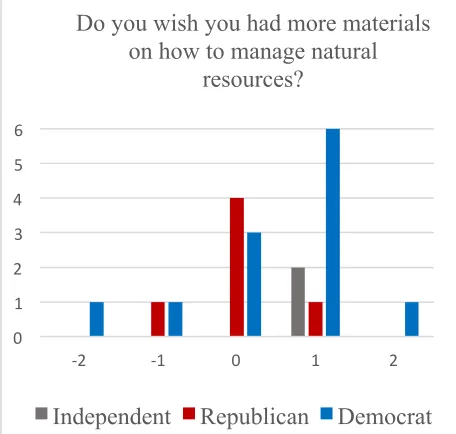
Per the survey’s third question, results found that overall, the median staffer (0.5) wished they had more material on how to properly manage natural resources. The median Democratic staffer (1.0) and Independent staffer (1.0), however, was more inclined to wish for greater material than the average Republican staffer (0.0).
0 1 2 3 4 5 6
-‐2 -‐1 0 1 2
How satisfied are you with the
quality of available information on
solving environmental issues?
Independent Republican Democrat
0 1 2 3 4 5 6
-‐2 -‐1 0 1 2
How satisfied are you with the
quality of available information on
solving economic issues?
Independent Republican Democrat
0 1 2 3 4 5 6
-‐2 -‐1 0 1 2
Do you wish you had more materials
on how to manage natural
resources?
Figure 4. Research question results.
Figure 5. Research question results.
Two sub-‐questions were asked in order to determine how able staffers are to balance economic and environmental goals. Results found that staffers are generally less able to make reasoned and informed decisions on the economy (median = 0.0) than they are on the environment (median = 1.0). Across party lines, the median
Republican staffer (0.5) felt they are more able to make reasoned economic decisions than the median Democratic (-‐0.5) and Independent (-‐1.0) staffer. These results switched for decisions regarding the environment, where the median Republican staffer (-‐0.5) felt less able to make reasoned decisions than the median Democratic (1.0) and Independent (0.5) staffer. These results suggest staffers feel less confident about their economic decision-‐making than their environmental decision-‐making, but there may be differences between opposing parties.
2. Do policymakers engage themselves with high-‐quality research?
Figure 6. Research question results. 0
1 2 3 4 5 6
-‐2 -‐1 0 1 2
How able are you to make good and
informed decisions on the economy?
Independent Republican Democrat
0 1 2 3 4 5
-‐2 -‐1 0 1 2
How able are you to make good and
informed decisions on the
environment?
Independent Republican Democrat
0 1 2 3 4
-‐2 -‐1 0 1 2
How often do you use peer-reviewed
research in your work?
Figure 7. Research question results.
The final section of the first survey, in addition to the second survey’s first question, asks three questions that provide insight on the staffers’ use of peer-‐reviewed research, engagement with academics, and top sources of evidence concerning general policy issues. Results show that the median staffer occasionally (0.5) uses peer-‐review research in their work. Democratic staffers in the survey, however, exhibited a more frequent median (1.0) than their Republican (0.0) and Independent (0.5) counterparts.
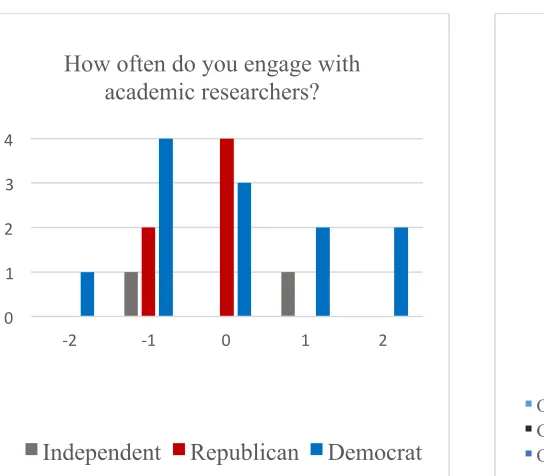
Answers to the final question of the first survey shows that staffers have low contact with academics (0.0). This median was exhibited across all political parties.
Figure 8. Research question results.
The second survey’s first question asked 14 staffers to provide their top source of environmental policy. 42 percent of the staffers surveyed cited online news sources. 14 percent of staffers cited scholarly journals, while another 14 percent of staffers cited government agencies as their top source. 7 percent of staffers cited think tanks and another 7 percent cited other staffers as their top source. The final 14 percent of staffers left the question blank.
The key takeaway from these findings is that most staffers have access to quality information and are satisfied with it, but don’t necessarily use it regularly. Of those surveyed, however, Democratic staffers wished for and used more quality information than Republican staffers.
5.3 Do Congressional staffers understand available information on remedies to curb climate change?
Three core questions were used to answer whether staffers understand available information on climate change mitigation tactics. The first question from the second survey asked staffers what the social cost of carbon (SCC) is. The SCC was defined by the U.S. Environmental Protection Agency (EPA) in December 2016 as, “a measure, in dollars, 0
1 2 3 4
-‐2 -‐1 0 1 2
How often do you engage with
academic researchers?
Independent Republican Democrat
What is your top source of
evidence on environmental
policy?
Online News Sources Scholarly Journal Articles
Government Agencies Think Tanks
of the long-‐term damage done by a ton of carbon dioxide (CO2) emissions in a given year. This dollar figure also represents the value of damages avoided for a small emission reduction (i.e. the benefit of a CO2 reduction)” (Environmental Protection Agency, 2016). According to the U.S. Government’s Interagency Working Group on Social Cost of Greenhouse Gases, the social cost of CO2 in 2015 with a 3 percent average
discount rate is $36 (IWG, 2016). The social cost of CO2 in 2020 with a 3 percent average
discount rate is $43. Because the second survey was conducted in 2017, the social cost of carbon with a 3 percent average discount rate at the time of its completion is likely to be somewhere between $36 and $43.
Figure 9. Research question results.
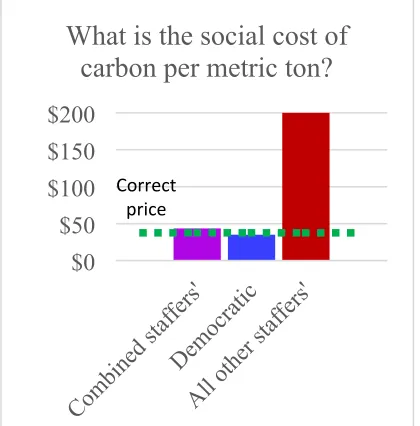
Survey results show the median answer by all Congressional staffers was $43.50, slightly above the estimated social cost of carbon with a 3 percent average discount rate in 2020. However, 57 percent of survey respondents were unsure of an answer and left the question blank. Five of the eight (62 percent) unanswered questions were left blank by Republican staffers, while one was left blank by a Democratic staffer. The median Democratic staffer’s answer was $35, while the median answer by all other staffers was
$200. Overall these results suggest that Democratic staffers have a good understanding of the social cost of carbon, while other staffers may not.
The second question asked staffers to choose the correct interpretation of a scholarly journal abstract that suggests a carbon tax should initially rise and then fall over time. Four multiple choice options were provided. Overall, 29 percent of those surveyed chose the correct interpretation. 33 percent of Republican staffers, 25 percent of Democratic staffers, and 25 percent of unknown staffers were able to interpret the abstract correctly.
The third and final question from the second survey asked staffers to choose the correct interpretation of an abstract from a policy brief written by a prominent think tank in Washington, D.C. Like the previous question, four multiple choice options were provided. Overall, half of those surveyed chose the correct interpretation of the abstract. Likewise, half of all Republican, Democratic, and unknown staffers answered the question correctly. This may suggest that staffers have an easier time understanding language from a policy brief than a journal abstract.
Overall, these results suggest staffers have a low to moderate understanding of available scholarly information on environmental remedies. Importantly, staffers may not be interpreting both academic literature or policy briefs correctly.
4. How impactful is environmental research on a legislator’s decision-‐making?
The final major question this paper sought to answer is whether environmental research is likely to influence a legislator’s decision making. When asked whether the research conducted in the two abstracts would impact the decision-‐making of a staffer’s Congressman, only three out of the 14 (21 percent) respondents said it would. All three of these staffers, however, were among the Democratic party. All Republican staffers
Correct price
$0
$50
$100
$150
$200
reasoned their Congressman wouldn’t be influenced “because of political interests.” All
unknown staffers reasoned their
Congressman wouldn’t be influenced “because it’s not reliable.” Taken as a whole group, these results suggest that research on climate change mitigation tactics is unlikely to impact decision-‐making on Capitol Hill.
V. Discussion
This paper’s results have a variety of implications for academic researchers, research brokers, and policymakers. This section provides a brief discussion of these findings and compares them to evidence found in similar literature.
The survey’s first finding that staffers are moderately satisfied with available information may suggest that researchers are fairly successful in the provision and dissemination of research. However, a switching effect for the degree to which Democrats and Republicans are satisfied with research on solving economic and environmental issues may be a signal that research brokers need to be more effective at tailoring their communication of such information to each respective party.
Numerous literature reviews (Rich and Oh, 1994; Garrett and Islam, 1998; Shulock, 1999; Neilson, 2001) have explained an apparent lack of direct use of research by policymakers as a whole group. Per answers to this paper’s first and second questions, however, Democratic and Independent staffers could be inferred to be more open to greater information on the management of natural resources, peer-‐reviewed research as a whole, and engagement with academics than their Republican counterparts. Future research should more concretely evaluate the degree to which staffers among differing political parties are open to and use research in their decision-‐making.
Results from the third question show that Democratic staffers have a good idea of what the SCC is. Republican and Independent staffers, on the other hand, were found to
have a poor understanding of the SCC. Because Republicans are less likely to believe that the effects of global warming have already begun to happen (Marquart-‐Pyatt et al., 2014), those staffers may not be exposed to information on the SCC. However, the newly established Climate Leadership Council (CLC) in Washington, D.C. is promoting the creation of a carbon tax to Republican policymakers (Baker et al., 2017). The effects of efforts to inform policymakers and their staff of the SCC should be investigated as the CLC continues its work.
Further results show that staffers may not comprehend and interpret academic literature on carbon taxes correctly. While not particular to climate change, this result contradicts Jeffreys et al. (2007) finding that staffers have a good understanding of scholarly information. This may be due to the two studies different methods of evaluating comprehension of research. Results from the third question do show, however, that staffers can better understand literature provided by think tanks than from scholarly journals. This may be due to the inherent complexity of academic language when compared to other forms of writing (Snow, 2010). Reading scientific literature may be a significant challenge for staffers who don’t use research on a regular basis.
The last finding of this paper shows that Republican policymakers are unlikely to be influenced from research on carbon taxes. This is supported by Weiss (1979) political model, which holds that research is used mainly to back-‐up pre-‐conceived notions on policy issues. Likewise, most Democratic staffer responses said research would be impactful to their decision-‐making. These findings are concerning for research brokers hoping to implement carbon taxation in order to mitigate climate change as they may find it difficult to sway Republicans using scientific research.
The primary limitation this study has is its low sample size of policymakers. Such low samples don’t allow for a more robust statistical analysis. This includes the possibility to conduct a regressive analysis in order to figure out causal relationships between independent variables. This is a major challenge and constraint on overall impact and the meaningfulness of this study.
Another limitation this study has is its lack of demographic data on staffers. This is contributed by policymakers’ need to remain anonymous, as such information can be politically damaging if revealed. The final major limitation this study has is its lack of pre-‐testing or follow-‐ups due to time constraints.
VII. Conclusion
The results of this paper suggest policymakers believe they are able to make reasoned decisions based on available
research but aren’t highly engaged with it. Further findings suggest policymakers have a poor understanding of environmental research and evidence is unlikely to impact their decision-‐making on implementing carbon taxes. Along with political polarization, these results may provide a cause behind the inaction Congress has taken on climate change. Academic researchers, research brokers, and policymakers may find these results useful and perhaps alarming if they want to induce widespread action. Further research should be conducted on policymakers using a greater sample size to better understand the effects and use of environmental research on Capitol Hill. This paper provides a foundation on which other scholars and practitioners can discern the relationship between policymakers and research on similar issues. This topic will become more important as a changing climate induces greater risk on communities and regions throughout the U.S.
References
Ackman, E. R. (2013). Getting scholarship into policy: Lessons from university-‐based bipartisan scholarship brokers (Doctoral dissertation, Arizona State University). Andres, G., & Hernnson, P. (2015). Lobbying
Reconsidered: Politics Under the Influence. Routledge.
Baker, J. A., III, Feldstein, M., Halstead, T., Mankiw, N. G., Paulson, H. M., Jr., Schultz, G. P., Walton, R. (2017, February). The Conservative Case for Carbon Dividends (Rep.). Retrieved March 7, 2017, from Climate Leadership Council website: https://www.clcouncil.org/wp-‐ content/uploads/2017/02/TheConservat iveCaseforCarbonDividends.pdf
Brinkmann, R., & Garren, S. J. (2011). Synthesis of climate change policy in judicial, executive, and legislative branches of US government. PORTAL Journal of Multidisciplinary International Studies, 8(3).
Caplan, N. (1975). The Use of Social Science
National Level: A Report to Respondents. Institute for Social Research, University of Michigan.
Cook, J., Oreskes, N., Doran, P. T., Anderegg, W. R., Verheggen, B., Maibach, E. W., ... & Nuccitelli, D. (2016). Consensus on consensus: a synthesis of consensus estimates on human-‐caused global warming. Environmental Research Letters, 11(4), 048002
Dahl, R. A. (2013). A preface to democratic theory. University of Chicago Press.
Dotson, G., & Bovarnick, B. (2016, June 29). Carbon Pricing in a Fiscal Context (Rep.). Retrieved February 2, 2017, from Center for American Progress website:
https://www.americanprogress.org/issu es/green/reports/2016/06/29/140638/ carbon-‐pricing-‐in-‐a-‐fiscal-‐context/ Dunlap, R. E., McCright, A. M., & Yarosh, J. H.