Address for correspondence
M. Shanti Prathyusha
*
Sree Vidyanikethan College of Pharmacy,
Department of Pharmaceutical Analysis, Sree
Sainath Nagar, A. Rangampet, Tirupati,
Andhra Pradesh –517102
E-mail: [email protected]
Shanti Prathyusha et al. / JGTPS / 6(2)-(2015) 2643– 2649
A REVIEW – BIOANALYTICAL METHOD DEVELOPMENT AND ITS VALIDATION
BY RP HPLC
INTRODUCTION
Bioanalytical method is a set of procedures that are involved in the collection, processing, storage, and analysis of biological samples for a chemical compound. Bioanalytical method validation (BMV) is the process used to establish suitable quantitative analytical method for biochemical applications.1Reassurances to the quality of the method and its reliability comes from performing a minimum series of experiments of validation and obtaining satisfactory results.
Maintenance of stability of analytes in biological samples collected during clinical studies together with that of assay reagents, including analyte stock solutions, is considered as an important component of biological assay and validation.2 Quality control and quality assurance are the major important areas in the pharmaceutical industry which deals with the analysis of materials starting from the raw material, intermediate products, APIS as well as finished products. Now new techniques are being developed all over the world. As a result of this, classical methods have changed to instrumental methods and finally it changed to sophisticated technique. Each technique is found to be much superior than the previous technique.3 Bioanalytical methods which are employed for the quantitative determination of drugs and their metabolites in biological matrix (plasma, urine, saliva, serum etc) play an important role in evaluation and interpretation of
Method validation is a process that determines whether a method will successfully meet the minimum standards recommended in the Food and Drug Administration (FDA) guidance. In today’s drug environment, highly sensitive and selective methods are required to quantify drugs in biological samples such as blood, plasma, serum, or urine. Chromatographic methods (high-performance liquid chromatography [HPLC] or gas chromatography [GC] have been widely used for the bioanalysis of small molecules, with liquid chromatography coupled to mass spectrometry (LC/MS/MS) After developing a method with required attributes, the method is validated for the parameters like accuracy, precision,etc. Bioanalytical method is the process used to establish that a quantitative analytical method is suitable for biomedical applications.It includes all of the procedures that demonstration of quantitative measurement of analytes in a given biological samples, such as blood, plasma, serum, or urine. The present review article focuses on various extraction techniques like liquid-liquid extraction, solid phase extraction and protein precipitation which play important role in sample preparation and detection by RP HPLC and consistent evaluation of the key bioanalytical method validation .Validation parameters include accuracy, precision, sensitivity, selectivity, standard curve, limits of quantification,limits of detection, range, recovery stability etc.
Keywords: Bioanalytical method validation; Validation parameters; extraction techniques, bioanalysis.
ABSTRACT
M. Shanti Prathyusha
1*,
R. Shanmugam
1,
A. Kirthi
1,
D. Jamal Basha
2,
D. Mounika
11
Sree Vidyanikethan College of
Pharmacy, Department of
Pharmaceutical Analysis, Sree
Sainath Nagar, A. Rangampet,
Tirupati, Andhra Pradesh –517102.
2
Sri Padmavathi School of Pharmacy,
Department of Pharmacognosy,
Tiruchanoor, Tirupati,
Andhra Pradesh- 517503.
Journal of Global Trends in Pharmaceutical Sciences
Journal home page: www.jgtps.com
ISSN: 2230-7346
bioavailability, bioequivalence and pharmacokinetic data. Both HPLC and LCMS-MS can be used for the bioanalytical method development and validation of drugs in plasma and biological samples. Each of the instruments has its own merits and demerits. HPLC coupled with UV, PDA or fluorescence detector can be used for determination and estimation of many compounds.4 The main advantages of LCMS/MS include low detection limits, the ability to generate structural information in clear picture, minimal requirement of sample treatment and the possibility to cover a wide range of analytes which differs in their polarities. Bioanalytical method validation includes all of the procedures that determine and demonstrate that a particular method used for quantitative measurement of analytes in a given biological samples, such as blood, plasma, serum, or urine, is reliable and reproducible for the intended use. The fundamental parameters for this validation to perform include selectivity, accuracy, precision, linearity and range, limit of detection, limit of quantification, recovery, robustness and stability.5
Estimation of Drugs in Biological Fluids
The choice of sampling media is estimated by the nature of the drug study. For example, drug levels in a clinical pharmacokinetic study demand the use of blood, urine, and saliva. A bioavailability study may require drug level data in blood or urine. Steps involved in the estimation of drugs in biological samples are collection of the sample, sample treatment and separation of the compound of interest from the matrix and analysis of respective samples.6
Extraction Procedures for Drugs and Metabolites from Biological Samples
Sample preparation threemajor objectives
1. The dissolution of analyte in solvent which is suitable Eg: Acetonitrile, methanol
2. Removal of interfering compound 3. Pre concentration of the analyte
Different types of extraction techniques are:
a. Liquid-Liquid Extraction
Liquid-liquid extraction is mainly useful for separating analytes from interferences by partitioning the sample between two immiscible liquids. One phase in LLE often is aqueous and second phase is an organic solvent. More hydrophilic compounds prefer the polar aqueous phase; whereas more hydrophobic compounds will prefer the organic solvents. Analyte extracted into the organic phase is easily recovered by evaporation of the solvent, whereas analytes extracted in to the aqueous phase can be injected directly into a reverse-phase column. The technique is simple, rapid and has relatively economic factor per sample when compared to other samples. The extraction containing drug sample can be evaporated till dryness and the
residue reconstituted in a smaller volume of a appropriate solvent (preferably mobile phase). Nearer quantitative recoveries of about 90% of most of the drugs can be obtained through multiple continuous extractions.
b. Solid phase extraction:
Solid phase extraction is the most widely preferable technique used in sample pretreatment for HPLC. SPE occur between a solid and a liquid phase. SPE is more efficient process of separation than LLE. It is easier to obtain a high recovery of analyte sample. SPE contains a small plastic disposable column or cartridge, in which the barrel of a medical syringe packed with 0.1 to 0.5 g of sorbent.7 The sorbent is commonly a reverse phase material (C18-silica), and a reverse phase SPE (RP-SPE) combines both LLE and reversed phase HPLC in its separation characteristics. In SPE, a liquid sample is added to the cartridge and cleaning solvent is selected so that the analyte is either strongly retained (k>>1) or unretained (K=0). When the analyte is strongly retained, interferences are eluted or washed from the column so as to minimize their presence in the final analyte concentration as well as minimizing the errors in the method. The analyte is then eluted in a small volume with strong elution solvent, and then collected, and either injected directly or evaporated to dryness and dissolution is performed in the HPLC mobile phase. In the other case, where analyte is low retained, interferences are strongly held on the cartridge and the analyte is collected for the further treatment in study.
Advantages of SPE V/s. LLE
Analyte is completely extracted.
High efficient separation of interferences from analyte and Low consumption of organic solvent.
Easy to collect the total analyte fraction
Manually convenient procedures and Removal of particulates easily
Easily automated8 c. Precipitation method
Method Development
Methods for analyzing drugs by HPLC can be developed when one has knowledge about the nature of the sample, mainly its molecular weight, polarity, ionic character, pKa values and the solubility etc. Method development cannot be standardized across the board as method development is unique and specific for each drug substance. It also depends on the nature of the sample and sensitivity.10 While there are a number of HPLC methods available to the development, but the most commonly applied method is reversed phase and reverse phase coupled with ion-pairing. The typical pharmaceutical compounds is considered to be an active pharmaceutical ingredient of less than 1,000 Daltons, either soluble in water or an organic solvent such as acetonitrile, methanol etc.11
General conditions to initiate HPLC Method Development
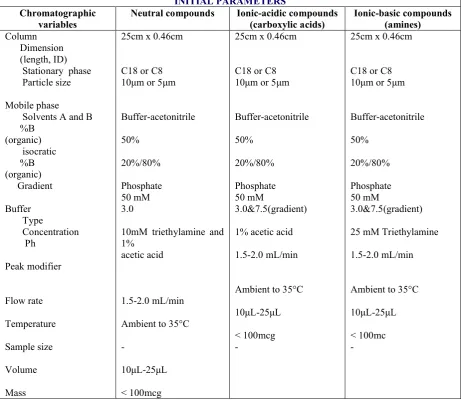
Method development mainly starts with literature survey for the molecule in which we find the nature of the molecule, its pKa, solubility, molecular weight etc. Either isocratic or gradient mode may be used to determine the initial conditions of the separation, followed by the suggested experimental conditions given in the Table 1. Depending on the number of active components to be separated, the mode of run can be determined. If the number of components is large or the pKa values of components are wide then gradient mode is preferred than isocratic mode.12 In order to decide whether a gradient mode or isocratic mode requirement which is adequate, an initial gradient run is performed and the ratio between the total gradient time and the difference in gradient time between the first and last component are noted and calculated.13 When the calculated ratio is <0.25, isocratic is adequate over gradient mode; when the ratio is >0.25, gradient would be beneficial for the separation of complex mixture and when there are many compounds or degradation products, a long gradient run is required. In this case, two separation modes using an isocratic method for product release and gradient method for stability assessment is done.
In general, one begins with reversed phase chromatography, when the compounds are hydrophilic in nature with more number of polar groups and are soluble in water. The organic phase concentration required for the mobile phase can be determined by gradient elution method. For aqueous sample mixtures, the best preferred way to start is with gradient reversed phase chromatography.
Validation assures
that-1. The analysis results are reliable, consistent and moreover there is reproducibility in the experiments.
2. It also provides an assurance that the method is suitable for the intended purpose.
3. It gives assurance of quality of products and formulations.
4. Achieving and enhancing of products by international agencies is possible.
5. For compulsive requirement of registration for pharmaceutical product or formulations.14
Types of validation:
Validation is of three types depending upon the method used. They are
Full validation
Partial validation
Cross validation
Full Validation
When bioanalytical method development of an analyte is performed for the first time, full method validation is employed here. Full method validation is much mandatory for any new drug entity. It is also recommended to use when metabolites are added to current assay of already existing analyte.
Partial Validation
Modification of validated bioanalytical methods that do not necessarily require for full revalidation. Partial Validation can range from as small as one intra-assay accuracy and precision determination to a Full Validation. Partial validation can also be carried out when there is use of different species within matrix (e.g. rat plasma to mouse plasma), changes in biological matrix within a species (e.g., human plasma to human urine), change in analytical method (e.g., change in detection systems), change in sample processing procedure, change in anticoagulant in biological fluid .15
Cross Validation
matrix effect, accuracy & precision, selectivity, recovery, purity of working standard.16
Selectivity/Specificity
For every step of product development, the analytical method must demonstrate specificity. The method must have the ability to assess the analyte of interest perfectly while in the presence of all expected components, which may consist of degradants, excipients, and sample blank peaks. The terms selectivity and specificity are often used alternatively. The term “specific” generally refers to a method that produces a response for a single analyte only, while the term selective refers to a method that provides responses for a number of analytes that may or may not be differentiated from each other. As there are very few methods that respond to only one analyte, the term selectivity is usually appropriate in exact. Optimized sample preparation can eliminate most of the components of the matrix.17 The absence of matrix interferences for a quantitative method should be determined by the analysis of atleast five independent sources of control matrix. The method must be able to differentiate between the analyte of interest and compounds with a similar chemical structure that may be present in the matrix.
Accuracy
Accuracy of an analytical method describes the closeness of mean experimental results obtained by the method to the true value of the analyte. This is sometimes referred as trueness. It is usually expressed as bias% or relative error%. The two most commonly used paths to determine the accuracy or method bias of an analytical method, are analyzing control samples injected with analyte and by comparison of the analytical method with a reference standard method. It is determined by repeated analysis of samples containing known amounts of the analyte. It is measured using atleast minimum of five determinations for each concentration. A minimum of atleast three concentrations in the range of expected concentrations is recommended. The mean value should be within 15% of the actual value except at LLOQ, where it should not show deviation by more than 20%. The deviation of the mean from the true value of analyte serves as the measure for accuracy.18
Precision
The precision of an analytical method is nothing but the closeness of individual measures of an analyte when the procedure is applied repeatedly to multiple concentrations of a single homogeneous concentration of biological matrix. Precision should be measured using a minimum of five determinations of analytes per concentration. A minimum of atleast three
concentrations in the range of expected concentrations is recommended. The precision determined at each level of concentration should not exceed 15% of the coefficient of variation except for the LLOQ, where it should not exceed 20% of the CV. Precision is further subdivided into within-run, intra-day precision or repeatability, which assesses precision during a single analytical run, and between-run, interday precision or repeatability. Repeatability expresses the precision under the same operating conditions over a short interval of time. It is sometimes also termed within-run or within-day precision. It shows how the method is performed in one lab on one instrument, within a given day for study. Repeatability can be determined by evaluating the precision from a minimum of atleast nine analytical determinations that encompass the specified range of the method. The nine determinations may be composed of triple repetetions of determinations at each of three different concentration levels, in which one would represent the 100% test concentration. Intermediate precision reflects within variations in laboratory such as different days, different analysts, and different equipment (between batches, different assay). Intermediate precision testing mainly consist of two different analysts, each preparing a total of six sample concentrations, as per the analytical method. The analysts perform their testing on different days using separate instruments and analytical columns. It is also called as between-run, between-day, or inter-assay precision. Reproducibility, i.e., the precision between laboratories i,e., interlaboratory studies, is not required, but can be taken into account for standardization of analytical procedures.
Linearity
i) A blank sample (matrix sample prepared without internal standard)
ii) A zero sample (matrix sample prepared with internal standard)
iii) Six to eight non-zero samples which covers the expected range, including LLOQ.
Matrix effect
The recent 3rd bioanalytical workshop proposed determines the matrix factor as a way of determining the matrix effect. Since ionization of analytes will be affected by presence of endogenous components in biological sample of matrix, it could be either suppression or enhancement.
Matrix Factor (MF) = Peak response in presence of matrix ions/ Peak response in absence of matrix ions
MFs for an analyte and its stable isotope are usually similar. It is advised that matrix factor or IS normalized MF being determined in six different lots of matrices. The variability in matrix factors that is measured by coefficient of variation (%CV) should be less than 15%.19
Carry over effect
Carry over effect in the assay is used to study the rinsing cycles or wash program of auto sampler required to clean up the injection needle properly so as not to get any interference from the previous sample injection. For carry over recovery comparison, sample of 1.5 to 1.8 times of non extracted standard H containing internal standard, extracted sample containing 1.5 to 1.8 times concentration of standard H containing internal standard, LLOQ sample in replicate with internal standard from biological matrix and extracted blank samples from the same matrix lots are used.
Stability
Stability is defined as the chemical stability of an analyte in a given matrix sample under specific conditions for a given intervals of time. Stability of the analyte during the whole analytical study is a prerequisite for reliable quantification.
Long-term stability
The stability in the sample matrix should be established under storage conditions, i.e. in the same vessels, at the same temperature and at over period of time at least as long as the one expected for genuine samples.
Freeze/thaw stability
As samples are often frozen and thawed, e.g. for reanalyis, the stability of analyte during several freeze/thaw cycles should also be analysed. It requires a minimum of three cycles at two concentrations which are spiked three times.
In-process stability
The stability of analyte under the conditions of sample preparation (e.g. ambient
temperature) is evaluated here. There is general agreement, that this type of stability should be performed and evaluated to find out, if any preservative have to be added to prevent degradation of analyte during sample preparation.
Processed sample stability
Instability cannot only occur in the sample matrix, but also in prepared samples. It is therefore also necessary to test the stability of an analyte in the prepared samples under conditions of analysis (e.g. auto sampler conditions for the expected maximum time of an analytical run). One should also test the stability of prepared samples under storage conditions, e.g. refrigerator, in case prepared samples must be stored prior to analysis.
ROBUSTNESS/ RUGGEDNESS
According to ICH guidelines, the robustness/ ruggedness of an analytical procedure is the measure of the capacity of method to remain unaffected by little, but deliberate variations in method parameters and provides an indication for its reliability during normal usage. Robustness can be defined as the ability to reproduce the results of method in different laboratories or under different circumstances without producing of unexpected differences in the obtained results, and a robustness test as an experimental set-up to evaluate the robustness of a method.
DETECTION LIMIT:
The limit of detection (LOD) is the least concentration of analyte in the sample that can be detected but cannot quantify under the stated experimental conditions. It is also defined as the lowest concentration that can be differentiated from the background noise with a certain degree of confidence. There is an overall agreement that the LOD should represent the smallest detectable amount of concentration of the analyte sample of interest. The detection is usually expressed in terms of concentration of the analyte in the sample, for example, percentage, parts per million (ppm), or parts per billion (ppb).20
LIMIT OF QUANTIFICATION
Table 1General Experimental Condition for HPLC
CONCLUSION
The present review work concludes the validation parameters that are necessary according; to the requirements of ICH guidelines. The method validation process and the minimum requirements that are to be included in a regulatory method are discussed. The objective of this paper is to provide steps for determining selectivity, limit of detection, lower limit of quantitation, linearity, accuracy, precision, carry over effect, stability, robustness of liquid chromatographic methods to Determine pharmacokinetic, toxicokinetic, bioanalytical, bioavailability, and bioequivalence studies. An attempt has been made in order of easy understanding of validation parameters to every analyst. The relatively new concepts and recent progress made in several areas of analysis including sample preparation, separation, how to reduce matrix effect and specific requirements
for bioanalytical method validation discussed in this review.
REFERENCES:
1. Kirthi et al. A Review on Bioanalytical Method Development and Validation By RP- HPLC Journal of Global Trends in Pharmaceutical Sciences. 2014, 5(4), 2265 – 2271.
2. Burhene J. Bioanalytical Method Validation. Jornal of Analyaia and Bioanalytical Technology. 2012, 3(7). 3. Sudha T. et al., Journal of Advanced
Pharmacy Education & Research. 2012, 2 (3), 146-176.
4. Murugan S et al., Journal of Chemical and Pharmaceutical Sciences 2010, 6(1). 5. Bressolle F, Validation of liquid
chromatography and gas chromatographic methods application to pharmacokinetics. J. Chromatogr. B. 1996, 3-10.
INITIAL PARAMETERS
Chromatographic
variables Neutral compounds Ionic-acidic compounds(carboxylic acids) Ionic-basic compounds(amines)
Column Dimension (length, ID) Stationary phase Particle size
Mobile phase
Solvents A and B %B (organic)
isocratic %B (organic)
Gradient
Buffer Type
Concentration Ph
Peak modifier
Flow rate
Temperature
Sample size
Volume
Mass
25cm x 0.46cm
C18 or C8
10μm or 5μm
Buffer-acetonitrile
50%
20%/80%
Phosphate 50 mM 3.0
10mM triethylamine and 1%
acetic acid
1.5-2.0 mL/min
Ambient to 35°C
-10μL-25μL
< 100mcg
25cm x 0.46cm
C18 or C8
10μm or 5μm
Buffer-acetonitrile
50%
20%/80%
Phosphate 50 mM
3.0&7.5(gradient)
1% acetic acid
1.5-2.0 mL/min
Ambient to 35°C
10μL-25μL
< 100mcg
-25cm x 0.46cm
C18 or C8
10μm or 5μm
Buffer-acetonitrile
50%
20%/80%
Phosphate 50 mM
3.0&7.5(gradient)
25 mM Triethylamine
1.5-2.0 mL/min
Ambient to 35°C
10μL-25μL
-6. Pranay Wal et al., Journal of Pharmaceutical Science and Technology. 2010, 2 (10), 333-347.
7. Willoughby, R., Sheehan, E. and Mitrovich, S. A Global View of LC/MS. Global View. 1998, Publishing, Pennsylvania.
8. Xu RN, L. Fan, M. Rieser, T.A. El-Shourbagy, J. Pharm. Biomed. Anal. 2007, 44 342–355.
9. Dams R, M. Huestis, W.E. Lambert, C.M. Murphey, J. Am. Soc. Mass. Spectrom. 2003, 14, 1290–1294.
10. Wells DA, High Throughput Bioanalytical Sample Preparation, Methods and Automation Strategies, Elsevier, 2003. 11. Horváth C, W. Melander, I. Molnar, J.
Chromatogr. 1976, 125, 129–156.
12. Snyder LR, J.W. Dolan, J.R. Gant, J. Chromatogr. 1979, 165, 3–308.
13. Prasanna Kumar et al., Int. Res J Pharm. App Sci., 2013; 3(2):82-85
14. Food and Drug Administration [FDA]: International Conference on Harmonization: Guideline on validation of analytical procedures: definitions and terminology, Federal Register 1997; 62(96): 27464– 27467.
15. Hartmann C, J. Smeyers-Verbeke, D. L. Massart, and R. D. McDowall.Validation of bioanalytical chromatographic methods. J. Pharm. Biomed. Anal. 1998; 17:193–218 . 16. Karnes HT, G. Shiu, and V. P.
Shah.Validation of bioanalytical methods.
Pharm. Res. 1991; 8:421– 426.
17. Shah VP. The History of Bioanalytical Method Validation and Regulation: Evolution of Guidance Document on Bioanalytical Methods Validation. AAPS Journal 2007; 9(1): 43-47.
18. Karnes HT, Shiu G, Shah VP .Validation of bioanalytical methods. Pharm. Res. 1991; 8:421- 426.
19. International Conference on Harmonization (ICH). Validation of Analytical Methods: Methodology. ICH Q2 B.1996
20. Nowatzke W., Woolf E. - Best Practices During Bioanalytical Method Validation for the Characterization of Assay Reagents and the Evaluation of Analyte Stability in Assay Standards, Quality Controls, and Study Samples, The AAPS Journal 2007; 9 (2): 117-122.