This is an open access journal, and articles are distributed under the terms of the Creative Commons Attribution-Non Commercial-ShareAlike 4.0 License, which allows others to remix, tweak, and build upon the work non-commercially, as long as appropriate credit is given and the new creations are licensed under the identical terms.
© 2019 Journal of Advanced Pharmacy Education & Research | Published by SPER Publication
1
Preparation of Al-doped NiO thin films by spray pyrolysis
technique for CO gas sensing
Yahya M. Abdul-Hussein
1*, Huda J. Ali
2, L. A. Latif
2, Mudar Ahmed Abdulsattar
1, Husham M.
Fadhel
11Ministry of Science and Technology, Baghdad, Iraq. 2Ministry of higher education, Mostansiriyah University, College of science, Baghdad, Iraq.
Correspondence:Yahya M. Abdul-Hussein, Ministry of Science and Technology, Baghdad, Iraq.
ABSTRACT
Undoped Nickel oxide (NiO) and Al-doped (NiO:Al) thin films were prepared by spray pyrolysis technique from a hydrated salt solution of nickel chloride (NiCl2.6H2O). The structural, morphological and sensing properties of the prepared films have been studied. X-ray diffraction investigation showed a polycrystalline (NiO) phase with a cubic crystalline structure. The morphology of the surface samples of thin films was investigated by Atomic Force Microscopic (AFM). The sensing properties of prepared nickel oxide thin films showed that the sensitivity to CO gas increased with changing aluminum doping.
Keywords:CO, Sensor, NiO thin films.
Introduction
Nickel oxide (NiO) thin film is a good-looking material because of its admirable chemical stability, optical, electrical and magnetic properties. NiO is (VIII-VI) semiconductor group which has Polycrystalline with cubic structure [1]. The interest in
NiO thin films is increasing fast because of their significance in various applications for science and technology [2]. NiO has
attached substantial attention for catalysts, electrochromic film
[3-5], gas sensors [6], fuel cells [7], anti-ferromagnetic materials [8],
anode material in organic light emitting diodes [9] and
thermoelectric materials [8]. Nickel oxide is p-type conductivity [10], with the range of band gap between 3.6 to 4.0 eV [11]. Metal
chlorides have the highest water solubility comparative to other metal salts. Metal chlorides are used in industrial production of numerous metal oxides and ferrites [12]. Several techniques can
be used to prepare NiO thin film such as sol-gel [13], spray
pyrolysis, plasma enhanced chemical vapor deposition [14],
pulsed laser deposition [15], chemical bath deposition [16] and
magnetron sputtering [17]. Spray pyrolysis method is low cost
and one through which the films can be coated for the large area
[5]. The properties of films that are prepared by spray deposition
depend on the substrate, spray rate, substrate temperatures and droplet sizes [18]. Drop size depends on nozzle diameter, spray
rate and gas pressure [19].
In this work, the influence of Al doping on structural, optical and sensing properties of NiO thin films are studied.
Experimental
Nickel oxide thin films were prepared from a 0.1M aqueous solution of NiCl2.6H2O using spray pyrolysis technique on a
glass substrate. AlCl3.H2O material was melted in a precursor
solution of NiCl2 for aluminum doping with different weight
ratio percentages (wt. %). The Al-doped films were prepared with various ratios of 0, 0.5, 1, 1.5 and 2 wt. %. The NiO films were deposited with the same conditions of solution volume 100 ml; the distance of the nozzle to substrate is 25 cm, and the optimized substrate temperature is 350 ºC. The resulting
solution was sprayed on preheated substrates. Substrates were heated to 350 ºC by using an electrical heater. When the solution was sprayed, the following reaction takes place at the surface of the heated substrate. The deposition parameters applied for the preparation of nickel oxide thin films are presented in table (1). For aluminum doping (AlCl3) was
dissolved in the precursor solution of (NiCl2) with different
weight percentage and sprayed onto preheated glass. The NiO Access this article online
Website: www.japer.in E-ISSN: 2249-3379
How to cite this article:Yahya M. Abdul-Hussein, Huda J. Ali, L. A. Latif, Mudar Ahmed Abdulsattar, Husham M. Fadhel.Preparation of Al-doped NiO thin films by spray pyrolysis technique for CO gas sensing. J Adv Pharm Edu Res 2019;9(3):1-6.
2 Journal of Advanced Pharmacy Education & Research | Jul-Sep 2019 | Vol 9 | Issue3 aluminum with the same deposition temperature and spray rat.
Table 1: Deposition parameters applied in present work.
NiCl2.6H2O solution concentration 0.1M
Gas pressure 1 bar
Substrate temperature(°C) 350 ºC Nozzle to substrate distance 25 cm
Solvent Distilled water
Deposition time (minutes) 15 min
Rat of spray 2.5 ml/ min
Spray time during each cycle 7 Sec
Result and Discussion
A. Structural properties: -
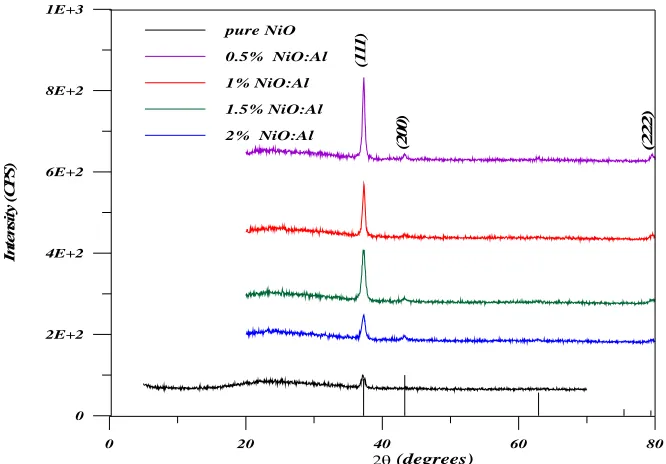
The crystallographic structure of NiO:Al films were characterized by XRD, which is presented in Fig (1). The XRD analysis indicates that all samples of the films NiO:Al deposited of undoped and doping (x= 0.5, 1, 1.5 and 2) wt% were polycrystalline and retain the NiO peaks of the film corresponding to 111, 200, and 222 reflections positions. The film deposited with x = 1.5% was disappeared polycrystalline
(2). All the prepared samples at 350 °C are crystalline, and all the diffracted peaks witnessed in XRD pattern refer to the cubic NiO phase, maximum peak alongside 2θ=37.15 corresponding with 111 plan. The value of lattice constant for 111 plane was valued to be 0.417 nm which is very close to that for bulk NiO taken from JCPDS file 04-0835.
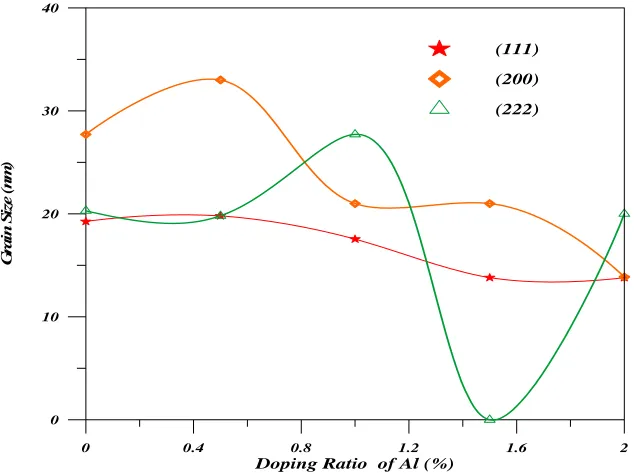
The intensity of the 111 plane decreases with the increase of doping ratio from x = 0.5 to 2 wt.%, as shown in Fig (1). The crystalline sizes of the crystallites of pure NiO and NiO:Al films with 111, 200, and 222 reflections positions were estimated to be 13.8 to 33 nm from the XRD results using Scherer's formula
[20] in Eq (1) and described in Fig (2).
D = 0.9 λ/ β C0Sθ (1)
Where D: crystalline size of the crystallite, (λ = 1.54059 Å) is the wavelength of the X-rays used, β: broadening of diffraction line measured at half of its maximum intensity in radians and θ: angle of diffraction.
The maximum grain size of polycrystalline was found to be 33 nm along 200 plan to the sample with doping ratio of x = 0.5 wt.%, as revealed in Fig (2).
Figure 1: XRD analysis of undoped NiO and NiO:Al samples
0 20 40 60 80
pure NiO
0.5% NiO:Al
1% NiO:Al
1.5% NiO:Al
2% NiO:Al
0 2E+2 4E+2 6E+2 8E+2 1E+3
In
te
n
sity
(
C
P
S
)
(1
1
1
)
(2
0
0
)
(2
2
2
)
Journal of Advanced Pharmacy Education & Research | Jul-Sep 2019 | Vol 9 | Issue3 3
Figure 2:Illustration of the crystalline size of the doping ratio of NiO:Al
B. Morphological properties: -
Atomic force microscope (AFM) is used to study the morphology of films. The images of the NiO:Al films
synthesized at different doping concentrations (x = 0.5, 1, and 2%) are shown in Fig (3).
0 0.4 0.8 1.2 1.6 2
Doping Ratio of Al (%)
0 10 20 30 40
Gr
a
in
S
iz
e (
n
m
)
(111)
(200)
4 Journal of Advanced Pharmacy Education & Research | Jul-Sep 2019 | Vol 9 | Issue3 3D 2D
Figure 3: Depicts 3D and 2D of AFM images of samples doping ratio (a) x = 0.5%, (b) x = 1% and (c) x = 2%.
AFM results displayed homogenous and smooth NiO:Al films. The average grain size, average roughness, and root mean square (RMS) roughness for NiO:Al films, founded from AFM, which is given in Table 1. Maximum doping ratio has enlarged the grain size and RMS roughness of the film. The increase of the grain size could be caused by columnar grain growth in the structure. The results of the crystalline size gained from AFM examination are different with those found from XRD via the Scherrer equation, may be, due to that AFM results were described an exterior crystalline surface, but the XRD results were described the interior crystalline structure, as presented in table 2.
Table 2: Parameters of the structural properties of NiO:Al samples. (x), D opi ng Con centration (RMS) nm A verage grai n size (nm) of AF M measur emen ts Maxi mu m cr ys ta lli ne s ize (nm) Ro ughne ss av erage (nm) undoped 0.5% 1% 1.5 2% 10.34 14.525 13.892 30.455 39.597 34 65 85 110 75 28 33 27 21 20 6.43 11.363 9.941 23.436 29.821
C. Sensing properties:
To study the electrical characterization of the films, the sensor element was connected in series with multimeters.
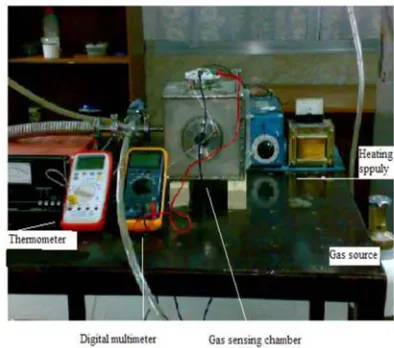
Electrical resistivity measurements were achieved using two millimeters for current and applied voltage measurements and power supply in the range of 0 –20 Volt. Gas sensing measurements have been achieved by a home-built gas sensing
chamber (gas flow elements) as displayed in Figure (4), where CO gas preparation was done by the following equation:
HCOOH (heat 70 ºC +H2SO4) → CO+H2O (2)
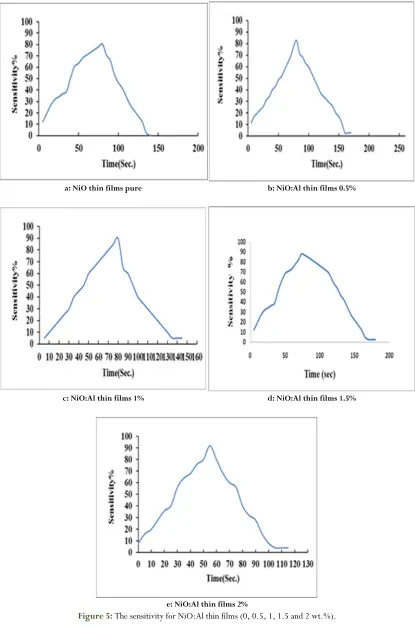
The gas sensitivity of thin film element for CO gas has been calculated at room temperature. The resistance response of each sensor structure was transformed into a sensitivity value using commonly used formula (3) for the reducing and oxidizing gases.
S = ΔR/ R = (Rair – Rgas) / Rair (3)
whereS: sensitivity, Rair: resistance in air and Rgas: resistance
with gas.
Figure 4: The gas sensing measurement setup
Journal of Advanced Pharmacy Education & Research | Jul-Sep 2019 | Vol 9 | Issue3 5
a: NiO thin films pure b: NiO:Al thin films 0.5%
c: NiO:Al thin films 1% d: NiO:Al thin films 1.5%
e: NiO:Al thin films 2%
Figure 5: The sensitivity for NiO:Al thin films (0, 0.5, 1, 1.5 and 2 wt.%).
6 Journal of Advanced Pharmacy Education & Research | Jul-Sep 2019 | Vol 9 | Issue3
Figure 6:The relation between sensitivity and doping ratio.
Conclusions
Structural and morphological properties of pure NiO and NiO:Al thin films deposited by CVD has been studied. The structural and morphological properties showed a good agreement between XRD analysis and AFM including grain size of the films prepared. The grain sizes of NiO:Al films increased when the doping ratio of Al increased. Sensitivity was increased with increasing doping ratio too. Because of growing up in grain size and growing up in roughness, these led to decrease in resistance and increase in conductivity.
References
1. Nidhal Nissan Jandow," Effect of Cu-doping on optical properties of NiO", International Letter of Chemistry, Physics and Astronomy, 2015, 48, pp155-165. 2. R. Romero, F. Martin, JR. Ramos-Barrado, D Leinen,
"Synthesis and characterization of nanostructured nickel oxide thin films prepared.", Thin Solid Films 2010, 518:4499–4502.
3. N. Penin, A. Rougier, L. Laffont, P. Poizat, J.M. Tarascon, "Sol. Energy Mater", Sol. Cells 2006, 90, 422.
4. H. Kamal, E.K. Elmaghraby, S.A. Ali, K. Abdel-Hady, "Thin Solid Films" 2005, 483, 330.
5. J. Olivier, B. Servet, M. Vergnolle, M. Mosca, G. Garry, "Synthetic Met." 2001, 122, 87.
6. I. Hotovy, J. Huran, P. Siciliano, S. Capone, L. Spiess, V. Rehacek "Enhancement of H2 sensing properties of NiO-based thin films with a Pt surface modification". Sens Actuator B-Chem. 2004;103, 300–311.
7. P. Puspharajah, S. Radhakrshna, AK. Arof "Transparent conducting lithium-doped nickel oxide thin films by
3001–3006
8. X. Rong, W. Xin, J. Delong, L. Junqiao, W. Guozheng, L. Ye, D. Qingduo, T. Jingquan "Structural and photoelectrical properties of NiO thin film", Chin J Electron 2010, 19:631–633.
9. IM. Chan, FC. Hong "Improved performance of the single-layer and double-layer organic light emitting diodes by nickel oxide coated indium tin oxide anode", Thin Solid Films. 2004,450,304–311.
10. SC. Chen, TY. Kuo, YC. Lin, CL. Chang" Preparation and properties of p-type transparent conductive NiO films", Adv Mater Res. 2010;123:181–184.
11. H. Fadheela Oleiwe, "Structural and optical Characterization of Nickle oxide thin film prepared by spray pyrolysis technique", Eng & Tech J., 2015, 33, 1503-1512
12. Raid A. Ismail, Sa’ad Ghafori, Ghada A. Kadhim," Preparation and characterization of nanostructured nickel oxide thin films by spray pyrolysis", Appl Nanosci 2013,3:509–514.
13. A. Ghamdi, W. Mahmoud, S. Yaghmour, F. Al-Marzouki "Structure and optical properties of nanocrystalline NiO thin film synthesized by sol-gel spin coating method", J Alloy Compd 2009, 486:9–13 14. S. Nandy, KS. Goswami, K. Chattopadhyay "Ultra
smooth NiO thin film on flexible (PET) substrate at room temperature by RF magnetron sputtering and effect of oxygen partial pressure on their properties". Appl Surf Sci ,2010, 256:3142–3147.
15. X. Xia, J. Tu, J. Zahang, X. Wang, W. Zahang, H. Huang Electrochromic properties of porous NiO thin films prepared by CVD. Sol Energy Mater Sol Cells, 2008, 92:628–633
16. H. Wang, Y. Wang, X. Wang, "Pulsed laser deposition of NiO thin film at room temperature for high-rate pseudocapacitive energy storage", Electrochem Commun, 2012, 18:92–95
17. E. Fujii, A. Tomozawa, H. Torii, R. Takayama," Preferred orientation of NiO films prepared by plasma-enhanced metalorganic chemical vapor deposition " Jpn. J. Appl. Phys., 1996, 35, 328-330,
18. Y.S. Sakhare, N.R. Thakare, A.U. Ubale, "Influence of quantity of spray solution on the physical properties of spray deposited nanocrystalline MgSe thin films", Petersburg Polytech Univ J: Phys Math 2016;2:17–26 19. J. Manifacier, J. Fillard, J. Bind, "Deposition of
In2O3SnO2 layers on glass substrates using a spraying method", Thin Solid Films 1981;77:67–80.