Organized by C.O.E.T, Akola, ISTE, New Delhi & IWWA. Available Online at www.ijpret.com257
INTERNATIONAL JOURNAL OF PURE AND
APPLIED RESEARCH IN ENGINEERING AND
TECHNOLOGY
A PATH FOR HORIZING YOUR INNOVATIVE WORK
DNA COMPUTER
SONAL KABRA
Department of Computer Science, San José State University, San Jose, CA, USA-95134
Accepted Date: 07/09/2016; Published Date: 24/09/2016
Abstract: Computers are an essential part of our daily lives and there is an increase in use of computers everyday. It has manyfeatures like parallel processing, hardware size, power consumption, operational speed, data storage etc. But the traditional von Neumann computer faces many challenges. The challenges like computation limitation, storage limitation, heat dissipation, and larger space requirement, etc. To overcome these challenges DNA based computers can be used. DNA computer is made from human genes. It is the interdisciplinary research area, which combines field of computer and biology. This paper provides an overview of the concept of DNA computing, how it can be designed, its impact on traditional silicon based computers, and its limitations and advantages.
Keywords: SResacetophenone , Bis-Chalcones, antibacterial, aromatic aldehyde.
Corresponding Author:MS. SONAL KABRA
Co Author:
Access Online On:
www.ijpret.com
How to Cite This Article:
Sonal Kabra, IJPRET, 2016; Volume 5 (2): 257-264
PAPER-QR CODE
SPECIAL ISSUE FOR
INTERNATIONAL CONFERENCE ON
Organized by C.O.E.T, Akola, ISTE, New Delhi & IWWA. Available Online at www.ijpret.com258
INTRODUCTION
Since the last two decades, computers have made overwhelming progress in the field of information and computing technology. It has become an inseparable part of human life. Though the speed of computers increasing day by day, we cannot avoid the limitation getting reached by it. So to overcome the limitations of the silicon-based computer, scientist started to explore substitution for silicon based computer. DeoxyriboNucleic Acid (DNA) computing is one of the innovations. DNA Based Computer is a nano-computer. The following research will explorehow DNA based computer will change the world.DNA is the material from which human genesare made. DNAcan be used to store information and perform complex calculations in seconds.Leonard Adleman, working in the University of Southern California, wasthe first person to experiment with DNA. He showed that DNA could be used as an alternative to silicon chips [1]. DNA computing research was inspired by similarity between the way DNA works and the operation of a theoretical device known as the Turing machine [2].
This literature review focuses mainly on two questions: First, what is DNA computing and second, how is it superior to silicon chip computers?
1. WHAT IS DNA COMPUTING?
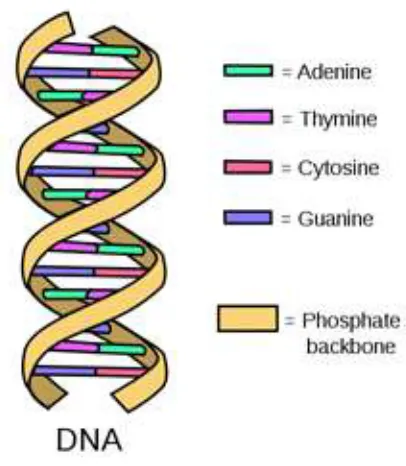
All organisms on the earth are made of a genetic blueprint. Coding in genetic blueprint decides the physical appearance of organism, that is, whether it is human or not. The human body is made up of millions and millions of cells. For each cell there is one nucleus and in each nucleus there are tightly coiled threads of DNA which is a long polymer made from repeating units called nucleotides [3].
DNA contains the genetic information of a cell. This information is nothing but the code, which is the building block upon which life is formed. It is used within cells to form proteins. The complete set of instructions for ‘building’ an organism is called the “genome.” It contains the master blueprint for all cellular structures and activities for the lifetime of the cell or organism. [3]
Organized by C.O.E.T, Akola, ISTE, New Delhi & IWWA. Available Online at www.ijpret.com259
Fig. 1. DNA double Helix
DNA computing is a branch of computing which uses DNA, biochemistry and molecular biology. A DNA computing is a molecular level in which each DNA strand represents a processor. It forms an interdisciplinary research area. It is a fast developing field as DNA molecules are implemented in a computational process. The goal behind this research is to study how to build a biologically inspired computer, which will run on biochip.
2. DNA VS SILICON
Organized by C.O.E.T, Akola, ISTE, New Delhi & IWWA. Available Online at www.ijpret.com260 The area of 1 cubic centimeter (0.06 cubic inches) can holdmore than 10 trillion DNA molecules. With this amount of DNA, a computer would be able to hold 10 terabytes of data, and perform 10 trillion calculations at a time [4]. DNA computers can perform 2 x 10¹⁹ (irreversible) operations per joule. Existing supercomputers are not very energy-efficient, executing a maximum of 109 operations per joule [4].
Thus, DNA can be the smallest computer ever made while at the same time can store more data. One pound of DNA can store much more information than all the electronic computers ever built. Thus we can summarize points of using DNA instead of silicon as follows [5]:
DNA computers are smaller in size than today's computers. It is a cheap resource because it is available in ample amount.
DNA biochips do not use any toxic material as of traditional microprocessors. Hence they can be made environment friendly.
It can perform billions of operations simultaneously. DNA Computer has a Big Data storage capacity.
It consumes very low power as compare to the super computer.
3. HOW DNA COMPUTER WORKS
DNA is a unique computational element because it has extremely dense information storage. It supports enormous parallelism and extraordinary energy efficiency. The 1gram of DNA can hold about 1x1014 MB of data. DNA computers will work through the use of DNA-based logic gates. These logic gates are very much similar to today’s logical operators like AND, OR, NOT, NOR,etc [5]. The only difference is how we input the signal and how we output the signal. It takes the input signal in the form of DNA code instead of binary code. The DNA computer can perform basic operations like addition, bit shifting, which helps them to perform complex calculations. DNA can also perform operations like cutting, copying, pasting, and repairing etc. In a test tube, enzymes do not function sequentially, working on one DNA at a time. Rather, many copies of the enzyme can work on many DNA molecules simultaneously. It shows the capability of DNA computing [3].
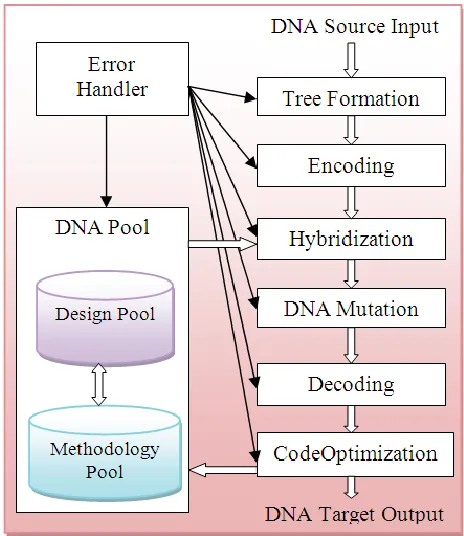
Organized by C.O.E.T, Akola, ISTE, New Delhi & IWWA. Available Online at www.ijpret.com261 Later, mutation performs the operation based on user specification by accessing components in processor. The code optimizer tires to improve performance of whole cycle by minimizing time and space requirement of a program.
Fig. 2. Design of DNA computer
3.1 Components of DNA computer
The DNA computer split processing in 2 parts, namely, active component and passive component [3]. The active component details both architectural and instruction set part of computer. While passive part consist of Finite state machine (FSM) description, how various components of design are connected to each other and Placement, which gives the exact location of various components in chip. The basic components of DNA computers are [3]:
DNA Field-Effect Transistor: They are used to detect and control the flow of the signals or DNA code that can trigger event in DNA computer.
DNA-Based Storage System: In this data is stored in the digital form using the sequence of DNA. It maps the alphabets onto strings over {A, C, G, T} parts of DNA.
Organized by C.O.E.T, Akola, ISTE, New Delhi & IWWA. Available Online at www.ijpret.com262
3.2 Specification of DNA computer
Parallelism: 3 x 10¹⁴ molecules at a time Energy efficiency: 1Joule = 2 x 10¹⁹ operations Data storage: 1cm of DNA = 10 TB of data Size of computer= Size of teardrop [6]
4. APPLICATIONS
The DNA computer has major impact on fields like artificial problem solving, Medical diagnosis, drug recovery and Cryptography. It can also be used in forecasting, image and signal processing. It can also be used to develop algorithms to solve various engineering problems [7].
5. ADVANTAGES
DNA computers have the potential to take computing to new levels, picking up where Moore's Law leaves off.
Speed: The DNA computer performs millions of operations simultaneously, which allows
the speed of DNA computer to increase exponentially.
Minimal storage requirements:DNA stores memory at a density of about one bit per
cubic nanometer where conventional storage media requires 10^12 cubic nanometers to storage one bit. Thus, it can store huge amount of data.
Minimal power requirements:No power is required for DNA computing while
computation is taking place. The chemical bonds that are the building blocks of DNA happen without any outside power source [6,7]
6. DISADVANTAGES
DNA computing have provided the promising results till now in every research conducted. But still there are some serious limitations in this field as follows [3,6,7]:
It can take longer time to sort out the results than it took to solve the problem. Errors may occur if mis-pairing of DNA strand happens.
It cannot run application software.
DNA computing has a high incremental cost both in terms of the operators and the raw materials that it uses.
Organized by C.O.E.T, Akola, ISTE, New Delhi & IWWA. Available Online at www.ijpret.com263
7. CURRENT PROBLEMS
There are considerable problems, which need to be resolved so that we can use a fully functional DNA computer.
They are not completely accurate at current point of time. There is only 95% chance that DNA computer will “compute” any given problem correctly.
It has a half-life that is which means that DNA solutions can dissolve away before the end results are found [3,6,7].
8. CURRENT RESEARCH &THE FUTURE
DNA technology is making very rapid progress. In the future we may have DNA computers more efficient. The University of Wisconsin is experimenting with a chip-based DNA computer. That computer will support features like emailing, word processing, etc. IBM is also seeking for fusion of DNA and silicon.
Microsoft developed a programming language named DNA Strand Displacement tool (DSD). It can be used for designing and simulating computational devices made of DNA. It is the 1st step towards the emergence of DNA computing implementation strategies.
9. CONCLUSION
DNA computing may solve the complex mathematical problems, but it is still in infancy stage. In the future, DNA computers might be integrated into a computer chip to create a Biochip that will make computers even faster and will help in storing enormous amounts of data. The first DNA computers may not support any fancy applications like word processing or solitaire but could be used by government agencies for cracking secret codes, or by aviation industry for planning efficient and effective routes, etc.
11. REFERENCES
1. L. Adleman, “Computing with DNA,”Scientific American, vol. 279, no. 8, pp. 34-41, 1998. [Online]. Available: https://www.usc.edu/dept/molecular-science/papers/fp-sciam98.pdf 2. L. Kari, G. Gloor and S. Yu, “Using DNA to solve the Bounded Post Correspondence Problem,”Theoretical Computer Science, vol. 231, no. 2, pp. 193-203, 2000. [Online]. Available: http://www.sciencedirect.com/science/article/pii/S0304397599001000
Organized by C.O.E.T, Akola, ISTE, New Delhi & IWWA. Available Online at www.ijpret.com264 4. S. N. Kumar, “A Proper Approach on DNA Based Computer,” American Journal of
Nanomaterials, vol. 3, no. 1, pp. 1-14, 2015. [Online]. Available:
http://pubs.sciepub.com/ajn/3/1/1/ .
5. K.Boruah, andJ. Dutta, “DNA computing models for boolean circuits and logic Gates,” in2015
IEEE International Conf. on Computational Intelligence & Communication Technology, pp.
529-533, 2015. [Online]. Available:
6. http://ieeexplore.ieee.org/xpl/articleDetails.jsp?arnumber=7078759&newsearch=true&quer yText=DNA%20Computing%20Models%20for%20Boolean%20Circuits%20and%20Logic%20Gate s .
7. K. Bonsor, “How DNA computers will work,” 2000. [Online]. Available: http://computer.howstuffworks.com/dna-computer.htm.
8. J. Watada, and R. B. A. Bakar, “DNA computing and its applications,”in Eighth International
Conf. on Intelligent Systems Design and Applications, 2008, vol. 2, pp. 288-294. [Online].
Available:
http://ieeexplore.ieee.org.libaccess.sjlibrary.org/xpl/abstractCitations.jsp?reload=true&arnumb er=4696346&queryText=DNA%20computing&searchField=Search_All