© 2018 Goben and Doubleday. This open access article is distributed under a Creative Commons Attribution-Noncommercial 4.0 License: https://creativecommons.org/ licenses/by-nc/4.0/
JCEL is published by Clemson University Press ISSN 2473-8336 | jcel-pub.org
Volume 2, Issue 2
Copyright in the Health Sciences Literature: A Narrative Review
Abigail Goben and Alison F. Doubleday
Journal of Copyright in Education and Librarianship 1
Copyright in Health Sciences Literature:
A Narrative Review
Abigail Goben, MLS University of Illinois at Chicago
Alison F. Doubleday, PhD University of Illinois at Chicago
Author Note: Abigail Goben, MLS, Information Services Librarian, Associate Professor, University of Illinois at Chicago.
Alison F. Doubleday, PhD, Associate Professor, College of Dentistry, University of Illinois at Chicago.
Correspondence concerning this article should be addressed to Abigail Goben, MLS, University Library,
University of Illinois at Chicago, 1750 W Polk, Chicago, IL 60612. Contact: [email protected].
Abstract
Health science educators, researchers, and clinicians are regularly faced with challenges surrounding copyright and fair use. However, the literature on how copyright is addressed in these specific contexts is scarce. To identify themes and gaps related to the copyright and fair use issues in the context of the health sciences, the authors undertook a narrative review of articles published in the health sciences literature between 2000 and 2016. Only 154 articles were identified that were appropriate for the topic and that addressed the areas of concern for educators, researchers, and clinicians across all health science disciplines. The overarching issues were identified, including the prevalence of misinformation or misunderstandings, particularly around fair use, and the continued need for authoritative copyright education and the definition of best practices.
Goben and Doubleday 2
Copyright in Health Sciences Literature: A Narrative
Review
Although the impact of copyright and fair use issues on health profession educators and clinicians is not new, the advent and increased prevalence of digital resources in academic and clinical settings has raised awareness of the legal and professional ramifications for ignorance of copyright and fair use laws. Curiosity and confusion around these topics abound as academics and clinicians wonder what they are legally permitted to use and how they can protect their own intellectual property. At universities, copyright education has periodically fallen under the purview of libraries, and documenting the types of copyright questions and attempts at educational interventions have been described (Charbonneau & McGlone, 2013; Gilliland & Bradigan, 2014). However, these efforts are focused on intervention from experts adjacent to these disciplines and do not identify the values or concerns that are raised by the practitioners themselves.
In 2016, a survey of the copyright knowledge, behaviors, and attitudes of dental faculty members who have educational, research, and clinical roles demonstrated a seeming paucity of literature addressing the copyright knowledge needs of health science faculty, practitioners, or students (Doubleday & Goben, 2016). This warranted further exploration throughout the health science professional literature in order to gain a better understanding of recent publications. The hypothesis for this narrative review is that no substantive body of copyright literature focuses on the health sciences. This review explores the identified health science copyright literature to identify where gaps exist, to review whether the material shows biases, and to identify opportunities for future copyright research and education for health science educators and practitioners.
Methods
3 Journal of Copyright in Education and Librarianship
prelude to the educational changes created by The Technology, Education and Copyright Harmonization Act (TEACH Act) of 2002. The search string is available in Appendix A. Articles were excluded if they were solely focused on plagiarism, trademark, or patent law. Articles were also excluded if they centered on laws and practices in countries other than the United States, due to the challenges of comparing the different legal environments. The authors chose to exclude articles focused specifically on librarian interventions, as well. While these papers inform librarian practice and demonstrate a method of copyright education exposure, the primary audience for them is librarians rather than the desired health science practitioner audience, and they focus more on library policy and practice. Zotero (v.5.0) was used for citation management.
The articles were coded to indicate the health field that was being addressed by the article, the audience focus of the article, and the article type. The articles were coded independently by each author and then reviewed by the authors once more to reach consensus. The health fields were drawn from the educational groupings at the authors’ institution, including medicine, nursing, veterinary, dentistry, applied health sciences (e.g., physical therapy, occupational therapy, and bioinformatics), public health, pharmacy, and library science. The audience focus of the article could be clinical practice, education, research, or other. The article types included editorials, directive articles for practitioners (targeted at working educators, researchers, or clinicians), case studies, original research studies, and one review article. Articles were searched by title in Scopus and Google Scholar to gather citation information in order to gain a sense of reuse and impact. Scopus was chosen for citation information due to its broad base of journals in the health sciences, and Google Scholar (GS) was selected as a comparison, as many health science articles are cited in white papers, scientific statements, and other gray literature that is only captured by GS.
Results Descriptive Statistics
Goben and Doubleday 4
Figure 1. Professional health fields represented in articles on copyright or fair use in health professions that meet inclusion criteria. Percentage of all articles included in the study are shown.
A total of 41.6% (n = 64) of the articles examined for this study focus on some aspect of research (authorship, copyright transfer agreements and copyright ownership, open access, etc.), while 31% (n = 48) focused on education applications, and 20% (n = 31) addressed issues of relevance to practicing clinicians (Fig. 2). The remaining 7% provided general definitions, descriptions, or basic interpretations of copyright law without discussions of its application in any specific context.
5 Journal of Copyright in Education and Librarianship
The articles were predominantly works designed to outline the specifics of copyright for practitioners (47%, n = 72) and editorials commenting on current copyright laws or changes (40%, n = 62) (Fig. 3).
Figure 3. The general type of publication represented by articles included in the study. Percentages of all articles are shown.
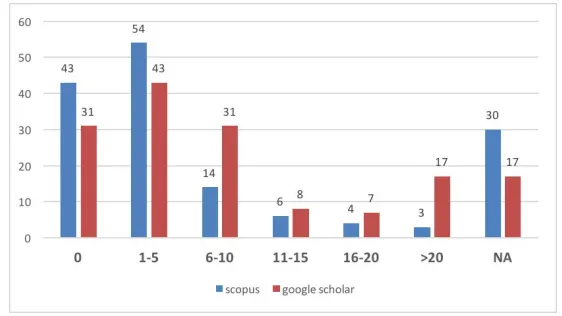
Over half the articles included in the study were cited by other articles less than 15 times (Fig. 4). According to Google Scholar, 20% had never been cited by another study (28% if using data from Scopus), and approximately 30% had been cited one to five times (35% using data from Scopus). For at least 11% (Google Scholar) to 19% (Scopus) of the articles included in this study, the citation information was unavailable.
Content Review
Health science practitioners are likely to encounter copyrighted materials in three contexts: education (either as student or instructor), research, and clinical practice. Each article reviewed was placed within one of these three categories to identify the trends and common thematic elements within these areas of focus.
Education
Using copyrighted materials in health sciences education. Copyright literature in the health sciences focusing on educational concerns includes examinations of the use of materials in the classroom, the expansion of course reserves to e-reserves, the move to an online classroom, how students can reuse materials for class and patient education, faculty retention of copyright over lecture materials, copyright and test materials, and media specific issues, such as videos and music.
The articles that addressed copyright in the context of teaching were frequently intended as “how to” guides and provided educators with a general, working knowledge of copyright so that it could be easily applied. Many of these articles have reviewed the basic guidelines on what is permissible when creating teaching materials (Alspach, 2010; Baker, 2013; Bergeson, 2010; Busey, 2005; Carlson & Ross, 2010). For example, Bergeson (2010) explored the types of works that can be protected, whether including a copyright symbol is necessary, what to do if one believes someone is using his or her copyrighted materials without permission, and a short description of materials not covered by copyright. Other articles have focused more specifically on particular media, such as video usage in the classroom. Masters (2005) and Herrman (2006) briefly addressed the use of feature films, re minding instructors th at they are required to use legally obtained versions of films, which is in alignment with the face-to-face teaching exception in copyright law, and noting that all films used in a classroom setting should also be relevant to the course.
Beyond the guidance articles, some authors have explored specific allowances in copyright law for educational use. The legal concept of fair use often arises, with many articles incorrectly specifying that it only be used for education (Clark, Mulligan, & Baba, 2011). Zimmerman (2011) provided a review of current copyright law and the specific effects of the T echnology, Education and Copyright Harmonization Act (TEACH Act). In addition to considerations related to displaying
7 Journal of Copyright in Education and Librarianship
materials in a classroom setting, these exceptions were also considered relevant in relation to providing electronic course reserves for class and navigating when permissions must be obtained. A great deal of variance regarding the permissions identified in the literature was apparent, with one article noting that some scholarly journal publishers ask for permission payments for quotes as short as 15 words (Langlois, Heller, Edwards, Lyratzopoulos, & Sandars, 2004), an atypical and exorbitant request. Other authors have called for changes and more restriction in the copyright law, such as removing the fair use permissions because the Internet and web access cross so many jurisdictions (Goudreau, 1999).
A particular focus of education and copyright discussions over the period examined was how to navigate the widespread use of digital resources. The increased transition to hybrid or online courses has inspired interest in how to navigate copyright and fair use regulations in those contexts. Dobbins et al. (2005), for example, provided instructors with information on how to secure copyright for developing online courses and stresses the importance of knowing the responsibilities with regard to copyright due to increased use of Internet resources. Perera (2010) expanded a little further on distance education and the reuse of copyrighted materials, with a reminder that citation and attribution—though important—are not the same as permission for the reuse of materials. Rhoads and White (2008) presented a clear focus on instruction and education for distance nursing education. However, while they provided a good summary of copyright law and fair use, they did not include any information on research, personal copyright, or the copyrights students hold on their own materials.
of the impact on clinical training and the subsequent implications for patient care.
Protecting personal materials in education. While many articles have focused on the reuse of materials, such as images from books or journal articles, many have also addressed faculty concerns about their personal copyright and their intellectual property rights in their lecture notes, recordings and podcasts, with one notable case having risen to the Kansas Supreme Court (McAndrew & Johnston, 2012; “Who owns your work?,” 2005). Several authors have noted that the legal implications specifically surrounding recordings had not yet been adequately addressed by current copyright law (Horvath et al., 2013; L. Johnson & Grayden, 2006; Pesut, 2002). Moore (2015) argued that instructor-generated materials are, essentially, works for hire and that clear policies are needed for institutions and faculty. It is worth noting that practices related to this issue vary across institutions, and some institutions grant ownership to instructors or may “gift” the works back to the instructor who created them.
In addition to institutional policies, identifying licenses that allow for the sharing of faculty-created copyrighted works has been explored, with Creative Commons licensing viewed as a partial solution (Pinto et al., 2008; Polson & Farmer, 2002; Poss, Bauer, & Heckman, 2004). However, further questions and a lack of appropriate guidelines have been outlined as concerns for materials created on social media (Haigh, 2010; McAndrew & Johnston, 2012). While McAndrew and Johnston (2012) recommended providing instruction on appropriate attribution and reuse, their recommendations were limited in that they did not mention fair use in any way. Overall, managing copyright on the web has frequently been presented as an insurmountable and frightening barrier for content creators (Polson & Farmer, 2002). This was further complicated by the fact that the articles for instructors frequently included misinformation. An example from Girard (2004) wrongly asserted that an instructor cannot use two articles by the same author in a semester, as it would violate fair use principles.
Teaching students about copyright. Instructors are not only concerned with copyright issues related to creating and providing materials for use in the classroom or online; educators are also concerned with teaching their students about the appropriate use of materials in their own work. Few articles, however, have addressed how to teach students copyright or help them navigate it appropriately. One article described having nursing students copyright their graduate portfolios and registering them with the copyright office, although it is important
9 Journal of Copyright in Education and Librarianship
to note that registration is a requirement for legal enforcement of copyright, but is not required for obtaining a copyright. However, the article did not address the permissions process for using others materials within this portfolio (Wassef, Riza, Maciag, Worden, & Delaney, 2012). Benjamin-Coleman et al. (2001) did address students’ use of copyrighted materials, but the article was specific to the use of videotapes and was a case study conducted at one institution. The study did indicate that the institution included student misuse of protected materials as part of the student honor code and specified the consequences for violating these regulations.
Research
Current legal concerns. Few practical examples have been written that define copyright specifically for researchers. Reider et al. (2016) provided a summary of U.S. copyright law as it has grown out of British law, while Baker (2013) covered general copyright concerns involving manuscript preparation and copyright transfer agreements, with an additional note of the teaching application of copyrighted materials. Adeney (2015) wrote an excellently comprehensive review of issues with authorship, including challenges with large collaborations, problems with honorary authors, ignored authors such as students or staff, and ghost authors. Adeney also reviewed the current criteria in medicine for authorship as defined by the International Council of Medical Journal Editors and pointed out the variances between Australian copyright and the U.S. laws, where the former has a moral rights policy against false attribution.
Goben and Doubleday 10
highlighted case was the Google Books/Authors Guild scanning lawsuit (von Bubnoff, 2005), which while ultimately successful for Google, went on for many years and was seen as particularly detrimental to medicine, as it may have prevented much-needed digital text analyses (Jockers, Sag, & Schultz, 2012).
Journal copyright transfer. The copyright transfer relationship between health science authors and publishers is evolving, with some publishers attempting to assert more control and others recognizing the emerging trends in scholarly communication. Signing over copyright to journals was put forth as a way to protect authors from claims of infringement (S. H. Johnson, 2003; Smart, 2016) despite the deferral of responsibility taken by the journal when plagiarism or libel accusations arose. This argument, however, contradicted one put forth by the New England Journal of Medicine (NEJM), which took the editors of The Journal of the American Medical Association (JAMA) to task for misleading authors on copyright and suggested that financial self-interest overtook all other considerations (Gass, 2004). Author copyright negotiation was also argued for in book contracts, where it was recommended to specifically contract with the publisher for a clause preventing future edits to the work without the author’s awareness (Katan, 2006).
Some journals and editors have attempted to further assert article ownership by moving the copyright transfer process to the beginning when the paper was first submitted to the journal rather than waiting until after a paper was accepted for publication (Peternelj-Taylor, 2013; Poss et al., 2004). This was perhaps a reaction to try and prevent authors from submitting their papers to more than one journal (Miziara, 2010), which violates most journal terms of submission. Even recent articles tended to assume the complete transfer of copyright to the journal was the current standard rather than acknowledging that there may be a range of options, including ones where the author retains copyright (Peregrin, 2014).
11 Journal of Copyright in Education and Librarianship
and the application of a Creative Commons license with a final PDF deposit in PubMedCentral to enhance access.
The default expectation presented to authors continued to be that that they will hand over all copyright (Peh & Ng, 2010) and did not address whether authors may negotiate their terms (Peregrin, 2014). This may change as authors assert more rights; recently, the American Journal of Roentgenology conducted a survey with journal stakeholders to understand the existing feelings about copyright and licensing (Berquist, 2016).
National Institutes of Health Public Access Policy. In 2004, the National Institutes of Health (NIH) drafted the NIH Public Access Policy, encouraging authors who were receiving funding from this federal agency. Any author publishing a paper after the specified implementation date was required to submit a copy of the final peer-reviewed manuscript to a newly created federal repository, PubMedCentral, where it would be freely available to read. In 2008, this policy became a mandate for authors that could prevent a researcher from receiving ongoing funds or from being eligible for new grants (National Institutes of Health, 2008).
A policy like this was seen as beneficial and needed in 2000, when an editorial in the Journal of the American Medical Informatics Association called for the freeing of publications and abolishing copyright transfer requirements to remove distribution and access barriers (Markovitz, 2000). Yet, when the policy was first released, it was met with hostility from publishers. An editorial in Blood in 2005 patronized the policy, calling it only a request instead of a requirement and arguing that the journal would not assist authors with compliance. The editorial board argued that the money would be better spent on funding more science rather than ensuring open and equitable access to currently funded research (George & Shattil, 2005). Gass (2004) expressed wariness of the requirement, particularly because NIH initially made no mention of copyright at the time. Gass further argued about the danger of third parties being able to use data and republish without copyright and pointed to a specific example in which the general public received email material about growth hormones attributed to a study in a particular journal, but in which the material was taken out of context and misleading.
Creative Commons licensing and open access. Two trends that appeared to bring a great deal of confusion regarding copyright were the emergence of Creative Commons licensing in 2001 (Creative Commons, n.d.) and the open access movement (“Budapest Open Access Initiative,” n.d.; Open Society Foundations, 2012; Suber, 2012). Introductory articles to these topics continue to be published, suggesting a lack of comprehensive understanding amongst health science researchers (G. O. Brown, 2003; Morrison & Desautels, 2016).
These two initiatives were seen as opportunities for researchers to control their message and impact through changes in copyright. Giglia (2007) called open access a “unique opportunity” for authors to retain their copyright, as well the beginning of efforts to remove the financial burden that scholarly publishing places on institutional libraries. Carroll, after reviewing current copyright law in 2011, argued that full open access including a Creative Commons attribution-only license (CC-BY) was most appropriate for scientific articles, pointing out the need for author recognition as well as article reuse (Carroll, 2011).
Some authors have gone further, calling for access not only to the literature but also to the data underlying the articles. One article asserted that the data should be released with a Creative Commons 0 (CC0) to facilitate the greatest amount of reuse and remix (Hrynaszkiewicz & Cockerill, 2012). It was assumed in this particular article that the author had copyright over the data. While there may be copyright implications for how the data are presented and the arrangement of the data, U.S. law currently states that facts (the actual data) are not copyrightable.
Also, Creative Commons licensing and open access have frequently been misrepresented. Rinaldi mistakenly represented open access journals as requiring full copyright transfer to the journal rather than a negotiation and also always requiring author payment (Rinaldi, 2008). Halsted argued that allowing research to be available through open access confuses the public, whom he described as not having the ability to comprehend scientific literature (Halsted, 2003). They notably did not address the issue of scientific readers, who are unaffiliated with major universities having libraries with large journal package subscriptions.
Questionable business models, such as reselling Creative Commons-licensed or open-access-paid materials, have only been sparsely addressed. S. J. Brown (2004) pointed out how piracy can occur, with publishing companies selling single copies of articles and the potential market impact, particularly on libraries.
Student authorship. Author ownership has also expanded beyond the relationship between journals and authors to between authors and specifically, between faculty mentors and students, especially for
13 Journal of Copyright in Education and Librarianship
thesis and research projects. Oddi and Oddi (2000) argued that even though the institutions or individual faculty may hold the belief that faculty should be co-authors on projects they supervise, this may violate autonomy and fidelity and be unethical. They argued that the Copyright Act of 1976 precludes faculty co-authorship on dissertations, and derivative articles must have specific faculty author contribution beyond supervision. Welsh et al. (2008) reviewed both the ethical and legal issues that may arise and suggested that rather than relying on copyright law, that contract law was an appropriate method for documenting planned practices and preventing misunderstandings between students and faculty.
Clinical
Copyright for the clinician. Articles intended for use by clinicians have tended to be of limited scope, focusing on definitions and not going beyond a narrow interpretation of the law (Busey, 2005; Jones, Raine, & Hanlon, 2006; Ritter-Gooder, Lewis, & Delserone, 2011). Some have touched on unique areas, such as protecting external measures that evaluate clinicians and hospitals (Ingram, 2010), reusing government and association materials for patient education handouts (Wilken CS & Isaacson M, 2005), answering the need for a public performance license for waiting room entertainment (Wooton, 2004), turning publications into presentations (Alspach G, 2010), and requesting permissions for reuse (Carlson & Ross, 2010).
Hough and Priddy (2012) produced the most comprehensive article, aimed at practicing nurses. It explored not only the copyright basics but also argued for payment for writing in addition to copyright retention, correlating the training and work that nurses have undergone with that of authors and artists. It also reviewed publisher requests for copyright and the Scholarly Publishing and Academic Resources Coalition (SPARC) author addendum, which is a standard form that authors can recommend to publishers as an alternate to them retaining all copyright (Hough & Priddy, 2012).
Goben and Doubleday 14
Additionally, these general articles have often not addressed fair use, which has implications outside the classroom. When it has been mentioned, misinformation is often included, such as an incorrect assertion that fair use is only applicable to nonprofit use (Grech, 2001) or it is only for educational use (Clark et al., 2011; McAndrew & Johnston, 2012), Also, trademark litigation has been conflated with copyright (Horseman, 2008).
Copyrighted tools, tests, and instruments. A frequently addressed aspect of copyright consideration in the clinical setting has been the use of tools, instruments, and tests that have been copyrighted. The Mini-Mental State Examination (MMSE) has been presented regularly as an example where copyright has limited the use and accessibility of a regularly needed clinical tool (Newman, 2015; Newman & Feldman, 2011; “Open access for ill and carers,” 2013). Additional depression scores have also been frequently copyrighted, impeding patient care (de Silva V & Hanwella R, 2010).
Powsner and Powsner (2005) described the “stealth copyright” approach taken after the MMSE was not initially charged for—where the copyright holder sat quietly on the copyright until there was a known market to exploit. Anfray et al. (2009; 2012) advocated applying a copyright for the tests, but argued against licensing or royalties. This was presented as a way to protect the integrity of the tool without limiting the efficacy and use in a clinical setting, and while Juniper agreed (2009a, 2009b), she also argued that they should be free to clinicians so that the focus was on improving health with a valid test rather than on money. Other challenges that have been presented include the difficulty of obtaining copyright permission for these scales, as detailed by Hunt (2002), and the fact that legal precedents were unclear (Feldman & Newman, 2013). Graepler (2006) argued that the assertion of copyright over examination results was a troubling trend, and Brechtelsbauer (2007) noted that medical professionals were starting to develop other tests as a result of the copyright issue.
15 Journal of Copyright in Education and Librarianship
Discussion
Overall, copyright is woefully under-addressed in the health science literature. What material is provided focuses on copyright maximalism (interpreting the law in the most extremely restrictive fashion) and on protecting one’s own intellectual property. Most articles entirely ignore the idea of the public domain and provide rampant misinformation when mentioning fair use, open access, and Creative Commons licensing. Instructor-targeted articles infrequently address local practices, where work such as syllabi, slides, and handouts may be considered work for hire. Nearly all the practitioner- or clinician-focused articles include at least one factually incorrect statement and often entirely ignore describing the appropriate reuse of material under current copyright law.
Attribution and permission seem to be regularly misunderstood. While several articles have addressed the incorrect notion that web-based discoverability implies reuse rights, more of the articles include demands for a permission request for all material reuse, seeming not to remember the varying permission requirements of individuals and their practices, their hospitals, their universities, and the fluidity between these settings in which individuals move. Similarly, attribution and plagiarism are often conflated with copyright misappropriation; none of the articles that were examined addressed either the remixing or sharing cultures driven by current technology.
Additionally, searching the literature is challenging. Because of the practice of including a copyright statement in an abstract, casual searchers are frequently stymied in their ability to easily seek certain literature. While other articles may have been identifiable using other copyright terms, such as “fair use” or compound searches in the abstract for “copyright” AND “law,” we found that these articles were not often given appropriate MeSH terms or other controlled vocabulary, preventing searchers from efficiently locating these materials. Further research is needed to identify articles that include information about copyright but only mention it in the abstract.
copyright and fair use in the health sciences never advance beyond basic policy interpretations and opinion pieces. Noticeably absent were case studies outlining how copyright and fair use topics are addressed in specific circumstances or at specific institutions, as well as research studies investigating outcomes related to educational and training initiatives. It is not surprising that faculty members are confused about what they can and cannot do and that institutions employ many varied training methods (Doubleday & Goben, 2016). The dearth of case studies likely makes it difficult for institutions to identify best practices because other institutions are not sharing what they do for training and education nor are they measuring effectiveness or evaluating outcomes.
There are interesting juxtapositions between that one and attitudes displayed in articles addressing the creator of copyrighted materials for education or research versus those articles addressing the user of copyrighted materials as educator or clinician. From the creator perspective, the focus is primarily on preserving intellectual property, with the exception of handing over all copyright to the publishing journals. Articles addressing copyright consumers focus on strategies to avoid violating copyright and to make sure the materials are available for reuse in an appropriate fashion. Considering the dual or triple nature of many faculty, staff, and students in the health sciences, it is surprising that no article addressed this particular tension.
While the subheading content in the review suggested ongoing interest in those topics and their relation to copyright law, mere repetition does not determine what the current copyright questions are, where people in the health sciences are still confused, and what further questions should be asked. There are notable g aps in the literature in terms of current copyright issues, such as the Georgia State E-reserves case (Cambridge University Press v. Mark Becker, 2016), the SPARC author addendum, institutional open access policies, and non-exclusive licensing. Also, the majority of the articles examined assumed a specific type of reader: educators, clinicians, or researchers. They did not seem to recognize the varying types of journal readers who might encounter the material from a different lens.
Conclusion
There continues to be an extensive need for practical copyright pieces that are factually correct and that address the ongoing questions about copyright transfer, the reuse of materials, and the application of the law in the classroom, in research, and in clinical practice. Additionally, a new method for identifying copyright literature is needed: a current
17 Journal of Copyright in Education and Librarianship
issue with searching for this material is the ubiquitous inclusion of copyright statements in abstracts. This prevents a general keyword search and is likely to discourage practitioners seeking this information, as it is extremely hard to find the signal amongst the noise.
References
Ackerman, M. B. (2005). Gatekeepers of scholarship. Orthodontics & Craniofacial Research, 8(1), 18–20. https://doi.org/10.1111/j.1601-6343.2004.00311.x
Adeney, E. (2015). Medical and scientific authorship: A conflict between discipline rules and the law. Journal of Law and Medicine, 23(2), 413–426.
Alspach G. (2010). Converting presentations into journal articles: A guide for nurses. Critical Care Nurse, 30(2), 8–15. https://doi.org/10.4037/ccn2010788
Anfray, C. (2009). Patient-reported outcomes instruments: Bridging the gap between international copyright laws and common practice for developers and users—a case example. Quality of Life Research: An International Journal of Quality of Life Aspects of Treatment, Care and Rehabilitation, 18(10), 1281–1283. https://doi.org/10.1007/ s11136-009-9552-5
Anfray, C., Emery, M-P., Conway, K., & Acquadro, C. (2012). Questions of copyright. Health and Quality of Life Outcomes, 10, 16. https://doi.org/10.1186/1477-7525-10-16
Baker, J. D. (2013). Walking the copyright tightrope. AORN Journal, 97(2), 167–171. https://doi.org/10.1016/j.aorn.2012.12.015
Benjamin-Coleman, R., Smith, M., Alexy, B., & Palmer, K. (2001). Distance education. A decade of distance education: RN to BSN. Nurse Educator, 26(1), 9–12.
Bergeson, P. (2010). Copyright basics for physician assistant educators. The Journal of Physician Assistant Education: The Official Journal of the Physician Assistant Education Association, 21(1), 32–33.
Berquist, T. H. (2016). The copyright transfer agreement: New modifications beginning in June 2016. AJR. American Journal of Roentgenology, 206(2), 229. https://doi. org/10.2214/AJR.15.15777
Brechtelsbauer D. (2007). Dear Dr. B. Now that the MMSE is under copyright. Caring for the Ages, 8(9), 2.
Brown, G. O. (2003). Out of the way: How the next copyright revolution can help the next scientific revolution. PLoS Biology, 1(1), E9. https://doi.org/10.1371/journal. pbio.0000009
19 Journal of Copyright in Education and Librarianship
Brown, S. J. (2004). Is your intellectual property being pirated? Journal of Nursing Scholarship: An Official Publication of Sigma Theta Tau International Honor Society of Nursing/Sigma Theta Tau, 36(4), 290–291; discussion 292.
Budapest Open Access Initiative. (n.d.). Retrieved from http://www.budapestopenac-cessinitiative.org/
Busey, J. C. (2005). Copyrights, trademarks, and patents, oh my! Journal of the American Dietetic Association, 105(10), 1514–1516. https://doi.org/10.1016/j.jada.2005.08.018
Calder, P. C., & Yngve, A. (2012a). Open access, the creative commons attribution licence, and the nutrition society journals. The British Journal of Nutrition, 108(11), 1913–1914. https://doi.org/10.1017/S0007114512004928
Calder, P. C., & Yngve, A. (2012b). Open access, the creative commons attribution licence, and the nutrition society journals. Public Health Nutrition, 15(12), 2167–2168. https://doi.org/10.1017/S1368980012004831
Cambridge University Press v. Mark Becker, No. 1:08-cv-01425 ODE (N.D. Ga.). Retrieved from http://counsel.cua.edu/res/docs/CambridgeUPress-v-Becker-Aug102012.pdf 2017. Retrieved from http://libguides.law.gsu.edu/gsucopyrightcase.
Carlson, K., & Ross, J. (2010). Publication ethics: Conflicts, copyright, permission, and
authorship. Journal of Perianesthesia Nursing: Official Journal of the American Society
of PeriAnesthesia Nurses/American Society of PeriAnesthesia Nurses, 25(4), 263–271. https://doi.org/10.1016/j.jopan.2010.05.006
Carroll, M. W. (2011). Why full open access matters. PLoSBiology, 9(11), e1001210.
https://doi.org/10.1371/journal.pbio.1001210
Charbonneau, D. H., & Mcglone, J. (2013). Faculty experiences with the National Institutes of Health (NIH) public access policy, compliance issues, and copyright
practices. Journal of the Medical Library Association, 101(1), 21–25.
Clark, G. T., Mulligan, R., & Baba, K. (2011). Developing and providing an online
(web-based) clinical research design course in Japan: Lessons learned. Journal of
Prosthodon-tic Research, 55(2), 61–68. https://doi.org/10.1016/j.jpor.2011.01.004
Cozzarelli, N. R., Fulton, K. R., & Sullenberger, D. M. (2004). Liberalization of PNAS
copyright policy: Noncommercial use freely allowed. Proceedings of the National
Creative Commons. (n.d.). About the licenses. Retrieved from https://creativecom-mons.org/licenses/
D’Agostino G, Hinds C, Jirotka M, Meyer C, Piper T, Rahman M, & Vaver D. (2008). On the importance of intellectual property rights for e-science and the integrated
health record. Health Informatics Journal, 14(2), 95–111.
De Silva V., & Hanwella R. (2010). Why are we copyrighting science? BMJ: British
Med-ical Journal (Overseas & Retired Doctors Edition), 341(7773), c4738–c4738. https://doi. org/10.1136/bmj.c4738
Dobbins, W. N., Souder, E., & Smith, R. M. (2005). Living with fair use and TEACH: A
quest for compliance. Computers Informatics Nursing, 23(3), 120–124.
Doubleday, A. F., & Goben, A. (2016). Exploring faculty knowledge and perceptions
of copyright at U.S. dental schools: A pilot study. Journal of Dental Education, 80(11),
1308–1318.
Edwards N, & Lockett D. (2004). The prohibitive costs of accessing evidence online.
Journal of Continuing Education in Nursing, 35(2), 89–90.
Feldman, R., & Newman, J. (2013). Copyright at the bedside: Should we stop the spread?
Stanford Technology Law Review: STLR: An Online High-Technology Law Journal from Stanford Law School, 16(3), 623–655.
Gass, A. (2004). Public access to biomedical research. The New England Journal of
Medicine, 351(27), 2879–2880; author reply 2879-2880.
George, J. N., & Shattil, S. J. (2005). Letter to authors and readers regarding the
new NIH policy on public access. Blood, 105(10), 3767. https://doi.org/10.1182/
blood-2005-04-1396
Giglia, E. (2007). Open access in the biomedical field: A unique opportunity for
re-searchers (and research itself). Europa Medicophysica, 43(2), 203–213.
Gilliland, A. T., & Bradigan, P. S. (2014). Copyright information queries in the health
sciences: Trends and implications from the Ohio State University. Journal of the
Medical Library Association : JMLA, 102(2), 114–117. https://doi.org/10.3163/1536-5050.102.2.011
Girard, N. J. (2004). Copyright and the AORN Journal. AORN Journal, 80(2), 203–206.
21 Journal of Copyright in Education and Librarianship
Goudreau, K. A. (1999). The copyright quagmire on the Internet. Computers in Nursing,
17(2), 82–5; quiz 86–88.
Graepler, F. (2006). Copyright and terms of use. Endoscopy, 38(5), 540–541. https://doi.
org/10.1055/s-2006-925417
Grech, V. (2001). Publishing on the WWW. Part 2 - Copyright and the WWW. Images
in Pediatric Cardiology, 3(1), 1–3.
Haigh, C. (2010). Legality, the web and nurse educators. Nurse Education Today, 30(6),
553–556. https://doi.org/10.1016/j.nedt.2009.11.008
Halsted, C. H. (2003). Copyright protection and open access. The American Journal of
Clinical Nutrition, 78(5), 899–901.
Herrman, J. W. (2006). Using film clips to enhance nursing education. Nurse Educator,
31(6), 264–269.
Hill, E., & Rossner, M. (2008a). You wrote it; you own it! The Journal of Cell Biology,
181(3), 405–406. https://doi.org/10.1083/jcb.200804037
Hill, E., & Rossner, M. (2008b). You wrote it; you own it! The Journal of Experimental
Medicine, 205(5), 996–997. https://doi.org/10.1084/jem.20080744
Hill, E., & Rossner, M. (2008c). You wrote it; you own it! The Journal of General
Physiology, 131(6), 521–522. https://doi.org/10.1085/jgp.200810020
Horseman, R. E. (2008). SNAP! Litigators and a lawsuit with teeth. Journal of the
California Dental Association, 36(3), 229–230.
Horvath, Z., O’Donnell, J. A., Johnson, L. A., Karimbux, N. Y., Shuler, C. F., & Spallek,
H.(2013). Use of lecture recordings in dental education: Assessment of status quo and
recommendations. Journal of Dental Education, 77(11), 1431–1442.
Hough, H., & Priddy, K. (2012). Copyright and perioperative nurse. Perioperative
Nursing Clinics, 7(2), 201–210. https://doi.org/10.1016/j.cpen.2012.02.008
Hrynaszkiewicz, I., & Cockerill, M. J. (2012). Open by default: A proposed copyright license and waiver agreement for open access research and data in peer-reviewed
journals. BMC Research Notes, 5, 494. https://doi.org/10.1186/1756-0500-5-494
manuscripts? Archives of Plastic Surgery, 39(5), 445–447. https://doi.org/10.5999/ aps.2012.39.5.445
Hunt, J. (2002). Faces scale copyright. Pediatric Nursing, 14(10), 10.
Ingram, J. (2010). Protecting hospital ratings with copyright law. The Journal of Legal
Medicine, 31(2), 217–230. https://doi.org/10.1080/01947641003800245
Jockers, M. L., Sag, M., & Schultz, J. (2012). Digital archives: Don’t let copyright block
data mining. Nature, 490(7418), 29–30. https://doi.org/10.1038/490029a
Johnson, L., & Grayden, S. (2006). Podcasts—an emerging form of digital publishing.
International Journal of Computerized Dentistry, 9(3), 205–218.
Johnson, S. H. (2003). Signing copyright transfer. Nurse Author & Editor, 13(2), 9–10.
Jones D, Raine S, & Hanlon S. (2006). Copyright and the allied health professional:
Rights and responsibilities . . . including commentary by Dobbins WN. International
Journal of Therapy & Rehabilitation, 13(4), 171–176.
Juniper, E. F. (2009a). Medical questionnaires are copyrighted to ensure that validity is
maintained. Chest, 136(4), 951–952. https://doi.org/10.1378/chest.09-1447
Juniper, E. F. (2009b). Modification, translation and adaptation of questionnaires:
Should copyright laws be observed? Quality of Life Research: An International Journal
of Quality of Life Aspects of Treatment, Care and Rehabilitation, 18(5), 531–533; discussion 535–539. https://doi.org/10.1007/s11136-008-9440-4
Katan, M. (2006). Book contracts and authors’ rights. Lancet (London, England),
367(9521), 1485. https://doi.org/10.1016/S0140-6736(06)68644-3
Langlois, M., Heller, R. F., Edwards, R., Lyratzopoulos, G., & Sandars, J. (2004). Restrictions impeding web-based courses: A survey of publishers’ variation in
authorizing access to high quality on-line literature. BMC Medical Education, 4, 7.
https://doi.org/10.1186/1472-6920-4-7
Li, X.-W., & Lee, I.-K. (2015). Robust copyright protection using multiple ownership
watermarks. Optics Express, 23(3), 3035–3046.
Markovitz, B. P. (2000). Biomedicine’s electronic publishing paradigm shift: Copyright
policy and PubMed Central. Journal of the American Medical Informatics Association:
JAMIA, 7(3), 222–229.
23 Journal of Copyright in Education and Librarianship
Masters, J. C. (2005). Hollywood in the classroom: Using feature films to teach. Nurse
Educator, 30(3), 113–116.
McAndrew, M., & Johnston, A. E. (2012). The role of social media in dental education.
Journal of Dental Education, 76(11), 1474–1481.
Miziara, I. D. (2010). Ethics in scientific publications: The double copyright problem.
Brazilian Journal of Otorhinolaryngology, 76(5), 543.
Moore, K. L. (2015). A penny for your thoughts: Intellectual property and the ownership
of video-captured lectures. The Journal of Physician Assistant Education: The Official
Journal of the Physician Assistant Education Association, 26(3), 147–148. https://doi. org/10.1097/JPA.0000000000000028
Morrison, H., & Desautels, L. (2016). Open access, copyright and licensing: Basics for
open access publishers. Journal of Orthopaedic Case Reports, 6(1), 1–2. https://doi.
org/10.13107/jocr.2250-0685.360
National Institutes of Health. (2008). NIH public access policy Details. Retrieved from https://publicaccess.nih.gov/policy.htm
Newman, J. C. (2015). Copyright and bedside cognitive testing: Why we need
alterna-tives to the Mini-Mental State Examination. JAMA Internal Medicine, 175(9), 1459–
1460. https://doi.org/10.1001/jamainternmed.2015.2159
Newman, J. C., & Feldman, R. (2011). Copyright and open access at the bedside.
The New England Journal of Medicine, 365(26), 2447–2449. https://doi.org/10.1056/ NEJMp1110652
Oddi, L. F., & Oddi, A. S. (2000). Student-faculty joint authorship: Ethical and legal
concerns. Journal of Professional Nursing: Official Journal of the American Association of
Colleges of Nursing, 16(4), 219–227. https://doi.org/10.1053/jpnu.2000.7829
Open access for ill and carers. (2013). CILIP Update, 12(11), 6–6.
Open Society Foundations. (2012, September 12). Scientists, foundations, libraries, universities, and advocates unite and issue new recommendations to make research freely available to all online. Retrieved from https://www.opensocietyfoundations.org/ press-releases/scientists-foundations-libraries-universities-and-advocates-unite-and-issue-new
Singapore Medical Journal, 51(11), 844–846; quiz 847.
Peregrin, T. (2014). Copyright clarity: What registered dietitian nutritionists need
to know about the basics of copyright law. Journal of the Academy of Nutrition and
Dietetics, 114(11), 1718–1722. https://doi.org/10.1016/j.jand.2014.06.356
Perera, G. D. (2010). Why copyright science? Because we can? BMJ (Clinical Research
Ed.), 341, c5803.
Pesut, D. J. (2002). Intellectual property: Complexity and commitment. Journal of
Professional Nursing: Official Journal of the American Association of Colleges of Nursing,
18(5), 251–252.
Peternelj-Taylor, C. (2013). Promoting ethical integrity in publishing. Journal of
Forensic Nursing, 9(2), 65–67. https://doi.org/10.1097/JFN.0b013e318294cff8
Philipsen NC. (2005). Ask an expert – perinatal exchange. Basic copyright law for use of
materials in childbirth education classes. Journal of Perinatal Education, 14(1), 50–51.
Pinto, A., Selvaggi, S., Sicignano, G., Vollono, E., Iervolino, L., Amato, F., … Grassi, R. (2008). E-learning tools for education: regulatory aspects, current applications in
radiology and future prospects. La Radiologia Medica, 113(1), 144–157. https://doi.
org/10.1007/s11547-008-0227-z
Polson R. G, & Farmer E. S. (2002). Integrating the humanities in the education of
health professionals: Implications for search and retrieval of information. Nurse
Education in Practice, 2(1), 49–54.
Poss, R., Bauer, T. W., & Heckman, J. D. (2004). Copyright, ownership, and truth in
data in the electronic age. The Journal of Bone and Joint Surgery. American Volume,
86–A(4), 669.
Powsner, S., & Powsner, D. (2005). Cognition, copyright, and the classroom. The
Amer-ican Journal of Psychiatry, 162(3), 627–628. https://doi.org/10.1176/appi.ajp.162.3.627-a
Reider, B. (2016). Write; copyright. The American Journal of Sports Medicine, 44(2),
295–296. https://doi.org/10.1177/0363546516628526
Rhoads, J., & White, C. (2008). Copyright law and distance nursing education. Nurse
Educator, 33(1), 39–44.
Rinaldi, A. (2008). Access evolved? Versatile open access policies are evolving together
25 Journal of Copyright in Education and Librarianship
with scholarly information, but copyright issues remain unsettled. EMBO Reports,
9(4), 317–321. https://doi.org/10.1038/embor.2008.40
Ritter-Gooder, P. K., Lewis, N. M., & Delserone, L. M. (2011). Obtaining and using
copyrighted research journal content—convenience vs ethics. Journal of the American
Dietetic Association, 111(11), 1746–1748. https://doi.org/10.1016/j.jada.2011.09.029
Smart, P. (2016). Copyright. Annals of the Royal College of Surgeons of England, 98(3),
162–164. https://doi.org/10.1308/rcsann.2016.0096
Steinke, E. E. (2001). Use of videotaped interventions in research. Western Journal of
Nursing Research, 23(6), 627–643.
Suber, P. (2012). Open access. Cambridge, MA: The MIT Press.
von Bubnoff, A . ( 2005). Science i n the web age: The real death of print. Nature,
438(7068), 550–552. https://doi.org/10.1038/438550a
Wassef, M. E., Riza, L., Maciag, T., Worden, C., & Delaney, A. (2012). Implementing a
competency-based electronic portfolio in a graduate nursing program. CIN: Computers,
Informatics, Nursing, 30(5), 242–248.
Watt, F. M., & Sever, R. (2004). Non-profit publishing: Open access and the end of
copy-right transfer. Journal of Cell Science, 117(Pt 1), 1. https://doi.org/10.1242/jcs.00873
Welsh, R. K., Lareau, C. R., Clevenger, J. K., & Reger, M. A. (2008). Ethical and legal
considerations regarding disputed authorship with the use of shared data. Accountability
in Research, 15(2), 105–131. https://doi.org/10.1080/08989620801946925
Who owns your work? (2005). Nature, 436(7054), 1066. https://doi.org/10.1038/4361066b
Wilken, C. S., & Isaacson, M. (2005). Educating caregivers of geriatric rehabilitation
consumers. Topics in Geriatric Rehabilitation, 21(4), 263–274.
Willinsky, J. (2009). The publisher’s pushback against NIH’s public access and scholarly
publishing sustainability. PLoS Biology, 7(1), e30. doi.org/10.1371/journal.pbio.1000030
Wooton, B. (2004). Waiting room entertainment and copyright laws. Family Practice
Management, 11(7), 14.
Zimmerman, C. (2011). Impact of the TEACH act and other copyright laws on
Appendix A: Search Strategy
PubMed
((Copyright[MeSH Terms]) OR Copyright[Title]) AND ( “2000/01/01”[PDat] : “2016/12/31”[PDat] )