Available Online at www.ijpret.com 193
INTERNATIONAL JOURNAL OF PURE AND
APPLIED RESEARCH IN ENGINEERING AND
TECHNOLOGY
A PATH FOR HORIZING YOUR INNOVATIVE WORK
PERFORMANCE OF RANDOMLY ORIENTED PLASTIC WASTE IN FLEXIBLE
PAVEMENT
DR. DHATRAK. A. I1, KONMARE S. D.2
1. Associate Professor, Department of Civil Engineering, Government College of Engineering, Amravati, Maharashtra, India. 2. PG Student, Department of Civil Engineering, Government College of Engineering, Amravati, Maharashtra, India.
Accepted Date: 05/03/2015; Published Date: 01/05/2015
\
Abstract: Plastic waste problem is now become very critical issue in aspect of decomposition, which is a challenge to environmental control system. Now plastic is not used for particular use, it becomes addiction in daily life of human being as well as in industry. Huge quantity of plastic waste is found in MSW i.e. drinking bottle, carry bags, packing paper etc. This plastic can be effectively used for improving the performance of flexible pavement, also solve the problem of disposal of plastic waste. In this paper, a review of studies carried out by different researchers on performance of plastic waste mixed soil as a geotechnical material is covered. On the basis various research paper studies, it is observed that the soil stabilization using waste plastic bottles chips is an alternative method for improvement of sub grade soil of pavement used for construction of flexible pavement. The common results from the literature included the increase in shear strength, unconfined compressive strength and tensile strength of the soil. It is evident that the studies presented in literature focus mainly on the strength and deformation characteristics of soil with the reinforcement. Furthermore, the study on the use of plastic waste as a reinforcing material has been limited as field application approach. Hence in this research, ‘Performance of Randomly Oriented Plastic Waste in Flexible Pavement’ will be studied, to determine the feasibility and effectiveness of the method in actual field construction. Also evaluate the economy of the method. This research is based on the experimental work study on use of plastic waste in soil used for construction of flexible pavement and an attempt is made to control plastic waste pollution for green
Environment as Geo environment trend.
Keywords: Plastic Waste, Stabilzation, Subgrade, Reinforcement
Corresponding Author: DR. DHATRAK. A. I.
Access Online On:
www.ijpret.com
How to Cite This Article:
Dhatrak A. I., IJPRET, 2015; Volume 3 (9): 193-202
Available Online at www.ijpret.com 194
INTRODUCTION
Plastic products have become an integral part in our daily life as a basic need. It produced on a massive scale worldwide and its production crosses the 150 million tonnes per year globally. In India approximately 12 Million tonnes plastic products are used every year (2014). Its broad range of application in films, wrapping materials, shopping and garbage bags, fluid containers, clothing, toys, household and industrial products, and building materials. It is a fact that plastics will never been degraded and remains as it is for 1000 years. Although most plastics are recyclable but recycled products becomes more hazardous than the virgin products. In India approximately 15342 tones of plastic waste is generated per day. Unskilled processing and non-biodegradability of plastic materials raises the following environmental issues:
i) During polymerization process fugitive emissions are released.
ii) During product manufacturing various types of gases are released.
iii) Indiscriminate plastic waste disposal on land makes the land infertile due to its impervious nature.
iv) Burning of plastics generates toxic emissions such as Carbon Monoxide, Chlorine, Hydrochloric Acid, Dioxin, Furans, Amines, Nitrides, Styrene, Benzene, 1, 3- butadiene, CCl4, and Acetaldehyde.
v) Lead and Cadmium pigments, commonly used in LDPE, HDPE and PP as additives are toxic
and are known to leach out.
vi) Non-recyclable plastic wastes such as multilayer, metalised pouches and other thermoset plastic poses disposal problems.
vii) Sub-standard plastic bags, films etc. pose problem in collection and recycling.
viii) Littered plastics give unaesthetic look and choke the drain.
ix) Garbage mixed with plastics interferes in waste processing facilities and also cause problems in landfill operations.
x) Recycling industries operating in non-conforming areas are posing environment problems due to unsound recycling practices.
Available Online at www.ijpret.com 195 distributed plastic waste strips/chips in soil. The common results from the literature included the increase in shear strength, unconfined compressive strength and tensile strength of the soil. It is evident that the studies presented in literature focus mainly on the strength and deformation characteristics of soil with the reinforcement. Furthermore, the study on the use of plastic waste as a reinforcing material has been limited as field application approach. Hence in this research, ‘Performance of Randomly Oriented Plastic Waste in Flexible Pavement’will be studied, to determine the feasibility and effectiveness of the method in actual field construction. Also evaluate the economy of the method. This research is based on the experimental work study on use of plastic waste in soil used for construction of flexible pavement and an attempt is made to control plastic waste pollution for green Environment as Geo environment trend.
LITERATURE REVIEW
The literature shows limited but sufficient work has been done on plastic waste mixed in soils in the recent past, with a number of researchers adopting various approaches for studying the behaviour of plastic waste reinforced soil. Several experimental studies have also been conducted to explore the effect of various parameters on the shear strength and compressibility characteristics of soils with randomly distributed plastic waste strips/chips in soil. The common results from the literature included the increase in shear strength, unconfined compressive strength and tensile strength of the soil. These papers have provided a basis for understanding the behaviour of randomly oriented plastic waste chips in soil. Some of related works are discussed below,
Available Online at www.ijpret.com 196
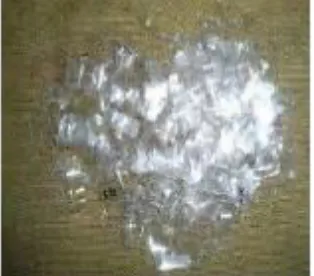
Figure 1. Plastic Chips
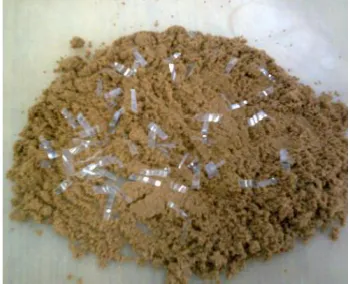
Figure 2. Plastic Waste Mixed Soil
K.Geetha Manjari et.al. (2011)8 presented paper on ‘Compressibility and permeability behaviour of plastic waste mixed Sand’. According to their investigation, they provided experimental results on the one dimensional compression test and permeability for plastic waste mixed sand. Based on experimental test results, it was observed that the compressibility and permeability reduced significantly with addition of a small percentage of plastic waste to the soil. An empirical relation has been formulated among void ratio, permeability and percentage of fibre content. In his analysis, to investigate the effects of plastic waste on the engineering properties of soils, a series of tests were performed on sand. One-dimensional consolidation test was performed for different percentages of plastic waste mixed sand. The fibre reinforced sand sample is shown in Figure 3, which was used in his experimental study.
Available Online at www.ijpret.com 197
Figure 3. Sand Mixed with Plastic Waste
Choudhary A.K. et.al. (2010)3 studied CBR behavior of waste plastic strip reinforced soil. In his study, a series of California Bearing Ratio (CBR) tests were carried out on randomly reinforced soil by varying percentage of HDPE strips with different lengths and proportions. Results of CBR tests demonstrated that inclusion of waste HDPE strips in soil with appropriate amounts improved strength and deformation behavior of subgrade soils substantially. The proposed technique can be used to advantage in embankment/road construction.
Anas Ashraf et.al (2011)1 conducted experimental analysis on soil stabiliisation using raw plastic bottles. Their analysis was done by conducting plate load tests on soil reinforced with layers of plastic bottles filled with sand and bottles cut to halves placed at middle and one third positions of tank. The comparison of test results showed that cut bottles placed at middle position were the most efficient in increasing strength of soil. The optimum percentage of plastic strips in soil was found out by California Bearing Ratio Test and using that percentage of plastic, plate load test was also performed. The size and content of strips of waste plastic bottles have significant effect on the enhancement of strength of the soil.
Available Online at www.ijpret.com 198
MATERIAL AND METHODOLOGY Plastic Waste
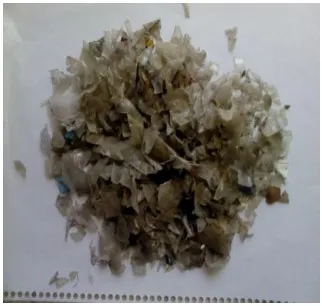
In this project, waste plastic bottles strips/chips will be used, which is produced from drinking water bottles. Drinking water bottles are also locally called as Bislari Bottle. Waste plastic strips/ chips are locally available in MIDC Amravati which is produce from waste drinking water bottles. Plastic strips/chips produced in MIDC by Plastic Granulator. Plastic granular is simple mechanical unit, fitted with sharp cutter, which is cuts plastic waste into Plastic waste strips. Plastic Strips/chips are randomly mixed with soil. The plastic waste strips/chips, which are used in project shown as Figure 4.
Figure 4. Waste Plastic Bottle Strips /Chips.
Properties of Plastic Waste
Plastic water bottle wastes in the form of chips were used as reinforcing material. Polyethylene terephthalate (PET) is the polymer used in the manufacture of plastic bottles. It has a molecular formula of (C10H8O4)n and its solubility in water is negligible at less than 0.4 percent. The melting point varies from 473 °F to 500 °F (245 °C to 260 °C). PET is incompatible with strong oxidizing agents and strongly alkaline materials. The extent of polymerization of PET varies from product to product. Specific gravity and tensile load is 1.33 and 350N respectively. Above data collected from research paper
Soil
The Soils used, in these investigations is obtained from the premises of Govt. Engg. College Amravati. The properties of soil were determined by standard test procedures and tabulated as per provision of IS codes of practice. The routine tests were done for characterization of soil.
Available Online at www.ijpret.com 199
Soft Murum
The soft murum will be used in these investigations, which will be collect for local quarry. The properties of soft murum will be determined by standard test procedures and tabulated as per provision of IS codes of practice.
Methodology
Various laboratory tests will be performed to determine the compaction characteristic, strength characteristic and stress strain. Characteristic of soil and soft murum mixed with varying percentage of randomly oriented plastic bottles strips/chips. There will mainly include compaction test to determine OMC and MDD. CBR soaked & unsoaked tests to determine the effectiveness as well as optimum percentage of plastic waste in the soil and soft murum. CBR test will be perform to calculate the optimum percentage of plastic waste strips/chips. In this test, plastic waste strips will be mixed with soil and soft murum in percentage of dry weight of soil and murum
respectively .i.e. 0%,0.5%,1%,1.5%,2.0%,
2.5%,.
In this study, model flexible pavement will be constructed in field, with plastic waste strips/chips mixed soil as subgrade and plastic waste strips/chips mixed soft murum as sub base layer. The optimum percentage of plastic strips for soil and soft murum will be determined from CBR test of plastic waste strips/chips mixed soil and plastic waste strips/chips mixed soft murum respectively. And a field CBR test will be performed on this model pavement. The results are compared with conventional pavement design , which will be design for soil as subgrade and soft murum as sub base. After comparing these two pavement designs, the economy of construction of flexible pavement construction on field will be found out.
TEST RESULTS AND DISCUSSION The results of various tests carried out during the experimental invetigation have been presented in this section.
Index properties of the soil
Available Online at www.ijpret.com 200
Table 1. Index Properties Of Soil
Sr No Property Values
1 Specific Gravity of Soil ( %) 2.67
2 Liquid Limit ( %) 54.32
3 Platic Limit (%) 27.21
4 Shrinkage Limit (%) 13.00
5 Plastic Index (%) 27.11
6 Gravel (%) 1.4
7 Sand (%) 18.6
8 Silt and Clay (%) 80
9 IS Classification CH
10 Maximum Dry Density (KN/m3) 16.00
11 Optimum Moisture Content (%) 19.60
12 Compressive Strength (KN/m2) 16.25
Proctor’s test results
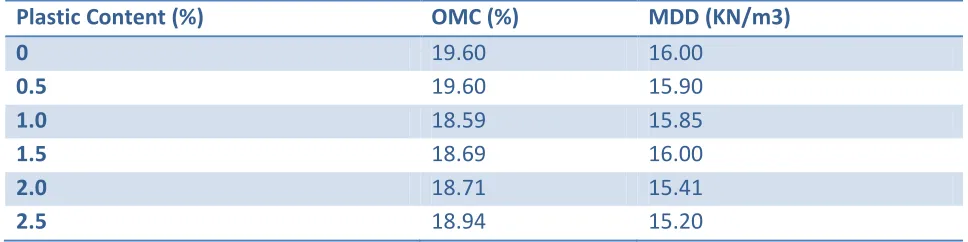
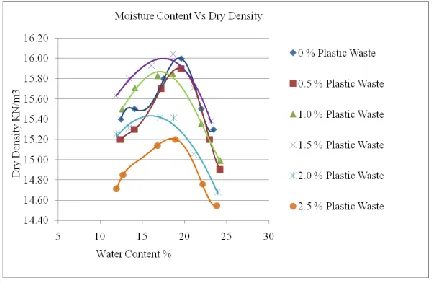
The maximum dry densities and optimum moisture contents of the soil with different percentage of plastic strips contents are reported in the table 2. These data indicate that the maximum dry density decreases with the increase in the plastic strips/chips content, which is due to lower density of plastic strips than the soil particles.
Table 2. MDD & OMC of soil at varying plastic strip/chips content.
Plastic Content (%) OMC (%) MDD (KN/m3)
0 19.60 16.00
0.5 19.60 15.90
1.0 18.59 15.85
1.5 18.69 16.00
2.0 18.71 15.41
2.5 18.94 15.20
Available Online at www.ijpret.com 201
Figure 5. The moisture content vs dry density relationship of the composite soil
Soaked and unsoaked CBR test for CH soil and soft murum, design of model flexible pavement, and field CBR on model flexible pavement, will be conducted and on basis of all test result, the present research study conclusion will be finalized
CONCLUSIONS
Based on the experimental investigations following are some of the conclusions will be found out for present research work.
i) There will a good improvement in the strength of soil with inclusion of plastic waste strips/chips.
ii) Results of CBR tests will demonstrate that inclusion of Plastic waste strips in soil with appropriate amounts improved strength and deformation behavior of subgrade soils substantially.
iii) Using plastic waste strips/chips as a soil stabiliser will an economical and gainful utilization since there is scarcity of good quality soil for embankments and fills.
iv) Waste plastics strips /chips will be used as alternative reinforcement materials in place of conventionally used reinforcing materials
v) Using plastic waste strips/chips in flexible pavement will control plastic waste pollution for green environment as Geo environment trend.
Available Online at www.ijpret.com 202 vii) Use of Plastic Waste strips/chips in flexible pavement will be achieved economy by reducing
pavement thickness.
REFERENCES
1. Ashraf Anas, Arya Sunil, Dhanya J., Joseph Mariamma, Varghese Meera , Veena M, “Soil Stabiliisation Using Raw Plastic Bottles”, Proceedings of Indian geotechnicalConference Kochi, December 15-17,2011, (Paper No. H-304)
2. Babu G.L. Sivakumar, Chouksey S., Anoosha G., Geetha Manjari. K., “Strength and Compressibility Response of Plastic Waste Mixed Soil”, Indian Geotechnical Conference – 2010, GEOtrendz December 16–18, 2010 IGS Mumbai Chapter & IIT Bombay.
3. Choudhary A.K., Jha J.N. and K.S. Gill , “A Study on CBR Behavior of Waste Plastic Strip Reinforced Soil”, Emirates Journal for Engineering Research, 15 (1), 51-57 (2010)
4. Dr Punmia.B.C., Jain Ashok Kumar & Jain Arun Kumar,Laxmi Publications (P) Ltd., New elhi,India,2005.
5. Dr. Khanna S.K. & Dr. Justo C.E.G., Highway Engineering, Nem Chand & Bros., Roorkee 247667, India, 2009.
6. Dr. Prasad D S V, Dr. Prasad Raju G V R, Anjan Kumar M, “Utilization of Industrial Waste in Flexible Pavement Construction”,EJGE, Vol. 13, Bund. D
7. Dr.Arora K.R., Soil Mechanics and Foundation Engineering, Standard Publishers Distributors,
Delhi-110006, India, 2009.
8. Geetha Manjari K., G.Anoosha, Pawan Kumar, Chouksey Sandeep Kumar, Babu G.L.Sivakumar, “Compressibility and Permeability Behaviour of Plastic Waste Mixed Sand”,
Proceedings of Indian Geotechnical Conference Kochi, December 15-17, 2011, i (Paper No. L-