
Download complete issue: Vol. 1, No. 1 (PDF)
7
0
0
Full text
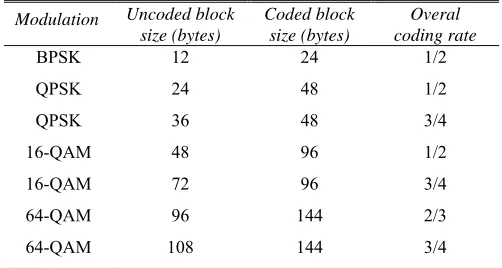
(2) INTERNETWORKING INDONESIA JOURNAL. 4. maintained during their existence, and may be terminated. The maintenance requirements depend on the type of selected service.. CS SAP Service-Specific Convergence Sub-layer (CS). C. Physical OFDM Symbols Parameters According to the standard, four primitive parameters are defined to characterize the OFDM symbol:. MAC. MAC SAP MAC Common Part Sub-layer (MAC CPS). • • •. Security Sub-layer. PHY. PHY SAP. •. Data/Control Plane Fig.1. IEEE 802.16 – layer model – data/control plane. B. PMP Topology In this topology a central BS operates with a sectorized antenna capable of handling multiple independent sectors simultaneously. Within a given frequency channel and antenna sector, all stations receive the same transmission. The subscriber stations communicate only with the BS and not with each other. This scenario is shown in Figure 2. BS. SS 2. BW – nominal channel bandwidth, Nused – number of used subcarriers, n – sampling factor, in conjunction with BW and Nused determines the subcarrier spacing and the useful symbol time, G – ratio of CP time to useful time.. Using these primitive parameters are identified:. Physical Layer (PHY). SS 1. ULVAN ET AL.. SS n. Fig.2. Point to Multipoint topology. In downlink, the BS is the only transmitter, so that it doesn’t have to coordinate with other stations, except for the overall time division duplexing (TDD) when time is divided into uplink and downlink transmission periods. In the uplink direction, SSs transmit on a demand basis. A SS may have continuing rights to transmit, or the rights may be granted by the BS after receipt of a request. The MAC operates in a connection-oriented mode. After SS registration, connections are associated with service flows to provide a reference against which to request bandwidth. Service flows provide a mechanism for uplink and downlink quality of service (QoS) management. In addition, bandwidth is granted by the BS to an SS as an aggregate of grants in response to per connection requests from the SS. Once the connections are established, they may be. parameters. another. •. NFFT – smallest power of two grater than Nused,. •. Sampling frequency;. •. Subcarrier spacing;. •. Useful symbol time;. •. CP Time ;. •. OFDM symbol time;. •. Sampling time ;. derived. Fs = ⎣⎢ n ⋅ BW / 8000 ⎦⎥ ⋅ 8000 ,. Δf = Fs / N FFT , Tb = 1/ Δf. ,. Tg = G ⋅ Tb ,. Ts = Tb + Tg ,. Tb / N FFT .. Possible values of G are 1/4, 1/8, 1/16 and 1/32. The sampling factor has different values for bandwidths that are being multiples of different frequencies. Nused is specified as 200 which mean that NFFT is 256. Therefore the number of lower frequency guard subcarriers is equal to 28, the number of higher frequency guard subcarriers is 27. Thus, together with the DC carrier, the number of null subcarriers is 56 [2]. After subtracting 8 pilot subcarriers, there are 192 subcarriers available for data transmission. D. Channel Coding/Modulations The channel coding process is composed of three steps: randomizing, forward error correction (FEC) and interleaving. During transmission they are applied in this order, during reception their order is reversed. The mandatory channel coding with different modulations used in this paper can be seen in table 1. Encoded data bits are then interleaved by an interleaving block with a block size corresponding to the number of coded bits per the allocated subchannel per OFDM symbol (Ncbps). For BPSK, QPSK, 16-QAM and 64-QAM, this number is 1, 2, 3 and 6, respectively. III. THE EFFICIENCY ON MAC LAYER The MAC overhead can be evaluated by means of determining the efficiency of the MAC layer. According to [5] the MAC efficiency can be defined as the ratio of the net throughput on MAC layer and the throughput per OFDM symbol.. η=. Θ MAC net ΘOFDM symbol. ISSN: 1942-9703 / © 2009 IIJ. (1).
(3) INTERNETWORKING INDONESIA JOURNAL. Vol. 1/No. 1 (2009). η=. TABLE I. MANDATORY CHANNEL CODING/MODULATION. BPSK. Uncoded block size (bytes) 12. Coded block size (bytes) 24. Overal coding rate 1/2. QPSK. 24. 48. 1/2. Modulation. 5. Lnet payload. (6). L frame. The number of symbols in a frame does not depend on the modulation nor coding, as defined by equation 7.. QPSK. 36. 48. 3/4. 16-QAM. 48. 96. 1/2. 16-QAM. 72. 96. 3/4. ⎢T ⎥ L frame = ⎢ frame ⎥ ⎢⎣ Tsymbol ⎥⎦. 64-QAM. 96. 144. 2/3. A. MAC Efficiency in PMP Topology. 64-QAM. 108. 144. 3/4. In this section the MAC layer efficiency of the PMP topology is assessed. Our goal is to express the Lnet payload. The net throughput on the MAC layer is defined by equation 2. It is the ratio of the total number of payload bits, i.e. without all MAC overhead, in a frame to the frame duration Tframe.. Θ MAC net =. ∑ Payload bits. (2). T frame. (7). value. The uplink sub-frame consists of symbols used for ranging (LRNG) and bandwidth requests (LBW) and then of symbols containing UL physical layer PDUs. The length of the frame in OFDM symbols, when assuming one UL PHY PDU per subscriber station, can be written as:. L frame = LDL subframe + LUL subframe = N SS. = LDL PHY PDU + LRNG + LBW + ∑ LUL PHY PDU i. The throughput of an OFDM symbol is given by: data rate =. i =1. numberof uncoded data bits per OFDM symbol (3) OFDM symbol duration. Equation 4 shows the calculation in a more symbolic way, where Nused is the number of used OFDM subcarriers, Npilot is the number of OFDM pilot subcarriers, Ncbps is the number of coded bits per allocated symbol (e.g. Ncbps = 6 for 64-QAM) and C is the code rate.. ΘOFDM symbol =. (N. used. − N pilot ) ⋅ N cbps ⋅ C. (4). Tsymbol. (N. used. − N pilot ) ⋅ N cbps ⋅ C 8. 1) Downlink Subframe The DL sub-frame contains only one DL PHY PDU, which consists of the two-symbol long preamble and one-symbol Frame Control Header (FCH), then followed by the DL bursts. The DL burst #1 is different from other DL bursts (if present), since it contains broadcast MAC messages. These broadcast messages comprise DL-MAP, UL-MAP, DCD and UCD messages. Their presence means less space for payload transmission, which means that longer broadcast messages decrease the MAC layer efficiency. The overhead in bytes introduced by them when assuming that all of them are present in the frame is given by equation 9.. OHDLburst #1 =OHDL−MAP +OHUL−MAP +OHDCD +OHUCD +4⋅OHMACPDU. The number of uncoded bytes per symbol is given as:. BpS =. (8). (5). Higher modulation used for individual OFDM subcarriers, which results in higher Ncbps, together with higher code rate affect both Θ MAC net and ΘOFDM symbol . Therefore we propose to evaluate the MAC layer efficiency as the ratio of OFDM symbols used for payload transmission in a frame to the total number of OFDM symbols in a frame. Letter L in the following equation always means length expressed as a number of OFDM symbols.. (9). For our purposes it is necessary to express the length of the overhead in DL burst #1 in OFDM symbols, which can be done by using equation 10, where BpS is the number of uncoded bytes per OFDM symbol, as specified by equation 5.. LDL burst. #1. =. OH DL burst. #1. (10). BpS. The resulting number of bytes available for transmission of data MAC PDUs can be calculated using equation 11.. LDL data = LDL subframe − LLP − LFCH − LDL burst. ISSN: 1942-9703 / © 2009 IIJ. #1. (11).
(4) INTERNETWORKING INDONESIA JOURNAL. 6. LLP (long preamble) is 2 symbols and LFCH is 1 symbol. 2) DL-MAP MAC Management Message The DL-MAP message defines the access to the downlink information. It is a fixed part that is created by 8 bytes at the beginning. After this fixed part, several information elements (IEs) defining the fifth and further DL bursts are present. The first four DL burst are specified in the DLFP burst. Another IE is at the end of the DL-MAP message, the DLMAP end IE. Each of these IEs is 4 bytes long. The overhead in bytes introduced by the DL-MAP message is described by equation 9.1. NDL burst is the number of downlink bursts in the frame.. (. OH DL − MAP = 8 + 4 ⋅ N DL burst − 3. ). (9.1). ULVAN ET AL.. can be calculated according to equation 12. NSS is the number of subscriber stations. We assume that every SS sends one BW request every frame. OH. BW. = N SS ⋅ O H M AC. (12). PDU. Expressed in OFDM symbols, equation 12 can be written as:. L BW =. N SS ⋅ OH MAC. (13). PDU. BpS. We obtain the resulting number of OFDM symbols available for transmission of data MAC PDUs from the following equation.. LUL data = LUL subframe − LBW − N SS ⋅ LSP. (14). 3) UL-MAP MAC Management Message The UL-MAP message allocates access to the uplink channel. The length of the fixed part is for this message 7 bytes. The following IEs are 6 bytes long. One IE is used for every UL burst, i.e. for every subscriber station. The resulting overhead in bytes can be found in equation 9.2. NSS is the number of transmitting subscriber stations.. B. Total Efficiency Using equations 8, 11 and 14 it is possible to obtain the total number of OFDM symbols available for MAC PDUs as given by equation 15.. OHUL − MAP = 7 + 6 ⋅ ( N SS + 2 ). Ldata = L frame − LLP − LFCH − LDL burst. (9.2). 4) DCD MAC Management Message The DCD message is transmitted periodically by the MBS to define the characteristics of a downlink physical channel. Three bytes construct the fixed part of the message, the rest of the message is formed by the TLV tuples. Numerous TLV encodings are defined to describe the downlink channel properties and the burst profiles. Each burst profile definition occupies 9 bytes. The resulting overhead caused by the DCD message is defined by equation 9.3. NDL burst profiles represents the number of downlink burst profiles used.. OH DCD = 68 + 9 ⋅ N DL burst. profiles. (9.3). 5) UCD MAC Management Message The UCD message is similar to the DCD, but it describes the uplink physical channel. The fixed part comprises 6 bytes. TLV part without definition of burst profiles is 32 bytes long and each burst profile used occupies additional 12 bytes [1]. The UCD overhead can be evaluated as in equation 9.4. NUL burst profiles represents the number of uplink burst profiles used.. OH UCD = 38 + 12 ⋅ N DL burst. profiles. (9.4). 6) Uplink sub-frame The uplink sub-frame contains slots for ranging, which are mainly used during the initial network entry or re-entry during handover. The number of bytes used for bandwidth requests. #1. − LBW − N SS ⋅ LSP. (15). Another important overhead introduced by the MAC layer are the generic MAC headers and CRCs of the data PDUs. We suppose that the frame is fully used, the number of MAC PDUs which without considering fragmentation fit into one frame is given by equation 16, where k is the length including the generic MAC header and CRC of the MAC PDU in bytes. Applicable lengths are from 11 bytes (1 byte of payload) to 2047 bytes. The maximum length is restricted by the capacity of the Length field of the generic MAC header, which is 11 bits.. ⎢L ⎥ N MAC PDU = ⎢ data ⎥ ⎣ k ⎦. (16). Using the number of MAC PDUs in a frame, the number of OFDM symbols utilized for the data MAC PDUs overhead can be calculated, as given by equation 17.. Ldata MAC PDU OH =. N MAC PDU ⋅ 10 BpS. (17). The number of OFDM symbols usable for the payload of the data MAC PDUs – SDUs from higher layers is given by equation 18.. Lnet payload = Ldata − Ldata MAC PDU OH. ISSN: 1942-9703 / © 2009 IIJ. (18).
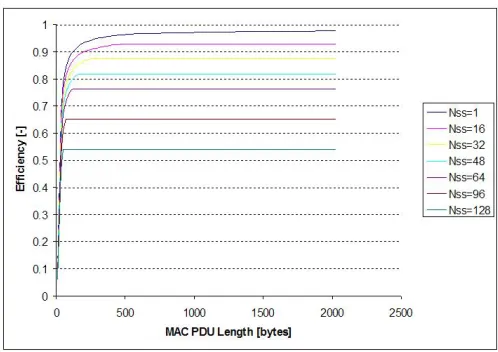
(5) Vol. 1/No. 1 (2009). INTERNETWORKING INDONESIA JOURNAL. 7. Using the equation 6, efficiency on the MAC layer can be finally calculated. Results for various parameters will be presented in the next section. IV. RESULTS IN MAC EFFICIENCY The numerical values of the OFDM parameters, which are used to obtain the resulting efficiencies and haven’t been presented before, are Tframe and Tsymbol. Tframe defined by the standard IEEE802.16e-2005 [2], can have values from 2.5 ms to 20 ms. The third highest value, Tframe = 10 ms, is chosen for the calculations. Tsymbol can be calculated using equation 19, with substituting the following: G = 1/4, BW = 20 MHz and n = 144/125. These values are allowed by the standard for license-exempt bands. Bandwidth of 20 MHz and the ratio of the cyclic prefix to the useful symbol time are both the largest allowed. The final symbol duration is then 13.89 μs. Ts = Tb + Tg = (1/ Δf ) + G ⋅ Tb = (1/ Δf ) ⋅ (1 + G) = = ( NFFT / Fs ) ⋅ (1 + G) = ⎡⎣ NFFT /(⎢⎣n ⋅ BW / 8000⎥⎦ ⋅ 8000)⎤⎦ ⋅ (1 + G). (19). Besides the main parameter, which is the number of subscriber stations (Nss), other variables are chosen for the evaluated efficiency. These are the length of the data MAC PDUs, modulation/coding used, and number of burst profiles. A. MAC PDU length The length of the data MAC PDUs plays an important role for the efficiency value. The shorter the PDU is, the bigger part of it is occupied by the generic MAC header and CRC bytes, which for lower lengths significantly decreases the efficiency. The modulation QPSK 1/2 is assumed in the simulation. 1 DL burst profile and 1 UL burst profile is also considered. In Figure 3, results for different number of subscriber stations (Nss) are shown. It can be seen that the efficiency rises rapidly for smaller k values (approx. up to 100 bytes). After this point, the efficiency increases only gradually and for k values of 1000 bytes and more it is almost constant. At the same time it can be seen that for a certain MAC PDU length the largest number of subscriber stations has the lowest efficiency. For higher number of subscriber stations, it obviously comes into effect for a lower initial PDU length. Nevertheless, the higher number of subscriber stations means lower efficiency.. Fig.3. PMP efficiency – Paramater PDU length, parameter Nss. B. Various modulation and coding The influence of modulation and coding is presented when using 1 DL burst profile, 1 UL burst profile and fixing the MAC PDU length to 1024 bytes. When assuming this length or higher, the influence of the number of subscriber stations is much more noticeable than the influence of the PDU length. Based on table 1, the efficiencies are calculated for six most common modulations/coding of them, omitting only the most robust BPSK 1/2 modulation. The modulation/coding types are numbered as in table 1. Figure 4 shows that higher modulations usage means lower MAC overhead. That is due to the fact that the PMP broadcast messages don’t have to be transmitted by the most robust modulation/coding. When a modulation/coding with a higher,. Fig.4. PMP efficiency – various modulations/coding, parameter modulation type. number of bytes per symbol is used the messages occupy a smaller portion of the PMP frame. For a higher number of subscriber stations the difference in efficiency for different modulations increases, because the more SSs are connected, the more OFDM symbols are used to send them and the more. ISSN: 1942-9703 / © 2009 IIJ.
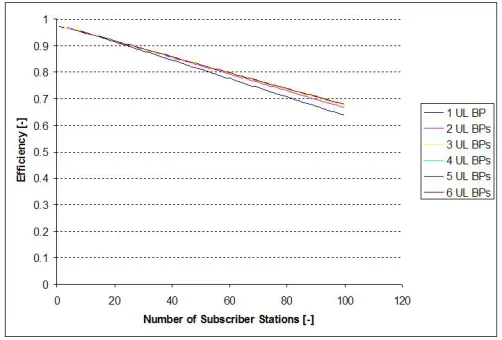
(6) 8. INTERNETWORKING INDONESIA JOURNAL. ULVAN ET AL.. is consequently saved. It is obvious that lower modulations mean lower efficiency variations when assuming different number of subscriber stations. The higher modulation is able to keep the efficiency high. That is caused by the fact that higher modulations slightly compensate the influence of growing broadcast messages.. Figure 5 shows that the lower number of burst profile gives the lowest efficiency when Nss is higher. On the other hand, Figure 6 depicts the fact that the BPs has a minor impact on MAC efficiency for particular number of subscriber stations. When the network has a lower number of subscriber stations then they will have a better efficiency.. C. Various number of burst profiles Another parameter, which affects performance on the MAC layer, is the number of burst profiles (BP). We assume that the MAC PDU length is 1024 bytes and more uplink and downlink burst profiles are specified. For UL/DL burst profile 1 modulation/coding 1 is used, for UL/DL burst profile 2 modulation/coding 2 is used, etc. Maximum number of burst profiles is 6, since 6 most common modulations are used.. V. CONCLUSIONS. Fig.5. PMP efficiency – various number of Nss, parameter BPs. Since the broadcast messages are assumed to be always transmitted using QPSK 1/2 modulation, using more burst profiles has only the influence of decreasing the efficiency because of additional overhead to define these BPs. This extra overhead is relatively small (approx. 6% between 1 BP and 6 BPs).. Performance on the MAC layer of the IEEE 802.16 WirelessMAN standard has been analyzed. The Point to Multipoint mode is well suited for higher number of subscriber stations. Using the QPSK 1/2 modulation and MAC PDU length of 1024 bytes, the efficiency on the MAC layer is for 100 subscriber stations connected to the base station around 75%. The data MAC PDU length is the parameter that highly influences the MAC layer performance. Obviously longer PDUs mean less MAC overhead. Another way of reducing the MAC overhead is usage of a higher modulation/coding. Especially for the PMP mode, transmitting the broadcast message with higher number of bytes per symbols gives more space to the data MAC PDUs transmission. Introducing some changes to the IEEE 802.16 standard, for example defining more space saving TLV tuples for some of the management MAC messages could also bring some minor savings, but as the standard already experienced a gradual evolution and being implemented in many real-life applications, it doesn’t make any sense to call for its change. ACKNOWLEDGMENT The authors would like to acknowledge the contributions of both Czech Technical University and their colleagues from IST-EU FIREWORKS project consortium. REFERENCES [1]. [2]. [3]. [4]. [5]. [6] Fig.6. PMP efficiency – various number of burst profiles, parameter NSS. [7]. “802.16-2004, IEEE Standard for Local and Metropolitan Area Networks – Part 16: Air Interface for Fixed Broadband Wireless Access Systems,” New York, USA: The Institute of Electrical and Electronics Engineers, 2004. ISBN 0-7381-4070-8 “802.16e-2005, IEEE Standard for Local and Metropolitan Area Networks – Part 16: Air Interface for Fixed and Mobile Broadband Wireless Access Systems – Amendment 2: Physical and Medium Access Control Layers for Combined Fixed and Mobile Operation in Licensed Bands and Corrigendum 1,” New York, USA: The Institute of Electrical and Electronics Engineers, 2006. ISBN 0-7381-4857-1. M. K. Marina and S. R. Das, “Impact of Caching and MAC Overheads on Routing Performance in Ad Hoc Networks,” Computer Communications, vol. 27, no. 3, pp. 239-252, February 2004. G. R. Hiertz, L. Stibor, J. Habetha, E. Weiss, and S. Mangold, “Throughput and Delay Performance of IEEE 802.11e Wireless LAN with Block Acknowledgements,” in European Wireless 2005, Nicosia, Cyprus, pp. 246-252, April 2005. S. Redana, “Advanced Radio Resource Management Schemes for Wireless networks,“ Ph.D. dissertation, Politecnico di Milano, Milano, Italy, 2005. F. Ohrtman, “WiMAX Handbook: Building 802.16 Wireless Networks,” New York, USA: McGraw-Hill, 2005. ISBN 0-07-145401-2. L. Nuaymi, WiMAX: “Technology for Broadband Wireless Access,” Chichester, England: John Wiley & Sons, 2007. ISBN: 0-470-02808-4.. ISSN: 1942-9703 / © 2009 IIJ.
(7) Vol. 1/No. 1 (2009). INTERNETWORKING INDONESIA JOURNAL Ardian Ulvan received the B.Eng degree in electrical engineering in 1997 from The University of North Sumatra, Indonesia, and MSc in Networks Engineering from Sheffield Hallam University, UK in 2001. In 2006 he received the accredited Engineering (Ing.) acknowledgement from Czech Technical University in Prague, Czech Republic. His PhD degree in Telecommunication Engineering is awarded in 2009 from CTU in Prague. In 19992005 periods he worked as a Senior Lecturer in Department of Electrical Engineering, The University of Lampung, Indonesia. He is currently working as researcher at wireless networks research group Department of telecommunication engineering, CTU in Prague. His research interests include MAC functionalities on broadband and gigabit wireless based on standards IEEE802.16d/e/j/m and 3GPP LTE/LTE-A, multihops-multicells wireless networks and the IP Media Subsystem (IMS). He involves in European research projects FIREWORKS (IST-FP6) and ROCKET (IST-FP7) and several projects at CTU R&D Centre.. Vit Andrlik received his engineering diploma from the Czech Technical University in Prague, Faculty of Electrical Engineering, in 2008. He did some researches on MAC functionalities of WiMAX 1.0 and WiMAX 2.0. He is currently works as a solution engineer at Siemens Enterprises Communication.. ISSN: 1942-9703 / © 2009 IIJ. 9 Robert Bestak received his engineering degree from the Czech Technical University in Prague, Faculty of Electrical Engineering, in 1999. Within 1999/2000, he did one-year engineering program in telecommunications and computer networks at the Institute EERIE de l’Ecole des Mines d’Alès, Nimes, France. In 2003, he received his Ph.D. degree in computer science from ENST Paris, France. Since 2004, he works as a researcher at the Department of telecommunication engineering, CTU in Prague. Since 2006, he heads wireless research group at the department. His research interests include RRM techniques in HSPA/LTE systems and multi-hop networks. He participated in EU FP projects ALLIPRO, FIREWORKS and he currently participates in EU FP7 project ROCKET. He has been involved in several R&D Centre projects..
(8)
Figure
Related documents
This study aims to provide a category-based account of CF-reduplications by means of a prototype category, dynamic prototypes and contrastive focus effects.. In 2.1, we revisit
Furthermore, while symbolic execution systems often avoid reasoning precisely about symbolic memory accesses (e.g., access- ing a symbolic offset in an array), C OMMUTER ’s test
Here, I express the four points that seem to arise from the data: (1) the unifying literacy practice of homeschooling is the continual process of selecting texts, curriculums
To determine the physical condition abilities of taekwondo athlete who was training at a special preparation stage, it was measured: ability of leg muscles strength with
Pros use every type of cloud, with most common being public cloud (91%) & least common is hybrid (45%); Pioneers use internal private cloud (56%) & PaaS (46%); 83% of
(1)(a) to operate a child welfare agency, group home, shelter care facility, or day care center who is an individual to provide that department with the applicant’s social
En tractar-se d'una de les plantes més rares de la vegetació dunar de l'illa qualsevol nova localitat que es pugui coneixer té intereso La seva escassetat no només
In efforts to establish the fundamental building blocks required for the information security program, Loblaw constituted a hierarchical directives structure that links the
