THE RELATIONSHIP OF INFRASTRUCTURE AND FACILITIES TO STUDENTS'
PREPAREDNESS IN THE FACE OF DISASTER AND THE ROLE OF NURSES IN
PREPAREDNESS
Sujarwo*1, Noorhamdani2, Mukhamad Fathoni2
1
Nursing Master's Degree Program (Emergency Nursing) Medical Faculty, Universitas Brawijaya, Jl. Veteran, Ketawanggede, Lowokwaru, Kota Malang, Jawa Timur 65145, Indonesia.
2
Lecturers of Medical Faculty, Universitas Brawijaya, Jl. Veteran, Ketawanggede, Lowokwaru, Kota Malang, Jawa Timur 65145, Indonesia.
Received date: 02 April 2018 Revised date: 23 April 2018 Accepted date: 14 May 2018
INTRODUCTION
Tsunami in Indonesia has occurred since 1861. It is estimated that Tsunami has occurred about 62 times in Indonesia from 1861 to 2014. Almost 90% of it happened due to tectonic earthquake activity while the other 9% is due to volcanic activity and 1% is due to landslides.[1] Mentawai is one of the areas in Indonesia which has a very high Tsunami potential. This is because the coastline of the area is long and is located in the active subduction zone namely Sunda Megathrust that has high earthquake intensity that can cause Tsunami.[2]
Besides Tsunami incident in Aceh, 2004 which resulted in severe damage and heavy casualties, Tsunami also occurred in Mentawai Islands in 2010. These two events should be a lesson for the whole community and government. Tsunami in Mentawai Islands caused many damage and fatalities. It is estimated that there were 509 deaths, five people injured, 21 people missing, and 2553
people displaced. There was also a damage in the residential areas and public facilities. Roads, bridges, 7 worship areas, and 6 schools were severely damaged that the loss amounted to 348,92 billion rupiahs.[3]
The damage to infrastructure and facilities can lead to the interruption of community and socio-economic activities. Therefore, in the effort of disaster risk reduction, an infrastructure reconstruction must be integrated.[4] so that the damage can be minimized. An adequate infrastructure in a school building that is resistant to earthquake and Tsunami is a feasible step in disaster risk reduction. According to Rachmalia et al.,[5] the efforts that can be made in disaster risk reduction is to increase one’s preparedness which is part of disaster management. To build such a culture, it requires innovative, economic, logical, human-oriented, and needs-oriented interventions.[6] One of the stakeholders responsible to build this culture is school because of its
Original Article www.wjahr.com
Volume: 2. Issue: 3. Page N. 93-98
Year: 2018
HEALTHCARE RESEARCH
Corresponding author: Sujarwo
Nursing Master's Degree Program (Emergency Nursing) Medical Faculty, Universitas Brawijaya, Jl. Veteran, Ketawanggede, Lowokwaru, Kota Malang, Jawa Timur 65145, Indonesia.
ABSTRACT
Background: Infrastructure and facilities is an important aspect of disaster management especially in areas with high Tsunami potential such as Mentawai Islands. One of the groups which are vulnerable to Tsunami is students. This vulnerability is due to the low preparedness of Sekolah Siaga Bencana (School-Based Disaster Preparedness, abbreviated as SBB) students in disaster risk reduction. Objective: This study aims to analyze the relationship of infrastructure and facilities to the preparedness of SSB students in disaster risk reduction especially tsunami. Methods: This study is a quantitative research conducted by using a correlative-analytic observational design and cross-sectional approach with a sample of 109 students taken from 5th and 6th grader in 3 Sekolah Dasar Negeri (Elementary School or SDN) namely SDN 13, SDN 16 and SDN 17 in Sipora District, Mentawai Islands. Result: There is a significant relationship between infrastructure-facilities and the preparedness of SBB students towards the reduction of Tsunami risk with the value of (p = 0.000) and r = 0.98. Conclusion: Infrastructure and facilities have a significant relationship with the preparedness of SBB students so that it can inhibit the reduction of tsunami risk in Sipora District, Mentawai Islands.
strategic role in developing one’s preparedness especially disaster preparedness for students.[7] Students are a strategic tool to disseminate information among communities and a source of knowledge in improving preparedness.[8]
Various efforts have been made in disaster risk reduction such as in the form of Sekolah Siaga Bencana (School-Based Disaster Preparedness or SSB). The establishment of SSB is based on the Hyogo Framework 2005-2015 supported with World Conference on Disaster Risk Reduction which states that there are 3 pillars in Comprehensive School Safety such as; safe school facilities, effective management of school disaster and disaster risk reduction, as well as resilience education (HSEM, 2014).[9] According to CDE,[10] in disaster risk management, SSB must have disaster management planning (before, during, and after the disaster), logistics availability, security,and comfort in education, infrastructure and facilities, emergency systems supported by knowledge and capability of disaster alert, fixed procedures, and early warning systems.
Some studies have said that SSB is proven to increase the disaster preparedness of students. Adiyoso and Kanegae[11] stated that schools that have implemented the concept of SSB have a better preparation than schools that have not implemented the concept of SSB either in terms of knowledge, perceptions of risk, awareness, attitudes, and behavior. However, different findings are found in the study of Lesmana & Purborini[12] which believed that the level of preparedness in SSB is still very poor in terms of knowledge, attitude, and actions undertaken by SSB in disaster risk reduction. Supported by the research from LIPI-UN/ISDR[13] in Aceh Besar, Bengkulu, and Padang, it is written that the level of school preparedness is lower than the society and government with the index value of 40 (under-prepared). The results could illustrate the condition of school preparedness in Mentawai Islands which is part of West Sumatra Province. Compared to Kota Padang, the infrastructure is still inadequate in every aspect of the resource such as school buildings made with materials that are not resilient to earthquakes and Tsunamis as well as the unavailability of a shelter and a good evacuation path to evacuate students whenever a disaster might occur. School is a public space that has a high vulnerability to disaster.[10]
MATERIALS AND METHODS
This research is a quantitative research carried out by using observational analysis with cross-sectional approach. The setting of the study was in 3 elementary schools, namely SDN 13, SDN 16, SDN 17 of which location was areas prone to tsunami disaster in mentawai island, Indonesia. This study has been carried out on 9 January to 1 February 2018. The population was 150 student elementary school in 3 elementary school SSB in mentawai island and the number of sample in the study was 109 students in SSB is taken from grade 5 and 6 in 3
Elementary Schools with purposive sampling technique. The instruments used were questionnaires was modified by researcher from LIPI & UN/ISDR (2006), Amri, A (2015), Tuladhar, G, et al (2014) and Ocal, A, et al (2011) and have been tested for validity and then the data was brought to be analyzed with univariat and bivariate technique with gamma correlation test. The study was examined and approved by health research ethics commitee of Andalas University Padang (Number 016/KEP/FK/2018). There were two types of analysis, univariat and bivariat. the univariat analysis was conducted to identify characteristic of the respondent, while bivariat analysis was conducted to describe relationship between infrastructure and facilties with SSB students preparedness deal with tsunami disaster using gamma correlation test with significant level (α) = 0,005.
RESULTS
The general characteristics of respondents are age, gender, training experience, infrastructure and facilities, and preparedness which can be seen as follows:
Table 1: Respondent distribution based on student age in SSB.
Variables N % Mean SD Min-Max
Age 109 100 11,68 744 10-13 Source: Primary Data (2018)
Based on table 1, it can be seen that from 109 respondents, the average age is 11.68 years with a standard deviation of 744. The youngest age is known to be 10 and the oldest age is 13.
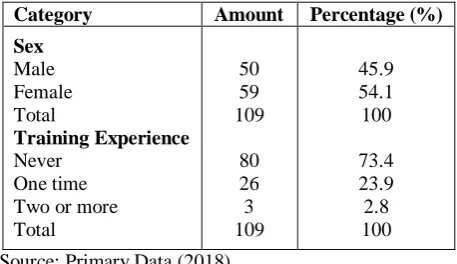
Table 2: Respondent distribution based on sex and training experience.
Category Amount Percentage (%)
Sex Male Female Total
Training Experience Never
One time Two or more Total
50 59 109
80 26 3 109
45.9 54.1 100
73.4 23.9 2.8 100 Source: Primary Data (2018)
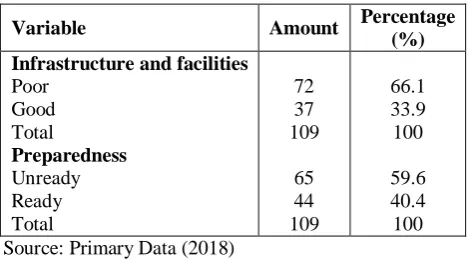
Table 3: Respondent distribution based on infrastruc-ture-facilities and preparedness.
Variable Amount Percentage
(%) Infrastructure and facilities
Poor Good Total
Preparedness Unready Ready Total
72 37 109
65 44 109
66.1 33.9 100
59.6 40.4 100 Source: Primary Data (2018)
In table 3 above, we can see the data on infrastructure-facilities and preparedness towards disaster. The results from the univariate analysis showed that 109 respondents said that the infrastructure and facilities in disaster risk reduction still very less and is equal to (66.1%). Overall, the preparedness of SSB students on Tsunami risk reduction in Sipora District, Mentawai Islands is still poorly prepared (59.6%).
Table 4: The results from bivariate analysis of gamma correlation in the relationship between infrastructure-facilities and the preparedness of SSB students in Tsunami risk reduction.
The Preparedness of SSB Students
Less Ready
(r) p-value
Infrastructure-facilities N (%) N (%)
Poor Good
63 2
87.5 5.4
9 35
12.5
94.6 0.98 0.000
Total 65 59.6 44 40.4
Source: Primary Data (2018)
From table 4 above, the correlation value of infrastructure-facilities on the preparedness of SSB students towards Tsunami can be known. In the variable of infrastructure-facilities, the value of p 0.000 is less than alpha (5%). This indicates that there is a significant relationship between infrastructure facilities with SSB students’ preparedness. The correlation value of 0.98 shows a positive correlation in a very strong correlation strength.
DISCUSSION
Infrastructure and Facilities towards the Preparedness of SBB Students in Tsunami Risk Reduction
Based on the result of the analysis, it is found that the variable of infrastructure and facilities have a significant relationship with the preparedness of SSB students in disaster risk reduction. The significance value (0.000) is known to be less than alpha (5%) with a correlation value of 0.98. This shows a positive correlation with a very strong correlation strength.
The results of this study are supported by the research from Susanti et al.,[14] conducted in one of the SSB communities in Banda Aceh. The research stated that infrastructure facilities have a close relationship to the preparedness of SSB students in Banda Aceh. Moreover, Alhamda[15] who examined the preparedness of red-zone primary schools in facing earthquake and Tsunami in Koto Tangah, Padang found that the lack of infrastructure and facilities preparedness led to the lack of student’s preparedness in facing earthquake and Tsunami.
The lack of infrastructure and facilities become the biggest obstacle to the preparedness of SSB students in Sipora District, Mentawai Islands. The facilities are found to be very minimal which can be seen from the unavailability of books related to disaster, a map of disaster-risk areas, radio communication, evacuation direction, and early warning system. Besides that, the school is still built with heavy materials so that itcan be harmful if such disaster occurs. This can certainly cause the preparedness of SBB students to be low.
According to LIPI-UNESCO/UNISDR,[13] SSB should have a safe and disaster-friendly construction. This already set out in government regulation in the implementation of disaster management number 21 of 2008 article number 20 stating that in concern to the existence of construction arrangements, the construction of infrastructure and building arrangements shall apply the technical standards established by authorized agencies/institutions. This is certainly applicable to build safe and standardized school buildings.
Although the process of learning and teaching is mostly done by using lectures, there must be an innovation or other methods such as workshops, field visits, disaster simulation, and laboratory-based activities. Other important activities also integrated as disaster themes in school extracurricular by which it should be supported by adequate infrastructure.[16] Ministry of Culture and Education-UNICEF[17] has explained that the school committee is established as an independent institution to improve the service quality of the school by giving consideration, personnel, infrastructure, and supervision in disaster risk reduction. However, in practice, there are many obstacles and challenges in implementing such issues as resources (funding, personnel, and facilities) so that the efforts to integrate disaster risk reduction into education systems (i.e safe construction of school buildings, training for teacher and student, disaster simulation, inviting experts to the school, and the development of school management) are inhibited.[18]
The absence of funds from the government in the efforts of disaster risk reduction is an obstacle for SSB in Sipora District to integrate and implement the concept optimally. Up to this time, SSB only gets encouragement from an external organization that is ASB NGOs to integrate such SSB concept. The assistance from external parties is certainly not forever. Thus, government or the Ministry of Education should be aware of it so that there are efforts for the sustainability of SSB in disaster risk reduction, especially in the improvement of school infrastructure. It is important to analyze the safety of the schools in a comprehensive manner even though students have been taught how to save themselves. However, the safety of students will not be secured if the school building it self is not resilience to disaster.[8]
There are many challenges in realizing the standardized construction of the school, among others, are the inadequate infrastructure in red-zone areas, the lack of responsibility, and the lack of clear accountability mechanisms. This is being complicated again by the political independence and the limited allocation of resources which often conflicted with other purposes. Political problems, infrastructure availability, technical capacity, resource availability, and project scale are aspects that can affect disaster risk reduction so that there must be an approach to that matter.[19] Funding is an important resource in disaster management; financial policies and clear procedures will enable the availability of good infrastructure so that the efforts of disaster risk reduction can be implemented.[20]
The lack of infrastructure owned by SSB in Sipora District should be the concern of the local government. From the observation of the researchers, it is found that there is only one school that has posters related to disaster risk reduction. Whereas, those three schools are located in the central government of Mentawai Islands. One teacher also believes that a long-term reconstruction should focus on restoring the damaged infrastructure and
finding an alternative rather than just focusing on the improvements of the existing facilities.
Schools with facilities and personnel to respond emergency situations will greatly support the community in disaster risk and prevention analysis. In addition to being a place of education, schools can play a deeper role to build an awareness of hazard and disaster mitigation for both community and family. With such skills and knowledge, trained teachers and students will be able to assist social, emotional, psychological, and family needs in the post-disaster incident.[21] To support students' ability to respond and recover from disasters, it must be supported by adequate infrastructure and comprehensive preparedness.[22]
Even though some of the infrastructure and facilities are available such as gathering point and evacuation routes from mosque, canteen, and classroom, there are still many shortages which must be repaired and added in the effort of disaster risk reduction. The schools are also known to not have evacuation route and map while it is very needed by students to build such alert attitude and behavior especially when a disaster happened and in panic condition.[23]
The unavailability of vehicles and special lanes for the mobilization of students will be an obstacle. Given the fact that SDN 13 is very close to the waterfront, it has a very high risk to be affected by Tsunami. Therefore, the functions and responsibilities of schools and students in emergency situations become an important point in disaster reduction risk so that competent human resources is very needed.[18]
School infrastructure and facilities is a key component that can contribute to achieve better quality education, to provide a sense of security, and to improve student preparedness. It should be consistent with improved and advanced teacher training, education, special educational needs, as well as science, technology, and other infrastructure. The quality of infrastructure depends on the human, financial resources, and capacity available to each institution in managing the construction project. In Sipora District, Mentawai Islands, all of the three schools have not received special assistance from the government in improving the infrastructure for disaster reduction risk. Assistance is only obtained from non-governmental organizations or ASB NGOs in the form of increased knowledge of students and teachers. It is also found that the schools have not obtained other facilities. Therefore, infrastructure and facilities in the education sector should also be the center of attention in government policy.[24]
Islands already had 8 EWS units even though those cannot function properly. This will certainly affect the students and the public to prepare when a disaster occurs.
According to Sakurai et al.,[8] one of the most important means of improving student preparedness for disaster risk reduction is by EWS. The early warning system is one the disaster risk reduction efforts to prevent fatalities and reduce economic losses. A comprehensive and effective early warning system consists of four elements: (1) Risk awareness: prior knowledge of risk scenarios that the public may face, (2) Monitoring and warning services: rapid capacity monitoring for risk and reliable decision-making process for early warning, (3) Communication: the dissemination of understandable warnings, preparations, and information to those whose at risk, and (4) Responsiveness: knowledge of ability and readiness to act by all chain of information.[26] The nature of early warning is to use an empirical database and existing knowledge base to assess the probability of an emergency. A failure in one part of the chain could damage the overall system. This is due to the fact that the warning system has a strong connection between these four elements.[26-27]
While comprehensive DRR initiatives are not limited to infrastructure alone, they should include many things, such as representatives of the knowledge flow, engineering, structural, and physical organization [28]; in addition, in the integration of DRR, health workers also have an important role in the disaster before and after the disaster. According to International Counsil Nurse (ICN) there is a strategic role of nurses in disaster handling, especially in disaster areas. This role is organized into 4 fields namely; competence, preparedness, capability and competence. In improving preparedness, nurses may contribute to the domains of preparedness education such as maintaining relational knowledge with disaster areas within the school environment, conducting disaster related training and implementing preparedness activities as part of multidisciplinary groups. Yet all stakeholder roles still can not be used properly in Mentawai, thus requires the enhancement of the role relationships of each stakeholder in disaster management. This is particularly important for developing countries such as Indonesia where the ability of communities to implement DRR itself is very limited.
CONCLUSION AND SUGGESTIONS
There is a significant relationship between infrastructure-facilities and the preparedness of SSB students in disaster risk reduction in Sipora District, Mentawai Islands.
Sekolah Siaga Bencana (School-Based Disaster Preparedness or SSB) should be the foundation for school-based disaster risk reduction efforts. SBB will not work if there is no cooperation between stakeholders. It needs adequate infrastructure, financial support, as well
as support from all stakeholders to build student preparedness.
FINANCIAL SUPPORT AND SPONSORSHIP
Nil.
CONFLICTS OF INTEREST
There are no conflicts of interest.
REFERENCES
1. Data dan Informasi Bencana Indonesia (DIBI). 2017. Badan Penanggulangan Bencana Indonesia. https://dibi.bnpb.go.id/. Diakses pada tanggal 02 September 2017.
2. Badan Penanggulangan Bencana Daerah (BPBD). Laporan Tahunan Pusat Pengendali Operasi Penanggulangan Bencana Sumatra Barat, 2015; 4: 3–49
3. Badan Penanggulangan Bencana Daerah (BPBD). Laporan Tahunan Pusat Pengendali Operasi Penanggulangan Bencana Sumatra Barat, 2010. 4. Rachmalia., Hatthakit, U., Chaowalit, A. Tsunami
Preparedness Of People Living In Affected And Non Affected Areas: A Comparative Study In Coastal Area In Aceh Indonesia. Australasian Emergency Nursing Journal, 2011; 14: 17-25. 5. Palliyaguru, R., Amaratunga, D and Haigh, R. 2010.
Integration Of Disaster Risk Reduction Into Infrastructure Reconstruction Sector Policy Vs Practise Gaps. International Journal Of Disaster Resilience In The Built Environment, 2010; 1(3): 277-296. Emerald Group Publishing Limited 1759-5908 doi 10.1108/17595901011080878.
6. Oetting, E. R., Jumper-Thurman, P., Plested, B., & Edwards, R. W. Community Readiness and health services. Substance Use & Misuse, 2001; 36(6 and 7): 825–843.
7. Takahashi, K., Kodama, M., Gregorio, E.R., Tomokawa, JR.S., Asakura, T., Waikagul, J and Kobayashi, J. School Health: An Essential Strategy In Promoting Community Resilience And Preparedness For Natural Disasters. Disaster Resilience Promotion Strategy, 2015; (8): 1–3. 8. Sakurai, A., Bisri, T. Oda., Oktari, Y., Marayama.,
Nizammudin. Exploring Minimum Essential For Sustainable School Disaster Preparedness: A Case Of Elementary School In Banda Aceh City Indonesia. International Journal of Disaster Risk Reduction, 2017. doi.org/10.1016/j.ijdrr.2017.08.005. 1-19.
9. Homeland Security and Emergency Managemen (HSEM). Comprehensive School Safety Guide, 2014; 1: 6-12.
10. Consortium Disaster Education (CDE) Indonesia. A Framework Of School Based Disaster Preparedness, 2011; 4–23.
Earthquake-Preparedness. Journal Of Disaster Research, 2013; 8(5): 1009–1017.
12. Lesmana dan Purborini. Kesiapsiagaan Komunitas Sekolah Dalam Menghadapi Bencana Tsunami Di Kabupaten Magelang. Jurnal Tekhnik Sipil, 2015; 1: 1–14.
13. LIPI-UNESCO/ISDR. Kajian Kesiapsiagaan Masyarakat Dalam Mengantisipasi Bencana Gempabumi Dan Tsunami, 2006; 1: 1-29.
14. Susanti, R., Sri Adelila Sari, Sri Milfayetty M dan Dirhamsyah. 2014 Hubungan Kebijakan, Sarana Dan Prasarana Dengan Kesiapsiagaan Komunitas Sekolah Siaga Bencana Banda Aceh. Jurnal ilmu kebencanaan (JIKA). ISSN 2355-3324. Agustus 2014; 1(1): Pp. 42- 49.
15. Alhamda, S. Gambaran Kesiapan Sekolah Dasar di Zona Merah Dalam Menghadapi Bencana Gempa Dan Tsunami di Koto Tangah Kota Padang, 2012; 115–116.
16. Kemendikbud-UNICEF. Pendidikan Pencegahan Dan Pengurangan Risiko Bencana, Modul 3 Pilar. Jakarta: Sekretariat Jendral Kemendikbud, 2015. 17. GADRRRES & UNISDR. Comprehensive School
Safety - A Global Framework In Support Of The Global Alliance For Disaster Risk Reduction And Resilience In The Education Sector And The Worldwide Initiative For Safe School, In Preparation For The 3rd U. World Conference On Disaster Risk Reduction, 2017.
18. International Strategy Disaster Reduction (ISDR)., Inter Agency Network for Education in Emergencies (INEE) and the Global Facility for Disaster Reduction and Recovery (GFDRR). Guidance Notes on Safer School Construction. Global Facility for Disaster Reduction and Recovery, 2009; 1: 1-142. 19. International Strategy Disaster Reduction (ISDR).,
Inter Agency Network for Education in Emergencies (INEE) and the Global Facility for Disaster Reduction and Recovery (GFDRR). Guidance Notes on Safer School Construction. Global Facility for Disaster Reduction and Recovery, 2009; 1: 1-142. 20. Pathirage, C., Krisanthi Seneviratne,. Dilanthi
Amaratunga and Richard. Haigh School Of The Built Environment, University Of Salford, Salford Managing Disaster Knowledge: Identification Of Knowledge Factors And Challenges. International Journal Of Disaster Resilience In The Built Environment, 2012; 3(3): 237-252 Q Emerald Group Publishing Limited 1759-5908 doi 10.1108/17595901211263620.
21. Mutch, C. The Role Of Schools In Disaster Settings: Learning From The 2010–2011 New Zealand Earthquakes. International Journal Of Educational Development, 2014; 1576: 1–9.
22. Thornley, L., Ball, J., Signal, L., Lawson-Te Aho, K., & Rawson, E. 2013. Building Community Resilience: Learning From The Canterbury Earthquakes. Final Report To The Health Research Council And Canterbury Medical Foundation. Wellington: Health Research Council.
23. Abbas Ostad Taghizadeh,. Mostafa Hosseini,. Iman Navidi,. Ali Asghar Mahaki,. Hassan Ammari and Ali Ardalan. 2012. Knowledge, Attitude And Practice Of Tehran’s Inhabitants For An Earthquake
And Related Determinants.
https://dx.doi.org/10.1371%2f4fbbbe1668eef. 24. Hirano, S., Kayumba, E., Grafweg, A and Kelman,
I. Developing Rwanda’s Schools Infrastructure Standards And Guidelines. International Journal of Disaster Resilience in the Built Environment, 2011; 2(1): 30-46. Emerald Group Publishing Limited 1759-5908 doiI 10.1108/17595901111108353. 25. Hettiarachchia and Weeresinghe, S. Achieving
Disaster Resilience Through The Sri Lankan Early Warning System: Good Practises Of Disaster Risk Reduction And Management. Procedia Economics and Finance, 2014; 789 - 794 doi: 10.1016/S2212-5671.
26. Davis, I and Izadkhah, Y. Tsunami Early Warning System (EWS) and Its Integration Within The Chain Of Seismic Safety. Disaster Prevention and Management, 2008; 17(2): 281-291. Emerald Group Publishing Limited 0965-3562 DOI 10.1108/09653560810872569.
27. Xie Kefan and Liu Jia. 2013. Early-Warning Management Of Regional Tourism Emergency: A Holistic Approach. Kybernetes, 2014; 43(3/4): 497-512. Emerald Group Publishing Limited 0368-492X doi 10.1108/K-07-2013-0151.