• 4 • New Zealand Journal of Psychology Vol. 47, No. 1, March 2018
“I have goals and plans to achieve them”. An
online survey of the career perceptions of trainee
and practising educational psychologists
Jacqueline Seymour, Tom Nicholson and Terence Edwards
Massey University, Auckland
,
New Zealand
Contemporary career literature indicates that careers are becoming less traditional and two new career concepts, boundaryless and protean career orientations, help provide insight and understanding. A third concept is career adaptability, which is also essential for individuals to maintain personal flexibility. The current study investigated whether or not these new concepts of career applied to educational psychology students and practicing educational psychologists. Results indicated that both students and practicing psychologists held boundaryless and protean attitudes, with a preference for mobility, breaking organisational boundaries, and using personal values for career guidance. Data also showed a high degree of career adaptability, with qualitative data suggesting that participants combined contemporary career attitudes with aspects of the traditional career. They understood the hierarchical opportunities available to them but also favoured innovative new endeavours.
Keywords: educational psychologists, trainees, career perceptions, adaptability, protean and boundaryless attitudes
It has been suggested that millennial graduates will be “the first in history to fail to exceed the economic success of their parents” (Hall & Mirvis, 1996, p.19). Graduates are likely to have non-traditional careers because the supply of and demand for graduates and graduate positions has become unbalanced (King, 2003). New perceptions of career have been established which reflect both the instability of modern work arrangements and opportunities for independent career management.
Theorists such as Cappelli (1999) and Friedman (2007) have suggested that the world of work is changing to such an extent that the kinds of work people do and the way they are doing it have been transformed, indicating that graduates today are entering a different kind of workforce than in the past. Many of the observed changes in career are associated with shifting economic, political, technological, and socio-cultural environments (Buchner, 2007) which have a profound effect on how people make sense of their careers (Rousseau, 1995). Against this background of a rapidly changing economy and society, researchers have been developing new models to explain the career attitudes of workers today. This has given rise to the boundaryless and protean career concepts as two ways of describing how people make sense of their career. Changes to the traditional career and psychological contract have led to interest in individuals as “agents of their own career destinies” (Inkson & Baruch, 2008, p. 217) and to concepts of boundaryless and protean careers, as well as career adaptablility.
The Boundaryless Career
The boundaryless career does not describe a single career form, but rather a range of possible forms which are different to those found in the organisational career. The boundaryless career may involve cycles of upskilling, with more lateral than upward moves (Mirvis & Hall, 1996). A career agent enacting a boundaryless career may (Arthur & Rousseau, 1996):
1. Move across boundaries of different employers 2. Draw marketability and validation from outside the
present employer
3. Sustain their career by external networks or information
4. Break organisational career boundaries
5. Reject current work opportunities for personal or family reasons, or
6. Believe they have a boundaryless future despite the existence of structural constraints.
The Protean Career
The protean career is driven by the individual rather than the company, involving individually created goals encompassing one’s whole life, and being motivated by psychological success rather than external markers of accomplishment (Hall, 1996; Hall & Moss, 1998; Mirvis & Hall, 1996). The protean career involves understanding success as developing as a whole person, rather than viewing performance as the main criterion for success. A career is an ongoing reinvention of oneself (Inkson, 2006), involving a personal identification with meaningful work (Bridgstock, 2005) and requiring adaptability for learning demands and performance (Briscoe & Hall, 2006). The protean career consists of all of an individual’s experiences in training, education, work, and movements between jobs (Hall & Moss, 1998) and is a shift of focus from ‘work self’ to ‘whole self’ (Hall & Chandler, 2005).
Career Adaptability
Adaptability means being able to change fairly easily to fit new or changed circumstances. Career adaptability is essential for individuals in all stages of their career because in a non-linear and fluid work context, individuals are required to hold personal flexibility and the ability to cope with changing work environments and other life transitions. Career adaptability is also a focal point in career counselling theory and practice (van Vianen, De Pater, & Preenan, 2009), and plays an important part in graduates’ career development (Zhang, 2010).
Types of Career Profile
Briscoe and Hall (2006) suggest there are eight main types of career profile based on boundaryless and protean career attitudes. By overlapping protean and boundaryless categories, Briscoe and Hall (2006) created 16 possible combinations for career orientation. Each combination represented a career profile that was low or high in four areas: being values driven and self-directed (relating to protean orientations) and psychological and physical mobility (relating to boundaryless orientations). They noted that some of these combinations may not be likely to occur in the natural environment, so further analysed the possibilities to determine eight combinations which have a medium or high chance of occurring. The eight types of career profile according to Briscoe and Hall (2006) are presented in Table 1 in a simplified form.
What are the promises and limitations of the
Boundaryless and Protean career ideas? Boundaryless Career
Inkson (2006) suggests the term ‘boundary-crossing career’ as a more accurate alternative to ‘boundaryless career’. Hall (2002) concludes that modern careers are not completely boundaryless and Baruch (2006) suggests that the quality of being boundaryless is best presented on scale, ranging between two extremes: total order and total chaos. Baruch (2006) states that many firms still apply well-established management practices and that even in the traditional mode, psychological contracts were not completely rigid. Given these different perspectives, it could be suggested that ideas about career are shifting along the continuum, but will never reach either extreme, as both organisational and boundaryless ideas will always be relevant.
Protean Career
As discussed by Gubler, Arnold, and Coombs (2013), the protean career concept is widely acknowledged as a new career idea, but empirical analysis of the model is scarce. Contributing to this paucity of research is the fact that writers disagree about what constitutes the protean outlook. Due to the emphasis on self-direction in the search for psychological success, some scholars have suggested that the protean career in fact involves a contract between oneself and one’s work, rather than with the organisation (Hall & Moss, 1998). Briscoe and Hall (1996) suggest that a person’s perception of their career can involve a greater or lesser degree of protean orientation, similar to an attitude. In this way, the protean career can be understood as a mind-set, reflecting self-direction, freedom, and choice-making based on personal values.
Significance of the present study
The current study is important as it explores changing career concepts among both practicing psychologists and graduate students about to transition into the world of professional psychology. Vocational guidance research has produced new insights regarding students’ interests and decisions when choosing a tertiary course (Borges, Savickas, & Jones, 2004), but there have been far fewer studies focusing on the career choices made by students in higher education as they approach graduation (Cassin, Singer, Dobson, & Altmaier, 2007). Few studies focus on professional guidance and the interests of students transitioning from undergraduate to graduate studies, particularly in areas such as psychology and medicine (Ferreira, Rodrigues, & da Costa Ferriera, 2016). Understanding the perspectives of students on the cusp of entry to the profession can help to ensure that newly qualified professionals are being trained in a way that prepares them for success (Benes & Mazerolle, 2014). The present study was an opportunity to examine these perspectives, to compare the career profiles of both practicing psychologists and students about to enter the field, and to examine the extent to which they were aligned in terms of the potential difficulties of a limited job market.
Research Questions
Question 1: To what extent do postgraduate educational psychology students and educational psychology professionals hold boundaryless and/or protean career attitudes?
Question 2: To what extent do postgraduate educational psychology students and professionals endorse career adaptability?
Question 3: Do the responses to boundaryless and protean survey items fit with the eight career profiles?
Methodology
Participants
The respondents were approximately one-third students (22 respondents) and two-thirds psychologists (45 respondents). Student participants were enrolled either at
Table 1
Protean and boundaryless combinations: Career profiles Protean:
Self-directed career management
Protean: Values driven
Boundaryless: Psychological mobility
Boundaryless: Physical
mobility Hybrid category/archetypes Low Low Low Low “Lost” or Trapped”
Low High Low Low “Fortressed”
Low Low Low High “Wanderer”
Low High High Low “Idealist”
High Low High Low “Organization man/woman”
High High High Low “Solid Citizen”
High Low High High “Hired gun/hired hand”
• 6 • New Zealand Journal of Psychology Vol. 47, No. 1, March 2018 University A (72.7%) in the Master of Educational Psychology
programme or University B (27.3%) in the Postgraduate Diploma of Educational Psychology programme. The majority of practising psychologists were employed by the Ministry of Education (72.3 per cent); 20 per cent selected ‘other’, referring to non-governmental organisations. Almost half of the psychologists had been in practice for one to five years (46.7 per cent).
Measures
Briscoe, Hall and Frautschy DeMuth (2006) used factor analysis to determine the four different aspects of career attitude targeted by the measure. These were: protean self-concept; protean values-driven attitude; boundaryless mindset; and organisational mobility. The present study used these factors as the basis for data analysis. The survey included questions (see Table 2) on several different factors, based on factor analyses done by Briscoe et al. (2006).
Career adaptability was assessed using items from the Career Futures Inventory-Revised (CFI-R; Rottinghaus, Buelow, Matyja, & Schneider, 2012). The CFI was first developed by Rottinghaus et al. (2005), and measures career adaptability, career optimism, and perceived knowledge of the job market. The updated CFI (CFI-R) has 28 items and five scales, including: Career Agency, Negative Career Outlook, Occupational Awareness, Support, and Work–Life Balance. The different sections of the present survey (see Table 3) are based on factor analysis by Rottinghaus et al. (2012).
There were also four qualitative questions in the survey. One asked respondents if they held a two, five, or 10-year plan and what that may involve. A qualitative follow-up question was also included after three of the Likert-scale items. The questions were:
1. Do you have a two, five, and/or 10 year career plan? If so, please provide some indicative commentary about your short (2 year), medium (5 year), or long-term (10 year) career plans.
2. You have indicated that you enjoy working with people outside of your organisation. Why is that? Table 2
Boundaryless and protean career attitude scale items
Factor 1: Boundaryless mindset
1 I enjoy working with people outside of my organization
2 I enjoy jobs that require me to interact with people in many different organizations 3 I enjoy job assignments that require me to work outside of the organization 4 I like tasks at work that require me to work beyond my own department 5 I would enjoy working on projects with people from across many organizations 6 I have sought opportunities in the past that allow me to work outside the organization 7 I am energized in new experiences and situations
8 I seek job assignments that allow me to learn something new
Factor 2: Mobility preference
9 If my organization provided lifetime employment, I would never desire to seek work in other organizations R
10 In my ideal career, I would work for only one organization R 11 I would feel very lost if I couldn’t work for my current organization R
12 I like the predictability that comes with working continuously for the same organization R
13 I prefer to stay in a company I am familiar with rather than look for employment elsewhere R
Factor 3: Self-directed attitude
14 I am in charge of my own career
15 Ultimately, I depend upon myself to move my career forward 16 I am responsible for my success or failure in my career 17 Where my career is concerned, I am very much “my own person” 18 Overall, I have a very independent, self-directed career
19 In the past I have relied more upon myself than others to find a new job when necessary
20 Freedom to choose my own career path is one of my most important values 21 When development opportunities have not been offered by my company, I’ve sought them out on my own
Factor 4: Values-driven attitude
22 I’ll follow my own guidance if my company asks me to do something that goes against my values
23 In the past I have sided with my own values when the company has asked me to do something I don’t agree with
24 What I think about what is right in my career is more important to me than what my company thinks
25 It doesn’t matter much to me how other people evaluate the choices I make in my career
26 I navigate my own career, based upon my personal priorities, as opposed to my employer’s priorities
27 What’s most important to me is how I feel about my career success, not how other people feel
R = reverse-scored items
Table 3
Career adaptability scale items
Factor 1: Career Agency (CA): Perceived capacity for self-reflection and forethought to intentionally initiate, control, and manage career transitions
28 I can adapt to change in the world of work 29 I understand my work related interests 30 I am aware of priorities in my life 31 I can establish plans for my future career 32 I am aware of my strengths
33 I am in control of my career
34 I will successfully manage my present career transition process 35 I understand my work-related values
36 I can overcome potential barriers that may exist in my career
Factor 2: Negative Career Outlook (NCO): Negative thoughts about career decisions and belief that one will not achieve favourable career outcomes
37 I doubt my career will turn out well in the future 38 It is unlikely that good things will happen in my career 39 I lack the energy to pursue my career goals 40 Thinking about my career frustrates me
Factor 3: Occupational Awareness (OA): Perceptions of how well an individual understands job market and employment trends
41 I am good at understanding job market trends
42 I keep up with trends in at least one occupation or industry of interest to me 43 I keep current with job market trends
44 I keep current with changes in technology
45 I understand how economic trends affect career opportunities available to me 46 I do not understand job market trends
Factor 4: Support: Perceived emotional and instrumental support from family and friends in pursuing career goals
47 My family is there to help me through career challenges
48 I receive all the encouragement I need from others to meet my career goals 49 Others in my life are very supportive of my career
50 Friends are available to offer support in my career transition
Factor 5: Work-Life Balance (WLB): Ability to understand and manage responsibilities to others across multiple life roles
51 I am good at balancing multiple life roles such as worker, family member, or friend 52 I am very strategic when it comes to balancing my work and personal lives 53 Balancing work and family responsibilities is manageable
3. You have indicated that you are responsible for your success or failure in your career. Why is that? 4. You have indicated that what is most important to
you is how you feel about your career success not how other people feel. Why is that?
Ethics Approval, Recruitment, and Informed Consent The research study was granted ethical approval by Massey University Human Ethics Committee, application number 4000015409. Consent procedures were followed whereby respondents were provided with information sheets and made aware of the voluntary nature of the research. Responses were anonymous, as invitations were sent to groups of possible participants who followed a web link to the survey. The questionnaire did not include any questions which could lead to respondents being identified, and the survey software did not collect this information automatically either.
Procedure
A request for participation was sent by e-mail to present students and students from three previous years. Practising psychologists were invited to participate through the EdPsych forum and a request for participation was sent to Ministry of Education psychologists. The invitation emails included the participant letter with key terms, contact details for the researcher and supervisors, and the ethics application number. If respondents chose to participate, they clicked on a web link which took them to the survey. There were 64 items on the survey in total (4 demographic questions, 4 open-ended questions, and 56 items from Briscoe & Hall, 2006 and Rottinghaus et al., 2012), and completion of each item was optional. Survey Monkey collected the results, which were exported in SPSS format for analysis.
Data Analysis Method
Responses for the boundaryless, protean and adaptability items were analysed using SPSS and multivariate analysis of variance (MANOVA). Analysis included comparison of students and psychologists, psychologists from different workplaces, and psychologists with more and less experience. The Negative Outlook items from the adaptability scale were reversed scored, as was done by Rottinghaus et al. (2012). The qualitative questions were coded according to emerging themes in the responses.
Results
This chapter reports on the findings collected from the survey and is divided into two sections. First the quantitative results will be presented. Then the qualitative results will be presented.
Part 1 - Quantitative Data
Boundaryless and protean career attitudes
Both students and psychologists gave similar responses for boundaryless and protean attitudes . A MANOVA showed no difference between the two groups on any items, λ=.99, F(4,50)=.02 (see Table 4).
Career Profiles
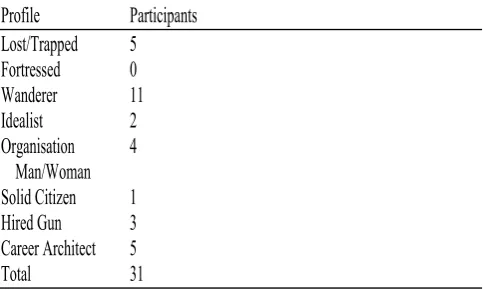
The results were also analysed in relation to Briscoe and Hall’s (2006) career profiles. To create these categories, participant responses were divided into higher or lower scores on each of the four main factors that Briscoe and Hall (2006) used. Participants in the higher group for the boundaryless and protean questions were those whose mean score for the various questions indicated that they agreed or strongly agreed. Those in the lower group were those who either were neutral or disagreed. Participants were then classified according to the eight profiles. For example, someone who was lower for all four factors (psychological mindset and physical mobility for boundaryless and self-directed or values driven for protean) was categorised as ‘lost/ trapped’. These results are shown in Table 5.
The results of the profiling showed that 31 out of 55 (56%) of the total sample could be classified into the eight profiles. Separate analyses of career profiles were carried out for subsamples of the total group of participants: psychologists only, students only, Ministry psychologists, and Non-Ministry psychologists. These breakdowns showed similar patterns of response to those of the total sample.
Career Adaptability
[image:4.595.302.544.104.232.2]Students and psychologists showed strong indications of career adaptability (see Table 6). The MANOVA showed no significant difference between the two groups, λ=.10, F(5,47) =1.01 on these measures.
Table 4
Student and psychologist scores for boundaryless and protean attitudes
Factor Group N Mean SD Boundaryless mindset Students 16 4.11 .61 Psychologists 40 4.12 .52 Mobility preference Students 16 3.60 .67 Psychologists 40 3.59 .72 Self-directed attitude Students 16 4.06 .58
Psychologists 39 4.07 .49 Values-driven attitude Students 16 3.75 .68
Psychologists 39 3.71 .57 Across factors score Students 16 3.98 .38
Psychologists 39 3.87 .37
Table 5
Participant results according to the eight career profiles of Briscoe and Hall (2006)
Profile Participants Lost/Trapped 5
[image:4.595.304.546.472.617.2]• 8 • New Zealand Journal of Psychology Vol. 47, No. 1, March 2018 Part 2 - Qualitative Data
Working with others (boundaryless mindset)
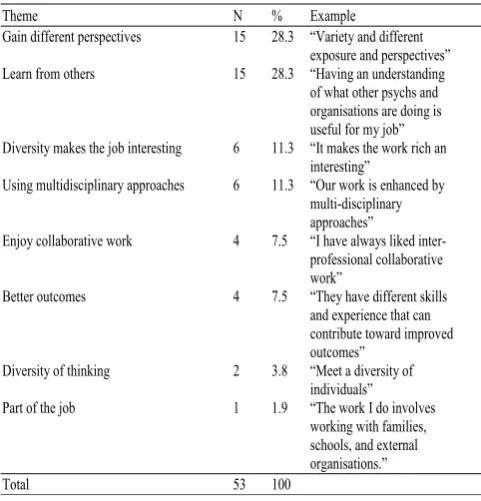
Question 1 in the boundaryless mindset section asked whether the respondent enjoyed working with others outside the organisation. This item was followed by an open-ended question: “You have indicated that you enjoy working with people outside of your organization. Why is that?” Gaining different perspectives and learning from others were popular reasons for respondents endorsing this item. Respondents often detailed the ways they can engage in these learning opportunities, such as acquiring new skills, sharing information, interacting with people from different knowledge bases, networking, and making the most of others’ strengths and expertise (see Table 7).
Feeling responsible for career success or failure (self-directed attitude).
In the self-directed attitude section, a follow up question was: “You have indicated that you are responsible for success
or failure in your career. Why is that?” Having good skills associated with self-direction was important for almost a third of respondents, and having appropriate knowledge, goals, a willingness to learn, and the ability to work hard were also mentioned as contributing towards feelings of responsibility (see Table 8).
Feelings about career success (values-driven attitude).
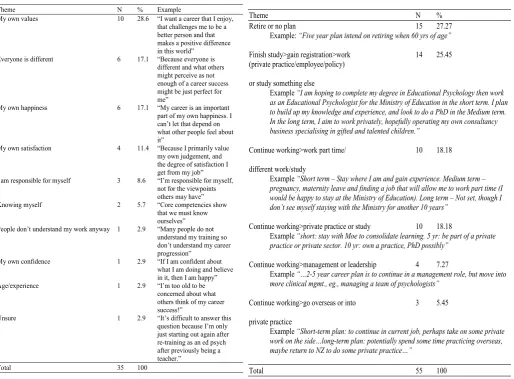
In the section on values driven attitudes, the follow up question was “You have indicated that what is most important to you is how you feel about your career success, not how others feel. Why is that?” Responses included accepting the fact that everyone measures success differently, being guided by values and self-knowledge, and putting ones’ own happiness, confidence, and satisfaction first (see Table 9). Respondents also mentioned that they felt successful in their work because they are helping others.
Career Plans
This question asked respondents to give information about their two, five, and 10-year career plans. The majority of students were focused on finishing study and gaining registration as a psychologist, then gaining work experience (see Table 10). Respondents often described staying in their current position as a short-term plan and then either studying, changing employer, working overseas, moving into private practice, changing to a leadership role or working part time. Many answers included a mixture of all possible combinations.
Summary of Results
[image:5.595.307.571.169.427.2]The quantitative data revealed that participants in the study exhibited boundaryless and protean career attitudes, as well as career adaptability. Students and psychologists had similar scores on all measures, except for the “support” section of the adaptability measure, which indicated that psychologists
Table 6
Students and psychologists adaptability scores
Factor Group N Mean SD
Career agency Students 14 4.3492 .43
Psychologists 39 4.1567 .47 Negative career outlook Students 14 4.1429 .36
Psychologists 39 3.9423 .51 Occupational awareness Students 14 3.3214 .56
Psychologists 39 3.2650 .43
Support Students 14 4.4107 .64
Psychologists 39 4.0000 .62 Work-life balance Students 14 4.1071 .67
Psychologists 39 3.9038 .64 Across factors score Students 14 4.0663 .30
Psychologists 39 3.8536 .36
Table 7
Question 7: Student and psychologist responses
Theme N % Example
Gain different perspectives 15 28.3 “Variety and different exposure and perspectives”
Learn from others 15 28.3 “Having an understanding
of what other psychs and organisations are doing is
useful for my job”
Diversity makes the job interesting 6 11.3 “It makes the work rich an interesting”
Using multidisciplinary approaches 6 11.3 “Our work is enhanced by
multi-disciplinary
approaches”
Enjoy collaborative work 4 7.5 “I have always liked inter- professional collaborative
work”
Better outcomes 4 7.5 “They have different skills
and experience that can contribute toward improved
outcomes”
Diversity of thinking 2 3.8 “Meet a diversity of
individuals”
Part of the job 1 1.9 “The work I do involves
working with families, schools, and external
organisations.”
Total 53 100
Table 8
Question 23: Student and psychologist responses
Theme N % Example
Responsibility 18 38.3 “Because I am responsible
for my own professional development and career path”
Self-direction 14 29.7 “It’s based on the choices
and decisions I make”
Ability to work hard 5 10.6 “I will be successful if I
work hard, foster positive relationships, continue to
upskill”
Having appropriate knowledge 3 6.4 “No one knows me better than I do”
Adaptability 3 6.4 “Need to seize opportunities
and plan for future steps”
Having goals 2 4.3 “I have goals and plans to
achieve them”
Unsure 2 4.3 “Working for a govt
department you are not always necessarily able to achieve the desired outcomes given funding and time restraints that are not
conducive to ‘success’”
[image:5.595.56.297.463.714.2]felt less supported than did students. Psychologists working at the Ministry had a lower mean score for boundaryless attitudes than psychologists working outside the Ministry, as well as a lower score for “career agency” on the adaptability measure. The qualitative data for participants reflected the quantitative results and gave further insight into their career plans, why they enjoyed working with others, why they felt responsible for their own career success, and why they did not focus on how others perceived their career.
Discussion
Data from the survey demonstrates that boundaryless attitudes and a preference for mobility were evident among both educational psychology students and educational psychologists. Gaining new perspectives and learning from others were mentioned in almost 60 per cent of open-ended responses for why respondents enjoy working with people from outside their organisation. Late-career psychologists appear to identify slightly more with the boundaryless mindset than early-career psychologists, where the difference was approaching significance.
In terms of career plans, respondents appear to enact many of the aspects of the boundaryless career. They described switching to work for different providers of psychological services, intending to work part time in private practice as
well as for an organisation, collaborating with colleagues to start new businesses, prioritising part-time work for family reasons, and accepting that there will be structural changes in the services they provide.
[image:6.595.52.567.90.469.2]As discussed by Walton and Mallon (2004), some organisations are moving away from using large hierarchies relying on career planning and succession, and attention is shifting to the meanings that individuals find in their career. Interestingly, many of the psychologist respondents in this study are employed by the Ministry of Education, which does have a ladder system in place for career progression; however, these respondents were just as likely as others to mention engaging in future activities which were not associated with their current employer (such as switching to private practice). The data in this study provides strong support for protean attitudes toward career. A protean attitude involves driving one’s own career, having individually created goals encompassing all areas of life, and being motivated by psychological success rather than external markers of accomplishment. This attitude was evident, and was measured using scales related to self-directed and values-driven attitudes. There were no statistically significant differences between responses of students and psychologists, psychologists from different workplaces, and early and late-career psychologists. Feelings of self-direction and responsibility were mentioned Table 9
Question 35: Student and psychologist responses
Theme N % Example
My own values 10 28.6 “I want a career that I enjoy,
that challenges me to be a better person and that makes a positive difference
in this world”
Everyone is different 6 17.1 “Because everyone is different and what others might perceive as not enough of a career success might be just perfect for
me”
My own happiness 6 17.1 “My career is an important
part of my own happiness. I
can’t let that depend on
what other people feel about
it”
My own satisfaction 4 11.4 “Because I primarily value
my own judgement, and the degree of satisfaction I
get from my job”
I am responsible for myself 3 8.6 “I’m responsible for myself,
not for the viewpoints
others may have”
Knowing myself 2 5.7 “Core competencies show
that we must know
ourselves”
People don’t understand my work anyway 1 2.9 “Many people do not understand my training so
don’t understand my career progression” My own confidence 1 2.9 “If I am confident about
what I am doing and believe
in it, then I am happy”
Age/experience 1 2.9 “I’m too old to be
concerned about what others think of my career
success!”
Unsure 1 2.9 “It’s difficult to answer this
question because I’m only
just starting out again after re-training as an ed psych after previously being a
teacher.”
Total 35 100
Table 10
Respondents’ career plans
Theme N %
Retire or no plan 15 27.27
Example: “Five year plan intend on retiring when 60 yrs of age”
Finish study>gain registration>work 14 25.45
(private practice/employee/policy)
or study something else
Example “I am hoping to complete my degree in Educational Psychology then work as an Educational Psychologist for the Ministry of Education in the short term. I plan to build up my knowledge and experience, and look to do a PhD in the Medium term. In the long term, I aim to work privately, hopefully operating my own consultancy business specialising in gifted and talented children.”
Continue working>work part time/ 10 18.18
different work/study
Example“Short term – Stay where I am and gain experience. Medium term – pregnancy, maternity leave and finding a job that will allow me to work part time (I would be happy to stay at the Ministry of Education). Long term – Not set, though I don’t see myself staying with the Ministry for another10 years”
Continue working>private practice or study 10 18.18
Example “short: stay with Moe to consolidate learning. 5 yr: be part of a private practice or private sector. 10 yr: own a practice, PhD possibly”
Continue working>management or leadership 4 7.27
Example“…2-5 year career plan is to continue in a management role, but move into more clinical mgmt., eg., managing a team of psychologists”
Continue working>go overseas or into 3 5.45
private practice
Example “Short-term plan: to continue in current job, perhaps take on some private work on the side…long-term plan: potentially spend some time practicing overseas, maybe return to NZ to do some private practice…”
• 10 • New Zealand Journal of Psychology Vol. 47, No. 1, March 2018 as reasons why respondents felt responsible for success or
failure in their career. Respondents felt that accepting that everyone is different and understanding their own values influences why they are not concerned about how others feel about their career.
The Interaction of Protean and Boundaryless Attitudes
Responses to the protean and boundaryless items were analysed to determine the extent to which they fit within Briscoe and Hall’s (2006) eight career profiles. Although only about half of the respondents fitted the eight profiles (31/55) there was a spike in the pattern of responses. Of the 31 participants who could be placed into the eight profiles, 11 fitted the ‘wanderer’ profile, making it the most common category. This profile represents people who are very boundaryless physically, but not so psychologically, as they are lower on the protean dimensions. Briscoe and Hall (2006) suggest that the ‘wanderer’ is open to whatever opportunities arise for them, and they do not see geographical or organisational boundaries as barriers. The limitation for people of this profile is that their psychological appreciation across boundaries is not as sophisticated as their ability to be physically mobile. The high number of respondents fitting into this category may relate to the fact that the sample included students and a high proportion of early career psychologists. This group may still be exploring their physical boundaries, as they work towards becoming more self-directed.
Five participants fell into the ‘lost/trapped’ category and five into the ‘protean career architect’ category. People who fitted the ‘lost/trapped’ profile were low on all four protean and boundaryless career dimensions. Briscoe and Hall (2006) suggest that people fitting this profile are trapped or lost because they lack emphasis on inner values which could direct their behaviour, and boundaryless perspectives which could uncover new possibilities. People in this situation may benefit from basic career development processes such as value clarification and career exploration activities. At the other extreme, the ‘protean career architect’ is thought to be psychologically and physically boundaryless, actively directing their own career management and being driven by personal values.
Four respondents fitted the profile of the ‘organisation man/woman’, which refers to people who are able to successfully take charge of career management, but who are not clear about their own values (Briscoe & Hall, 2006). These people work well across psychological boundaries but are less willing to work across physical boundaries, meaning that they may match their needs to those of the organisation.
Three respondents fitted the ‘hired-gun/hired-hand’ profile, representing people who may work across physical and psychological boundaries, but are not values-driven. Briscoe and Hall (2006) used this label to describe people who are mobile and adaptive in career management, but not skilled in defining their own values; “Their gun or hand is for hire, but not their heart” (p. 14). Two respondents fit the ‘idealist’ profile. This label describes people who are psychologically boundaryless and values-driven, but who are not as effective in physical boundary-crossing or career self-management. One person fitted the ‘solid citizen’ profile, describing people
who are self-directed, values-driven, and psychologically boundaryless, but not physically boundaryless.
Career Adaptability
Qualitative data demonstrates that the majority of students are focused on finishing study and gaining registration as a psychologist, then gaining work experience. Eleven per cent of respondents plan on continuing in their current position in the long term. Thirty-two per cent planned on staying in their current position and then either studying, changing employer, working overseas, moving into private practice, changing to a leadership role or working part time. Twenty-five per cent of students and 23 per cent of psychologists comment that they would like to go into private practice at some point in the future.
The results showed that all factors associated with adaptability were rated in a positive way (Career Agency, Career Outlook, Occupational Awareness, Support, and Work-Life Balance), with Career Agency gaining the highest mean score.
What are the strengths/limitations of the research?
One strength of the present study is that it was an anonymous online survey and in this respect was able to ask questions about career attitudes with complete anonymity. The use of open-ended questions also gave participants an opportunity to clarify their responses and explain their thinking.
However, there are limitations to the study. One limitation is sample size; it is difficult to generalise the results to all educational psychology students. Only twenty-two students responded, with the majority attending University A; University B students may have different attitudes which were not represented in this study. Practicing psychologists were invited to participate through the Educational Psychology Forum, which includes educational psychologists in its membership, through email invitation to graduates from University A, and through two email invitations sent to psychologists in Auckland. This may have led to a larger number of psychologist respondents from Auckland, however this is not clear because location information was not collected. Psychologists in different parts of the country may have varying career attitudes depending on their particular job situation and location.
Another limitation is the design of the study, which is mainly exploratory. The survey used two previously developed measures, and added qualitative follow-up questions to some items. Validity and reliability of the current survey items were not calculated, however the protean and boundaryless items were validated by Briscoe et al. (2006), and the adaptability measure was validated by Rottinghaus et al. (2012).
Conclusion
where long-term contracts are rare and career movement is constant, but the results of this study were that many respondents held boundaryless and protean attitudes, even when job security existed. The results of the study indicate that independent career management was important to this sample of educational psychology students and career psychologists, as they determine what success means to them and how they can achieve it.
Survey responses indicate that educational psychology students and professionals both held boundaryless and protean attitudes. Answers to the qualitative questions expanded on these results, identifying the many ways respondents planned on enacting their boundaryless attitudes. Switching between employers, working in private practice as well as for an organisation, starting new businesses, prioritising personal lives, and accepting change were mentioned as some of the possible future career paths that respondents may take. These behaviours were influenced by their protean career perceptions, in which respondents prioritised how they felt about their career and their responsibility for career success. Respondents appeared to understand the organisational opportunities available to them, while still navigating their careers independently. These students and professionals also agreed with the need for career adaptability so as to engage in planning and decision making behaviours which allow them to respond to change.
Implications
There is a vast amount of research into career attitudes and adaptability, however there is little research that looks specifically at these new career concepts of boundaryless and protean careers in the field of educational psychology. One practical implication of the study is that it provided us with a window into current career attitudes in the field of educational psychology, not just among practicing psychologists but among students about to transition into the field. These insights will be helpful not only for psychologists themselves to consider, but also for policy makers and managers as to how best to forward the careers of their staff.
Concluding statement
The results of this study suggest that in terms of career thinking, many psychologists in today’s working environment do not see themselves as forever in one career but are oriented toward learning and exploration, while also understanding the importance of being able to adapt to change. While they may eventually find themselves on diverse career paths, holding on to these new career concepts, so different to traditional career ideas, will support them to succeed in the constantly evolving world of work.
References
Arthur, M. B., & Rousseau, D. M. (1996). The boundaryless career: A new employment principle for a new organisational era. New York, NY: Oxford University Press.
Baruch, Y. (2006). Career development in organisations and beyond: Balancing traditional and contemporary viewpoints. Human Resource Management Review, 16,(2) 125 - 138.
Benes, S. S., & Mazerolle, S. M. (2014). Factors influencing athletic training students’ perceptions of the athletic training profession and career choice. Athletic Training Education Journal, 9(3), 104
- 112.
Borges, N. J., Savickas, M. L., & Jones, B. J. (2004). Holland’s theory applied to medical specialty choice. Journal of Career Assessment, 12(2), 188 - 206.
Bridgstock, R. (2005). Australian artists, starving and well-nourished: What can we learn from the prototypical protean career? Australian Journal of Career Development, 14(3), 40 – 48. Briscoe, J., Hall, D. T., & Frautschy DeMuth, R. (2006). Protean
and boundaryless careers: An empirical exploration. Journal of Vocational Behaviour, 69(1), 30 – 47.
Briscoe, J. P., & Hall, D. T. (2006). The interplay of boundaryless and protean careers: Combinations and implications. Journal of Vocational Behavior, 69(1), 4 - 18.
Buchner, T. (2007). Performance management theory: A look from the performer's perspective with implications for HRD. Human Resource Development International, 10(1), 59-73. doi:10.1080/13678860601170294
Cappelli, P. (1999). Career jobs are dead. California Management Review, 42(1), 146 - 167.
Cappelli, P. (2001). The national employer survey: Employer data on employment practices. Industrial Relations, 40(4), 635. Cassin, S. E., Singer, A. R., Dobson, K. S., & Altmaier, E. M. (2007).
Professional interests and career aspirations of graduate students in professional psychology: An exploratory survey. Training and Education in Professional Psychology, 1(1), 26-37. doi:10.1037/1931-3918.1.1.26
Ferreira, A. I., Rodrigues, R. I., & da Costa Ferreira, P. (2016). Career interests of students in psychology specialties degrees: Psychometric evidence and correlations with the RIASEC dimensions. International Journal for Educational and Vocational Guidance, 16(1), 91-111. doi:10.1007/s10775-015-9289-3 Friedman, T. L. (2007). The world is flat: A brief history of the
twenty-first century: New York, NY: Farrar, Straus and Giroux.
Granrose, C. S., & Baccili, P. A. (2006). Do psychological contracts include boundaryless or protean careers? The Career Development International, 11(2), 163-182. doi:10.1108/13620430610651903 Gubler, M., Arnold, J., Coombs, C. (2013). Reassessing the protean
career concept: Empirical findings, conceptual components, and measurement. Journal of Organisational Behaviour, 35(1), 23 – 40. doi:10.1002/job.1908
Hall, D., & Mirvis, P. (1996). The new protean career: Psychological success and the path with a heart. In D. Hall (Ed.), The career is dead - long live the career: A relational approach to careers (pp. 15 – 45). San Francisco, CA: Jossey-Bass.
Hall, D. T. (1996). Protean Careers of the 21st Century. The Academy of Management Executive 10(4), 8 – 16.
Hall, D. T. (2002). Careers in and out of organisations. Thousand Oaks, CA: Sage.
Hall, D. T., & Chandler, D. E. (2005). Psychological success: When the career is a calling. Journal of Organizational Behaviour, 26(2), 155-176.
Hall, D. T., & Moss, J. E. (1998). The new protean career contract: Helping organizations and employees adapt. Organizational Dynamics, 26(3), 22 - 37.
Inkson, K. (2006). Protean and boundaryless careers as metaphors. Journal of Vocational Behaviour, 69(1), 48 - 63. doi: 10.1016/j. jvb.2005.09.004
• 12 • New Zealand Journal of Psychology Vol. 47, No. 1, March 2018
C. Copper (Eds.), The SAGE handbook of organisational behavoiur. Thousand Oaks, CA: Sage.
King, Z. (2003). New or traditional careers? A study of UK graduates' preferences. Human Resource Management Journal, 13(1), 5 - 26. Mirvis, P., & Hall, D. (1996). Psychological success and the boundaryless career. In M. Arthur & D. Rousseau (Eds.), The boundaryless career: A new employment principle for a new organisational era (pp. 237 - 255). New York, NY: Oxford University Press.
Punch, K. (2014). Introduction to social research : quantitative & qualitative approaches: Thousand Oaks, CA: Sage.
Rottinghaus, P. J., Buelow, K. L., Matyja, A., & Schneider, M. R. (2012). The career futures inventory-revised: Measuring dimensions of career adaptability. Journal of Career Assessment, 20(2), 123-139. Rottinghaus, P. J., Day, S. X., & Borgen, F. H. (2005). The career futures inventory: A measure of career-related adaptability and optimism. Journal of Career Assessment, 13(1), 3-24.
Rousseau, D. M. (1995). Psychological contracts in organizations: Understanding written and unwritten agreements: Thousand Oaks, CA: Sage.
van Vianen, A. E. M., De Pater, I. E., & Preenan, P. T. Y. (2009). Adaptable careers: Maximizing less and exploring more. Career Development Quarterly, 57(4), 298-309. doi: 10.1002/j.2161-0045.2009.tb00115.x
Walton, S., & Mallon, M. (2004). Redefining the boundaries? Making sense of career in contemporary New Zealand. Asia Pacific Journal of Human Resources, 42(1), 75 – 95.
Zhang, Y. (2010). Recent tertiary graduates' career attitudes, career adaptability, and career self-management behaviours: Focus on continuity in a fragmented employment context. (Master’s Thesis). Retrieved from http://hdl.handle.net/10179/2322.
Corresponding Author
Jacqueline Seymour Massey University Auckland Private Bag 102904,
North Shore, Auckland, 0745 New Zealand