Working Memory Load and the
Stroop Interference Effect
Quanying Gao, Zhe Chen, & Paul Russell
University of CanterburyAlthough the effect of working memory (WM) load on the degree of distractor processing has been investigated in a number of paradigms, a common feature in prior research is that the target and distractors pertain to different objects. The present experiments examine the effect of WM load on distractor interference when the relevant and irrelevant features belong to the same object. In Experiment 1, participants saw stimulus displays that consisted of a memory set followed by a Stroop stimulus, whose colour and meaning were either unrelated or incongruent. The task was to make a speeded response to the colour of the target while holding either one or six digits in memory. Although a signifi cant Stroop interference effect was found, its magnitude was not infl uenced by WM load. Experiment 2 manipulated the size of attentional focus in addition to WM load and the response congruency between the relevant and irrelevant features of Stroop stimuli. Again, there was a strong Stroop interference effect, but no effect of WM load or attentional focus. These results suggest that the effect of WM load on selective attention may be more complex than was previously conceived. They also emphasize the importance of stimulus structure in understanding the effect of WM load on selective attention.
Visual perception is intrinsically selective. A typical natural scene consists of numerous objects and events. However, only a subset of them is relevant to our behavioural goals. Given that the visual system has a limited capacity to process multiple objects at any given time (Broadbent, 1958; Neisser, 1967), it is critical that only relevant information is processed while irrelevant information is either suppressed or ignored. The question is: how does the visual system select relevant information among competing distractors?
One way to understand selective attention is to identify the factors that modulate it under various circumstances. Past research has shown that interference from task irrelevant
distractors can be reduced by increasing the spatial separation between a target and distractors (B. A. Eriken & C. W. Eriksen, 1974; C. W. Eriksen & Hoffman, 1973), cuing participants’ attention to the location of the target before the target appears (C. W. Eriksen & Hoffman, 1973; Yantis & Jonides, 1990), grouping targets and distractors into different perceptual groups (Chen & Cave, 2006a; Harms & Bundersen, 1983; Kramer & Jacobson, 1991), or by increasing the perceptual load of a stimulus display (Lavie, 1995).
Recent research suggests that working memory (WM) load may also play an important role in modulating the degree of distractor processing. Kane and Engle (2003) examined the relationship between WM capacity
and Stroop interference. They found a negative correlation between the two. Relative to those with small WM capacity, the participants with large WM capacity showed less Stroop interference. Related findings were observed by Unsworth, Schrock and Engle (2004). In their study, the participants with large WM capacity were not only faster in performing antisaccade tasks, but also less likely to make refl exive saccades to an exogenous cue on the wrong side of the screen. Manipulating WM load directly, Lavie and her colleagues (Lavie, Hirst, de Fockert, & Viding, 2004) required participants to retain either one digit (low WM load) or several digits (high WM load) while performing a letter discrimination task. Distractor interference was larger in the high WM load condition than in the low WM load condition, suggesting that high WM load impaired distractor inhibition.
are perceived. As a result, whereas a high perceptual load reduces distractor processing because of the unavailability of resources, a high WM load results in large distractor interference due to the lack of resources to inhibit distractors.
However, not all studies show an inverse relationship between WM load and the efficiency of selective attention (Chen & Chan, 2007; Logan, 1978; Woodman, Vogel, & Luck, 2001). For example, both Logan (1978) and Woodman et al. (2001) reported comparable visual search slopes when their participants performed visual search with or without a concurrent memory task. Han and Kim (2004) also demonstrated that the effect of WM load in the effi ciency of visual search depended on the involvement of executive WM. They showed that whereas increasing WM load impaired visual search effi ciency when executive WM was involved (e.g., counting backwards in threes from a three-digit number), it had no effect when simple maintenance of verbal information was required (e.g., holding seven digits in memory).
Chen and Chan (2007) further proposed that the size of attentional focus may have played an important role in many previous experiments. They noted that because WM load was usually manipulated by varying the number of items held in memory, a high WM load was typically associated with a wide attentional focus while a low WM load was typically associated with a small attentional focus (e.g., Lavie et al., 2004). In other words, WM load was confounded, at least in some studies, with the size of attentional focus, which is known to infl uence the magnitude of distractor interference (Chen, 2000; 2003; Eriksen & St. James, 1986; LaBerge, Brown, Cater, Bash, & Hartley, 1991). To determine whether attentional focus could contribute to the observed WM load effect, Chen and Chan manipulated both factors within the same paradigm. They found that a high WM load resulted in ineffi cient distractor inhibition only when it was coupled with a large attentional focus. When attentional focus was equated across different experimental conditions, the WM load effect became negligible. Together, these fi ndings suggest that the
effect of WM on distractor interference is more complex than was proposed in the load theory of attention.
Although WM load had been manipulated directly in selective attention tasks (e.g., Lavie et al., 2004; Lavie & de Fockert, 2005), previous studies used stimulus displays where the relevant and irrelevant information belonged to separate objects. There is reason to believe that WM load may infl uence visual selection differently when the relevant and irrelevant information pertain to the same object. It has been shown that the effect of perceptual load on distractor processing differs as a function of the nature of stimulus displays (e.g., Chen, 2003; Lavie, 1995; Lavie & Cox, 1997). For example, in a study conducted by Lavie and Cox, participants searched for a target among irrelevant distractors that were either homogeneous (the low perceptual load condition) or heterogeneous (the high perceptual load condition). Distractor interference from a critical incompatible distractor was larger in the low load condition than in the high load condition. This result is consistent with the load theory of attention. It suggests that a high perceptual load decreases distractor interference.
However, a similar effect was not found when the target was a Stroop stimulus (Chen, 2003). In a typical experiment that uses Stroop stimuli (Stroop, 1935), participants make a speeded response to the colour of a word. The relationship between the colour and meaning is manipulated so that they can be congruent (e.g., the word RED written in red ink), incongruent (e.g., the word GREEN written in red ink), or neutral (e.g., the word SHOE written in red ink). The standard finding is that RT is faster in the congruent condition than in the neutral condition, which in turn is faster than in the incongruent condition. The slower RT in the incongruent condition is termed the Stroop interference effect (see MacLeod, 1991, for a review), and the magnitude of the Stroop interference effect is taken to indicate the degree of distrator processing. Using Stroop stimuli in a go/nogo paradigm, Chen (2003, Experiment 3) manipulated processing load by requiring participants
to respond to the colour of the Stroop stimulus on the basis of either a single feature (e.g., whether a bar which was situated above or below the Stroop stimulus was white - the low load condition) or a conjunction of features (e.g., whether the bar was white and above the Stroop stimulus - the high load condition). She found that although RT was substantially slower in the high load than in the low load condition, the magnitude of the Stroop interference effect was comparable in the two situations. In a subsequent experiment (Experiment 4), the size of attentional focus was manipulated by varying the size of a cue, which was a rectangle presented before the onset of the target display. The Stroop interference effect was greater when the cue was large rather than when it was small. These results suggest that differences in stimulus structure infl uence participants’ processing strategies (Garner, 1970; 1974; Garner & Felfoldy, 1970), which in turn modify the effect of perceptual load on distractor interference.
focus on distractor inhibition when the distractor is part of the same object as the target.
Experiment 1
Method
Participants. Thirty-six University of Canterbury students volunteered to participate in the experiment in exchange for payment.1 All reported to have normal or corrected-to-normal vision. The participants were treated in accordance with the “Ethical Principles of Psychologists and Code of Conduct” (American Psychological Association, 1992), and the research was approved by the University of Canterbury Human Ethics Committee.
Apparatus and Stimuli. All stimuli were presented on a grey background using a Pentium-III computer with a 17-inch monitor. E-Prime (Schneider, Eschman, & Zuccolotto, 2002), a commercially available experimental program, was used to generate stimuli and to collect responses.
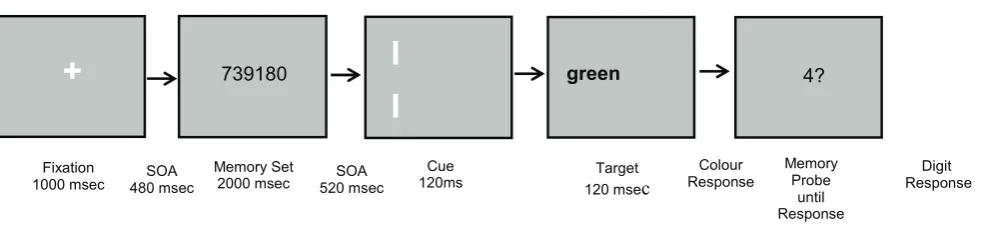
Each trial consisted of a central fi xation, a memory set, a cue, a target display, and a memory probe (see Figure 1). The fi xation was a white cross that extended 1.240 horizontally and vertically. The memory set consisted of either one or six black digits at the centre of the screen. All digits were randomly selected from 1 to 9 without replacement on a given trial, and were written in 36 point Arial font. The cue, which was located 6.210 left or right from the fi xation, was made of two vertically aligned white bars separated by a gap of 2.10. Each bar was 1.340 in length and 0.300 in width. The target display consisted of either a coloured word (“red”, “blue”, “green”, or “yellow”) or a string of letters of
corresponding length (“vvv”, “oooo”, “sssss”, “nnnnnn”) that extended between 3.060 and 6.020 horizontally. The target always appeared at the location indicated by the cue. Four possible colours were associated with the target stimuli. They were: red (RGB: 100, 0, 0), blue (RGB: 0, 0, 100), green (RGB: 0, 100, 0), and yellow (RGB: 100, 100, 0). Each specifi c word or letter string could be in one of three colours except for the colour that matched the meaning of the word (e.g. the word “red” and its equivalent “vvv” could be blue, green, or yellow, but not red). The memory probe comprised a single black digit and a question mark.
Design and Procedure. The experiment was a mixed design with WM load (high vs. load) as the between-subjects variable and response congruency between the meaning and colour of the target (neutral vs. incongruent) as the within-subjects variable. There were equal numbers of incongruent trials (e.g. “red” written in green ink) and neutral trials (e.g. “vvv” written in green ink).
The participants were randomly assigned to one of two WM load conditions. Each trial started with a 1000 msec fi xation, followed by a 480 msec blank screen. A memory set was then presented for either 520 ms in the low load condition or 2000 msec in the high load condition. Upon the offset of the memory set, a blank screen appeared for 520 msec, followed by a cue, which appeared on the left or right side of the screen for 120 msec. Immediately after the offset of the cue, the target display was shown for 120 msec at the location indicated by the cue. Participants made a speeded response to the colour of the target
by pressing one of four labelled keys on the keyboard (“z” for red, “x” for green, “,” for yellow and “.” for blue). Upon response, the memory probe appeared on the screen. It remained there until the participants responded by depressing one of two labelled keys (“a” for probe-present and “’” for probe-absent responses). The memory probe was equally likely to be present or absent from the memory set.
Each participant performed 48 practice trials. They then completed three blocks of 64 trials for a total of 192 trials. Whereas both speed and accuracy were emphasized for the Stroop task, accuracy was stressed for the memory task.
Results and Discussion
Table 1 shows the data for Experiment 1. For the Stroop task, RTs longer than 2000 msec (about 1% of the total data) were excluded from data analyses. A mixed analysis of variance (ANOVA) indicated a significant main effect of response congruency [FFF(1, 34) = (1, 34) = 14.26, ηp2 = .30, p < 0.001], with faster RTs on the neutral trials (730.5 msec) than on the incongruent trials (755.5 msec). Neither the main effect of WM load nor the interaction between load and response congruency reached signifi cance [FFF(1, 34) = 1.71,(1, 34) = 1.71, ηp2 = .05, n.s., for load; and FFF(1, 34) = 1.1,(1, 34) = 1.1, ηp2 = .03, n.s., for the interaction]. A similar analysis was conducted on the accuracy data. No signifi cant results were found [FFF(1, 34) = 1.53,(1, 34) = 1.53, ηp2 = .04, n.s., for load; FFF(1, 34) = 1.98,(1, 34) = 1.98, ηp2 = .05, n.s., for response congruency; and F(1, 34) = 0.05,
F(1, 34) = 0.05,
F ηp2 = .001, n.s., for the interaction].
Accuracy for the memory task was high, with the mean memory error rates being 7.1% and 5.7% for the high
+
739180 4?Fixation
1000 msec 480 msec SOA Memory Set 2000 msec 120ms Cue 120 mseTarget c Response Colour Memory Probe Response Digit until
Response
I
I
green [image:3.595.61.552.673.792.2]SOA 520 msec
and low load conditions, respectively. However, despite the numerical difference, the two conditions did not differ statistically [t(34) = .90, d= 0.3, n.s.]. Although RT for the memory task was not emphasized in the instructions, we conducted a ttt test to see if there was test to see if there was any difference in response latencies. The participants were faster in the low WM load condition (908 msec) than in the high WM load condition (1144 msec) [t(34) = 4.02, d= 1.34, p < .001]. This result made sense. It is consistent with prior research (e.g., Sternberg, 1966) that participants took longer to determine whether the probe digit was in the memory set when they had to search through six digits rather than one digit in memory.
Consistent with prior research, a reliable Stroop interference effect was found. Relative to the neutral trials, the participants were slower to respond to the colour of the target stimulus when it was incompatible with the meaning. Interestingly, the magnitude of the Stroop interference effect did not differ as a function of WM load, suggesting that WM load played a negligible role in the suppression of meaning in a Stroop colour word stimulus.
However, because memory error rates did not differ signifi cantly between the two WM load conditions, it is possible that the lack of a load effect on Stroop interference in Experiment 1
was due to ineffective manipulation of the WM load. To provide converging evidence to the results of Experiment 1, we conducted Experiment 2, using a slightly different paradigm.
Experiment 2
Experiment 2 had two goals: To provide converging evidence for the results of Experiment 1 and to examine the roles of WM load and the size of attentional focus on Stroop interference in the same paradigm. We chose to increase the sensitivity of the experiment by increasing the number of participants rather than the number of digits in the memory set for two reasons. First, a power analysis (Cohen, 1988) based on the effect size of the participants’ RTs in the low and high memory load tasks of Experiment 1 indicated that the power for detecting the memory load effect would be greater than .80 if more than 20 participants were used in each group in Experiment 2. Second, keeping the same number of digits would make the level of memory load in our experiment comparable to that of Lavie et al. (2004), who showed that one vs. six digits was a sensitive manipulation of low vs. high WM load.
In addition to manipulating WM load and response congruency, we also varied the size of the cue to induce participants in different groups to adopt different sizes of attentional
focus. As we noted earlier, Chen and Chan (2007) observed a positive correlation between WM load and the magnitude of distractor interference when WM load co-varied with the size of attentional focus. Furthermore, the effect of WM load was eliminated when the size of attentional focus was held constant. Interestingly, when WM load was held constant, the magnitude of distractor interference differed as a function of attentional focus. Because the target and distractors belonged to different objects in Chen and Chan, it was unclear whether similar effects would be found when the relevant and irrelevant information pertained to the same object.
Method
Participants. Seventy-fi ve participants from the same participant pool as before took part in the experiment. None had participated in Experiment 1, and none knew the purpose of the experiment.
Apparatus and Stimuli. The apparatus was the same as used in Experiment 1. Only one change was made to the stimuli. Instead of two vertical bars, the cue display consisted of either one small white square of 0.570 (narrow focus) or four identical small white squares located at the four corners of an imaginary square that extended 8.500 (wide focus). As in Experiment 1, the cue was equally likely to appear at the left or right side of the screen, with its centre at the same location as the centre of the target in the subsequent display.
Design and Procedure. WM load and attentional focus were manipulated in such a way that there were three different load/focus combinations: a high load with a narrow attentional focus (the high-narrow condition), a low load with a narrow attentional focus (the low-narrow condition), and a low load with a wide attentional focus (the low-wide condition). Within each combination, there were an equal number of neutral and incongruent trials. This design allowed us to compare the effect of WM load (the high-narrow condition vs. the low-narrow condition) and the effect of attentional focus (the low-narrow condition vs. the low-wide condition) directly.
Table 1. (A) Mean Reaction Times (RTs, in Milliseconds) and Error Rates (%E) for the Colour Task and (B) Mean Error Rates for the Memory Task in Experiment 1. Standard Errors are in the Parentheses.
I = incongruent; N = neutral.
A
Low Load High Load
Dependent
Variable I N I N
RT 797 (47) 765 (46) 714 (37) 696 (35)
% Error 4.1 (1.0) 4.7 (0.7) 5.8 (1.3) 6.6 (1.3)
B
Dependent
Variable Low Load High Load
RT 908 (45.9) 1144 (35.3)
The participants were randomly assigned 25 each to the three load/focus conditions. Whereas the load/focus manipulation was a between-subjects variable, response congruency was a within-subjects variable. All other aspects of the experiment were identical to those of Experiment 1.
Results and Discussion
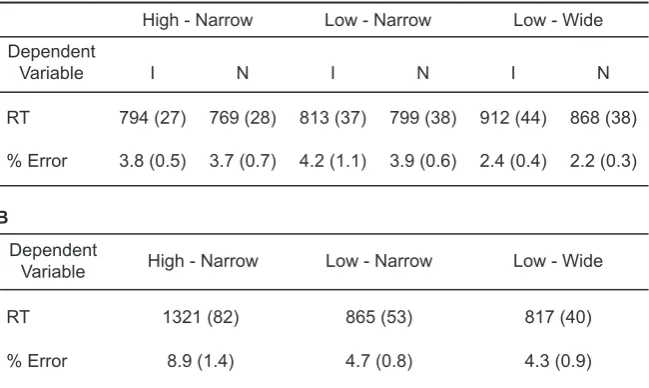
The data are illustrated in Table 2. Three participants’ data were not included in the analyses because a large proportion of their RT trials (over 30% of the total trials) were longer than the cut-off score of 2000 ms.
For the Stroop task, a mixed ANOVA (with the three load/focus conditions as the between-subjects factor and response congruency as the within-subjects factor) on participants’ mean RTs revealed a signifi cant main effect of response congruency [FFF(1, (1, 69) = 13.55, ηp2 = .16, p < .001], with faster RT on the neutral trials (812 msec) than on the incongruent trials (839.7 msec). Neither the main effect of condition nor the condition by response congruency interaction was signifi cant [FFF(2, 69) = 2.62,(2, 69) = 2.62, ηp2 = .07, n.s., for condition; and FFF(2, 69) = 1.31,(2, 69) = 1.31, ηp2 = .04, n.s. for the interaction]. A similar analysis was conducted on the accuracy data. No signifi cant effects were found [FFF(2, 69) = 1.72,(2, 69) = 1.72, ηp2 = .05, n.s. for condition; FFF(1, 69) = 0.25,(1, 69) = 0.25, ηp2 = .004, n.s. for response congruency; and FFF(2, 69) = 0.04,(2, 69) = 0.04, ηp2 = .001, n.s. for the interaction].
To assess the effect of WM load on Stroop interference directly, we
compared participants’ mean RT data in the low-narrow and high-narrow conditions, even though the condition by response congruency interaction in the omnibus ANOVA was not signifi cant. A 2x2 mixed ANOVA with response congruency as the within-subjects variable and WM load as the between-subjects variable revealed a significant Stroop interference effect [803.5 msec and 784 msec for the incongruent and neutral trials, respectively, FFF(1, 46) = 10.35,(1, 46) = 10.35, ηp2 = .18, p < .01]. Neither the main effect of WM load [FFF(1, 46) = 0.27,(1, 46) = 0.27, ηp2 = .006, n.s.] nor the interaction [F(1, 46) = 0.89, ηp2 = .02, n.s.] reached signifi cance.
A similar analysis was performed on participants’ mean RT data in the low-narrow and low-wide conditions to investigate the effect of attentional focus on Stroop interference. The response congruency effect was significant [862.5 msec for the incongruent and 833.5 msec for the neutral trials, FFF(1, 46) = 8.37,(1, 46) = 8.37, ηp2 = .15, p < .01]. However, there was no signifi cant effect of attentional focus [FFF(1, 46) = 2.40,(1, 46) = 2.40, ηp2 = .05, n.s.] or the interaction [FFF(1, 46) = 2.22,(1, 46) = 2.22, ηp2 = .05, n.s.].
[image:5.595.56.554.89.263.2]For the memory task, we conducted two separate one-way ANOVAs for the three load/focus conditions. Signifi cant Figure 2. Examples of stimulus displays from Experiment 2
+
739180 4?Fixation 1000 msec
Target 120 msec SOA
480 msec
Cue
120ms Response Colour Memory Set
2000 msec
Digit Response Memory
Probe until Response green
SOA 520 msec
Table 2. (A) Mean Reaction Times (RTs, in Milliseconds) and Error Rates (%E) for the Colour Task and (B) Mean Error Rates for the Memory Task in Experiment 2. Standard Errors are in the Parentheses.
I = incongruent; N = neutral.
A
High - Narrow Low - Narrow Low - Wide
Dependent
Variable I N I N I N
RT 794 (27) 769 (28) 813 (37) 799 (38) 912 (44) 868 (38)
% Error 3.8 (0.5) 3.7 (0.7) 4.2 (1.1) 3.9 (0.6) 2.4 (0.4) 2.2 (0.3)
B
Dependent
Variable High - Narrow Low - Narrow Low - Wide
RT 1321 (82) 865 (53) 817 (40)
[image:5.595.228.553.602.796.2]effects were found in both accuracy [F effects were found in both accuracy [F effects were found in both accuracy [ (2, FF(2, 69) = 6.53, ηp2 = .16, p < .01] and RT [FFF(2, 69) = 21.16,(2, 69) = 21.16, ηp2 = .38, p < .001]. Post-doc Tukey’s Honestly Signifi cant Differences tests further indicated higher error rates and longer reaction times in the high-narrow condition than in both the low-narrow and low-wide conditions (all p values were smaller than .05) with no signifi cant difference between the latter two conditions. These results indicate that our manipulation of the WM load was effective.
The most important finding of Experiment 2 was the negligible effect of WM load on the magnitude of the Stroop interference effect. Although an increase in WM load led to a higher memory error rate in the high-narrow condition than in the low-narrow condition, the magnitude of Stroop interference was comparable in the two conditions. Given the large effect sizes (ηp2 = .16 and η
p2 = .38 for accuracy and
RT respectively) and power (over .8) of the WM load effect in the experiment, it is unlikely that our results are due to a lack of statistical power.
It is worth noting that the amount of Stroop interference was also comparable in the low-narrow and low-wide conditions. In other words, the size of attentional focus had a negligible effect on the degree of distractor processing in the present paradigm too. This fi nding may seem to be inconsistent with previous research (e.g., Chen, 2003) which showed larger Stroop interference when the attentional focus was wide rather than when it was narrow. There was one potentially important methodological difference between the two studies. Whereas the participants in Chen’s study were required to process the cue because the cue indicated whether the target should be responded to or not on a given trial (the experiment used a go/nogo paradigm), there was no such requirement for the participants in the present experiment.2 Perhaps this difference made the cue in Chen’s study a more effective stimulus in controlling the participants’ attentional focus. Further experiments are needed to reveal the exact cause of this inconsistency in results.
General Discussion
Using Stroop stimuli in which the relevant and irrelevant information belonged to a single object, we investigated the effect of WM load on distractor processing in two experiments. Our results show that the level of WM load had little effect on the magnitude of Stroop interference. How do we explain these results?
There are two possible interpret-ations, one concerning the size of attentional focus, and the other the nature of the target stimulus. With regard to attentional focus, previous studies showed that when the size of attentional focus was equated by a precue or by the sequential presentation of items in the memory set, the effect of WM load became negligible (Chen & Chan, 2007; Logan, 1978). However, although the present results are consistent with these previous fi ndings, we consider it unlikely that the control of attentional focus was a determining factor in the present experiments. This is because Lavie and de Fockert (2005) demonstrated that WM load could affect distractor interference even when the size of attentional focus was roughly the same. In one experiment, their participants performed an orientation discrimination task either with or without a concurrent memory task (i.e., single- and dual-task conditions, respectively). The target was always presented among a number of distractors. On half of the trials, one of the distractors had a unique colour (i.e., a colour singleton). On the remaining trials, all the distractors were the same colour. Because colour singletons are known to capture attention (see Yantis, 2000, for a review), the degree of impairment in orientation discrimination due to the presence of the colour singleton in the presence or absence of the memory task was taken to indicate the effect of WM load on distractor inhibition. The results showed that the irrelevant colour singleton impaired participants’ performance more in the dual-task condition than in the single-task condition. Although attentional focus was not explicitly controlled in the experiment, the fact that a small fi xation point was displayed for 2 seconds after the offset of the memory digits in the dual-task condition makes it unlikely for the results to be contaminated by the size of attentional focus.
A more plausible explanation for our results is the special relationship between the relevant and irrelevant information of the target stimulus that we used in our experiments. Stroop stimuli are unique in that the relevant and irrelevant features belong to the same object. Research on object-based attention has indicated that the processing of one feature facilitates that of other features which belong to the same object (Chen, 1998; Duncan, 1984; Egly, Driver, & Rafel, 1994), and that participants process task irrelevant features even though doing so impairs their behavioural goals (Chen, 2005; Chen & Cave, 2006b; Remington & Folk, 2001). In terms of the present study, these results suggest that when attention selects one dimension of an object, it is impossible to limit the processing to only the task relevant feature dimension. All the other features that belong to the same objects are processed.
In addition to meaning being an integral part of a Stroop stimulus, the fact that reading is a highly practised activity for most people including the participants in the present experiments may also contribute to our observed results. It is possible that because reading is an automatic process that requires little resources (Keele, 1972; Posner & Snyder, 1975; but also see Kahneman & Chajczyk, 1983), unless WM resources are totally depleted, variations in WM load may not lead to observable effects on the magnitude of the Stroop interference effect. Related phenomena have been observed in feature search, which does not require attention under most circumstances (Treisman & Gelade, 1980). However, when attention is completely depleted by a demanding concurrent task, performance in feature search is impaired (Joseph, Chun, & Nakayama, 1997).
focus adopted by the participants (Chen & Chan, 2007).
More recently, Sobel and colleagues (Sobel, Gerrie, Poole, & Kane, 2007) demonstrated that the effect of WM capacity in visual search was also modulated by the degree of top-down processing required in a task. In their experiment, participants performed a speeded arrow discrimination task regarding a red horizontal arrow (facing left or right) among distractors of green horizontal arrows and red arrows which were either vertical (distinct orientation condition) or orientated about 15 degrees from horizontal (similar orientation condition). Set size of the red distractors varied across trials while the overall set size of the display was held constant. Relative to participants with high WM capacity, those with low WM capacity showed a steeper increase in RT with the number of red distractors in the similar orientation condition, but not in the distinct orientation condition. Assuming that similar distractors require greater top-down processing, which in turn requires more processing resources, these results are consistent with the view that the manifestation of WM load effect may require relatively complete depletion of attentional resources. One way to test this hypothesis directly would be to conduct an experiment similar to that of Joseph, Chun, and Nakayama (1997) to see if participants with low WM capacity would be disproportionably impaired in feature search by a demanding concurrent attention task relative to those with a high WM capacity. We are currently conducting experiments to investigate this issue.
In conclusion, the present experiments indicate that the manifestation of the WM load effect on selective attention may depend on a number of factors that include but are not limited to the type of tasks involved in WM, the extent of attentional focus adopted by the participants, and the nature of stimulus structure of the target.
References
American Psychological Association. (1992). Ethical principles of psychologists and code of conduct. American Psychologist, 47, 1597-1611.
Broadbent, D. E. (1958). Perception and communication. London: Pergamon. Chen, Z. (1998). Switching attention
within and between objects: The role of subjective organization. Canadian Journal of Experimental Psychology, 52, 7-16.
Chen, Z. (2000). An object-based cost of visual filtering. Perception & Psychophysics, 62, 482-495.
Chen, Z. (2003). Attentional focus, processing load, and Stroop interference. Perception & Psychophysics, 65, 888-900.
Chen, Z. (2005). Selective attention and the perception of an attended nontarget object. Journal of Experimental Psychology: Human Perception and Performance, 31, 1493-1509.
Chen, Z., & Cave, K. R. (2006a). Reinstating object-based attention under positional certainty: The importance of subjective parsing. Perception & Psychophysics, 68, 992-1003.
Chen, Z., & Cave, K. R. (2006b). When does visual attention select all features of a distractor? Journal of Experimental Psychology: Human Perception and Performance, 32, 1452-1464.
Chen, Z., & Chan, C. (2007). Distractor interference stays constant despite variation in working memory load. Psychonomic Bulletin & Review, 14, 306-312.
Cohen, J. (1988). Statistical power analysis for the behavioural sciences. Hillsdale, NJ: Erlbaum.
Duncan, J. (1984). Selective attention and the organization of visual information. Journal of Experimental Psychology: General, 113, 501-517.
Egly, R., Driver, J., & Rafal, R. D. (1994). Shifting visual attention between objects and locations: Evidence form normal and parietal lesion participants. Journal of Experimental Psychology: General, 123, 161-177.
Eriksen, B. A., & Eriksen, C. W. (1974). Effects of noise letters upon the identification of a target letter in a nonsearch task. Perception & Psychophysics, 16, 143-149.
Eriksen, C. W., & Hoffman, J. E. (1973). The extent of processing of noise elements during selective encoding from visual displays. Perception & Psychophysics, 14, 155-160.
Eriksen, C. W., & St. James, J. D. (1986). Visual attention within and around the field of focal attention: A zoom lens model. Perception & Psychophysics, 40, 225-240.
Garner, W. R. (1970). The stimulus in information processing. American Psychologist, 25, 350-358.
Garner, W. R. (1974). The processing of information and structure. Hillsdale, NJ: Erlbaum.
Garner, W. R., & Felfoldy, G. L. (1970). Integrality of stimulus dimensions in various types of information processing. Cognitive Psychology, 1, 225-241. Han, S-H, & Kim, M-S. (2004). Visual
search does not remain effi cient when executive working memory is working. Psychological Science, 15, 623-628. Harms, L., & Bundesen, C. (1983). Color
segregation and selective attention. Perception & Psychophysics, 33, 11-19. Joseph, J. S., Chun, M. M., & Nakayama, K. (1997). Attentional requirements in a “preattentive” feature search task. Nature, 387, 805-807.
Kahneman, D., & Chajczyk, D. (1983). Tests of the automaticity of reading: Dilution of Stroop effects by color-irrelevant stimuli. Journal of Experimental Psychology: Human Perception and Performance, 9, 497-509.
Kane, M. J., & Engle, R. W. (2003). Working-memory capacity and the control of attention: The contributions of goal neglect, response competition, and task set to Stroop interference. Journal of Experimental Psychology: General, 132, 47-70.
Keele, S. W. (1972). Attention demands of memory retrieval. Journal of Experimental Psychology, 93, 245-248. Kramer, A. F., & Jacobson, A. (1991).
Perceptual organization and focused attention: The role of objects and proximity in visual processing. Perception & Psychophysics, 50, 267-284.
LaBerge, D., Brown, V., Carter, M., Bash, D., & Hartley, A. (1991). Reducing the effects of adjacent distractors by narrowing attention. Journal of Experimental Psychology: Human Perception and Performance, 17, 65-76.
Lavie, N. (1995). Perceptual load as a necessary condition for selective attention. Journal of Experimental Psychology: Human Perception and Performance, 21, 451-468.
Lavie, N., & Cox, S. (1997). On the effi ciency of attentional selection: Effi cient visual search results in inefficient distractor rejection. Psychological Science, 8, 395-398.
Lavie, N., & de Fockert, J. (2005). The role of working memory in attentional capture. Psychonomic Bulletin & Review, 12, 669-674.
Lavie, N., Hirst, A., de Fockert, J. W., & Viding, E. (2004). Load theory of selective attention and cognitive control. Journal of Experimental Psychology: General, 133, 339-354.
Logan, G.. D. (1978). Attention in character-classification tasks: Evidence for the automaticity of component stages. Journal of Experimental Psychology: General, 107, 32-63.
MacLeod, C. M. (1991). Half a century of research on the Stroop effect: An integrative review. Psychological Bulletin, 109, 163-203.
Neisser, U. (1967). Cognitive Psychology. New York, NY: Appleton.
Posner, M. I., & Snyder, C. R. R. (1975). Facilitation and inhibition in the processing of signals. In P. M. A. Rabbitt & S. Dornic (Eds.), Attention and performance V (pp. 669-682). New York: Academic Press. Remington, R. W., & Folk, C. L. (2001).
A dissociation between attention and selection. Psychological Science, 12, 511-515.
Schneider, W., Eschman, A., & Zuccolotto, A. (2002). E-Prime user’s guide. Pittsburgh: Psychology Software Tools, Inc. Sobel, K. V., Gerrie, M. P., Poole, B. J., &
Kane, M. J. (2007). Individual differences in working memory capacity and visual search: The roles of top-down and bottom-up processing. Psychonomic Bulletin & Review, 16, 840-845.
Sternberg, S. (1966). High-speed memory scanning in human memory. Science, 153, 652-654.
Stroop, J. R. (1935). Studies of interference in serial verbal reactions. Journal of Experimental Psychology, 18, 643-662. Treisman, A., & Gelade, G. (1980). A
feature-integration theory of attention. Cognitive Psychology, 12, 97-136.
Unsworth, N., Schrock, J. C., & Engle, R. W. (2004). Working memory capacity and the antisaccade task: Individual differences in voluntary saccade control. Journal of Experimental Psychology: Learning, Memory, and Cognition, 30, 1302-1321. Woodman, G. F., & Luck, S. J. (2004). Visual
search is slowed when visuospatial working memory is occupied. Psychonomic Bulletin & Review, 11, 269-274.
Woodman, G. F., Vogel, E. K., & Luck, S. J. (2001). Visual search remains effi cient when visual working memory is full. Psychological Science, 12, 219-224. Yantis, S. (2000). Control of visual attention.
In S. Monsell & J. Driver (Eds.), Control of cognitive processes: Attention and performance XVIII (pp. 73-104). Cambridge, MA: MIT Press.
Yantis, S., & Jonides, J. (1990). Abrupt visual onsets and selective attention: Voluntary versus automatic allocation. Journal of Experimental Psychology: Human Perception and Performance, 10, 121-134.
Notes:
1. The majority of the participants were between the ages of 20 and 28. Approximately 67% were female. 2. Practical consideration of the already
high demand of processing load in the high-narrow condition prevented us from using a similar go/nogo task as that in Chen (2003).
Address for correspondence:
Zhe Chen
Department of Psychology University of Canterbury Private Bag 4800
Christchurch, New Zealand