www.ann-geophys.net/32/1/2014/ doi:10.5194/angeo-32-1-2014
© Author(s) 2014. CC Attribution 3.0 License.
Annales
Geophysicae
Evaluation of a space-observed electric field structure for the ability
to destabilize inhomogeneous energy-density-driven waves
I. V. Golovchanskaya, B. V. Kozelov, I. V. Mingalev, M. N. Melnik, and A. A. Lubchich
Polar Geophysical Institute, Apatity, Russia
Correspondence to: I. V. Golovchanskaya ([email protected])
Received: 18 August 2013 – Revised: 17 November 2013 – Accepted: 21 November 2013 – Published: 10 January 2014
Abstract. We examine the effectiveness of nonuniform, qua-sistatic, transverse electric fields that are often observed in the auroral region in destabilization of inhomogeneous energy-density-driven (IEDD) waves. Specifically, the IEDD dispersion relation of Ganguli et al. (1985a, b) is evaluated for an electric field structure observed by the FAST satel-lite in the auroral ionosphere at 1000 km altitude. The back-ground field-aligned current, plasma density and ion compo-sition are derived from FAST observations. Other input pa-rameters adopted in the calculations are varied in pertinent ranges. Unstable solutions are obtained that indicate a vari-ety of frequencies and perpendicular wavelengths. These can manifest as a broadband spectrum of IEDD waves.
Keywords. Ionosphere (plasma waves and instabilities)
1 Introduction
By now it has been demonstrated in numerous studies that the broadband extremely low frequency (BBELF) waves that are often detected in the auroral ionosphere, as reported by Bonnell et al. (1996), Ergun et al. (1998), Kintner et al. (2000) and others, can hardly be explained in terms of the current-driven electrostatic ion-cyclotron instability (CDE-ICI) (Drummond and Rosenbluth, 1962; Kindel and Kennel, 1971). The reasons are too low observed values of the par-allel drift of electrons, especially at lower (≤1000 km) al-titudes, the lack of spectrum ordering by ion gyrofrequen-cies, the occurrence of intense ion heating in association with BBELF waves, which must lead to CDEICI quenching, etc.
A plausible alternative to the CDEICI is the mechanism proposed by Ganguli et al. (1985a, b). It is based on the ob-servational fact of the presence of nonuniform, quasistatic, perpendicular electric fields during BBELF events (e.g.,
Mozer et al., 1977; Basu et al., 1988; Kintner et al., 1996; Hamrin et al., 2001). The theoretical framework was ini-tially developed by Ganguli et al. (1985a, b) and Ganguli and Palmadesso (1988) for a single layer of transverse, local-ized electric field (shearedE×B plasma flow) surrounded by zero electric field regions. It was shown that in such a configuration the dispersive properties of electrostatic waves change dramatically. Due to the Doppler shift of the wave frequency in the plasma reference frame, the energy density
εof the waves in the region with localized electric field may become negative, while it keeps positive in the surrounding regions. When the regions are coupled by a nonlocal wave packet, a flow of energy from the region of negativeεto that of positiveεcan enable the mode to grow, giving rise to the instability, which is referred to as the inhomogeneous energy-density-driven (IEDD) instability. Furthermore, in the theo-retical studies of Ganguli and Palmadesso (1988), Ganguli et al. (1994), and Gavrishchaka et al. (1996), it was shown that by changing the resonance properties of the system a combination of transverse localized electric fields and field-aligned currents results in a lower excitation threshold cur-rent for CDEIC waves than inferred from the classical the-ory of the CDEIC instability. This theoretical prediction was validated in a number of laboratory experiments (Koepke and Amatucci, 1992; Amatucci et al., 1994; Koepke et al., 1994). It was also corroborated experimentally that broad-band waves in the ion-cyclotron frequency range can be driven solely by a transverse, localized electric field, with-out the dissipation of a field-aligned current (Amatucci et al., 1998).
the flow velocities are oppositely directed in adjacent layers because in this case one of the layers can act as an en-ergy sink, thereby provoking destabilization. Reynolds and Ganguli (1998) pointed out that the generalized theory may have implications for the understanding of the auroral iono-sphere, where such spatial structures in the transverse electric field often occur.
In this study we verify their prediction by evaluating the IEDD dispersion relation for a structured electric field ob-served by the FAST satellite in the auroral region. Earlier, the possibility that the nonuniform, quasistatic, transverse elec-tric fields may be important for the generation of broadband waves in the auroral ionosphere was examined by Hamrin et al. (2001) by using Freja observations. Here we expand on the treatment of Hamrin et al. (2001) and provide a more quantitative analysis to confirm the effectiveness of the pro-posed mechanism.
In the following section the equilibrium configuration, which is adopted from FAST observations, is described. In Sect. 3 we present unstable solutions of the IEDD dispersion relation and demonstrate that for a handful of input parame-ters they indicate a variety of frequencies and perpendicular wavelengths. The results are summarized and discussed in Sect. 4.
2 Setting the equilibrium configuration
We treat an event of structured electric fields observed by the FAST satellite in a crossing of the morning auroral zone on 25 April 1998, UT = 00:43:00–00:44:00 (Fig. 1) at 1000 km altitude. The part of the FAST orbit corresponding to the time interval of interest is marked in bold in Fig. 1a. The north–south electric field ENS, as well as the perturbation of the east–west magnetic field BEW, measured during the event, are shown in Fig. 1b. The sample rate of the electric field measurements is 512 s−1. Under the assumption that the satellite is sampling spatial, rather than temporal varia-tions, whose validity is discussed further in Sect. 4, this cor-responds to 14 m spatial resolution, the FAST velocity be-ing 7.5 km s−1. The frequencies below 2 Hz (scales > 3.5 km) are filtered out from the data to avoid contamination from residual spin harmonics (spin period of FAST is 5 s). The fre-quency range of magnetic observations is restricted by 8 Hz from above because of low-pass filtering of fluxgate magne-tometer data on FAST.
Figure 1c plots a wavelet power vs. scale (note the log– log coordinates) for the observedENSfield, the Daubechies wavelet of the fifth order applied (Daubechies, 1988). It is seen that the power-law dependence (indicated by the solid line) with the slope of 2.2±0.3 extends up to frequency of 32 Hz (224 m) and then is violated at higher frequen-cies. Previously, the presence of two types of oscillations in the BBELF signals with a transition region in the frequency
Fig. 1. (a) FAST crossing of the morning auroral zone at 1000 km altitude on 25 April 1998 (orbit 06617). The time interval of interest is marked in bold; (b) FAST observations of the structured electric fields at UT = 00:43:00–00:44:40. Shown are the north–south elec-tric fieldENSmeasured with 512 s−1sample rate and the
perturba-tion of the east–west magnetic fieldBEW. The frequency range of
magnetic observations is restricted by 8 Hz from above. A horizon-tal bar with arrows indicates the position of an “isolated” electric field structure selected for the analysis; (c) plot of a wavelet power vs. scale in the log–log coordinates for the observedENSfield,
con-structed with the Daubechies wavelet of the fifth order applied. The power-law dependence characterized by the slope of 2.2±0.3 is in-dicated by the solid line.
domain at 30–60 Hz has been reported, for example, by Heppner et al. (1993).
[image:2.595.310.544.64.455.2]to the background magnetic field (Chang et al., 2004). In this regard, any structured electric fields at scales > 224 m in the analyzed data series can be selected to test for the ability to destabilize IEDD waves. At the same time, a nonlocal anal-ysis that will be performed in Sect. 3 to evaluate the effec-tiveness of the mechanism is formally applicable either to the entire time sequence or over a period where the eigen-modes can be considered to be evanescent at the boundaries. Since it is known that the BBELF emissions are observed as transversely limited bursts of a spatial extent from hun-dreds of meters to tens of kilometers (e.g., Fig. 2 of Bonnell et al., 1996, Fig. 1 of Ergun et al., 1998, etc.), we inferred the second possibility and searched for “isolated” electric field structures in our data series.
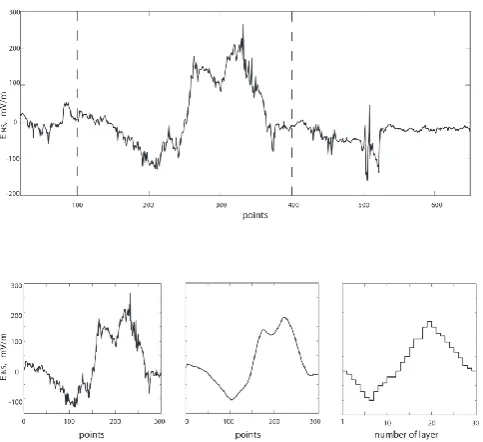
A structure of this type was encountered in the time in-terval marked by a horizontal bar with arrows in Fig. 1b. As seen from simultaneous magnetic observations, it is embed-ded in the downward Region 1 field-aligned current. A close-up of the structure is presented in Fig. 2 (top panel), where the dashed lines mark its borders. The bottom middle and right panels in this figure show the same structure being low-pass filtered with a cutoff scale of 448 m and approximated by a piecewise constant function. A resulting multilayer con-figuration is examined from the viewpoint of the IEDD the-ory, as will be described in Sect. 3.
From FAST magnetic observations the density of the background field-aligned current was estimated as ∼30×
10−6A m−2, which for the measured plasma density of 3×
103cm−3corresponded to the parallel drift velocity of elec-trons equal to 62 km s−1.
The measurements of ion composition by the TEAMS instrument on FAST indicated the presence of three ion species, O+, He+ and H+, in the considered time interval. Accordingly, in our calculations we tried three values of the ion-to-electron mass ratiomi/me.
To evaluate the IEDD dispersion relation, one also needs the value of temperature ratioτ =Ti
Te, whereTiandTeare the ion and electron temperatures. Unfortunately, the lowest en-ergies measured by the electrostatic analyzer (ESA) on FAST were 3 eV for ions and 4 eV for electrons; therefore in our treatmentTiandTewere free parameters. Using their values observed by other spacecraft in the events of structured elec-tric fields at similar altitudes (e.g., Basu et al., 1988),Tiwas varied in the range 0.1–0.6 eV andτ from 0.1 to 2. In set-ting large values ofτ, we suppose thatTiis elevated above the background level due to IEDD instability developing in a steady-state structure crossed by FAST.
3 Evaluation of the IEDD dispersion relation
We evaluate the IEDD dispersion relation of Ganguli et al. (1985a, b) for theE field configuration shown in Fig. 2, bottom right panel, and for assumptions made plausible from space observations described in the previous section.
Fig. 2. (top) An “isolated” electric field structure selected to be eval-uated by the IEDD theory. The dashed lines mark the borders of the structure; (bottom) the same structure being smoothed and approx-imated by a piecewise constant function.
Following Ganguli et al. (1985a, b), Gavrishchaka et al. (1996), Reynolds and Ganguli (1998), we consider the dispersion relation for the electrostatic ion-cyclotron (EIC) mode in the nonuniform plasma, where non-uniformities in thex direction are included by suggesting small values of the wave vector component kx, so that the substitution
kx→ −i∂/∂xcan be made (the background configuration is
assumed uniform in theyandzdirections). The plasma re-sponse then results in the second-order differential equation for the electrostatic potential φ. When the plasma parame-ters are piecewise constant, this (eigenvalue) equation can be written in each region as
(∂
2
∂ξ2+κ
2)φ (ξ )=0, (1)
whereξ= x
ρi,ρi the ion Larmor radius,
κ2(ξ )=
−2
1+τ+P
n
0n(b) (|k| |ω|1Vti)Z(
ω1−ni
|k| ||Vti )+τ (
ω1−k| |Vd
|k| ||Vte )Z(
ω1−k| |Vd |k| ||Vte )
P
n
00n(b) (|k| |ω|1Vti)Z(
ω1−ni
|k| ||Vti )
(2)
and the general solution forφin each region is a superposi-tion of two exponentials:∼exp(+iκx)and∼exp(−iκx). In Eq. (2),k2λ2i <<1 is assumed, whereλiis the Debye length
for ions, 0n(b)=In(b)exp(−b), where b=
(kyρi)2
2 , In are the modified Bessel functions,nbeing integer,0n0 = ∂
∂b0n,
[image:3.595.308.550.59.280.2]VtiandVteare the thermal velocities of ions and electrons, re-spectively, andZis the plasma dispersion function. The usual large (small) argument expansion is applied for the ion (elec-tron) Z function (e.g., Drummond and Rosenbluth, 1962). In the present study we retainn=0,±1 harmonics for ions andn=0 harmonic for electrons, and use that 00(be)=1 forbe≡(kyρe)
2 2 1.
The nonlocal dispersion relation is obtained for the piece-wise constant flow profile by matching bothφ and∂φ/∂x
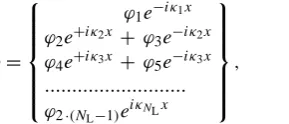
across the boundaries between the layers and assuming that the solution fades in the outermost regions. In the case ofNL layers we have
φ=
ϕ1e−iκ1x
ϕ2e+iκ2x+ ϕ3e−iκ2x
[image:4.595.310.544.61.156.2] [image:4.595.52.197.216.278.2] [image:4.595.309.547.306.401.2]ϕ4e+iκ3x+ ϕ5e−iκ3x
... ϕ2·(NL−1)e
iκNLx
, (3)
whereI m(κ1) >0,I m(κNL) >0. The two matching condi-tions (continuity ofφ and of ∂φ∂x across each boundary) ap-plied at NL−1 boundaries result in a set of 2·(NL−1) equations for amplitudesϕ1, ϕ2, . . ., ϕ2·(NL−1) of the poten-tial, which can be written as a matrix equation:
M·ϕ=0. (4)
Setting the determinant of the matrix M to zero gives a non-local dispersion relation:
det M=0. (5)
A shooting code was used to find roots of the nonlocal dis-persion relation in Eq. (5), which has multiple eigenstates in the presence of velocity shears for each set of parameters (for discussion see Reynolds and Ganguli, 1998).
Since from our analysis it appeared that for O+ions IEDD waves are destabilized more readily, that is, for a wider range of the input parameters, we present the results for this par-ticular species (µ≡mi/me=29 392). For definitenessTi= 0.5 eV is set, which corresponds toρi=10 m, given the ge-omagnetic field B0 at 1000 km altitude is about 40 000 nT. The ion thermal velocity isVti=2.4 km s−1, and the elec-tron thermal velocityVte=(µ/τ )1/2·Vti.
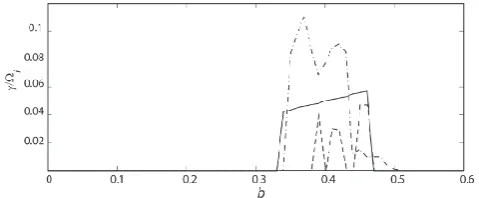
Figure 3 plots the growth rateγ normalized by the O+ gy-rofrequency (γ> 0 indicating destabilization) as a function of
bfor four different real frequenciesωrof the IEDD instabil-ity that develops in a nonuniform electric field configuration under study. The dashed line refers toωr=0.94, thick solid line toωr=0.96, dashed-dotted line toωr=0.98, and thin solid line toωr=0.99, whereωris the real frequency nor-malized byi. Other parameters areτ =0.5,Vd/Vte=0.1 andu≡k||/ k⊥=0.1. The dotted line in Fig. 3 indicates a CDEIC solution that would appear (atωr/ i=1.245) if the nonuniform electric fields were removed,Vd/Vte increased to 0.2 andutaken as 0.05.
Fig. 3. Plots of the growth rate normalized by the ion gyrofrequency
vs.b≡ (kyρi)
2
2 for the IEDD instability that develops in a
nonuni-form electric field configuration shown in Fig. 2, bottom right panel. The dashed line refers toωr=0.94, thick solid line toωr=0.96,
dashed-dotted line toωr=0.98, and thin solid line toωr=0.99,
whereωris the real frequency normalized byi. Other parameters
areτ=0.5,Vd/Vte=0.1 andu≡k||/ k⊥=0.1. The dotted line indicates a CDEIC solution that would appear (atωr/ i=1.245)
if the nonuniform electric fields were removed,Vd/Vte increased
to 0.2 andu taken as 0.05. The CDEIC solution degenerates for τ> 0.5.
Fig. 4. Behavior of the IEDD solutions shown in Fig. 3 forωr=
0.94 with varying temperature ratioτ: the dashed line refers toτ= 0.5, solid line toτ=1, and dotted line toτ=1.2.
In the runs illustrated in Fig. 3 and further in Figs. 4 and 5, we used a stepwise approximation of the steady-state struc-ture by 30 layers of constant width (shown in the bottom right panel in Fig. 2). We also tried other approximations with dif-ferent number of layers (NL ranging from 30 to 3) of both constant and variable widths. It was verified that unstable so-lutions are persistent to changes inNL, slightly shifting to smallerb values for coarser approximations ofE(x)in the structure.
Generally, the solutions for IEDD instability depend on the temperature ratioτ, getting scarcer with increasingτ. How-ever, this dependence is much weaker than that for CDEIC instability. For instance, the CDEIC root shown in Fig. 3 by the dotted line degenerates already atτ =0.6, while some of the IEDD roots typically persist atτ> 1. This can be seen in Fig. 4, where the evolution of the IEDD solutions obtained forωr=0.94 (dashed line in Fig. 3) with increasingτ is pre-sented.
Fig. 5. Behavior of the IEDD solutions shown in Fig. 3 forωr=
0.98 with varyingu: the dashed line refers tou=0.05, dashed-dotted line tou=0.1, and solid line tou=0.2.
∼0.2 (Fig. 5) ifωr=0.98 and all other parameters are such as those adopted in the case shown in Fig. 3. This range ofuis consistent with the range 0 <u< 0.22 determined by Bonnell et al. (1996) from interferometric observations of BBELF phase velocities with AMICIST sounding rocket in-strumentation.
4 Discussion
Accurate knowledge of the generation mechanism of the broadband electrostatic ELF waves in the auroral topside ionosphere is important, taking into account high correla-tion between this emission and ion transverse heating (e.g., André et al., 1998; Lund et al., 2000). In the previous sec-tions we demonstrated that the nonuniform electric fields (multiple shear layers) that are actually observed in the auroral region can destabilize the broadband electrostatic waves via the mechanism of IEDD instability proposed by Ganguli et al. (1985a, b) and generalized by Ganguli and Palmadesso (1988), Gavrishchaka et al. (1996), Reynolds and Ganguli (1998) and others.
One problem concerning the applicability of the theory of inhomogeneous energy-density-driven instability (IEDDI) is that the nonuniform electric fields in the auroral iono-sphere considered to be a driver of IEDD instability usu-ally have a magnetic counterpart (e.g., Mishin and Förster, 1995; Golovchanskaya et al., 2011), and thus a Poynting flux is present in the background configuration. Throughout this paper it was assumed that the magnetic counterpart is pro-duced by quasistatic field-aligned currents that are closed to the ionosphere (Vickery et al., 1986; Golovchanskaya et al., 2013), so that the Poynting flux input to the system dis-sipates in the conductive ionosphere and does not invali-date a quasi-static energy density consideration on which the IEDDI theory is based. Furthermore, generalization of the IEDDI theory to the electromagnetic regime was accom-plished by Peñano and Ganguli (1999, 2002). A class of unstable electromagnetic ion cyclotron (EMIC) eigenmodes were found. Tejero et al. (2011) reported on laboratory obser-vations of EMIC waves generated by a localized transverse
direct-current electric field. Peñano and Ganguli (1999, 2002) argue that electromagnetic IEDDI could account for the Poynting flux that originates from the ionosphere, being observed by satellites at a higher altitude.
As already mentioned, in the present study it is assumed that the frequencies in the satellite frame are Doppler-shifted frequencies, resulting from satellite traversing spatial struc-tures. Clearly, this is true for quasistatic fields. We note that this is also justified for O+ IEDD waves, since the FAST velocity of 7.5 km s−1several times exceeds their transverse phase velocity.
While in this brief report the results have been presented for a single event of the structured electric field observed by FAST in the auroral region (shown in Fig. 2), we tried several other structures of this type and verified their effectiveness in destabilizing IEDD waves. Generally, a common feature of the unstable IEDD solutions obtained for multilayer configu-rations is a variety of modes, which differ in frequencies and perpendicular wave numbers and persist even for zero paral-lel electron drift, as opposed to the solutions for the CDEIC instability (Kindel and Kennel, 1971), which occur for a sin-gle ωr and a single b, and require strong parallel electron drift.
Acknowledgements. Authors acknowledge the NASA National Space Science Data Center and R. C. Elphic, R. E. Ergun, R. J. Strangeway, and C. W. Carlson for FAST data usage. This work was supported by Program 22 of the Presidium of the Russian Academy of Sciences (RAS) “Fundamental problems of the Solar system exploration” and grant 13-01-00063a of RFBR.
Topical Editor K. Hosokawa thanks E. V. Mishin and one anony-mous referee for their help in evaluating this paper.
References
Amatucci, W. E., Koepke, M. E., Carroll III, J. J., and Sheridan, T. E.: Observation of ion-cyclotron turbulence at small values of magnetic-field-aligned current, Geophys. Res. Lett., 21, 1595– 1598, 1994.
Amatucci, W. E., Walker, D. N., Ganguli, G., Duncan, D., An-toniades, J. A., and Bowles, J. H.: Velocity-shear-driven ion-cyclotron waves and associated transverse ion heating, J. Geo-phys. Res., 103, 11711–11724, 1998.
André, M., Norqvist, P., Andersson, L., Eliasson, L., Eriksson, A. I., Blomberg, L., Erlandson, R. E., and Waldemark, J.: Ion energiza-tion mechanisms at 1700 km in the auroral region, J. Geophys. Res., 103, 4199–4222, 1998.
Basu, S., Basu, S., Mackenzie, E., Fougere, P. F., Coley, W. R., May-nard, N. C., Winningham, J. D., Sugiura, M., Hanson, W. B., and Hoegy, W. R.: Simultaneous density and electric field fluctua-tion spectra associated with velocity shears in the auroral oval, J. Geophys. Res., 93, 115–136, 1988.
Chang, T.: Colloid-like behavior and topological phase tran-sitions in space plasmas: Intermittent low frequency turbulence in the auroral zone, Phys. Scripta, T89, 80, doi:10.1238/Physica.Topical.089a00080, 2001.
Chang, T., Tam, S. W. Y., and Wu, C.: Complexity induced anisotropic bimodal intermittent turbulence in space plasmas, Phys. Plasma, 11, 1287–1299, 2004.
Daubechies, I.: Orthonormal bases of compactly supported wavelets, Commun. Pure Appl. Math., 41, 909–996, 1988. Drummond, W. E. and Rosenbluth, M. N.: Anomalous diffusion
arising from microinstabilities in a plasma, Phys. Fluids, 5, 1507–1513, 1962.
Ergun, R. E., Carlson, C. W., McFadden, J. P., Mozer, F. S., De-lory, G. T., Peria, W., Chaston, C. C., Temerin, M., Elphic, R., Strangeway, R., Pfaff, R., Cattell, C. A., Klumpar, D., Shelley, E., Peterson, W., Moebius, E., and Kistleret, L.: FAST satellite observations of electric field structures in the auroral zone, Geo-phys. Res. Lett., 25, 2025–2028, 1998.
Ganguli, G. and Palmadesso, P. J.: Electrostatic ion instabilities in the presence of parallel currents and transverse electric fields, Geophys. Res. Lett., 15, 103–106, 1988.
Ganguli, G., Palmadesso, P., and Lee, Y. C.: A new mechanism for excitation of electrostatic ion cyclotron waves and associated per-pendicular ion heating, Geophys. Res. Lett., 12, 643–646, 1985a. Ganguli, G., Lee, Y. C., and Palmadesso, P.: Electrostatic ion-cyclotron instability caused by a nonuniform electric field per-pendicular to the external magnetic field, Phys. Fluids, 28, 761– 763, 1985b.
Ganguli, G., Keskinen, M. J., Romero, H., Heelis, R., Moore, T., and Pollock, C.: Coupling of microprocesses and macropro-cesses due to velocity shear: An application to the low-altitude ionosphere, J. Geophys. Res., 99, 8873–8889, 1994.
Gavrishchaka, V., Koepke, M. E., and Ganguli, G.: Dispersive prop-erties of a magnetized plasma with a field-aligned drift and inho-mogeneous transverse flow, Phys. Plasmas, 3, 3091–3106, 1996. Golovchanskaya, I. V., Kozelov, B. V., Mingalev, O. V., Fedorenko, Y. V., and Melnik, M. N.: Magnetic perturbations in the events of broadband ELF turbulence observed by FAST, Geophys. Res. Lett., 38, L17103, doi:10.1029/2011GL049003, 2011.
Golovchanskaya, I. V., Kozelov, B. V., and Despirak, I. V.: Sea-sonal asymmetry in the broadband ELF electric fields observed by the FAST satellite, J. Atmos. Sol.-Terr. Phys., 99, 111–116, doi:10.1016/j.jastp.2012.12.011, 2013.
Hamrin, M., André, M., Ganguli, G., Gavrishchaka, V. V., Koepke, M. E., Zintl, M. W., Ivchenko, N., Karlsson, T., and Clemmons, J. H.: Inhomogeneous transverse electric fields and wave gener-ation in the auroral region: A statistical study, J. Geophys. Res., 106, A6, 10803–10816, 2001.
Heppner, J. P., Liebrecht, M. C., Maynard, N. C., and Pfaff, R. F.: High-latitude distributions of plasma waves and spatial irregular-ities from DE2 alternating current electric field observations, J. Geophys. Res., 98, 1629–1652, 1993.
Kindel, J. M. and Kennel, C. F.: Topside current instabilities, J. Geo-phys. Res., 76, 3055–3078, 1971.
Kintner, P. M., Bonnel, J., Arnoldy, R., Lynch, K., Pollock, C., and Moore, T.: SCIFER – Transverse ion acceleration and plasma waves, Geophys. Res. Lett., 23, 1873–1876, 1996.
Kintner, P. M., Franz, J., Schuck, P., and Klatt, E.: Interferometric coherency determination of wavelength or what are broadband ELF waves?, J. Geophys. Res., 105, 21237–21250, 2000. Koepke, M. E. and Amatucci, W. E.: Electrostatic ion-cyclotron
wave experiments in the WVU Q-machine, IEEE T. Plasma Sci., 20, 631–635, 1992.
Koepke, M. E., Amatucci, W. E., Carroll, J. J., and Sheridan, T. E.: Experimental verification of the inhomogeneous energy-density driven instability, Phys. Rev. Lett., 72, 3355–3358, 1994. Lund, E. J., Möbius, E., Carlson, C. W., Ergun, R. E., Kistler, L. M.,
Klecker, B., Klumpar, D. M., McFadden, J. P., Popecki, M. A., Strangeway, R. J., and Tung, Y. K.: Transverse ion acceleration mechanism in the aurora at solar minimum: occurrence distribu-tions, J. Atmos. Sol.-Terr. Phys., 62, 467–475, 2000.
Mishin, E. V. and Förster, M.: “Alfvénic shocks” and low-altitude auroral acceleration, Geophys. Res. Lett., 22, 1745–1748, 1995. Mozer, F. S., Carlson, C.W., Hudson, M. K., Torbert, R. B., Parady, B., Yatteau, J., and Kelley, M. C.: Observations of paired elec-trostatic shocks in the polar magnetosphere, Phys. Rev. Lett., 38, 292–295, 1977.
Peñano, J. R. and Ganguli, G.: Ionospheric source for low-frequency broadband electromagnetic signatures, Phys. Rev. Lett., 83, 1343–1346, 1999.
Peñano, J. R. and Ganguli, G.: Generation of electromagnetic ion cyclotron waves in the ionosphere by localized transverse dc electric fields, J. Geophys. Res., 107, SIA14.1–SIA14.7, doi:10.1029/2001JA000279, 2002.
Reynolds, M. A. and Ganguli, G.: Ion Bernstein waves driven by two transverse flow layers, Phys. Plasmas, 5, 2504–2512, 1998. Tam, S. W. Y., Chang, T., Kintner, P. M., and Klatt, E.: Intermittency
analyses on the SIERRA measurements of the electric field fluc-tuations in the auroral zone, Geophys. Res. Lett., 32, L05109, doi:10.1029/2004GL021445, 2005.
Tejero, E. M., Amatucci, W. E., Ganguli, G., Cothran, C. D., Crab-tree, C., and Thomas Jr., E.: Spontaneous electromagnetic emis-sion from a strongly localized plasma flow, Phys. Rev. Lett., 106, 185001, doi:10.1103/PhysRevLett.106.185001, 2011.