Copyright © 2019 (K. Hazel Kwon, Monica Chadha, and Feng Wang). Licensed under the Creative Commons Attribution Non-commercial No Derivatives (by-nc-nd). Available at http://ijoc.org.
Proximity and Networked News Public:
Structural Topic Modeling of Global Twitter Conversations
about the 2017 Quebec Mosque Shooting
K. HAZEL KWON
1MONICA CHADHA
FENG WANG
Arizona State University, USA
The current study used structural topic modeling to investigate the ways in which news of the 2017 Quebec mosque shooting mobilized global public discourse on Twitter. The resulting globally generated Twitter conversations were divided into 9 relevant topics, the prevalence of which were examined based on geographic and informational proximity to the location of the incident. Tweets posted from locations geographically closer to the shooting location prevalently incorporated individual-oriented and conflict-focused storytelling. Conversely, tweets geographically farther from the incident prevalently featured macro-narratives that pointed to societal implications. This study also explored informational distance, which defines the ability to access to in-depth news sources. Results showed that there were topical differences between journalist/institutional tweets and laymen tweets. This study concludes that proximity influences global conversations related to hate crime news.
Keywords: mass shooting, anti-Muslim, proximity, networked framing, topic modeling, networked public, hate crime, Twitter, construal level theory
Hate crimes are social malaises that threaten the health of a pluralistic society (Sacco, 1995), and the increase in anti-Muslim violence in Western societies has become a cause for concern. Islamophobia, which has long been prevalent in Western societies, has recently been amplified in the global political climate with the rise of White nationalism, influx of migrants from Muslim-majority countries to Western countries, and terrorist acts in the name of ISIS or the Islamic State. As well, Islamophobia has “gained momentum through global digital networks” in recent years, via online
K. Hazel Kwon: [email protected] Monica Chadha: [email protected] Feng Wang: [email protected] Date submitted: 2018‒11‒26
subcultural groups that circulate anti-Muslim imageries and various narratives that render Islamophobia as “accepted racism” in many parts of the West (Horsti, 2017, pp. 1440–1442). In multiple countries, anti-Muslim hate crimes have increased in recent years, along with a growing Islamophobic sentiment. The U.S. FBI reported that anti-Muslim crimes saw the biggest surge among all categories of hate crimes in the United States in recent years (Lichtblau, 2016). Likewise, Germany and the UK showed a large spike in violence against Muslim migrants in the past few years (Ahmed, 2017; Dodd & Marsh, 2017).
Although Canada is proud of its “attitudes sympathetic to immigration and globalized cultural diversity” (Deibert, 2016, p. 3), recent reports indicate that the anti-Muslim crime rate in Canada increased by 60% between 2014 and 2015 (“Anti-Muslim Crimes in Canada,” 2017), similar to trends observed in other Western nations. The current study focuses on an extreme example of such anti-Muslim violence: the mass shooting that occurred at the Islamic Cultural Centre in Quebec City, Canada, in January 2017. Henceforth, this incident will be referred to as “the Quebec mosque shooting.” Six people died and 19 others were injured when a perpetrator opened fire inside a local mosque during evening prayers. The shooter was outspoken about his anti-Muslim immigrant, antifeminist, pronationalism, and far-right views. He pleaded guilty to first degree murder and was sentenced to 40 years in prison. Although Canada’s prime minister Justin Trudeau called the event an act of domestic terrorism, the shooter was not officially charged with terrorism (Page, 2019).
The current study aims to explore how networked global publics construct news narratives in the aftermath of a seemingly localized hate crime event. When examining responses to domestic hate crime news, scholars have usually limited their focus to domestic audiences. However, Islamophobia is entrenched in many societies, and anti-Muslim violence could potentially draw not only domestic but also worldwide reactions. The current study addresses the worldwide spread of Islamophobia by broadening the research’s scope to the global level. Specifically, it examines global Twitter discourses regarding news of the Quebec mosque shooting. On social media platforms such as Twitter, discursive publics reified as a “hashtag community” (Bruns & Burgess, 2012, p. 803) have the potential to transcend geographic, national, or editorial boundaries (Papacharissi, 2015). Through these networked discourses, communities collectively make sense of why the event occurred and who should be held responsible for its cause and solution. Considering the recent increase of anti-Muslim sentiment and violence across many countries, global audiences’ exposure to and conversations about anti-Muslim violence could have local sociopolitical ramifications in their own cities and/or countries, even if the violence occurred far away from their local community.
Literature Background
Global News and Networked Public
Social media enables rapid spread of information across geographic boundaries, allowing audiences to not only consume a variety of media reports but also construct a bottom-up, spontaneous news narrative (Jiang, Leeman, & Fu, 2016; Papacharissi, 2015). Studying the ways in which networked publics engage with news events offers an insight to news sensemaking in the contemporary media ecology (Robinson, 2017). Emerging through the collective use of texts, hashtags, keywords, and/or retweets, networked publics often construct a news event differently from traditional media (Burch, Frederick, & Pegoraro, 2015; Jackson, Bailey, & Foucault-Welles, 2018). For example, Qin (2015) found that although traditional news outlets depicted whistle-blower Edward Snowden as a traitor, networked social media publics portrayed him as a hero who did the right thing. Burch et al. (2015) contended that Twitter public narratives are as important as mainstream news coverage in shaping public perceptions of political events.
Less discussed, however, is the extent to which a networked publics’ news narrative is influenced by proximity. Traditionally, media organizations have considered proximity as a fundamental news value (Oppegaard & Rabby, 2015), especially for international news journalists who prefer to select and report a global event in ways that resonates with local contexts and values (Schaeffer, 2003). Although proximity as a news value has mainly referred to geographic closeness (Oppegaard & Rabby, 2015), scholars also have expanded the concept to mean cultural, political and economic similarities (Al-Rawi, 2017). For instance, in a comparative analysis of U.S. news coverage of terrorist events in France versus Nigeria, Nevalsky (2015) found that the U.S. media depicted France—a Western democracy like the United States—more favorably. Specifically, the U.S. news coverage depicted Nigeria as being ill-equipped to deal with terrorist threats, but it depicted France as capable of handling terrorist situations, even if the attack was planned and sophisticated. Nevalsky (2015) contended that such difference in news reporting was influenced by the United States’ closer cultural and economic proximity to France versus Nigeria, which could reiterate a stereotype of the global South.
Proximity and Networked Public’s News Narratives
Unlike traditional news outlets, social media is a space not bound by newsroom practices. On social media, networked publics may share and talk about a global news event freely, unrestricted by journalistic values and norms. Therefore, a networked public’s storytelling could be better attributed to social cognitive processes that occur in the minds of audiences when thinking, perceiving, and talking about events. That is, the notion of a networked public’s news proximity is better conceived broadly as a psychological concept rather than a news value (Kwon, Chadha, & Pellizzaro, 2017).
As a theoretical framework, construal level theory (CLT; Trope & Liberman, 2010) may accurately describe networked public storytelling, as it assists to examine networked news narratives as a product of collective cognitive processes rather than as an outcome of newsroom routines (Kwon et al., 2017). Also, CLT defines proximity as “psychological distance” that comprises multidimensional determinants including time (temporal distance), space (geographic distance), culture and socioeconomic similarities (cultural distance), relational affinity (social distance), and accessibility to information (informational distance; Fiedler 2007; Liviatan, Trope, & Liberman, 2008; Trope & Liberman, 2010, p. 440). The theory suggests that an individual is likely to think in more abstract terms if an action or event occurs at a time, place or to someone that is psychologically distant to the self. Conversely, a person is likely to think in more concrete terms (i.e., specific details) if the time, place or people involved are psychologically closer to the self. The level of abstractness versus concreteness of a message is what Trope and Liberman (2010) call the construal level, which influences individuals’ judgements and decisions. For instance, if an event will occur in the distant future, someone may speak it in terms of its desirability—what it should be like (high construal). If the event will occur closer in time (e.g., within days), then people are more likely to think of it in terms of feasibility— what should be done (low construal; Trope & Liberman, 2010). Furthermore, people may perceive socially or culturally dissimilar others as psychologically distant from themselves and therefore evaluate their behaviors more stereotypically as a uniformed collective. In contrast, socially and culturally similar others will be perceived as individuals with unique traits (Eyal, Liberman, & Trope, 2008). In other words, people paint distant others in broad strokes that may lead to stereotyping, and they respect individual differences and singularities when they perceive others as being psychologically close.
News Storytelling of Mass Shooting Events
Violence is a “durable news commodity” that comprises a nontrivial portion of news coverage (Sacco, 1995, p. 142). As with other news topics, journalists employ the principles of newsworthiness when reporting on international violence events, such as victimization, responsibility attribution, and profiles of perpetrators (Weimann & Brosius, 1991). These themes are also consistently found in the coverage of domestic crimes, such as mass shooting incidences (Husselbee & Elliott, 2002; Iyengar, 1993), although the responsibility attribution of a domestic event often conflates individual traits with interracial/ethnic biases (Dixon, 2008; Gorham, 2006; Iyengar, 1993). For example, when the perpetrator is non-White, media coverage tends to employ the otherness frame, which underlines out-group identity markers such as ethnic background, foreign origin, immigrant status, and language proficiency (Chuang, 2012).
One notable characteristic of mass shooting news storytelling is to juxtapose the lone-wolf and terrorist analogy, with the former focusing on an individual perpetrator’s mental state and the latter linking the perpetrator’s action to a bigger scheme of political ideology (Chuang & Roemer, 2013; Morin, 2016; Nacos & Torres-Reyna, 2007). The “lone-wolf” narrative constructs an episodic and low-construal news frame as it focuses on individual attributes, whereas the “domestic terrorism” narrative relates to a thematic and high-construal frame by underscoring societal and political factors. However, this dichotomy may be problematic, as some so-called domestic terrorist perpetrators do have an individual history of mental illness (Gruenewald, Chermak, & Freilich, 2013).
Another practice for reporting mass shootings is what Chyi and McCombs (2004) refer to as “changing-frame” (p. 24). A changing frame focuses on the relationship between the temporal development of the event and the spatial scope of news coverage (e.g., Holody & Daniel, 2017; Kwon & Moon 2009; Muschert & Carr, 2006). Although the changing frame does consider temporal and geographical proximity, studies that have adopted the changing frame have rarely associated proximity with other topical prominences or news values. Considering that traditional newsworthiness may have a spillover effect on networked audiences’ discourses in social platforms (Trilling, Tolochko, & Burscher, 2017), this study examines whether and how proximity influences the prominence of news topics and news values in the networked conversations surrounding the Quebec mosque shooting.
Research Questions
The current study explores the ways in which proximity influenced networked global conversations on Twitter regarding the Quebec mosque shooting. Our first research question (RQ1) asks the following:
RQ1: What news topics and values emerged from Twitter conversations about the Quebec mosque shooting?
The next set of research questions investigated the relationship between proximity and prominence of news topics. Based on CLT, we defined proximity as the global public’s psychological distance to the Quebec mosque shooting. We contend that proximity influences the construal level of Twitter conversations. Specifically, within the concept of psychological distance, this study addressed two proximity variables: geographic and informational distance. The first variable, geographic distance, is fundamental to the perception of psychological distance (Liberman & Trope, 1998). For example, in the context of the Quebec mosque shooting, although both Toronto and Vancouver are Canada’s major cities, Toronto is geographically closer to Quebec than Vancouver is. Such differences in geographic distance may trigger different construal levels in the minds of audience members, resulting in different levels of abstraction in their storytelling. Thus, the second research question asked in this article follows:
RQ2: How did geographic distance influence the construal level of Twitter conversations about the Quebec mosque shooting?
The second proximity variable, informational distance, is especially relevant to news storytelling. Informational distance refers to an individual’s ability to access relevant information from primary or secondary sources to understand the event. Journalists and institutional elites may have immediate access to primary news sources and thus could offer granular descriptions of the incident. On the contrary, the majority of networked publics are lay people who may not have such informational access and thus rely on secondary sources. Subsequently, they tend to talk about the event in a nonspecific, abstract manner. Exceptions could be made for local residents who have their sources within the community and thus have access to specific information. Following the logic of CLT, the third research question inquires whether informational distance influences the ways in which news narratives are constructed.
RQ3: How did informational distance—specifically, of layman tweets versus journalist and institutional tweets—influence the construal level of Twitter conversations about the Quebec mosque shooting?
Social and cultural distances may also affect the construal level of a message (Liberman & Trope, 1998). However, prior studies have operationalized social and cultural distances in interpersonal relational contexts (e.g., Eyal et al., 2008), which are hardly inferable from the big Twitter data. Another proximity variable, temporal distance, was excluded from the analysis, as the data is comprised of tweets posted in the week immediately after the incident. Our sample showed that tweets about the Quebec mosque shooting rapidly dwindled within a couple of days, which aligned with the overall temporal pattern of information diffusion on Twitter (Kwak, Lee, Park, & Moon, 2010). Another study (Kwon et al., 2017) found no meaningful temporal changes in terrorism news frames within such a short period on Twitter.
Method
Data Collection
excluding duplicate tweets. From the sample, we removed non-English and illegible tweets (e.g., broken fonts). Tweets posted in French, which comprised about 20% of the total volume (N = 135,386), were excluded because of the researchers’ limited proficiency in the French language. Although excluding French tweets posed a potential limitation, we decided to use only English language tweets to enhance interpretability.
Measurements
Geographic Distance
Measuring geographic distance requires location detection. Location detection is a challenging task for Twitter data due to the scarce use of accurate geotags. Although the majority of Twitter users self-report location information in their profiles, some could use bogus locations. Valid locations may have nonstandard spelling or characters, either by mistake or intentionally to thwart automated systems. Although acknowledging these limitations, we adopted the Twitter geo-tagging algorithm of Wang et al. (2016) to detect the geographic locations of tweets based on four resolvers: tweet coordinates, tweet place, location in user profile, and tweet texts. This algorithm expanded the “Carmen” library in Python (Dredze, Paul, Bergsma, & Tran, 2013) by adding zip codes, airport codes, monuments, nicknames, possible spelling errors, and so on. As a result, we resolved the latitudes and longitudes for 80.09% of the tweets (N = 404,652). Based on the resolved spatial information, geographic distance (in miles) was measured as the physical distance between the tweeted location and the County of Quebec, Canada. This distance was then log transformed for further analysis.
Informational Distance
Informational distance is defined as one’s ability to access relevant information from primary and/or second sources. We operationalized informational distance based on a previous study that applied supervised machine learning to classify whether a tweet belonged to a professional journalist, media organization, or established institutional actor, as opposed to general publics (Kwon, Priniski, & Chadha, 2018). By using the manually coded training and test data sets, as well as the Random Forest algorithm applied in the previously mentioned study (Kwon et al., 2018), we automatically classified our data corpus into journalist/institutional tweets versus general user tweets. The classification model showed high accuracy, precision, and recall rates, each of which reached .90 or above. For details, see Kwon et al. (2018).
Analytic Strategy: Structural Topic Modeling
The second approach, unsupervised learning, is useful when there is no rigorous a priori classification scheme (Roberts et al., 2014, p. 1071), as was the case in our study. Structural topic modeling (STM) is a popular unsupervised learning technique for text analysis, based on a topic modeling algorithm called latent Dirichlet allocation (LDA). The LDA algorithm identifies latent topics not against predefined categories but rather from patterns of words that occur together in documents (i.e., tweets in this study). In other words, multiple topic clusters are detected from the distributions of words that, together, “represent semantically interpretable themes” (Roberts et al., 2014, p. 1066).
One advantage of STM is that it assumes the presence of multiple topics in a single document. For example, STM can account for both thematic and episodic frames found in a single news story, while acknowledging that one frame may be more prominent. Such disproportionate visibility of topics is called “topical prevalence” (Roberts et al., 2014, p. 1068), usually computed as a statistical probability. For instance, suppose STM examines two tweets and identifies two topics (e.g., individual perpetrator vs. societal conditions) present in the tweets’ word distributions. In the first tweet, 90% of the words are strongly associated with the description of the perpetrator (e.g., “criminal” or “shooter”), whereas the remaining 10% are associated with societal conditions (e.g., “policy” or “government”). The second tweet has the opposite combination of words, where 90% are associated with societal conditions and 10% are associated with perpetrator characteristics. Then, STM generates a matrix consisting of tweet-topic probabilities:
𝐷 = $0.9 0.1 0.1 0.9),
where D is a matrix that represents topic probability vectors for the examined tweets, wherein each row pertains to each tweet and each column indicates each topic. Once topical prevalence is determined, STM then uses the resulting probability information to test regression-based statistical relationships between the covariates of interest (e.g., proximity variables in this study) and each of the generated topics.
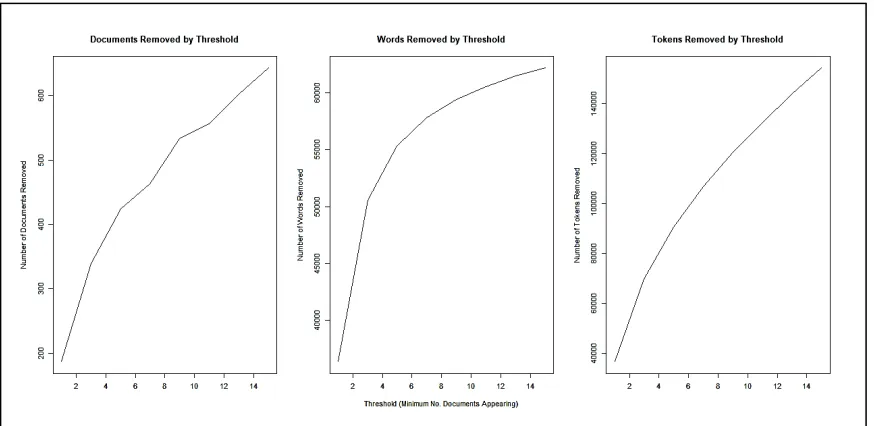
Figure 1. Changes in the number of documents (tweets), unique words, and tokens (total word counts) according to the level of threshold.
Results
Data Description
In the location detection process, 172 countries were identified as location origins for the sample tweets, reflecting that the Quebec shooting was indeed globally disseminated via Twitter. Among them, not surprisingly, Canada accounted for the largest portion of tweets (N = 208,245; 51.46%), and the majority of these messages originated from Quebec (N= 142,237). The United States produced the second highest number of tweets (N = 151,969; 37.56%), followed by the UK and France.
The average geographic distance of tweeting locations from Quebec was 1,995.65 miles. The tweet volumes showed a power-law distribution along the geographic distances, meaning that the immediate vicinity (i.e., Quebec) generated a disproportionately large number of tweets, with a long tail beginning at around 5,000 miles. Given the nonlinearity of the sample, further analysis related to geographic distance was based on the log-transformed value. For informational distance, 35,248 tweets (8.70%) were classified as journalist/institutional tweets; the rest were classified as laymen tweets.
What News Topics and Values Emerged From Twitter Conversations? (RQ1)
well as manual reviews by the authors on the degree of thematic overlaps across topic clusters, we selected our 10-topic model for further interpretation.
The clustering result alone lacked meaning without human insight, as clusters were computationally determined purely by patterns of how words co-occurred in a tweet. Therefore, we identified 1,000 most representative tweets of each cluster, which showed a high topic prevalence probability for a given topic and inferred thematic characteristics from them. The majority of tweets bundled by STM into the same topic cluster were retweets or variations of similar messages. However, each cluster also included some portions of irrelevant tweets that created noise, which we took into consideration when interpreting results. For further validation, a small sample of tweets from each topic cluster (n = 75) were manually coded for intercoder reliability test, Cohen’s kappa =.83.
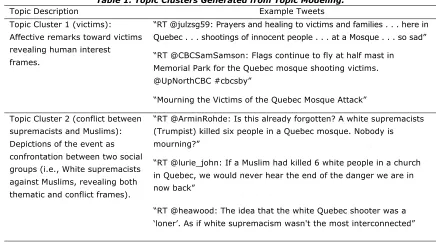
[image:10.612.86.527.406.657.2]Of the 10 topic clusters, nine were directly related to the Quebec shooting. The remaining cluster included mostly irrelevant tweets—for example, “4am: light snow and blowing snow −10.8C—Feels: −21C— . . . #Quebec #Weather.” This cluster was removed from further analysis. Also, two clusters contained the similar nature of conversations and thus was read as conveying the same theme. As a result, the theme of each topic cluster was interpreted as follows: victims (Topic Cluster 1), conflict between supremacists and Muslims (Topic Cluster 2), hate crime (Topic Cluster 3), immigration and Islamophobia (Topic Cluster 4), the shooter (Topic Clusters 5 and 6); Muslim community (Topic Cluster 7), government response (Topic Cluster 8), media bias (Topic Cluster 9), and irrelevant content (Topic Cluster 10). Table 1 explains our interpretation of the thematic characteristics of each topic cluster, along with example tweets.
Table 1. Topic Clusters Generated from Topic Modeling.
Topic Description Example Tweets
Topic Cluster 1 (victims): Affective remarks toward victims revealing human interest frames.
“RT @julzsg59: Prayers and healing to victims and families . . . here in Quebec . . . shootings of innocent people . . . at a Mosque . . . so sad” “RT @CBCSamSamson: Flags continue to fly at half mast in Memorial Park for the Quebec mosque shooting victims. @UpNorthCBC #cbcsby”
“Mourning the Victims of the Quebec Mosque Attack” Topic Cluster 2 (conflict between
supremacists and Muslims): Depictions of the event as confrontation between two social groups (i.e., White supremacists against Muslims, revealing both thematic and conflict frames).
“RT @ArminRohde: Is this already forgotten? A white supremacists (Trumpist) killed six people in a Quebec mosque. Nobody is mourning?”
“RT @lurie_john: If a Muslim had killed 6 white people in a church in Quebec, we would never hear the end of the danger we are in now back”
Topic Cluster 3 (hate crime and misinformation): Definitions of the event as a hate crime, and/or a report of error of Fox News misidentifying the perpetrator as a Moroccan national.
“RT @DavideMastracci: The #QuebecShooting is not an isolated incident. Hate crimes against Muslims doubled from 2012 to 2014” “Hate crime as spillover from the US criticizes islamophobia increase”
“@cristinalaila1 - I'll remind you how you fell for the #fakenews of the #Quebec shooter being Muslim”
Topic Cluster 4 (immigration and Islamophobia): Reflections on immigration or refugee policy and anti-immigrant sentiments.
“A hateful fringe stirs as Canada embraces migrants, by CRAIG S. SMITH and DAN LEVIN via The New York Times”
“RT @DarrylLeroux: Read the work of @UwokwaMugabo & find out more about history of anti-black Islamophobia in Quebec.
#QuebecShooting”
“RT @mawovan: Out rallying against #Islamophobia #noIslamophobia #Vancouver #MosqueeQuebec #Quebec #NoBanNoWall #NoWar #vanpoli #cdnpo”
Topics Clusters 5 and 6 (shooter): Comments on the perpetrator’s individual traits and background.
“RT @markhughesfilms: The white nationalist terrorist who massacred Muslims in Quebec was a Trump supporter”
“@juvelenah I'm not shocked that he's a #trump supporter. So disgusting. #SupportRefugees #onerace #QuebecShooting” “RT @EdwardTHardy: The Quebec shooter was a terrorist. Not a lone wolf. A terrorist.”
“RT @Lompemann: What could possibly be Quebec terrorist Alexandre Bissonnette's motive for killing Muslims . . .?” Topic Cluster 7 (Muslim
community): Responses from Muslim communities (e.g., reopening the mosque, reminder of religious principles, expert commentators).
“RT @worldnews_net: Quebec City mosque reopens for prayers after deadly mass shooting.”
“RT @feministabulous: The consequence of islamophobia in one image: Mohamed Labidi president of the mosque in Quebec city shooting weeps.”
“RT @TheCurrentCBC: Living as a Canadian Muslim after QC shooting with @shireenahmed_@MohamedHuque &
@CCMWCanada's Farida Mohamed” Topic Cluster 8 (government
response and solidarity): Discussions on government responses and calls for national solidarity.
“RT @TonySeskus: We cannot be divided by these hate-mongers. These tragic incidents bring us together.”
“RT @newsking2k1: Refugees fleeing FROM the US. This is who we are now.”
Topic Cluster 9 (media bias): Criticism against news media’s and public figures’ inattention to the event.
“RT @ASE: Weird now that police here in Quebec confirm shooter is White young male with Supremacist views the story DISSAPEARS from @Breitbart”
“RT @ThePerezHilton: No one died. And not one tweet from you after SIX DIED in a shooting at a Quebec mosque by a white Canadian nationalist.”
“Explains why @Potus is surprisingly quiet about #QuebecShooting” Topic Cluster 10 (Irrelevant
Content): Not included in data analysis.
“4am: light snow and blowing snow -10.8C - Feels: -21C - . . . #Quebec #Weather”
“Quebec's FIMAV Reveals Full 2017 Lineup with Terry Riley”
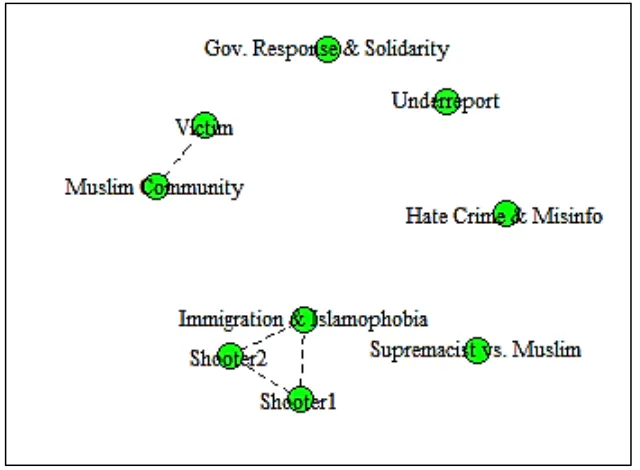
Several of the identified topic clusters demonstrated both episodic and thematic frame components. For example, Topic 1 included discourse about victims of the tragedy, whereas Topics 5 and 6 highlighted the perpetrator’s troubled ideological stance as the cause of the issue. With this focus on the individual level, the victim or perpetrator-oriented storytelling in these topic clusters resonates with Iyengar’s (1993) conceptualization of episodic frame. However, the traditional definition of episodic frame may understate the complexity of narratives found in the conversations among networked publics. For example, although Topic 1 predominantly focused on the victims, its messages also included an abundance of collective guilt and alluded to the public’s moral responsibility for those who died in the shooting. Moreover, the analysis of topic prevalence indicated that Topic 1 tended to occur with Topic 7 in the same tweet, which offered a broader perspective regarding the Muslim community at large.
Figure 2. Correlations among topic clusters. The correlated topics are indicated as connections. The connected topics are likely to occur together in one tweet.
Various topic clusters for this study included discussions of intercultural tensions, the status quo of Muslim communities in Western society, and the rise of White nationalism. For example, Topic 2 (conflict between supremacists and Muslims) included tweets that highlighted the victimization of the former by the latter. Topic 7 (Muslim community) included tweets that focused on the troubling reality of hate crimes against Muslims. Both Topic 4 (immigration and Islamophobia) and Topic 8 (government response) called for national solidarity as well as governmental and societal actions such as revisiting immigration and refugee settlement policies.
Proximity and Construal Level of Twitter Conversations (RQ2 and RQ3)
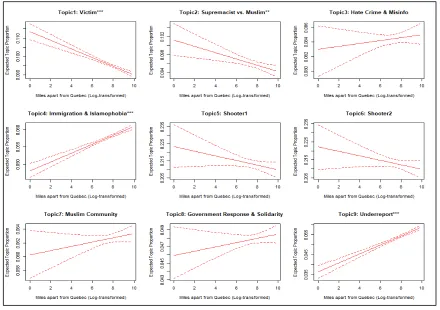
RQ2 and RQ3 asked how geographic and informational distance, respectively, influenced the construal level of Twitter conversations regarding the Quebec mosque shooting. In terms of geographic distance, tweets posted from locations close to where the event took place included more issue-specific (i.e., low construal) accounts of the shooting. For example, victim-related stories (Topic 1) and emphasis on conflict between White supremacists and Muslims (Topic 2) appeared more frequently in tweets posted from geographically close areas. Conversely, tweets from geographically farther locations tapped on broader societal issues such as immigration policy and Islamophobia (Topic 4) and media bias (Topic 9). Figure 3 shows the effect of geographic distance on the distribution of each topic cluster.
[image:14.612.89.529.262.572.2]**p < .01. ***p < .001.
Figure 3. Geographic distance and topic distributions.
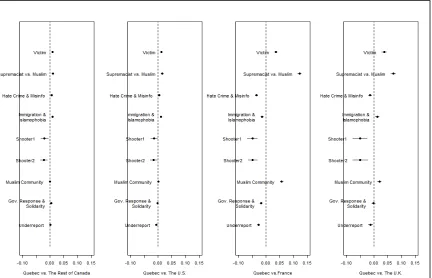
Specifically, tweets related to the shooter (Topics 5 and 6) were significantly less frequent in France and the UK, whereas conversations related to victims (Topic 1), conflict between supremacists and Muslims (Topic 2), and the Muslim community (Topic 7) were more prominent in tweets posted from France and the UK than from the Quebec region, the rest of Canada, and the United States. Figure 4 presents differences in topic distribution across the different countries.
Figure 4. Topical distributions of different countries, with Quebec as the reference location. The whiskers indicate 95% confidence intervals.
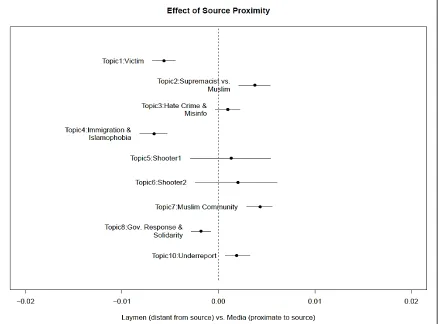
Figure 5. Topic distribution by informational distance, represented as media (journalist and institutions) versus laymen tweets. The whiskers indicate 95% confidence intervals.
Discussion and Conclusion
The social media environment allows a seemingly isolated hate crime to influence the minds of audiences situated far away. The current study investigated networked global publics’ Twitter conversations in the aftermath of the Quebec mosque shooting, an anti-Muslim crime that occurred in Quebec, Canada, in 2017. Overall, the study showed that perpetrator-related storytelling was a predominant topic during the Quebec mosque shooting, in line with previous discussions about mass shooting news coverage (Chyi & McCombs, 2004).
perceived a greater psychological closeness to the shooter, which led them to be more concerned with granular details of the shooter’s identity as both an individual and fellow Quebec resident (low construal).
An in-depth reading of the tweets revealed that the networked public’s news storytelling defied the episodic-thematic dichotomy, which challenges extant understanding of terror-related news framing. Particularly, many tweets from Quebec included both episodic discussions of the shooter and thematic criticisms of U.S. President Donald Trump’s political ideology for influencing the shooter’s extreme views. In fact, the reference of Donald Trump was prevalent across other topic clusters as well. For example, a tweet that exemplified Topic 3 (hate crime and Islamophobia) said, “the #QuebecMosqueAttack has 1 person to blame #POTUS #Trump 4 inciting fear xenophobia and racist hate against #Muslims.” Our inductive approach using STM, designed to acknowledge different topical scopes that occurred together in one message, was best suited to address such combination of episodic and thematic elements.
Consistent with Qin (2015) and Burch et al. (2015), who suggested that Twitter news storytelling is distinct from mainstream news coverage, our results alluded that networked publics do not adhere to journalistic norms or routines. Tweets by the general public were more likely to express sympathy and condolences to victims than tweets by journalists/institutions, and they were more inclined to link the event to societal conditions such as immigration policy, government responses, and national solidarity. Laymen tweets were characterized with a high construal level, as they included abstract language related to broader ideas. The high construal level may be attributed to far informational distance from the incident, as general audiences have little access to authoritative sources who can provide specific details or related policies.
Journalist and institutional tweets often highlighted the tension between White supremacists and Muslim victims (Topic 2) in their narratives. This conflict-oriented narrative was less prominent in general users’ tweets, possibly because conflict has an entrenched news value that media practitioners seek when reporting a crime such as a mass shooting. Muslim community-related stories (Topic 7) were also more prevalent in journalist and institutional tweets than laymen tweets, possibly due a closer information distance between journalists and the Muslim community. For example, journalists may be better connected with leaders of social institutions and community organizations representative of Muslim populations.
A high volume of tweets highlighted media bias, suggesting that the Twitter platform enabled users to assume a “watchdog” role over elite media institutions and hold them accountable. Interestingly, journalists and institutional users tweeted about media bias more than general users, which implies that they were holding each other accountable for the news coverage.
Our findings on geographic distance were in line with CLT. Individual-oriented conversations (low construal) were more prominent in tweets that originated from geographically close locations, whereas tweets that originated from geographically farther distances tended to contain macro-level, thematic discussions such as immigration policy and media bias (high construal).
though France is geographically farther away from Quebec. Such inconsistency may be attributed to the sociopolitical circumstance of each country. It is possible that topics of conflict (Topic 2) and the Muslim community (Topic 7) were particularly salient in tweets from France due to the “extraordinary discrimination” French Muslims have experienced (Sides, 2015). In recent years, France has seen a massive influx of migrants, a significant portion of whom are Muslim (Sherwood, 2017). A survey found that many French citizens were concerned not only about the burden these migrants would put on their nation, but also an increase in terror-related activities (Poushter, 2016). Meanwhile, Canada and the United States were similar in topic distribution, possibly due to cultural similarities and shared political ties.
This study is not without limitations. First, although Twitter is a useful data source to examine networked global publics’ conversations, there is growing evidence that data collected via Twitter Stream API could be systematically biased (Freelon 2018; González-Bailón, Wang, Rivero, Borge-Holthoefer, & Moreno, 2014). The use of Stream API allows access to only 1% of the total tweets posted in real time, and the selection criteria for this 1% capture is unknown to researchers outside of Twitter (Driscoll & Walker, 2014). Such algorithmic filtering could cause a sampling bias (Kwon et al., 2018). Furthermore, this study only accounted for English-language tweets, yet Quebec is primarily a French-speaking region. Excluding French-language tweets may also have produced unknown sampling bias. Another possible source of sampling bias may be the limitations of our location detection process, which relied heavily on self-reported locations and implicit geo-local cues present in the tweets. To that end, we may have excluded more tweets from general users than from journalists/institutions, as general users are more likely to have missing or inaccurate location information. Although we had to exclude nongeotagged tweets because STM does not allow a missing variable, the elimination of nongeotagged tweets could unintentionally affect the results related to informational distance (journalist vs laymen). Also, although defining the difference between journalist and laymen tweets as a purely informational distance was a useful operationalizable treatment, it could be an oversimplified interpretation. Journalists and institutional actors may use tweets with different goals (e.g., professional work) from ordinary users (e.g., personal sharing). Accordingly, even without considering their closeness to news source, the two groups could show different language uses and topical interests.
References
Ahmed, A. S. (2017). Islamophobia thriving in Europe, new report Says. Huffington Post. Retrieved from
https://www.huffingtonpost.com/entry/islamophobia-thriving-in-europe-new-report-says_us_58dd909ce4b05eae031e8eb4#
Al-Rawi, A. (2017). News values on social media: News organizations’ Facebook use. Journalism, 18(7), 871–889. doi:10.1177/1464884916636142
Anti-Muslim crimes in Canada up 60%, StatsCan reports. (2017). CBC News. Retrieved from http://www.cbc.ca/news/politics/hate-crimes-muslims-statscan-1.4158042
Barisione, M., Michailido, A., & Airoldi, M. (2017). Understanding a digital movement of opinion: The case of #refugeeswelcome. Information, Communication & Society. Advance online publication. doi:10.1080/1369118X.2017.1410204
Bruns, A., & Burgess, J. (2012). Researching news discussion on Twitter. Journalism Studies, 13(5/6), 801–814. doi:10.1080/1461670X.2012.664428
Burch, L. M., Frederick, E. L., & Pegoraro, A. (2015). Kissing in the carnage: An examination of framing on Twitter during the Vancouver riots. Journal of Broadcasting and Electronic Media, 59(3), 399– 415. doi:10.1080/08838151.2015.1054999
Chuang, A. (2012). Representations of foreign versus (Asian) American identity in a mass-shooting case: Newspaper coverage of the 2009 Binghamton massacre. Journalism & Mass Communication Quarterly, 89(2), 244–260. doi:10.1177/1077699012439179
Chuang, A., & Roemer, R. C. (2013). The immigrant Muslim American at the boundary of insider and outsider: Representations of Faisal Shahzad as “homegrown” terrorist. Journalism & Mass Communication Quarterly, 90(1), 89–107. doi:10.1177/1077699012468740
Chyi, H. I., & McCombs, M. (2004). Media salience and the process of framing: Coverage of the Columbine school shootings. Journalism & Mass Communication Quarterly, 81(1), 22–35.
doi:10.1177/107769900408100103
Curran, J., Esser, F., Hallin, D. C., Hayashi, K., & Lee, C. C. (2017). International news and global integration: A five-nation reappraisal. Journalism Studies 18(2), 118–134.
doi:10.1080/1461670X.2015.1050056
Dixon, T. L. (2008). Crime news and racialized beliefs: Understanding the relationship between local news viewing and perceptions of African Americans and crime. Journal of Communication, 58(1), 106–125. doi:10.1111/j.1460-2466.2007.00376.x
Dodd, V., & Marsh, S. (2017, June 7). Anti-Muslim hate crimes increase fivefold since London Bridge attacks. The Guardian. Retrieved from https://www.theguardian.com/uk-news/2017/jun/07/anti-muslim-hate-crimes-increase-fivefold-since-london-bridge-attacks
Dredze, M., Paul, M. J., Bergsma, S., & Tran, H. (2013, June). Carmen: A Twitter geolocation system with applications to public health. AAAI Workshop on Expanding the Boundaries of Health Informatics Using AI (HIAI), Making Proactive, Personalized, and Participatory Medicine a Reality (pp. 20–24). Retrieved from https://www.aaai.org/ocs/index.php/WS/AAAIW13/paper/view/7085/6497
Driscoll, K., & Walker, S. (2014). Big data, big questions | Working within a black box: Transparency in the collection and production of big twitter data. International Journal of Communication, 8, 1745–1764.
Entman, R. M. (1993). Framing: Toward clarification of a fractured paradigm. Journal of Communication, 43(4), 51–58. doi:10.1111/j.1460-2466.1993.tb01304.x
Eyal, T., Liberman, N., & Trope, Y. (2008). Judging near and distant virtue and vice. Journal of Experimental Social Psychology, 44(4), 1204–1209. doi:10.1016/j.jesp.2008.03.012
Fiedler, K. (2007). Construal level theory as an integrative framework for behavioral decision-making research and consumer psychology. Journal of Consumer Psychology, 17(2), 101–106. doi:10.1016/S1057-7408(07)70015-3
Freelon, D. (2018). Computational research in the post-API age. Political Communication, 35(4), 665–668. doi:10.1080/10584609.2018.1477506
Gerhards, J., & Schäfer, M. S. (2014). International terrorism, domestic coverage? How terrorist attacks are presented in the news of CNN, Al Jazeera, the BBC, and ARD. International Communication Gazette, 76(1), 3-26. doi:10.1177/1748048513504158
González-Bailón, S., Wang, N., Rivero, A., Borge-Holthoefer, J., & Moreno, Y. (2014). Assessing the bias in samples of large online networks. Social Networks, 38, 16–27. doi:10.1016/j.socnet.2014.01.004
Gorham, B. W. (2006). News media’s relationship with stereotyping: The linguistic intergroup bias in response to crime news. Journal of Communication, 56(2), 289–308. doi:10.1111/j.1460-2466.2006.00020.x
Holody, K. J., & Daniel, E. S. (2017). Attributes and frames of the Aurora shootings. Journalism Practice, 11(1), 80–100. doi:10.1080/17512786.2015.1121786
Horsti, K. (2017). Digital Islamophobia: The Swedish woman as a figure of pure and dangerous whiteness. New Media & Society, 19(9), 1440-1457. doi:10.1177/1461444816642169
Husselbee, L. P., & Elliott, L. (2002). Looking beyond hate: How national and regional newspapers framed hate crimes in Jasper, Texas, and Laramie, Wyoming. Journalism & Mass Communication Quarterly, 79(4), 833–852. doi:10.1177/107769900207900405
Iyengar, S. (1993). Is anyone responsible? Chicago, IL: University of Chicago Press.
Jackson, S. J., Bailey, M., & Foucault-Welles, B. (2018). # GirlsLikeUs: Trans advocacy and community building online. New Media & Society, 20(5), 1868‒1888. doi:10.1177/1461444817709276
Jiang, M., Leeman, R. W., & Fu, K. (2016). Networked framing: Chinese microbloggers’ framing of the political discourse at the 2012 Democratic National Convention. Communication Reports, 29(2), 87–99. doi:10.1080/08934215.2015.1098715
Kasmani, M. F. (2014). The nation-state factor in global news reporting: A study of the BBC World News and Al Jazeera English coverage. International Communication Gazette, 76(7), 594–614. doi:10.1177/1748048514547835
Kwak, H., Lee, C., Park, H., & Moon, S. (2010). What is Twitter, a social network or a news media? In Proceedings of the 19th International Conference on World Wide Web (pp. 591–600). doi:10.1145/1772690.1772751
Kwon, K. H., Chadha, M., & Pellizzaro, K. (2017). Proximity and terrorism news in social media: A construal-level theoretical approach to networked framing of terrorism in Twitter. Mass Communication and Society, 20(6), 869–894. doi:10.1080/15205436.2017.1369545
Kwon, K. H., & Moon, S. I. (2009). The bad guy is one of us: Framing comparison between the US and Korean newspapers and blogs about the Virginia Tech shooting. Asian Journal of
Communication, 19(3), 270–288. doi:10.1080/01292980903038998
Kwon, K. H., Priniski, J. H., & Chadha, M. (2018). Disentangling user samples: A supervised machine learning approach to proxy-population mismatch in Twitter research. Communication Methods and Measure, 12(2/3), 216–237. doi:10.1080/19312458.2018.1430755
Liberman, N., & Trope, Y. (1998). The role of feasibility and desirability considerations in near and distant future decisions: A test of temporal construal theory. Journal of personality and social
Lichtblau, E. (2016, November 14). U.S. Hate crimes surge 6%, fueled by attacks on Muslims. The New York Times. Retrieved from https://www.nytimes.com/2016/11/15/us/politics/fbi-hate-crimes-muslims.html
Lichtenstein, D., Esau, K., Pavlova, L., Osipov, D., & Argylov, N. (2019). Framing the Ukraine crisis: A comparison between talk show debates in Russian and German television. International Communication Gazette, 81(1), 66–88. doi:10.1177/1748048518755209
Liviatan, I., Trope, Y., & Liberman, N. (2008). Interpersonal similarity as a social distance dimension: Implications for perception of others’ actions. Journal of Experimental Social Psychology, 44(5), 1256–1269. doi:10.1016/j.jesp.2008.04.007
Morin, A. (2016). Framing terror: The strategies newspapers use to frame an act as terror or crime. Journalism & Mass Communication Quarterly, 93(4), 986–1005. doi:10.1177/1077699016660720
Muschert, G. W., & Carr, D. (2006). Media salience and frame changing across events: Coverage of nine school shootings, 1997–2001. Journalism & Mass Communication Quarterly, 83(4), 747–766. doi:10.1177/107769900608300402
Nacos, B. L., & Torres-Reyna, O. (2007). Fueling our fears: Stereotyping, media coverage, and public opinion of Muslim Americans. Lanham, MD: Rowman & Littlefield.
Nevalsky, E. C. (2015). Developing terrorism coverage: Variances in news framing of the January 2015 attacks in Paris and Borno. Critical Studies on Terrorism, 8(3), 466–477.
doi:10.1080/17539153.2015.1096656
Oppegaard, B., & Rabby, M. K. (2015). Proximity. Digital Journalism, 4(5), 621–638. doi:10.1080/21670811.2015.1063075
Page, J. (2019). Quebec City mosque shooter sentenced to at least 40 years in prison. (2019). Canadian Broadcasting Corporation. Retrieved from https://www.cbc.ca/news/canada/montreal/alexandre-bissonnette-sentence-quebec-city-mosque-shooting-1.4973655
Papacharissi, Z. (2015). Affective publics: Sentiment, technology, and politics. Oxford, UK: Oxford University Press.
Poushter, J. (2016, September 16). European opinions of the refugee crisis in five charts. Pew Research Center. Retrieved from http://www.pewresearch.org/fact-tank/2016/09/16/european-opinions-of-the-refugee-crisis-in-5-charts/
Roberts, M. E., Stewart, B. M., & Airoldi, E. M. (2016). A model of text for experimentation in the social sciences. Journal of the American Statistical Association, 111(515), 988–1003.
doi:10.1080/01621459.2016.1141684
Roberts, M. E., Stewart, B. M., Tingley, D., Lucas, C., Leder-Luis, J., Gadarian, S. K., & Rand, D. G. (2014). Structural topic models for open-ended survey responses. American Journal of Political Science, 58(4), 1064–1082. doi:10.1111/ajps.12103
Robinson, S. (2017). Networked news, racial divides: How power and privilege shape public discourse in progressive communities. New York, NY: Cambridge University Press.
Sacco, V. F. (1995). Media constructions of crime. The ANNALS of the American Academy of Political and Social Science, 539(1), 141–154. doi:10.1177/0002716295539001011
Schaeffer, T. M. (2003). Framing the US embassy bombings and September 11 attacks in African and US newspapers. In P. Norris, M. Kern, & M. Just (Eds.), Framing terrorism: The news media, the government, and the public (pp. 93–112). New York, NY: Routledge.
Semetko, H., & Valkenburg, P. (2000). Framing European politics: A content analysis of press and television news. Journal of Communication, 50(2), 93–109.
doi:10.1111/j.1460-2466.2000.tb02843.x
Sherwood, H. (2017). Muslim Population in some EU countries could triple, says report. The Guardian. Retrieved from https://www.theguardian.com/world/2017/nov/29/muslim-population-in-europe-could-more-than-double
Sides, J. (2015). New research shows that French Muslims experience extraordinary discrimination in the job market. The Washington Post. Retrieved from https://www.washingtonpost.com/news/ monkey-cage/wp/2015/11/23/new-research-shows-that-french-muslims-experience-extraordinary-discrimination-in-the-job-market/?utm_term=.e643cf6d181c
Trilling, D., Tolochko, P., & Burscher, B. (2017). From newsworthiness to shareworthiness: How to predict news sharing based on article characteristics. Journalism & Mass Communication
Quarterly, 94(1), 38–60. doi:10.1177/1077699016654682
Trope, Y., & Liberman, N. (2010). Construal-level theory of psychological distance. Psychological Review, 117(2), 440–463. doi:10.1037/a0018963