UNIVERSITY OF TRENTO
Doctoral School in Cognitive and Brain Sciences
The development of number processing and its relation to other
parietal functions in early childhood
by
ALESSANDRO CHINELLO
Prof. Manuela Piazza, University of Trento, Promoter
Jury: Prof. Marie-Pascal Noël, Université Catholique de Louvain Prof. Paolo Cherubini, University of Milan – Bicocca Prof. Angelo Maravita, University of Milan – Bicocca
“Nella nostra infanzia c'è sempre un momento in cui una porta si apre e lascia entrare l'avvenire”.
(Graham Greene)
Table of Contents
THE PRESENT THESIS... 1
Chapter 1 THE PARIETAL LOBE AND ITS RELEVANCE IN NUMBER PROCESSING ... 5
1.1 The parietal lobe ... 5
1.1.1 Anatomical aspects ... 5
1.1.1.1 Development ... 7
1.1.2 Functional aspects... 9
1.1.2.1 Development ... 13
1.2 Parietal circuits for number processing... 14
1.2.1 In non human animals... 14
1.2.2 In humans ... 15
Chapter 2 NUMBER REPRESENTATIONS... 22
2.1 Presymbolic numerical representation ... 22
2.1.1 The Weber’s fraction and its development ... 25
2.1.2 Models of early numerical abilities ... 27
2.1.3 The case of small numbers ... 30
2.2 Symbolic numerical representation... 32
2.2.1 Verbal and Arabic codes... 32
2.2.2 From pre-symbolic to symbolic numbers ... 37
2.2.3 The role of counting ... 41
Chapter 3 CONTRIBUTIONS OF NON-NUMBER RELATED PARIETAL FUNCTIONS TO NUMBER PROCESSING ... 45
3.1 Space ... 45
3.2 Fingers ... 53
3.3 Action: Grasping... 58
Chapter 4 CLINICAL EVIDENCES OF PARIETAL IMPAIRMENTS IN NUMBER PROCESSING ... 64
4.1 Developmental dyscalculia ... 64
4.2 Gerstmann’s syndrome ... 69
Chapter 5 EXPERIMENTAL QUESTIONS ... 77
Chapter 6 NUMBER ACUITY CLUSTERIZES WITH OTHER PARIETAL FUNCTIONS IN PRESCHOOLERS AND ADULTS ... 79
6.1 ABSTRACT... 79
6.2 INTRODUCTION ... 80
6.3 METHODS ... 85
6.3.1 Participants ... 85
6.4 RESULTS ... 89
6.4.1 Experiment 1A: CHILDREN ... 89
6.4.2 Experiment 1B: ADULTS ... 101
6.5 DISCUSSION ... 106
Chapter 7 INDIVIDUAL DIFFERENCES IN FINGER, SPATIAL AND QUANTITY REPRESENTATIONS CORRELATE WITH MATH ACHIEVEMENT IN FIRST GRADERS ... 110
7.1 ABSTRACT... 110
7.2 INTRODUCTION ... 111
7.3 METHODS ... 113
7.3.1 Participants ... 113
7.3.2 General testing procedure ... 114
7.4 RESULTS ... 117
7.5 DISCUSSION ... 125
Chapter 8 PREDICTIVE POWER OF NUMERICAL AND NON-NUMERICAL ABILITIES FOR ARITHMETIC: A LONGITUDINAL STUDY ... 128
8.1 ABSTRACT... 128
8.2 INTRODUCTION ... 129
8.3 METHODS ... 131
8.3.1 Participants ... 131
8.3.2 General testing procedure ... 131
8.4 RESULTS ... 135
8.4.1 Single tasks results... 135
8.4.2 Correlation from T1 to T2 ... 135
8.4.3 Hierarchical Models ... 136
8.5 DISCUSSION ... 139
Chapter 9 GENERAL DISCUSSION ... 143
9.1 Developmental trajectories of numerosity acuity and symbolic numbers... 143
9.2 Finger gnosis and its relation to number domain ... 145
9.3 Contributions of quantity-related functions to arithmetical achievement ... 147
9.4 Contributions of non quantity-related functions to arithmetical achievement... 147
9.5 Practical implications ... 149
9.6 Limits and future directions ... 150
Chapter 10 APPENDIX ... 151
Gender differences and cognitive development... 151
THE PRESENT THESIS
The project has explored the developmental trajectories of several cognitive functions related to different brain regions: parietal cortex (quantity manipulation, finger gnosis, visuo-spatial memory and grasping abilities) and occipito-temporal cortex (face and object processing), in order to investigate their contributions to the acquisition of formal arithmetic in the first year of schooling. We tested preschooler, first grader and adult subjects, using correlational cross-sectional and longitudinal approaches. Results show that anatomical proximity is a strong predictor of behavioural correlations and of segregation
between dorsal and ventral streams’ functions. This observation is particularly prominent in children: within parietal functions, there is a progressive separation across functions during development.
During preschool age, presymbolic and symbolic number systems follow distinct developmental trajectories that converge during the first year of primary school. Indeed a possible cause of this phenomenon could be due to the refinement of the numerosity acuity during the acquisition of symbolic knowledge for numbers.
Among the tested parietal functions, we observe a strong association between the numerical and the finger domain, especially in children. In preschoolers, finger gnosis is strongly associated with non-symbolic quantity processing, while in first graders it links up to symbolic mental arithmetic. This finding may reflect a pre-existing anatomical connection between the cortical regions supporting the quantity and finger-related functions in early childhood. In contrast, first graders exhibit a finger-arithmetic association more influenced by functional factors and cultural-based strategies (e.g. finger counting).
These results are important because, primarily, they are the first to observe a strong relation between visuo-spatial, finger and quantity related abilities in young children, and, secondly,
Chapter 1
THE PARIETAL LOBE AND ITS RELEVANCE IN NUMBER
PROCESSING
Parietal cortex has a crucial role in a vast series of cognitive and sensory-motor processes among which the manipulation of numerical information (Culham & Kanwisher, 2001). In the first part of this chapter I briefly illustrate the anatomical and functional properties of parietal cortex in adults together with their development during childhood. I then focus on number processing and discuss the relevance of different sub-regions of parietal cortex for representing and manipulating numbers.
1.1 The parietal lobe
1.1.1 Anatomical aspects
The parietal lobe is delimited from the frontal lobe by the central sulcus (CeS) and from temporal and occipital cortices by superior/middle temporal gyrii, the transverse occipital sulcus (TOS) and the parieto-occipital sulcus (POS).
The somatosensory cortex, localized in the post-central gyrus (PCG), covers the cortical area between the CeS and the post-central sulcus (PCS). All the regions that are posterior to the PCG constitute the posterior parietal cortex (PPC) which is divided into inferior (IPL) and superior parietal lobules (SPL) by an antero-posterior oriented sulcus, called intraparietal sulcus (IPS). The IPL is further composed by angular gyrus (AG) and supramarginal gyrus (SMG; see Fig. 1; (Culham, Cavina-Pratesi, & Singhal, 2006)).
Despite inter-individual variability, the IPS is composed by three parts: an ascending and
anterior branch from the post-central sulcus, a horizontal segment placed centrally to the IPS, and a descending branch approaching the occipital cortex (Molko, et al., 2003).
However, certain asymmetries have been reported in favour to grater gray matter in the left hemisphere in the AG, the posterior part of SPL and IPS (Watkins, et al., 2001).
Fig. 1. The posterior parietal cortex (PPC). Anatomical illustration of the postero-lateral (a) and medial (b)
views of the left hemisphere of the human brain (pial surface) of one subject. The white lines highlight the
principal sulci: central sulcus (CS), postcentral sulcus (PCS), intraparietal sulcus (IPS), transverse occipital
sulcus (TOS), parieto-occipital sulcus (POS), the ascending ramus of the cingulate sulcus (arCingS) and the
subparietal sulcus (sPS). Different colors represent different anatomical subdivisions of the PPC: the
postcentral gyrus (PCG), the superior parietal lobule (SPL), the precuneus (PCu) and the inferior parietal
lobule (IPL), which is divided into the supramarginal gyrus (SMG) and angular gyrus (AG). The SPL and
PCu include both Brodmann areas 5 (BA5) and 7 (BA7). Note, the PCG is part of the parietal lobe, but is not
1.1.1.1
Development
During development, and in particular during the first several years of life, the human brain undergoes a long and non-linear process of maturation characterized by both progressive and regressive changes. Two general laws seem to govern brain maturation. First, the maturation of somato-sensory and visual cortices constitutes the basic step for subsequent development of highly integrated associative cortices. Second, the brain maturation follows its philogenesis with a delay in the development of phylogenetically more recent regions, such as the inferior parietal or the dorsolateral prefrontal cortex (Gogtay, et al., 2004). Brain development is typically investigated by using different approaches based on
physiological, cognitive, and imaging techniques.
At birth, the brain of a child is only one-quarter to one-third of the adult brain, reaching its peak at 14,5 years for males and 11,5 years for female (Giedd, et al., 1999). Driven by genetic and environmental factors, the dendritic branching of neurons and their synaptic connections increase robustly during the first years of life up to adolescence, with a time-course that varies enormously by brain region. Moreover a long processes of myelinization allows a faster conduction speed of the information shared by interconnect brain regions (Toga, Thompson, & Sowell, 2006). Subsequently to this amplification of neural connections, a curious process of dendritic pruning and synapse delectation occurs, with the aim to remove weak and overproduced connections, and to reach a high level of efficiency and specialization. Interestingly, an heterochronous synaptic pruning for different regions has been shown in both primate and human cortical development (Giedd, et al., 1999; Gogtay, et al., 2004; Huttenlocher, 1979).
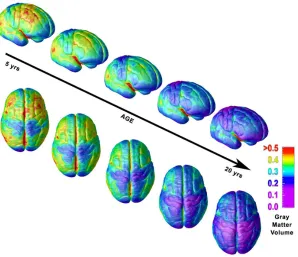
Recently, studies demonstrated a more complex panorama regarding brain maturation. Indeed maturational processes occurs firstly in dorsal parietal cortices, (e.g. in primary
sensorimotor areas), then spread rostrally over the frontal cortex and finally, in the lateral and caudal parts of the parietal, occipital, and the temporal cortex (Gogtay, et al., 2004). Imaging data suggest a non-linear changes in gray matter (GM) density during childhood up to prepubertal age followed by a postpubertal loss (Giedd, et al., 1999; Jernigan & Tallal, 1990). The GM density represents an indirect measure concerning the outcome of dendritic and synaptic processes within a complex architecture of glia, vasculature, and neurons. Indeed a loss of GM density was reported over time in relation to the postmortem synaptic pruning exhibited in adolescence and adulthood (Sowell, et al., 2003; Sowell, Thompson, Holmes, Jernigan, & Toga, 1999).
Most studies based on imaging techniques have adopted a particular method called “volumetrical parcellisation” trying to define the neurodevelopmental trajectories of each cerebral region in terms of grey and white matter growth curves (Toga, et al., 2006).
Structural imaging data demonstrated that most cerebral regions, such as parietal and frontal cortices, exhibit a cubic-like developmental trajectory with an increase in childhood, followed by a decline during adolescence and a stabilization of cortical thickness in adulthood. This developmental trend can be described on the base of regionally specific inverted U-shaped trajectories of gray matter volumes.
Within the parietal regions, the first area to reach its thickness peak is the somatosensory cortex (at about 7 years), while the posterior polymodal regions reach the peak later, at 9-10 years (Shaw, et al., 2008).
This time course was also showed in a longitudinal pediatric imaging study, in which data
Fig. 2. Right lateral and top views of the dynamic sequence of GM maturation over the cortical surface. The
side bar shows a color representation in units of GM volume (from Gogtay et al., 2004).
1.1.2 Functional aspects
Functionally, the parietal lobe represents a typical example of associate cortex recruited in processing information coming from different sensory districts and thus involved in several cognitive functions (Culham & Kanwisher, 2001). In particular, it constitutes the major component of a neural network massively involved in space and action processing called “dorsal stream”, in contrast with occipito-temporal network, the “ventral stream”, more dedicated to the analysis of perceptual features and form recognition (Goodale & Milner, 1992).
such as the arm, leg and face were found in the posterior parietal lobe. For example, one of the best studied representations, the arm one, is represented at least 8 times. Indeed, many
functional motor representations (“motor fields”) can be located in different anatomical areas coherently with some recent studies of corticospinal projections (He, Dum, & Strick, 1993, 1995). Each parietal area is connected with motor areas by a complex system of “predominant” and “additional” connections. Each segregated parieto-frontal functional circuit is involved in a specific sensory-motor transformation for action, constituting the functional unit of the cortical motor system (Rizzolatti, Fogassi, & Gallese, 1997).
Furthermore, recent evidences have redesigned the role of IPL and SPL. Indeed anatomical data have now showed that posteriorly, both lobules receive somatosensory and visual inputs. Anteriorly, however, these two lobules showed significant differences: SPL is involved in the somatosensory processing, while IPL has a role in the integration of the somatosensory and visual information (for a review see (Caminiti, Ferraina, & Johnson, 1996; Rizzolatti, et al., 1997; Wise, Boussaoud, Johnson, & Caminiti, 1997)).
Studies on monkey brain have contributed to understand in depth the parietal organization, suggesting important differences and some homologies across species, comparing the human to the macaque parietal regions (Orban, Van Essen, & Vanduffel, 2004). First, we see a specific expansion of both parietal and frontal lobes in humans, in particular in the region of IPL and IPS. Second, imaging data revealed peculiar differences in the responses to same stimuli while comparing directly human to monkey brains (Orban, et al., 2003; Van Essen, et al., 2001). For example, some main differences consist in a higher sensitivity for motion, especially for 3D motion, of intraparietal regions in humans compared to monkeys, suggesting the presence of specific areas for visuospatial processing in human intraparietal
Fig. 3. Comparison of monkey and human parietal lobes. Lateral view of (a) macaque monkey brain and (b)
human brain, showing parietal lobes in white (from Cuhlam & Kanwisher, 2001).
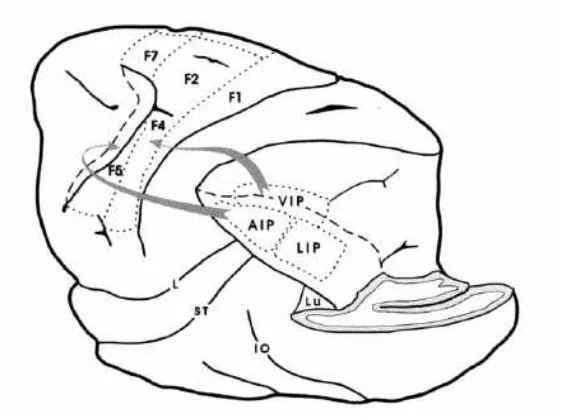
Among the potential homologues areas identified, three of them - areas LIP, VIP and AIP - are particular relevant here (fig. 3), considering their roles and locations within the intraparietal area (Grefkes, Ritzl, Zilles, & Fink, 2004).
Posterior to IPS, a human homologous of monkey area LIP was identified. This region is characterized to be sensitive to target-oriented saccades in the space with a retinotopic organization of its responses which are even effectors-independent, as seen in monkey (Ben Hamed, Duhamel, Bremmer, & Graf, 2001; Sereno, Pitzalis, & Martinez, 2001).
Converging data suggests the role of LIP in spatial updating in both humans and monkeys.
For example, in a double-saccade task using event-related fMRI, it was possible to show that when the position of the target moves, the LIP activity also shifts, to represent the new
The other tentative human homologous region is the VIP area, typically responsive to motion in a multimodal way in monkey. Considering this property, only one region in the
depth of the IPS was found activated by visual, tactile and auditory motion (Bremmer, et al., 2001). However, the anatomical divergences concerning IPS between human and macaque brain needs additional studies on this line.
The neurons of AIP area are specifically recruited in hand-centred coordinates during fine grasping (Culham, et al., 2003; Shikata, et al., 2003). Some regions of IPS were considered as AIP homologues due to their dual involvement in the identification of grasped objects and in selective impairment in patients regarding grasping actions (Binkofski, et al., 1998). Neuroimaging studies demonstrated the functional specialization of parietal regions contrasting hand versus eye movements, and grasping versus pointing (Grafton, Fagg, Woods, & Arbib, 1996; Kawashima, et al., 1996). In particular, grasping actions was contrasted to reaching and pointing movements. Imaging data show stronger activations for grasping actions on the anterior part of the IPS in contrast to reaching (Culham, et al., 2003), while pointing movements selectively recruits even the HIPS and the posterior part of the superior parietal lobule bilaterally (Simon, Mangin, Cohen, Le Bihan, & Dehaene, 2002). Indeed, coherently with what found in monkey brain, the hypothetical presence of an AIP homologous in human brain should be located more anteriorly compared to homologues areas LIP and VIP (Hubbard, Piazza, Pinel, & Dehaene, 2005).
Recently, an extensite study on parietal functions was showed in Simon, Mangin, Cohen, Le Bihan, Dehaene (2002). The authors found a common orderly and topographically defined organization in all examined subjects for grasping, pointing, saccades, calculation, attention and phoneme detection. This observed systematic posterior-to-anterior
AIP, MIP, V6A, and LIP. This organization fits well with the cytoarchitectonic model of human parietal lobe (proposed in (Eidelberg & Galaburda, 1984)) indicating a significant
expansion of human inferior parietal lobule whose activity is related to language and calculation.
1.1.2.1
Development
A restrict number of developmental studies measuring brain activity using functional imaging techniques show a complex pattern of changes in brain activation from childhood to adulthood (Gaillard, et al., 2000; Turkeltaub, Gareau, Flowers, Zeffiro, & Eden, 2003),
often accompanied by an increasing hemispheric specialization. Specifically, across ages, imaging data often show an increasing activation in task-related regions together with a decreased activation in regions less relevant to the task (Rivera, Reiss, Eckert, & Menon, 2005). Speculatively, both maturational processes and experience may contribute to the transition from a widespread activation pattern to a focal one as the result of plasticity reduction and higher efficiency (Durston & Casey, 2006; Durston, et al., 2006). On this wave, even increasing number of neural connections was reported during the development (Brown, et al., 2005).
The parallel between brain development and cognitive development is evident and supported by the fact that the improvement of cognitive capacity during childhood may coincide with a progressive specialization and reorganization of the anatomical structures (Casey, Giedd, & Thomas, 2000; Chugani, Phelps, & Mazziotta, 1987; Diamond, 1996; Flavell, Beach, & Chinsky, 1966; Huttenlocher, 1979; Keating, Keniston, Manis, & Bobbitt, 1980; Rakic, Bourgeois, & Goldman-Rakic, 1994).
Although the recent introduction of sophisticated techniques (e.g. fMRI) contributed to open a fascinating research field concerning the interplay between anatomical brain
development and functional performance, further investigations are necessary about the neural bases of parietal functions in normally developing children. Indeed, despite a clearer panorama about the overall anatomical development of parietal cortex, the specific contributions of developing parietal subregions on behavioral performance lacks of relevant evidences.
1.2 Parietal circuits for number processing
1.2.1
In non human animals
The extraction of numerical information from the environment (the number of objects in a set) is thought to be a phylogenetically old ability, because it is found in animals of many different species (Boysen & Capaldi, 1993). These findings suggest a preverbal precursor
system for our language-based counting and arithmetic. In particular, rhesus monkey has represented the best model for testing the non human numerical cognition and their neural
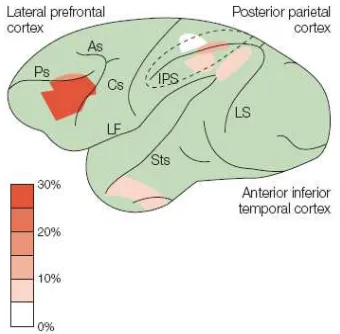
the lateral prefrontal cortex (31% of all randomly selected cells, (Nieder, Freedman, & Miller, 2002)), followed by the fundus of the intraparietal sulcus (18%, (Nieder & Miller,
2004); see Fig. 4). Other number-encoding neurons were even found in the superior parietal lobe SPL (Sawamura, Shima, & Tanji, 2002).
Specifically, the time course within this fronto-parietal network was investigated analyzing the activity modulation over time. Results showed that the PPC number-encoding neurons are activated faster, and in particular show an
early onset of the selectivity for the numerical information, while the LPFC neurons show the onset of number selectivity firing much later (Nieder & Miller, 2004). These findings suggest that the first stage of extraction of numerical information is represented by parietal areas and then LPFC has the role to amplify and maintain this information. All the numerosity-selective neurons of both frontal and parietal areas constitute a sort of bank of overlapping numerosity filters. Interestingly, the neurons’ sequentially-arranged, overlapping tuning curves preserved an inherent order of cardinalities. Thus, the numerosities are not isolated categories, but they are reciprocal categories which exist in relation to one another (Nieder, 2005).
1.2.2 In humans
A robust record of clinical evidences from brain-lesioned patients (Cohen, Dehaene, Chochon, Lehéricy, & Naccache, 2000; Grafman, Passafiume, Faglioni, & Boller, 1982; Takayama, Sugishita, Akiguchi, & Kimura, 1994) and imaging data using PET and fMRI
Fig. 4. Lateral view of a monkey brain that
shows the recording sites in the lateral
prefrontal cortex, the posterior parietal
cortex and the anterior inferior termporal
cortex. The proportions of
numerosity-selective neurons in each area are colour
coded according to the scale shown (from
(Dehaene, et al., 1996; Fulbright, et al., 2000; Pesenti, Thioux, Seron, & De Volder, 2000; Rueckert, et al., 1996) point to a crucial role of parietal cortex in number processing.
However, neural activations of PPC were found also for other cognitive functions related to language processing (Paulesu, Frith, & Frackowiak, 1993), visuo-spatial attention (Corbetta, Kincade, Ollinger, McAvoy, & Shulman, 2000) and visuo-motor control (Culham, et al., 2006). Thus, the crucial question is whether PPC contributions are specific for numerical domain, and distinct from other verbal, spatial and visuo-motor functions (Simon, et al., 2002).
Here, I describe the model proposed by Dehaene and colleagues, exploring the different parietal circuits for number processing and their specific contributions ((Dehaene, Piazza, Pinel, & Cohen, 2003); Fig. 5). Several imaging studies demonstrate a sensitivity of posterior parietal cortex for different levels of numerical elaboration, such as number comparison (Chochon, Cohen, van de Moortele, & Dehaene, 1999), approximate calculation (Venkatraman, Ansari, & Chee, 2005), simple (Simon, et al., 2002; Zago, et al., 2001) and complex exact calculation (Ischebeck, et al., 2006) and counting (Piazza, Mechelli, Butterworth, & Price, 2002). With the aim to clarify the organization of number related-processes in the parietal cortex, a meta-analysis of several different published fMRI studies was performed (Dehaene, et al., 2003), suggesting the presence of three neural regions recruited for different aspects of number processing: the bilateral horizontal segment of intraparietal sulcus (HIPS), the left AG and the bilateral posterior superior parietal lobule (PSPL).
The HIPS, alternatively defined “core quantity system”, is consistently implicated in the processing of numerical magnitude. This region is thought to underlie the semantic
representation of magnitude, because it is task- and notation-independent and modulated by a numerical quantity-dependent semantic metric.
phoneme detection (Simon, et al., 2002). Fundamental contributions of the AG were shown for exact and automatic calculation, such as multiplications and simple additions which are
performed, in adults of western societies on the basis of retrieval of memorized tables (Chochon, et al., 1999; Lee, 2000).
Finally, the PSPL supports visuo-spatial processes, attention and spatial working memory associated with the manipulation of numbers and they contribute to explain the numerous interactions between numbers and space (Hubbard, et al., 2005).
In sum, despite little information about the interplay among HIPS, AG and PSPL, all these regions differently participate to the networks devoted to number processing in humans. Here, I describe in depth the specific role of each region within the neural circuit for number processing.
Fig. 5. Three-dimensional representation of the parietal regions of interest. For better visualisation, the
The horizontal segment of the intraparietal sulcus
According with the idea of a core quantity system, the HIPS region should be recruited for
all tasks requiring numerical processing. Indeed, this area is robustly activated during different tasks involving number comparison and arithmetic (Chochon, et al., 1999; Menon, Rivera, White, Eliez, et al., 2000; Stanescu-Cosson, et al., 2000).
Subtractions seem to elicit stronger HIPS activations compared with multiplications (Chochon, et al., 1999; Lee, 2000), especially for operations with large numbers (Stanescu-Cosson, et al., 2000). Indeed the results of additions and multiplications with small numbers are frequently retrieved from verbal memory without true access to magnitude information, and this fact results in a less systematic activation of the HIPS activity in these tasks with respect to complex calculation (Cohen, et al., 2000).
Less clear is the HIPS role for exact and approximate calculation: exact arithmetical operations (e.g. additions) may evoke less HIPS activation than approximate operations ((Dehaene, Spelke, Pinel, Stanescu, & Tsivkin, 1999) but see (Venkatraman, et al., 2005), for contrasting results). Probably, different factors might determine these non-converging results: methodological discrepancy among studies and inter-individual variability about the strategies used to perform the task, especially for the approximate operations, could contribute to make uncertain the neural dissociation between the exact and approximate calculation.
To address the true sensitivity of HIPS for numerical information, several imaging studies used more controlled tasks, such as number comparison. Interestingly, HIPS activation is inversely related to the numerical distance: close numbers (e.g. 5 - 4) elicited stronger activations than distant numbers (e.g. 5 - 9), irrespective of the numerical notations, such as
dots arrays (Piazza, Giacomini, Le Bihan, & Dehaene, 2003), Arabic digits (Pinel, Dehaene, Riviere, & LeBihan, 2001) or number words (Le Clec'H, et al., 2000).
approximate number shared by dots, digits, and number words. More specifically, multi-voxel pattern analysis on imaging data found the presence of both format-specific and
format-general number codes in human parietal cortex, where neural populations are more numerous, but more broadly tuned for non-symbolic than symbolic numbers (Eger, et al., 2009).
In children, age-related changes in the HIPS recruitment during the comparison of non-symbolic magnitudes were found (Ansari, Dhital, & Siong, 2006). In particular, the activation of left HIPS increases during the processing of non-symbolic magnitude with age, suggesting the presence of age-related changes in functional neuro-anatomy regarding the basic levels of numerical cognition. However, bilateral HIPS activations were showed even when no comparisons are requested such as in the case of passive exposure to numerical quantities when participants viewed sets of items with a variable number (Piazza, Izard, Pinel, Le Bihan, & Dehaene, 2004). Thus, considering the existence of numerosity-selective neurons in the VIP and their location anterior to PSPL and posterior to area AIP (Nieder & Dehaene, 2009), the HIPS is thought to be the human homology of monkey area VIP (Hubbard, et al., 2005).
Taken together, these findings are in favor of amodal (notation independent) system of numerical representation in HIPS which is modulated by a semantic metric and which activity changes with age.
The posterior superior parietal lobe
The posterior superior parietal lobe is thought to be the human homology of monkey area LIP. Indeed this region is involved in target-oriented saccades in the space showing a
In number comparison tasks, PSPL (as well as IPS) is activated irrespective of the number notation, with its neural activity modulated by distance between number words (Kaufmann,
et al., 2005), two-digit numbers (Pinel, et al., 2001) and dots array (Piazza, et al., 2004). Considering the important role of this area in attention orienting (Coull, Frith, Buchel, & Nobre, 2000; Coull & Nobre, 1998), the PSPL is thought to reflect the unspecific spatial processes subsidiary to the core magnitude system in the HIPS, especially in the numerical manipulation on the internal representation through attention shifts (Hubbard, et al., 2005). Indeed, the posterior superior parietal lobe (PSPL) is thought to support attentional orientation to the mental number line in tasks requiring number manipulation (Menon, Rivera, White, Glover, & Reiss, 2000; Pesenti, et al., 2000).
The angular gyrus (AG)
The activations of this brain region do not exhibit stronger influence of numerical distance (Pinel, et al., 2001). Indeed, the neural activity of AG is thought to reflect verbal or linguistic components of the manipulation of numbers. First, AG is not active during non-symbolic numerical information processing (Pesenti, et al., 2000; Piazza, Mechelli, Price, & Butterworth, 2006) (Piazza, et al., 2004). On the contrary, all study reporting activation in this region used symbolic numbers as stimuli. More precisely, AG activation is associated to arithmetic operations such as additions (Menon, Rivera, White, Glover, et al., 2000), subtractions (Burbaud, et al., 1999) and multiplications (Gruber, Indefrey, Steinmetz, & Kleinschmidt, 2001). In particular, AG is intensively recruited for the solution of exact additions, with greater activations for small problems (2+3) than large ones (7+5; (Stanescu-Cosson, et al., 2000)) showing a peculiar role for arithmetical facts
retrieval. Furthermore, the activity of angular gyrus also increases after training with complex operations indicating the transition from computation to retrieval strategy in solving the trained problems(Delazer, et al., 2003).
Battaglia, 1978) by using a sort of phonological associations accessible from the verbal representation of numbers (Dehaene, 1992).
Some evidences are in favor of this interpretation, such as a better performance for addition and multiplication problems if showed in the same language used to learn them (Spelke & Tsivkin, 2001). Second, both arithmetical facts and language processing induced activations in same (left) dominant hemisphere and, more specifically, parietal regions for phoneme detection and subtraction are partly overlapped in the AG (Dehaene, et al., 2003; Fiez & Petersen, 1998; Simon, et al., 2002).
More evidence comes from interference studies (Lee & Kang, 2002) showing that phonological rehearsal delayed significantly the performance in multiplication but not in subtraction, whereas visuo-spatial suppression interfered with subtraction but not multiplication performance. This result suggests the influence of phonological loop on the multiplication problems and of visuo-spatial sketchpad on subtraction.
Some observations arise at this point. Imaging and physiological data have contributed to clarify the neuroanatomy of parietal cortex in terms of structural organization, even showing relevant homologies between human and monkey brain. Additionally, some imaging studies tried to define parietal circuits that differently contribute to the verbal, visuo-spatial, and quantity-related aspects of number processing. Unfortunately, for my knowledge, less is known about the developmental trajectories of this parietal circuit and its progressive emergence in children. Indeed, although a clearer panorama about the functions that recruit parietal areas such as grasping, pointing, saccades, calculation and attention in adults, further studies are necessary to explore the anatomical changes in the neural
Chapter 2
NUMBER REPRESENTATIONS
From birth, humans are sensitive to numerical information, in either the form of the approximate number of objects in large sets or in the form of the exact number of objects in
small sets. Both types of numerical sensitivity, are thought to be part of the Number Sense (see below) (Dehaene, 1997; Feigenson, Dehaene, & Spelke, 2004) are language-independent and shared with other species. During enculturation, a long process of symbolization allows children to have a more precise and discrete concept of both small and large quantities. In contrast to the large approximate numerosity representation, the symbolic number representation is precise, discrete, language-specific and influenced by culture.
In this chapter, I consider the main characteristics of Number Sense and its development showing the changes in the internal Weber fraction across ages. After introducing the models regarding the approximate representation of numbers, I focused on symbolic numbers.
2.1 Presymbolic numerical representation
representation, exhibiting the same psychophysical effects (Weber-Fechner law, see (Dehaene, 1997)) found in humans engaged in similar tasks.
Numerical relevant behaviors were consistently found also in untrained animals, in wild environments (Hauser, et al., 1996), and where number information was spontaneously extracted (Hauser, Dehaene, Dehaene-Lambertz, & Patalano, 2002; McComb, et al., 1994). Adopting the violation-of-expectation paradigm (Wynn, 1992b) frequently used with infants, untrained monkeys exhibited a natural sense for numerosities and basic arithmetical relations between numerical quantities ( Hauser, et al., 1996).
Both behavioral and electrophysiological studies suggest that numerosity extraction is not dependent on the specific modality of stimuli presentation, suggesting a modality-independent representation of number.
For example, the amodal features of numerosity representation were shown in a study (Church & Meck, 1984) where cats were trained to press the left lever for two flashes or two sounds, while the right lever for four flashes or four sounds. Then, cats spontaneously started pressing the right lever even for a combination of two sounds and two flashes. Electrophysiological studies confirm that number coding neurons exhibit amodal characteristics. In cats, for example, some neurons of the posterior associative cortex fire for a specific number as presented as visual and auditory stimulus modality (Thompson, Mayers, Robertson, & Patterson, 1970). Number neurons were also identified in the monkey’s parietal cortex related to the number of motor sequences performed by the monkeys (Sawamura, et al., 2002) or visual objects memorized by the monkeys (Nieder, et al., 2002). Finally, some number neurons of the monkey IPS respond for both sequential and simultaneous presentation of numerical stimuli (Nieder, Diester, & Tuduscius, 2006).
more accurate as the ratio between numbers to be compared increase, according with Weber’s law (Gallistel & Gelman, 2000).
Moreover the subject’s performance show no cost comparing numerosities across-modalities compared to within modality (auditory and visual) or across vs. within-format (sequential or simultaneous) presentation (Barth, La Mont, Lipton, & Spelke, 2005; Cordes, Gelman, Gallistel, & Whalen, 2001; Hauser, Tsao, Garcia, & Spelke, 2003; Piazza, et al., 2004). This general ratio-dependent behavior common to all sensory modality, is taken as to indicate the presence of a universal mechanism for approximate number processing, and supports the idea of an abstract and amodal representation of numerosity.
However, the question of the scaling of the number line remains unclear. Current models propose that numbers are internally represented either on a logarithmically compressed continuum with fixed internal variability (Dehaene & Changeux, 1993) or on a linear scale with increasing standard deviation of the internal noise (Gallistel & Gelman, 2000). Both models accurately accounts for Weberian ratio-dependent performance. Indeed, in the case of numerosity discrimination, performance improves when the distance between the numerosities increases, as predicted by the Weber’s law: namely, the extent to which two stimuli can be discriminated is determined by their ratio (Piazza, et al., 2004; Pica, Lemer, Izard, & Dehaene, 2004).
In an electrophysiological and behavioral study on monkeys by using a match-to-sample task, Nieder and colleagues (Nieder & Miller, 2003) found a peculiar symmetric data distribution when data are plotted on a logarithmic scale. While this finding was used in favor of the logarithmic scaling model, it was noticed that the observed symmetry on a Log scale represents the solely expression of Weber’s law (which is predicted by both linear and
logarithmic number line models; (Piazza & Izard, 2009)).
Preverbal approximate representations are also used to perform simple arithmetical operations. Indeed, some preverbal skills allow infants to judge the exactness of the solution of some basic problems like “1+1=2”, and not 3 (Wynn, 1992a).
al., 2005). The paradigm simulates approximate calculation (e.g. additions and subtraction) with dots arrays. More precisely, a first dots array was presented and occluded by a panel,
and then another array joined the first one behind the panel. After removing the panel, a third dots array differing from a small or large ratio from the correct sum was displayed. The participants had to compare it to the exact sum and decide whether is contained more or less dots. 5- and 6-years old children exhibited an above-chance ratio-dependent performance for approximate additions and subtractions with non symbolic stimuli. The contributions of perceptual factors or exact calculation strategies were excluded by successive studies (Barth, et al., 2006; Gilmore, McCarthy, & Spelke, 2007).
2.1.1 The Weber’s fraction and its development
On the basis of psychophysical and behavioral data, the measurement of the limits of human senses attracted several authors, E.H. Weber introduced a law able to specify the weakest different threshold (behavioral Weber fraction) necessary to produce a noticeable variation of the sensory experience, showing that the perception of a stimulus change depends on both the magnitude of the change (∆s) and the stimulus baseline intensity (s)
(Gescheider, 1997). Stimuli for which the Weber’s low holds (mostly sensory, such as loudness, brightness) can be thought of being internally represented on approximate and compressed continuum (Dayan & Abbott, 2001). The same reasoning can be applied to the
case of the internal representation of numbers. Indeed, one can think that numerosity (n) is represented on an internal continuum that is approximate and compressed (either
discriminate two sets differing by about 40% (e.g. 10 versus 14 items). The relation between behavioral and internal Weber’s fractions depends on the task, indeed a model of
decision making is assumed in a given task (see (Dehaene, 2007) for a review).
Intersingly, empirical data seem to achieve remarkably with what predicted by this psychophysical model (Dehaene, 2007). Comparable magnitudes of internal Weber fraction were found on the base of subject performance in different tasks (e.g. same-different task, lager-smaller task). Indeed the value of w in adults across different cultures in a larger-smaller or same-different judgment task is around 0.15 (Piazza, et al., 2004; Pica, et al., 2004). Moreover similar estimations for w were found on the basis of data from magnitude comparison tasks (dot arrays) in French (0.12) and Amazonian adults (0.17), even if the numerical lexicon of the Amazonian indigene people was restricted to 5 (Pica, et al., 2004).
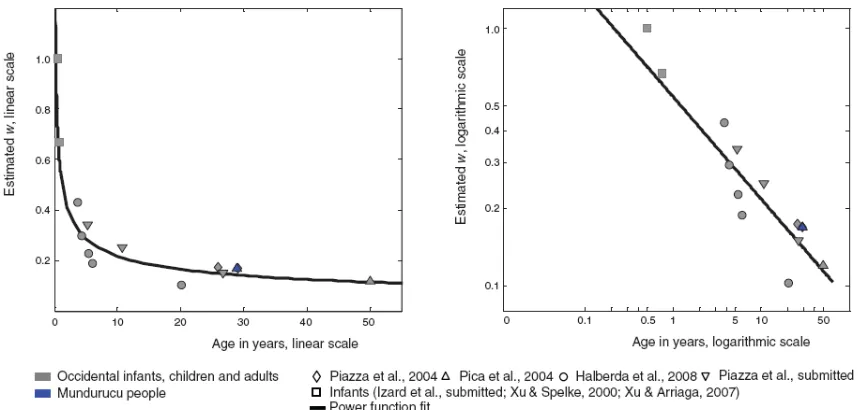
Fig. 6. Development of the precision of the approximate numerical representations. The graphs regroup the
values of w estimated in different papers (from Piazza & Izard, 2009).
Ratio-dependent numerical behavior also showed the presence of an approximate numerical
dramatic refinement over the first year of life: 1.0 at 6 months, (infants discriminate numerical changes for ratios of 2:1, e.g. 4 dots vs. 8 dots (Lipton & Spelke, 2003; Xu &
Spelke, 2000), 0.5 at 9 months (e.g. 8 vs. 12 dots), improving gradually until late childhood (0.40 at 5 years, 0.25 at 10 years), describing a typical power function (Halberda & Feigenson, 2008; Lipton & Spelke, 2003; Xu & Spelke, 2000).
As in adults (see above) also in children, similar values of w were obtained in both auditory and visual domains across ages (Lipton & Spelke, 2003; Wood & Spelke, 2005), suggesting that it is the internal representation of number itself, and not the visual or auditory sensitivity, that is improving.
The factors liable for the reduction of w with age are still unknown, although maturational processes and arithmetic education may play a significant role. However, the presence of similar values of w in different cultures, even when formal education for arithmetic is absent or limited, supports the maturational interpretation. In sum, this law seems pervasive in numerical cognition and stable across cultures, life span and animal species while performing different numerical tasks (Piazza & Izard, 2009).
2.1.2 Models of early numerical abilities
Several models were proposed with the aim to accounting for the natural preverbal sensitivity for approximate numerical information.
An original explanation of the ability to discriminate roughly the numerosity of sets of objects by using the metaphor of accumulator was proposed by (Meck & Church, 1983)
inconstant discharge. Thus, we get different amount of water (in our hypothetical glass) keeping constant the acquisition time. This variability increases with the number of water
acquisition which is proportional with the counted numerosity.
Interestingly, recent electrophysiological evidences have showed the presence in macaque monkey LIP of number neurons with an accumulator-like coding scheme (Roitman, Brannon, & Platt, 2007). Important differences regard the neural functional properties of these LIP neurons from those number neurons found in monkey area VIP and cat posterior cortex (Nieder & Miller, 2004; Sawamura, et al., 2002; Thompson, et al., 1970). First, LIP neurons exhibit numerosity sensitivity, rather than selectivity. Indeed these neurons code monotonically with the number of visual objects rather than to a given number. Second, the numerosity accumulator neurons receive the information coming from limited retinotopic receptive fields, thus they only code for a bunch of items displayed in their receptive field, and not for the overall amount of the presented items. This property derives also from the particular anatomical location of these neurons in area LIP, more dorsally and caudally with respect to VIP, that typically code for spatial information on the base of eye-centered co-ordinates (Hubbard, et al., 2005; Nieder, 2005; Piazza & Izard, 2009). Thus, LIP accumulator neurons is thought to constitute an intermediate step from the basic extraction of sensorial information to VIP number neurons following a hierarchical processing.
One of the first examples of connectionist approach to number cognition was proposed by Dehaene and Changeux (Dehaene & Changeux, 1993). This model also assumes an accumulation stage, but it also introduces a numerosity detection system. Three layers were considered within this model: an input “retina”, a map of objects location and an array of numerosity detectors. Through the retina, each stimulus is normalized and converted in a
Dehaene, 2009; Nieder & Miller, 2004). Then, the data suggest a parallel encoding of numerosity, which would be difficult to explain by the accumulator model that is, by
definition, serial. More likely, the model of Dehaene and Changeux (1993) suggests an approximate detection of numerosity based on a analog magnitude process, and in parallel fashion. Again, the numerosity detectors proposed by this model become less selective with increasing center numerosities following the Weber’s law.
More recently, another neural network model was suggested for the representation of number in animals and humans by Verguts and Fias (2005).
Firstly, number-selective neurons are created on the base of an initially neural network trained for given non-symbolic stimuli as input (e.g., collections of dots) under unsupervised learning. Interestingly, at the neural level the resultant network exhibits the properties of number-selective neurons previously hypothesized by Dehaene and Changeux (1993) and recently found by Nieder and colleagues (Nieder, et al., 2002; Nieder & Miller, 2003), showing the classical numerical effects such as distance and size effects. Then, the network was stimulated by the simultaneous presentation of symbolic and non-symbolic inputs. Interestingly, the previous number-selective neurons started learning the numerical magnitude of symbols. During this process, number-selective neurons do not quantitatively change their coding scheme (thus show reminiscent properties of the original network), but show a quantitative improvement in the representation efficiency of neurons after the presentation of symbolic input.
This finding represents concrete evidence regarding how symbolic cognition originates from a neural systems previously devoted to numerosity information from perceptual input,
2.1.3 The case of small numbers
Small numbers (up to 3 objects) seem to represent a special category from early childhood. Indeed, in infants, opposite behavioral patterns were shown in case of processing small or large sets of items. While in case of large sets of items, the children responses are more selective for the numerical information rather than other non-numerical parameters (such as area, (Wood & Spelke, 2005), the inverse pattern of results was found for small numerosity whose processing is more influenced by non-numerical continuous parameters (Xu, Spelke, & Goddard, 2005) then numerical information.
Indeed most studies evidence the role of some perceptual variables, such as total surface area, brightness, density etc. All these non-numerical variables seem to co-vary with the numerosity, with the relative impossibility to determine whether infants respond to continuous spatial dimensions rather than number itself (Feigenson, Carey, & Spelke, 2002). Although some studies documented that infants respond according to the numerical magnitude versus other continuous spatial parameters (Brannon & Gautier, 2003), the performances of 6- and 8- month-old and in 10- and 12-month-old infants seem to be respectively related to the contour length (Clearfield & Mix, 1999) or surface area and volume (Feigenson, Carey, & Hauser, 2002).
In adults, numerosity identification is as fast as accurate up to sets with three or four items, while for larger sets errors rate and reaction times increase progressively of about 200-400
ms/item (Revkin, Piazza, Izard, Cohen, & Dehaene, 2008). This pattern of data reflects the presence of two separate processes in exact numeration, the subitizing for small sets and
Interestingly, Trick and Pylyshyn (1994) proposed to consider this mechanism as a parallel tagging process that operates over small sets in the early stage of visual analysis. The idea
of a dedicated mechanism was support by Revkin and coll. (2008). Indeed, using a numerosity naming and dot comparison tasks respectively in adults, the subitizing range appears dissociated from the internal Weber’s fraction, underling its distinction from number sense domain. Our visual system can select a fixed number of about four objects based on their spatial information or to encode their details, respectively for objects individuation and identification, also explaining the limited capacity of working memory to process and successively maintain visual information.
2.2 Symbolic numerical representation
Humans come to life equipped with an approximate system for representing large numerosity and with an exact system for tracking exact small numerosities. During development children acquire symbols for numbers which represent a precise way to represents even large numerical information. Despite diverging ideas about the role and the relations among Arabic and verbal representations, there is a general consensus about the functional dissociations among symbolic representations on the base of what found in brain-damaged patients. Indeed functional separations were found for comprehension and
production mechanisms, between Arabic and verbal codes and, finally, between lexical and syntactical process for each code (McCloskey, Macaruso, & Whetstone, 1992). The anatomical segregation of Arabic and verbal codes was even supported by imaging data (Pinel, et al., 1999). In the next sections, I explore the verbal and Arabic codes, their interplay and the relation with the preverbal representations during development. Then, I focus on the contributions of language and verbal counting on the development of symbolic numbers.
2.2.1 Verbal and Arabic codes
German, English, French, Spanish and Italian which are not regular base-10 systems. For these reasons, at the beginning Chinese and western children showed similar performances
for number up to 10 (Miller, Smith, Zhu, & Zhang, 1995), but for larger numbers Chinese children from the age of 4/5 years to all elementary school ages perform better compared to western children on counting beyond 10 (Stevenson & Stigler, 1992).
Arabic digits represent the most common notation for encoding numerical quantity enabling children to read, write and understand even large numerical quantity in an exact fashion. Overall, despite a less attention on the acquisition of this notational system compared to the acquisition of verbal counting, developmental data does not show particular difficulties in learning the digits from 1 to 9 (Hughes, 1986). The only exception to this is represented by zero which determines specific difficulties in children while writing numbers (e.g. 203) containing a null position (Wellman & Miller, 1986)), responsible of a modification of the kinematics of the numerical handwriting (Lochy, Pillon, Zesiger, & Seron, 2002). Comparable results were found even with brain-damaged patients who showed impairments syntactic and lexical errors regarding the zero (Grana, Girelli, & Semenza, 2003). Probably this is due to the absence of correspondence with the verbal counting, but the real nature of this problem is still unclear. Specifically, in childhood, the main difficulties are represented by the positional nature of Arabic notation where the position occupied by the digit determines its value.
The acquisition of Arabic numbers, as well as verbal counting, can be differentiated in several phases on the base of the child’s ability to identify and handle them. First, preschoolers have to distinguish Arabic digits (0-9) from non-numerical symbols (Noël, 2001). At 3 years of age, their performances are at chance. About 1 year later, children
(considering their approximate cardinality and not the exact numerical value). Cross-sectional studies exploring the ability to compare Arabic digits in preschoolers, school age
children and adults, showed that numerical distance influences all groups performances with a stronger effect in younger children (Ansari, Garcia, Lucas, Hamon, & Dhital, 2005; Dehaene, Dehaene-Lambertz, & Cohen, 1998; Holloway & Ansari, 2008). Converging results were reported also by Duncan and McFarland (Duncan & McFarland, 1980).
These findings suggest similar Arabic representations in both children and adults which are influenced by our approximate system for numerosity. The decrement of the slope of numerical distance in young children might reflect their progressive refinement of magnitude mapping on symbolic numbers. Indeed a strong automatic access to Arabic number magnitude was reported at 7-8 years of age, roughly 1-2 years later the ability to compare Arabic numerals (Girelli, Lucangeli, & Butterworth, 2000; Rubinstein, Henik, Shahar-Shalev, & Berger, 2000). In other terms, the experience of children with Arabic numerals induces a more precise mapping of magnitude on these symbols, progressively amplifying their competence with larger numbers (Mussolin & Noel, 2007, 2008), and automatizing the access to semantic representations.
During the development, verbal numerals are acquired and used before Arabic numerals. Despite the fact that in western cultures number-words are use to teach the Arabic code at school, these two codes can be dissociated as suggested in neuropsychological studies by using transcoding task consisting in the transformation from a numerical format to another one (e.g. from Arabic notation to number-word, (Cipolotti & Butterworth, 1995; McCloskey, et al., 1992)).
However, some evidences from developmental studies on learning and cross-linguistic
the analogue quantity and the Arabic digits without verbal recoding, suggesting the dissociation of these two codes (see also (Donlan, Bishop, & Hitch, 1998)).
Several models were proposed to describe the multi-notational system for numbers on the base of the performance of brain-damaged patients (Deloche & Seron, 1987; McCloskey, Caramazza, & Basili, 1985). Among them, the model proposed by Dehaene ((Dehaene, 1992) (Dehaene & Cohen, 1995); Fig. 7), called “triple code model. The name of this model derives by the assumption that numbers can be mentally represented in a visual system, a verbal system and a quantity system recruiting three different neural circuits. The visual system is sensible for the encoding of strings of Arabic numbers and its neural equivalent is probably represented by occipito-temporal regions. The verbal system is involved in the lexical, phonological and syntactical representation of numbers. Despite a first location in the left frontal and temporal language areas, recently this system is thought to depend on the angular gyrus (Pesenti, et al., 2000; Zago, et al., 2001). The last system, also called the core semantic system for numbers, contains an abstract representation of size and distance relations among numbers (Dehaene, et al., 2003). This system emerges from the activity of intraparietal sulcus (IPS) during number comparison, approximate calculation and subtraction, and may play a crucial role in the interaction between numerical and a spatial domains.
Fig. 7. Schematic anatomical and functional depiction of the triple-code model, adapted from (Dehaene &
After acquiring a vast body of formal knowledge on the Arabic and verbal numbers, procedures (verbal and finger counting) and arithmetical principles (e.g. one-to-one
correspondence), children learn to retrieve the results of simple calculation. Since 4 or 5 years of age, children can solve simple additions using a vast repertoire of strategies (Siegler & Shrager, 1984). For instance, they can start from 1 adding the two operands, helped by fingers and verbal counting, or children can consider the larger operand and then counting forward for a number of positions equal to the magnitude of the smaller operand. These two strategies are called counting all and counting on (Baroody, 1987; Fuson, 1982) or sum and min procedures, respectively (Ashcraft, 1982; Groen & Parkman, 1972). Interestingly, cross-sectional and longitudinal findings showed the progressive shift from the use of counting all to counting on during schooling (Siegler & Jenkins, 1989). Thought practice, some arithmetic facts can be stored in our long-term memory determining a direct retrieval of the results without counting or computing, and helping us in the solution of complex operation via decomposition in partial results (Ashcraft, 1982). The transition from counting-based strategies to retrieval-based ones characterizes the acquisition of all simple operations (Siegler, 1988), despite the doubtful nature of the stored representation of these problems. Arithmetical facts can be conceptualized as abstract formats (McCloskey, et al., 1985), with operation-dependent nature (e.g. a preferential verbal format for the solution of multiplications and some additions, (Dehaene & Cohen, 1995)) or individual preference (Noel & Seron, 1993).
The use of a retrieve-based strategy for arithmetic facts depends on the size of the operands (the problem-size effect, (Geary, 1996)). Indeed longer RTs and more inaccurate responses were described in relation to the operand sizes (e.g. 2+3 vs. 7+8) in the solution of all the
problems involving additions (Ashcraft & Battaglia, 1978), subtractions (Geary, Frensch, & Wiley, 1993) and multiplications (Campbell, 1987).
simple problems can be influenced even by a more internal threshold, the confidence criterion, related to the child reliability about the exactness of the retrieval response (R. S.
Siegler, 1988).
2.2.2 From pre-symbolic to symbolic numbers
Despite a fast and easy acquisition of the first verbal numbers, the implicit association between the verbal labels to specific quantities can elicit particular difficulties. A sort of “transition phase” was reported during which children know the number words, but they are unable to associate them to precise cardinalities. During the early development, a considerable amount of time is necessary to understand the exact quantity hidden behind number words such as “three” and “four” (Wynn, 1992b). Even the particular nontransparent and conventional structure of the first numbers especially of western languages does not help the number understanding. In this way, the name dose not contribute to inform about the relative quantity, thus “four” is bigger than “five” just because its position on the verbal sequence. The transition from a preverbal representation to a verbal code involves a long period in which it is necessary to constitute a precise and automatic access to exact cardinal quantity from simple number names. Jordan and other authors (Huttenlocher, Jordan, & Levine, 1994; Jordan, Levine, & Huttenlocher, 1995) proposed the presence of a precise computational mechanism applicable to small quantity
independently of linguistic or cultural influences. This mechanism may depend on the objects file manipulation or on an abstract representation based on discrete and symbolic
code.
through fine motor movements (finger movement), and the accuracy of the finger representation (finger gnosis). Within this framework, subitizing represent a fundamental
component for the mapping of verbal numbers to numerosities (Benoita, Lehalle, & Jouenb, 2004).
Coherently to Butterworth’s proposal, a recent vast work on first graders (N=146) showed clear dissociations among three behavioral tasks regarding subitizing speed (on RTs), finger gnosis and finger tapping, while arithmetical abilities were predicted from subitizing skills both directly and indirectly via number knowledge (Penner-Wilger, Fast, LeFevre, Smith-Chant, & et al., 2007). Clinical studies on dyscalculic children indicate a impaired subitizing skill (Landerl, Bevan, & Butterworth, 2004) in dyscalculia.
Fewer studies have focused the attention on the relation between preverbal representations and numbers presented in the Arabic form. Behavioral data suggests that the comparison of large numbers in adults follows firstly a sequential procedure (processing the different digits one after the other), and only successively they used a holistic procedure taking account of the overall quantity (Hinrichs, Berie, & Mosell, 1982; Poltrock & Schwartz, 1984). Contrastingly, in adults, comparisons of one- or two-digit numbers suggests the idea that Arabic numbers are directly activated and processed holistically on the basis of analogue representation, rather than considering the digits and their position in the number. Coherently to this, no decade break effect was reported while comparing two-digit numbers (Brysbaert, 1995; Dehaene, Dupoux, & Mehler, 1990; Reynvoet & Brysbaert, 1999). However, numbers larger than two-digit numbers seem to be compared using an analytical procedure regarding a serial analysis of the number components. Moreover, unclear evidences concern the numerical threshold for the passage from a holistic to an analytical
processing and about the between-subjects variability.
other terms, small numerical distances (e.g. 3-4) elicited slower RTs and higher error rates than large distances (e.g. 3-9). This phenomenon was called “numerical distance effect”
and it assumes that numbers are automatically converted into an internal-analog representation and compared each other (but see (Verguts & Fias, 2005) for a different interpretation). This effect was found also comparing number words (Foltz, Poltrock, & Potts, 1984), dots arrays (Buckley & Gillman, 1974) and, even for two-digit Arabic number comparison (Dehaene, et al., 1990) suggesting a holistic representation of numbers bigger than 9 on the number line (Brysbaert, 1995), in contrast with a compositional single-digit representation (Nuerk, Weger, & Willmes, 2001). Beyond the numerical distance, another effect may reflect the number magnitude processing. The “size effect” determines higher latencies in comparing large than small numbers (Moyer & Landauer, 1967) due to the stronger compression (Dehaene, 2003) or higher variability (Gallistel & Gelman, 1992) for larger numerosities
A ratio-dependent performance in preschool age was found by Gilmore and colleagues (Gilmore, et al., 2007) while children solve exact addition problems, underling the common influence of Weber’s law in both presymbolic and symbolic representation of numbers. Again, numerical distance at 6 to 8 years old children found in symbolic and non-symbolic numerical tasks correlates with arithmetic outcome.
Specifically, children showed that mathematical achievement correlated with symbolic distance effect with a peak at age of 6 followed by a progressive decline up to 8 years, but not to non-symbolic distance effect (Holloway & Ansari, 2008). Differences in the relation between symbols and magnitudes were accounted to explain this result, although other mechanisms can be involved, e.g. the identification of Arabic numbers or symbolic
Interestingly, mathematical competence from kindergarten to sixth grade was compared with the ability to compare non-symbolic numerosities of 14 years old children (Halberda,
Mazzocco, & Feigenson, 2008). Despite a high variability in the Weber’s fraction among participants, data showed that numerosity
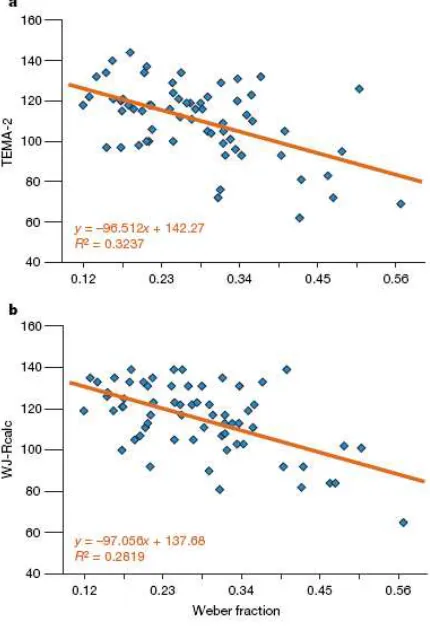
acuity (the precision of the numerosity comparison) at age of 14 retroactively correlated with the early mathematical skills, even controlling the effect of speed of processing and IQ. Thus, the precision in non-symbolic numerical information processing was tightly related to symbolic mathematical competence from the age of 5 years (see Fig. 8). However, further studies are necessary to investigate the casual role of number sense acuity on mathematical achievement and the effect of mathematic on the refinement of magnitude representation.
A recent study investigates the mapping of acquired symbolic numbers on a
preexisting system for approximate quantity in children. Data show that children develop the ability to map between symbolic and non-symbolic number representations from 6 to 8 years of age (Mundy & Gilmore, 2009). Then,
using a Stroop-type task in school age children and adults, it was possible to note the level of automatic numerical processing (Girelli, et al., 2000). The task consists in comparing the physical size or the magnitude of two different numbers written in congruent or
Fig. 8. Linear regression of the standard score for each
subject on the TEMA-2 test (a) or on the WJ-Rcalc
test (b) of symbolic maths achievement and the acuity
of the ANS (w). For TEMA-2 and WJ-Rcalc, higher
numbers indicate better performance, whereas for the
Weber fraction, lower numbers indicate better
incongruent dimensions in respect to the numerical magnitude. In the case of physical comparison, the mismatch between physical and numerical information afflicted just older
children and adults, suggesting the gradual process of automatization in Arabic number processing.
In summary, the easy structure of Arabic code, especially for small quantities, is quickly learnt and used but a long phase is necessary for accessing to the associated precise quantity in an automatic fashion.
2.2.3 The role of counting
The acquisition of counting represents the first attempt toward a precise and symbolic representation of numbers. In this way, children progressively learn a particular way to symbolize numerosity (“digitization”) that allows us to better identify larger numerical quantity and constitutes the starting point for our capacity to perform complex arithmetical operations. As seen above, from about the age of 2 children start to recite the sequence of number words but do not understanding basilar principles related to counting (Wynn, 1990). Indeed, roughly 4 years are necessary to acquire all the sequence of number words and its properties, from a sterile repetition of words to a deeper knowledge of their meaning (Wynn, 1992b).
This long-lasting process was documented in English speaking children who progressively
acquire the meaning of “one”, after about 6 months the meaning of “two”, 9 months later the meaning of “three” up to “twenty” at 6 years old. The number “four” seems to represent
the turning point of this process, which, once acquired, allows children to understand the logic of n