R E S E A R C H
Open Access
Effectiveness of the
‘
Girls Active
’
school-based physical activity programme:
A cluster randomised controlled trial
Deirdre M. Harrington
1*, Melanie J. Davies
1,2,3, Danielle H. Bodicoat
1,6, Joanna M. Charles
4, Yogini V. Chudasama
1,
Trish Gorely
5, Kamlesh Khunti
1,3,6, Tatiana Plekhanova
1, Alex V. Rowlands
1,2,7, Lauren B. Sherar
8,
Rhiannon Tudor Edwards
4, Thomas Yates
1,2and Charlotte L. Edwardson
1,2Abstract
Background:Globally, adolescent girls’physical activity (PA) levels are low. The‘Girls Active’secondary school-based programme, developed by the Youth Sport Trust, aims to increase PA in adolescent girls. This paper explores the effectiveness of the‘Girls Active’school-based PA programme.
Methods:A random sample of girls aged 11–14 from 20 secondary schools (Midlands, UK) participated in a two-arm cluster randomised controlled trial. Ten schools received Girls Active and 10 continued with usual practice. Measurements were taken at baseline, seven- and 14-month follow-up. Primary outcome: wrist-worn accelerometer measured moderate- to vigorous-intensity PA (MVPA). Secondary outcomes: overall PA, light PA, sedentary time, body composition, and psychosocial outcomes. Generalised estimating equations, adjusted for school cluster and potential confounders, were used and A priori subgroup analysis was undertaken. Micro-costing and cost-consequence analyses were conducted using bespoke collection methods on programme delivery information. Outcomes for the cost-consequence analysis were health related quality of life measured by the Child Health Utility-9D and service use.
Results:Overall, 1752 pupils participated, 1211 (69.1%) provided valid 14-month accelerometer data. No difference in MVPA (mins/day; 95% confidence intervals) was found at 14 months (1.7; -0.8 to 4.3), there was at seven months (2.4; 0.1 to 4.7). Subgroup analyses showed significant intervention effects on 14-month in larger schools (3.9; 1.39 to 6.09) and in White Europeans (3.1; 0.60 to 6.02) and in early maturers (5.1; 1.69 to 8.48) at seven months. The control group did better in smaller schools at 14-months (-4.38; -7.34 to -1.41). Significant group differences were found in 14-month identified motivation (-0.09; -0.18 to -0.01) and at seven months in: overall PA (1.39 mg/day; 0.1 to 2.2), after-school sedentary time (-4.7; -8.9 to -0.6), whole day (5.7; 1.0 to 10.5) and after-school day (4.5; 0.25 to 8.75) light PA, self-esteem. Small, statistically significant, differences in some psychosocial variables favoured control schools. Micro-costing demonstrated that delivering the programme resulted in a range of time and financial costs at each school. Cost-consequence analysis demonstrated no effect of the programme for health related quality of life or service use.
Conclusions: Compared with usual practice,‘Girls Active’ did not affect 14-month MVPA. Trial registration: ISRCTN10688342
Keywords: Intervention, Physical education, Teacher, Adolescent female
* Correspondence:[email protected]
1Diabetes Research Centre, University of Leicester, Leicester, UK Full list of author information is available at the end of the article
Background
Youth physical activity (PA) levels worldwide [1] and in the UK [2] are low despite the physiological and
psycho-logical benefits [3]. Adolescent females have been
highlighted as a particular group at risk of declining PA with recent data showing that only 16% and 9% of girls aged 11–12 and 13–15 years, respectively, are suffi-ciently active [2]. Although the decline in PA may begin prior to the transition between primary and secondary (high) school, and occurs in both boys and girls [4], there is a need to identify ways to stem the decline in PA in girls once they enter secondary schools as the de-cline is steeper and faster in girls than boys. Schools have been highlighted as a setting to tackle the inactivity crisis [5–7] using a variety of strategies [8–12]. Effects are generally small and short-term [11,13]. Furthermore, potential mediators of physical activity changes (i.e. to help explain effectiveness) are not robustly or routinely assessed [14]. Reviews have identified that much of the evidence comes from the US, [8, 9] and there is an ab-sence of robust “proven” or “promising” practice within the UK [15].
In an effort to tackle youth inactivity the Youth Sport Trust (YST; the largest non-profit organisation focussing on youth sport and activity in the UK) have developed programmes designed to support schools in engaging girls in PA.‘Girls Active’ is one such programme which uses peer leadership and marketing to empower adoles-cent girls to influence school decisions, develop them-selves as role models, and promote PA to peers. Schools are provided with training and resources to review the their PA, sport and physical education (PE) provision, culture and practices to girls and to create action plans for how they will implement changes. The programme had not been robustly or independently evaluated.
The aim of this study was to assess the effectiveness of the Girls Active PA programme in UK secondary schools.
Methods
Ethics approval and study sponsorship were obtained from the University of Leicester. The sponsor had no role in the design, undertaking or reporting of the study. School principals provided written consent for their school to participate. Parents/guardians were provided with an opt out consent form and only pupils who did not return the opt out consent form participated. Partic-ipants provided verbal assent prior to each measurement session and could withdraw at any time.
Design
This cluster RCT had follow-up at seven and 14 months. Following baseline measurements, schools were rando-mised by an independent statistician to one of two
groups stratified by school size (pupil median: < 850,
≥850) and percent black and minority ethnicity (BME)
pupils (median: < 20%, ≥20%). Sequentially numbered sections within a folder were used to implement the group allocations. The investigator team were not aware of the sequence until after randomisation. Measurement team members, except the team lead for the day, were blinded to group randomisation. The trial statistician was not blinded. However, the statistical analysis plan was signed off prior to database lock and any deviations from the analysis plan are reported herein.
Stakeholder involvement
Girls Active is built on over 10 years of work by the YST that includes consultations with school senior leaders, teachers, young people, national agencies and corporate partners. This extended to consultations with adolescent girls and their teachers in order to refine the programme prior to this evaluation study. The research team con-sulted with two groups (n = 8 and n = 6) of adolescents and PE teachers (n= 3) at local schools in Leicester City ahead of the funding application. This informed the deci-sion around outcome measures: i.e. preference of a wrist worn accelerometer over one worn on the hip or the thigh, economic evaluation cost diaries and process evalu-ation themes and questions. Key stakeholders were in-volved in the study as two lay members sat on the trial steering committee (TSC). Lead teachers co-designed their own school reports so that anonymised baseline data specific to their school could be used within their schools. Further dissemination will be undertaken to the study par-ticipant through a further anonymised school level report as well as a briefing event for school leads and other personnel involved in education, sport and physical activ-ity decision making. Stakeholders were not involved in de-cisions around study design, recruitment or conduct of the study and the burden of the programme was not assessed.
Participants and school clusters
parent/guardian information sheet and opt out consent form as well as an invitation letter. Pupils had two weeks to return the opt out consent form. Using a random number generator, 90 girls from each school were chosen at random (split between year groups).
Sample size
This study was designed to provide adequate power to detect a meaningful group difference [16] in MVPA of 10 mins/day assuming a standard deviation of 18 mins/ day in MVPA [17], a power of 90%, a significance of 0.05, a cluster size of 56 girls and an intra-class correlation of 0.1. Twenty schools and≥80 girls/cluster allowed for cluster attrition and 30% loss to follow-up and non-compliance with accelerometer wear.
Participant assessments
Measurement sessions took place at school during the school day. There was an explanation of methods, the assent process, question and answers and the acceler-ometer protocol.
Objective PA
Methods used in this study have been described in the protocol paper [18]. Briefly, girls wore a GENEActiv ac-celerometer 24 h/day for seven days on their non-dominant wrist at all time-points and were given a £5 gift voucher on return of the device with at least 4 days of data collected. The GENEActiv devices were initia-lised with a sampling frequency of 100 Hz and set to start recording at midnight on the first day of data col-lection and stop recording at midnight seven days later.
Data processing
GENEActiv .bin files were analysed with R-package GGIR v1.2–11 (http://cran.r-project.org) [19, 20]. Vari-ables of interest were calculated over the 24 h day using published thresholds: MVPA, overall PA (average accel-eration; derived using the Euclidean Norm Minus One method), light PA and sedentary time [21,22]. Sedentary time was partitioned out from sleep using the nocturnal
sleep detection algorithm in GGIR [23]. The meeting
of PA guidelines [24] was calculated as those achieving
≥60 mins MVPA on each measurement day.
Accelerom-eter variables were calculated for the whole day and by specific periods: during school, after school (up to 9 pm) , school days and non-school days. Each school’s own start and end times were used to define school hours variables. PA data analysis include participants with ≥16 h of wear-time during each 24 h period [25] on≥2 days including≥1 school day.
Psychological outcomes
A range of psychological factors that may mediate PA par-ticipation were self-reported on a paper-based question-naire as described in the protocol paper [18]: intentions and motivation to be active; attitudes to PA; perceived family, peer and teacher social support for PA; perceptions of the school social and physical environment; PA self-efficacy and enjoyment; perceived importance of PA, and physical self-perceptions (self-esteem, body attractiveness and physical self-worth).
Anthropometric and body composition measurements
Standing and sitting heights (Seca 213 stadiometer, Seca, Birmingham, UK) and weight (Tanita SC-330ST, Tanita Europe BV, Middlesex, UK) were assessed to the nearest 0.1 cm and 0.1 kg, respectively, using standardised pro-cedures. Body mass index (BMI) was calculated and con-verted into z-scores relevant to the UK population [26]. Percentage body fat was estimated using pediatric scales (Tanita SC-330ST, Tanita Europe BV, Middlesex, UK).
Potential covariates
Participant age (in months) was calculated from date of birth, year group was self-reported, and socioeconomic status was represented by calculating the index of mul-tiple deprivation (IMD) from participants’ self-reported postcode. Age at peak height velocity (APHV) was used as an indicator of biological maturity category [27].
School level data
School level socioeconomic position/deprivation was represented by the percentage of pupils eligible for free school meals (%FSME) from the relevant 2015 school census [28]. School pupil numbers were reported by the lead teacher and verified by 2015 school census data.
Intervention group–Girls Active programme
course of the programme, resources for lead teachers were uploaded to an online file sharing system. School leads attended a peer review day to share practice with other teachers facilitated by the development coach and a hub school teacher. Lead teachers were offered in-person or phone support through the hub school or de-velopment coach. Lead teachers were free to implement the programme flexibly in whatever way they wished but were encouraged to set up a peer leader group who were to market PA to their peers and help prioritise PA deci-sions within their school. Teachers were encouraged to identify pupils that are not necessarily the sporty pupils but those who bring a range of perspectives and could communicate with, and motivate their peers. They were provided with two £500 capacity funding instalments to coincide with action plan submission. The programme was delivered in the same manner as would have been done in the real-world setting and, in theory, Girls Active has the potential to continue on in schools if implemented with sustainability and embedding in mind.
The elements of the “off-the-shelf” programme which
was originally developed without specific reference to theory were mapped to constructs in social cognitive
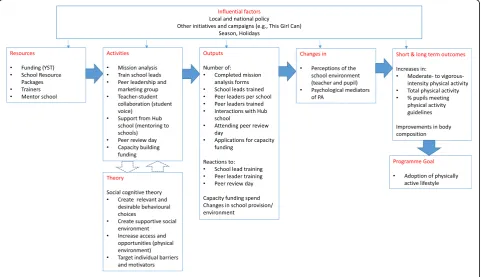
theory post-hoc by the academic team (Fig. 1). Seven
core components of Girls Active were identified: submis-sion of the first self-review and action plans; attendance of lead teacher at initial training; use of package of resources or use of an alternative; engagement of young
people as peer leaders; use of online, in person or phone support of hub and/or development coach; lead teacher attendance at peer review day; and submission of the second mission analysis. The intervention was delivered at the cluster level but the participant data reported herein were collected at the individual level.
Control group - usual practice
Control arm schools were not given any specific guid-ance or advice and were assumed to carry on with their usual practice of PE and sport provision.
Primary and secondary outcomes
The primary outcome was difference in the change in mean mins/day of MVPA at 14-month follow-up between groups. Secondary outcomes included: overall PA; sedentary time; and all PA outcomes split by weekday and weekend day, and during school hours and after school hours; BMI z-score; percentage body fat; and psychological factors that may mediate PA participation as described above.
Economic analysis
A full description of the economic assessment methods of the Girls Active trial are available [29]. Briefly, micro-costing methodology [30] was applied to calculate the costs of delivering the programme over a whole school year for the intervention arm schools. This provides a mean cost per school. Money and time spent on delivering Girls
Active were self-reported by lead teachers using two types of bespoke cost diaries and a questionnaire and, if needed, these were followed up with a phone call for clarification. The cost-consequence analysis was conducted from a pub-lic sector, multi-agency perspective. Health related quality of life measured by the Child Health Utility-9D [31] was used as the measure of effect. Use of GP and school based services (school nurse and school counsellor) were used as the measure of costs. These were all self-reported by partic-ipants at each timepoint.
Statistical analysis
The results are reported according to the CONSORT statement for cluster RCTs [32]. Primary and secondary outcome analyses were based on a complete case
analysis. Intention to treat (ITT; all schools and re-cruited pupils were analysed in the group they were ran-domised to) and per protocol analyses were also undertaken for the primary outcome as sensitivity ana-lyses. The per protocol population included schools that engaged with 70% of the seven core components (as de-tailed above) of the programme over the 14 months and had complete data for the analysis concerned on‘by ana-lysis’basis. In the control arm, the per protocol popula-tion included all schools/pupils randomised to that arm.
Generalised estimating equations, accounting for
school level clustering, and adjusting for baseline MVPA, stratification factors of school size (< 850, ≥850) and % of non-White pupils (< 20%,≥20%), %FSME and partici-pant year group, were employed. Subgroup analyses
involved within subgroup stratification and between sub-group interactions effects between the intervention arm and pre-specified subgroups: baseline school (social deprivation and size) and pupil (ethnicity, maturation status, year group, PA level) characteristics. Sensitivity analyses explored the effect of the number of valid accel-erometer days and the season of data collection. All ana-lyses were performed using Stata (v.14.0), with statistical significance set as p < 0.05. Changes from the agreed statistical analysis plan included the addition of %FSME (school SES) and participant year group as covariates in the primary and secondary outcomes analyses.
Results
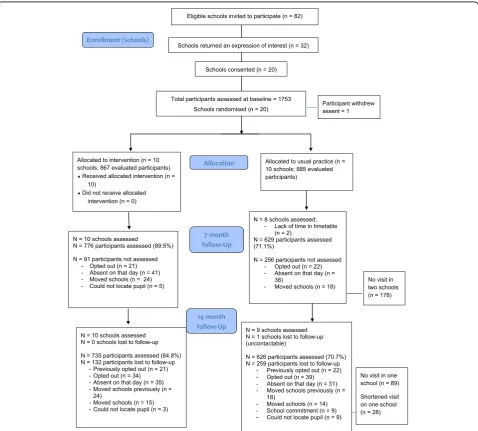
In Spring 2015, 20 secondary schools were recruited (Fig.2). Of these, 18 schools agreed to be followed-up at seven months, and 19 at 14 months. From these schools, 1752 adolescent girls provided assent and participated at
baseline (Feb – April 2015), 1405 (80.2%) at seven
months (Sept – Nov 2015), and 1361 (77.7%) at
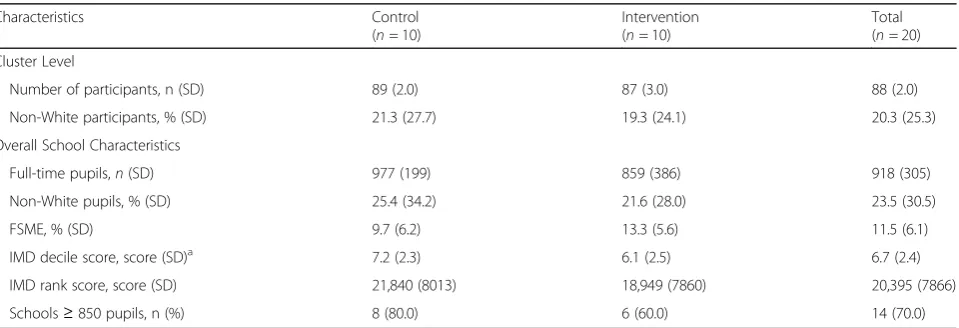
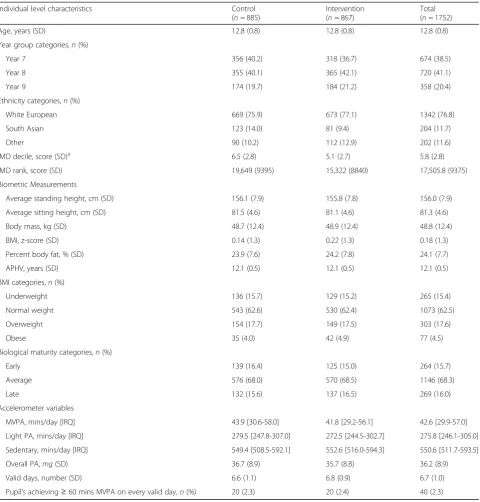
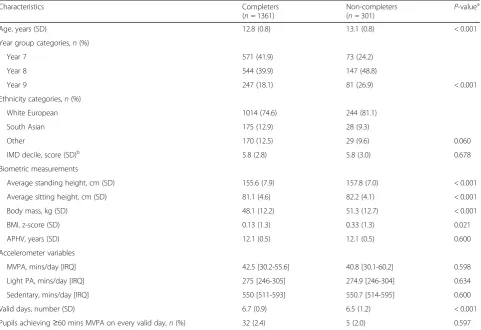
14 months (April–June 2016). Tables1and2present the baseline characteristics of the schools and participants, respectively. Participants who did not complete the 14 month assessment (n= 301) were older (p< 0.001), had a higher BMI z-score (p= 0.021) and provided 0.2 days less accelerometer data (p < 0.001) at baseline (Table 3). Complete accelerometer data (i.e.,≥ 2 valid days, includ-ing at least one school day at baseline and 14 months) was available for 1211 participants (69.1%) for the primary out-come analysis at 14-month follow-up. No serious adverse events/reactions were reported.
Primary outcome analysis
There were no differences between intervention and con-trol groups at 14 months for the change in mean mins/
day of MVPA in the complete case (1.8 mins/day; 95% C.I. -0.8 to 4.3; p = 0.178), intention-to-treat (1.7 mins/day; 95% C.I. -0.6 to 3.9;p= 0.158) or per protocol (1.7 mins/ day; 95% C.I. -1.15 to 4.48;p= 0.246) analyses (Table 4). At seven months, a difference in MVPA between groups was found in the complete case (2.4 mins/day; 95% C.I 0.1 to 4.7;p= 0.039), intention-to-treat (2.3 mins/day; 95% C. I. 0.2 to 4.3; p = 0.028) and per-protocol (3.1 mins/day; 95% C.I. 0.93 to 5.35;p= 0.005) analyses.
Subgroup analysis
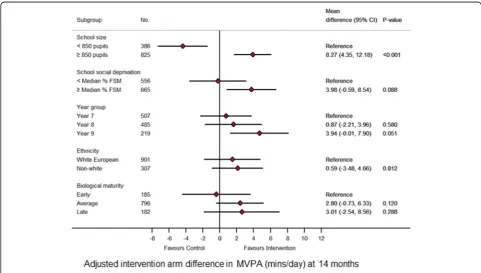
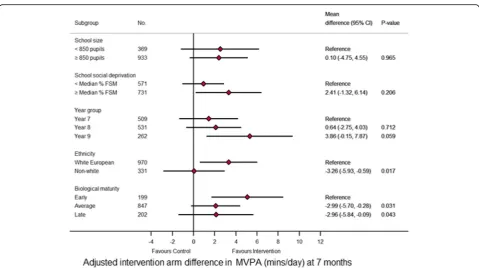
Between subgroup interaction effects revealed subgroup effects (i.e. the programme had a differing effect depend-ing on certain baseline characteristics) at 14 and seven months (Figs. 3 and 4, respectively). At 14 months, the
between subgroup interaction effects (p < 0.001)
revealed a difference between randomised arms of 3.9 mins/day (95% C.I. 1.39 to 6.09; p< 0.001) favouring the
intervention arm in larger schools (≥850 pupils).
In smaller schools (< 850 pupils) there was a difference between randomised arms of -4.4 mins/day (95% C.I. -7.34 to -1.41; p= 0.004) favouring the control arm. At seven months, in White European and early maturers there was a difference between randomised arms of 3.1 mins/day (95% C.I. 0.60 to 6.02;p= 0.017) and 5.1 mins/
day (95% C.I. 1.69 to 8.48; p = 0.003), respectively,
favouring the intervention arm.
Accelerometer secondary outcomes
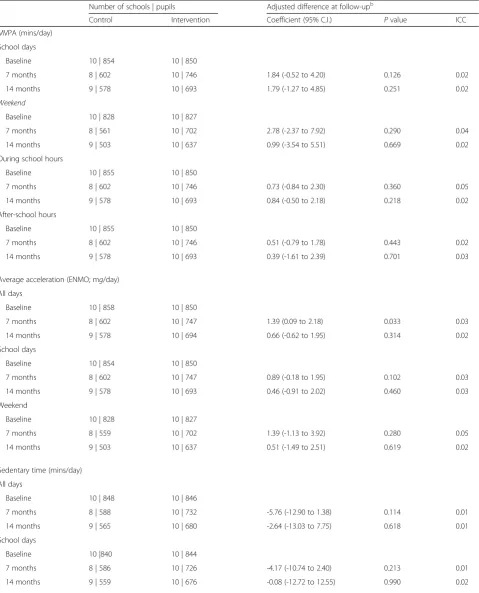
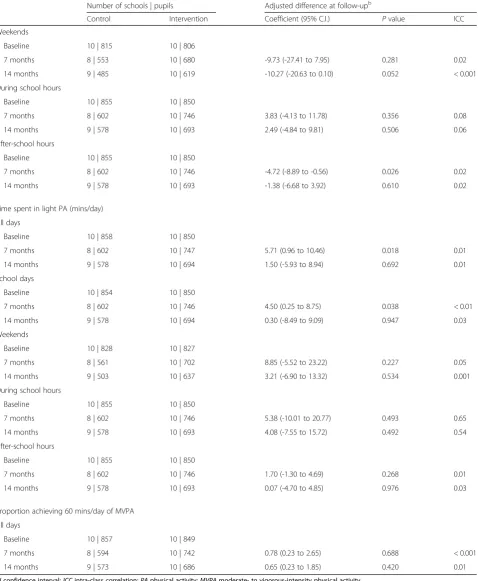
No differences were found in the MVPA variables at seven or 14 months when stratified by weekday/weekend or time of day (Table5). Generally, there were no changes in the other accelerometer variables at seven or 14 months except a significant difference in total PA at seven months (1.4 mg; 95% C.I. 0.1 to 2.2;p= 0.030), in sedentary time
Table 1Baseline characteristics of each school (cluster) by randomised group; usual practice (control) or the Girls Active programme (intervention)
Characteristics Control
(n= 10)
Intervention (n= 10)
Total (n= 20)
Cluster Level
Number of participants, n (SD) 89 (2.0) 87 (3.0) 88 (2.0)
Non-White participants, % (SD) 21.3 (27.7) 19.3 (24.1) 20.3 (25.3)
Overall School Characteristics
Full-time pupils,n(SD) 977 (199) 859 (386) 918 (305)
Non-White pupils, % (SD) 25.4 (34.2) 21.6 (28.0) 23.5 (30.5)
FSME, % (SD) 9.7 (6.2) 13.3 (5.6) 11.5 (6.1)
IMD decile score, score (SD)a 7.2 (2.3) 6.1 (2.5) 6.7 (2.4)
IMD rank score, score (SD) 21,840 (8013) 18,949 (7860) 20,395 (7866)
Schools≥850 pupils, n (%) 8 (80.0) 6 (60.0) 14 (70.0)
All values, unless otherwise stated, are presented as a mean and standard deviation (SD) across schools; Values are presented as means (standard deviation) for continuous variables and number (%) for categorical variables.FSMEFree School Meal Eligibility;IMDIndex of Multiple Deprivation
a
during the after school period at seven months (-4.7 mins/day; 95% C.I. -8.9 to -0.6; p= 0.026), in total light PA at seven months (5.7 mins/day; 95% C.I 1.0 to 10.5;
p= 0.018), and light PA on school days at 7 months (4.5
mins/day; 0.3 to 8.8; p = 0.038). No differences were
found in the proportions of participants active at least 60 min over the measurement period at either seven or 14 months.
Table 2Baseline characteristics at the individual participant level by randomised group; usual practice (control) or the Girls Active programme (intervention)
Individual level characteristics Control
(n= 885)
Intervention (n= 867)
Total (n= 1752)
Age, years (SD) 12.8 (0.8) 12.8 (0.8) 12.8 (0.8)
Year group categories,n(%)
Year 7 356 (40.2) 318 (36.7) 674 (38.5)
Year 8 355 (40.1) 365 (42.1) 720 (41.1)
Year 9 174 (19.7) 184 (21.2) 358 (20.4)
Ethnicity categories,n(%)
White European 669 (75.9) 673 (77.1) 1342 (76.8)
South Asian 123 (14.0) 81 (9.4) 204 (11.7)
Other 90 (10.2) 112 (12.9) 202 (11.6)
IMD decile, score (SD)a 6.5 (2.8) 5.1 (2.7) 5.8 (2.8)
IMD rank, score (SD) 19,649 (9395) 15,322 (8840) 17,505.8 (9375)
Biometric Measurements
Average standing height, cm (SD) 156.1 (7.9) 155.8 (7.8) 156.0 (7.9)
Average sitting height, cm (SD) 81.5 (4.6) 81.1 (4.6) 81.3 (4.6)
Body mass, kg (SD) 48.7 (12.4) 48.9 (12.4) 48.8 (12.4)
BMI, z-score (SD) 0.14 (1.3) 0.22 (1.3) 0.18 (1.3)
Percent body fat, % (SD) 23.9 (7.6) 24.2 (7.8) 24.1 (7.7)
APHV, years (SD) 12.1 (0.5) 12.1 (0.5) 12.1 (0.5)
BMI categories,n(%)
Underweight 136 (15.7) 129 (15.2) 265 (15.4)
Normal weight 543 (62.6) 530 (62.4) 1073 (62.5)
Overweight 154 (17.7) 149 (17.5) 303 (17.6)
Obese 35 (4.0) 42 (4.9) 77 (4.5)
Biological maturity categories,n(%)
Early 139 (16.4) 125 (15.0) 264 (15.7)
Average 576 (68.0) 570 (68.5) 1146 (68.3)
Late 132 (15.6) 137 (16.5) 269 (16.0)
Accelerometer variables
MVPA, mins/day [IRQ] 43.9 [30.6-58.0] 41.8 [29.2-56.1] 42.6 [29.9-57.0]
Light PA, mins/day [IRQ] 279.5 [247.8-307.0] 272.5 [244.5-302.7] 275.8 [246.1-305.0]
Sedentary, mins/day [IRQ] 549.4 [508.5-592.1] 552.6 [516.0-594.3] 550.6 [511.7-593.5]
Overall PA,mg(SD) 36.7 (8.9) 35.7 (8.8) 36.2 (8.9)
Valid days, number (SD) 6.6 (1.1) 6.8 (0.9) 6.7 (1.0)
Pupil’s achieving≥60 mins MVPA on every valid day,n(%) 20 (2.3) 20 (2.4) 40 (2.3) Values are presented as means (standard deviation) or median [interquartile range] for continuous variables and number (%) for categorical variables
a
IMD 2015 decile score ranges 1–10, where 1 is the least deprived and 10 the most deprived
IMDindex of multiple deprivation;BMIbody mass index;APHVage at peak height velocity;MVPAmoderate- to vigorous-intensity physical activity;PA physical activity
Body composition secondary outcomes
No differences between the groups were seen for BMI z-score at either seven (0.003 kg/m2; 95% C.I. -0.06 to 0.07;
p = 0.908) or 14 months (0.02 kg/m2; 95% C.I. -0.06 to 0.09; p= 0.636). Similarly, no differences between the groups were seen for % body fat at either seven (-0.15%; 95% C.I.-0.83 to 0.52;p= 0.656) or 14 months (0.25%; 95% C.I. -0.68 to 1.17;p= 0.600).
Psychosocial secondary outcomes
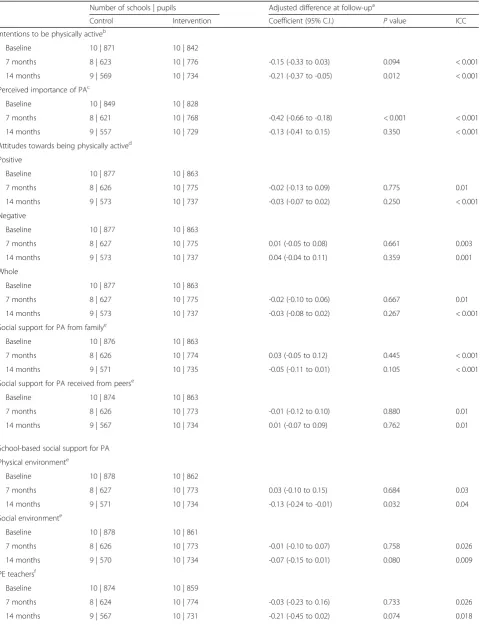
There was no pattern in the differences found and they were sporadic (Table6) and slight (questionnaire scales were on a five or seven point scale). At 14 months there was a differ-ence in intentions to being active in favour of the control group (-0.21; 95% C.I. -0.37 to -0.05; p = 0.012). At seven months there was a difference in perceived importance in favour of control group (-0.42; 95% C.I. -0.66 to -0.18;
p< 0.001). At 14 months there was a difference in partici-pants confidence in being active in favour of the control group (-0.08; 95% C.I. -0.14 to -0.02;p= 0.013). A signifi-cant difference in self-esteem was seen at seven months (0.06; 95% C.I. 0.01 to 0.11; p = 0.025) in favour of the intervention group. At 14 months there was a difference between groups perceptions of their school physical environment in favour of the control group (-0.13; 95% C.I. -0.24 to -0.01; p = 0.032). At 14 (-0.09; 95% C.I. -0.18 to -0.01; p = 0.032) months there was a difference in identified motivation (motivated by engaging in activities that are a means to an end) in favour of the intervention group.
Sensitivity analyses
Sensitivity analyses showed similar results to the main analysis with no differences between groups at 14 months Table 3Baseline characteristics of completers versus non-completers at 14 month follow-up
Characteristics Completers
(n= 1361)
Non-completers (n= 301)
P-valuea
Age, years (SD) 12.8 (0.8) 13.1 (0.8) < 0.001
Year group categories,n(%)
Year 7 571 (41.9) 73 (24.2)
Year 8 544 (39.9) 147 (48.8)
Year 9 247 (18.1) 81 (26.9) < 0.001
Ethnicity categories,n(%)
White European 1014 (74.6) 244 (81.1)
South Asian 175 (12.9) 28 (9.3)
Other 170 (12.5) 29 (9.6) 0.060
IMD decile, score (SD)b 5.8 (2.8) 5.8 (3.0) 0.678
Biometric measurements
Average standing height, cm (SD) 155.6 (7.9) 157.8 (7.0) < 0.001
Average sitting height, cm (SD) 81.1 (4.6) 82.2 (4.1) < 0.001
Body mass, kg (SD) 48.1 (12.2) 51.3 (12.7) < 0.001
BMI, z-score (SD) 0.13 (1.3) 0.33 (1.3) 0.021
APHV, years (SD) 12.1 (0.5) 12.1 (0.5) 0.600
Accelerometer variables
MVPA, mins/day [IRQ] 42.5 [30.2-55.6] 40.8 [30.1-60.2] 0.598
Light PA, mins/day [IRQ] 275 [246-305] 274.9 [246-304] 0.634
Sedentary, mins/day [IRQ] 550 [511-593] 550.7 [514-595] 0.600
Valid days, number (SD) 6.7 (0.9) 6.5 (1.2) < 0.001
Pupils achieving≥60 mins MVPA on every valid day,n(%) 32 (2.4) 5 (2.0) 0.597
IMDindex of multiple deprivation;BMIbody mass index;APHVage at peak height velocity;MVPAmoderate- to vigorous-intensity physical activity; PAphysical activity
Missing data: 2 age; 2 ethnicity; 110 pupils social deprivation score; 29 standing height; 50 sitting height; 6 body weight; 33 BMI, BMI categories; 56 percentage body fat; 72 APHV, biological maturity; 41 light PA, 43 pupils meeting PA guidelines, 41 number of valid days; 52 sedentary; 0 all other variables
NOTE: Completers included all those who assented at the 14 month visit from all 18 completing schools and the one school with the modified 14 month visit. Non-completers included all those who did not provide assent at the 14 month visit from all 18 completing schools and the one school with the modified 14 month visit. Participants from one school lost to follow-up were not included in either group
a
P-values test for the difference between completers and non-completers and were estimated using either two sample t-test, Chi-squared test or Wilcoxon rank sum test, as appropriate
b
when the various levels of accelerometer data provision were used. The differences found at 7 months in the main analysis were similar when accelerometer data provision was one day or more (2.4 mins/day; 95% C.I 0.13 to 4.62;
p= 0.038), any 2 days or more (2.4 mins/day; 95% C.I 0.12 to 4.72;p= 0.039), and any 3 days or more (2.4 mins/day;
95% C.I 0.02 to 4.7; p = 0.048), any 4 or more days
(2.3 mins/day; 95% C.I. -0.03 to 4.7; P = 0.053) and
any three weekdays plus one weekend day or more
(2.2 mins/day; 95% C.I. -0.2 to 4.6; p = 0.078). The
addition of baseline season of data collection to the analysis revealed a difference in MVPA change at 14 month of 0.8 mins/day (95% C.I. 1.2 to 3.5;p= 0.027) only. When follow-up season was included in the model Table 4Changes in minutes per day of MVPA at 7 and 14 (primary outcome) month follow-up between participants randomised to usual practice (control) or to the Girls Active programme (intervention)a
Number of schools | pupils Mean change from baseline (95% C.I.) Adjusted difference at follow-upb
Control Intervention Control Intervention Coefficient (95% C.I.) P-value ICC
Complete casec
7 months 8 | 572 10 | 730 -6.18 (-7.30 to -5.06) -2.45 (-3.50 to -1.41) 2.42 (0.13 to 4.72) 0.039 0.03
14 months 9 | 539 10 | 672 -3.47 (-4.91 to -2.03) -2.09 (-3.27 to -0.90) 1.75 (-0.80 to 4.29) 0.178 0.02
Per protocold
7 months 8 | 572 8 | 586 -6.18 (-7.30 to -5.06) -1.91 (-3.11 to -0.72) 3.14 (0.93 to 5.35) 0.005 0.02
14 months 9 | 539 8 | 549 -3.47 (-4.91 to -2.03) -1.46 (-2.74 to -0.18) 1.67 (-1.15 to 4.48) 0.246 0.02
Intention-to-treate
7 months 10 | 885 10 | 867 -5.92 (-7.05 to -4.78) -2.50 (-3.57 to -1.44) 2.30 (0.25 to 4.35) 0.028
-14 months 10 | 885 10 | 867 -3.63 (-5.03 to -2.23) -2.01 (-3.20 to -0.81) 1.65 (-0.64 to 3.94) 0.158
-CIconfidence interval;ICCintra-class correlation;MVPAmoderate- to vigorous-intensity physical activity
a
Including pupils who have worn the accelerometer with a minimum of two valid days with at least one school day at baseline and 7 months, and at baseline and 14 months
b
Difference in the mean MVPA at follow-up adjusted for cluster effect, baseline MVPA value, participant year group, school percentage free school meal eligibility and stratification categories (school size and percentage of non-White pupils)
c
Those with missing outcome data or missing variables required for the model adjustment are excluded
d
Schools that did not engage with 70% of the programme have been excluded from this analysis
e
Missing data imputed using multiple imputation
there was a difference in MVPA change of 2.8 mins/day at seven months (95% C.I. 0.4 to 5.1;p= 0.020).
Economic analysis
Depending on how Girls Active was implemented costs ranged from an estimated £1054 per year to £3498 per year per school. There were no statistically significant differences found between the groups for health-related quality of life (CHU9D utility index scores) and frequen-cies and costs of GP and school service use.
Process evaluation
How each schools implemented the programme was ad-dressed specifically within the process evaluation. In par-ticular, how peer leaders identified and the groups established and run; the positive feelings lead teachers and pupils had about the programme; the challenges and opportunities to implementing a flexible programme within the current educational landscape and school-level constraints to implementation.
Discussion
Girls Active was designed by the YST to be, and is being delivered as, a flexible programme for UK schools. This paper investigated the effectiveness of the programme in impacting MVPA of adolescent females. PA of this population is of significant public health interest. The complete case, intention-to-treat and per protocol analyses found no evidence of a sustained intervention
effect on MVPA between intervention and control groups after 14 months (primary outcome). At the shorter follow-up of seven months, significant differ-ences in MVPA were observed between groups in the complete case, intention-to-treat and per protocol ana-lyses, but the differences in change were small: 2.4, 2.3 and 3.1 mins/day, respectively. When observing MVPA changes in the per-protocol analysis it would seem that implementation of more of the seven core components (as presented in the methods) of Girls Active prevented the MVPA decline i.e. control schools declined by 6.2 mins/day while the intervention schools declined by 1.9 mins/day between baseline and seven months. Due to the flexible nature of the programme lead teachers spent a wide range of time and money on delivering and implementing Girls Active within their schools. The cost-consequence analysis showed no effect on health related quality of life or service use (typical measures utilised in health economic analysis).
Table 5Objectively measured activity variables at follow-up between participants randomised to usual practice (control) or to the Girls Active programme (intervention)a
Number of schools | pupils Adjusted difference at follow-upb
Control Intervention Coefficient (95% C.I.) Pvalue ICC
MVPA (mins/day)
School days
Baseline 10 | 854 10 | 850
7 months 8 | 602 10 | 746 1.84 (-0.52 to 4.20) 0.126 0.02
14 months 9 | 578 10 | 693 1.79 (-1.27 to 4.85) 0.251 0.02
Weekend
Baseline 10 | 828 10 | 827
7 months 8 | 561 10 | 702 2.78 (-2.37 to 7.92) 0.290 0.04
14 months 9 | 503 10 | 637 0.99 (-3.54 to 5.51) 0.669 0.02
During school hours
Baseline 10 | 855 10 | 850
7 months 8 | 602 10 | 746 0.73 (-0.84 to 2.30) 0.360 0.05
14 months 9 | 578 10 | 693 0.84 (-0.50 to 2.18) 0.218 0.02
After-school hours
Baseline 10 | 855 10 | 850
7 months 8 | 602 10 | 746 0.51 (-0.79 to 1.78) 0.443 0.02
14 months 9 | 578 10 | 693 0.39 (-1.61 to 2.39) 0.701 0.03
Average acceleration (ENMO; mg/day)
All days
Baseline 10 | 858 10 | 850
7 months 8 | 602 10 | 747 1.39 (0.09 to 2.18) 0.033 0.03
14 months 9 | 578 10 | 694 0.66 (-0.62 to 1.95) 0.314 0.02
School days
Baseline 10 | 854 10 | 850
7 months 8 | 602 10 | 747 0.89 (-0.18 to 1.95) 0.102 0.03
14 months 9 | 578 10 | 693 0.46 (-0.91 to 2.02) 0.460 0.03
Weekend
Baseline 10 | 828 10 | 827
7 months 8 | 559 10 | 702 1.39 (-1.13 to 3.92) 0.280 0.05
14 months 9 | 503 10 | 637 0.51 (-1.49 to 2.51) 0.619 0.02
Sedentary time (mins/day)
All days
Baseline 10 | 848 10 | 846
7 months 8 | 588 10 | 732 -5.76 (-12.90 to 1.38) 0.114 0.01
14 months 9 | 565 10 | 680 -2.64 (-13.03 to 7.75) 0.618 0.01
School days
Baseline 10 |840 10 | 844
7 months 8 | 586 10 | 726 -4.17 (-10.74 to 2.40) 0.213 0.01
Table 5Objectively measured activity variables at follow-up between participants randomised to usual practice (control) or to the
Girls Active programme (intervention)a(Continued)
Number of schools | pupils Adjusted difference at follow-upb
Control Intervention Coefficient (95% C.I.) Pvalue ICC
Weekends
Baseline 10 | 815 10 | 806
7 months 8 | 553 10 | 680 -9.73 (-27.41 to 7.95) 0.281 0.02
14 months 9 | 485 10 | 619 -10.27 (-20.63 to 0.10) 0.052 < 0.001
During school hours
Baseline 10 | 855 10 | 850
7 months 8 | 602 10 | 746 3.83 (-4.13 to 11.78) 0.356 0.08
14 months 9 | 578 10 | 693 2.49 (-4.84 to 9.81) 0.506 0.06
After-school hours
Baseline 10 | 855 10 | 850
7 months 8 | 602 10 | 746 -4.72 (-8.89 to -0.56) 0.026 0.02
14 months 9 | 578 10 | 693 -1.38 (-6.68 to 3.92) 0.610 0.02
Time spent in light PA (mins/day)
All days
Baseline 10 | 858 10 | 850
7 months 8 | 602 10 | 747 5.71 (0.96 to 10.46) 0.018 0.01
14 months 9 | 578 10 | 694 1.50 (-5.93 to 8.94) 0.692 0.01
School days
Baseline 10 | 854 10 | 850
7 months 8 | 602 10 | 746 4.50 (0.25 to 8.75) 0.038 < 0.01
14 months 9 | 578 10 | 694 0.30 (-8.49 to 9.09) 0.947 0.03
Weekends
Baseline 10 | 828 10 | 827
7 months 8 | 561 10 | 702 8.85 (-5.52 to 23.22) 0.227 0.05
14 months 9 | 503 10 | 637 3.21 (-6.90 to 13.32) 0.534 0.001
During school hours
Baseline 10 | 855 10 | 850
7 months 8 | 602 10 | 746 5.38 (-10.01 to 20.77) 0.493 0.65
14 months 9 | 578 10 | 693 4.08 (-7.55 to 15.72) 0.492 0.54
After-school hours
Baseline 10 | 855 10 | 850
7 months 8 | 602 10 | 746 1.70 (-1.30 to 4.69) 0.268 0.01
14 months 9 | 578 10 | 693 0.07 (-4.70 to 4.85) 0.976 0.03
Proportion achieving 60 mins/day of MVPA
All days
Baseline 10 | 857 10 | 849
7 months 8 | 594 10 | 742 0.78 (0.23 to 2.65) 0.688 < 0.001
14 months 9 | 573 10 | 686 0.65 (0.23 to 1.85) 0.420 0.01
CIconfidence interval;ICCintra-class correlation;PAphysical activity;MVPAmoderate- to vigorous-intensity physical activity
a
Based on a complete case analysis
b
Table 6Scores for psychosocial measures at follow-up for participants randomised to usual practice (control) or to the Girls Active programme (intervention)
Number of schools | pupils Adjusted difference at follow-upa
Control Intervention Coefficient (95% C.I.) Pvalue ICC
Intentions to be physically activeb
Baseline 10 | 871 10 | 842
7 months 8 | 623 10 | 776 -0.15 (-0.33 to 0.03) 0.094 < 0.001
14 months 9 | 569 10 | 734 -0.21 (-0.37 to -0.05) 0.012 < 0.001
Perceived importance of PAc
Baseline 10 | 849 10 | 828
7 months 8 | 621 10 | 768 -0.42 (-0.66 to -0.18) < 0.001 < 0.001
14 months 9 | 557 10 | 729 -0.13 (-0.41 to 0.15) 0.350 < 0.001
Attitudes towards being physically actived
Positive
Baseline 10 | 877 10 | 863
7 months 8 | 626 10 | 775 -0.02 (-0.13 to 0.09) 0.775 0.01
14 months 9 | 573 10 | 737 -0.03 (-0.07 to 0.02) 0.250 < 0.001
Negative
Baseline 10 | 877 10 | 863
7 months 8 | 627 10 | 775 0.01 (-0.05 to 0.08) 0.661 0.003
14 months 9 | 573 10 | 737 0.04 (-0.04 to 0.11) 0.359 0.001
Whole
Baseline 10 | 877 10 | 863
7 months 8 | 627 10 | 775 -0.02 (-0.10 to 0.06) 0.667 0.01
14 months 9 | 573 10 | 737 -0.03 (-0.08 to 0.02) 0.267 < 0.001
Social support for PA from familye
Baseline 10 | 876 10 | 863
7 months 8 | 626 10 | 774 0.03 (-0.05 to 0.12) 0.445 < 0.001
14 months 9 | 571 10 | 735 -0.05 (-0.11 to 0.01) 0.105 < 0.001
Social support for PA received from peerse
Baseline 10 | 874 10 | 863
7 months 8 | 626 10 | 773 -0.01 (-0.12 to 0.10) 0.880 0.01
14 months 9 | 567 10 | 734 0.01 (-0.07 to 0.09) 0.762 0.01
School-based social support for PA
Physical environmente
Baseline 10 | 878 10 | 862
7 months 8 | 627 10 | 773 0.03 (-0.10 to 0.15) 0.684 0.03
14 months 9 | 571 10 | 734 -0.13 (-0.24 to -0.01) 0.032 0.04
Social environmente
Baseline 10 | 878 10 | 861
7 months 8 | 626 10 | 773 -0.01 (-0.10 to 0.07) 0.758 0.026
14 months 9 | 570 10 | 734 -0.07 (-0.15 to 0.01) 0.080 0.009
PE teachersf
Baseline 10 | 874 10 | 859
7 months 8 | 624 10 | 774 -0.03 (-0.23 to 0.16) 0.733 0.026
Table 6Scores for psychosocial measures at follow-up for participants randomised to usual practice (control) or to the Girls Active
programme (intervention)(Continued)
Number of schools | pupils Adjusted difference at follow-upa
Control Intervention Coefficient (95% C.I.) Pvalue ICC
Confidence to take part in PA (self-efficacy)d
Baseline 10 | 879 10 | 853
7 months 8 | 625 10 | 774 -0.02 (-0.09 to 0.04) 0.472 < 0.001
14 months 9 | 568 10 | 733 -0.08 (-0.14 to -0.02) 0.013 < 0.001
Enjoyment of PAg
Baseline 10 | 876 10 | 851
7 months 8 | 625 10 | 772 -0.03 (-0.14 to 0.08) 0.592 0.140
14 months 9 | 566 10 | 731 -0.04 (-0.12 to 0.04) 0.361 < 0.001
Motivation to take part in PAg
Extrinsic
Baseline 10 | 877 10 | 842
7 months 8 | 626 10 | 771 -0.02 (-0.11 to 0.07) 0.680 < 0.001
14 months 9 | 568 10 | 735 -0.01 (-0.15 to 0.13) 0.919 0.009
Introjected
Baseline 10 | 878 10 | 842
7 months 8 | 626 10 | 771 -0.05 (-0.11 to 0.02) 0.143 < 0.001
14 months 9 | 568 10 | 735 -0.05 (-0.14 to 0.04) 0.260 < 0.001
Identified
Baseline 10 | 878 10 | 842
7 months 8 | 626 10 | 771 -0.02 (-0.15 to 0.10) 0.700 0.020
14 months 9 | 568 10 | 735 -0.09 (-0.18 to -0.01) 0.032 < 0.001
Intrinsic
Baseline 10 | 878 10 | 842
7 months 8 | 626 10 | 771 -0.01 (-0.18 to 0.18) 0.990 0.028
14 months 9 | 568 10 | 735 -0.06 (-0.16 to -0.04) 0.243 0.002
Amotivation
Baseline 10 | 877 10 | 841
7 months 8 | 626 10 | 771 -0.03 (-0.15 to 0.09) 0.578 0.007
14 months 9 | 568 10 | 735 -0.02 (-0.14 to 0.09) 0.684 0.002
Physical self-perceptione
Self-esteem
Baseline 10 | 760 10 | 700
7 months 8 | 622 10 | 769 0.06 (0.01 to 0.11) 0.025 < 0.001
14 months 9 | 535 10 | 730 -0.06 (-0.13 to 0.01) 0.086 < 0.001
Physical self-worth
Baseline 10 | 760 10 | 699
7 months 8 | 622 10 | 769 -0.01 (-0.07 to 0.05) 0.742 0.007
different programmes, may be needed for non-White European girls and late maturing girls based on the find-ings of the sub-group analysis at seven months.
We saw some differences between groups at seven months for accelerometer variables in favour of the inter-vention group, but again these differences were relatively small. Little evidence of any changes in potential psycho-social mediators during the course of the programme were found. Process evaluation data will map out timelines of programme activity to help explain these findings.
Comparison with extant literature
School-based PA interventions targeting adolescents have shown limited success on objective measures of PA, particularly for older adolescents [33]. Recent evi-dence from school-based trials with a primary outcome
of objectively measured MVPA from the UK [34–37],
Australia [38,39] and the Netherlands [40] has emerged. Of these, two were aimed at adolescent girls in second-ary schools, [37,39] and only one reported a significant effect on objective MVPA but in males only [38]. Other studies are currently underway in UK secondary schools which capitalise on influential pupils, mentors, or in-class peer leaders [41,42].
The findings of this study add to evidence from well-designed, adequately powered trials on the lack of effect-iveness of school-based PA programmes on objectively assessed PA [34, 37, 39]. When there is a significant effect, it is‘small’(a standardised mean difference≤0.49) [33] highlighting the challenges with intervening on ado-lescents’ PA within the school setting. Although small effects are seen multi-component programmes and those underpinned by theory may be more effective [9, 13]. Extensive support may be required to show significant but modest intervention effects (e.g. PA4E1 [38]).
This was an evaluation of a programme currently imple-mented in UK secondary schools so addressing the
limitations to the Girls Active programme itself was beyond the scope of this study. Accompanying process evaluation and cost-effectiveness papers will underscore barriers to implementing school-based PA programmes and also dem-onstrate what resources were actually used to implement the programme, which will be highly valuable for future research and roll-out at scale.
Strengths and limitations
The strengths of this evaluation study include a fully powered cluster RCT design. The sample was multi-ethnic, incorporating diverse schools. A random sam-ple of 90 girls/schools were included in the evaluation
to ensure it was not the “most active” girls who
would sign-up. The baseline PA levels would shows that meeting PA levels are low (2.3%) the IQR of MVPA of 29.9–57.0 mins/day would suggest pupils with a wide variety of activity levels were included in this study. Overall, 25.9 to 78.2% of all KS3 girls/ school (mean 37.2%) were included making our re-sults generalisable to a whole school population in this age group. However, this may have also acted as a limitation in that over a 14 month period Girls Ac-tive is likely to only have had a modest reach, mean-ing our sample may have not been fully exposed to the intervention. A targeted evaluation sample may have yielded different results. Objective measurement of MVPA as the primary outcome was in line with pub-lic heath priorities and meets the need for“objective and
comprehensive evaluation” methods for evaluating
pro-grammes [43]. Although flexible programme such as Girls Active may benefit from more pragmatic study designs, from a research methods standpoint the RCT design was well received by partners, schools and pupils. Overall, 24% of the schools that were contacted entered the trial (20 out of 82) and schools and pupils were recruited to target. There was good compliance with the accelerometer, low
Table 6Scores for psychosocial measures at follow-up for participants randomised to usual practice (control) or to the Girls Active
programme (intervention)(Continued)
Number of schools | pupils Adjusted difference at follow-upa
Control Intervention Coefficient (95% C.I.) Pvalue ICC
Body attractiveness
Baseline 10 | 760 10 | 699
7 months 8 | 622 10 | 769 -0.05 (-0.12 to 0.03) 0.195 < 0.001
14 months 9 | 535 10 | 730 0.02 (-0.05 to 0.08) 0.630 < 0.001
IQRinterquartile range;CIconfidence interval;ICCintra-class correlation;PAphysical activity
a
Based on a complete case analysis, adjusted difference at follow-up between randomised groups with 95% confidence interval,pvalue and ICC for schools; ad-justed for cluster effect, baseline value, participant year group, school %free school meal eligibility and stratification categories (school size and percentage of non-White pupils)
b
Score ranges from 1 =‘very unlikely’to 7 =‘very likely’
c
Scale ranges from 1 =‘very unimportant’to 10 =‘very important’
d
Score ranges from 1 =‘disagree a lot’to 5 =‘agree a lot’
e
Score ranges from 1 =‘strongly disagree’to 5 =‘strongly agree’
f
Score ranges from 1 =‘strongly disagree’to’7 =‘strongly agree’
g
levels of missingness from questionnaires, and participant loss to follow-up was in line with other studies. A full eco-nomic analysis was also completed for the Girls Active trial. Based on best-practice, the methods used with
schools were designed for this study and the
methods used and results found add to the literature on the costs of delivering programmes in the school setting.
Conclusion
At 14 months, our primary measure of effectiveness was change in MVPA at 14 months. No difference in change in MVPA between Girls Active control and intervention schools was found. At seven months there was less of a decline in MVPA in the interven-tion schools compared to the control schools. Differ-ences in sub-groups may mean the programme has potential in certain types of schools or pupils. Process evaluation and complete and detailed economic ana-lysis papers will give context and detail of the delivery of such a flexible programme.
Abbreviations
APHV:Age at peak height velocity; BME: Black and minority ethnicity; BMI: Body mass index; CI: Confidence interval; FSME: Free school meal eligibility; ICC: Intra-class correlation; IMD: Index of multiple deprivation; ITT: Intention to treat; KS3: Key Stage three; LLR : Leicester City, Leicestershire and Rutland; MVPA: Moderate- to vigorous-intensity physical activity; PA: Physical activity; PE: Physical education; RCT: Randomised controlled trial; SD: Standard deviation; SES: Socioeconomic status; UK: United Kingdom; YST: Youth Sport Trust
Acknowledgments
We thank all the pupils and lead teachers who took part in the Girls Active evaluation study. We thank all of the Girls Active project staff: Mrs. Kyla Harrington (project manager) and Mrs Harshada Chauhan (research administrator). We thank the individual members of the measurement teams that went into schools (comprising of staff and intern students from Leicester Diabetes Centre and the NIHR BRU and students from Loughborough University) and the Leicester CTU staff (data manager, database builder and the statistical team in particular Dr Laura Gray). We particularly thank the members of the Girls Active TSC for their advice and support over the course of the study: Angie Page (University of Bristol; chair), Esther van Sluijs (University of Cambridge), Siobhan Creanor (Plymouth University) and our public members Stephanie Dunkley (Leicester City Council) and Wayne Allsopp (New College, Leicester). Finally we thank the Youth Sport Trust for an inspiring collaboration: Chris Wright, Dominique Lammie, Paulina Skladanowska and Ali Goodall as well as YST tutors and hub school staff who brought the programme to life.
Funding
This project was funded by the NIHR Public Health Research programme (13/ 90/30). Professors Davies and Khunti are NIHR Senior Investigators. University of Leicester authors are supported by the NIHR Leicester-Loughborough Biomed-ical Research Unit (2012–2017), the NIHR Leicester Biomedical Research Centre (2017–2022) and the Collaboration for Leadership in Applied Health Research and Care (CLAHRC) East Midlands. This study was undertaken in collaboration with the Leicester Clinical Trials Unit a UKCRC-registered clinical trials unit in re-ceipt of NIHR CTU support funding. The Youth Sport Trust or the aforemen-tioned funders had no involvement in the TSC, the data analysis, data interpretation, data collection, or writing of this manuscript.
Availability of data and materials
Owing to the use of opt out consent, and not including any specific data sharing information in the participant and parent/guardians information sheets, there are no data that can be shared publically. Please contact the
corresponding author for further details. Document relating to this study can be found onwww.leicesterdiabetescentre.org.uk/girls-active-evaluation
Authors’contributions
DMH co-led the study, co-led the study design and methods development, conducted fieldwork, co-wrote the first draft of the manuscript, coordinated responses from all authors and obtained funds to complete the project. MJD had overall responsibility for the study as the primary investigator, led the study design development and obtained funds to complete the project. DB led the study design development, designed the statistical analysis plan, under-took subsequent rounds of statistical analysis and obtained funds to complete the project. JC conducted the economic analysis of the wider study and drafted the related sections of the manuscript. YC wrote the statistical analysis plan, cleaned and managed the data, undertook the first round of statistical analysis. TG contrib-uted to methods development, drafted the related sections of the manuscript and obtained funds to complete the project. KK contributed to methods develop-ment and obtained funds to complete the project. TP conducted and led the fieldwork team and managed and analysed the accelerometer data. AR cleaned, managed and analysed the accelerometer data and drafted the related sections of the manuscript. LS contributed to methods development, conducted fieldwork, and obtained funds to complete the project. RTE designed and oversaw the eco-nomic analysis of the wider study and obtained funds to complete the project. TY contributed to study design and methods development and obtained funds to complete the project. CLE co-led the study, co-led the study design and methods development, conducted fieldwork, co-wrote the first draft of the manuscript, and obtained funds to complete the project. All authors made critical revisions to the manuscript a number of times. All authors read and approved the final manuscript.
Ethics approval and consent to participate
Ethics approval was obtained from the College of Medicine, Biological Sciences and Psychology ethics representative at the University of Leicester. School principals provided written consent for their school to participate. Parents/ guardians were provided with an opt out consent form and only pupils who did not return the opt out consent form participated. Participants provided verbal assent prior to each measurement session and could withdraw at any time.
Consent for publication
Not applicable.
Competing interests
All authors have completed the Unified Competing Interest form (available on request from the corresponding author) and declare: no support from any organisation for the submitted work, no financial relationships with any organisations that might have an interest in the submitted work in the previous three years and no competing interest related to this work. MJD and KK reports personal fees from Novo Nordisk, Sanofi-Aventis, Lilly, Merck Sharp & Dohme, Boehringer Ingelheim, AstraZeneca, Janssen, Servier, Mitsu-bishi Tanabe Pharma Corporation, Takeda Pharmaceuticals International Inc. and grants from Novo Nordisk, Sanofi-Aventis, Lilly, Boehringer Ingelheim, and Janssen. Outside of the submitted work, JC reports grants from Public Health Wales. CE reports grants from National Institute for Health Research Public Health Research during the conduct of the study. YC, TP, RTE, DB, TG, DMH, AR, LS and TY all have nothing to declare.
Publisher’s Note
Springer Nature remains neutral with regard to jurisdictional claims in published maps and institutional affiliations.
Author details
Received: 3 January 2018 Accepted: 14 March 2018
References
1. Hallal PC, Andersen LB, Bull FC, Guthold R, Haskell W, Ekelund U. Global physical activity levels: surveillance progress, pitfalls, and prospects. Lancet. 2012;380:247–57.
2. Public Health England. Health Survey for England 2015, Trend Tables.Health and social care information Centre. Available fromhttp://www.content. digital.nhs.uk/catalogue/PUB22610. Accessed 2 Jan 2018.
3. Janssen I, LeBlanc AG. Systematic review of the health benefits of physical activity and fitness in school-aged children and youth. Int J Behav Nutr Phys Activ. 2010;7:1–16.
4. Farooq MA, Parkinson KN, Adamson AJ, Pearce MS, Reilly JK, Hughes AR, et al. Timing of the decline in physical activity in childhood and adolescence: Gateshead millennium cohort study. Br J Sports Med; 2017. Online first.https://doi.org/10.1136/bjsports-2016-096933.
5. UK Active Kids. Generation Active.Available fromhttp://www.ukactive.com/ downloads/managed/ON02629_UK_Active_Kids_report_online_spreads_FP. PDF. Accessed 2 Jan 2018.
6. Sport England. Sport England: Towards an Active Nation Strategy 2016–2021.
London:Sport England. Available fromhttps://www.sportengland.org/media/ 10629/sport-england-towards-an-active-nation.pdf. Accessed 2 Jan 2018. 7. Association for Physical Education. Health Position Paper.Available from
http://www.afpe.org.uk/physical-education/wp-content/uploads/afPE_ Health_Position_Paper_Web_Version2015.pdf. Accessed 2 Jan 2018. 8. Camacho-Miñano MJ, LaVoi NM, Barr-Anderson DJ. Interventions to
promote physical activity among young and adolescent girls: a systematic review. Health Educ Res. 2011;26:1025–49.
9. van Sluijs EMF, McMinn AM, Griffin SJ. Effectiveness of interventions to promote physical activity in children and adolescents: systematic review of controlled trials. Brit Med J. 2007;335:703.
10. Dobbins M, Husson H, DeCorby K, LaRocca RL. School-based physical activity programs for promoting physical activity and fitness in children and adolescents aged 6 to 18. Cochrane Libr. 2013;2:CD007651.
11. Hynynen S, van Stralen M, Sniehotta F, Araújo-Soares V, Hardeman W, Chinapaw M, et al. A systematic review of school-based interventions targeting physical activity and sedentary behaviour among older adolescents. Int Rev Sport Exerc Psycho. 2016;9:22–44.
12. Pearson N, Braithwaite R, Biddle SJ. The effectiveness of interventions to increase physical activity among adolescent girls: a meta-analysis. Acad Pediatr. 2015;15:9–18.
13. Owen MB, Curry WB, Kerner C, Newson L, Fairclough SJ. The effectiveness of school-based physical activity interventions for adolescent girls: a systematic review and meta-analysis. Prev Med. 2017;105:237–49.
14. Lubans DR, Foster C, Biddle SJ. A review of mediators of behavior in interventions to promote physical activity among children and adolescents. Prev Med. 2008;47:463–70.
15. Public Health England. Identifying what works for local physical inactivity interventions. Waterloo Road, London: Public Health England. Available fromhttp://researchinstitute.ukactive.com/downloads/managed/Identifying_ what_works.pdf. Accessed 2 Jan 2018.
16. Ekelund U, Luan J, Sherar LB, Esliger DW, Griew P, Cooper A, et al. Moderate to vigorous physical activity and sedentary time and cardiometabolic risk factors in children and adolescents. J Am Med Assoc. 2012;307:704–12. 17. Jago R, Sebire SJ, Cooper AR, Haase AM, Powell J, Davis L, et al. Bristol girls
dance project feasibility trial: outcome and process evaluation results. Int J Behav Nutr Phys Activ. 2012;9:1–10.
18. Edwardson CL, Harrington DM, Yates T, Bodicoat DH, Khunti K, Gorely T, et al. A cluster randomised controlled trial to investigate the effectiveness and cost effectiveness of the‘girls active’intervention: a study protocol. BMC Public Health. 2015;15:526.
19. van Hees VT, Fang Z, Langford J, Assah F, Mohammad A, da Silva IC, et al. Autocalibration of accelerometer data for free-living physical activity assessment using local gravity and temperature: an evaluation on four continents. J Appl Physiol. 2014;117:738–44.
20. van Hees VT, Gorzelniak L, Leon ECD, Eder M, Pias M, Taherian S, et al. Separating movement and gravity components in an acceleration signal and implications for the assessment of human daily physical activity. PLoS One. 2013;8:e61691.
21. Hildebrand M, Van Hees VT, Hansen BH, Ekelund U. Age group comparability of raw accelerometer output from wrist-and hip-worn monitors. Med Sci Sports Exerc. 2014;46:1816–24.
22. Hildebrand M, Hansen BH, van Hees VT, Ekelund U. Evaluation of raw acceleration sedentary thresholds in children and adults. Scand J Med Sci Spor. 2017;27:1814–23.
23. van Hees VT, Sabia S, Anderson KN, Denton SJ, Oliver J, Catt M, et al. A novel, open access method to assess sleep duration using a wrist-worn accelerometer. PLoS One. 2015;10:e0142533.
24. UK Chief Medical Officers. Start Active, Stay Active: A report on physical activity for health from the four home countries’Chief Medical Officers. Department of Health. Available fromwww.dh.gov.uk/en/Publicationsandstatistics/ Publications/PublicationsPolicyAndGuidance/DH_128209. Accessed. 25. da Silva IC, van Hees VT, Ramires VV, Knuth AG, Bielemann RM, Ekelund U,
et al. Physical activity levels in three Brazilian birth cohorts as assessed with raw triaxial wrist accelerometry. Int J Behav Nutr Phys Activ. 2014;43:1959–68. 26. Cole TJ, Freeman JV, Preece MA. Body mass index reference curves for the
UK, 1990. Arch Dis Childhood. 1995;73:25–9.
27. Malina RM, Bouchard C, Bar-Or O. Growth, maturation and physical activity. Champaign: Human Kinetics; 2004.
28. UK Government. Schools, pupils and their characteristics: January 2015.
London:UK National Statistics. Available fromhttps://www.gov.uk/ government/statistics/schools-pupils-and-their-characteristics-january-2015. Accessed 2 Jan 2018.
29. Harrington DM, Davies MJ, Bodicoat D, Charles JM, Chudasama YV, Gorely T, et al. Girls Active: a cluster randomised controlled trial, cost-effectiveness analysis and process evaluation of a school-based intervention to increase physical activity levels among 11- to 14- year-old girls.London:National Institute for Health Research. Available from. Accessed.
30. Charles JM, Edwards RT, Bywater T, Hutchings J. Micro-costing in public health economics: steps towards a standardized framework, using the incredible years toddler parenting program as a worked example. Prev Sci. 2013;14:377–89.
31. Stevens KJ. Assessing the performance of a new generic measure of health related quality of life for children and refining it for use in health state valuation. Am J Pub Health. 2011;9:157–69.
32. Campbell MK, Piaggio G, Elbourne DR, Altman DG, for the CONSORT Group. Consort 2010 statement: extension to cluster randomised trials. Brit Med J. 2012;345:e5661.
33. Borde R, Smith J, Sutherland R, Nathan N, Lubans D. Methodological considerations and impact of school-based interventions on objectively measured physical activity in adolescents: a systematic review and meta-analysis. Obes Rev. 2017;18:476–90.
34. Tymms PB, Curtis SE, Routen AC, Thomson KH, Bolden DS, Bock S, et al. Clustered randomised controlled trial of two education interventions designed to increase physical activity and well-being of secondary school students: the MOVE project. Brit Med J Open. 2016;6:e009318.
35. Fairclough SJ, McGrane B, Sanders G, Taylor S, Owen M, Curry W. A non-equivalent group pilot trial of a school-based physical activity and fitness intervention for 10–11 year old english children: born to move. BMC Public Health. 2016;16:861.
36. Kipping RR, Howe LD, Jago R, Campbell R, Wells S, Chittleborough CR, et al. Effect of intervention aimed at increasing physical activity, reducing sedentary behaviour, and increasing fruit and vegetable consumption in children: active for life year 5 (AFLY5) school based cluster randomised controlled trial. Brit Med J. 2014;348:g3256.
37. Jago R, Edwards MJ, Sebire SJ, Tomkinson K, Bird EL, Banfield K, et al. Effect and cost of an after-school dance programme on the physical activity of 11–12 year old girls: the Bristol girls dance project, a school-based cluster randomised controlled trial. Int J Behav Nutr Phys Activ. 2015;12:128. 38. Sutherland R, Campbell E, Lubans DR, Morgan PJ, Okely AD, Nathan N, et al.
‘Physical activity 4 Everyone’school-based intervention to prevent decline in adolescent physical activity levels: 12 month (mid-intervention) report on a cluster randomised trial. Brit J Sport Med. 2016;50:488–95.
39. Okely AD, Lubans DR, Morgan PJ, Cotton W, Peralta L, Miller J, et al. Promoting physical activity among adolescent girls: the girls in sport group randomized trial. Int J Behav Nutr Phys Activ. 2017;14:81.
41. Sebire SJ, Edwards MJ, Campbell R, Jago R, Kipping R, Banfield K, et al. Update to a protocol for a feasibility cluster randomised controlled trial of a peer-led school-based intervention to increase the physical activity of adolescent girls (PLAN-A). Pilot Feasibility. 2016;2:68.
42. Brown HE, Whittle F, Jong ST, Croxson C, Sharp SJ, Wilkinson P, Wilson EC, van Sluijs EM, Vignoles A, Corder K. A cluster randomised controlled trial to evaluate the effectiveness and cost-effectiveness of the GoActive intervention to increase physical activity among adolescents aged 13–14 years. BMJ Open. 2017:7:e014419.
43. All-Party Commission on Physical Activity. Tackling physical inactivity–a coordinated approach.London: All-Party Commission on Physical Activity. Available fromhttps://parliamentarycommissiononphysicalactivity.files. wordpress.com/2014/04/apcopa-final.pdf. Accessed 2 Jan 2018.
• We accept pre-submission inquiries
• Our selector tool helps you to find the most relevant journal
• We provide round the clock customer support • Convenient online submission
• Thorough peer review
• Inclusion in PubMed and all major indexing services
• Maximum visibility for your research
Submit your manuscript at www.biomedcentral.com/submit