Kang et al. Nano Convergence (2018) 5:13
https://doi.org/10.1186/s40580-018-0144-3
REVIEW
Recent developments of nano-structured
materials as the catalysts for oxygen reduction
reaction
SungYeon Kang, HuiJung Kim and Yong‑Ho Chung
*Abstract
Developments of high efficient materials for electrocatalyst are significant topics of numerous researches since a few decades. Recent global interests related with energy conversion and storage lead to the expansion of efforts to find cost‑effective catalysts that can substitute conventional catalytic materials. Especially, in the field of fuel cell, novel materials for oxygen reduction reaction (ORR) have been noticed to overcome disadvantages of conventional platinum‑based catalysts. Various approaching methods have been attempted to achieve low cost and high electro‑ chemical activity comparable with Pt‑based catalysts, including reducing Pt consumption by the formation of hybrid materials, Pt‑based alloys, and not‑Pt metal or carbon based materials. To enhance catalytic performance and stabil‑ ity, numerous methods such as structural modifications and complex formations with other functional materials are proposed, and they are basically based on well‑defined and well‑ordered catalytic active sites by exquisite control at nanoscale. In this review, we highlight the development of nano‑structured catalytic materials for ORR based on recent findings, and discuss about an outlook for the direction of future researches.
Keywords: Electrocatalyst, Nano‑structured material, Oxygen reduction reaction, Pt alloys, Non‑Pt catalyst
© The Author(s) 2018. This article is distributed under the terms of the Creative Commons Attribution 4.0 International License (http://creat iveco mmons .org/licen ses/by/4.0/), which permits unrestricted use, distribution, and reproduction in any medium, provided you give appropriate credit to the original author(s) and the source, provide a link to the Creative Commons license, and indicate if changes were made.
1 Background
According to the change of global demands to green energy as the substitute of fossil fuel, electrocatalysts with high efficiency have been received great attentions to var-ious researchers in the field of renewable energy [1–3]. Especially, oxygen reduction reaction (ORR) was cru-cial issue in polymer electrolyte membrane (PEM) fuel cell, because slow kinetics of cathodic reaction related with oxygen reduction limits overall system efficiency. PEM fuel cell has been regarded as the most promising energy system for the environmental friendly vehicles, resulted from high energy density and fast refueling. As a result, several commercial PEM fuel cell vehicles were launched by global automobile makers, but development of electrocatalyst with high efficiency and low cost was remained as the ongoing task for the market expansion.
Platinum (Pt) and Pt-based materials were mainly uti-lized in the fuel cell as the catalysts due to the fact that they were considered as the most effective electrocata-lysts for ORR [4, 5], but high cost of Pt and low durability of support materials such as carbon particle prevent the practical commercialization [6]. The platinum contents of commercial Pt/C catalyst were ranged from 10 to 60 wt%, and loading amount of Pt was about 0.4 ~ 0.8 mgpt/
cm2. The set target of the Department of Energy (DOE)
is 0.125 mgpt/cm2 for the practical commercialization
until 2020, and researches for reducing Pt consumption have been attempted. Also, there was another problem in addition to high cost and catalytic performance, and it was long-term stability. Pt-based catalysts have the prob-lems related with Pt dissolution and corrosion of carbon support due to the acidic operating condition. Therefore, development of cost-effective electrocatalyst for fuel cell was governed by maximizing mass and specific activities, and minimizing Pt usage with high stability.
Various researches have been attempted to improve those problems above mentioned. Common research
Open Access
*Correspondence: [email protected]
Page 2 of 15 Kang et al. Nano Convergence (2018) 5:13
directions were reduction of Pt consumption in elec-trochemical cell, even though there were a lot of approaching methods to achieve high cost-efficiency and durability. Increasing surface area by reducing the size of Pt particle was the most simple and effective method to minimize Pt consumption, because catalytic reaction is operated in the surface of catalyst, however size con-trolling to the scale of a few nanometers has the practi-cal limitation caused by the severe aggregation due to the high surface energy of nanoparticles. To synthesize Pt nanoparticle without aggregation, site-specific syn-thetic methods in the template were attempted in several research groups [7, 8]. Graphene as the template for the Pt nanoparticle has the planar structure with sp2-bonded carbon atoms, and it has excellent conductivity and sta-bility, resulted in the widely applications to energy con-version system including fuel cell.
Electrodes of fuel cell were usually formed with com-plex composed of catalysts and supporting materials for preventing aggregation and maximizing surface area, and carbon black has been utilized as supporting materials due to its high conductivity and porosity. But, this mate-rials could be easily corroded in the acidic working con-dition, resulted in fast degradation of cell performance. So, there have been various efforts to develop alternat-ing materials with high durability for fuel cell, such as TiO2, SiC, and CeO2 [9–11]. Another method to reduce
Pt consumption was to enhance the performance of elec-trocatalyst, and results by the formation of alloy using Pt and other metals showed different activity according to the facets and bonding structure [12–14]. For example, octahedral PtxNi1−x alloy showed excellent performance
than conventional Pt/C catalysts alloy that Ni atoms were segregated in (111) facets [15].
In addition, numerous approaching methods based on Pt-free catalyst have been attempted to develop cost-effective materials [16–19]. Though several materials showed possibilities to applications as the catalysts in terms of catalytic performance, serious problems such as catalytic activity and durability should be improved for practical commercialization [19].
In this review, we investigate and discuss about the electrocatalysts with high cost-efficiency and durabil-ity for fuel cell based on recent findings, and highlight important results. Also, we will conclude this review by arranging current challenging and future perspective for the catalysts of fuel cell.
2 Downsizing Pt nanoparticle
2.1 Pt/graphene oxide (GO) nanocomplex
Among the methods for increasing efficiency of platinum catalysts, the method to increase surface area was the most efficient way. It has been shown that reducing the
size of the particles to the nanometer greatly enhanced the performance of the catalysts. However, effective sup-porting materials were needed because increasing the surface area of platinum particles will have an aggrega-tion effect between platinum molecules [20–23].
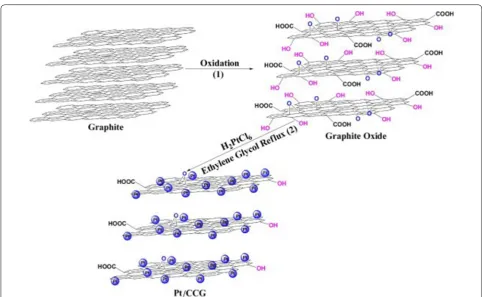
Graphene is a 0.34 nm single layer structure and is suit-able as a supporting material of platinum because of its properties such as excellent thermal, electrical conduc-tivity, high electron transfer rate, and excellent chemi-cal resistance [24–29]. Graphene effectively prevents the aggregation of platinum by allowing it to be placed between pores in the increased surface area for the effi-ciency of the catalyst. Also, graphene is used as a sup-porting material because it is active in acidic and alkaline solutions better than carbon black and also has long-term stability [30, 31]. Figure 1 showed representative synthetic process of Pt/GO hybrid sheet. Pre-treated GO sheets have numerous functional groups on the surfaces such as –O, –OH, and –COOH, and they could provide stable site for the synthesis of Pt nanoparticles. Nano-sized Pt particle could be located on the graphene sheet with well-dispersed shape, and that complex showed enhanced catalytic performance [32], compared with Pt/ multi-wall carbon nanotube that was considered as an excellent promising catalytic materials for fuel cell [33,
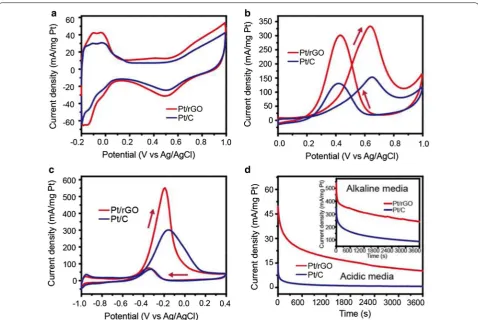
34]. Wu et al. reported another method for the synthesis of Pt–GO hybrid materials based on substitution of sac-rificial materials [30]. MnOx/GO nanocomplex produced
by laser ablation in liquids were reacted with PtCl62−,
and Pt/GO complex could be easily synthesized by the substitution of MnOx to Pt atoms. As a result, they
dem-onstrated a better performance based on fabricated nano-complex than conventional Pt/C electrocatalyst as shown in Fig. 2. Also, several researches based on graphene such as GO modified Pt nanoflower [35], Pt nanoparticle on defective graphene [36], and sandwich-structured gra-phene/Pt/graphene [7] have been researched to reduce Pt consumption.
2.2 Pt/GO/CB nanocomplex
Page 3 of 15 Kang et al. Nano Convergence (2018) 5:13
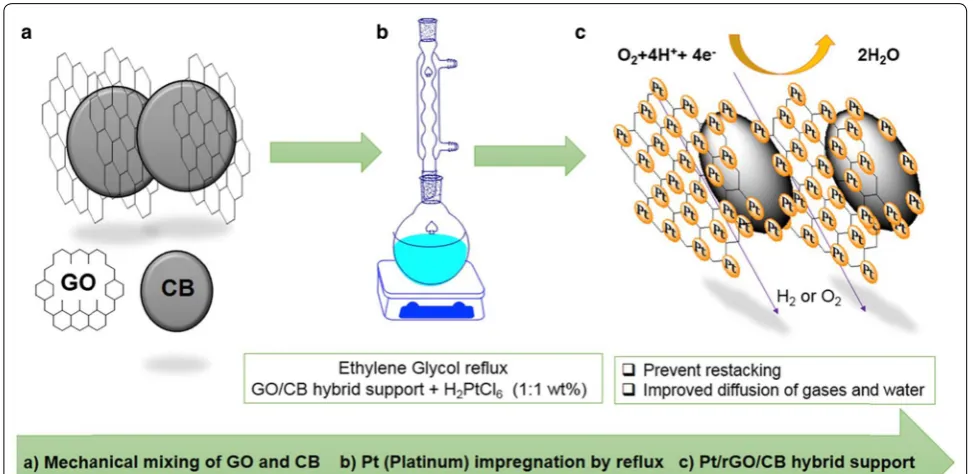
graphene and carbon black result in reducing platinum usage, since they can improve the performance of the catalyst and power output, and provide high utilization of platinum. The highest current produced when the cata-lyst was synthesized at a ratio of GO and CB with a rate of 75:25, and comparing the efficiency of platinum in H00 (Pt/CB), H100 (Pt/GO), and H75 (Pt/GO/CB) showed that H75 has the highest efficiency as the 2.58 KW/g Pt. When the catalyst is synthesized at a ratio of H75, the amount of platinum consumption could be effectively reduced [39].
2.3 Pt/GO/TiO2 nanocomplex
In case of CB support, it is difficult to secure long-term durability as a catalyst for fuel cells due to the corrosivity of CB in acidic working condition. As described above, it is necessary to add supporting materials between gra-phene sheets for mitigating the stacking effect. Various alternating materials have been researched to overcome the limitation of CB [9–11, 40, 41]. Especially, metal oxides such as titanium oxide may become substitutes for carbon black due to low price and inherent characteris-tics related with high stability in working condition of fuel cell [42, 43]. Though the electrical activity of the titanium
oxide is lower than the carbon black, it is similar to the power output of the conventional catalysts because of the electrical activity with graphene. The result using tita-nium oxide showed stability enhancement of 15% (Fig. 4) in comparison with Pt/rGO catalyst and the increase of its power output by 55%. This could be caused by strong interaction between metal and supporting materials, and synergetic effect between TiO2 and graphene [44].
2.4 Pt/carbon nanotube nanocomplex
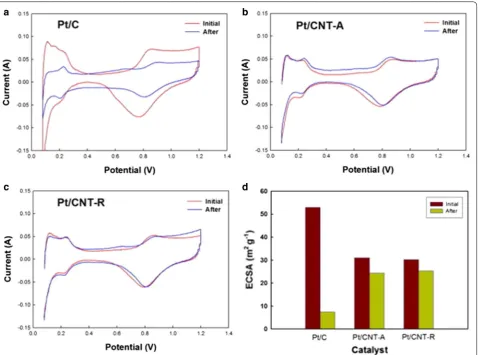
Another way to replace the carbon black and reduction of Pt consumption is to apply carbon nanotubes (CNT) to the catalyst formation. CNT has the properties of excel-lent corrosion resistance, electronic conductivity and specific surface area [45, 46], and can prevent the aggre-gation of platinum, resulting in enhancement of catalytic activity [4, 47]. Also, long-term durability mentioned by the demerit of CB was crucial point to overcome for the commercialization of fuel cell. Lee et al. have reported Pt/CNT catalyst with improved durability for PEM fuel cell [48]. As shown in Fig. 5a, the high initial current was monitored in Pt/C commercial catalyst, but the total current was decreased after acceleration test, and that meant low durability of commercial Pt/C electro-catalyst.
Page 4 of 15 Kang et al. Nano Convergence (2018) 5:13
However, initial current in case of Pt/CNT catalyst was changed a little after test in Fig. 5b–d. Activity loss about 62.5% was monitored in Pt/C, but only 6.2% variation was occurred in Pt/CNT catalyst. Also, polarization resistance of Pt/CNT was increased only 3%, in con-trast with 700% of Pt/C catalyst. Li et al. have reported size-differences between Pt nanoparticles fabricated on GO and multi-wall CNT [32]. Average Pt sizes of Pt/GO and Pt/MWCNT were 2.75 and 3.5 nm, respectively, and it meant that GO was more suitable template material to reduce the size of Pt nanoparticle, in spite of several advantages of CNT.
3 Pt‑based alloys
Pt-alloys with late transition metals have been firstly researched from the early 1980s, and various results reported that alloys with Ni and Co have the higher activities than Pt-based catalyst in terms of ORR [49], but low stabilities of those researches related with the disso-lution during operation process were ongoing research topics. Recently, numerous attempts to synthesize Pt-alloys using rare earth and early transition metals have
been operated by the theoretical simulation and specific experimental results. In 2009, Greeley et al. proposed calculated data named volcano plot for predicting activi-ties of Pt-based alloy materials [50], and this plot showed reliable correlation with recent reported findings [51]. Reported researches have showed meaningful cost-effec-tive performances, but suitable methods for practical commercialization such as simple mass production were still remained ongoing researches. Wu et al. reported effective synthetic method for Pt-metal (Co, Fe, Ni, Pd) alloys [52]. Four kinds of Pt–M alloys were synthesized with same process, and shapes were controlled as cubic and octahedral structure to form well-defined morpholo-gies because they usually play key roles in catalytic reac-tions (Fig. 6). Also, the ORR mass activities of fabricated octahedral Pt3Ni catalyst achieved 0.44 A/mgpt, and it
was higher result than conventional Pt/C catalysts.
3.1 Pt–Ni alloys
Intermediates species such as O, OH, OOH molecules could be easily adsorbed into the platinum surface in the operation process of the oxygen reduction reaction
Fig. 2 CV curve of fabricated Pt/rGO and conventional Pt/C in a 0.5 M N2‑saturated H2SO4, b 0.5 M H2SO4+ 0.5 M CH3OH, and c 0.5 M KOH + 0.5 M
Page 5 of 15 Kang et al. Nano Convergence (2018) 5:13
(ORR), and it leads to decrease total active sites for oxy-gen adsorption, resulted in decline of ORR activities. Platinum and oxygen molecules have mixed potential through the formation of oxide, and the formed oxide prevents ORR [53, 54]. Oxygen molecules in the surface may be adsorbed by secondary transition metals such as Fe, Cu, and Ni in the alloy with platinum [55]. Platinum has high binding energy between oxygen molecules and
the surface. The D-band center of the platinum surface has a higher Fermi level than the alloy catalyst. When the alloys are combined, electron transfer takes place from the metal to platinum, resulting in a larger D-band and lower Fermi level [56, 57]. Also, when those alloys were combined with carbon support such as carbon black, gra-phene and carbon nanotubes, catalyst performance could be enhanced by synergetic effects. Figure 7 indicated
Fig. 3 Fabrication process and structure of Pt/GO/CB hybrid support (reprinted with permission from Ref. [39] Copyright @ 2017 Elsevier)
Fig. 4 a TEM image of Pt/graphene/TiO2 catalyst, b single DMFC performance of Pt/graphene and Pt/graphene/TiO2 catalyst (reprinted with
Page 6 of 15 Kang et al. Nano Convergence (2018) 5:13
ORR activities according to the change of supporting materials as Vulcan XC-72 (CB), graphene, and CNT. Among three results, the catalysts using graphene sup-port showed the highest value, but its stability was lower than other two cases [58].
Chen et al. developed Pt3–Ni bimetallic
nanocrys-tals for electrocatalyst [59], and it showed 5.7 A/mgpt in
mass activity. This nanostructure has the special open-framework with crystalline Pt–Ni alloy (111), resulting in high stability, more active than commercial Pt/C cata-lysts, even after 10,000 rounds of voltage cycles. Also, in 2015, Huang et al. reported novel Pt–Ni octahedral alloy catalyst supported by carbon with transition metals [60]. Overall structure were represented as M–Pt3Ni/C, where
M is applied with vanadium, chromium, manganese, iron, cobalt, molybdenum tungsten, or rhenium. Among them, Mo–Pt3Ni/C recorded the best ORR performances
which were a specific activity of 10.3 mA/cm2 and a mass
activity of 6.98 A/mgPt, respectively, in contrast of the
values of commercial Pt/C catalysts (0.127 mA/cm2 and
0.096 A/mgPt).
3.2 Pt–Cu alloys
Platinum and copper alloy were also used as catalysts for fuel cell because they have benefits to generate high current in comparison with Pt/C catalysts. Because copper was highly active in the oxidation of the inter-mediate carbon, Pt–Cu alloy has been considered as promising candidate for the cost-effective catalysts [61]. Various methods based on hydrothermal process have been reported to fabricate Pt–Cu alloys [62, 63], and those methods usually required additional process to make porous Pt-rich structure by removing pre-com-bined Cu atoms. Yang et al. reported fabrication method based on simple electrodeposition method [64]. They have developed hierarchical Pt–Cu/reduced GO cata-lyst by one-step fabrication process, in which high elec-trocatalytic activity of 2.3 times (vs. commercial Pt/C
Page 7 of 15 Kang et al. Nano Convergence (2018) 5:13
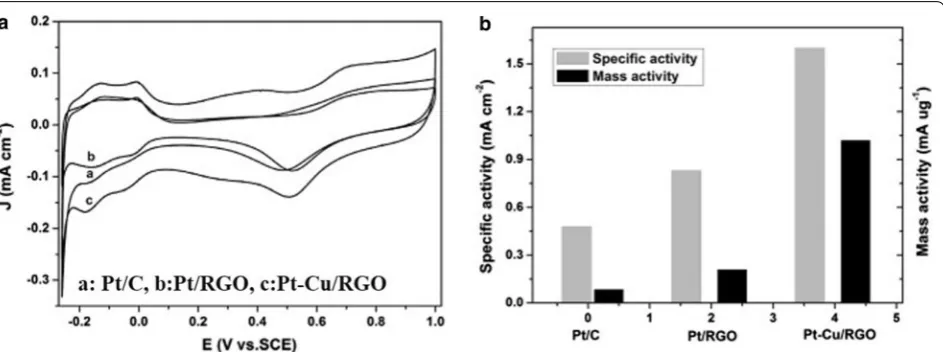
catalyst) and robust durability was achieved. Normally, morphological control using supporting materials with large surface area have been used to enlarge active sites of catalysts. Graphene oxide has not only excellent prop-erties as the supporting materials, but also its numerous functional group in the surface can provide binding site with catalyst nanoparticle. However, natural tendency of graphene to stack horizontally resulted in the decrease of catalytic sites as described above. Fabrication of hierar-chical structure using GO could be desirable method to enhance catalytic activities by facilitating transfer ratio
and increasing accessibility [65, 66], in addition to other methods based on supporting materials such as carbon black or metal oxide [39, 44]. Results about electrochemi-cal activities according to the species of catalysts complex in Fig. 8a indicated the effects of alloying metal and gra-phene support [67]. Strong responses corresponding to adsorption and desorption of hydrogen were monitored in all CV curves, but Pt–Cu/RGO catalysts showed the highest value in all cases. Also, normalized values based on Pt loading (mass activities) and electrochemical active surface areas (specific activities) were represented in
Fig. 6 Schematic description of shape controlled synthesizing process. Pt‑metal alloys were fabricated by gas reducing agent in liquid solution (GRAILS) method (reprinted with permission from Ref. [52] Copyright @ 2011 American Chemical Society)
Page 8 of 15 Kang et al. Nano Convergence (2018) 5:13
Fig. 8b, in which Pt–Cu/RGO catalysts showed remark-able catalytic activity compared to Pt/RGO and Pt/C catalysts.
3.3 Catalysts based on Pt‑based alloys
Besides Pt alloys with Ni and Cu as described above, several researches based on other metals or structural changes have been attempted to achieve low cost and high durability [68, 69]. Zhao et al. reported octahedral core–shell nanocrystals composed of Pd and Pt–Ni, and fabricated nanocrystal achieved 5 times higher mass activities than commercial Pt/C catalysts [70]. Also, another research group developed core–shell tetrapod
structures composed of Pd and Pt [71]. This nanostruc-ture with dendritic morphology showed remarkable activity and durability as the 13% loss of initial electro-chemical surface area in comparison with the 78% loss that of Pt/C catalyst. In addition to those researches, var-ious researches based on structural control with several non-Pt materials have been attempted including Pd–Pt nanostructure with the shape of cube as shown in Fig. 9
[72], ternary Pt–Pd–Cu sphere [73], dendritic Pt–Ni–P alloy [74], multimetallic nancube [75], dealloyed Pt– Cox [76], core–shell Ni/Fe–Pt [77], octahedral Pt2–Cu–
Ni [78], and Pt-coated Co nanowire [79]. Even though remarkable scientific results in terms of high activity
Fig. 8 a Cyclic voltammograms of Pt/C, Pt/RGO, and Pt–Cu/RGO catalysts in 0.5 M H2SO4 at a scan rate of 50 mV/s. b Specific and mass activities of
the Pt/C, Pt. RGO, and Pt–Cu/RGO catalysts modified GC electrode at 0.62 V (reprinted with permission from Ref. [67] Copyright @ 2013 Elsevier)
Page 9 of 15 Kang et al. Nano Convergence (2018) 5:13
and stability have been reported from various research groups, the ultimate research direction for fuel cell cat-alyst should be non-Pt based catcat-alysts, because those results above mentioned were based on the catalytic per-formance of platinum with high cost.
4 Non‑Pt catalysts
The penetration of ethanol through polymeric mem-branes (alcohol crossover phenomenon) could interfere with ORR rate. Also, the combination of oxygen atoms to catalysts is so strong that very slow ORR occurs at the cathode. Pt-based catalysts have been mainly utilized in the practical fuel cells to solve these problems. However, numerous researches to apply non-Pt catalytic materials have been conducted at the same time to overcome dis-advantages of Pt-based catalysts such as high price and low stability [80–85].
4.1 Pd‑based catalysts
Among the different types of non-platinum catalyst, pal-ladium nanoparticles have high resistance to crossover and excellent ORR performance. The face-centered cubic
(fcc) of the palladium has the same atomic size and elec-trical properties with Pt. Furthermore, the price of Pd is very low than Pt because of abundant deposit [86, 87]. However, Pd has low stability in acidic condition and high temperature than Pt, it should be synthesized with vari-ous transition metals and supports to secure stabilities [88, 89]. Especially, Pd–Ni/C catalyst has been consid-ered promising candidate due to the low price, non-toxic, and high ORR response [90].
Recently, Sanij et al. reported fabrication of Pd–Ni/C with superior catalytic performance [91]. Figure 10a, b indicated size differences of Pt/C and Pt8Ni2/C
nano-particles, and the latter has relatively smaller than the former as 3.6 and 5.5 nm, respectively. Electrochemical activities according to the atomic ratio between Pd and Ni were shown in Fig. 10c, d, in which Pd8–Ni2/C has the
highest activity in all catalysts in addition that Pd–Ni/C catalysts were basically higher than Pd/C. Also, hydro-gen adsorption/desorption peaks were observed between
− 0.2 and 0.02. As a result, the separation of hydrogen could be restricted by adding Ni to Pd atoms. Those phe-nomena related with performance improvement of mass
Fig. 10 a TEM images of Pd/C, b Pd–Ni/C, c CV curves of the Pd/C, Ni/C, and Pd–Ni/C catalysts according to the atomic ratio in 0.5 M H2SO4, d mass
Page 10 of 15 Kang et al. Nano Convergence (2018) 5:13
and specific activities were caused by synergetic effects between Ni and Pd, nanoscale particle size, and carbon support materials [92, 93]. As a result, Pd–Ni/C has showed high possibilities than other catalysts in terms of activity, resistance to methanol, ORR efficiency, and sta-bility [91].
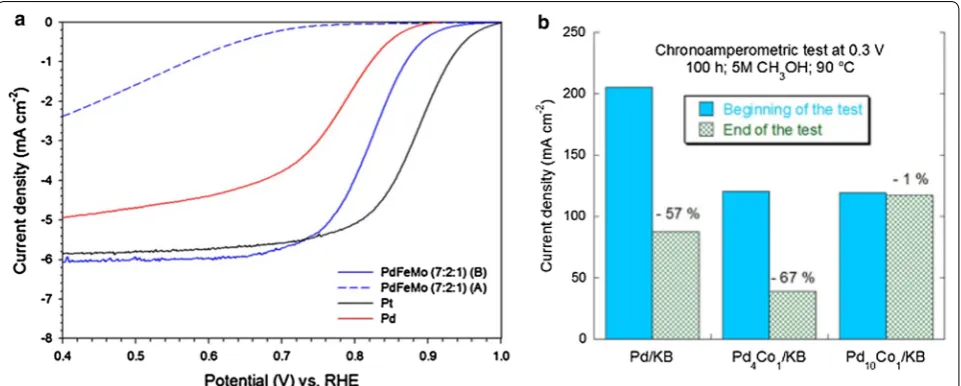
Also, several Pd-based alloy materials with transition metal such as Co and Fe have been researched in vari-ous research groups. Tang et al. have developed Pd–Fe/C electrocatalyst and reported the effect of Fe state [94], and Zhang et al. reported results related with the effect of heat treatment to control Pd–Co nanoparticle size which could affect ORR activity [95]. Co atoms combined with Pd could aid to enhance corrosion resistance and durabil-ity of the catalyst [96]. Figure 11a showed high stability of Pd–Co/C electrocatalyst, in contrast with considerable differences between BOT and EOT of Pd/C. Compared to the stability of the Pd catalyst, the Pd–Co catalyst was much more stable than that of the Pd. Also, the Pd cata-lyst has a good property than the commercial catacata-lyst in transmitting methanol, it is more advantageous in terms of cost reduction and increase of energy density as an alternation materials of Pt-based catalysts. Pd–Fe–Mo/C synthesized with the ratio of 7.5:1.5:1.0 at 500 °C showed high activity and durability compared with commercial Pt-based and non-Pt catalysts as shown in Fig. 11b [97].
4.2 Various catalysts based on non‑Pt materials
Besides Pd-based catalysts above mentioned, numerous researches using non-Pt materials have been developed to achieve efficient novel electro-catalysts with low cost [17, 19, 98–100]. Titanate has been investigated to apply
catalyst for fuel cell because of its low price and stability. However, it has low conductivity and poor performance compared with commercial catalyst, so it should be made into catalysts with other materials [101, 102]. Carbon nanostructure with larger surface area are often used for catalyst synthesis due to their electrical and structural characteristics [103]. As a result of complex formation, the property of titanate composite as the catalyst could be reinforced in terms of surface area, structural stability, and lifespan. Mohamed et al. reported catalytic perfor-mance of Ag/titanate and Ag/titanate-SWCNT [104]. As a non-platinum catalyst, the titanate compound showed high stability, current generation and corrosion resist-ance. It was due to the fact that the catalytic function of Ag could be improved by the interaction between Ag and titanate and the Ag particle size was reduced by synthesis process with titanate. Also, the electrode catalyst perfor-mance was enhanced by uniform distribution (Fig. 12).
Among various non-Pt based catalysts, the most prom-ising material was transition metal/nitrogen supported with carbon (M/N/C, M=Co, Fe, Ni) catalysts, and they have been researched constantly after the Jasinski’s find-ings about co-phtalocyanine in 1964 [105]. The disadvan-tages of those materials in comparison with commercial Pt/C catalysts could be divided with three points of volu-metric activity, mass transport ratio, and durability. The volumetric activities of M/N/C catalysts were merely 1/10 that of Pt–C catalysts in spite of recent progress [17, 106, 107], but this level could be sufficient to apply those materials to operate fuel cell, because the increase of input to electrode for retaining total activity was tech-nically feasible. However, M/N/C structure has low mass
Page 11 of 15 Kang et al. Nano Convergence (2018) 5:13
transfer characteristics so that practical applications were restricted due to the insufficient power density. Proi-etti et al. achieved high power density using Fe-based catalysts [19], in which fabricated Fe/Phen/Z8 catalyst showed the power density comparable with the results of commercial Pt/C catalyst that loaded with 0.3 mgpt/
cm2 as shown in Fig. 13. Also, improved long-term
sta-bility was achieved as only 15% degradation after opera-tion test, though further researches required to provide sufficient performance for commercial applications. In 2016, novel results has been reported by Sa et al. [108]. As shown in Fig. 14, they proposed fabrication method based on silica-protective-layer for maximizing Fe–Nx
active sites in catalysts. Iro prorphyrin precursor was
Fig. 12 The change in conductivity values of Ag/titanate/SWCNT, titanate, and titanate/SWCNT at 500 Hz, and 1 kHz (reprinted with permission from Ref. [104] Copyright @ 2016 Elsevier)
Fig. 13 Polarization and power density curves of MEAs using NRE 211 membranes (Fe/Phen/Z8: blue, previous most active Fe‑based catalyst: red, commercial Pt‑based catalyst: green). a Polarization curves for MEAs, b power density curves corresponding to polarization curves in a (reprinted with permission from Ref. [19] Copyright @ 2011 Macmillan Publishers Ltd: [Nature Communication])
Fig. 14 Fabrication process of Fe/PC/CNT with maximizing FeNx active sites (reprinted with permission from Ref. [108] 2016 American Chemical
Page 12 of 15 Kang et al. Nano Convergence (2018) 5:13
adsorbed into CNT, then these complex were coated with silica layer. This coating was important step for preserv-ing active sites durpreserv-ing synthesis process. The coated layer was removed by etching, resulting in the formation of Fe–N/C catalysts which consisted of porphyrin carbon with FeNx sites supported with CNT. Fabricated
cata-lyst showed very high ORR activity and stability in alka-line media, and it achieved volumetric current density of 320 A/cm3 in acidic media that exceeds DOE target of
300 A/cm3 in 2020.
Encapsulated non-Pt metal based catalysts (ENPMC) have been considered as promising materials for fuel cell due to the advantages according to the protection of metal active sites with outer carbon layer [109–112]. The structure consisting of metal core and carbon shell by encapsulation process was typical concept for pre-serving active sites of metal. For example, Deng et al. reported Fe encapsulated pot-like CNT catalyst in 2013 [110], and fabricated materials showed low activities than M/N/C type catalysts, but remarkable enhancement of stability could be achieved. After operation test for 200 h, its activity was preserved similarly with initial value, and this result was caused by structural characteristics of encapsulated metal. Those kinds of materials have struc-tural disadvantage related with access of reactant because active metal sites were not exposed in the catalyst sur-face, and further studies required to compliment low ORR activities. Recently, encapsulated Fe-based catalyst with high activity was proposed by Strickland et al. [99]. This complex was based on metal–organic-framework (MOF) as the template and FePhen organic precursor. This FePhen@MOF has well-ordered encapsulated struc-ture with 2 nm thin film, and it showed high activity than commercial Pt/C catalyst in alkaline media and similar activity in acidic media.
Metal-free materials such as doped carbon were also important candidates to substitute commercial Pt-based catalysts. Basically, carbon-based materials did not have activity for ORR, but they have gained broad attentions from the result of Gong et al. in 2009 [113] that nitrogen doped CNT without metal exhibited high electrocata-lytic activity and long-term stability. They first reported N-doped CNT as the promising candidates for metal-free electrocatalysts, and various research groups have been attempted to develop cost-effective metal-free catalysts based on similar structural concepts [114–116]. Recently, graphene has been noticed as promising materials to various applications resulted from high stability and sur-face area, and it has been applied to fabricate metal-free electrocatalysts [117, 118], in which novel materials with higher activities in comparison with N-doped CNT was reported that showed comparable activities with com-mercial Pt/C catalysts [119].
5 Summary and future challenges
Development of novel electrocatalysts with low cost and high activity as an alternation of expensive Pt-based cata-lyst has been one of the most important topics in the field of PEMFC. In this review, we have highlighted recent findings based on the fabrication of nano-structured materials. Nanocomplexes composed of carbon-based materials and Pt showed high activity and long-term stability in comparison with commercial Pt/C catalysts, even though total amount of Pt loading was decreased. Also, Pt alloys exhibited synergetic effect that each disad-vantage of Pt and non-Pt materials as a catalytic materi-als for fuel cell was counterbalanced by the formation of alloy. Non-Pt based catalysts have been considered as the most promising materials to replace conventional cata-lysts, recent findings showed possibility to practical com-mercial applications such as Fe–N/C, FePhen@MOF, and N-doped CNT. In spite of new findings above mentioned, carbon supported Pt nanoparticles are unique catalysts that can be utilized in fuel cell. Recent advances related with structural optimization of Pt-based catalyst showed potentials to solve cost problem, but there is obvious lim-itation in terms of market expansion. The desirable solu-tion would be non-Pt based materials that have exhibited sufficient performance in recent results, but improve-ment of long-term stability is required for the commer-cial applications.
Authors’ contributions
SK, HK and YHC wrote the manuscript. All authors read and approved the final manuscript.
Acknowledgements Not applicable.
Competing interests
The authors declare that they have no competing interests.
Ethics approval and consent to participate Not applicable.
Funding
This work was supported by the National Research Foundation of Korea (NRF) Grant funded by the Korea government (MSIP; Ministry of Science, ICT & Future Planning) (No. NRF‑2017R1C1B5017625), and by the Human Resources Program in Energy Technology of the Korea Institute of Energy Technology Evaluation and Planning (KETEP) Granted financial resource from the Ministry of Trade, Industry & Energy, Republic of Korea (No. 20164030300260).
Publisher’s Note
Springer Nature remains neutral with regard to jurisdictional claims in pub‑ lished maps and institutional affiliations.
Page 13 of 15 Kang et al. Nano Convergence (2018) 5:13
References
1. G. Wu, K.L. More, C.M. Johnston, P. Zelenay, High‑performance elec‑ trocatalysts for oxygen reduction derived from polyaniline, iron, and cobalt. Science 332, 443 (2011)
2. C.W.B. Bezerra, L. Zhang, K. Lee, H. Liu, A.L.B. Marques, E.P. Marques, H. Wang, J. Zhang, A review of Fe–N/C and Co–N/C catalysts for the oxygen reduction reaction. Electrochim. Acta 53, 4937 (2008) 3. M.Z. Jacobson, W.G. Colella, D.M. Golden, Cleaning the air and improv‑
ing health with hydrogen fuel‑cell vehicles. Science 308, 1901–1905 (2005)
4. M.K. Min, J.H. Cho, K.W. Cho, H. Kim, Particle size and alloying effects of Pt‑based alloy catalysts for fuel cell applications. Electrochim. Acta 45, 4211 (2000)
5. J.K. Nørskov, J. Rossmeisl, A. Logadottir, L. Lindqvist, J.R. Kitchin, T. Bligaard, H. Jónsson, Origin of the overpotential for oxygen reduction at a fuel‑cell cathode. Phys. Chem. B 108, 17886–17892 (2004)
6. D. Wang, H.L. Xin, R. Hovden, H. Wang, Y. Yu, D.A. Muller, F.J. Disalvo, H.D. Abruna, Structurally ordered intermetallic platinum–cobalt core–shell nanoparticles with enhanced activity and stability as oxygen reduction electrocatalysts. Nat. Mater. 12, 81 (2013)
7. L. Zhao, Z.B. Wang, J.L. Li, J.J. Zhang, X.L. Sui, L.M. Zhang, A newly‑ designed sandwich‑structured graphene–Pt–graphene catalyst with improved electrocatalytic performance for fuel cells. J. Mater. Chem. A 3, 5313–5320 (2015)
8. F.H. Li, Y.Q. Guo, Y. Liu, J. Yan, W. Wang, J.P. Gao, Excellent electrocata‑ lytic performance of pt nanoparticles on reduced graphene oxide nanosheets prepared by a direct redox reaction between Na2PtCl4 and graphene oxide. Carbon 67, 617–626 (2014)
9. M. Tian, G.S. Wu, A.C. Chen, Unique electrochemical catalytic behavior of Pt nanoparticles deposited on TiO2 nanotubes. ACS. Catal. 2, 425–432 (2012)
10. H.F. Lv, S.C. Mu, N.C. Cheng, M. Pan, Nano‑silicon carbide supported catalysts for PEM fuel cells with high electrochemical stability and improved performance by addition of carbon. Appl. Catal. B 100, 190–196 (2010)
11. T. Yu, J. Zeng, B. Lim, Y.N. Xia, Aqueous‑phase synthesis of Pt/Ce2O hybrid nanostructures and their catalytic properties. Adv. Mater. 22, 5188–5192 (2010)
12. K. Jayasayee, J.A. Rob Van Veen, T.G. Manivasagam, S. Celebi, E.J. Hensen, F.A. De Bruijn, Oxygen reduction reaction (ORR) activity and durability of carbon supprted PtM (Co, Ni, Cu) alloys: influence of particle size and non‑noble metals. Appl. Catal. B 111–112, 515–526 (2012)
13. N. Todoroki, T. Kato, T. Hayashi, S. Takahashi, T. Wadayama, Pt–Ni nan‑ oparticle‑stacking thin film: highly active electrocatalysts for oxygen reduction reaction. ACS. Catal. 5, 2209–2212 (2015)
14. N. Markovic, H. Gasteiger, P.N. Ross, Kinetics of oxygen reduction on Pt (hkl) electrodes: implications for the crystallite size effect with sup‑ ported Pt electrocatalysts. J. Electrochem. Soc. 144, 1591–1597 (1997) 15. C. Cui, L. Gan, M. Heggen, S. Rudi, P. Strasser, Compositional segregation
in shaped Pt alloy nanoparticles and their structural behaviour during electrocatalysis. Nat. Mater. 12, 765–771 (2013)
16. R.Z. Yang, K. Stevens, A. Bonakdarpour, J.R. Dahn, Dependence of the activity of sputtered Co–C–N oxygen reduction electrocatalysts on heat‑treatment temperature. J. Electrochem. Soc. 154, B893–B901 (2007)
17. M. Lefevre, E. Proietti, F. Jaouen, J.P. Dodelet, Iron‑based catalysts with improved oxygen reduction activity in polymer electrolyte fuel cells. Science 324, 71 (2009)
18. P.H. Matter, E. Wang, M. Arias, E.J. Biddinger, U.S. Ozkan, Oxygen reduction activity and surface properties of nanostructured nitrogen‑ containing carbon. J. Mol. Catal. A Chem. 264, 73 (2007)
19. E. Proietti, F. Jaouen, M. Lefevre, N. Larouche, J. Tian, J. Herranz, J.P. Dodelet, Iron‑based cathode catalyst with enhanced power density in polymer electrolyte membrane fuel cells. Nat. Commun. 2, 416 (2011) 20. A. Serov, C. Kwak, Review of non‑platinum anode catalysts for DMFC
and PEMFC application. Appl. Catal. B 90, 313–320 (2009)
21. L. Gu, L. Qian, Y. Lei, Y.Y. Wang, J. Li, H.Y. Yuan, D. Xiao, Microwave‑assisted synthesis of nanosphere‑like NiCo2O4 consisting of porous nanosheets and its application in electro‑catalytic oxidation of methanol. J. Power Sources 261, 317–323 (2014)
22. K.W. Kim, S.M. Kim, S.H. Choi, J.W. Kim, I.S. Lee, Electroless Pt deposition on Mn3O4 nanoparticles via the galvanic replacement process: elec‑ trocatalytic nanocomposite with enhanced performance for oxygen reduction reaction. ACS Nano 6, 5122–5129 (2012)
23. Y.N. Tang, Z.X. Yang, X.Q. Dai, A theoretical simulation on the cata‑ lytic oxidation of CO on Pt/graphene. Phys. Chem. Chem. Phys. 14, 16566–16572 (2012)
24. A.K. Geim, K.S. Novoselov, The rise of grapheme. Nat. Mater. 6, 183–191 (2007)
25. H.S. Oh, J.H. Lee, H.S. Kim, Electrochemical carbon corrosion in high temperature proton exchange membrane fuel cells. Int. J. Hydrogen Energy 37, 10844–10849 (2012)
26. Y. Xin, J. Liu, X. Jie, W. Liu, F. Liu, Y. Yin, J. Gu, Z. Zou, Preparation and electrochemical characterization of nitrogen doped grapheme by microwave as supporting materials for fuel cell catalysts. Electrochim. Acta 60, 354–358 (2012)
27. Y. Xin, J. Liu, Y. Zhou, W. Liu, J. Gao, Y. Xie, Y. Yin, Z. Zou, Preparation and characterization of Pt supported on grapheme with enhanced electro‑ catalytic activity in fuel cell. J. Power Sources 196, 1012–1018 (2011) 28. E.J. Yoo, T. Okata, T. Akita, M. Kohyama, J. Nakamura, I. Honma, Enhanced
electrocatalytic activity of Pt subnanoclusters on graphene nanosheet surface. Int. Nano Lett. 9, 2255–2259 (2009)
29. T.K. Lee, H.J. Park, M.K. Kwon, J.H. Jung, J.B. Kim, S.H. Hur, Fabrication of magnetite/silica/titania core‑shell nanoparticles. J. Nano Mater. 2012, 1–6 (2012)
30. S. Wu, J. Liu, Z. Tian, Y. Cai, Y. Ye, Q. Yuan, C. Liang, Highly dispersed ultrafine Pt nanoparticles on reduced graphene oxide nanosheets: in situ sacrificial template synthesis and superior electrocatalytic per‑ formance for methanol oxidation. ACS. Appl. Mater. Int. 7, 22935–22940 (2015)
31. J.H. Jung, H.J. Park, J.B. Kim, S.H. Hur, Highly durable Pt/grapheme oxide and Pt/C hybrid catalyst for polymer electrolyte membrane fuel cell. J. Power Sources 248, 1156–1162 (2014)
32. Y. Li, W. Gao, L. Ci, C. Wang, P.M. Ajayan, Catalytic performance of Pt nanoparticles on reduced graphene oxide for methanol electro‑oxida‑ tion. Carbon 48, 1124–1130 (2010)
33. G. Girishkumar, T.D. Hall, K. Vinodgopal, P.V. Kamat, Single wall carbon nanotube supports for portable direct methanol fuel cells. J. Phys. Chem. B 110(1), 107–114 (2006)
34. A. Kongkanand, K. Vinodgopal, S. Kuwabata, P.V. Kamat, Highly dis‑ persed Pt catalysts on single‑walled carbon nanotubes and their role in methanol oxidation. J. Phys. Chem. B 110(33), 16185–16188 (2006) 35. C.Y. Zhai, M.S. Zhu, D. Bin, H.W. Wang, Y.K. Du, C.Y. Wang, P. Yang, Visible‑
light‑assisted electrocatalytic oxidation of methanol using reduced graphene oxide modified Pt nanoflowers—TiO2 nanotube arrays. ACS Appl. Mater. Interfaces. 6, 17753–17761 (2014)
36. C.L. He, Y.X. Jiang, L. Rao, Q. Wang, B.W. Zhang, Y.Y. Li, S.G. Sun, Synthesis of ultrafine size platinum nanoparticles on defective graphene with enhanced performance towards methanol electro‑oxidation. Fuel Cells 5, 873–880 (2013)
37. E. Quesnel, F. Roux, F. Emieux, P. Faucherand, E. Kymakis, G. Volonakis, G. Volonakis, F. Giustino, B.M. Garcia, I. Moreels, S.A. Gursel, Graphene‑ based technologies for energy applications, challenges and perspec‑ tives. 2D Mater. 2, 3 (2015)
38. A. Iwan, M. Malinowski, G. Pasciak, Polymer fuel cell components modi‑ fied by graphene: electrodes, electrolytes and bipolar plates. Renew. Sustain. Energy Rev. 49, 954–967 (2015)
39. L.I. Sanlı, V. Bayram, S. Ghobadi, N. Du¨zen, S.A. Gu¨ rsel, Engineered catalyst layer design with graphene–carbon black hybrid supports for enhanced platinum utilization in PEM fuel cell. Int. J. Hydrogen Energy 42, 1085–1092 (2017)
40. M.L. Dou, M. Hou, D. Liang, W.T. Lu, Z.G. Shao, B.L. Yi, Nanocluster sup‑ ported Pt catalyst with high stability for proton exchange membrane fuel cells. Electrochim. Acta 92, 468–473 (2013)
41. N. Muthuraman, P.K. Guruvaiah, P.G. Agneeswara, Mater, high perfor‑ mance carbon supported Pt–WO3 nanocomposite electrocatalysts for polymer electrolyte membrane fuel cell. Mater. Chem. Phys. 133, 924–931 (2012)
Page 14 of 15 Kang et al. Nano Convergence (2018) 5:13
43. B.Y. Xia, J.N. Wang, S.J. Teng, X.X. Wang, Durability improvement of a Pt catalyst with the use of a graphene carbon support. Chem. 16, 8268–8274 (2010)
44. L. Zhao, Z.B. Wang, J. Liu, J.J. Zhang, X.L. Sui, L.M. Zhang, D.M. Gu, Facile one‑pot synthesis of Pt/grapheme–TiO2 hybrid catalyst with enhanced methanol electrooxidation performance. J. Power Sources 279, 210–217 (2015)
45. M.M. Shaijumon, S. Ramaprabhu, N. Rajalakshmi, Platinum/multiwalled carbon nanotubes‑platinum/carbon composites as electrocatalysts for oxygen reduction reaction in proton exchange membrane fuel cell. Appl. Phys. Lett. 88, 253105 (2006)
46. K.C. Kil, S.G. Hong, J.O. Park, C. Pak, H. Chang, U. Paik, The use of MWCNT to enhance oxygen reduction reaction and adhesion strength between catalyst layer and gas diffusion layer in polymer electrolyte membrane fuel cell. Int. J. Hydrogen Energy 39, 17481–17486 (2014)
47. A.K. Roy, C.T. Hsieh, Pulse microwave‑assisted synthesis of Pt nanopar‑ ticles onto carbon nanotubes as electrocatalysts for proton exchange membrane fuel cells. Electrochim. Acta 87, 63–72 (2013)
48. T.K. Lee, J.H. Jung, J.B. Kim, S.H. Hur, Improved durability of Pt/CNT catalysts by the low temperature self‑catalyzed reduction for the PEM fuel cells. Int. J. Hydrogen Energy 37, 17992–18000 (2012)
49. Y.J. Wang et al., Carbon‑supported Pt‑based alloy electrocatalysts for the oxygen reduction reaction in polymer electrolyte membrane fuel cells: particle size, shape, and composition manipulation and their impact to activity. Chem. Rev. 115, 3433–3467 (2015)
50. J. Greeley, I. Stephens, I. Chorkendorff, J.K. Nørskov et al., Alloys of plati‑ num and early transition metals as oxygen reduction electrocatalysts. Nat. Chem. 1, 552–556 (2009)
51. J.H. Nielsen, T.W. Hansen, A. Nilsson, I. Stephens, I. Chorkendorff, Mass‑ selected nanoparticles of PtxY as model catalysts for oxygen electrore‑ duction. Nat. Chem. 6, 732–738 (2014)
52. J. Wu, A. Gross, H. Yang, Shape and composition‑controlled platinum alloy nanocrystals using carbon monoxide as reducing agent. Nano Lett. 11(2), 798–802 (2011)
53. Q. Huang, H. Yang, Y. Tang, T. Lu, D.L. Akins, Carbon‑supported Pt–Co alloy nanoparticles for oxygen reduction reaction. Electrochem. Com‑ mun. 8, 1220–1224 (2006)
54. S. Tominaka, T. Hayashi, Y. Nakamura, T. Osaka, Mesoporous PdCo sponge‑like nanostructure synthesized by electrodeposition and deal‑ loying for oxygen reduction reaction. J. Mater. Chem. 20, 7175–7182 (2010)
55. T. Maiyalagan, K. Scott, Performance of carbon nanofiber supported Pd–Ni catalysts for electrooxidation of ethanol in alkaline medium. J. Power Sources 195, 5246–5252 (2010)
56. V. Stamenkovic, B.S. Mun, K.J.J. Mayrhofer, P.N. Ross, N.M. Markovic, J. Rossmeisl et al., Changing the activity of electrocatalysts for oxygen reduction by tuning the surface electronic structure. Angew. Chem. 118, 2963–2967 (2006)
57. V.R. Stamenkovic, B. Fowler, B.S. Mun, G. Wang, P.N. Ross, C.A. Lucas et al., Improved oxygen reduction activity on Pt3Ni (111) via increased surface site availability. Science 315, 493–497 (2007)
58. W.K. Suh, P. Ganesan, B. Son, H. Kim, S. Shanmugam, Graphene sup‑ ported Pt–Ni nanoparticles for oxygen reduction reaction in acidic electrolyte. Int. J. Hydrogen Energy 41, 12983–12994 (2016) 59. C. Chen, Y. Kang, Z. Huo, Z. Zhu, W. Huang, H. Xin et al., Highly crystal‑
line multimetallic nanoframes with three dimensional electrocatalytic surfaces. Science 343, 1339–1343 (2014)
60. X. Huang et al., High‑performance transition metal‑doped pt3ni octahe‑ dra for oxygen reduction reaction. Science 348, 1230–1234 (2015) 61. F. Nosheen, Z. Zhang, G. Xiang, B. Xu, Y. Yang, F. Saleem et al., Three‑
dimensional hierarchical Pt–Cu superstructures. Nano Res. 8, 832–838 (2015)
62. H.H. Li, C.H. Cui, S. Zhao, H.B. Yao, M.R. Gao, F.J. Fan et al., Mixed‑PtPd‑ shell PtPdCu nanoparticle nanotubes templated from copper nanow‑ ires as efficient and highly durable electrocatalysts. Adv. Energy. Mater. 2, 1182–1187 (2012)
63. D. Wang, Y. Yu, J. Zhu, S. Liu, D.A. Muller, H.D. Abruña, Morphology and activity tuning of Cu3–Pt/C ordered intermetallic nanoparticles by selective electrochemical dealloying. Nano. Lett. 15, 1343–1348 (2015) 64. L. Yang, Y. Ding, L. Chen, S. Luo, Y. Tang, C. Liu, Hierarchical reduced
graphene oxide supported dealloyed platinumecopper nanoparticles
for highly efficient methanol electrooxidation. Int. J. Hydrogen Energy 42, 6705–6712 (2017)
65. L. Yang, Y. Tang, D. Yan, T. Liu, C. Liu, S. Luo, Polyaniline reduced gra‑ phene oxide hybrid nanosheets with nearly vertical orientation anchor‑ ing palladium nanoparticles for highly active and stable electrocatalysis. ACS. Appl. Mater. Inter. 8, 169–176 (2015)
66. C. Hu, H. Cheng, Y. Zhao, Y. Hu, Y. Liu, L. Dai et al., Newly designed complex ternary Pt/PdCu nanoboxes anchored on three‑dimensional graphene framework for highly efficient ethanol oxidation. Adv. Mater. 24, 5493–5498 (2012)
67. F. Li, Y. Guo, M. Chen, H. Qiu, X. Sun, W. Wang, Y. Liu, J. Gao, Comparison study of electrocatalytic activity of reduced graphene oxide supported Pt–Cu bimetallic or Pt nanoparticles for the electrooxidation of metha‑ nol and ethanol. Int. J. Hydrogen Energy 38, 14242–14249 (2013) 68. W. Wang, B. Lei, S. Guo, Engineering multimetallic nanocrystals for
highly efficient oxygen reduction catalysts. Adv. Energy Mater. 6, 1–16 (2016)
69. J. Lai, R. Luque, G. Xu, Recent advances in the synthesis and electrocata‑ lytic applications of platinum‑based bimetallic alloy nanostructures. ChemCatChem. 7, 3206–3228 (2015)
70. X. Zhao, S. Chen, Z. Fang, J. Ding, W. Sang, Y. Wang, J. Zhao, Z. Peng, J. Zeng, Octahedral [email protected] core–shell nanocrystals with ultrathin PtNi alloy shells as active catalysts for oxygen reduction reaction. J. Am. Chem. Soc. 137, 2804–2807 (2015)
71. R. Zhao, Y. Liu, C. Liu, G. Xu, Y. Chen, Y. Tang, T. Lu, Pd@Pt core–shell tetrapods as highly active and stable electrocatalysts for the oxygen reduction reaction. J. Mater. Chem. A 2, 20855–20860 (2014) 72. K. Jukk, N. Kongi, K. Tammeveski, J. Solla‑Gullón, J.M. Feliu, PdPt alloy
nanocubes as electrocatalysts for oxygen reduction reaction in acid media. Electrochem. Commun. 56, 11–15 (2015)
73. B. Jiang, C. Li, V. Malgras, Y. Yamauchi, Synthesis of ternary PtPdCu spheres with three‑dimensional nanoporous architectures toward superior electrocatalysts. J. Mater. Chem. A 3, 18053–18058 (2015) 74. J. Zhang, K. Li, B. Zhang, Synthesis of dendritic Pt–Ni–P alloy nanopar‑
ticles with enhanced electrocatalytic properties. Chem. Commun. 51, 12012–12015 (2015)
75. Y. Kuang, Y. Zhang, Z. Cai, G. Feng, Y. Jiang, C. Jin, J. Luo, X. Sun, Single‑ crystalline dendritic bimetallic and multimetallic nanocubes. Chem. Sci. 6, 7122–7129 (2015)
76. Q. Jia, K. Caldwell, K. Strickland, J.M. Ziegelbauer, Z. Liu, Z. Yu, D.E. Ram‑ aker, S. Mukerjee, Improved oxygen reduction activity and durability of dealloyed PtCox catalysts for proton exchange membrane fuel cells: strain, ligand, and particle size effects. ACS Catal. 5, 176–186 (2015) 77. S. Zhang, Y. Hao, D. Su, V.V.T. Doan‑Nguyen, Y. Wu, J. Li, S. Sun, C.B.
Murray, Monodisperse core/shell Ni/FePt nanoparticles and their con‑ version to Ni/Pt to catalyze oxygen reduction. J. Am. Chem. Soc. 136, 15921–15924 (2014)
78. C. Zhang, W. Sandorf, Z. Peng, Octahedral Pt2CuNi uniform alloy nano‑ particle catalyst with high activity and promising stability for oxygen reduction reaction. ACS Catal. 5, 2296–2300 (2015)
79. S.M. Alia, S. Pylypenko, K.C. Neyerlin, D.A. Cullen, S.S. Kocha, B.S. Pivovar, Platinum‑coated cobalt nanowires as oxygen reduction reaction elec‑ trocatalysts. ACS Catal. 4, 2680–2686 (2014)
80. W. Yuan, B. Zhou, J. Hu, J. Deng, Z. Zhang, Y. Tang, Passive direct metha‑ nol fuel cell using woven carbon fiber fabric as mass transfer control medium. Int. J. Hydrogen Energy 40, 2326–2333 (2015)
81. R. Liu, Y. Jin, P. Xu, X. Xing, Y. Yang, D. Wu, A hybrid‑assembly approach towards nitrogen‑doped graphene aerogel supported cobalt nanopar‑ ticles as high performance oxygen reduction electrocatalysts. J. Colloid Interface Sci. 464, 83–88 (2016)
82. K. Kakaei, A. Balavandi, Synthesis of halogen‑doped reduced graphene oxide nanosheets as highly efficient metal‑free electrocatalyst for oxygen reduction reaction. J. Colloid Interface Sci. 463, 46–54 (2016) 83. J. Liang, M. Hassan, D. Zhu, L. Guo, X. Bo, Cobalt nanoparticles/nitrogen‑
doped graphene with high nitrogen doping efficiency as noble metal‑ free electrocatalysts for oxygen reduction reaction. J. Colloid Interface Sci. 490, 576–586 (2017)
Page 15 of 15 Kang et al. Nano Convergence (2018) 5:13
85. K. Kakaei, A. Balavandi, Hierarchically porous fluorine‑doped graphene nanosheets as efficient metal‑free electrocatalyst for oxygen reduction in gas diffusion electrode. J. Colloid Interface Sci. 490, 819–824 (2017) 86. D. Park, M.S. Ahmed, S. Jeon, Covalent functionalization of graphene
with 1,5‑diaminonaphthalene and ultrasmall palladium nanoparticles for electrocatalytic oxygen reduction. Int. J. Hydrogen Energy 42, 2061–2070 (2016)
87. L. Zhang, Q. Chang, H. Chen, M. Shao, Recent advances in palladium‑ based electrocatalysts for fuel cell reactions and hydrogen evolution reaction. Nano Energy 29, 198–219 (2016)
88. S. Mukerjee, Particle size and structural effects in platinum electroca‑ talysis. J. Appl. Electrochem. 20, 537–548 (1990)
89. O. Savadogo, K. Lee, K. Oishi, S. Mitsushima, N. Kamiya, K.I. Ota, New palladium alloys catalyst for the oxygen reduction reaction in an acid medium. Electrochem. Commun. 6, 105–109 (2004)
90. H. Liu, C. Koenigsmann, R.R. Adzic, S.S. Wong, Probing ultrathin one‑ dimensional Pd–Ni nanostructures as oxygen reduction reaction catalysts. ACS Catal. 4, 2544–2555 (2014)
91. F.D. Sanij, H. Gharibi, Preparation of bimetallic alloyed palladium– nickel electro‑catalysts supported on carbon with superior catalytic performance towards oxygen reduction reaction. Colloids Sur. A 538, 429–442 (2018)
92. L.L. He, P. Song, J.J. Feng, W.H. Huang, Q.L. Wang, A.J. Wang, Simple wetchemical synthesis of alloyed PdAu nanochain networks with improved electrocatalytic properties. Electrochim. Acta 176, 86–95 (2015)
93. J.N. Zheng, L.L. He, F.Y. Chen, A.J. Wang, M.W. Xue, J.J. Feng, Simple one‑pot synthesis of platinum–palladium nanoflowers with enhanced catalytic activity and methanol‑tolerance for oxygen reduction in acid media. Electrochim. Acta 137, 431–438 (2014)
94. Y.W. Tang, S. Cao, Y. Chen, T.H. Lu, Y.M. Zhou, L.D. Lu, J.C. Bao, Effect of Fe state on electrocatalytic activity of Pd–Fe/C catalyst for oxygen reduc‑ tion. Appl. Surf. Sci. 256, 4196–4200 (2010)
95. L. Zhang, K. Lee, J. Zhang, The effect of heat treatment on nanoparticle size and ORR activity for carbon‑supported Pd–Co alloy electrocatalysts. Electrochim. Acta 52, 3088–3094 (2007)
96. C.L. Vecchio, D. Sebastián, C. Alegre, A.S. Aricò, V. Baglio, Carbon‑sup‑ ported Pd and Pd–Co cathode catalysts for direct methanol fuel cells (DMFCs) operating with high methanol concentration. J. Electronal. Chem. 808, 464–473 (2018)
97. Y. Lee, J. Jang, J.G. Lee, O.S. Jeon, H.S. Kim, H.J. Hwang, Y.G. Shul, Opti‑ mization of the Pd–Fe–Mo catalysts for oxygen reduction reaction in proton‑exchange membrane fuel cells. Electrochim. Acta 220, 29–35 (2016)
98. V. Nallathambi, J.W. Lee, S.P. Kumaraguru, G. Wu, B.N. Popov, Develop‑ ment of high performance carbon composite catalyst for oxygen reduction reaction in PEM proton exchange membrane fuel cells. J. Power Sources 183, 34–42 (2008)
99. K. Strickland et al., Highly active oxygen reduction non‑platinum group metal electrocatalyst without direct metal–nitrogen coordination. Nat. Commun. 6, 7343 (2015)
100. J. Shui, C. Chen, L. Grabstanowicz, D. Zhao, D.J. Liu, Highly efficient nonprecious metal catalyst prepared with metal‑organic framework in
a continuous carbon nanofibrous network. Proc. Natl. Acad. Sci. USA 112, 10629–10634 (2015)
101. D. Eder, A.H. Windle, Carbon‑inorganic hybrid materials: the carbon‑ nanotube/TiO2 interface. Adv. Mater. 20, 1787–1793 (2008) 102. X.L. Sui, Z.B. Wang, C.Z. Li, J.J. Zhang, L. Zhao, D.‑M. Gu, S. Guc, Mul‑
tiphase sodium titanate/titania composite nanostructure as Pt‑based supports of methanol oxidation. J. Mater. Chem. A 3, 840–847 (2015) 103. S.J. Park, H. Kim, Y.J. Kim, H. Lee, Preparation of carbon‑coated TiO2
nanostructures for lithium‑ion batteries. Electrochim. Acta 56, 5355–5362 (2011)
104. M.M. Mohamed, M. Khairy, S. Eid, Activity and stability studies of titan‑ ates and titanate–carbon nanotubes supported Ag anode catalysts for direct methanol fuel cell. J. Power Sources 304, 255–265 (2016) 105. R. Jasinski, A new fuel cell cathode catalyst. Nat. 201, 1212–1213 (1964) 106. F. Jaouen et al., Recent advances in non‑precious metal catalysis for
oxygen‑reduction reaction in polymer electrolyte fuel cells. Energy Environ. Sci. 4, 114–130 (2011)
107. L. Wu et al., Pt‑free cathode catalysts prepared via multi‑step pyrolysis of Fe phthalocyanine and phenolic resin for fuel cells. Chem. Commun. 46, 6377–6379 (2010)
108. Y.J. Sa et al., A general approach to preferential formation of active Fe–Nx sites in Fe–N/C electrocatalysts for efficient oxygen reduction reaction. J. Am. Chem. Soc. 138, 15046–15056 (2016)
109. H.T. Chung, J.H. Won, P. Zelenay, Active and stable carbon nanotube/ nanoparticle composite electrocatalyst for oxygen reduction. Nat. Commu. 4, 1992 (2013)
110. D. Deng et al., Iron encapsulated within pod‑like carbon nanotubes for oxygen reduction reaction. Angew. Chem. Int. Ed. 52, 371–375 (2013) 111. W. Yang, X. Liu, X. Yue, J. Jia, S. Guo, Bamboo‑like carbon nanotube/
Fe3C nanoparticle hybrids and their highly efficient catalysis for oxygen reduction. J. Am. Chem. Soc. 137, 1436–1439 (2015)
112. K. Qiu et al., Highly efficient oxygen reduction catalysts by rational synthesis of nanoconfined maghemite in a nitrogen‑doped graphene framework. ACS Catal. 6, 3558–3568 (2016)
113. K. Gong, F. Du, Z. Xia, M. Durstock, L. Dai, Nitrogen‑doped carbon nano‑ tube arrays with high electrocatalytic activity for oxygen reduction. Science 323, 760–764 (2009)
114. N. Daems, X. Sheng, I.F. Vankelecom, P.P. Pescarmona, Metal‑free doped carbon materials as electrocatalysts for the oxygen reduction reaction. J. Mater. Chem. A 2, 4085–4110 (2014)
115. C.G. Hu, L.M. Dai, Carbon‑based metal‑free catalysts for electrocatalysis beyond the ORR. Angew. Chem. Int. Ed. 55, 11736–11758 (2016) 116. J.T. Zhang, H.L. Li, P.Z. Guo, H.Y. Ma, X.S. Zhao, Rational design of
graphitic carbon based nanostructures for advanced electrocatalysis. J. Mater. Chem. A 4, 8497–8511 (2016)
117. Z.H. Sheng, H.L. Gao, W.J. Bao, F.B. Wang, X.H. Xia, Synthesis of boron doped graphene for oxygen reduction reaction in fuel cells. J. Mater. Chem. 22, 390–395 (2012)
118. Z. Yang et al., Sulfur‑doped graphene as an efficient metal‑free cathode catalyst for oxygen reduction. ACS Nano 6, 205–211 (2011)