Volume 2, Issue 3, March 2013
Page 34
ABSTRACT
Cloud Computing model, a large scale distributed computing infrastructure is built in order to meet the demand for power and memory storage, increasing vigorously due to scientific research and industrialization. It is a recently proposed model providing access to the distributed resources consistently. Maintaining the security, confidentiality and integrity of both users and resources is the most challenging aspect of cloud. The main disturbing element of the security of the cloud i.e. the DDoS attacks has led to the establishment of various technologies in order to gain defense against DDoS attacks. So here, this paper will propose a defense mechanism against the DDoS attacks which is known as cloud specific Intrusion Detection System. This defense mechanism will be able to detect the attack before the DDoS attack succeeds.
Keywords: Cloud, DoS, DDoS, Defense, Security.
1. INTRODUCTION
The main goal of cloud computing model is to provide the user an instant access of the resources they need in order to support the scientific computation. Many researchers are looking forward to use the cloud approach for many different applications. Since it is a recently proposed model, new to the technology world, managing security is still a major issue. Although the cloud infrastructure ensures a number of security features, an intruder can still explore many security flaws. If an intruder gets unauthorized access to the cloud, the cloud resources can be misused in many ways. Among the numerous types of attacks, the intruder can also choose the most deadly attack i.e. distributed denial-of-service attack. These attacks flood the system with an excessive amount of attack traffic thereby consuming bandwidth and network resources. So, in order to achieve protection against such attacks this paper will establish a defense mechanism fighting immediately against these attacks. So, in this paper, in order to achieve the goals of managing security in the cloud computing model we will propose an intrusion detection system. This mechanism will prevent the cloud user from the attack before the attack succeeds.
2. THE CLOUD AND THE SECURITY MEASURES
The cloud computing model is based on three tenants: infrastructure as a service (IaaS), platform as a service (PaaS) and software as a service (SaaS)[1].
2.1 Infrastructure as a Service
This capability provides storage and many computing resources to the customer in order to deploy and run the software.
2.2 Platform as a Service
This capability provides applications involving programming languages, which are to be deployed onto the cloud infrastructure.
2.3 Software as a Service
This capability helps to use the above mentioned applications running on the cloud infrastructure. Now, the four deployment models for the cloud services are:
2.3.1 Public Cloud
It helps in making available the cloud infrastructure to the general public or a large industry group or an organization.
2.3.2 Private Cloud
This model enables the third party to make available cloud infrastructure to operate for a single organization.
2.3.3 Community Cloud
In this model, the cloud infrastructure supports a community that has shared concerns. It can also be managed by some organization or the third party.
2.3.4 Hybrid Cloud
This model enables the cloud infrastructure established by two or more clouds to remain unique but bound together by a standardized technology [2].
A Dual Mechanism for defeating DDoS Attacks
in Cloud Computing Model
Upma Goyal1, Gayatri Bhatti2 and Sandeep Mehmi3
1,2,3
Volume 2, Issue 3, March 2013
Page 35
3. THE CLOUD COMPONENTS
Cloud comprises of five components [3]. These are as follows:
3.1 A Portal
It acts as a user interface through which we can login and use the cloud. After the login step, the user can submit a task.
3.2 A Service Broker
This identifies the resources involved in handling a particular task submitted by the user.
3.3 A Task Scheduler
This component of the cloud computing model sets the rules for scheduling the jobs on the cloud infrastructure.
3.4 A Task Manager
It launches the submitted task.
3.5 A Group of Cloud Nodes
These can be the servers, the clusters, the work stations belonging to the different LANs, WANs or the internet.
4. EXECUTING THE TASK IN THE CLOUD
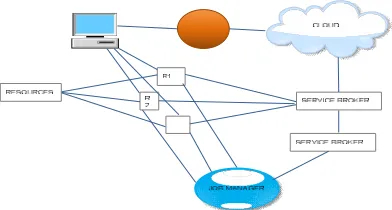
In the cloud computing model [4], the execution of the task is carried out in four steps as shown in figure 1. These are as follows:
1.The user logs in to the cloud through the portal and submits the task to the task manager after the verification. 2.The task manager checks the available resources and from them picks up a list of resources in order to satisfy that particular task.
3.The scheduler sets the rules on the cloud infrastructure in order to schedule the submitted task.
4.The job manager supplies data to the listed resources and returns the computed result to the user after the completion of the task.
Figure 1 Executing the Task in the Cloud
5. THE CLOUD ARCHITECTURE
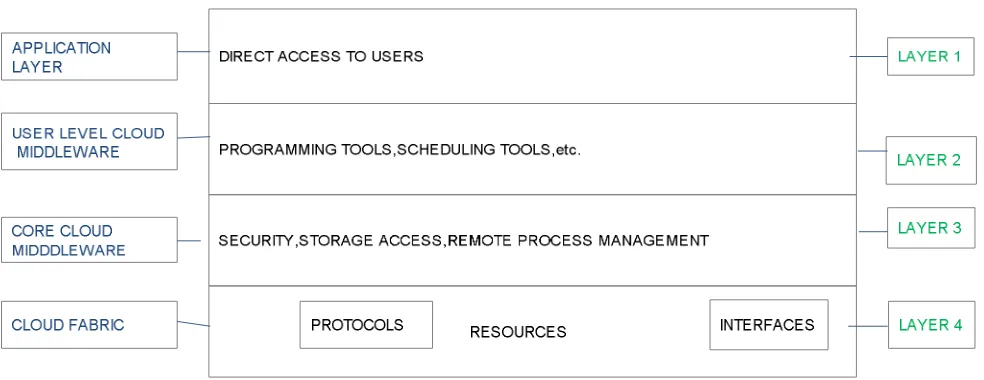
Cloud has a four layered architecture [5] which identifies the system’s fundamental components and specifies the function of these components as shown in figure 2. These four layers are:
5.1Cloud Fabric
This layer comprises of all the resources accessible from the internet. It also includes the protocols and the interfaces accessing and managing these resources.
5.2 Core Cloud Middleware
This layer offers the services like storage access, security, information registration and remote process management.
5.3 User Level Cloud Middleware
Also named as Cloud tools, this layer involves programming tools, scheduling the task, managing the resources and developing the application environment.
5.4 Application Layer
Volume 2, Issue 3, March 2013
Page 36
Figure 2 Cloud Architecture6. SURVEY
The survey of DoS attacks in cloud says that as the use of cloud grows the rate of DDoS [7] attacks will also catch a fast pace. In 2012, the eighth annual Worldwide Infrastructure Security Report, after examining a twelve-month period resulted with the key finding that 14% had to deal with the DoS attacks targeting the cloud services. Last year, this report also published that not only the companies but also the cloud providers are being infiltrated by these attacks. In year 2008 only, these attacks were commonplace i.e. it became a game to keep them which had to be exposed on public networks[8]. The survey of past few years says that the automated tools and the defense mechanisms built up for the cloud services in order to prevent them from attacks were not that very useful. In November 16, 2012, 65 persons of organizations experienced the DoS[9] attacks in the past twelve months. Survey also depicts that the companies always live under the consecutive threat of a salt resulting in a huge damage. It came into notice that the infection by the attacks is done within average downtime of 54 minutes per attack resulting in the cost revenue of 3.5 million $ per year. The survey up till now shows that 60% ask to halt an attacker’s computer in the company, 75% rely on antiviruses, 34% feels the lack of system visibility, and 31% are the negligent one. The respondents of the survey depict that in a cloud computing model, highly affected sectors are public sector, financial department, pharmaceutical as well as health care in the past 11 years[3],[10].
7. THE CLOUD SECURITY
As cloud is in commercial use now, so maintaining the users and resource security, integrity, confidentiality and privacy is a prime issue. Cloud security[6] itself ensures many security challenges and defense mechanisms. The main goal of the cloud security is to provide an easy access to the legitimate users by preventing them from the serious attacks like DDoS[7] attacks which are degrading the performance of the cloud computing model.
The cloud intrusions are of four types. These are listed below: 1. Unauthorized Access
2. Misuse 3. Cloud Exploit
4. Host or Network Specific Attacks
In order to gain defense against these above listed cloud intrusions, this paper has proposed a cloud intrusion detection system. This defense mechanism will first analyze the attack traffic features. The analysis can be extracted from the packet header since it has a field called traffic feature. This defense mechanism then finds a metric that can extract the attack traffic feature to be used in the detection system [8].
Some different types of DDoS attacks along with their effects and defense mechanisms occurring in the cloud computing model are listed in the table given below:
Table 1: Cloud DDoS Attacks, their effects and solutions
Volume 2, Issue 3, March 2013
Page 37
1. Bandwidth Attack Consumes target’s resources Multops, tree of nodes, detects the disproportionalpackets going and coming from the attacker
2. ICMP (Ping) Flood Bandwidth attack that uses ICMP packets
ScreenOS, providing a Screening option which sets a threshold that once exceeded invokes the ICMP flood attacks
3. Ping of death Sends multiple malformed or malicious pings to a computer
Add checks for each incoming IP fragment telling whether the packet is invalid or valid.
4. Amplification attack Attacker makes a request that generates a larger response
Using high performance OS, load balancer, limiting the connection, limiting the connection rate.
5. DNS Flood Attacks both infrastructure and DNS application
Radware carrier solution, allowing continuous DNS service even under the attack and mitigating the DNS attack.
6. HTTP GET Flood Attackers send a huge flood of requests to the server and consume its resources
NS FOCUS provides web application firewall, Intrusion prevention system, carrier-grade anti-DDOS system.
7. Reflector Attack Where third parties bounce the attack traffic from attacker to the target
DERM (Deterministic Edge Router Marking), helps in identifying, tracking and filtering the attack.
8. Smurf Attack Attackers use ICMP echo request packet to generate DOS attacks
Ingress filtering, configuring all the hosts and routers not to respond to ICMP requests and not to forward the packets directly to broadcast addresses.
8. THE CLOUD INTRUSION DETECTION SYSTEM
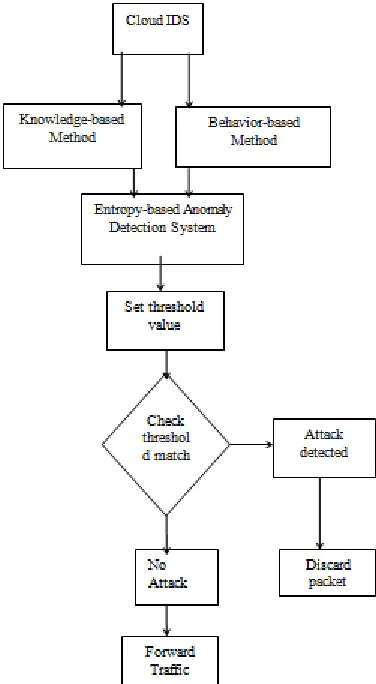
This defense mechanism includes two methods of intrusion detection: the Behavior-based method which compares the recent user actions to the usual behavior and the Knowledge- based method which detects known attacks. The behavior deviation is analyzed using artificial intelligence. With all the responses, the IDS detect the attack and alert the other nodes.
The Cloud Intrusion Detection Model [11],[12] will be detecting the attack traffic with the help of Entropy and The Anomaly based detection system.
Volume 2, Issue 3, March 2013
Page 38
Entropy, being an important concept of information theory will be measuring the randomness of the data coming over the network. The value of entropy lies in the range [0, log n]. More random is the data, the more entropy it has. When the data belongs to one class, i.e. the class distribution is less even, the entropy will be smaller. On the other hand, if the class distribution is more even the entropy will be larger. In order, to detect the deviation in the behavior of the packets, a threshold value of the entropy will be set. On comparing, the actual value of the entropy of the packet with the threshold value, if the value of the entropy of the packet mismatches the threshold value, it will be resulting in an attack or detecting the changes in the randomness [13].
8.2 The Anomaly-based Detection System
In the Anomaly-based Detection System, the change or deviation in the entropy is used for the detection of the attack traffic over the IP addresses or ports. Here, routers will communicate with each other in order to detect the attack. The Anomaly-based Detection System will be deployed in every router. The entropy of each router is calculated and compared with the carefully set threshold value. The entropy rates of different routers in the network are same. On being mismatched, the suspected DDoS attack from the attack traffic is identified. The Anomaly-based Detection System has an advantage over the Signature-based Detection System because in ADS, a new attack can be detected even if it falls out of the normal traffic behavior. With the help of above mentioned two measures, the attack can be detected [14]. The flow chart for this defense mechanism is as follows shown in figure 3.
Figure 3 Flow Chart for attack detection in Cloud Intrusion Detection System
9. CONCLUSION
Volume 2, Issue 3, March 2013
Page 39
REFERENCES
[1] I. Foster, and C. Kesselman, “The Grid: Blueprint for a new computing Infrastructure,” Morgan Kaufmann publishers, San Francisco, USA, 1999.
[2] M. Zakarya, and A. Ali Khan, “Cloud QoS, High Availability & Service Security Issues with Solutions,” IJCSNS International Journal of Computer Science and Network Security, Vol.12, July 2012, PP 71 – 72.
[3] J. Joseph, M. Ernest, and C. Fellenstein, “Evolution of grid computing architecture and grid adoption models, “ IBM systems journal, Vol. 43, No. 4, 2004.
[4] S. Kar, and B.Sahoo, “An Anomaly Detection System for DDOS Attack in Grid Computing,” International Journal of Computer Applications in Engineering Technology and Sciences (IJ-CA-ETS), Vol. 1, Issue 2, April 2009, PP 553-557.
[5] S. Kar, and B.Sahoo,” Security Issues and Preventive Model for Grid computing,” National Conference on Modern Trends of Operating Systems, (MTOS- 09), March, 2009, PP 35-38.
[6] I.Gul, and M. Hussain, “Distributed Cloud IntrusionDetection Model,” International Journal of AdvancedScience and Technology, Vol. 34, September, 2011, PP 71-82.
[7] C. Douligeris and A. Mitrokotsa, “DDoS attacks and defense mechanisms: Classification and state-of-the-art,” Computer Networks: the Int. J. Computer and Telecommunications Networking, Vol. 44, No. 5, April 2004, pp. 643–666.
[8] G.Bhatti, R.Singh and P.Singh, “A look back at Issues in the layers of TCP/IP Model,” International Journal of Enhanced Research in Management & Computer Applications, Vol. 1, Issue 2, November 2012.
[9] J. Mirkovic, S. Dietrich, D. Dittrich, and P.Reiher, “Internet Denial of Service: Attack and Defense Mechanisms,” Prentice Hall PTR, December 2004.
[10] S. Shirasuna, A. Slominski, and D.Gannon, “Performance comparison of security mechanisms for grid services,” Proceedings in 5th IEEE/ACM International Workshop on Grid Computing, 2004, PP 360-364.
[11] K. Vieira, A. Schulter, C. B. Westphall, and C. M.Westphall,“ IntrusionDetection for Grid and Cloud Computing ,“ IEEEComputer Society, Vol. 12, July/August 2010, PP 38-43.
[12] S. Roschke, F. Cheng, and C.Meinel,“Intrusion Detection in Cloud,” 8th IEEE International Conference on Dependable, Automatic and Secure Computing, PP 729 – 734.
[13] G.Meera Gandhi, and S.K. Srivatsa, “An Entropy Architecture for defending Distributed denial-of-service attacks,” International Journal of Computer Science and Information Security, Vol. 6, 2009, PP 129 – 136.