A New Product Type Estimator of Population
Mean and Its Efficiency
K.B.Panda
#1, M. Samantaray
#2#
Department of Statistics, Utkal University, Bhubaneswar, Odisha, India
ABSTRACT:
In this paper, a new product type estimator for the population mean using population correlation coefficient between the study variable and auxiliary variable has been proposed. The suggested estimator, both in first and second phase sampling,fares better than its competitors when compared with respect to bias and mean square error up to first degree of approximation. Empirical investigations have been carried out to support the theoretical findings.
KEYWORDS: Auxiliary variable, correlation coefficient, first and second phase sampling, product type estimator, mean square error.
I. INTRODUCTION
The use of auxiliary information has been studied by various authors in various form to improve the efficiency of their suggested estimators. In the use of auxiliary variable, ratio, product and regression estimators are corner-stones in the estimation of population characteristics.
In order to improve the efficiency of the estimators, auxiliary information is used at both selection as well as estimation stage. While Cochran, (1940) used auxiliary information at estimation stage and proposed ratio estimator, Murthy(1964) envisaged product estimator and Searl(1964), Sisodia and Dwibedi(1981) utilised co-efficient of variation of auxiliary variable in their respective ratio and product method of estimation. Srivenkataraman(1980) first proposed dual to ratio estimator, Singh and Tailor(2005) and Tailor and Sharma(2009) worked on ratio cum product estimator. Deriving inspiration from the above works completed with the estimator due to Mallick and Tailor(2013), we have proposed a new product -cum-dual to product estimator of finite population mean.
Consider a finite population U :
U
1,
U
2,...,
U
Nof N units. Let (y
i,
x
i), i = 1, 2...n denote the values of the units included in a sample of size n drawn by simple random sampling without replacement (SRSWOR). Inorder to have a survey estimate of the population mean
Y
of the study variableY
, assuming the knowledge of the population meanX
of the auxiliary variableX
, Murthy(1964) proposed the classical product estimator defined asX
x
y
y
p
(1.1)
where,
ni i
y
n
y
1
1
and
ni i
x
n
x
1
1
are unbiased estimator of population mean
ni i
Y
N
Y
1
1
and
ni i
X
N
X
1
1
respectively.
Then, the bias and MSE of
y
pup to first degree of approximation are obtained asyx x
y
p
Y
f
C
C
Y
f
C
y
Bias
(
)
1
1(1.2)
)
2
(
)
(
y
pY
2f
1C
y2C
x2C
yxMSE
(1.3)
)
(
)
(
*
x
X
y
y
r (1.4)and in double sampling, the corresponding ratio estimator is expressed as
)
(
)
(
*
x
x
y
y
r (1.5) where,N
n
f
1
1
1
,
N i iy
Y
Y
N
1 2)
(
1
1
,
N i iX
X
X
N
1 2)
(
1
1
,
N i i iXY
X
X
Y
Y
N
1)
)(
(
1
1
, Y X XY
= population correlation coefficient,X Y yx
C
C
C
,2 2 2
X
C
X X
and 2 2 2Y
C
Y Y
are co-efficient of variation of X and Y respectively.II. THE SUGGESTED ESTIMATOR
We propose a new product type estimator as
(
)
)
(
*
X
x
y
y
p (2.1)To obtain the bias and MSE of the suggested estimators
y
*pandy
*'p, we let)
1
(
e
0Y
y
,x
X
(
1
e
1)
,x
'
X
(
1
e
2)
,)
1
(
e
1X
x
,x
'
X
(
1
e
2)
where
X
X
Now,
E
(
e
0)
E
(
e
1)
E
(
e
2)
0
, 21 2 0
)
(
e
f
C
YE
,E
(
e
12)
f
1C
X2,E
(
e
22)
f
2C
X2 , YXC
f
e
e
E
(
0 1)
1 ,E
(
e
0e
2)
f
2C
YX,E
(
e
1e
2)
f
2C
X2 ,Substituting the above values in equation (2.1) we have (up to first degree of approximation)
YX X
Y p
p
E
y
Y
Y
f
C
C
Y
f
C
y
Bias
(
*)
(
*
)
.
.
1.
.
.
.
.
1.
(2.2)
)]
2
(
[
.
)
.
2
(
[
.
)
(
)
(
* * 2 1 2 2Y
f
1C
2C
2k
C
C
C
C
f
Y
Y
y
E
y
MSE
Y XX Y X
Y p
p
(2.3) III.EFFICIENCY COMPARISON:
Using simple random sampling without replacement (SRSWOR) we know that sample mean is unbiased estimator of population mean, having
2 2 1
)
(
y
f
Y
C
YComparing equations (2.4) and (3.1), we have find that suggested estimator
y
*pwould be more efficient than that of sample mean estimatory
, if.
i.e.
MSE
(
y
*p)
V
(
y
)
C
X2(
2
k
)
0
provided,
0
and
(
2
k
)
0
0
(
2
k
)
(3.2)or,
0
and
(
2
k
)
0
2
k
0
Comparing equations (2.4) and (1.3) , we find that,
y
*p would be more efficient than that of sample mean estimatory
P. if
0
)
2
1
(
)
1
(
)
(
)
(
y
*
MSE
y
C
2
k
MSE
p p
X
Provided,
(
1
)
0
and
(
1
2
k
)
0
1
(
2
k
1
)
(3.3)or,
(
1
)
0
and
(
1
2
k
)
0
(
2
k
1
)
1
Combining equations (3.2)and (3.3), we find that
y
*p is more efficient thany
andy
p,under the following conditionseither,
1
(
2
k
1
)
(3.4)or
2
k
0
.IV. PERFORMANCE OF THE PROPOSEDESTIMATOR IN TWO-PHASE SAMPLING
There exit cases when
X
is unknown. T get rid of such cases, two phase sampling or double samplingprocedure come into play, wherein we replace
X
byx
, the sample mean based on large preliminary sample of sizen
drawn with SRSWOR from the population of size N, corresponding to ith auxiliary variable. Thus, the product estimator due to classical estimator and the proposed estimator can be expressed respectively, asWhen population mean of auxiliary variable X is not known, then double sampling product estimator is defined as,
' '
x
x
y
y
p
(4.1)
and
)
(
)
(
' *
x
x
y
y
p(4.2)
where,
'
1 '
'
1
n
i i
x
n
x
is unbiased estimator of population meanX
based on sample sizen
'.Thus, the bias and MSE of
y
p'up to first degree of approximation are obtained as,YX X
Y
p
Y
f
C
C
Y
f
C
y
Bias
(
)
3
3 , (4.3))]
2
1
(
[
)]
2
1
(
[
)
(
1 2 2 3Y
f
1C
2C
2f
3k
C
C
f
C
C
f
Y
y
MSE
Y XX y X
Y
p
,where
N
n
f
2
1
'
1
,n
n
f
f
f
1 21
1
3
, X
Y
C
C
k
(4.4)
The bias and MSE of
y
*'p up to first degree of approximation are defined as,YX X
Y p
p
E
y
Y
Y
f
C
C
Y
f
C
y
Bias
(
*)
(
*
)
.
.
3.
.
.
.
.
3.
)]
2
(
[
)
.
2
(
.[
)
(
)
(
* *' 2 1 2 2 3Y
f
1C
2C
2f
3k
C
C
f
C
C
f
Y
Y
y
E
y
MSE
Y XX Y X
Y p
p
(4.6)
It can be easily be seen that, in two phase sampling , the performance of the propose estimator as measured in
terms of bias and mean square error is better than its competing estimator.
V. EFFICIENCY COMPARISON IN DOUBLE SAMPLING
With a view to comparing the efficiency of the proposal estimator, we proceed as follows:
From equations (4.6)with (3.1) , we have
y
p* would be more efficient than that of sample mean estimatory
. if0
)
2
(
)
(
)
(
y
*
V
y
C
2f
3
k
MSE
p
X
provided,
0
and
(
2
k
)
0
0
(
2
k
)
(5.1)or,
0
and
(
2
k
)
0
2
k
0
Again, comparing equations (4.6)and (4.4) ,
y
p* would be more efficient than that of sample mean estimator'
P
y
,0
)
2
1
)(
1
(
)
(
)
(
y
*
MSE
y
k
MSE
p p
provided,
(
1
)
0
and
(
1
2
k
)
0
1
(
2
k
1
)
(5.2)or,
(
1
)
0
and
(
1
2
k
)
0
(
2
k
1
)
1
Combining equations (5.1) and (5.2), we found that
y
p* is more efficient thany
andy
p ,under the following conditions , ifprovided,
0
2
k
or
(
2
k
1
)
1
. (5.3)VI. EMPIRICAL STUDY
To check, the performance of suggested estimators
y
*pandy
*'p over their competitors two natural population data set are being considered. Descriptions of the population are given below:Population I:
we have considered a real population data taken from Adewaraet. al.(2012) wherein the variables of interest are as follows;
X: The number of rooms per block
Y: The number of person per block
X
=75.6375,Y
=7.6375,C
Y=0.2278,C
X =0.098,
=-0.6823, n= 3,n
,=20Table I: Bias and MSE of the competing estimators
Sl. No. Estimators bias Mean square error(MSE)
1
y
0.0000 3.02682
p
y
0.0349 1.80883 *
p
y
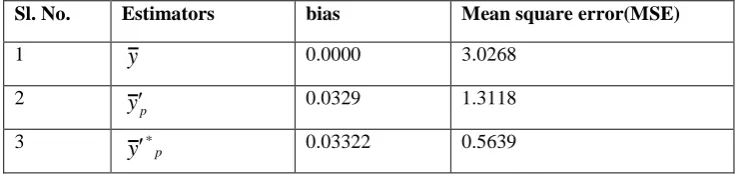
0.03521 0.9204Table II: Bias and MSE of the competing estimators in case of double sampling
Sl. No. Estimators bias Mean square error(MSE)
1
y
0.0000 3.02682
p
y
0.0329 1.31183
y
*p 0.03322 0.5639Population II:
We refer to Example-8.1(Highway data) given in weiberg (1980, p. 1979). the sample quantities given therein have been taken as the corresponding population quantities whch are as follows:
X: LEN = Length of the segment in miles
Y: RATE= 1973 accident rate per million vehicle miles.
X
=49.23,Y
=9.81,C
Y=0.7152,C
X =0.1499,
= - 0.00042, N=69, n= 3,n
,=20The bias and MSE of the above comparing estimators have been computed and presented in the following table:
Table III: Bias and MSE of the competing estimators
Sl. No. Estimators Bias Mean square error(MSE)
1
y
0.0000 132.7742
p
y
0.0001472 63.7563 *
p
y
0.0001480 46.241Table IV: Bias and MSE of the competing estimators in case of double sampling
Sl. No. Estimators Bias Mean square error(MSE)
1
y
0.0000 132.7742 '
p
y
0.000372 50.40553 *'
p
y
0.00037 44.8678VII.CONCLUSION:
A new product type estimator which is vindicated to be more efficient than its competitors both under single and double sampling has been proposed. Theoretical findings are numerically supported.
REFERENCES:
[1] Cochran W.G., 1977: Sampling Techniques.Third U.S. Edition.Wiley Eastern Limited. A.; 325
[2] Cochran W. G., Sampling Theory when sampling Units are of Unequal sizes.Journal American Statist.Association. 1942. 37; 191-212
[3] Das A. K., 1988: Contribution to the Theory of Sampling Strategies based on Auxiliary Information. Ph. D. Thesis, BCKY, West Bengal, India.
[4] Housila P. Singh, Ritesh Tailor and Tailor Rajesh, 2012: Estimation of Finite Population Mean In Two Phase Sampling with Known Coefficient of Variation of Auxiliary Character. Statistica. 72(1) ;1-22
[5] Kalidar C. and Cingi H., 2004: Ratio Estimators in Simple Random sampling. Applied Mathematics and Computation. 151; 893-902
[6] Malik K. A. and Tailor R., 2013: Ratio Type Estimator Of Population Mean in double sampling. International Jour. Of Advanced Math.and Statist. Volume 1.Issue 1; 34-39
[7] Murthy M. N., 1964: Product Method Of Estimation. Sankhya. A. 26; 294-307
[8] Searls D.T., 1964: The Utilization of Known Coefficient of Variation in the estimation procedure. Journal of American Statistical Association. 59; 1125-1126
[9] Singh H. P. and Tailor R. , 2005: Estimation of Population Mean Using Known Correlation Coefficient between Auxiliary Characters. Statistica. Anno LXV. 4; 407-418
[10] Sisodia B. V. S. and Dwibedi V. K., 1981: A Modified Ratio Estimator Using CCo-efficient of Variation Of Auxiliary variable. Journal.Ind. Soc. Agril.Statist. 33(2); 13-18
[11] Sodipo A. A. and Obisesan K. O., 2007: Estimation of The Population Mean Using Difference Cum Ratio Estimator with Full Response on the Auxiliary Character. Research Journal Of Applied Sciences. 2(6); 769-772
[12] Srivenkataramana T., 1980: A Dual Of Ratio Estimator in sample surveys. Biometrika.67(1). 199-204