Tensor optimized shell model using bare interaction for light nuclei
Takayuki Myo1,2,a, Hiroshi Toki2, and Kiyomi Ikeda3
1 Osaka Institute of Technology, Osaka, Osaka 535-8585, Japan
2 Research Center for Nuclear Physics, Osaka University, Ibaraki, Osaka 567-0047, Japan 3 RIKEN Nishina Center, Wako, Saitama 351-0198, Japan.
Abstract. We propose a new theoretical approach to calculate nuclear structure using bare nuclear interac-tion, in which the tensor and short-range correlations are described by using the tensor optimized shell model (TOSM) and the unitary correlation operator method (UCOM), respectively. We compare the obtained results using TOSM+UCOM for4He with the rigorous calculation. We also apply TOSM to the analysis of two-neutron
halo nuclei,6He and11Li, on the basis of the “core with TOSM”+n+n model. The halo formation of11Li is
explained by inclusion of the tensor correlation in9Li core, which produces the Pauli-blocking on the p-wave
neutrons in11Li and enhances the s-wave component of halo structure.
1 Introduction
It is important to develop a theoretical framework to calcu-late nuclear structure using bare nucleon-nucleon interac-tion. Recently it becomes possible to calculate nuclei up to mass around A∼12 by using the Green’s Function Monte-Carlo method[1]. The binding energies of nuclei were suc-cessfully reproduced by including three body interaction. One big surprise is a large contribution of the one-pion ex-change interaction, which is about 70∼80 % of the whole bare interaction. It is however extremely time consuming to apply this method to heavier nuclei. It is desired to de-velop a new method to calculate nuclei with large nucleon numbers by using the bare interaction.
The nucleon-nucleon interaction has distinctive features, namely there exist strong tensor interaction at intermediate distance caused by pion exchange and strong short-range repulsive interaction at a short distance caused by quark dynamics. Although these two interactions have totally dif-ferent characteristics, it is customary to adopt the theory, such as the Brueckner Hartree-Fock, to integrate out the high-momentum components emerging from the tensor in-teraction and short-range repulsion on the same footing. In this way, one loses direct information on the tensor cor-relation and a short-range corcor-relation in the wave func-tion. Hence, we search for a powerful method of treating treat explicitly both the tensor interaction and the short-range interaction to study of not only light nuclei but also medium and heavy nuclei.
There are two important developments for this purpose. One is to find out that the tensor interaction is of inter-mediate range. We are able to express the tensor correla-tion in a reasonable shell model space[2–4]. We name this method as Tensor Optimized Shell Model (TOSM), where the wave function is constructed in terms of the shell model
a e-mail:[email protected]
basis states with full optimization of the two particle-two hole (2p2h) states. We have shown that the tensor inter-action could be treated by taking a reasonable amount of multipoles (l≤5) for the particle states[2].
The other is the Unitary Correlation Operator Method (UCOM) for the treatment of the short-range correlation[5, 6]. We shall combine two methods, TOSM and UCOM (TOSM + UCOM), to describe nuclei using bare inter-action. We hope to apply a newly developed method to many nuclei[4]. We use TOSM for the strong tensor in-teraction utilizing the intermediate nature caused by finite angular momentum of the relative wave function, and use UCOM for the strong short-range interaction utilizing the short-range nature. Using TOSM+UCOM, we aim to un-derstand the roles of the tensor and short-range correla-tions in nuclei using bare interaction. As a good start, we apply TOSM+UCOM to4He and compare the obtained re-sults with rigorous calculations[7] and see how this method works by using bare interaction and how far we can de-scribe each correlations and to find what we are supposed to do for further improvement.
We have also investigated the characteristics of the ten-sor correlations in He and Li isotopes, such as the p-wave doublet splitting energy in5He and6He[8, 9], the mecha-nisms of the inversion phenomenon in10Li and the neutron halo formation in11Li[3]. In particular, so far, the prob-lem of the neutron halo formation in11Li is still unclear. The halo structure of11Li has a large (1s)2component of last two neutrons, indicating the magic number breaking of N =8. The mechanism to explain this exotic phenom-ena of11Li has been not explained theoretically. We solved this problem of the N =8 shell gap by treating the tensor correlation explicitly in TOSM. Based on the three-body model with the 9Li core described in TOSM, the Pauli-blocking for the tensor correlation in core produces the energy loss for the p-wave configuration of 10,11Li. As a
DOI:10.1051/epjconf/201004019
result, the magic number breaking in 11Li was naturally explained[3].
2 Tensor Optimized Shell Model (TOSM)
We explain the framework of TOSM. We shall begin with many-body Hamiltonian,
H=X i
Ti−Tc.m.+ X
i<j
Vi j, (1)
Vi j =vCi j+v T i j+v
LS i j +v
Clmb
i j . (2)
Here, Ti is the kinetic energy of each nucleons with Tc.m. being the center of mass term. We take the bare interaction for Vi jsuch as AV8′consisting of central (vCi j), tensor (vTi j) and spin-orbit (vLS
i j ) terms.v Clmb
i j is the Coulomb term. We obtain the many-body wave functionΨwith the equation, HΨ=EΨ.
We begin with the TOSM wave function. We write the case of4He explicitly as an example including the varia-tional coefficients{Ak}.
Ψ =A0|0i+X k=1
Ak|2p2hik, (3)
|2p2hik=|[[ψn1α1(x1), ψn2α2(x2)]
J
(4) ⊗[ ˜ψn3α3(x1),ψ˜n4α4(x2)]
J]0i (5) Here,|0iis|(0s)4ifor4He.|2p2hiare the 2p2h states with various radial components. k denotes representable quan-tum number of 2p2h states using the single particle (hole) wave functionsψn,α ( ˜ψn,α) with the quantum numbers n andα; n is an index to distinguish the different radial wave functions.αare the sets of the spin-isospin quantum num-bers to distinguish the single particle orbits. We describe the the various radial wave functions of single particle or-bits by using the Gaussian expansion method[2, 10].
We explain the Gaussian expansion technique for single-particle orbits. Each Gaussian basis function has the form of a nodeless harmonic oscillator wave functions (HOWF), except for 1s orbit. When we superpose a sufficient num-ber of Gaussian bases with various length parameters, we can fully optimize the radial component of every orbit of every configuration with respect to the total Hamiltonian in Eq. (1). We construct the following ortho-normalized single-particle wave functionψn
αwith a linear combination of Gaussian bases{φα}with length parameter bα,ν.
ψnα(r)= Nα
X
ν=1
dnα,mφα(r,bα,ν) (6)
for n = 1,· · ·,Nα, (7)
where Nα is a number of basis functions for the orbit α, andνis an index that distinguishes the bases with differ-ent values of bα,ν. The explicit form of the Gaussian basis function is expressed as
φα(r,bα,ν)=Nl(bα,ν) rle−(r/bα,ν)
2/2
[Yl(ˆr), χσ1/2]jχtz, (8)
Nl(bα,ν)=
2 b−α,ν(2l+3) Γ(l+3/2)
1 2 , (9)
where l and j are the orbital and total angular momenta of the single-particle states, respectively, and tzis the projec-tion of the nucleon isospin. The coefficients{dn
α,ν}are de-termined by solving the eigenvalue problem for the norm matrix of the non-orthogonal Gaussian basis set in Eq. (8) with the dimension Nα. Following this procedure, we ob-tain new single-particle wave functions{ψn
α}in Eq. (7) for TOSM.
We choose the Gaussian bases for the particle states to be orthogonal to the occupied single-particle states, which are 0s1/2 in the 4He case. For 0s1/2 states, we employ one Gaussian basis function, namely, HOWF with length b0s1/2,ν=1 =b0s. For 1s1/2states, we introduce an extended 1s basis function orthogonal to the 0s1/2 states and pos-sessing a length parameter b1s,νthat differs from b0s[2]. In the extended 1s basis functions, we change the polynomial part from the usual 1s basis states to satisfy the conditions of the normalization and the orthogonality to the 0s state.
Two-body matrix elements in the Hamiltonian are ana-lytically calculated using the Gaussian bases[2, 10], whose explicit forms are given in Appendix of Ref. [4] for cen-tral, LS and tensor interactions, respectively. In the numer-ical calculation, we prepare 9 Gaussian functions at most with various range parameters to get a convergence of the energy.
We have to furthermore take care of the center-of-mass excitations. For this aim, we take the well-tested method of introducing a center-of-mass term in the many body Hamiltonian[11].
Hcm=λ
P2cm
2A m + 1 2A mω
2R2 cm− 3 2 ~ω ! , (10)
Pcm= A X
i=1
pi, Rcm = 1 A
A X
i=1
ri, (11)
ω= ~ m b2
0s
, (12)
where m and A are the nucleon mass and the mass number, respectively, and b0sis the length parameter of HOWF for the hole 0s state. We take sufficiently large coefficient,λ, to project out only the lowest HO state for the center-of-mass motion. In the numerical calculation, the excitation of the spurious center-of-mass motion is suppressed to be less than 10 keV.
The variation of the energy expectation value with re-spect to the total wave functionΨis given by
δhΨ|H|Ψi
hΨ|Ψi =0, (13) which leads to the following equations:
∂hΨ|H−E|Ψi ∂bα,ν
=0, (14)
∂hΨ|H−E|Ψi ∂Ak
=0. (15)
We solve two kinds of variational equations in the follow-ing steps. First, fixfollow-ing all the length parameters bα,ν, we solve the linear equation for{Ak}as an eigenvalue problem for H with partial waves up to Lmax. We thereby obtain the eigenvalue E, which is a function of{bα,ν}. Next, we try to search various sets of the length parameters{bα,ν}in or-der to find the solution which minimizes the total energy. In this TOSM wave function, we can describe the spatial shrinkage with an appropriate radial form, which is impor-tant for the tensor correlation[2].
3 Unitary Correlation Operator Method
(UCOM)
We present UCOM for the short-range correlation[5, 6], in which the following unitary operator is introduced
C=exp(−iX i<j
gi j) = Y
i<j
ci j, (16)
ci j=exp(−igi j). (17)
We express the correlated wave function,Ψ, in terms of less sophisticated wave function,Φ, asΨ = CΦ. Hence, the Schr¨odinger equation becomes ˆHΦ= EΦwhere ˆH = C†HC. Since C is expressed with a two-body operator in the exponential, it is a many-body operator. In the case of the short-range correlation, we are able to truncate modi-fied operators at the level of two-body operators[5].
We define the two-body Hermite operatorgin Eq. (17) as
g= 1
2{prs(r)+s(r)pr}, (18) dR+(r)
dr =
s (R+(r))
s(r) , (19)
where pr is the radial component of the relative momen-tum, which is conjugate to the relative coordinate r. s(r) is the amount of the shift of the relative wave function and depending on r. In UCOM, we use R+(r) instead of s(r). The function R+(r) corresponds to the transformed relative coordinate from r, and represents the correlation function to reduce the amplitude of the short-range part of the rela-tive wave functions. The explicit transformation of the op-erator for the relative motion is given as c†rc = R
+(r) for example[5]. We use TOSM to describeΦ.
In the calculation using UCOM, we parametrize R+(r) in the same manner as proposed by Neff-Feldmeier and Roth et al.[5, 6, 12]. We assume the following forms for even and odd channels, respectively.
Reven+ (r)=r+α r β
!γ
exp[−exp(r/β)], (20)
Rodd+ (r)=r+α 1−exp(−r/γ)exp[−exp(r/β)].(21)
Here, α,β, γ are the variational parameters to optimize the function R+(r) and minimize the energy of the system. They are independently determined for four channels of
the spin-isospin pair. In the actual procedure of the vari-ation, once we fix the parameters included in R+(r), we solve the eigenvalue problem of the Hamiltonian using Eq. (15) and determine the configuration mixing of the shell model-type bases in TOSM. Next, we try to search vari-ous sets of the R+(r) parameters to minimize the obtained energy.
3.1 Extension of UCOM –S-wave UCOM–
In the framework of UCOM, we introduce the UCOM func-tion R+(r) for each spin-isospin channel and ignore the partial wave dependence of R+(r). It is generally possible to introduce the partial wave dependence in UCOM and then R+(r) functions are determined in each relative partial wave in the two-body matrix elements. Here, we consider the specific case of this extension of UCOM by taking care of the characteristics of the short range correlation. One of the simplest case of this extension is UCOM for only s-wave relative motion. Since all the other partial s-waves l ex-cept for s-wave (l=0) have rlbehavior near at the origin, this rlbehavior cuts down the effect of the short range hard core largely. However, only the s-wave function is finite at the origin and the behavior in the origin is determined by the hard core dynamics. In fact, the method used by Feld-meier et al. is to determine the unitary operator in order to reproduce the short range behavior of s-wave relative wave function[5].
When we incorporate S -wave UCOM (S -UCOM, here-after) into TOSM, we extract the relative s-wave compo-nent in every two-body matrix elements in TOSM using the V type basis expanded by the Gaussian functions. For numerical calculations, we prepare the completeness rela-tion consisting of the T type basis funcrela-tions|Tias
1=X
i
|TiihTi|, (22)
|Tii=|[[ψlrψLR]L′, χS]JχTi, (23) where the T type basis is expanded by the two coordinates of the relative part r and the center of mass part R of two nucleons, which are the set of Jacobi coordinate. The or-bital angular momenta of each coordinate, r and R are l and L, respectively. It is easy to prepare the s-wave relative part by putting l to be zero in the T type basis. We con-struct the above completeness relation of the T type basis states by diagonalizing the norm matrix expanded by the finite number of the Gaussian basis functions for two coor-dinates. In the actual calculation, we use 12 bases for each coordinate, with which convergence is achieved.
We calculate the matrix elements of the arbitrary two-body operator ˆO including the S -UCOM correlator Cs us-ing the V type basis with indicesαandβ. Here, we insert the above T type completeness relation in Eq. (23) as
hVα|C†sOCˆ s|Vβi= X
i j
hVα|TiihTi|C†sOCˆ s|TjihTj|Vβi. (24)
ten-Table 1.Optimized parameters in R+(r) in TOSM+UCOM for four channels in fm in the present work.
α β γ
singlet even 1.32 0.88 0.36 triplet even 1.33 0.93 0.41 singlet odd 1.57 1.26 0.73 triplet odd 1.18 1.39 0.53
sor interactions. For the kinetic part and the central inter-action, the matrix elements conserve the relative angular momentum, and then we can easily calculate the matrix el-ements of the transformed operator C†sOCˆ s. For the tensor interaction, the sd coupling matrix elements are properly treated, in which Csis operated on only the s-wave part of the relative motion. In this case, the operator Csacts on the s-wave relative Gaussian basis functionφl=0(r), which is transformed as
CS φl=0(r)= R−(r)
r p
R′
−(r)φl=0(R−(r)), (25)
where R−(r) is the inverse transformation of R+(r), namely R−(R+(r)) = r. The matrix elements of the T type basis function are calculated using the above transformed wave function. We also calculate the overlap between V type and T type bases using Gaussian basis functions, whose ex-plicit form is given in the appendix of Ref. [4].
4 Variational calculation of
4He in
TOSM+UCOM
First, we determine the UCOM functions R+(r) for the cal-culation of TOSM+UCOM. We optimize R+(r) function by changing the three parameters ofα,βandγto search for the energy minimum in TOSM+UCOM. In Table 1, the optimized three parameters in S -UCOM are listed. The adopted R+(r) in UCOM for four channels are shown in Fig. 1. The demonstration of the calculated result to search for the energy minimum is shown in Fig. 2. In Fig. 2, the
0.00 0.05 0.10 0.15 0.20 0.25
0.0 0.5 1.0 1.5 2.0 2.5
R
+(r) - r [MeV]
r [fm]
R
+(r)-r
1E3E
1 O 3
O
Fig. 1.The UCOM functions R+(r) used in even (1,3E) and odd
(1,3O) channels. The differenes between R+(r) and the original
coordinate r are displayed.
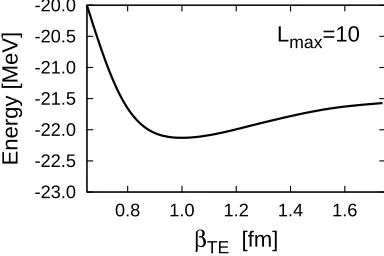
total energy is plotted as a function of the range parameter, βof R+(r) function in Eq. (20) for the triplet even channel in the case of Lmaxbeing 10. We have already minimizedα andγfor eachβin this calculation. We see clearly a desired behavior, where the energy has a minimum as a function of β. Hence, we fixβthat provides the lowest energy.
We show the calculated results for the energy of4He in Fig. 3, where Lmaxis the maximum orbital angular mo-mentum of the particle states. In Fig. 3, we get a good con-vergence of the energy with respect to Lmax. We show two results using UCOM and S -UCOM. The latter S -UCOM is the extended UCOM, in which the UCOM transformation is performed only for the relative s-wave component of the even channel, while the original UCOM does not consider any partial wave dependence. In UCOM, it is found that the binding energy of 4He is underestimated. The reason are understood as due to too large removal of the short-range part of the relative wave functions, in particular, in the d-wave part of the sd coupling of the tensor matrix ele-ment, where the tensor interaction possesses some amount of strength. We have also calculated the contributions be-yond the 2p2h configurations in TOSM such as 3p3h and 4p4h configurations. When we include the 4p4h configu-rations within the p-shell, their contribution to the bind-ing energy is approximately 50 keV. This fact denotes that these more complicated wave functions contribute very lit-tle in the total4He wave function.
In order to overcome this feature of UCOM, we have decided to restrict the use of UCOM to the relative s-wave only for the even channel (S -UCOM), where the treat-ment of the short-range repulsion is absolutely necessary. In other partial waves, we have the centrifugal potential that cuts out the short-range part from the wave functions of the higher partial waves. In this case, we can use the transformed interaction and the kinetic energy only for the relative s-wave component in the even channels. Since the use of the UCOM for the odd partial wave is slightly better, we use the UCOM for all odd partial waves. we have intro-duced S -UCOM and found that the situation was largely improved to give about 23 MeV of the binding energy. The tensor force contribution also gains by about 5 MeV in comparison with the one using UCOM. This gain mainly
-23.0 -22.5 -22.0 -21.5 -21.0 -20.5 -20.0
0.8 1.0 1.2 1.4 1.6
Energy [MeV]
β
TE[fm]
L
max=10
Fig. 2.Energy surface of 4He with respect toβof triplet even
-60
-40
-20
0
20
40
60
80
100
0
2
4
6
8 10 12 14 16 18
[MeV]
L
max
4
He with AV8’
Energy
Kinetic
V
CV
TV
LSFig. 4.Matrix elements of the central interaction (VC), tensor interaction (VT) and the spin-orbit interaction (VLS) together with the
kinetic energy (Kinetic) and total energy (Energy) in the Hamiltonian using AV8′for4He as function of L
max. These values are compared
with the benchmark results of Ref. [7], which are indicated by the thick short solid lines on the right-hand side of the figure.
-25 -20 -15 -10 -5 0 5
0 2 4 6 8 10 12 14 16
Energy [MeV]
L
max exact4
He with AV8’
TOSM + S-UCOM
UCOM S-UCOM
Fig. 3.Energy of 4He in TOSM+UCOM/S -UCOM. Exact
calculation is taken from Ref. [7].
comes from the sd coupling matrix elements of the tensor force.
As for the comparison with the rigorous calculation, we see that vC agrees with the rigorous value, about 55 MeV. On the other hand, the tensor matrix element,vT con-verges to 55 MeV, while the rigorous one is 68 MeV. The kinetic energy is about 90 MeV, while the rigorous one is 102 MeV. The spin orbit matrix element is also smaller than the rigorous value. As the net value, the total energy is 23 MeV which is close to the rigorous value 26 MeV. One of the possibilities for the lack of the energy in TOSM +(S )-UCOM is due to the separate treatment of the short-range and tensor correlations. Although the dominant part of the tensor interaction is of intermediate and long range, there may remain some small strength in the short-range
part of the tensor interaction, which can couple with the short-range correlations. This effect can be included by ex-tending the truncation of the UCOM transformation in the Hamiltonian to more than the two-body level. Three-body term of the UCOM transformation is one of the possibili-ties to overcome the lack of energy in TOSM+UCOM[5]. This term can contribute to increase the tensor matrix el-ement and produce the high momentum component in the wave function.
To see the properties of the obtained4He wave func-tion, the dominant configurations are listed in Table 2 with their probabilities. It is found that the several 2p2h states such as (0s)−102(0p1/2)210are largely mixed and those config-urations are essential for the tensor correlation in4He[2, 13]. It is also found that the 0p0h-2p2h coupling exhausts 94% of the tensor matrix element.
Table 2.Mixing probabilities in the4He ground state in %, where
two subscripts of 00 and 10 are the spin-isospin quantum num-bers.
(0s)4
00 83.01
(0s)−2
10(0p1/2)210 2.45
(0s)−2
10[(1s1/2)(0d3/2)]10 2.31
(0s)−2
10[(0p3/2)(0 f5/2)]10 1.90
(0s)−2
10[(0p1/2)(0p3/2)]10 1.45
(0s)−2
10[(0d5/2)(0g7/2)]10 0.80
(0s)−2
10(0d3/2)210 0.48
remaining part 7.60
5 Tensor correlation in neutron halo nuclei
In this section, we discuss the effect of tensor correlation in halo nuclei6He and11Li. It is shown that in4He, there exists the selection rule of the particle states in the 2p2h configurations, coupled by the tensor force. In particular, the 0p1/2 component is largely mixed, as shown in Table 2. It is interesting to investigate the coupling between4He core nucleus and halo neutrons in6He. Similarly the11Li case with9Li+n+n system can be considered. For this pur-pose, we employ the three-body cluster model of halo nu-clei with core+n+n, in which the core nucleus is described using TOSM.
5.1 Three-body model of halo nuclei with TOSM core
The Hamiltonian of two-neutron halo nuclei with core+n+n system is given in the orthogonality condition model[3]
H=H(core)+ 3 X
i=1
Ti−TG+ 2 X
i=1
Vcn,i+Vnn, (26)
where H(core), Tiand TGare the internal Hamiltonian of core given in Eq. (1), the kinetic energies of each cluster and the center-of-mass of the three-body system, respec-tively. The microscopic core-n potential, Vcn, is given by a folding-type one[3, 9]. AV8′is used for the last two
neu-trons. We remove the Pauli forbidden states for the core-n relative motiocore-n, which depecore-nds ocore-n the cocore-nfiguratiocore-n of core in TOSM, including 2p2h states[8, 3]. We slightly ad-just the strength of the core-n potential to reproduce the observed two-neutron separation energies of6He and11Li, respectively. We do not introduce any conventional partial-wave dependence, such as the deep s-partial-wave9Li-n potential for11Li.
The wave function of two-neutron halo nuclei with the spin J is given as
ΨJ =X k
An[ΦJc
k, χ j k(nn)]
Jo
, (27)
where Jcand j are the spins of the core configurationΦkJc and the coupled last two neutrons, respectively. The two-neutron wave functionχkj(nn) is exactly obtained in a few-body technique. The wave function of subsystem such as
5He and 10Li are similarly given in a coupled two-body problem of the core+n system.
5.26He
We investigate the effect of tensor correlation in6He. As for5He, the subsystem of6He, the effect of the tensor force has been shown to have the dependence of orbital states occupied by the last neutron. Terasawa[14–16] and Nagata et al.[17] performed the configuration mixing for the4He part. The internal excitation of4He causes the Pauli block-ing in5He, which produces the orbital-state dependence. Thus, this effect is responsible for some amount of the ob-served doublet splitting of p-wave states[8].
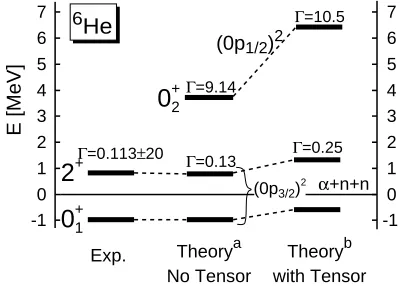
Here, we reanalyze the doublet splitting of p-waves in6He within an extended4He+n+n model[9], where we explicitly take into account the tensor correlation in the 4He cluster in TOSM. The (0s)2(0p
1/2)2configurations are strongly suppressed due to the Pauli principle between a valence neutron of p1/2-wave and 0p1/2orbital neutrons in the4He, as shown in Fig. 5. Thus, we investigate to what extent the tensor correlation of 4He generates the Pauli blocking and results in the doublet splitting of p-waves in 6He.
ν π
6He
(p3/2)
2
ν π
ν π
ν π
ν π
ν π
Pauli blocking
6He
(p1/2)
2
0p0h Tensor
+
+
4He
(GS)
last neutron
0p3/2 0p1/2
0s1/2
0p3/2 0p1/2
0s1/2
0p3/2 0p1/2
0s1/2
Fig. 5.Pauli-blocking effects of tensor correlations in6He.
E [MeV]
α+n+n
(0p1/2)2
(0p3/2)
2
-1 0 1 2 3 4 5 6 7
-1 0 1 2 3 4 5 6 7
6
He
0
+2Theoryb
with Tensor
Theorya
No Tensor Exp.
Γ=0.113±20
Γ=9.14
Γ=0.13
Γ=10.5
Γ=0.25
2
+0
+1Fig. 6. Results of6He spectra w/o (a) and with (b) the tensor
We obtain the6He spectra in the coupled 4He+n+n model in Fig. 6.Resonances are treated by using the com-plex scaling method. Due to the large mixing of 0p1/2 com-ponent from the tensor correlation in4He, the Pauli block-ing strongly occurs in the 0+2 state of6He in which two va-lence neutrons occupy the 0p1/2orbit and suppress the ten-sor correlation in the4He core due to the Pauli-principle. On the other hand, the ground state of6He is dominated by (p3/2)2configuration for halo neutrons with about 90%, then the blocking effect is small. As a result, the splitting from the ground state becomes large[9], which is the theo-retical prediction.
5.311Li
We explain the essential point of the model for Li iso-topes to incorporate the tensor correlation, whose details were given in the Refs. [3, 25]. We start from 9Li with TOSM. Instead of UCOM, we here use the G-matrix ef-fective force, which retains the strong tensor force of the AV8′bare NN force, and adjust the central force to
repro-duce the observed binding energy of9Li[3]. In TOSM, we consider up to the 2p2h excitations within the p shell in TOSM. This treatment does not change the characteristics of the tensor and pairing correlations, and also the essen-tial results obtained for Li isotopes. In TOSM, we adopt the spatially modified harmonic oscillator basis as a single par-ticle orbit and treat their length parameters independently and variationally to optimize the tensor correlation.
We show the results of the9Li in TOSM, where b0s and b0p3/2 are optimized as 1.45 fm and 1.8 fm. For 0p1/2
-orbit, we superpose two bases with different length of b0p1/2
as 0.85 fm and 1.8 fm. This is to describe both the ten-sor and pairing correlations, since the tenten-sor correlation is optimized with spatially shrunk excited nucleons and the pairing correlation is optimized with the spatially ex-tended orbits[3]. Among the 2p2h configurations, the large components are given by (0p3/2)−012(0p1/2)201with 9.0 % for the pairing correlation and (0s)−2
10(0p1/2) 2
10 with 7.2 % for the tensor one. The subscripts 01 or 10 represent spin and isospin for the two-nucleon pair, respectively. The tensor force contribution is−20.7 MeV. The charge radius of9Li is 2.23 fm, which reproduces the experiments (2.217 ± 0.035[18]).
We consider the dynamical effect of the tensor and pair-ing correlations on the structures of 11Li. When we add two neutrons to9Li, the 2p2h excitations induced by two correlations in9Li are blocked by the last neutrons under the Pauli-principle. In Fig. 7, we show this Pauli-blocking effect on the (0p)2 and (1s)2 configurations in 11Li. For the (0p)2case (middle panel), the 2p2h excitation in 9Li is suppressed and the9Li energy is lost inside11Li[3, 25]. For the (1s)2 case (lower panel), the Pauli-blocking does not occur and9Li part gains its energy by the configura-tion mixing with the 2p2h excitaconfigura-tions. Hence, the relative energy distance between two configurations of11Li can be-come small, which reduces the shell gap. The same block-ing effect is similarly taken into account in10Li.
Table 3.Various r.m.s. radius of11Li.
Present Expt.
Rmatter[fm] 3.41 3.12±0.16[20]
3.53±0.06[21] 3.71±0.20[22]
Rcharge 2.44 2.467±0.037[18]
Rn-n 7.33
Table 4. p-wave resonances in10Li, where E
r andΓare the
res-onance energy measured from the9Li+n threshold and the decay
width. The value asis the s-state scattering length of the9Li+n
system.
(Er, Γ)(1+) [MeV] (0.22, 0.09)
(Er, Γ)(2+) [MeV] (0.64, 0.45)
as(1−) [fm] −5.6
as(2−) [fm] −17.4
0 10 20 30 40 50 60
Tensor+Pairing Inert core
P(s
2
) in
11
Li [%]
expt.
Fig. 8.(1s)2 probability in11Li in comparison with the
experi-ment[19].
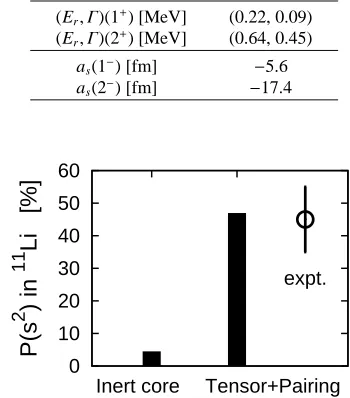
We perform the coupled three-body calculation to ob-tain ΨJ(11Li) in Eq. (27). In Fig. 8, our present calcu-lation “Tensor+Pairing” gives 46.9% of the (1s)2 proba-bility P(s2) for11Li, which explains the observations[19]. The probabilities of (p1/2)2, (p3/2)2, (d5/2)2and (d3/2)2for the last two neutrons are obtained as 42.7%, 2.5%, 4.1% and 1.9%, respectively. For comparison, we calculate11Li without core excitations of9Li (“Inert Core”), namely, we adopt only the single 0p0h configuration for 9Li without the Pauli-blockings explained in the middle panel of Fig. 7. In that case,11Li has almost p-shell closed configuration of 90.6% with a small P(s2) of 4.3%. In the present model of “Tensor+Pairing”, the energy difference between (1s)2and (0p1/2)2configurations is estimated as−0.1 MeV, which is enough to couple two configurations by the pairing corre-lation between the last two neutrons. This means that the blocking effect of the tensor and pairing correlations are essential for the breaking of magicity in11Li. The tensor effect is found to be stronger than the pairing one[3].
ν π
11Li
(0p)2
ν
π π ν
ν π
ν π
ν
π π ν
ν
π π ν
Pauli blocking
11Li
(1s)2
0p0h 2p2h: Pairing 2p2h: Tensor
+
0p3/2
0p1/2
0s1/2
1s1/2
9
Li
last neutron
0p3/2
0p1/2
0s1/2
1s1/2
0p3/2
0p1/2
0s1/2
1s1/2
+
+
+
Fig. 7.Pauli-blocking effects of tensor and pairing correlations in11Li.
0.0 0.5 1.0 1.5 2.0 2.5 3.0 3.5
0 1 2 3 4
d
σ
/dE [b/MeV]
Energy [MeV] Tensor+Pairing
Pairing
Fig. 9.Three-body Coulomb breakup cross section of11Li
mea-sured from the9Li+n+n threshold energy. Pairing case is taken
from Ref. [23].
of charge radius from that of9Li is mainly caused by the large distance between 9Li and the paired two neutrons, Rc−2n, obtained as 5.69 fm[3]. This is a recoil effect.
We further investigate the unbound states of10Li. In Table 4, the dual p state resonances coupled with the spin of9Li(3/2−) are obtained near the9Li+n threshold energy. For the s states, the9Li+n scattering lengths, as, show neg-ative values. In particular, the 2−state gives a large
nega-tive value of as, which indicates the virtual s state near the9Li+n threshold energy. Therefore the inversion phe-nomenon in10Li is explained in the present model.
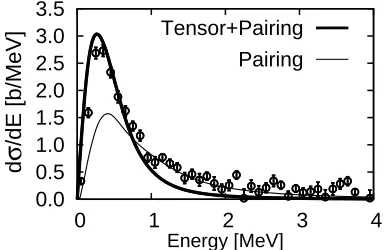
We finally calculate the Coulomb breakup strength of 11Li into the9Li+n+n system to investigate the properties of the dipole excited states. We cannot find any three-body resonance to make structures in the strength. In Fig. 9, the present model well reproduces the experiment[24], in par-ticular, for low energy enhancement. Among the final state interactions, both of the core-n and nn interactions give comparable contributions to produce the low energy en-hancement in the strength[25].
6 Summary
We have developed a method to calculate nuclear ground state by using the bare interaction in the tensor optimized shell model (TOSM+UCOM). We have treated the tensor interaction in terms of TOSM, in which the 2p2h states are fully optimized to describe the excitations due to the tensor interaction. As for the short-range repulsive inter-action, we have introduced the unitary correlation opera-tor method (UCOM). We have furthermore considered the extension of UCOM by introducing the partial wave de-pendence on the correlation function, named as S -UCOM, which largely improves the results.
We have also performed the systematic studies of halo nuclei, 6He and 11Li based on the extended core+n+n model. In the model, the tensor and pairing correlations are explicitly included for core nucleus using TOSM. For Li isotopes, the Pauli-blocking effect induced by two kinds of the correlations in9Li explains the halo structure of11Li and the inversion phenomena of10Li. The similar blocking effect can be seen in the excited 0+
2 state of 6He.
Acknowledgements
The authors are grateful to Prof. H. Horiuchi and Prof. K. Kat¯o for the fruitful discussions on the role of the tensor in-teraction on nuclear structure. This work was supported by a Grant-in-Aid for Young Scientists from the Japan Society for the Promotion of Science (JSPS, No. 21740194) and also by the JSPS Core-to-Core Program. Numerical calcu-lations were performed on the computer system at RCNP, Osaka University.
References
2. T. Myo, S. Sugimoto, K. Kat¯o, H. Toki, K. Ikeda, Prog. Theor. Phys.117(2007) 257.
3. T. Myo, K. Kat¯o, H. Toki and K. Ikeda, Phys. Rev.
C76(2007) 024305.
4. T. Myo, H. Toki, K. Ikeda, Prog. Theor. Phys. 121 (2009) 511.
5. H. Feldmeier, T. Neff, R. Roth and J. Schnack, Nucl. Phys.A632(1998) 61.
6. T. Neff and H. Feldmeier, Nucl. Phys.A713 (2003) 227.
7. H. Kamada et al., Phys. Rev.C64(2001) 044001. 8. T. Myo, K. Kat¯o, K. Ikeda, Prog. Theor. Phys.113
(2005) 763.
9. T. Myo, K. Kat¯o, H. Toki, K. Ikeda, J. of Phys.G31 (2005) S1681.
10. E. Hiyama, Y. Kino and M. Kamimura, Prog. Part. Nucl. Phys.51(2003) 223.
11. D.H. Gloeckner, R.D. Lawson, Phys. Lett.B53(1974) 313.
12. R. Roth, P. Papakonstantinou, N. Paar, H. Hergert, T. Neff and H. Feldmeier, Phys. Rev. C73 (2006) 044312.
13. H. Toki, S. Sugimoto and K. Ikeda, Prog. Theor. Phys.
108(2002) 903.
14. T. Terasawa, Prog. Theor. Phys.22(1959) 150. 15. T. Terasawa, Prog. Theor. Phys.23(1960) 87. 16. A. Arima and T. Terasawa, Prog. Theor. Phys. 23
(1960) 115.
17. S. Nagata, T. Sasakawa, T. Sawada and R. Tama-gaki, Prog. Theor. Phys.22(1959) 274.
18. R. S´anchez et al., Phys. Rev. Lett.96(2006) 033002. 19. H. Simon et al., Phys. Rev. Lett.83(1999) 496. 20. I. Tanihata et al., Phys. Lett. B206(1988) 592. 21. J. A. Tostevin and J. S. Al Khalili, Nucl. Phys.A616
(1997) 418c.
22. A. V. Dobrovolsky et al., Nucl. Phys.A766(2006) 1. 23. T. Myo, S. Aoyama, K. Kat¯o, and K. Ikeda, Phys. Lett.
B576(2003) 281.
24. T. Nakamura et al., Phys. Rev. Lett. 96 (2006) 252502.
![Fig. 3. Energy of 4He in TOSM + UCOM / S -UCOM. Exactcalculation is taken from Ref. [7].](https://thumb-us.123doks.com/thumbv2/123dok_us/9040894.1440327/5.595.183.446.100.345/fig-energy-tosm-ucom-ucom-exactcalculation-taken-ref.webp)