Volume 2, Issue 4, April 2013
Page 318
ABSTRACT
In real life, a person may observe that an object belongs and not belongs to a set to certain degree, but it is possible that he is not sure about it. In other words, there may be some hesitation or uncertainty about the membership and non-membership degree of an object belonging to a set. In fuzzy set theory there is no means to incorporate that hesitation in membership degree. A possible solution is to use vague sets and the concept of vague set was proposed by Gau and Buehrer [1993]. Distance measure between vague sets is one of the most important technologies in various application fields of vague sets. But these methods are unsuitable to deal with the similarity measures of IFSs. In this paper we have extended the work of Zeshui Xu [2007] and also proposed a method to develop some similarity measure of interval valued vague sets and define the positive and negative ideal of interval valued vague sets, and apply the similarity measures to multiple attribute decision making based on vague information. A numerical example is also given to elaborate our technique.
Keywords- Vague sets; Fuzzy sets; Intuitionstic Fuzzy Sets (IFS); Membership function; Distance measure; Interval
Valued Vague Sets; Similarity Measure; Decision Making
1.
INTRODUCTION
Atanassov (1986) defined the notion of intuitionstic fuzzy sets, which is a generalization of notion of Zadeh’s fuzzy set which was later on called vague set the concept given by Gau and Buehrer (1993), which is characterized by a membership function and a non membership function. The concept of vague set is the generalization of the fuzzy set which introduced by Zadeh (1965), and has also been found to be very highly useful to deal with vagueness. In less than two decades since its first appearance, the IFS theory has been investigated by many authors (Atanassov & Georgiev , 1993; Bustince et al.,2000; De et al ., 2001; Deschrijver & Kerre, 2003; Grzegorzewski, 2004; Mondal & Samanta, 2001,2002; Szmidt & Kacprzyk, 2000,2001), and has been applied in different fields, including decision making ( Atanassov, Pasi & Yager, 2005; Chen and Tan.1994; Hong & Choi, 2000; Szmidt & Kacprzyk, 2002; Xu & Ronald, 2006), logic programming ( Atanassov & Georgiev, 1993), medical diagnosis ( De et al., 2001), etc Gau & Buehrer (1993) defined the concept of vague set. Bustine & Burillo (1996) showed that the notion of vague set coincides with that of IFS. De et al., 2000 defined concentrated IFS, dilated IFS, normalization of IFS, and made some characterization. Atanassov & Georgiev (1993) presented a logic programming system which uses a theory of IFSs to model various forms of uncertainty. Bustince et al (2000) proposed some definitions of distances between IFSs and compared them with the approach used for fuzzy sets. Szmidt & Kacprzyk (2001) introduced a measure of entropy for IFS. Mondal and Samanta (2001) defined the topology of interval valued IFSs. Mondal and Samanta (2002) established an intuitionistic fuzzy topological space. Deschrijver & Kerre (2003) presented an intuitionistic fuzzy version of triangular compositions and investigated some properties of these compositions, such as containment, convertibilitry, monotonicity, interaction with union and intersection. Many methods have been proposed for measuring the degree of similarity between fuzzy sets.
In real life, a person may observe that an object belongs and not belongs to a set to certain degree, but it is possible that he is not sure about it. In other words, there may be some hesitation or uncertainty about the membership and non-membership degree of an object belonging to a set. In fuzzy set theory there is no means to incorporate that hesitation in membership degree. A possible solution is to use vague sets and the concept of vague set was proposed by Gau and Buehrer [1993]. But these methods are unsuitable to deal with the similarity measures of IFSs.
In this paper we have extended the work of Zeshui Xu [2007] and also proposed a method to develop some similarity measure of interval valued vague sets and define the positive and negative ideal of interval valued vague sets, and apply the similarity measures to multiple attribute decision making based on vague information.
SIMILARITY MEASURE OF INTERVAL
VALUED VAGUE SETS TO MULTIPLE
ATTRIBUTE DECISION MAKING
M. K. Sharma1, 2Rajesh Dangwal, 2Vintesh Sharma and 3Vinesh Kumar
1
Department of Mathematics, R.S.S. (PG), Pilkhuwa, (Hapur), India
2
H.N.B. Garhwal University, Campus Pauri (U.K)
3
Volume 2, Issue 4, April 2013
Page 319
2. SOME DEFINITIONS:
2.1: Definition: An interval valued fuzzy sets
A
over a universe of discourseX
is defined by a function:
([0,1]),
A
T
X
D
where D ([0, 1]) is the set of all intervals within [0, 1] i.e. for allx
X T x
,
A( )
is an interval1 2
[
,
]
and0
1 21.
2.2: Definition: An interval valued vague sets
A
Vover a universe of discourseX
is defined as an object of the form[ ,
V,
V] ,
,
V
i A i A i i
A
x T
x
F
x
x
X
whereT
AV:
X
D
([0,1]),
andF
AV:
X
D
([0,1]),
are called“Truth membership function” and “False membership function” respectively and where D ([0, 1]) is the set of all intervals within [0, 1], or in other word an interval valued vague set can be represented by
1 2 1 2
( ), [
,
], [ ,
]
,
,
V
i i
A
x
x
X
where0
1 21.
and0
2 11.
For each interval valued vague set
A
V,
1 V( )
i1
1( )
i 1V( )
iA
x
x
Ax
and are called degree of hesitancy ofx
iinV
A
respectively.3. SIMILARITY MEASURES:
Let X = {
x x
1,
2,...
x
n} be a universe of discourse, and(
1,
2,...
n)
T be the weight vector of the elementsx
i(i=1, 2 …….n), where i1
1.
ni i
A vague set
,
V,
V( ) |
V
i A i A i i
A
x T
x
F
x
x
X
(1)which is characterized by a truth membership function
T
AV and a false membership functionF
AV , where:
0,1 ,
0,1 ,
V j V j
A A
T
X
x
X
T
x
F
AV:
X
0,1 ,
x
jX
F
AVx
j0,1
,With the condition
0
T
AVx
iF
AVx
i1,
for allx
iX
For each vague set in
X
,
if1
0,
V i V i V i
A
x
T
Ax
F
Ax
then vague setV
A
is reduced to a fuzzy setA
Thus, the IFS A is reduced to a fuzzy set.Chen et al. (1995) examined the similarity measures of fuzzy sets, which are based on the geometric model, set theoretic approach, and matching function. In this paper, we extend the work of Chen et al. (1995); to investigate similarity measures of interval valued vague set.
For convenience,
similarity measure between two interval valued vague sets.
Definition 3.1 Let
S
be a mappingS
:
X
20,1 ,
then the degree of similarity betweenA
V( )
x
and( )
V
B
x
is defined asS A
(
V,
B
V),
which satisfies the following properties: (1)0
S A
(
V,
B
V)
1;
(2)
S A
(
V,
B
V)
1
, iffA
VB
V; (3)(
V,
V)
(
V,
V);
S A
B
S B
A
(4)If
(
V,
V)
0
S A
B
andS A
(
V,
C
V)
thenS B
(
V,
C
V)
0.
3.2Similarity measures based on the geometric distance model:-
We first review the most widely used distances for fuzzy sets
A
andB
inX
(Kacprzyk, 1997):(1) The Hamming distance:
1
( , )
( )
( ) .
n
i B i
A i
d A B
x
x
……….………(2)(2) The normalized Hamming distance:
1
1
( , )
( )
( ) .
n
i B i
A i
d A B
x
x
Volume 2, Issue 4, April 2013
Page 320
(3)The Euclidean distance:
2
1
( , )
( )
( )
n
i B i
A i
d A B
x
x
………(4)(4)The normalized Euclidean distance:
2
1
1
( , )
( )
( )
n
i B i
A i
d A B
x
x
n
…………..(5) LetA
V( )
x
andB
V( )
x
, where
A
VandB
Vare vague sets then based on above, Szmidt & Kacprzyk (2000) proposed the following distances:(1)The Hamming distance:
1
1
(
,
)
( )
( )
( )
( )
( )
( ) .
2
V V V V V Vn
V V
i i i i i i
A B A B A B
i
d A B
x
x
x
x
x
x
………(6)(2) The normalized Hamming distance:
1
1
(
,
)
( )
( )
( )
( )
( )
( ) .
2
V V V V V Vn
V V
i i i i i i
A B A B A B
i
d A B
x
x
x
x
x
x
n
……...(7)(3) The Euclidean distance:
2
2 2
1
1
(
,
)
( )
( )
( )
( )
( )
( ) .
2
V V V V V Vn
V V
i i i i i i
A B A B A B
i
d A B
x
x
x
x
x
x
…(8)(4) The normalized Euclidean distance:
2
2 2
1
1
(
,
)
( )
( )
( )
( )
( )
( ) .
2
V V V V V Vn
V V
i i i i i i
A B A B A B
i
d A B
x
x
x
x
x
x
n
..(9)Let
A
V( )
x
andB
V( )
x
, where
A
VandB
Vare vague sets then based on above, Zeshui Xu (2007)proposed the following distances:(1)
1
1
1
(
,
)
( )
( )
( )
( )
( )
( )
.
2
V V V V V Vn
V V
i i i i i i
A B A B A B
i
d A B
x
x
x
x
x
x
…(10)(2)
1
1
1
(
,
)
( )
( )
( )
( )
( )
( )
.
2
V V V V V Vn
V V
i i i i i i
A B A B A B
i
d A B
x
x
x
x
x
x
n
.(11)Where
0.
Particular case:(i) If then the above equations reduce to the equations (6) and (7) respectively. (Kacprzyk, in 1996) (ii)If
2
then these results reduce to equations (8) and (9) respectively. (Szmidt & Kacprzyk in 2000)Based on geometrical distance model and using interval valued vague sets, we generalized the above equations, (2)-(11) distances as follow:
1
1 1 2 2 1 1
1
2 2 1 1 2 2
( )
( )
( )
( )
( )
( )
1
(1)
(
,
)
.
2
( )
( )
( )
( )
( )
( )
V V V V V V
V V V V V V
n i i i i i i
A B A B A B
V V
i
i i i i i i
A B A B A B
x
x
x
x
x
x
d A
B
x
x
x
x
x
x
(12)
1
1 1 2 2 1 1
1
2 2 1 1 2 2
( )
( )
( )
( )
( )
( )
1
(2) (
,
)
.
2
( )
( )
( )
( )
( )
( )
V V V V V V
V V V V V V
n i i i i i i
A B A B A B
V V
i
i i i i i i
A B A B A B
x
x
x
x
x
x
d A
B
n
x
x
x
x
x
x
(13)
Volume 2, Issue 4, April 2013
Page 321
11 1 2 2 1 1
1
2 2 1 1 2 2
( )
( )
( )
( )
( )
( )
1
(
,
)
.
2
( )
( )
( )
( )
( )
( )
V V V V V V
V V V V V V
n i i i i i i
A B A B A B
V V
i i
i i i i i i
A B A B A B
x
x
x
x
x
x
d A
B
w
x
x
x
x
x
x
(14)
Where
w
(
w w
1,
2...
w
n)
Tis the weight vector ofx i
i(
1, 2,... ),
n
and0.
If(1 / , 1 / ...1 / ) ,
Tw
n
n
n
Then (14) reduces to (13).From Szmidt & Kacprzyk (2000), it follow that these distance satisfy the conditions of metric Kaufmann (1973). (1)
0
d A
(
V,
B
V)
1;
(2)
d A
(
V,
B
V)
1
, iffA
VB
V; (3)(
V,
V)
(
V,
V);
d A
B
d B
A
(4)If
(
V,
V)
0
d A
B
andd A
(
V,
C
V)
thend B
(
V,
C
V)
0.
Based on (13), we define the similarity measure between the interval valued vague sets
A
VandB
Vas follow: 11 1 2 2 1 1
1
2 2 1 1 2 2
( )
( )
( )
( )
( )
( )
1
(
,
)
1
.
2
( )
( )
( )
( )
( )
( )
V V V V V V
V V V V V V
n i i i i i i
A B A B A B
V V
i
i i i i i i
A B A B A B
x
x
x
x
x
x
S A
B
n
x
x
x
x
x
x
(15) Where
0
andS A
(
V,
B
V)
is the degree of similarity ofA
Vand V.
B
If we take the weight of each elements
x
iX
into account, then1
1 1 2 2 1 1
1
2 2 1 1 2 2
( )
( )
( )
( )
( )
( )
1
(
,
)
1
.
2
( )
( )
( )
( )
( )
( )
V V V V V V
V V V V V V
n
i i i i i i
A B A B A B
V V
i i
i i i i i i
A B A B A B
x
x
x
x
x
x
S A
B
w
x
x
x
x
x
x
(16)
If each elements has the same importance, i.e.
w
(1 / , 1 / ...1 / ) ,
n
n
n
Tthen (16) reduces to (15). By (16) it can easily be known that
S A
(
V,
B
V)
satisfies all the properties of definition 3.1.Similarly, we define another similarity measure of
A
VandB
Vas:1 1 2 2 1 1
1
2 2 1 1 2 2
1 1 2 2 1
( ) ( ) ( ) ( ) ( ) ( )
( ) ( ) ( ) ( ) ( ) ( )
( , ) 1
( ) ( ) ( ) ( )
V V V V V V
V V V V V V
V V V V V
n i i i i i i
A B A B A B
i
i i i i i i
A B A B A B
V V
i i i i
A B A B A
x x x x x x
x x x x x x
S A B
x x x x
1
1
1
2 2 1 1 2 2
.
( ) ( )
( ) ( ) ( ) ( ) ( ) ( )
V
V V V V V V
n i i
B i
i i i i i i
A B A B A B
x x
x x x x x x
(17)
If we take the weight of each element
x
iX
into account, then1 1 2 2 1 1
1
2 2 1 1 2 2
1 1 2 2
( ) ( ) ( ) ( ) ( ) ( )
( ) ( ) ( ) ( ) ( ) ( )
( , ) 1
( ) ( ) ( ) ( )
V V V V V V
V V V V V V
V V V V
n i i i i i i
A B A B A B
i i
i i i i i i
A B A B A B
V V
i i i i
A B A B
i
x x x x x x
w
x x x x x x
S A B
x x x x
w
1
1 1
1
2 2 1 1 2 2
.
( ) ( )
( ) ( ) ( ) ( ) ( ) ( )
V V
V V V V V V
n i i
A B
i
i i i i i i
A B A B A B
x x
x x x x x x
(18)
This has also been proved that all the properties of definition 3.1 are satisfied, if each element has the same importance, and then (18) reduces to (17).
Volume 2, Issue 4, April 2013
Page 322
LetA
V( )
x
andB
V( )
x
, whereA
VandB
Vare interval valued vague sets, then we define a similarity measureA
VandB
Vfrom the point of set theoretic as:1 1 2 2 1 1
1
2 2 1 1 2 2
1 1 2 2
min
( ),
( )
min
( ),
( )
min
( ),
( )
min
( ),
( )
min
( ),
( )
min
( ),
( )
(
,
)
max
( ),
( )
max
( ),
V V V V V V
V V V V V V
V V V
n i i i i i i
A B A B A B
i i i i i i i
A B A B A B
V V
i i i
A B A
x
x
x
x
x
x
x
x
x
x
x
x
S A
B
x
x
x
1 11
2 2 1 1 2 2
( )
max
( ),
( )
max
( ),
( )
max
( ),
( )
max
( ),
( )
V V V
V V V V V V
n i i i
B A B
i i i i i i i
A B A B A B
x
x
x
x
x
x
x
x
x
(19)
If we take the weight of each element
x
iX
into account, then1 1 2 2 1 1
1
2 2 1 1 2 2
1 1 2
min
( ),
( )
min
( ),
( )
min
( ),
( )
min
( ),
( )
min
( ),
( )
min
( ),
( )
(
,
)
max
( ),
( )
max
( )
V V V V V V
V V V V V V
V V V
n i i i i i i
A B A B A B
i i
i i i i i i
A B A B A B
V V
i i i
A B A
i
x
x
x
x
x
x
w
x
x
x
x
x
x
S A B
x
x
x
w
2 1 11
2 2 1 1 2 2
,
( )
max
( ),
( )
max
( ),
( )
max
( ),
( )
max
( ),
( )
V V V
V V V V V V
n i i i
B A B
i i i i i i i
A B A B A B
x
x
x
x
x
x
x
x
x
(20)
Particularly, if each element has the same importance, then (20) is reduced to (19), clearly this also satisfies all the properties of definition 3.1.
3.4 Similarity measures based for matching function by using interval valued vague sets:-
Chen (1988) and Chen et al. (1995) introduced a matching function to calculate the degree of similarity between fuzzy sets. In the following, we extend the matching function to deal with the similarity measure of interval valued vague sets.
( )
V
A
x
andB
V( )
x
, where
A
VandB
Vare interval valued vague sets, then we define a similarity measureV
A
andB
Vbased on the matching function as:1 1 2 2 1 1
1
2 2 1 1 2 2
2 2 2 2 2
1 2 1 2 1
( ) *
( )
( ) *
( )
( ) *
( )
( ) *
( )
( ) *
( )
( ) *
( )
(
,
)
( )
( )
( )
( )
( )
max
V V V V V V
V V V V V V
V V V V V
n i i i i i i
A B A B A B
i i i i i i i
A B A B A B
V V
i i i i i
A A A A A
x
x
x
x
x
x
x
x
x
x
x
x
S A
B
x
x
x
x
x
221
2 2 2 2 2 2
1 2 1 2 1 2
1
.
( ) ,
( )
( )
( )
( )
( )
( )
V
V V V V V V
n
i A i
n
i i i i i i
B B B B B B
i
x
x
x
x
x
x
x
(21)
If we take the weight of each element
x
iX
into account, then1 1 2 2 1 1
1
2 2 1 1 2 2
2 2 2 2 2
1 2 1 2 1
( ) *
( )
( ) *
( )
( ) *
( )
( ) *
( )
( ) *
( )
( ) *
( )
(
,
)
( )
( )
( )
( )
max
V V V V V V
V V V V V V
V V V V V
n i i i i i i
A B A B A B
i
i i i i i i i
A B A B A B
V V
i A i A i A i A i A
x
x
x
x
x
x
w
x
x
x
x
x
x
S A
B
w
x
x
x
x
221
2 2 2 2 2 2
1 2 1 2 1 2
1
.
( )
( ) ,
( )
( )
( )
( )
( )
( )
V
V V V V V V
n
i A i
i n
i B i B i B i B i B i B i
i
x
x
w
x
x
x
x
x
x
Volume 2, Issue 4, April 2013
Page 323
Particularly, if each element has the same importance, then (22) is reduced to (21), clearly this has also satisfied all the properties of definition 3.1. The larger the value ofS A
(
V,
B
V)
, the more the similarity betweenA
VandB
V.
3.5 APPLYING THE SIMILARITY MEASURE TO MULTIPLE ATTRIBUTE DECISION MAKING UNDER VAGUE ENVIRONMENT:
In the following section, we have applied the above similarity measures to multiple attribute decision making based on interval valued vague sets.
For a multiple attribute decision making problem, let
A
A A
1,
2,...
A
k be a set of alternatives, and let1
,
2,...
nC
C C
C
be a set of attributes andw
(
w w
1,
2...
w
n)
Tbe the weight vector of attributes, with the conditionw
i0
and1
1.
n i i
w
Assume that the characteristics of the alternativeA
Vj are represented by the interval valued vague sets as follows:1 2 1 2
, [
V,
V], [
V,
V]
,
1, 2... ,
j j j j
V
j i A i A i A i A i
A
C
C
C
C
C
j
k
(23)where
1AVj
C
iand
2AVj
C
iare the lower and upper bond of the degree of truth membership i.e. indicates the range of degree that the alternative
A
Vj satisfies the attributeC
i, similarly1AVj
C
iand
2AVj
C
iare the lower and upper bond of the degree of false membership i.e. indicates the range of degree that the alternative
A
Vj does not satisfies the attributeC
i, and 1 V,
2 V,
1 V,
2 V0. 1
j i j i j i j i
A
C
AC
AC
AC
,1,
V V
j i j i
mA
C
mAC
for m={1,2}.Let 1 V
1
1 V 1 V,
j i j i j i
A
C
AC
AC
and 2 V1
2 V 2 V,
j i j i j i
A
C
AC
AC
for allC
iC
,
then wedefine the positive and negative ideals for interval valued vague set as follows:
1 2 1 2
, [
V,
V], [
V,
V] :
V
i A i A i A i A i i
A
C
C
C
C
C
C
C
(24)1 2 1 2
, [
V,
V], [
V,
V] :
V
i A i A i A i A i i
A
C
C
C
C
C
C
C
, (25)Where,
1AV
C
imax
j 1AVjC
i,
2AVC
imax
j 2AVjC
i,
and1 V
min
1 V ji i
A
C
j AC
, 2 Vmin
2 V.
j
i i
A
C
j AC
Let the hesitation part for both the ideals be defined as follows
1AV
C
i1
1AVC
i 1AVC
i,
2AVC
i1
2AVC
i 2AVC
i,
and 1AVC
i1
1AVC
i 1AVC
i,
2AVC
i1
2AVC
i 2AVC
i.
Then based on (16), we define the degree of similarity measure for the positive ideal interval valued vague set
A
V and alternativeA
Vj and degree of similarity for the negative ideal interval valued vague setA
V and alternativeV j
A
respectively as follow:1
1 1 2 2 1 1
1
1
2 2 1 1 2 2
( )
( )
( )
( )
( )
( )
1
(
,
) 1
.
2
( )
( )
( )
( )
( )
( )
V V V V V V
j j j
V V V V V V
j j j
n A i A i A i A i A i A i
V V
j i
i
i i i i i i
A A A A A A
x
x
x
x
x
x
s A
A
w
x
x
x
x
x
x
Volume 2, Issue 4, April 2013
Page 324
and1
1 1 2 2 1 1
1
1
2 2 1 1 2 2
( )
( )
( )
( )
( )
( )
1
(
,
) 1
.
2
( )
( )
( )
( )
( )
( )
V V V V V V
j j j
V V V V V V
j j j
n A i A i A i A i A i A i
V V
j i
i
i i i i i i
A A A A A A
x
x
x
x
x
x
S A
A
w
x
x
x
x
x
x
(27)
Based on (26) and (27), we define the percentage of similarity measure
d
jcorresponding to the alternativeA
Vj as follows:1
1 1
(
,
)
*100,
1, 2... .
(
,
)
(
,
)
V V
j
j V V V V
j j
s A
A
d
j
n
s A
A
s A
A
(28) Clearly, the bigger the value ofd
j, the better the alternativeA
Vj.
Similarity, based on (18), (20) and (22), we can define the degree of similarity of the positive ideal interval valued vague set
A
V and alternativeA
Vj,
and the degree of similarity of the negative ideal interval valued vague set and alternativeA
Vj,
respectively, as follow:(1)Based on (18), we define the following:
(2)
1 1 2 2 1 1
1
2 2 1 1 2 2
2
1 1 2
( ) ( ) ( ) ( ) ( ) ( )
( ) ( ) ( ) ( ) ( ) ( )
( , ) 1
( ) ( )
V V V V V V
j j j
V V V V V V
j j j
V V
j
n A i A i A i A i A i A i
i i
i i i i i i
A A A A A A
V V
j
i i
A A
i
C C C C C C
w
C C C C C C
S A A
C C
w
1
2 1 1
1
2 2 1 1 2 2
.
( ) ( ) ( ) ( )
( ) ( ) ( ) ( ) ( ) ( )
V V V V
j j
V V V V V V
j j j
n A i A i A i A i
i
i i i i i i
A A A A A A
C C C C
C C C C C C
(29)
1 1 2 2 1 1
1
2 2 1 1 2 2
2
1 1 2
( ) ( ) ( ) ( ) ( ) ( )
( ) ( ) ( ) ( ) ( ) ( )
( , ) 1
( ) ( )
V V V V V V
j j j
V V V V V V
j j j
V V
j
n A i A i A i A i A i A i
i i
i i i i i i
A A A A A A
V V
j
i i
A A
i
C C C C C C
w
C C C C C C
S A A
C C
w
1
2 1 1
1
2 2 1 1 2 2
.
( ) ( ) ( ) ( )
( ) ( ) ( ) ( ) ( ) ( )
V V V V
j j
V V V V V V
j j j
n A i A i A i A i
i
i i i i i i
A A A A A A
C C C C
C C C C C C
(30) (2) Based on (20), we define the following:
1 1 2 2 1 1
1
2 2 1 1 2 2
3
1 1
m in ( ) , ( ) m in ( ) , ( ) m in ( ) , ( )
m i n ( ) , ( ) m i n ( ) , ( ) m in ( ) , ( )
( , )
m a x ( ) ,
V V V V V V
j j j
V V V V V V
j j j
V
n A i A i A i A i A i A i i
i
i i i i i i
A A A A A A
V V j
i A A i
C C C C C C
w
C C C C C C
S A A
C
w 2 2 1 1
1
2 2 1 1 2 2
( ) m a x ( ) , ( ) m a x ( ) , ( )
m a x ( ) , ( ) m a x ( ) , ( ) m a x ( ) , ( )
V V V V V
j j j
V V V V V V
j j j
n i A i A i A i A i i
i i i i i i
A A A A A A
C C C C C
C C C C C C
(31)
1 1 2 2 1 1
1
2 2 1 1 2 2
3
1 1
m in ( ), ( ) m in ( ), ( ) m in ( ), ( )
m in ( ), ( ) m in ( ), ( ) m in ( ), ( )
( , )
m ax ( ) ,
V V V V V V
j j j
V V V V V V
j j j
V
n A i A i A i A i A i A i
i i
i i i i i i
A A A A A A
V V
j
i
A A
i
C C C C C C
w
C C C C C C
S A A
C
w 2 2 1 1
1
2 2 1 1 2 2
( ) m ax ( ), ( ) m ax ( ), ( )
m a x ( ), ( ) m a x ( ), ( ) m a x ( ), ( )
V V V V V
j j j
V V V V V V
j j j
n i A i A i A i A i
i
i i i i i i
A A A A A A
C C C C C
C C C C C C
Volume 2, Issue 4, April 2013
Page 325
(3) Based on (22), we define the following:1 1 2 2 1 1
1
2 2 1 1 2 2
4
2 2 2
1 2 1
(
) *
(
)
(
) *
(
)
(
) *
(
)
(
) *
(
)
(
) *
(
)
(
) *
(
)
(
,
)
(
)
(
)
(
max
V V V V V V
j j j
V V V V V V
j j j
V V V
n A i A i A i A i A i A i
i i
i i i i i i
A A A A A A
V V
j
i A i A i A
C
C
C
C
C
C
w
C
C
C
C
C
C
S
A
A
w
C
C
C
22 12 221
2 2 2 2 2 2
1 2 1 2 1 2
1
)
(
)
(
)
(
) ,
(
)
(
)
(
)
(
)
(
)
(
)
V V V
V V V V V V
j j j j j j
n
i A i A i A i
i n
i A i A i A i A i A i A i
i
C
C
C
w
C
C
C
C
C
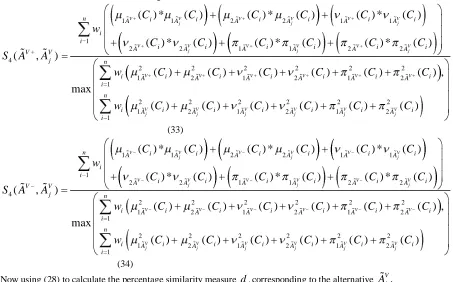
C
(33)
1 1 2 2 1 1
1
2 2 1 1 2 2
4
2 2 2
1 2 1
(
) *
(
)
(
) *
(
)
(
) *
(
)
(
) *
(
)
(
) *
(
)
(
) *
(
)
(
,
)
(
)
(
)
(
max
V V V V V V
j j j
V V V V V V
j j j
V V V
n A i A i A i A i A i A i
i i
i i i i i i
A A A A A A
V V
j
i A i A i A
C
C
C
C
C
C
w
C
C
C
C
C
C
S
A
A
w
C
C
C
22 12 221
2 2 2 2 2 2
1 2 1 2 1 2
1
)
(
)
(
)
(
) ,
(
)
(
)
(
)
(
)
(
)
(
)
V V V
V V V V V V
j j j j j j
n
i A i A i A i
i n
i A i A i A i A i A i A i
i
C
C
C
w
C
C
C
C
C
C
(34)
Now using (28) to calculate the percentage similarity measure
d
jcorresponding to the alternativeA
Vj.
3.6 NUMERICAL EXAMPLE:
Similarity measure of interval valued vague set has been illustrated in the following numerical example. Suppose that a high technology company needs to hire an engineer. Now there are eight candidates
A
A A
1,
2,...,
A
8 and six benefit criteria are considered:(1) Personality (
C
1)(2) Past experience (
C
2)(3) Education level (
C
3)(4) Self-confidence (
C
4)(5) Emotional steadiness (
C
5)(6) Oral communication skill (
C
6).The weight vector of these criteria
C i
i(
1, 2..., 6)
isw
(0.12, 0.3, 0.07, 0.25, 0.06, 0.2).
TAssuming that the characteristics of the alternatives
A j
j(
1, 2, 3, 4, 5, 6, 7, 8)
are represented by interval valuedvague sets as follow in table 1
Table 1 Candidates
1 V
A
2V
A
3V
A
4V
A
5V
A
6V
A
4V
A
5V
A
( )
w
VA
A
VPersonality
1
C
C
1C
1C
1C
1C
1C
1C
1C
1C
1C
11 1 V
(
)
j
A
C
0.2 0.3 0.6 0.4 0.8 0.3 0.5 0 0.12 0.8 0 12AVj
(
)
C
0.25 0.35 0.7 0.45 0.9 0.35 0.6 0.2 0.12 0.9 0.2
1 1V
(
)
j
A
C
0.6 0 0.2 0.1 0.1 0.3 0.4 0.8 0.12 0 0.8 12AVj
(
)
C
0.5 0 0.1 0 0.05 0.2 0.3 0.7 0.12 0 0.7
1 1 V
(
)
j
Volume 2, Issue 4, April 2013
Page 326
1 2 V
(
)
j
A
C
0.25 0.65 0.2 0.55 0.05 0.45 0.1 0.1 0.12 0.1 0.1Past
experience
C
2C
2C
2C
2C
2C
2C
2C
2C
2C
2C
22 1 V
(
)
j
A
C
0.5 0.3 0.7 0.1 0.2 0.4 0.6 0.5 0.3 0.7 0.12
2AVj
(
C
)
0.53 0.4 0.8 0.3 0.4 0.5 0.65 0.6 0.3 0.8 0.32 1V
(
)
j
A
C
0.2 0.6 0.1 0.1 0.5 0.4 0.3 0.1 0.3 0.1 0.62 2AVj
(
)
C
0.15 0.5 0 0 0.2 0.3 0.2 0.05 0.3 0 0.5
2 1 V
(
)
j
A
C
0.3 0.1 0.2 0.8 0.3 0.2 0.1 0.4 0.3 0.2 0.32 2AVj
(
)
C
0.32 0.1 0.2 0.7 0.4 0.2 0.15 0.35 0.3 0.2 0.2
Education
level
C
3C
3C
3C
3C
3C
3C
3C
3C
3C
3C
33 1AVj
(
)
C
0.1 0.5 0.5 0.5 0.4 0.2 0.3 0.3 0.07 0.5 0.1
3 2 V
(
)
j
A
C
0.2 0.6 0.55 0.6 0.45 0.3 0.35 0.4 0.07 0.6 0.2 31AVj
(
)
C
0.4 0.1 0.4 0.2 0.4 0.6 0.3 0.4 0.07 0.1 0.6
3 2 V
(
)
j
A
C
0.3 0.05 0.3 0.1 0.3 0.5 0.2 0.3 0.07 0.05 0.5 31AVj
(
)
C
0.5 0.4 0.1 0.3 0.2 0.2 0.4 0.3 0.07 0.4 0.3
3 2 V
(
)
j
A
C
0.5 0.35 0.15 0.3 0.25 0.2 0.45 0.3 0.07 0.35 0.3
Self-confidence
C
4C
4C
4C
4C
4C
4C
4C
4C
4C
4C
44 1 V
(
)
j
A
C
0.2 0.3 0.1 0.5 0.6 0.2 0.4 0.7 0.25 0.7 0.1 42 V
(
)
jA
C
0.4 0.5 0.25 0.55 0.65 0.3 0.5 0.75 0.25 0.75 0.25 41V
(
)
jA
C
0.05 0.3 0.6 0.4 0.3 0.6 0.1 0.2 0.25 0.05 0.6 42 V
(
)
jA
C
0 0.2 0.5 0.3 0.2 0.5 0.05 0.1 0.25 0 0.5 41 V
(
)
jA
C
0.75 0.4 0.3 0.1 0.1 0.2 0.5 0.1 0.25 0.25 0.3 42 V
(
)
jA
C
0.6 0.3 0.25 0.15 0.15 0.2 0.45 0.15 0.25 0.25 0.25Emotional
steadiness
C
5C
5C
5C
5C
5C
5C
5C
5C
5C
5C
55 1AVj
(
)
C
0.5 0.2 0.7 0.3 0.4 0.5 0.1 0 0.06 0.7 0
5 2 V
(
)
j
A
C
0.65 0.3 0.75 0.35 0.45 0.55 0.2 0.25 0.06 0.75 0.2 51AVj
(
)
C
0.3 0.05 0.2 0.6 0.2 0.4 0.1 0.6 0.06 0.05 0.6
5 2 V
(
)
j
A
C
0.2 0.01 0.1 0.5 0.1 0.3 0.05 0.5 0.06 0 0.5 51AVj
(
)
C
0.2 0.75 0.1 0.1 0.4 0.1 0.8 0.4 0.06 0.25 0.4
5 2 V
(
)
j
A
C
0.15 0.69 0.15 0.15 0.45 0.15 0.75 0.25 0.06 0.25 0.3Communi-
cation skill
C
6C
6C
6C
6C
6C
6C
6C
6C
6C
6C
66 1 V
(
)
j