COMMUN. IN SOIL SCI. PLANT ANAL., 22(5&6), 517-528 (1991)
COMPARISON OF DTPA AND RESIN EXTRACTABLE SOIL ZN TO PLANT ZN UPTAKE
M. A. Hamilton and D. T. Westermann
USDA-ARS Soil and Water Management Research Center, Kimberly, Idaho 83341
ABSTRACT: Extraction of soil zinc with routine chemical extractants does not
always reflect differences in Zn availability as detected by plant uptake. This study was undertaken to explore and compare the use of an ion exchange resin and diethylenetriaminepentaacetic acid (DTPA) for extracting soil Zn as related to plant Zn uptake. Beans were grown in 1989 following differential cropping with corn and beans or fallow in 1988 on a Portneuf silt loam near Kimberly, Idaho. Two Zn fertilizer treatments were imposed across previous cropping treatments. A batch method for determining resin extractable soil Zn was established.
Both plant Zn concentration and Zn uptake by beans in 1989 were signifi-cantly higher in Zn fertilized than unfertilized treatments regardless of previous crop; and higher in plots previously cropped with corn than beans or fallow, regardless of Zn treatment. DTPA and resin extractable soil Zn were significantly higher in Zn fertilized plots compared to unfertilized plots but did not differ between previous cropping treatments. Resin and DTPA extractable soil Zn con-centrations were positively correlated. Resin extracted soil Zn correlated better with plant Zn concentration and Zn uptake throughout the growing season than DTPA extracted soil Zn, particularly in plots that had been fallowed or previously cropped with corn. Resin may be extracting labile soil Zn not extracted with DTPA and, therefore, be better simulating plant uptake. Both extraction methods correlated better with Zn uptake when evaluated within cropping treatments, emphasizing the need to consider previous crop when calibrating soil tests.
INTRODUCTION
Soil testing for micronutrient cations such as Zn is often difficult because plant
517
518 HAMILTON AND WESTERMANN
requirements are relatively low. Soil solution concentrations are usually low as well and contamination problems are common. Chemical analysis of plant tissues for micronutrients and calibration of the results with response to fertilizers may be superior to soil tests but can be time consuming and costly. Plant analysis is also of little use in predicting fertilizer needs before the crops are planted. A soil test is essential for predicting yield responses prior to planting.
Extractants commonly used to determine soil Zn concentrations include acids such as 0.1 N HC1, which is used extensively and has the most calibration work, and synthetic chelating agents such as DTPA, EDTA, and dithizone. Viets and Lindsay (1) suggest that a satisfactory soil test should: a) extract nutrients from the same labile nutrient pool in the soil that plants do; and b) be cheap, be reproducible by different laboratories, and be easily adaptable to routine lab procedures.
It was shown, however, that chemically extracted soil Zn does not always correlate with Zn uptake by plants. Bauer and Lindsay (2), using short term up-take, demonstrated an increase in available Zn to corn plants after incubating soil at 43°C for 1 to 3 weeks. The temperature-released Zn was not detected by chemical soil extractants. Leggett and Westermann (3) demonstrated differences in Zn con-centration and uptake by beans depending on the previous crop which was not detected with DTPA extractable soil Zn tests. An alternative soil test for Zn that better reflects Zn availability as detected by plant uptake would be useful in such situations.
Synthetic ion exchange resins were used to extract ions from the soil, particularly P (4,5,6,7) and N (8,9,10). Use of resins for extracting soil K has also been investigated (11). However, little work has been done using ion ex-change resins for extracting soil Zn. Salomon and Smith (11) found that use of exchange resin appeared to be more effective in estimating crop response to K fertilizer than buffered acetate solutions. Moser et al. (7) concluded that an ion ex-change resin method of estimating soil P concentration demonstrated greater precision in predicting P uptake than routine chemical extractants. The purpose of this study was to compare ion exchange resin and DTPA for determining soil Zn concentrations as related to Zn uptake by plants.
METHODS AND MATERIALS
DTPA AND RESIN EXTRACTABLE ZN 519
mesic, Durixerollic Calciorthid) at the Snake River Conservation Research Center near Kimberly, ID. A field was differentially cropped with bean (Phaseolus vulgaris L.) and corn (Zea mays L.) or fallowed in 1988. At harvest, whole plant tops were removed from the corn plots. Bean seed was separated from the plants and removed from the plots. An application of 11 kg Zn/ha as ZnSO4 was made to half of each plot in a randomized split plot design in the fall of 1988. Soil samples (0-30 cm) were taken from each split plot in the spring of 1989. Each sample was air dried, and ground in a stainless steel mill to pass a 2-mm sieve. Viva dry bean variety was planted (56 cm spacing) in 1989. During both the differentially cropped year and the test crop year, plots were row irrigated. All plots were irrigated for the same length of time. Whole bean plant tops were sampled periodically through-out the growing season, washed with distilled water, dried in forced air ovens (60°C), and ground in a stainless steel mill to pass through a 0.6-mm sieve. The plant samples were digested with perchloric and nitric acids, and Zn concentration was determined with an atomic absorption spectrophotometer (A.A.).
The DTPA extractable Zn was determined for each soil sample (12). Sub-samples of the remaining soil Sub-samples were extractedwith the heavy metal, cation exchange, Chelex 100 resin (Na-form) using a batch method. Moist resin was prepared by mixing with two bed volumes of 50% NaOH and heated to 60°C for 24 hours to insure complete regeneration to the Na-form. The resin was then rinsed with five bed volumes of deionized, distilled water to remove interstitial NaOH. The CEC of the Na-form resin is 0.7 meq/n1L (defined as Cu(NH3)4 +2 uptake) (13).
Several trials were run initially on all the soil samples, using duplicate sets to determine the appropriate soil/resin ratio and to assess the reproducibility of results. A trial using replicates of one sample was run to determine the extraction time necessary to reach maximum Zn extraction by the resin. Two replicates were re-moved and analyzed at 24 hr intervals. The following procedure was established and conducted on all soil samples.
520 HAMILTON AND WESTERMANN
for one week. The solution with resin was then rinsed onto a stainless steel sieve (0.18 mm) and rinsed with a stream of deionized, distilled water until all visible soil and debris was gone. The resin was then transferred into a 100 mL volumetric flask and filled to volume with 1 N HC1, to extract Zn from the resin. The resin was left in the acid for 1.5 hr with periodic swirling. Previous trials indicated no further removal of resin Zn after 1 hr in acid. Zinc concentration of the acid solu-tions was then determined. The volume of the 1N HCl solution was corrected for the volume occupied by the resin in all calculations. While this batch technique of ion removal is considered less efficient than column exchange, it is fast, easy, and large sample sets can be run routinely. Standard Zn solutions were mixed with resin and treated in the same manner as the soil solutions. Percent recovery from the standard solutions was used to correct soil sample results, thereby adjusting for any loss of efficiency resulting from this batch method.
RESULTS
Resin Exchange Method: Initial trials were run using 4 g of air dry soil. A 50
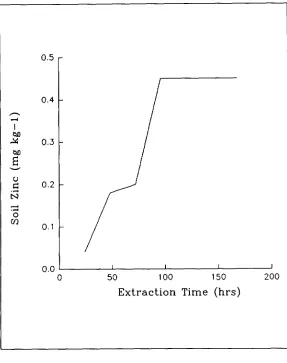
to 100 mL volume of acid was needed to satisfactorily rinse the resin into a flask and provide enough solution volume to insure contact between acid and resin when swirling flasks. This produced a final solution with Zn concentrations too low to be detected with A.A. In subsequent trials, it was established that 20 g of air dry soil were necessary to obtain high enough Zn concentrations in the final solutions to detect differences with A.A. Based on average soil Zn concentrations as deter-mined with DTPA, it was calculated that 20 mL of moist Chelex 100 resin (Na-form) would provide an excess exchange capacity for the 20 g sample of soil. Means were not significantly different between duplicates. There was no appreci-able change in Zn concentration with continued shaking beyond 96 hr (Fig. 1). Mean Zn recovery by resin for standard Zn solutions extracted concurrently with the soil samples was 75%. Resin extractable soil Zn concentrations reported were corrected for standard recovery using this figure.
Comparison of Resin and DTPA Extraction: The precropping and Zn
0.4
Z
Z 0.2
N
0.1
50 100
0.0
0 150
I
200 0.5 —
Extraction Time (hrs)
DTPA AND RESIN EXTRACTABLE ZN 521
FIGURE 1. Effect of Shaking Time on Soil Zinc Extracted With Resin
522 HAMILTON AND WESTERMANN
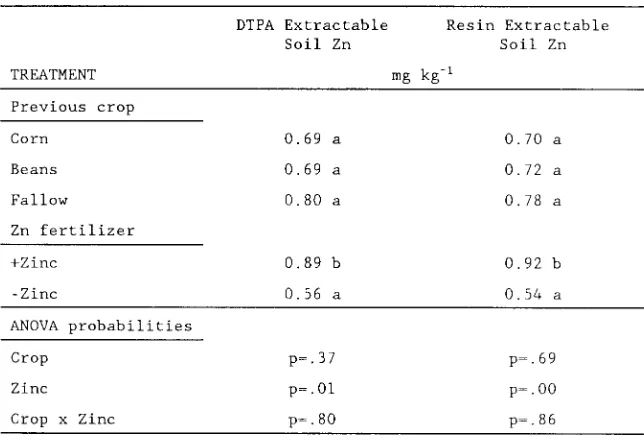
TABLE 1. Treatment Effects on DTPA and Resin Extractable Soil Zinc Concentrations
TREATMENT
DTPA Extractable Resin Extractable
Soil Zn Soil Zn
mg kg -1
Previous crop
Corn 0.69 a 0.70 a
Beans 0.69 a 0.72 a
Fallow 0.80 a 0.78 a
Zn fertilizer
+Zinc 0.89 b 0.92 b
-Zinc 0.56 a 0.54 a
ANOVA probabilities
Crop p=.37 p=.69
Zinc p=.01 p=.00
Crop x Zinc p=.80 p=.86
* Treatment means with similar letters within columns and treatments are not significantly different at the 0.05 level based on LSD multiple comparisons.
Zinc concentration and uptake at four stages of bean plant development
indi-cated a difference in Zn availability due to both precropping treatment and Zn
fert-ilizer treatment (Table 2). In comparison to plants from plots previously cropped
with bean, plant Zn uptake was higher in plots previously cropped with corn, and
lower in plots previously fallowed. Plant Zn concentration and uptake were
consistently greater in Zn fertilized plots compared to unfertilized plots. Soil Zn
concentrations, however, were only significantly different between Zn fertilized
and unfertilized treatments, regardless of extraction method (Table 1). There were
no significant differences in soil Zn concentration between precropping treatments.
Correlation coefficients between soil Zn concentration and plant Zn
• • • •
0 2 0.4 0.6 0.8 1.0 1.2 Resin Extracted Soil Zn (mg kg-1)
1.4
1 1.2
bo
to
S 1 . 0
0.8 — o Cr/
0.6
x Cx.1
a 0.4
0.2
•
•
•
• • •
• •
y = 0.96x + 0.02 r = 0.94 p<0.05
• •
DTPA AND RESIN EXTRACTABLE ZN 523
FIGURE 2. Resin vs DTPA Extractable Soil Zinc
6/30/89, 7/10/89, and 7/21/89, respectively) than for DTPA-Zn extraction (0.19, 0.21, 0.20, and 0.28). All correlation coefficients between resin extracted soil Zn and plant Zn concentrations were significant (p<0.05), while none were between DTPA extracted soil Zn and plant Zn concentrations.
01 CO v-4 W ro H 114 on • ea)1 U
z
0 40 E .0 %-D U (N 4 ro oo A r-i CV ro 0 L.ro t CO .0 -0 L0ul CO 0, CV (.0 CO a1:1 CV O
f u 4 LT1
• on
v-1
0 40 CV O
E Cl CV
.17 ro
0, 00
H to.
0 h0 Ln Cl 0
Cpl
0 U A t
• of)
(-) O
0 bri
E CV
4 al
H 4 00 CV CO 0. or) CV 0, 1-1 4 al • b.0
(-) Cl Cl
0 b4 CO L.c)
CV •-)
>,
,r) 4.)
Cl O L-1O CV ro
Cl 11 I ,-)
0. II I CI+ ol) 't
O O O
Cl O O
a)
CV
II
a. II 0
t
(1.)
ro
n-n
0 00 -7-Lc)
• • •
II 11 II
P. P. P.
ro
0
0
O 00 rn )-) •
Cc)
CV PL. a. III ro 0 00
0 "-I
al O O r-- 9 ro
O O
,z) O
II
a. P.11 P.11
a)
ad
P.
4-) a)
0 0 ,-)
CO 0
. 0. 0,.
II 11 II
'
)f) 4?).)
t O O
ul O O N rda)
II II d v1
al
P. P. 0;1
a)
O O In
O O
4-) Lai
0 In
1-1
En 0
at a) a) 4
a) 4-1
z
4-3< ›.
0 0 O
z
4-) 4-) a)
td W
CI) tl
0 4 A A O 11 csi 4 4 01 4 00 CV A o 4 O O c) O 0 -a <4 a) a) N a)
L).-1
z
1-1•
DTPA AND RESIN EXTRACTABLE ZN 525
The data were evaluated within pre-cropping treatments. Within the corn and fallow treatments, the correlation coefficients associated with the prediction equa-tions were higher using resin extractable soil Zn to predict Zn uptake than with DTPA extractable soil Zn (Table 3). Within bean treatments, there was little differ-ence in correlation coefficients between resin and DTPA extractable soil Zn. Slopes for the prediction equations were not significantly different between extraction methods for any precropping treatment. Within each precropping treat-ment, both methods of soil Zn extraction had higher correlation coefficients with Zn uptake than those obtained using the combined data, suggesting that soil tests are better predictors of Zn uptake when differential cropping is not a factor. Within both the Zn fertilized and unfertilized treatments, neither DTPA or resin extractable soil Zn concentration were correlated with plant Zn uptake.
CONCLUSIONS
The method described for using resin to extract soil Zn is easy, inexpensive, and can be done routinely. However, it does require lengthy extraction times when compared to DTPA extraction. For this particular soil, both methods gave similar results and were equally effective at detecting differences in soil Zn concentrations caused by Zn fertilization. Differences in Zn availability to the subsequent crop due to differential cropping were detected by plant uptake but not by DTPA or resin soil Zn extraction.
Following differential cropping, resin extractable soil Zn correlated better with plant Zn concentration and uptake than DTPA extractable Zn. This improvement appears to be primarily from the increased correlation between resin soil Zn and Zn uptake following corn and fallow treatments. This emphasizes the influence of pre-vious crop on Zn availability and on the soil test's ability to predict Zn availability. The increased correlation coefficients for both extraction methods when the data were evaluated within precropping treatments suggests the need to calibrate soil tests with consideration given to previous crop.
526 HAMILTON AND WESTERMANN
TABLE 3. Regressions Within Precropping Treatments: Soil Zn Concentration vs Plant Zn Uptake
Previous crop
6/19/89 6/30/89 7/10/89
Fallow DTPA Zn vs
r=0.73 r=0.48 r=0.49
Zn uptake
b=0.47 b=1.25 b=6 . 54
Fallow Resin r=0.85 r=0.54 r=0.57
Zn vs Zn uptake
b=0.64 b=1.63 b=8 . 91
Bean DTPA Zn
vs
r=0.89 r=0. 93 r=0. 77
Zn uptake
b=1.18 b=3 . 75 b=20.50
Bean Resin r=0.91 r=0.93 r=0. 76
Zn vs Zn uptake
b=1.13 b=3 . 54 b=19.18
Corn DTPA Zn
vs
r=0.61 r=0. 38 r=0.17
Zn uptake
b=1.62 b=2.18 b=5 . 04
Corn Resin r=0.83 r=0.48 r=0.33
Zn vs Zn uptake
b=1.99 b=2.44 b=8 . 63
soil Zn, and to reflect both intensity and capacity factors. It is possible, however,
that the lengthy extraction time with resin allows more removal of Zn from the
strongly adsorbed and labile soil Zn pools that are available only upon removal of
the readily exchangeable Zn from solution. DTPA, however,may be primarily
DTPA AND RESIN EXTRACTABLE ZN 527
Further investigation of the use of ion exchange resin to determine Zn availability is needed. The method described here may require considerable revision under different conditions and with different soils. Investigation of the effect of previous crop on Zn availability and on soil test calibration with Zn uptake offers interesting research possibilities.
REFERENCES:
1. Viets, F. G. Jr. and W. L. Lindsay. 1972. Testing soils for zinc, copper, manganese, and iron, pp. 153-172. IN: L. M. Walsh and J. D. Beaton (eds.) Soil Testing and Plant Analysis. Soil Science Society of America, Madison, WI.
2. Bauer, A. and W. L. Lindsay. 1965. The effect of soil temperature on the availability of indigenous soil zinc. Soil Sci. Soc. Am. Proc. 29:413-416 3. Leggett, G. E. and D. T. Westermann. 1986. Effect of corn, sugarbeets, and
fallow on zinc availability to subsequent crops. Soil Sci. Soc. Am. J. 50:963-968
4. Hislop, J. and I. J. Cooke. 1966. Anion exchange resin as a means of assessing soil phosphate status: a laboratory technique. Soil Sci. 105:8-11 5. Amer, F., D. R. Bouldin, C. A. Black, and F. R. Duke. 1955.
Char-acterization of soil phosphorus by anion exchange resin adsorption and P32 equilibration. Plant and Soil 6:391-408
6. Walmsley, D. and I. S. Cornforth. 1973. Methods of measuring available nutrients in West Indian soils II. Phosphorus. Plant and Soil 39:93-101 7. Moser, U. S., W. H. Sutherland, and C. A. Black. 1959. Evaluationof
laboratory indexes of absorption of soil phosphorus by plants:I. Plant and Soil 10:356-374
8. Schnabel, R. R. 1983. Measuring nitrogen leaching with ion exchange resin: a laboratory assessment. Soil Sci. Soc. Am. J. 47:1041-1042
9. Binkley, D. and P. Matson. 1983. Ion exchange resin bag method for assessing forest soil nitrogen availability. Soil Sci. Soc. Am. J. 47:1050-1052
10. Binkley, D. 1984. Ion exchange resin bags: factors affecting estimates of nitrogen availability. Soil Soc. Am. J. 48:1181-1184
528 HAMILTON AND WESTERMANN
12. Lindsay, W. L. and W. A. Norvell. 1978. Development of a DTPA soil test for zinc, iron, manganese, and copper. Soil Sci. Soc. Aer. J. 42:421-428. 13. Bio-Rad. 1983. Chelex 100 Chelating Ion Exchange Resin for Analysis,