InTrans Project Reports Institute for Transportation
6-2013
Evaluation of the TAPCO Sequential Dynamic
Curve Warning System
Omar G. Smadi
Iowa State University, [email protected]
Neal R. Hawkins
Iowa State University, [email protected]
Shauna L. Hallmark
Iowa State University, [email protected]
Skylar Knickerbocker
Iowa State University, [email protected]
Follow this and additional works at:http://lib.dr.iastate.edu/intrans_reports Part of theCivil Engineering Commons
This Report is brought to you for free and open access by the Institute for Transportation at Iowa State University Digital Repository. It has been accepted for inclusion in InTrans Project Reports by an authorized administrator of Iowa State University Digital Repository. For more information, please [email protected].
Recommended Citation
Smadi, Omar G.; Hawkins, Neal R.; Hallmark, Shauna L.; and Knickerbocker, Skylar, "Evaluation of the TAPCO Sequential Dynamic Curve Warning System" (2013).InTrans Project Reports. 23.
Evaluation of the TAPCO Sequential Dynamic Curve Warning System
Abstract
Implementing safety countermeasures on rural horizontal curves to address speeding can improve the safety performance for those locations. State safety and traffic engineers are faced with making decisions on what type of technology to use and which sites to use the technology on in a fiscally constrained environment. The research conducted for this project will evaluate a Sequential Dynamic Curve Warning System (SDCWS) that could be an additional tool for these engineers to use either separately or in combination with other
countermeasures to address horizontal curve locations with a history of safety concerns.
Keywords
Civil Construction and Environmental Engineering, horizontal curves, dynamic signs, SDCWS
Disciplines Civil Engineering
Evaluation of the TAPCO
Sequential Dynamic Curve
Warning System
Publication No. FHWA-HIF-13-040
Notice
This document is disseminated under the sponsorship of the U.S. Department of Transportation in the interest of information exchange. The U.S. Government assumes no liability for the use of the information contained in this document.
The U.S. Government does not endorse products or manufacturers. Trademarks or
manufacturers’ names appear in this report only because they are considered essential to the objective of the document.
Quality Assurance Statement
TECHNICAL REPORT DOCUMENTATION PAGE 1. Report No.
FHWA-HIF-13-040
2. Government Accession No. 3. Recipient’s Catalog No.
4. Title and Subtitle 5. Report Date
June 2013 EVALUATION OF THE TAPCO SEQUENTIAL DYNAMIC CURVE
WARNING SYSTEM
6. Performing Organization Code
7. Authors
Omar Smadi, Neal Hawkins, Shauna Hallmark, Skylar Knickerbocker
8. Performing Organization Report No.
9. Performing Organization Name and Address
Center for Transportation Research and Education Iowa State University
2711 S. Loop Drive, Suite 4700 Ames, IA 50010
10. Work Unit No. (TRAIS)
11. Contract or Grant No. DTFH61-10-D-00025
12. Sponsoring Agency Name and Address
Federal Highway Administration 1200 New Jersey Avenue, SE Washington, DC 20590
13. Type of Report and Period Covered
Interim Report
14. Sponsoring Agency Code
15. Supplementary Notes
Work performed as a subcontractor to SAIC, under the direction of Julie Zirlin, FHWA Contracting Officer’s Technical Manager
16. Abstract
Implementing safety countermeasures on rural horizontal curves to address speeding can improve the safety performance for those locations. State safety and traffic engineers are faced with making decisions on what type of technology to use and which sites to use the technology on in a fiscally constrained environment. The research conducted for this project will evaluate a Sequential Dynamic Curve Warning System (SDCWS) that could be an additional tool for these engineers to use either separately or in combination with other countermeasures to address horizontal curve locations with a history of safety concerns.
17. Key Words
horizontal curves—dynamic signs—SDCWS
18. Distribution Statement
No restrictions. This document is available to the public through the National Technical Information Service, Springfield, VA 22161.
19. Security Classif. (of this report)
Unclassified
20. Security Classif. (of this page) Unclassified
21. No of Pages 118
22. Price N/A
SI* (MODERN METRIC) CONVERSION
FACTORS APPROXIMATE CONVERSIONS TO SI UNITS
SYMBOL WHEN YOU KNOW MULTIPLY BY TO FIND SYMBOL
LENGTH
in inches 25.4 millimeters mm
ft feet 0.305 meters m
yd yards 0.914 meters m
mi miles 1.61 kilometers km
AREA
in2 square inches 645.2 square millimeters mm2
ft2 square feet 0.093 square meters m2
yd2 square yard 0.836 square meters m2
ac acres 0.405 hectares ha
mi2 square miles 2.59 square kilometers km2
VOLUME
fl oz fluid ounces 29.57 milliliters mL
gal gallons 3.785 liters L
ft3 cubic feet 0.028 cubic meters m3
yd3 cubic yards 0.765 cubic meters m3
NOTE: volumes greater than 1000 L shall be shown in m3
MASS
oz ounces 28.35 grams g
lb pounds 0.454 kilograms kg
T short tons (2000 lb) 0.907 megagrams (or "metric
ton")
Mg (or "t")
TEMPERATURE (exact degrees)
o
F Fahrenheit 5 (F-32)/9 or (F-32)/1.8 Celsius oC
ILLUMINATION
fc foot-candles 10.76 lux lx
fl foot-Lamberts 3.426 candela/m2 cd/m2
FORCE and PRESSURE or STRESS
lbf poundforce 4.45 newtons N
lbf/in2 poundforce per square inch 6.89 kilopascals kPa
APPROXIMATE CONVERSIONS FROM SI UNITS
SYMBOL WHEN YOU KNOW MULTIPLY BY TO FIND SYMBOL
LENGTH
mm millimeters 0.039 inches in
m meters 3.28 feet ft
m meters 1.09 yards yd
km kilometers 0.621 miles mi
AREA
mm2 square millimeters 0.0016 square inches in2
m2 square meters 10.764 square feet ft2
m2 square meters 1.195 square yards yd2
ha hectares 2.47 acres ac
km2 square kilometers 0.386 square miles mi2
VOLUME
mL milliliters 0.034 fluid ounces fl oz
L liters 0.264 gallons gal
m3 cubic meters 35.314 cubic feet ft3
m3 cubic meters 1.307 cubic yards yd3
MASS
g grams 0.035 ounces oz
kg kilograms 2.202 pounds lb
Mg (or "t") megagrams (or "metric ton") 1.103 short tons (2000 lb) T TEMPERATURE (exact degrees)
oC Celsius 1.8C+32 Fahrenheit oF
ILLUMINATION
lx lux 0.0929 foot-candles fc
cd/m2 candela/m2 0.2919 foot-Lamberts fl
FORCE and PRESSURE or STRESS
N newtons 0.225 poundforce lbf
kPa kilopascals 0.145
poundforce per square
inch lbf/in2
TABLE OF CONTENTS
INTRODUCTION ...1
Project Scope ...1
Project Objectives ...1
Report Overview ...1
LITERATURE REVIEW ...3
Relationship between Curve Crash Rate and Geometry ...3
Relationship between Curve Crash Rate and Speed of Curve Negotiation ...4
Effectiveness of DSFS Systems ...6
Tracking Vehicles for Data Reduction ...12
SELECTION OF TEST SITES FOR SDCWS ...15
Initial Review ...15
Site Visits ...17
Selection of Final Sites ...19
Selection of Study Direction ...19
Final Site Information by State ...19
INSTALLATION ...21
Technology Description ...21
METHODOLOGY FOR SPEED DATA COLLECTION ...25
Equipment ...25
Data Collection Periods ...25
Data Collection Protocol and Quality Assurance ...25
SPEED ANALYSIS...27
Speed Metrics...27
Results to Date ...27
APPENDIX A. BASELINE DATA FOR EACH TEST SECTION ...31
APPENDIX B. SITE DATA TABLES AND FIGURES ...61
Iowa Highway 144 ...62
Missouri Highway 221 ...66
Washington SR 7 ...70
Washington SR 9 ...74
iv
Wisconsin Highway 20 ...82
Wisconsin Highway 67 ...86
Wisconsin Highway 213 ...90
Texas FM 109 ...94
Texas FM 407 ...97
Texas FM 530 ...100
Texas FM 1148 ...103
LIST OF FIGURES
Figure 1. Photo. Northbound Interstate 5 DSFS systems in Oregon.(22) ...7
Figure 2. Photo. Southbound Interstate 5 DSFS systems in Oregon.(22) ...7
Figure 3. Photo. DSFS system in Norfolk.(23) ...8
Figure 4. Photo. DSFS system in Bellevue, Washington.(24) ...9
Figure 5. Photo. Speed warning sign in the Sacramento River Canyon.(26)...10
Figure 6. Photo. Comparison of curve warning sign (left) and speed feedback sign (right).(30)....11
Figure 7. Equation. True effect. ...13
Figure 8. Map. Washington State DOT candidate sites. ...16
Figure 9. Photo. Candidate curve site in Washington State. ...17
Figure 10. Chart. Example site visit speed data collection form. ...18
Figure 11. Photo. Example field report from initial visit. ...18
Figure 12. Map. Final test site locations. ...19
Figure 13. Photos. Installation of the SDCWS. ...21
Figure 14. Photo. SDCWS activation sequence. ...23
Figure 15. Diagram. Typical traffic counter placement. ...26
Figure 16. Photo. Iowa Highway 144 before data collection. ...31
Figure 17. Photo. Iowa Highway 144 1 month after data collection. ...32
Figure 18. Photo. Iowa Highway 144 site layout...33
Figure 19. Chart. Iowa Highway 144 site information. ...34
Figure 20. Photo. Missouri Highway 221 before data collection. ...35
Figure 21. Photo. Missouri Highway 221 1 month after data collection. ...36
Figure 22. Photo. Missouri Highway 221 site layout. ...37
Figure 23. Chart. Missouri Highway 221 site information. ...38
Figure 24. Map. Washington State Route 9 before data collection. ...39
Figure 25. Map. Washington State Route 9 1 month after data collection. ...40
Figure 26. Chart. Washington State Route 9 site information. ...41
Figure 27. Map. Washington State Route 203 before data collection. ...42
Figure 28. Map. Washington State Route 203 1 month after data collection. ...43
Figure 29. Chart. Washington State Route 203 site information. ...44
Figure 30. Map. Washington State Route 7 before data collection. ...45
vi
Figure 32. Chart. Washington State Route 7 site information. ...47
Figure 33. Map. Wisconsin Highway 213 before data collection...48
Figure 34. Map. Wisconsin Highway 213 1 month after data collection. ...49
Figure 35. Map. Wisconsin Highway 213 site layout. ...50
Figure 36. Chart. Wisconsin Highway 213 site information. ...51
Figure 37. Map. Wisconsin Highway 20 before data collection...52
Figure 38. Map. Wisconsin Highway 20 1 month after data collection. ...53
Figure 39. Map. Wisconsin Highway 20 site layout. ...54
Figure 40. Chart. Wisconsin Highway 20 site information. ...55
Figure 41. Map. Wisconsin Highway 67 before data collection...56
Figure 42. Map. Wisconsin Highway 67 1 month after data collection. ...57
Figure 43. Map. Wisconsin Highway 67 site layout. ...58
Figure 44. Chart. Wisconsin Highway 67 site information. ...59
Figure 45. Graph. Impact on vehicle speed - Iowa Hwy 144. ...64
Figure 46. Map and graphs. Location and change in percentile vehicle speed - Iowa Hwy 144. .65 Figure 47. Graph. Impact on vehicle speed - Missouri Hwy 221. ...68
Figure 48. Map and graphs. Location and change in percentile vehicle speed - Missouri Hwy 221...69
Figure 49. Graph. Impact on vehicle speed - Washington SR 7. ...72
Figure 50. Map and graphs. Location and change in percentile vehicle speed - Washington SR 7.73 Figure 51. Graph. Impact on vehicle speed - Washington SR 9. ...76
Figure 52. Map and graphs. Location and change in percentile vehicle speed - Washington SR 9.77 Figure 53. Graph. Impact on vehicle speed - Washington SR 203. ...80
Figure 54. Map and graphs. Location and change in percentile vehicle speed - Washington SR 203...81
Figure 55. Graph. Impact on vehicle speed - Wisconsin Hwy 20. ...84
Figure 56. Map and graphs. Location and change in percentile vehicle speed - Wisconsin Hwy 20...85
Figure 57. Graph. Impact on vehicle speed - Wisconsin Hwy 67. ...88
Figure 58. Map and graphs. Location and change in percentile vehicle speed - Wisconsin Hwy 67...89
Figure 59. Graph. Impact on vehicle speed - Wisconsin Hwy 213. ...92
Figure 61. Graph. Impact on vehicle speed - Texas FM 109. ...95
Figure 62. Map and graphs. Location and change in percentile vehicle speed - Texas FM 109. ..96
Figure 63. Graph. Impact on vehicle speed - Texas FM 407. ...98
Figure 64. Map and graphs. Location and change in percentile vehicle speed - Texas FM 407. ..99
Figure 65. Graph. Impact on vehicle speed - Texas FM 530. ...101
Figure 66. Map and graphs. Location and change in percentile vehicle speed - Texas FM 530. 102
Figure 67. Graph. Impact on vehicle speed - Texas FM 1148. ...104
viii
LIST OF TABLES
Table 1. Advisory message for Interstate 5 dynamic speed-activated feedback sign system. ...6
Table 2. Final test sites by State...19
Table 3. Curve characteristics. ...20
Table 4. Installation dates. ...21
Table 5. Summary of results at point of curvature after 1 month. ...28
Table 6. Summary of results at center of curve after 1 month. ...28
Table 7. Schedule of activities, all sites. ...29
Table 8. Results for Iowa - Hwy 144 at PC. ...62
Table 9. Results for Iowa - Hwy 144 at CC. ...62
Table 10. Speed Reduction for Iowa - Hwy 144. ...63
Table 11. Results for Missouri - Hwy 221 at PC. ...66
Table 12. Results for Missouri - Hwy 221 at CC. ...66
Table 13. Speed reduction for Missouri - Hwy 221...67
Table 14. Results for Washington - SR 7 at PC. ...70
Table 15. Results for Washington - SR 7 at CC. ...70
Table 16. Speed reduction for Washington - SR 7. ...71
Table 17. Results for Washington - SR 9 at PC. ...74
Table 18. Results for Washington - SR 9 at CC. ...74
Table 19. Speed reduction for Washington - SR 9. ...75
Table 20. Results for Washington - SR 203 at PC. ...78
Table 21. Results for Washington - SR 203 at CC. ...78
Table 22. Speed reduction for Washington - SR 203. ...79
Table 23. Results for Wisconsin - Hwy 20 at PC. ...82
Table 24. Results for Wisconsin - Hwy 20 at CC. ...82
Table 25. Speed reduction for Wisconsin - Hwy 20. ...83
Table 26. Results for Wisconsin - Hwy 67 at PC. ...86
Table 27. Results for Wisconsin - Hwy 67 at CC. ...86
Table 28. Speed Reduction for Wisconsin - Hwy 67...87
Table 29. Results for Wisconsin - Hwy 213 at PC. ...90
Table 30. Results for Wisconsin - Hwy 213 at CC. ...90
Table 32. Results for Texas - FM 109 at PC...94
Table 33. Results for Texas - FM 109 at CC. ...94
Table 34. Results for Texas - FM 407 at PC...97
Table 35. Results for Texas - FM 407 at CC. ...97
Table 36. Results for Texas - FM 530 at PC...100
Table 37. Results for Texas - FM 530 at CC. ...100
Table 38. Results for Texas - FM 1148 at PC...103
x
LIST OF ABBREVIATIONS AND ACRONYMS
AADT Annual average daily traffic
Caltrans California Department of Transportation
CC Center of curve
DOT Department of Transportation
DSFS Dynamic speed feedback sign
FARS Fatality Analysis Reporting System
GES General Estimates System
HSIS Highway Safety Information System
LIDAR Light detection and ranging
MUTCD Manual on Uniform Traffic Control Devices
PC Point of curvature
SD Standard deviation
SDCWS Sequential Dynamic Curve Warning System
TE True effect
INTRODUCTION
Horizontal curves make up a small percentage of total road miles, yet account for one-quarter of all highway fatalities. The majority of curve-related crashes are attributed to speeding and driver error and involve lane departures. There are a number of low-cost countermeasures traditionally used to help keep vehicles on the road and in their lane; however, the impacts of their application can be limited, which leads to the need for additional research and testing on more dynamic devices to assist traffic engineers in managing speed and safety across their diverse roadway network.
Project Scope
More than 25 percent of fatal crashes are associated with a horizontal curve, and the vast majority of these crashes involve a roadway departure. The average crash rate for horizontal curves is about three times that of other highways segments. About three-quarters of curve-related fatal crashes involve a single vehicle leaving the roadway and striking trees, utility poles, rocks, or other fixed objects, or overturning. The majority of these crashes are speed related.
Implementing safety countermeasures on rural horizontal curves to address speeding can improve the safety performance for those locations. State safety and traffic engineers are faced with making decisions on what type of technology to use and which sites to use the technology on in a fiscally constrained environment. The research conducted for this project will evaluate a Sequential Dynamic Curve Warning System (SDCWS) that could be an additional tool for these engineers to use either separately or in combination with other countermeasures to address horizontal curve locations with a history of safety concerns.
Project Objectives
The objective of this project is to test and evaluate the effectiveness of TAPCO’s SDCWS in reducing vehicle speed as well as the frequency and severity of speed-related crashes on horizontal curves on rural roadways. With 12 treatment sites and 24 control sites having been identified in Missouri, Texas, Washington, and Wisconsin, speed data will be collected before and immediately after the installation, as well as at 12 and 18 months post installation.
Report Overview
LITERATURE REVIEW
This section discusses the relationship between roadway geometry, vehicle speeds, and crashes on horizontal curves and reviews the effectiveness of various applications of Dynamic Speed Feedback Sign (DSFS) systems installed to date. This research effort will test the effectiveness of the SDCWS and its impact on safety. Even though several dynamic curve sign systems have been tested in the past, this system is unique in terms of including guidance not just before or at the curve, but also throughout the curve with the blinking chevrons. The results from this research will add to the body of knowledge and provide safety engineers with another tool to address curve crashes.
Relationship between Curve Crash Rate and Geometry
Curves have about three times the crash rate of tangent sections.(1) Preston and Schoenecker reported that 25 to 50 percent of the severe road departure crashes in Minnesota occurred on curves, even though curves account for only 10 percent of the total system mileage.(2) Shankar et al. evaluated divided State highways without median barriers in Washington State and found a relationship between the number of horizontal curves per kilometer and median crossover crashes.(3) Farmer and Lund evaluated single-vehicle fatal and injury rollover crashes using Fatality Analysis Reporting System (FARS) data and data from Florida, Pennsylvania, and Texas.(4) Using logistic regression, they found that the odds of having a rollover on a curved section were 1.42 to 2.15 times the odds of having a rollover on a straight section.
The majority of crashes on curves involve lane departures. A total of 76 percent of curve-related fatal crashes are single vehicles leaving the roadway and striking a fixed object or overturning. Another 11 percent of curve-related crashes are head-on collisions.(5)
The frequency and severity of curve-related crashes have been correlated to a number of geometric factors, including radius, degree of curve, length of curve, type of curve transition, lane and shoulder widths, preceding tangent length, and required speed reduction.
Luediger et al. found that crash rates increase as the degree of curve increases, even when traffic warning devices are used to warn drivers of the curve.(6) Miaou and Lum found that truck crash involvement increases as horizontal curvature increases, depending on the length of curve.(7) Council found that the presence of spirals on horizontal curves reduced crash probability on level terrain but did not find the same effect for hilly or mountainous terrain.(8) Vogt and Bared
evaluated two-lane rural road segments in Minnesota and Washington State using Highway Safety Information System (HSIS) data and found a positive correlation between injury crashes and degree of horizontal curve.(9)
Zegeer et al. evaluated curves on two-lane roads in Washington State using a linear regression model.(10) The researchers found that the degree of curve was positively correlated with crashes, while total surface width and presence of spirals were negatively correlated. They also evaluated 10,900 horizontal curves on two-lane roads in Washington State using a weighted linear
4
Preston and Schoenecker examined severe roadway departure crashes and found that 90 percent of fatal crashes and 75 percent of injury crashes occurred on curves with a radius of less than 1,500 ft.(2) Milton and Mannering evaluated 2,725 miles of highway in Washington State using a negative binomial model and reported that an increase in radius was associated with decreases in crash frequency.(12) They also found that a shorter tangent length between horizontal curves was associated with decreases in crash frequency. They speculated that drivers may be traveling at lower speeds and are therefore more likely to be paying attention when tangent lengths between curves are short.
In contrast, Deng et al. evaluated head-on crashes on 729 segments of two-lane roads in Connecticut using an ordered probit model.(13) They included geometric characteristics in the analysis but did not find that the presence of horizontal or vertical curves was significant.
Taylor et al. evaluated the relationship between speed and crashes on rural single-carriageway roads in England.(14) The authors collected data from 174 road sections with 60 mph speed limits with a wide range of conditions. Data collected included injury crash data, traffic volume, speed data, and roadway geometry. Speed and flow were measured at each site for 1 or 2 days, and various speed metrics were calculated, including mean speed, 85th percentile speed, and standard deviation of speed. The authors found that crashes were more highly correlated with mean speed than any other speed metric. They also found that crash frequency increased with mean speed. In general, a 10 percent increase in mean speed resulted in a 26 percent increase in the frequency of injury crashes.
More recently, Khan et al. analyzed curves in Wisconsin to determine the relationship between safety, horizontal curve signs, and geometry.(15) Compared to previous research, a larger data set with greater detail was used to develop a model showing the relationship of the horizontal curves. The data showed that crashes increased with an increase in annual average daily traffic (AADT), posted speed, and curve length; they also increased with a decrease in curve radius. In addition, an analysis of traffic control signs indicated that sites with curve signs (W1-2) had fewer crashes than sites with turn signs (W1-1). Sharper curves, however, showed no significant correlation to sign type in reducing crashes because of other, more substantial influencing factors.
Relationship between Curve Crash Rate and Speed of Curve Negotiation
Although curve-related crashes are correlated to geometric factors, driver factors such as speed selection also contribute to curve-crash frequency and outcome. Driver factors include driver workload, driver expectancy, and speed selection.
Speeding, defined by FHWA as “exceeding the posted speed limit or driving too fast for
conditions,” is generally problematic. Council et al. evaluated FARS, General Estimates System (GES), and HSIS data to assess the impact of speeding on fatal crashes.(16) Using 2005 FARS data, they found that 29.5 percent of fatal crashes were speed-related. They conducted several different types of analyses and found the single-vehicle run-off-road crashes are more likely to be related than are multi-vehicle crashes. Crashes on curves were more likely to be speed-related as compared to tangent sections and nighttime crashes. Additionally, FARS data
FHWA estimates that approximately 56 percent of run-off-road fatal crashes on curves are speed-related.(6) The vehicle speed reduction from the tangent section required for traversing a curve has an impact on the frequency and severity of crashes in curves. Abrupt changes in
operating speed resulting from changes in horizontal alignment are suggested to be a major cause of crashes on rural two-lane roadways.(6)
Anderson and Krammes developed a model comparing mean speed reduction and mean crash rate for 1,126 horizontal curves on rural two-lane roadways.(17) They reported that the
relationship between mean crash rate and required speed reduction to negotiate the curve is roughly linear. This finding is also supported by Fink and Krammes, who indicated that curves requiring no speed reduction did not have significantly different mean crash rates than their preceding roadway tangent.(18)
Driver errors on horizontal curves are often due to the inappropriate selection of speed and the inability to maintain lane position. Drivers’ speed selection at curves depends on both explicit attentional cues and implicit perceptual cues.(19) A driver’s speed prior to entering a curve has a significant effect on his or her ability to negotiate the curve successfully.(2) Inappropriate speed selection and lane positioning can be a result of a driver failing to notice an upcoming curve or misperceiving the roadway curvature.
Driver workload plays an important role in driver speed maintenance. Distracting tasks such as radio-tuning or cell phone conversations can draw a driver’s attention away from speed
monitoring, detection of headway changes, lane keeping, and detection of potential hazards.(19) Other factors include sight distance issues, fatigue, or complexity of the driving situation.(19,20) Preston and Shoenecker evaluated vehicle paths through a curve on a two-lane rural roadway as part of an evaluation of a dynamic curve message sign.(2) The roadway had a posted speed limit of 55 mph and AADT of 3,250 vehicles per day (vpd). The researchers collected data over a 4-day period and randomly selected and evaluated 589 vehicles. A total of 340 of the vehicles (58 percent) were traveling over 55 mph, and the rest were traveling at or below the speed limit. The authors evaluated whether each vehicle successfully negotiated the curve. Vehicles that crossed a left or right lane line on one or more occasions were defined as “not successfully navigating the curve.”
A logistic regression model was developed to determine the relationship between initial speed and the probability of a vehicle unsuccessfully navigating the curve. The researchers found that there was a 20 percent better chance for vehicles that were traveling at or below the speed limit to successfully navigate the curve than for vehicles that were traveling over the speed limit, with the difference being statistically significant at 99 percent. They found that 45 percent of vehicles traveling at or above 65 mph were unable to negotiate the curve compared to 30 percent for vehicles that were traveling under 65 mph, with the difference being statistically significant at the 90 percent confidence interval.
6
Charlton conducted a simulator study and evaluated driver speed adjustments on several types of curves with several types of signing.(20) Charlton found that, in general, drivers approached and entered curves at higher speeds when engaged in cell phone tasks than when in non-distraction scenarios.
Effectiveness of DSFS Systems
DSFS systems have been used in only a few cases to reduce speeds and warn drivers of upcoming curves. They have been used more extensively for a number of other related
applications. A summary of information about the application of DSFS on curves and in related situations is provided below.
Bertini et al. studied the effectiveness of a DSFS system on Interstate 5 near Myrtle Creek, Oregon.(22) The system consisted of two displays that provided different messages to drivers based on the speed detected, as shown in table 1.
Table 1. Advisory message for Interstate 5 dynamic speed-activated feedback sign system.
Sign Panel
Sign Messages Detected Vehicle Speeds
Less than 50 mph Detected Vehicle Speeds 50–70 mph Detected Vehicle Speeds over 70 mph 1 CAUTION SLOW DOWN SLOW DOWN
2 SHARP CURVES AHEAD YOUR SPEED IS XX MPH YOUR SPEED IS OVER 70 MPH
The curve has an advisory speed of 45 mph with an AADT of 16,750 vpd. Before the DSFS system was in place, there was what the authors termed “dual overhead horizontal
alignment/advisory speed combination sign assemblies with 4 flashing beacons.” The DSFS system was put in place alongside one of the existing signs in both the northbound and
southbound directions. Each system consisted of the actual dynamic message sign, a radar unit, a controller unit, and computer software. Figures 1 and 2 show the system.
The researchers collected speed data using a laser gun. Results indicated that, after installation of the DSFS system, passenger vehicle speeds were reduced by 2.6 mph and commercial truck speeds were reduced by 1.9 mph, with the results being statistically significant at the 95 percent confidence level. The distribution of speeds shifted to the left after installation of the signs, and the differences were found to be statistically significant based on a 95 percent confidence level using the chi-square test.
Figure 1. Photo. Northbound Interstate 5 DSFS systems in Oregon.(22)
Figure 2. Photo. Southbound Interstate 5 DSFS systems in Oregon.(22)
8
Figure 3. Photo. DSFS system in Norfolk.(23)
The signs were blank when the driver was under a specified speed threshold and displayed the curve sign when a driver exceeded the threshold. The speed threshold was set at the 50th percentile speed for the sign location because the researchers wanted to target the upper half of driver speeds. Once activated, the bend warning display was shown for 4 seconds. Based on previous research, the researchers had calculated this time as being sufficient for drivers to register and understand the message.
Speed data were collected for a minimum of 7 days before the signs were installed, and again 1 month and 1 year after installation. Data were collected at the 1-year period to determine if habituation occurs—in other words, whether drivers become immune to treatments and stop responding. Data were collected using pneumatic tubes at two sites and a radar gun at the third. Mean speeds were reduced by 2.1 mph at West Sussex, 3.0 mph at Wiltshire, and 6.9 mph at Norfolk.
Crash data were available for two sites, and the researchers found that crashes decreased 54 percent at the Norfolk bend site and 100 percent at the Wiltshire bend site. A public survey found that drivers approved of the signs.
Figure 4. Photo. DSFS system in Bellevue, Washington.(24)
Preston and Shoenecker also evaluated the safety effect of a DSFS system on County Highway 54 in Minnesota, which is a two-lane rural roadway with a speed limit of 55 mph and an AADT of 3,250 vpd.(2) The curve has an advisory speed of 40 mph. The DSFS system had a changeable message sign and radar unit. A field test was conducted over a 4-day period with a unit that consisted of a closed circuit TV camera, a VCR, and a personal computer. A portable trailer housed the entire system.
The sign displayed the following:
• From 6 a.m. to 10 a.m., 11 a.m. to 2 p.m., and 4 to 7 p.m.: CURVE AHEAD.
• No message during other times of the day unless activated.
During all times of the day, when the radar unit detected a vehicle traveling 53 or more mph, the camera would activate and record the vehicle for 18 seconds. Using a random number generator and depending on the time of day, the computer would either continue displaying the CURVE AHEAD message, display the CURVE AHEAD – REDUCE SPEED message, or display no message.
The team randomly selected 589 of the vehicles captured during data collection and evaluated whether each vehicle successfully negotiated the curve. Successful negotiation was defined as a vehicle remaining within the lane lines as it traversed the curve. Vehicles that crossed a left or right lane line on one or more occasions were defined as “not successfully navigating the curve.”
The team found that approximately 35 percent of the drivers who received the message were unable to successfully negotiate the curve. Vehicles that received the CURVE AHEAD sign were more likely to negotiate the curve successfully, but the difference was not statistically significant. Only 26 percent of vehicles that received the CURVE AHEAD – REDUCE SPEED sign were unable to negotiate the curve successfully, and the difference was statistically
10
Mattox et al. looked at the effectiveness of a DSFS system on secondary highways in South Carolina.(25) This system consisted of a radar device and a 4-ft by 4-ft yellow sign with 6-inch lettering reading YOU ARE SPEEDING IF FLASHING. In addition, there were two 1-ft by 1-ft orange flags and a type B flashing beacon light. Teams collected data in a before-and-after study upstream of the sign, at the sign, and then downstream of the sign. Results showed a significant reduction in speed at the sign and downstream of the sign. Overall mean speed and 85th
percentile speeds were reduced by approximately 3 mph.
A report by the California Department of Transportation (Caltrans) provided a summary of the effectiveness of safety treatments in one California district.(26) A changeable message sign was installed at five locations along Interstate 5 to reduce truck collisions. Caltrans reported that truck crashes decreased from 71 percent to 91 percent at four of the sites, while truck crashes increased by 140 percent at one site.
A study by the 3M Company evaluated driver speed feedback signs, which display the
approaching drivers’ speeds, in the United Kingdom. Signs were tested at various locations in Doncaster, including semi-rural roadways. The sites had speed limits of 40 mph, and reductions up to 7 mph in 85th percentile speeds were noted.(27)
[image:24.612.241.375.400.581.2]Tribbett et al. evaluated dynamic curve warning systems for advance notification of alignment changes and speed advisories at five sites in the Sacramento River Canyon on Interstate 5.(28) The roadway has high traffic volumes (7,650 to 9,300 vpd), mountainous terrain, and a number of heavy vehicle crashes. The signs were a 10-ft by 7-ft full matrix LED panel that could be programmed to display a variety of messages. Messages used by the researchers included curve warning (shown in figure 5) and driver speed feedback.
Figure 5. Photo. Speed warning sign in the Sacramento River Canyon.(26)
The researchers collected speed data using stopwatches. Data were collected before installation of the signs and at several points after the signs were installed; the researchers did not indicate when these after periods were, however. Speed results at the point of curvature (PC) include the following:
• Site 1: statistically significant decreases in mean truck speeds from 2.4 to 5.4 mph and decreases in mean passenger car speeds from 3.0 to 4.5 mph.
periods.
• Site 3: statistically significant decreases in mean truck speeds from 1.9 to 3.7 mph and increases in passenger cars from 5.2 to 7.8 mph.
• Site 4: no statistically significant change in mean truck speed and a 1.4 mph decrease for passenger cars for one time period that was statistically significant.
• Site 5: a statistically significant change in mean truck speed of 4.5 for one time period and decrease in mean passenger car speeds from 2 to 3 mph.
The researchers also compared 5 years of crash data before installation of the signs and 6 months after. However, due to the very short after period, the results were determined to be unreliable.
The Texas Transportation Institute evaluated the use of a portable speed display trailer in work zones.(29) They found that passenger vehicle speeds were reduced by 7 to 9 mph at one site and 2 to 3 mph at another. Truck speeds were reduced 3 to 10 mph at both sites.
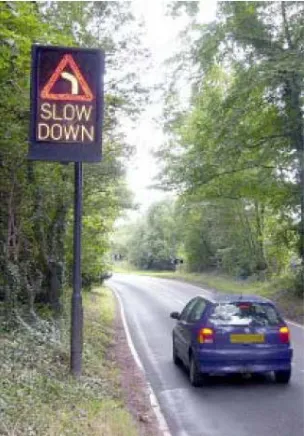
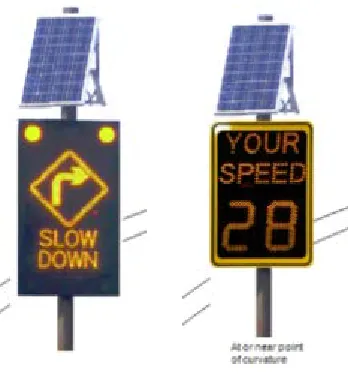
[image:25.612.220.394.341.528.2]Hallmark et al. also analyzed the installation of DSFS on curves throughout the country to determine the safety benefits.(30) Seven States participated, installing curve warning signs as well as speed feedback signs, which can be seen in figure 6. For the analysis, the mean speed, 85th percentile speed, and the percentage of vehicles going over the speed limit were compared.
Figure 6. Photo. Comparison of curve warning sign (left) and speed feedback sign (right).(30) The average for all of the sites showed a 1.8 mph reduction in mean speed at 1 month, a 2.6 mph reduction in mean speed at 1 year, and a 2.0 mph reduction in speed at 2 years; all of these reductions occurred at the PC. The 85th percentile speed at the PC was reduced by 2.2 mph at both the 1-month and 2-year data collection period and was reduced by 2.9 mph at the 1-year data collection period. Similar decreases were seen in the percentage of vehicles going over the speed limit. The mean speed and 85th percentile speed were also lower at the center of curve, with the largest speed reductions occurring at the 1-month data collection period.
12
analysis was also performed for the direction of travel for the DSFS and for both directions combined. The analysis showed that, compared to control sites, crashes were reduced 2 to 4 times more for both directions and in the direction of travel by 1.7 to 6.0 times per quarter. Crash modification factors developed using a full Bayes model were .85 for both directions and .97 for the direction of the DSFS.
Sun et al. researched the effectiveness of sequential warning lights as a method to better define the beginning and taper into nighttime work zones.(31) The sequential lights were evaluated in Missouri along Interstate 70 with a right lane closure. Vehicle speeds at the closure were compared in addition to speeds at the point where the vehicle merged and at the lateral position in the taper. Decreases were seen in the mean speed of 2.2 mph and by 1 mph in the 85th percentile speeds, both of which were statistically significant. The lateral position of vehicles in the closed lane increased from 6.2 percent without sequential lights to 7.8 percent with sequential lights. The sequential lights had a negative effect, which could be due to drivers being more aggressive because the taper is illuminated better. The location where vehicles merged was split into eight zones with zone 8 being the zone closest to the taper. With the sequential lights, the total vehicles merging in zones 5 through 7 decreased while the vehicles merging in zones 1 through 4 increased. The exception that occurred was an increase in vehicles merging in zone 8, which further supports the aggressive driver assumption given the lateral position of the driver. Overall, vehicles were merging 20 ft earlier with the sequential lights.
Santiago-Chaparro et al. evaluated the spatial effectiveness of speed feedback signs at a single location along State Highway 164 in Wisconsin.(32) Vehicles were tracked while approaching and receding from the speed feedback signs, and the speeds were monitored to determine when vehicles were slowing down and whether the speed reductions were sustained. The research found that vehicles were reducing their speed the most between 1,200 and 1,400 ft upstream of the speed feedback sign. Speeds began to increase again between 300 to 500 ft downstream of the speed feedback sign, and some vehicles increased speed before even passing the speed feedback sign. The results of the study showed that the speed feedback signs are not adequate for speed reductions at a corridor level but only at the location where the desired speed reduction should occur.
Tracking Vehicles for Data Reduction
Tracking involves monitoring individual vehicles as they traverse multiple data collection points. Limited research has been completed in this area; the literature search revealed only one study that used tracking to reduce data down to only affected vehicles.(33) In this study, tracking was used to determine how much vehicles were slowing down when approaching the sign. This aligns very well with curves, as the speeds of vehicles can be tracked while approaching and through the curve. Vehicles were tracked so that only free-flow passenger vehicles would be analyzed, eliminating vehicles that were influenced by a turning movement. To track the vehicles, the vehicle speed, vehicle length, and time headway were compared at each data collection location.
then determining the speed reduction for each vehicle before and after implementation. TE was calculated as shown in figure 7.
True Effect=ΔV1-2, during-
ΔV1-2, before
Figure 7. Equation. True effect.
The tracked data were used to determine the statistics ΔV1-2, during, which is the mean speed
reduction between sensors 1 and 2 during the study and ΔV1-2, before, which is the mean speed
reduction between sensors 1 and 2 before implementation. Cruzado and Donnell briefly discussed that, depending on the upstream data collection, the data may be over- or
underestimated by using only the mean speed reduction at the treatment location.(34) TE better reflects any changes in speeds while approaching the curve.
Another form of tracking was performed by McFadden and Elefteriadou, who determined
whether calculating the difference of 85th percentile speeds between two points was significantly different than calculating the 85th percentile of speed reduction between the two points.(33) The 85th percentile of the speed reduction requires that individual vehicles be tracked to determine the speed reduction between the two points. This was achieved using light detection and a light detection and ranging (LIDAR) gun. With the tracked data, the 85th percentile speed reduction was significantly different than the change in 85th percentile speed. The change in the 85th percentile speed underestimated the speed reduction of the vehicles traversing the curve. Hirsh (1987) accounted for this with the differences of the distributions of the two locations.(35)
Misaghi and Hassan expanded on this research in Canada, but instead of using LIDAR guns they used counters.(36) The counters were tracked successfully if three criteria were met at both
locations: number of axles, wheel base, and the expected time gap between the two locations. Tolerances were used in the tracking because of variance with the counter clock and
SELECTION OF TEST SITES FOR SDCWS
The intent of this project was to evaluate the TAPCO SDCWS in five participant States (Iowa, Missouri, Texas, Washington, and Wisconsin). The research team developed site selection criteria for each and worked with each State to develop a list of candidate locations. The site selection criteria included the following:
• Two-lane rural paved roads.
• Posted speed limit of 50 mph or above.
• Existing chevrons.
• No unusual conditions within the curve (e.g., railroad crossing or major access).
• High crash location (10 or more crashes in the last 5 years, not including animal collisions); speed-related crashes preferred.
• No major rehabilitation/changes in alignment/operations in the last 3 years.
• No major rehabilitation/changes in alignment/operations planned for the next 2 years. Specific information requested for each candidate site included:
• Curve location (Google map, latitude/longitude, etc.).
• Crash data including the location, direction, type, date, causation, etc.
• Posted speed limit (mph).
• Advisory curve speed, if present (mph).
• AADT.
• Truck traffic data, if available.
• Presence of passing lanes.
After reviewing the information from each State, the team developed a finalized list of potential sites and then conducted site visits. Final test sites were then selected in each State. The general methodology used to select sites in each State is described in the following sections.
Initial Review
A request for initial data was made to each State. The States were asked to provide data on multiple high-crash curve sites on rural two-lane roadways. It was left up to the discretion of each agency to determine what they thought were high-crash locations. Rural was defined as being at least 1 mile outside an incorporated area. Each curve was required to meet the following criteria:
• No rehabilitation or reconstruction activities that change the geometry of the roadway scheduled during the 2-year assessment.
• No geometric or cross-section changes made for 3 years prior to the study.
• Posted speed limit on tangent section 50 mph or greater.
Each State was also asked to provide the following information about the potential sites:
• Crash frequency.
16
• Geometry (lane width, shoulder width, and type).
• Speed limit (posted or advisory) in mph.
The research team spatially located each site using Google Earth or the aerial images provided by the agency. The suitability of each curve location was evaluated, and locations that had major developments, railroads, or major points of access, including intersections other than low-volume intersections, were eliminated. Following this, additional information about the remaining sites was requested from each State, including:
• Presence of posted speed advisory on curve.
• Information about crashes (speed-related, severity, etc.).
• Expert opinion about safety and speed problems.
• Existence of unusual traffic or other conditions.
[image:30.612.91.525.324.688.2]Based on the information received, the sites were ranked in terms of number of crashes with a threshold of at least 5 crashes over a 5-year period being used to define a high-crash location.
Figure 8 shows the 10 candidate curve locations identified by the Washington State Department of Transportation (DOT) for which the team conducted site visits. A similar site visit map of candidate test locations was developed for each State.
Site Visits
The research team conducted site visits to all candidate locations. These field observations identified roadway characteristics including curve layout, operational conditions, presence of speed and advisory signs, and relevant roadway conditions (see the example photo in figure 9).
In addition, a speed study was conducted using a radar gun to verify whether a speeding problem exists. (An example of the site visit data collection form is shown in figure 10.) At least 25 speed observations were collected for both directions of traffic unless physically prohibited due to site conditions or topography. Mean speed, by direction, was calculated for each location. When sample size was sufficient, 85th percentile speeds were calculated. A speeding problem was identified if at least one of the following conditions existed:
• Mean speed exceeded the advisory speed limit by 5 mph or more, or, if an advisory speed was not posted, exceeded the posted speed limit by 5 mph or more.
• 85th percentile speed exceeded the advisory speed limit by 5 mph or more, or exceeded the posted speed limit by 5 mph or more, if an advisory speed was not present.
A field report was prepared which included all of the field information collected for each site visited; see the example shown in figure 11.
18
Figure 10. Chart. Example site visit speed data collection form.
Selection of Final Sites
Following the site visits, the research team selected the final test curve locations for installation of the TAPCO SDCWS, as shown in table 2 and figure 12.
Table 2. Final test sites by State.
State Number of Test Sites
Iowa 1
Missouri 1
Texas 4
Washington 3 Wisconsin 3
Figure 12. Map. Final test site locations.
Selection of Study Direction
Since only one SDCWS was installed per curve location, it was necessary to determine in which direction of travel the system would be installed (e.g., eastbound versus westbound). If one direction had a higher percentage of speed-related and/or single-vehicle run-off-road crashes than the other direction, the SDCWS was placed for this direction. It should be noted that direction information was not available for all crashes. If no predominant crash direction was noted, the SDCWS was assigned to whichever direction of travel had the highest speeds based on the initial speed study.
Final Site Information by State
20
Table 3. Curve characteristics.
Study
Direction Crashes (#) Years (#) Crashes/ Year ADT
Roadway Geometry Posted Speed of Tangent Sections Curve Advisory Speed Chevrons (#) Chevron Size (in.) Access Points In/ Near Curve? Lanes (#) Lane Width (ft) Road Surface Shoulder Width (ft) Shoulder Surface
EB 8 5 1.6 1,435 2 12 Asphalt 4 Gravel 55 45 7 30x36 Yes
NB 31 5 6.2 1,000 2 11 Asphalt 4 Asphalt 55 40 6 18x24 No
WB 7 3 2.3 3,583 2 12 Asphalt 2 Mix 55 30 9 18x24 Yes
SB 9 3 3.0 3,494 2 12 Asphalt 3 Mix 55 25 5 18x24 No
SB 7 3 2.3 2,369 2 12 Asphalt 3 Asphalt 55 50 5 18x24 Yes
SB 19 5 3.8 1,408 2 11 Asphalt 3 Asphalt 50 20 3 24x30 Yes
SB 6 5 1.2 5,800 2 10 Asphalt 2 Asphalt 50 40 3 18x24 Yes
SB 5 5 1.0 11,000 2 11 Asphalt 5 Asphalt 55 40 6 18x24 No
EB 10 7 1.4 5,000 2 11 Treated Surface 1 Treated Surface 55 40 5 18x24 Yes
NB 8 7 1.1 4,400 2 11 Treated Surface 4 Treated Surface 55 40 13 18x24 No
NB 16 7 2.3 2,500 2 11 Treated Surface 2 Treated Surface 60 35 6 18x24 Yes
INSTALLATION
Once the test sites were established, the research team provided the chevron quantity and sign curve warning sign details to the manufacturer. All installations were completed by the SDCWS manufacturer with support from each State DOT. Table 4 provides a summary of installation dates by location. The manufacturer calibrated the sign and radar operational settings specific to each location. Figure 13 shows several photos from a typical installation.
Table 4. Installation dates.
State Installation Date Iowa September 2012 Missouri June 2012 Texas July 2012 Washington August 2012 Wisconsin June 2012
Figure 13. Photos. Installation of the SDCWS.
Technology Description
22
The SDCWS is meant to replace existing W1-8 and advance warning signage or be used in the design of a new curve as a low-cost warning system. Chapter 2C of the Manual on Uniform Traffic Control Devices (MUTCD) and engineering judgment should be applied when determining appropriate sign layouts and locations.
Using the length and speed of the curve, the user can set each of the W1-8 chevron signs to flash in a specific sequence or time interval. Each curve design will have different sign placement and geometry for consideration when determining the appropriate flash sequence.
Typically, each sign will flash at least once per second according to MUTCD guidelines, with a minimum flash “ON” time of 100 milliseconds. When the quantity of chevrons exceeds nine, chevrons are commonly divided into two separate sequentially flashing systems in which the first and fifth sign will start flashing at the same time, followed by the second and sixth, and so on. This gives the effect of the system guiding or pulling the driver through the curve and highlights the geometry while still meeting the MUTCD guidelines.
The speed of the sequence and flash duration are determined based on the quantity of signs and speed of the curve. For example, when the speed of the curve is 45 mph and the curve distance from the start of the advance warning sign to the last chevron is 1,000 ft, the flash duration can be set to 15 seconds (1,000 ft ÷ 66 ft/sec = 15 seconds). This time will vary based on existing sign locations, driver speed, and other factors noticed during installation.
The radar can detect up to 300 ft in advance of the curve sign and will commonly be set to flash at or just below the advisory speed of the curve. Once this speed threshold is exceeded, the radar will trigger the flash of the advance warning sign and sequential chevron signs using TAPCO’s 900-Mhz BlinkerBeam™ wireless network. This wireless network is constantly communicating with each sign and providing a synchronization pulse throughout the network. This
synchronization pulse is what each sign controller will use to keep the proper flash time and sequence.
During setup, the user can program when the sign LEDs should turn on (called “Beacon Start”) and the duration they should stay on (called “Beacon Stop”). The Beacon Stop will become the duty cycle, which is typically no less than 100 milliseconds. This allows many options for
METHODOLOGY FOR SPEED DATA COLLECTION
The collection of traffic speed and volume data was integral to this project because these data provide the before-and-after contrast necessary to assess the effectiveness of the SDCWS.
Equipment
Pneumatic road tubes and counters were used to collect speed and volume data. The advantage of the road tubes is that they are reasonably accurate, can collect individual vehicle speeds
(allowing for spot-checking of the data), are low-cost, and are nondestructive to the existing roadway surface. The counters used were Trax I automatic traffic recorders manufactured by JAMAR Technologies, Inc. The units can collect individual vehicle speeds, headways, vehicle class, and volume.
For each data collection period, the counters were set up to record time, vehicle speed, and vehicle class for individual vehicles. Other metrics such as volume, headway, average speed, etc., can be calculated from these data. Since time on the counter can drift the counters, clocks were checked and reset each time they were used.
Data Collection Periods
Speed and volume data were collected at each test location using the pneumatic road tubes. Data collected about 1 month before installation are referred to as “before” data. Data collected about 1 month after installation are referred to as “1 month after” data. In all States, data will be collected again at about 12 and 18 months after installation (referred to as “1 year” and “18 months” data).
Data Collection Protocol and Quality Assurance
Speed and volume data were collected at three locations per test site. The goal was to understand driver speed selection in advance, at the beginning of the curve, and within the curve. These three locations are described below and shown in figure 15:
• Upstream – Road tubes were placed approximately 500 ft before the advanced curve warning sign (just in advance of being detected by the radar within the advance curve warning sign).
• PC – These tubes were placed at the point of curvature or beginning point of the curve.
26
Figure 15. Diagram. Typical traffic counter placement.
In most cases, data were collected for at least 1 day (24 hours) during the week (Monday through Friday). During data collection, the equipment was spot checked to determine whether any problems had occurred. Common problems included the pneumatic tubes getting pulled up from the pavement, the tubes being damaged in some way, or the counters malfunctioning.
Data were checked in the field during data collection to spot problems early, and the full data sets were checked when data collection was complete. Data were checked for the following situations that, based on the team’s experience, indicate problems with the counters:
• Large number of low speeds (≤5 mph).
• Large number of high speeds (90 mph and higher) (this usually indicates a problem with road tube layout).
SPEED ANALYSIS
This chapter describes the speed metrics used to assess the effectiveness of the SDCWS. Since data were collected at three locations per curve, results for individual sites are summarized.
Speed Metrics
The change in speed from the before period was compared to each after period. A negative result indicates that speeds were reduced from the before period to the after period. A positive value indicates that speed increased from the before period to the after period. Mean and 85th percentile speeds are shown using a trend line. This is shown for graphical purposes only and should not be interpreted to indicate that speeds can be interpolated between data collection periods.
The change in mean and 85th percentile speed from the before period speed to specific after period speed are shown in miles per hour (mph). The percentage change in the fraction of vehicles exceeding the posted or advisory speed is also presented. A number of speed metrics were calculated for the direction of travel towards the signs. They include average speed, standard deviation (SD) of speed, 50th percentile speed, 85th percentile speed, and number of vehicles traveling 5, 10, 15, or 20 mph over the posted or advisory speed limit. For simplicity in setting up the pneumatic road tubes, the traffic counters were set up to record both directions of traffic on the two-way roadway. Results were reduced by lane and are only presented for traffic traveling in the direction of the SDCWS.
Results to Date
28
Table 5. Summary of results at point of curvature after 1 month.
State IA MO TX WA WI
Road Hwy 144 Hwy 221 109 FM 407 FM 530 FM 1488 FM SR 7 SR 9 203 SR Hwy 20 Hwy 67 Hwy 213 Posted Speed 55 55 60 55 60 55 50 55 55 55 55 55 Curve Advisory Speed 45 40 35 40 -0.9 40 20 40 None 30 25 50 Change in mean speed (mph) -1.5 -1.5 -0.8 -1.8 -2 -2.4 -2.8 -1.4 -2 -1.8 -1.6 -0.7
Change in 85th percentile
speed(mph) -1 -1 -1 -2 -2.6 -3 -3 -1 -2 -2 -1 0 Change in fraction of
vehicles exceeding posted or advisory
speed by
5 mph -19.7% -6.4% -2.2% -6.7% -20.3% -8.5% -7.3% -30.4% -2.1% -9.1% 0.0% -9.5% 10 mph -33.3% -17.1% -8.8% -20.9% -36.4% -27.1% -30.0% -50.0% -14.5% -19.0% -3.1% -25.0% 15 mph 0.0% -32.0% -23.3% -41.9% -63.6% -53.6% -51.4% -100.0% -46.5% -40.7% -8.0% 0.0% 20 mph 0.0% -50.0% 0.0% 0.0% 0.0% 0.0% -77.8% 0.0% -62.5% -57.1% -21.5% 0.0%
Table 6. Summary of results at center of curve after 1 month.
State IA MO TX WA WI
Road Hwy 144 Hwy 221 109 FM 407 FM 530 FM 1488 FM SR 7 SR 9 203 SR Hwy 20 Hwy 67 Hwy 213 Posted Speed 55 55 60 55 60 55 50 55 55 55 55 55 Curve Advisory Speed 45 40 35 40 35 40 20 40 None 30 25 50 Change in mean speed (mph) -2.1 0.3 -1.4 -1.1 -2 -0.1 -1.4 -0.9 -0.1 -1.8 -1.8 -1
Change in 85th percentile
speed (mph) -2 0 -2 -2 -2.6 0 -1 -1 0 -2 -2 -1 Change in fraction of
vehicles exceeding posted or advisory speed
by
Table 7. Schedule of activities, all sites.
Activity Description Schedule (Week) Status
Before data collection
Complete Washington 7/17/2012
Wisconsin 5/21 2012 Missouri 6/13 2012
Texas 6/25 and 7/9 2012 Iowa 8/29 2013
Installation
Complete Washington 8/1/2012
Wisconsin 6/11 2012 Missouri 6/25 2012 Texas 7/16/2012 Iowa 9/10 2012
1-month after data collection
Complete Washington 9/12/2012
Wisconsin 7/9 2012 Missouri 8/1 2012
Texas 9/3, 9/10,/9/24 2012 Iowa 10/10 2012
12-month after data collection
Washington August 2013 Wisconsin June 2013 Missouri July 2013 Texas June/July 2013 Iowa September 2013
18-month after data collection
Washington February 2014 Wisconsin December 2013 Missouri January 2014 Texas December 2013/January 2014 Iowa March 2014
Before Crash data collection
Washington April 2013 Wisconsin May 2013 Missouri February 2013
Texas TBD
Iowa February 2013
After Crash data collection
Washington April 2014 Wisconsin May 2014 Missouri September 2013
Texas TBD
Iowa February 2014
First Year Evaluation 12/31/2013
31
AP
P
E
NDI
X
A.
B
AS
E
L
INE
DAT
A F
O
R
EA
C
H
T
ES
T S
EC
TI
O
N
32
33
34
Iowa 144
Date: 8/29-8/30/2012 Period: Before
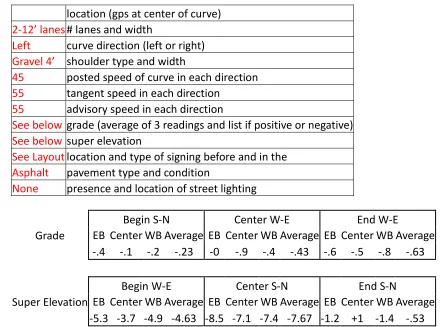
location (gps at center of curve) 2-12’ lanes# lanes and width
Left curve direction (left or right)
Gravel 4’ shoulder type and width
45 posted speed of curve in each direction
55 tangent speed in each direction
55 advisory speed in each direction
See below
grade (average of 3 readings and list if positive or negative)
See below
super elevation
See Layoutlocation and type of signing before and in the
Asphalt pavement type and condition
None presence and location of street lighting
Grade
Begin S-N Center W-E End W-E
EB Center WB Average EB Center WB Average EB Center WB Average -.4 -.1 -.2 -.23 -0 -.9 -.4 -.43 -.6 -.5 -.8 -.63
Super Elevation
Begin W-E Center S-N End S-N
[image:48.792.60.500.125.452.2]EB Center WB Average EB Center WB Average EB Center WB Average -5.3 -3.7 -4.9 -4.63 -8.5 -7.1 -7.4 -7.67 -1.2 +1 -1.4 -.53
35
36
37
38
Missouri 221
Date: 6/13-6/1/2012 Period: Before
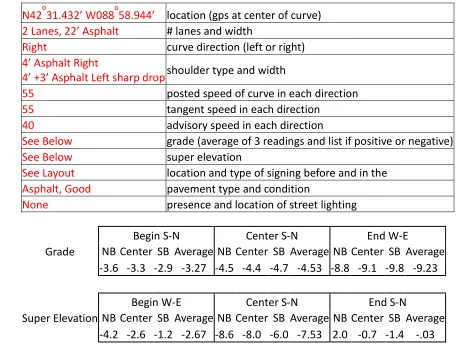
N42o31.432’ W088o58.944’ location (gps at center of curve)
2 Lanes, 22’ Asphalt # lanes and width
Right curve direction (left or right)
4’ Asphalt Right
4’ +3’ Asphalt Left sharp dropshoulder type and width
55 posted speed of curve in each direction
55 tangent speed in each direction
40 advisory speed in each direction
See Below grade (average of 3 readings and list if positive or negative)
See Below super elevation
See Layout location and type of signing before and in the
Asphalt, Good pavement type and condition
None presence and location of street lighting
Grade
Begin S-N Center S-N End W-E
NB Center SB Average NB Center SB Average NB Center SB Average -3.6 -3.3 -2.9 -3.27 -4.5 -4.4 -4.7 -4.53 -8.8 -9.1 -9.8 -9.23
Super Elevation
Begin W-E Center S-N End S-N
[image:52.792.50.506.127.471.2]NB Center SB Average NB Center SB Average NB Center SB Average -4.2 -2.6 -1.2 -2.67 -8.6 -8.0 -6.0 -7.53 2.0 -0.7 -1.4 -.03
39
40
41
Washington SR 9 Date: 7/17-7/18/2012 Period: Before
location (gps at center of curve) 2 Lanes, 10’ Each
CL Rumble 12” Wide # lanes and width
Left curve direction (left or right)
2’ Asphalt Shoulder Both shoulder type and width
50 posted speed of curve in each direction
50 tangent speed in each direction
40 advisory speed in each direction
See Below grade (average of 3 readings and list if positive or negative)
See Below super elevation
See Layout location and type of signing before and in the
Asphalt pavement type and condition
[image:55.792.61.485.125.335.2]None presence and location of street lighting
42
43
44
Washington SR 203 Date: 7/17-7/18/2012 Period: Before
location (gps at center of curve)
2 lanes with 12” CL Rumble, 11’ NB Lane;10.5’ SB Lane # lanes and width
Left curve direction (left or right)
NB-4.5’ Asphalt Shld
SB-8’ Asphalt w/ 12” Rumble shoulder type and width
55 posted speed of curve in each direction
55 tangent speed in each direction
None advisory speed in each direction
See Below grade (avg. of 3 readings and list if positive or negative)
See Below super elevation
See Layout location and type of signing before and in the
Asphalt pavement type and condition
[image:58.792.62.609.122.338.2]None presence and location of street lighting
45
46
47
Washington SR 7 Date: 7/17-7/18/2012 Period: Before
location (gps at center of curve) 2 Lane with 12” Rumble
NB 11’ Lane; SB 10’ Lane# lanes and width
Right curve direction (left or right)
Paved shoulder type and width
50 posted speed of curve in each direction
50 tangent speed in each direction
20 advisory speed in each direction
See Below grade (average of 3 readings and list if positive or negative)
See Below super elevation
See Layout location and type of signing before and in the
Asphalt, Good pavement type and condition
[image:61.792.61.484.124.335.2]None presence and location of street lighting
48
49
50
51
Wisconsin 213
Date: 5/21-5/22/2012 Period: Before
N42o35.977’ W089o12.570’ location (gps at center of curve)
2 Lanes, 24’ # lanes and width
Left curve direction (left or right)
3’ Asphalt with varying gravel edgeshoulder type and width
55 posted speed of curve in each direction
55 tangent speed in each direction
50 advisory speed in each direction
Below grade (average of 3 readings and list if positive or negative)
Below super elevation
Previous Slide (5 Chevrons) location and type of signing before and in the
Asphalt, Good pavement type and condition
None presence and location of street lighting
Grade
Begin W-E Center W-E End W-E
SB Center NB Average SB Center NB Average SB Center NB Average -4.9 -4.9 -4.8 -4.87 -5.6 -5.4 -5.7 -5.57 -3.8 -3.2 -3.1 -3.37
Super Elevation
Begin S-N Center S-N End S-N
[image:65.792.57.532.128.456.2]SB Center NB Average SB Center NB Average SB Center NB Average -3.8 -3.5 -4.7 -4.00 -6.5 -7.1 -8.6 -7.40 -4.6 -4.8 -5.4 -4.93
52
53
54