The Thirty-Third AAAI Conference on Artificial Intelligence (AAAI-19)
Human-Like Delicate Region Erasing Strategy for Weakly Supervised Detection
Qing En,
1Lijuan Duan,
1Zhaoxiang Zhang,
2∗Xiang Bai,
3Yundong Zhang
4 1Beijing Key Laboratory of Trusted Computing, Faculty of Information Technology,Beijing University of Technology, Beijing 100124, China
2Center for Research on Intelligent Perception and Computing, National Laboratory of Pattern Reconition,
Institute of Automation, Chinese Academy of Sciences, Beijing 100190, China
3School of Electronic Information and Communications, Huazhong University of Science and Technology, Wuhan 430074, China 4State Key Lab of Digital Multimedia Chip Technology, Vimicro Corp, Beijing 100191, China
[email protected], [email protected], [email protected]. [email protected], [email protected]
Abstract
We explore a principle method to address the weakly super-vised detection problem. Many deep learning methods solve weakly supervised detection by mining various object pro-posal or pooling strategies, which may cause redundancy and generate a coarse location. To overcome this limitation, we propose a novel human-like active searching strategy that re-currently ignores the background and discovers class-specific objects by erasing undesired pixels from the image. The pro-posed detector acts as an agent, providing guidance to erase unremarkable regions and eventually concentrating the atten-tion on the foreground. The proposed agents, which are com-posed of a deep Q-network and are trained by the Q-learning algorithm, analyze the contents of the image features to infer the localization action according to the learned policy. To the best of our knowledge, this is the first attempt to apply re-inforcement learning to address weakly supervised localiza-tion with only image-level labels. Consequently, the proposed method is validated on the PASCAL VOC 2007 and PASCAL VOC 2012 datasets. The experimental results show that the proposed method is capable of locating a single object within 5 steps and has great significance to the research on weakly supervised localization with a human-like mechanism.
Introduction
Object detection is among the most fundamental and vital research problems in the domain of computer vision. The main issues in object detection lie in constructing a favor-able discriminative model and gaining a more compact area. Due to the advancement of convolutional neural networks (He et al. 2016), researchers have made progress on this problem. Supervised learning relies on a large set of train-ing examples with strong supervision. However, acquirtrain-ing large amounts of strongly supervised labels entails large la-bor and financial expense. To alleviate the costly annota-tion requirement, weakly supervised learning methods have
∗
Corresponding Author ([email protected]).
Copyright c2019, Association for the Advancement of Artificial Intelligence (www.aaai.org). All rights reserved.
CNN
Agent
Glimpse
Action
CNN
Agent
Glimpse
CNN
Agent
Action Action Glimpse
t t+1 t+2 ……
Figure 1: Illustration of the proposed idea. A sequence of glimpsing actions are taken in each time step to locate the object. Undesired regions are erased recurrently. The pro-posed agents determine which area should be attended in the next time step, and the focusing regions are finally acquired.
been proposed to explore the exploitation of cheaper train-ing labels to complete complex tasks. To address the weakly supervised detection problem, several researchers integrate bottom-up information to acquire class-specific regions of images and treat it as a multiple instance learning (MIL) problem (Song et al. 2014; Oquab et al. 2015). However, although CNN-based models have demonstrated their effec-tiveness in weakly supervised localization, they do not fol-low the human visual mechanism, which guides humans to focus on the irregular shapes of objects. Meanwhile, top-down searching cues provide a promising research line, sub-stantially reducing the searching space in detection tasks (Lu, Javidi, and Lazebnik 2016). Attention shifts to the ob-ject center when the viewpoint changes, which can be repre-sented by a sequential policy routine. These methods instruct biosystems to integrate feature maps together by combining prior knowledge and the current target.
Con-sequently, three basic observations motivate our research. First, humans search attentional regions according to fovea movement. Second, during visual information processing, the human eye’s visual system can select only a few signif-icant information points to process. Third, the visual atten-tional regions are always shown in an irregular shape, which prevents border confusion with the background.
In this paper, we propose a novel human-like active searching strategy that recurrently ignores the background and discovers class-specific objects by erasing undesired pixels from the image, as is shown in Fig. 1. Our proposed method conforms to the fact that the greater the area of ob-jects that are focused, the better the classification of the im-age. Specifically, a CNN-based feature extractor is trained by image-level annotation. Then, the features and a discrim-inating heat map are extracted by the feature extractor. Our proposed agents analyze the contents of the current features to infer the localization action according to the learned pol-icy, which is composed of deep Q-network. As a result, a single object is detected in fewer than 5 steps per image. The experimental results of the proposed method in weakly supervised localization are comparable with those of CNN-based methods and can generate meaningful visualization results. In summary, our work makes the following contri-butions:
• To the best of our knowledge, this work presents the first deep reinforcement learning solution for weakly super-vised object localization.
• We propose a novel human-like active searching strategy to remove undesired regions iteratively by utilizing a deep Q-network.
• The proposed method is validated on two datasets and is shown to be efficient in weakly supervised localization.
Related Work
CNN-Based Weakly Supervised Learning
A beam searching approach is described in (Bency et al. 2016), leveraging local spatial information and semantic patterns to detect multiple objects effectively. Additionally, multiscale fully convolution streams are applied to pro-pose possible object regions in Pronet (Sun et al. 2016). Moreover, a multifold MIL approach is presented in (Gok-berk Cinbis, Verbeek, and Schmid 2014) to avoid early de-termination of the error location. (Zhang et al. 2016) pro-poses a probabilistic WTA model along with excitation backpropagation to generate top-down attention maps based on a top-down signal. Additionally, (Zhou et al. 2016) ana-lyzes the response value of the neuron instead of the gradient to indicate the class-specific object location. Further efforts (Selvaraju et al. 2017) use the category-aware neuron gradi-ent, backing along convolutional layers to generate a local-ization map. The above methods represent many inspiring ideas in weakly supervised learning.
Active Top-Down Searching
(Kong et al. 2017a) design several different types of rever-sion connections to select and integrate the features from
different layers. (Fu, Zheng, and Mei 2017) imitate the hu-man principle by proposing a framework called the recurrent attention convolutional neural network that iteratively gains attention proposals that focus on the most distinguished area. Meanwhile, reinforcement learning has shown competitive performance due to its superior decision process (Mnih et al. 2013; Silver et al. 2016). In (Cao et al. 2017), long short-term memory is combined with a policy network to consider the attended region recurrently to solve the face hallucina-tion problem.
Our work has similarities with (Wei et al. 2017; Ku-mar Singh and Jae Lee 2017), but we do not require the clas-sification network to be retrained after each image is erased. Additionally, instead of setting the size of the erasing area manually, our proposed agents have the ability to learn the erasing degree themselves.
Proposed Approach
Overview
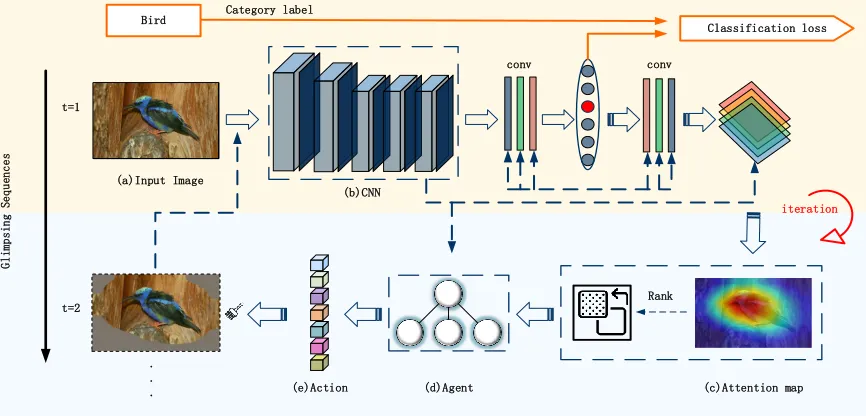
The process of weakly supervised localization is seen as controlling a sequence of actions to change the fixation area and identify the target objects. Hence, we cast the challenge of object localization as a Markov decision process (MDP) because this setting allows the proposed agents to make a de-cision in continuous steps. As in Fig. 2, a CNN-based feature extractor is trained by image-level annotation and is used to extract the feature maps of input images. Subsequently, actions are made by deep Q-network-based agents to maxi-mize the long-term global reward. The environment is com-posed of the input image and the actions taken thus far, and an action is defined to guide the next erasing regions. The agent receives the state of the current image status and se-ries history actions to make a decision, which then generates a positive or negative reward and guides the agent to search for as large of a reward as possible during the training phase. Strictly, this MDP contains a set of components.Sdescribes the understanding of the current environment.Arepresents a series of operations that help us to achieve the goal.Rgives agents a reward for optimizing the decision strategy.
CNN-Based Feature Extractor
The CNN-based feature extractor is initialized based on the Resnet-50 model. Global average pooling and class-wise pooling (Durand et al. 2017) are applied on top of the model. We denote the training set with the image-level labels as
D={(xi, yi)}Ni=1, wherexi represents the image data, and yi is a C-dimensional label vector withC categories. The
correct loss for multi-label classification is the multi-label cross-entropy loss function:
Loss=−1 N
N X
i=1
[yilog(
1
1 +e−xi) + (1−yi)log(
e−xi
1 +e−xi)]. (1)
Here,log(·)is the logarithmic function.
Actions
Bird
Classification loss
. . .
iteration
(a)Input Image
Category label
(b)CNN
conv conv
(c)Attention map Rank
(d)Agent (e)Action
t=1
t=2
G
l
im
p
s
in
g
Se
q
u
en
c
e
s
Figure 2: Pipeline of the proposed active searching strategy. We first train the feature extractor (b) using the category label. Then, the CAM method is employed to obtain the class-specific attention map (c). Ranking the attention map (c) reveals both of the most discriminate and undesired regions. The feature vector of the input image (a) is seen as the state of the proposed agents (d). The proposed agents (d) erase the input image and produce the next step image, which is then fed into the feature extractor.
2015; Lan et al. 2017; Kong et al. 2017b), which are com-posed of several transformations on the bounding box. Fur-thermore, our actions are close to operating on a pixel-level rather than a bounding box. First, the class activation maps (CAMs) (Zhou et al. 2016) are obtained from the current step imagexi
twith categoryc. In this way, we define the
ac-tivation mapsMc(u, v)in the localization(u, v)as category c, which is given by formulation:
Mc(u, v) =
K
X
k=1
wckfk(u, v), (2)
wherekis thekthneuron from the last convolutional layer,
andwck represents the weights amounting to categorycfor neuronk. Given a spatial location(u, v),fk(u, v)indicates
the activation of neuron k in the last convolutional layer from the feature extractor. Mc(u, v)represents the
impor-tance guiding the classification of image to categoryc. Second, the activation values from Mc(u, v) are sorted
in descending order to obtain rankMc(u,v). We define
the action set A to enable the agent to decide the location and size of the erasing region according to
rankMc(u,v). Formally, the action set is composed of six
ac-tions,A={5%,10%,15%,20%,25%,terminate}, which repre-sent different degrees of increments for erasing. Therefore, the terminate action is performed when the entire region is erased, which is not expected to occur in our experiments. Compared with moving a fixed degree in each step, our pro-posed dynamic strategy improves the efficiency in detecting different sizes of objects through a process of “brushing” us-ing different sized brushes.
States
We denote a two-tuple asS=(e, h), the feature vectors of the current input imageei
t ∈ R512∗7∗7 and the history vector
representing taken actions in last few steps h ∈ R24. The feature extractor f : RW 7→ R512∗7∗7forward propagates the imagexi
t ∈ RW ofW pixels at steptand extracts the
image informationeitof theithimages of thetthstep. We propose to erase the input image xi
tby replacing the pixel
values in a given mask of the image M askit ∈ RW with
the 3-dimensional vectorg. Vectorgis learned from a train-ing set as the mean value of the channels of each image. The function that erases image xi
t given maskM askit
us-ing vectorgashgis: RW 7→RW. Note that the output of the function is again the image, and the masks M askti are
generated by our proposed actions. We define the state tran-sition of imagexi
tsubject to maskM asktias the value of the
functionδf(xit, M askti) :RW ×RW ∈RW given by
δf(xit, M askit) =f(hg(xit, M askit)). (3)
Rewards
The reward functionR(s, a)is the critical factor in guiding which action to encourage in the decision-making process. We define image xitat step t and obtain imagexit+1 after
taking actiona. The current classification confidence is rep-resented as clsxi
t , and classification confidence of the next
step is defined asclsxi
t+1. Denote statessands0in steptand
classification confidence
softmax
erased percentage
history action
image feature
reward
1024-d 1024-d 6-actions
take action
CNN feature
map ...
Figure 3: Architecture of the proposed Q-network.
defined as follows:
Rcla(s, s0) = (
+σ, if clsx
i t t+1−cls
xit
t < τ and cls xit t+1> ξ
−σ, otherwise
. (4)
Eq. 4 shows that the proposed agent will receive the reward if the change in classification confidence is less thanτ, and the agent will be penalized otherwise.σis the classification reward, which we set to 3.2 in our experiments. We constrain the classification confidence to not less thanξ = 0.4. Con-sidering some of the situations that may occur in Fig. 9, we set the difference in the classification confidence of the cur-rent step and next stepτas -0.1 in Eq. 4. This setting avoids the insufficiency of the CNN model when the objects of fo-cus have irregular borders. The agent is penalized when the discriminate region of the object is erased and is rewarded when the target object is retained in the current state.
We design a reward function to restrict the degree of the erasing region to a feasible range. For ease of explanation, we defineerasexi
t as steptof the accumulative erasing
de-gree. The reward function of the degree of the erased region can be written as follows:
Raerase(s, s0) =
(
+β, if µ < erasexti < ψ
−β, otherwise , (5)
where we setµto 0.5 andψto 0.8. The erasing degree re-wardβis set to 0.5 in our experiments.
The terminating action acts as a penalty in our setting. Therefore, the termination reward function is presented as follows:
Rtermia (s, s0) =ζ, (6)
whereζ is -0.5 in our experiments. In other words, the re-ward function aims to force the proposed agent to not stop until the final step. The total number of stepsT is set to 5.
Deep Q-Learning
A policyπ(s)is specified to learn the optimal action for the current state in each time step. We apply a deep Q-learning framework to build the relation between state and action. In the training phase, the agent randomly selects an action from the action container with probabilityand chooses the max-imum activation value action with probability1−. Starting from 0.9,decreases by 0.1 in each epoch until= 0.1. To
overcome the unstable and useless learning in traditional Q learning, a memory replay scheme is applied in the training stage. Moreover, the Bellman equation is adopted to
itera-Algorithm 1Training process of the proposed method
Require: Training data D={(xi, yi)}Ni=1, replay counter,
class num, max epoch,T;
1: Train the feature extractorf withD;
2: forc= 1, class numdo
3: Initialize agentDQNcwith paramθc;
4: forepoch=1,max epochdo
5: forxi,yiinDandcinyido
6: Set status=1; 7: Get statesxi
t , current step confidencecls xi
t ;
8: whilet< T and status==1do
9: CalculateMc
i,t(u, v)by CAM(xit, CLS, yi);
10: Select actionaxi
t with-greedy;
11: ifa==6do
12: status=0; 13: ObtainM askc
xi,tanderase
xi
t ;
14: Do erasexci,t+1=xci,t⊗M askxci,t;
15: Getsxi
t+1andcls
xi
t+1;
16: Calculate rewardrxi
t by Eq. 4,5;
17: Storetransition(sxi
t , a
xi
t , r
xi
t , s
xi
t+1);
18: Update confidenceclsxi
t =cls
xi
t+1;
19: Do memory replay; 20: end for
Ensure: Trained DQNDQN={DQNc}class numc=1
Figure 4: Examples of the post-processing refined bound-ing box. The first row of each sample represents the bi-nary mask (A) and its segmentation cues (B) generated by saliency technology. The second row of each sample shows the erased image (C) and the selected bounding box pro-posed by the agents (D). (E) shows the refined results.
tively update the selection of the action policy, wheresanda
are the current state and action, respectively.ris the reward, andmaxa0Q(s0, a0)represents the future reward. The action
achosen at statesdetermines the corresponding reward of the agent via the functionQ(s, a), where the highest reward is acquired through the selected action:
Q(s, a) =r+γmaxa0Q(s0, a0), (7)
whereγrepresents a discount factor to balance future and current rewards. We set γ to 0.9 in our experiments. The weights of the deep Q-networkθtat time steptwith
transi-tion quadruple(s, a, r, s0)update as follows:
θt+=θt+α(r+Q(s0, a0;θt)−Q(s, a;θt))∇θtQ(s, a;θt).
Table 1: Quantitative comparison of the detection task on the PASCAL VOC 2007testset. The average precision of our method is computed by detecting one object of the same category per image. The average detection precision is compared for common detection tasks in the same dataset. Hence, we consider a horizontal comparison in this section.
Method plane bike bird boat btl bus car cat chair cow table dog horse moto pers plant sheep sofa train tv mAP
Cinbiset al. 35.8 40.6 8.1 7.6 3.1 35.9 41.8 16.8 1.4 23.0 4.9 14.1 31.9 41.9 19.3 11.1 27.6 12.1 31.0 40.6 22.4
Wanget al. 48.9 42.3 26.1 11.3 11.9 41.3 40.9 34.7 10.8 34.7 18.8 34.4 35.4 52.7 19.1 17.4 35.9 33.3 34.8 46.5 31.6
LocNet 57.1 52.0 31.5 7.6 11.5 55.0 53.1 34.1 1.7 33.1 49.2 42.0 47.3 56.6 15.3 12.8 24.8 48.9 44.4 47.8 36.3 OICR-VGG 58.0 62.4 31.1 19.4 13.0 65.1 62.2 28.4 24.8 44.7 30.6 25.3 37.8 65.5 15.7 24.1 41.7 46.9 64.3 62.6 41.2
Ours-H 52.5 34.0 32.0 16.9 5.1 55.3 46.1 54.5 12.6 29.0 49.0 41.0 49.6 54.1 28.4 15.4 26.5 42.8 44.1 10.0 34.9 Ours-M 57.5 35.6 39.9 25.6 6.1 58.0 50.0 56.7 13.6 29.0 49.4 48.0 62.5 58.2 29.3 15.4 27.1 45.4 51.4 10.0 38.4 Ours-M-D 57.5 42.0 39.9 31.2 10.0 58.8 50.0 57.2 13.6 35.6 49.4 49.0 62.5 58.2 30.4 15.5 33.8 45.4 57.0 28.4 41.2
Table 2: Quantitative comparison of localization on the PASCAL VOC 2012valset. Note that RCNN and Fast-RCNN are supervised with a bounding box label, while the other methods have only category labels.
Method plane bike bird boat btl bus car cat chair cow table dog horse moto pers plant sheep sofa train tv mAP
RCNN 92.0 80.0 80.0 73.0 49.9 86.8 77.7 87.6 50.4 72.1 57.6 82.9 79.1 89.8 88.1 56.1 83.5 50.1 82.0 76.6 74.8 Fast-RCNN 79.2 74.7 74.7 65.8 39.4 82.3 64.8 85.7 54.5 77.2 58.8 85.1 86.1 80.5 76.6 46.7 79.5 68.3 85.0 60.0 71.3 Oquabet al. 90.3 77.4 77.4 79.2 41.1 87.8 66.4 91.0 47.3 83.7 55.1 88.8 93.6 85.2 87.4 43.5 86.2 50.8 86.8 66.5 74.5 ProNet-P 91.6 82.0 85.1 78.6 45.9 87.9 67.1 92.2 51.0 72.9 60.8 89.3 85.1 85.3 86.4 45.6 83.5 55.1 85.6 65.9 74.8
Benet al. 90.0 81.2 81.2 82.2 47.5 86.7 64.9 85.7 53.9 75.8 67.9 82.2 84.1 83.4 83.9 71.7 83.1 63.7 89.4 78.2 77.1
Ours 91.5 87.0 77.6 65.7 54.3 85.1 68.1 94.0 55.9 78.3 87.0 90.0 86.1 89.3 68.0 59.7 68.2 81.2 83.0 79.3 77.5
The training process of the proposed method is described in Algorithm 1.
Experiments
In the following sections, the details of the experiments with the proposed method are discussed.
Experimental Settings
We evaluate the proposed method on the PASCAL VOC 2007 and 2012 datasets. Average precision (AP) and correct localization CorLoc are used to evaluate the performance of our method. For both metrics, the true positive bound-ing box is determined as correct only if it has an at least 50% intersection-over-union (IoU) ratio with the ground-truth object instance annotation. To compare the state-of-the-art weakly supervised localization methods, we also ap-ply the localization metrics proposed in (Oquab et al. 2015) and (Zhu et al. 2017).
Implementation details. First, for the feature extractor, we use Resnet-50, pretrained on the ImageNet dataset and fine-tuned on the corresponding training sets, for the back-bone architecture. We train the network with stochastic gra-dient descent (SGD) with momentum at a learning rate of 0.01 for 20 epochs. Second, the image descriptor and the history vector are the inputs of the deep Q-network, whose structure is composed of two fully connected layers with 1024 neurons and an action layer with 6 neurons. The archi-tecture of the deep Q-network is shown in Fig. 3. Further-more, we train each deep Q-network model for 50 epochs, apply an experience replay of 1000 memory capacity, and set the target parameter update step to 100. In post-processing, we adopt saliency detection technology (Jiang et al. 2013) to refine the detected results, as shown in Fig. 4. “Ours-H” indi-cates the hard threshold post-processing, and “Ours-M”
rep-resents the mean value threshold. “Ours-M-D” uses the di-lation CNN to obtain the heat maps (Wei et al. 2018), which demonstrates the flexibility of our proposed method.
Detection Results
In Table 1, compare the object detection results on the PAS-CAL VOC 2007testset with those of (Gokberk Cinbis, Ver-beek, and Schmid 2014; Wang et al. 2014; Kantorov et al. 2016; Tang et al. 2017). The proposed method achieves a higher average detection precision in the conveyance cate-goriesi.e., plane, bus, motorbike and train, reaching 57.5%, 58.0%, 58.2% and 51.4%, respectively. First, the proposed reward function forces the agent to consider both the clas-sification confidence and the area when focusing on only a specific part of an object. Second, the irregular shape, such as “cat” and “horse”, is the difference with respect to the conveyance category. CNN-based weakly supervised meth-ods often propose rectangle bounding boxes, and the pro-posed method retains more of the original shapes of objects. In addition, the proposed method achieves a CorLoc of 32.7%, outperforming the compared transfer learning (32.1%) and mining (30.2%) methods in Table 3. We com-pare two pre-deep learning methods in Table 3, mainly be-cause we do not extract and classify proposals in the training stage so poorer performance occurs in thetrainvalset.
Localization Results
Table 3: Quantitative comparison of Corloc on the PASCAL VOC 2007trainvalset. The method Ours-top3* is the percentage of positive images in which an object is correctly located by at least one of the top-3 proposals.
Method plane bike bird boat btl bus car cat chair cow table dog horse moto pers plant sheep sofa train tv mAP
Sivaet al. 45.8 21.8 30.9 20.4 5.3 37.6 40.8 51.6 7.0 29.8 27.5 41.3 41.8 47.3 24.1 12.2 28.1 32.8 48.7 9.4 30.2
Shiet al. 54.7 22.7 33.7 24.5 4.6 33.9 42.5 57.0 7.3 39.1 24.1 43.3 41.3 51.5 25.3 13.3 28.0 29.5 54.6 11.8 32.1
Ours-H 41.1 24.2 39.0 15.8 9.4 42.0 42.0 52.0 10.1 29.7 37.5 41.4 42.8 49.3 28.1 14.7 31.2 45.2 49.5 9.8 32.7 Ours-M 42.3 25.5 39.2 19.1 9.4 42.0 43.7 53.3 10.3 30.4 37.5 41.7 49.0 50.6 28.3 16.3 31.2 45.2 55.6 9.8 34.7
Ours-top3* 53.3 30.5 48.5 21.0 9.8 49.5 49.5 63.2 10.8 34.8 46.5 57.5 59.2 60.4 35.9 19.6 35.4 54.1 63.2 10.2 40.6
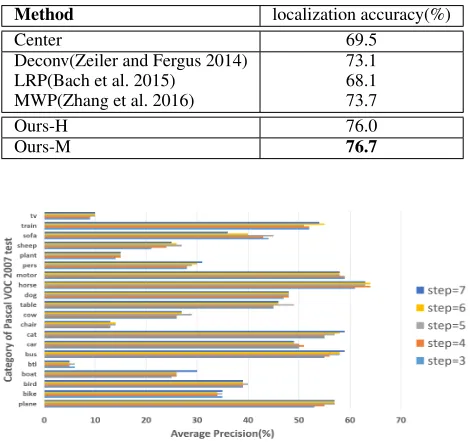
Table 4: Pointing localization accuracy (%) on the PASCAL VOC 2007testset.Centeris a baseline method that uses the image center as the estimate of the object center.
Method localization accuracy(%)
Center 69.5
Deconv(Zeiler and Fergus 2014) 73.1 LRP(Bach et al. 2015) 68.1 MWP(Zhang et al. 2016) 73.7
Ours-H 76.0
Ours-M 76.7
Figure 5: Detection performance with respect to the total number of stepsT on the PASCAL VOC2007 test set. The histogram represents the categories (x-axis) and the corre-sponding average precision (y-axis) for different total num-ber of stepsT.
19.1% (87% vs 67.9%), and for “sofa”, the proposed method outperforms Fast-RCNN by 12.9% (81.2% vs 68.3%), illus-trating the substantial improvement on furniture categories. Furniture class objects are usually located in complicated scene, often overlapping each other, as shown in the second row of Fig. 7. Therefore, furniture class objects are often dif-ficult to identify separately. Our proposed method is able to separate the main objects to produce good results because the overlapping regions are erased correctly. Moreover, the proposed method has comparable localization accuracy re-sults, as shown in Table 4. The proposed method achieves a localization accuracy of 34.7%, outperforming the com-pared transfer learning (32.1%) and mining (30.2%) meth-ods. When considering the top-3 condition, the localization accuracy of the proposed method increases 8%, reaching 40.6%.
B
us
P
ot
tedp
lant
C
at
B
icycl
e
B
ird Car
B
icycl
e
B
icycl
e
C
ar Cat Horse
D
ini
ngt
ab
le
D
ini
ngt
abl
e
A
er
opl
ane
C
hai
r
D
ini
ngt
ab
le
C
hai
r
D
ini
ngt
ab
le
C
at Chai
r
B
ird Bot
tle Dog Car
BG
OTH
MC
PO
Figure 6: Sample detection results. Red boxes represent the ground-truth annotation. Green boxes indicate correct detec-tion results. “BG” represents samples that are easily con-fused with the background. “OTH” indicates samples that are easily confused with other categories. “MC” shows sam-ples that are located in messy surroundings. “PO” denotes samples that are shown partially.
Further Analysis
Impact of the total number of stepsT. To validate the choice of the total number of stepsT, we evaluate various values, as displayed in Fig. 5. This comparison demonstrates that the detection precision may be influenced by changing
T from 3 to 7. For most of the compared categories, except “horse”, “moto” and “sofa”, the greater the number of steps is, the higher the average precision. These three categories always appear with overlap, indicating that the erasing ac-tion may damage the structural informaac-tion.
Impact of hyperparameters.We investigate the effect of the parametersξ,σ,βandζon the detection performance. The results in Fig. 8 show that a lower classification confi-dence, i.e., ξ = 0.4, is beneficial for detection. We further note that a higher classification reward, i.e.,σ= 3.2, yields the best results. Moreover, the erasing degreeβalso affects the performance and is set toβ= 0.5to achieves the best re-sults. Another important parameter is the termination reward
ζ, which penalizes the agents when the terminate action is triggered.ζ=−0.5leads to the highest precision.
P
ers
on
S
of
a
Hor
se
A
irpl
an
e
P
er
son
Image Heatmap Step1 Step2 Step3 Step4 Step5 Image Heatmap Step1 Step2 Step3 Step4 Step5
Hor
se
Tra
in
B
ird
B
ike
Car
P
ers
on
Hor
se
Figure 7: Examples of the erased object regions produced by the proposed method. The third to seventh and the tenth to fourteenth columns show the erasing procedure. The second and ninth columns present the produced heat maps.
(A) (B)
(C) (D)
Figure 8: Detection results of category “aeroplane” with dif-ferent parameters on the PASCAL VOC 2007 test set. (A) Impact ofξ. (B) Impact ofσ. (C) Impact ofβ. (D) Impact ofζ. Each histogram represents the value of the parameter (x-axis) and the corresponding average precision (y-axis).
the third and fourth rows. The heat maps and the correspond-ing erascorrespond-ing action are visualized to help us to understand the proposed method in Fig. 7. In the last erasing step, key components of people are retained, which demonstrates the meaningful procedure of the proposed method. The ideal re-sults shown in the second row and the appearance of overlap-ping areas indicates that our proposed method has the abil-ity to distinguish class-specific regions of interest in regions of overlap. Certain relations exist among different objects in the training sets. Therefore, searching for a class-specific object in an image is unreasonable when the areas of correl-ative objects have responses. However, our proposed method can effectively avoid this situation by fully utilizing top-down information. Clearly, the hard-to-interpret appearance, which often occurs in CNN models, has been overcome to some extent.
Analysis of classification confidence. As is commonly believed, the more focused an object is, the better the
classi-Classification confidence:0.44 Classification confidence:0.97
Figure 9: Red frame images, which indicate more fo-cused objects, have lower classification confidence, and the blue frame images have higher confidence under conditions where a limited region is erased.
fication accuracy of the neural network. However, the oppo-site phenomenon may occasionally occur, as shown in Fig. 9. CNN always acts as a black box to some extent, but the proposed method provides an explanation of the reason why each action is taken. From another perspective, it is reason-able that the background is related to the object during train-ing on large amounts of data. Nonetheless, the background information would affect the performance in some extent. Hence, a sufficient amount of data is the only way to cope with the adequate condition for CNN models. This problem can be solved by ignoring the background and focusing on only the area where the object has a higher possibility of appearing, as is done with our method.
Conclusions
supervised localization performance of the proposed model is comparable to that of CNN-based methods and that the efficiency is improved simultaneously. We conclude that the proposed method with a human-like mechanism is applica-ble to weakly supervised localization.
Acknowledgments
This work was supported in part by the National Key R&D Program of China (No. 2018YFB1004600, No. 2017YFC0803705), the National Natural Science Foundation of China (No. 61761146004, No. 61836084 No. 61773375, No. 61572004, No. 61771026), the Beijing Municipal Natural Science Foundation (No. Z181100008918010), the Key Project of Beijing Municipal Education Commission (Research and application on a co-evolutionary model of visual perception and coginition); and the innovation Platform Construction of QingHai Province (2016-ZJ-Y04).
References
Bach, S.; Binder, A.; Montavon, G.; Klauschen, F.; M¨uller, K.-R.; and Samek, W. 2015. On pixel-wise explanations for non-linear classifier decisions by layer-wise relevance propagation.PloS one
10(7):e0130140.
Bency, A. J.; Kwon, H.; Lee, H.; Karthikeyan, S.; and Manjunath, B. 2016. Weakly supervised localization using deep feature maps. InECCV.
Caicedo, J. C., and Lazebnik, S. 2015. Active object localization with deep reinforcement learning. InICCV.
Cao, Q.; Lin, L.; Shi, Y.; Liang, X.; and Li, G. 2017. Attention-aware face hallucination via deep reinforcement learning. In
CVPR, 1656–1664. IEEE.
Durand, T.; Mordan, T.; Thome, N.; and Cord, M. 2017. Wildcat: Weakly supervised learning of deep convnets for image classifica-tion, pointwise localization and segmentation. InCVPR.
Fu, J.; Zheng, H.; and Mei, T. 2017. Look closer to see better: recurrent attention convolutional neural network for fine-grained image recognition. InCVPR.
Girshick, R.; Donahue, J.; Darrell, T.; and Malik, J. 2014. Rich feature hierarchies for accurate object detection and semantic seg-mentation. InCVPR.
Girshick, R. 2015. Fast r-cnn. InICCV.
Gokberk Cinbis, R.; Verbeek, J.; and Schmid, C. 2014. Multi-fold mil training for weakly supervised object localization. InCVPR. He, K.; Zhang, X.; Ren, S.; and Sun, J. 2016. Deep residual learn-ing for image recognition. InCVPR.
Jiang, H.; Wang, J.; Yuan, Z.; Wu, Y.; Zheng, N.; and Li, S. 2013. Salient object detection: A discriminative regional feature integra-tion approach. InCVPR.
Kantorov, V.; Oquab, M.; Cho, M.; and Laptev, I. 2016. Context-locnet: Context-aware deep network models for weakly supervised localization. InECCV.
Kong, T.; Sun, F.; Yao, A.; Liu, H.; Lu, M.; and Chen, Y. 2017a. Ron: Reverse connection with objectness prior networks for object detection. InCVPR.
Kong, X.; Xin, B.; Wang, Y.; and Hua, G. 2017b. Collaborative deep reinforcement learning for joint object search. InCVPR.
Kumar Singh, K., and Jae Lee, Y. 2017. Hide-and-seek: Forcing a network to be meticulous for weakly-supervised object and action localization. InCVPR.
Lan, X.; Wang, H.; Gong, S.; and Zhu, X. 2017. Identity alignment by noisy pixel removal.arXiv preprint arXiv:1707.02785. Lu, Y.; Javidi, T.; and Lazebnik, S. 2016. Adaptive object detection using adjacency and zoom prediction. InCVPR.
Mnih, V.; Kavukcuoglu, K.; Silver, D.; Graves, A.; Antonoglou, I.; Wierstra, D.; and Riedmiller, M. 2013. Playing atari with deep reinforcement learning.arXiv preprint arXiv:1312.5602.
Oquab, M.; Bottou, L.; Laptev, I.; and Sivic, J. 2015. Is object lo-calization for free?-weakly-supervised learning with convolutional neural networks. InCVPR.
Selvaraju, R. R.; Cogswell, M.; Das, A.; Vedantam, R.; Parikh, D.; and Batra, D. 2017. Grad-cam: Visual explanations from deep networks via gradient-based localization. InICCV.
Silver, D.; Huang, A.; Maddison, C. J.; Guez, A.; Sifre, L.; Van Den Driessche, G.; Schrittwieser, J.; Antonoglou, I.; Panneershel-vam, V.; Lanctot, M.; et al. 2016. Mastering the game of go with deep neural networks and tree search.Nature529(7587):484–489. Song, H. O.; Lee, Y. J.; Jegelka, S.; and Darrell, T. 2014. Weakly-supervised discovery of visual pattern configurations. InNIPS. Sun, C.; Paluri, M.; Collobert, R.; Nevatia, R.; and Bourdev, L. 2016. Pronet: Learning to propose object-specific boxes for cas-caded neural networks. InCVPR.
Tang, P.; Wang, X.; Bai, X.; and Liu, W. 2017. Multiple instance detection network with online instance classifier refinement. In
CVPR.
Wang, C.; Ren, W.; Huang, K.; and Tan, T. 2014. Weakly super-vised object localization with latent category learning. InECCV. Wei, Y.; Feng, J.; Liang, X.; Cheng, M.-M.; Zhao, Y.; and Yan, S. 2017. Object region mining with adversarial erasing: A simple classification to semantic segmentation approach. InCVPR. Wei, Y.; Xiao, H.; Shi, H.; Jie, Z.; Feng, J.; and Huang, T. S. 2018. Revisiting dilated convolution: A simple approach for weakly-and semi-supervised semantic segmentation. InCVPR.
Zeiler, M. D., and Fergus, R. 2014. Visualizing and understanding convolutional networks. InECCV.
Zhang, J.; Lin, Z.; Brandt, J.; Shen, X.; and Sclaroff, S. 2016. Top-down neural attention by excitation backprop. InECCV.
Zhou, B.; Khosla, A.; Lapedriza, A.; Oliva, A.; and Torralba, A. 2016. Learning deep features for discriminative localization. In
CVPR.