MicrobMatcher: a microbial comparison software based on
matrix-assisted laser desorption/ionization with time-of-flight
mass spectrometry
Yizhen Fu, Feng Liu*, Yalu Ye
Depatment of Software Engineering, Wuhan University, Wuhan, China. Email: [email protected], [email protected], [email protected] Received 10 March 2011; revised 25 March 2011; accepted 25 April 2011.
ABSTRACT
Matrix-assisted Laser Desorption/Ionization with Time-of-flight Mass Spectrometry (MALDI-TOFMS) was investigated as a method for the rapid identifica-tion of species. Current demand in microbial identi-fication is how to compare unknown strains to the known one quickly, semi-automatically and accu-rately. In this paper, we present a software tool that allows flexibly microbial matching in a user-friendly way, by letting the users to customize comparison parameters including: in vitro transcription enzyme, mass tolerance, minimum fragment length, intensity threshold and corresponding weights. We provide three spectral scoring functions to compute the affin-ity between the species. Therefore, the precision of microbial comparison increases. To test and verify this tool, we employed experimental spectral data based on MALDI-TOFMS and the gene sequences of E.coli and Salmonella. This software is written in Java for cross-platform intention.
Keywords: Microbial Comparison; Matrix-Assisted Laser Desorption/Ionization with Time-of-Flight Mass Spectrometry
1. INTRODUCTION
MALDI-TOFMS is an analytical technique that meas-ures the mass-to-charge ratio of charged particles. It is used for determining masses of particles, for determining the elemental composition of a sample or molecule, and for elucidating the chemical structures of molecules, such as peptides and other chemical compounds. With the development of this technology, microbial identifica-tion by mass cataloging has attracted considerable atten-tion owing to its high efficiency and automaatten-tion. Mean-while, there is a current demand that to compare mass spectrometric observables with theoretical fragmentation
patterns, and further to determine the genetic affinity between the sample gene and genes of known species in the database quickly, semi-automatically and accurately.
Within this context, our paper presents a software tool that allows flexibly microbial matching in a user-friendly way. When it comes to the matching speed and accuracy, this software provides three spectral scoring functions to compute the coincidence between the species. As for the semi-automation, the tool allows the users to customize comparison parameters including: transcription enzyme, mass tolerance, minimum fragment length, intensity threshold and corresponding weight.
To test and verify this tool, we employed the experi-mental spectra data based on MALDI-TOFMS and the gene sequences of E.coli and Salmonella.
The remainder of the document is structured as fol-lows. We present three algorithms for computing the coincidence between the sample gene and genes of known species in Section 2, followed by the description and the verification of the software separately in Section 3 and Section 4. Subsequently, related work is discussed in Section 5. Finally, Section 6 concludes.
2. ALGORITHM
2.1. Overall Algorithm
The overall algorithm in comparison process is as fol-low:
1) Amend the gene sequence of the known reference species according to the transcription enzyme. To form the theoretical gene sequence, if the promoter is T7, the nucleotide sequence “TTCTATAGTGTCACCTAAAT” will be added to the original one, while If the promoter is Sp6, reverse and complement(A-T, G-C) the original gene sequence, and then add the nucleotide sequence “CCCTATAGTGAGTCGTATTAC” as its subsequence.
nu-cleotides. L is determined by the user.
3) Calculate the mass of all fragments (also referred to as ‘fingerprint biomarkers’) from the sequence and then form the sequence’s mass vector. The mass of every fragment is:
- 329.2 305.2
361.2 18.0148 1.0072
M fragment A G
T
Da
(1)
A, G, C and T separately stand for the one-to-one total number of Adenylic acid, Guanylic acid, Cytidylic acid and Thymidylic acid in each fragment.
4) Take the mass vector of the gene sequence and cal-culate the score indicating their similarity by using one of the spectral scoring functions introduced below.
2.2. The First Spectral Scoring Function
The first spectral scoring function [1] in our work is as follow:
Let N denote the total number of fingerprint bio-markers in the given theoretical gene sequence. A vector u of length N is constructed. The elements of u contain 0’s and 1’s. The ith element of u is 0 if the ith fingerprint peak is not observed in the blinded sample and 1 if the mass of ith fragment is observed within tolerance in the blinded sample. The number of 1’s in u (or sum of all elements of u) indicates the number of fingerprint bio-markers observed in the blinded sample.
For each blinded sample and each reference species, likelihood is computed based on the number of frag-ments observed in the blinded sample. This likelihood is a value between 0 and 1. If the likelihood is close to 1, then the reference bacterium is determined to be present. If the likelihood is close to 0, then the blinded sample does not contain the significant fingerprint biomarkers, and the reference is determined to be absent.
2.3. The Second Spectral Scoring Function
Based on the first method, the second spectral scoring function [2] in our work allows the user to define two intensities, partitioning the whole experimental peaks into three parts: the first peaks list, whose intensities are higher than the larger defined intensity; the second peaks list, whose intensities are between the two defined inten-sities; and the third peaks list, whose intensities are lower than the smaller defined intensity. Furthermore, users can assign the credibility for the three intervals of peaks, and give weights for them separately, but the weighted sum must be one. This method considers the reliability of the intensities and involves the users’ ex-perience. The scoring function is as follow:
1 1 2 2 3 3D MP W MP W MP W N (1)
where:
MP1is the number of the matched fragments between the theoretical fragments and the experimental peaks whose intensities are higher than the larger defined in-tensity.
MP2is the number of the matched fragments between the theoretical fragments and the experimental peaks whose intensities are lower than the larger defined inten-sity and higher than the smaller defined inteninten-sity.
MP3is the number of the matched fragments between the theoretical fragments and the experimental peaks whose intensities are lower than the smaller defined in-tensity.
W1, W2and W3 are separately the credibility of the three intervals of peaks corresponding to MP1, MP2and MP3.
N is the total number of fingerprint biomarkers in the given theoretical gene sequence.
A higher score indicates more genetic affinity, indi-cating a higher possibility of being the same species.
2.4. The Third Spectral Scoring Function
The third spectral scoring function [2,3] in our work is as follow:
2*
M M
CM M M M
(3)
The scalar product (often referred to as a ‘dot-product’) of two mass in the function is defined as:
1 2 1 1 δ N N i ji j
M M m
m
(4)where M is the mass vector of one sample’s fragmenta-tion, which has N1 fragments with mi standing for the mass of the ith fragment, while M' is the mass vector of the other sample’s fragmentation, which has N2 frag-ments with standing for the jth fragment. The discrete delta functionδ is:
1; δδ
0;otherwise k
k
(5)
Given inevitable experimental inaccuracy, the discrete delta function δcan be further modified to be:
1; toleranceδ
0;otherwise k
k
3. SOFTWARE
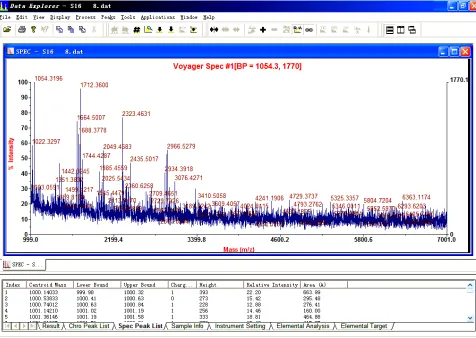
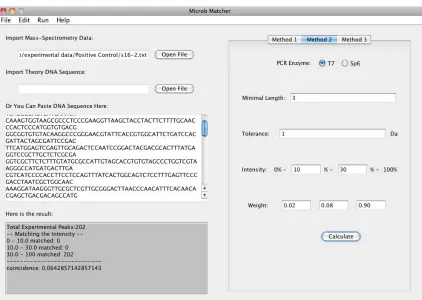
tion of the experimental inaccuracy by means of adopt-ing tolerance, and finally provides the comparison con-sequence of the selected method. For further research, it is available for users to save the comparison result as a txt report file. Figures 2, 3 and 4 separately represent the user interfaces of the three scoring methods in the soft-ware.To perform microbial comparison, the software uses the exported ASCII Spectrometry .txt file from DataEx-plorer (Figure 1), whose data is the mass-intensity spec-trometry result from MALDI-TOFMS, and the theoretic gene sequence of the known reference species, either .txt file imported from the local file system or direct text pasted in the blank box, as inputs. The software offers three spectral scoring functions mentioned above, and users can choose one of them to calculate the coinci-dence between the experimental data and the theoretic DNA sequence. In all the three methods, users are free to customize some conditional parameters in their mass- spectrometry experiment, including: in vitro transcrip-tion enzyme-either T7 or Sp6, mass tolerance, minimum fragment length and intensity threshold. In addition, in Method 2, users can customize the intensity range and corresponding weight according to their previous ex-perience of the importance of the peaks among the rela-tive intensity scope. Subsequently, the software parses the input file, generates peak lists after filtering peak values below the intensity threshold, with the considera-
4. VERIFICATION
This paper presents two parts of experiments, the nega-tive control and the posinega-tive one, to verify the accuracy and the utility of the software.
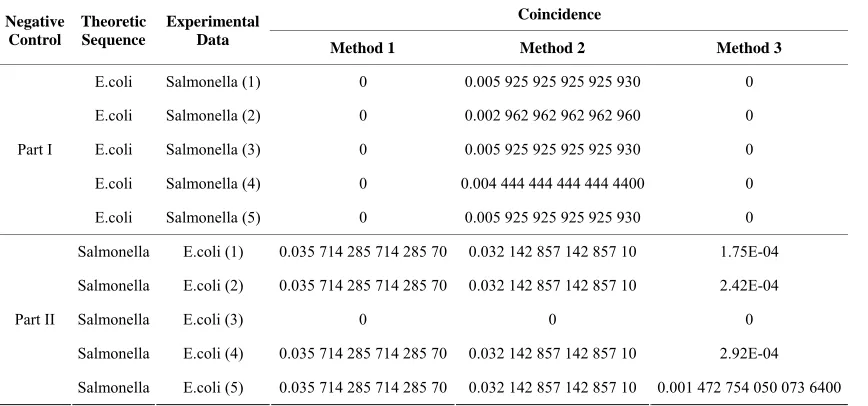
[image:3.595.61.537.367.705.2]In the negative control, we divide it into two parts, and in each part we use five sets of data from five sepa-rate experiments of one species and the DNA sequence of another species as input to test the consequence of inconsistence. For example, we calculate the coincidence between the theoretic sequence of E.coli and each set of the experimental data of Salmonella. To ensure justice, we control the experimental conditions with the same parameters. Table 1 shows the results of these negative control experiments.
Figure 2.The user interface of Method 1.
[image:4.595.88.510.399.699.2]Figure 4.The user interface of Method 3.
Table 1.The results of the negative control experiments.
Coincidence Negative
Control
Theoretic Sequence
Experimental
Data Method 1 Method 2 Method 3
E.coli Salmonella (1) 0 0.005 925 925 925 925 930 0
E.coli Salmonella (2) 0 0.002 962 962 962 962 960 0
E.coli Salmonella (3) 0 0.005 925 925 925 925 930 0
E.coli Salmonella (4) 0 0.004 444 444 444 444 4400 0
Part I
E.coli Salmonella (5) 0 0.005 925 925 925 925 930 0
Salmonella E.coli (1) 0.035 714 285 714 285 70 0.032 142 857 142 857 10 1.75E-04
Salmonella E.coli (2) 0.035 714 285 714 285 70 0.032 142 857 142 857 10 2.42E-04
Salmonella E.coli (3) 0 0 0
Salmonella E.coli (4) 0.035 714 285 714 285 70 0.032 142 857 142 857 10 2.92E-04
Part II
Salmonella E.coli (5) 0.035 714 285 714 285 70 0.032 142 857 142 857 10 0.001 472 754 050 073 6400
We find that the results of the coincidence are all too low for the microbe to be classified as the certain species of the theoretic sequence. In other words, it demonstrates that the experimental species is probably not the same kind as the theoretical species, which accords with our expectation.
Meanwhile, in the positive control, we divide it into
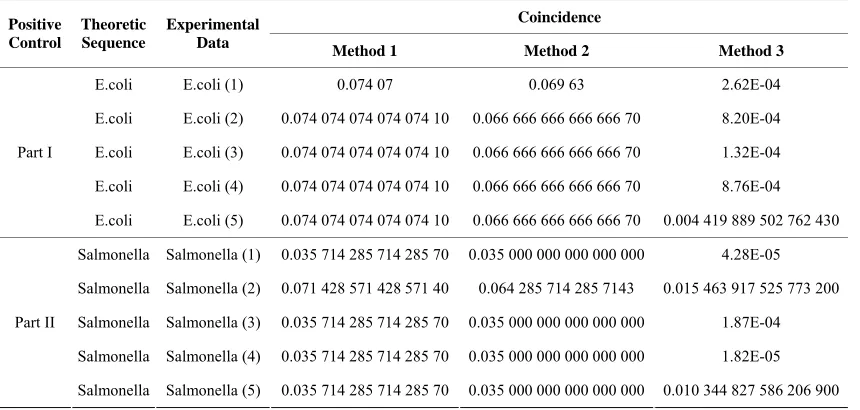
[image:5.595.86.520.423.626.2]Table 2. The results of the positive control experiments. Coincidence Positive Control Theoretic Sequence Experimental
Data Method 1 Method 2 Method 3
E.coli E.coli (1) 0.074 07 0.069 63 2.62E-04
E.coli E.coli (2) 0.074 074 074 074 074 10 0.066 666 666 666 666 70 8.20E-04
E.coli E.coli (3) 0.074 074 074 074 074 10 0.066 666 666 666 666 70 1.32E-04
E.coli E.coli (4) 0.074 074 074 074 074 10 0.066 666 666 666 666 70 8.76E-04
Part I
E.coli E.coli (5) 0.074 074 074 074 074 10 0.066 666 666 666 666 70 0.004 419 889 502 762 430
Salmonella Salmonella (1) 0.035 714 285 714 285 70 0.035 000 000 000 000 000 4.28E-05
Salmonella Salmonella (2) 0.071 428 571 428 571 40 0.064 285 714 285 7143 0.015 463 917 525 773 200
Salmonella Salmonella (3) 0.035 714 285 714 285 70 0.035 000 000 000 000 000 1.87E-04
Salmonella Salmonella (4) 0.035 714 285 714 285 70 0.035 000 000 000 000 000 1.82E-05 Part II
Salmonella Salmonella (5) 0.035 714 285 714 285 70 0.035 000 000 000 000 000 0.010 344 827 586 206 900
experiments.
Given the allowed tolerance during experiment and the previous experience, we find the results of the coin-cidence are all within acceptance, which reflects high probability of the similarity between two species in the comparison, and which also demonstrates that our soft-ware is robust and accurate.
5. RELATED WORK
The software in this paper completes the comparison between the known species in the databases and the un-known species which has mass-intensity data generated by MALDI-TOFMS. In the next phrase, we will do sta-tistical analysis to amount of spectra from one species and expect to compare affinity among unknown species. Furthermore, we will try to model for species and search the possible species range for the unknown species based on its MALDI-TOFMS data.
6. CONCLUSIONS
In order to allow flexibly microbial matching in a user- friendly way, we design the software “micromatcher”. To perform microbial comparison, the software uses exported ASCII Spectrometry .txt file from DataExplorer, whose data is the mass-intensity spectrometry result from MALDI-TOFMS and the theoretical gene sequence of the known species in the database as inputs. The soft-ware offers three spectral scoring functions and users can choose one of them. Then users are free to customize some comparison parameters, including: in vitro tran-scription enzyme, mass tolerance, minimum fragment length, intensity threshold and corresponding weight. The software parses the input file, generates peek lists after filtering peak values below the intensity threshold,
taking into account the experimental inaccuracy by means of adopting tolerance and finally provides the comparison consequences.
The software computes the genetic affinity between the sample gene and genes of known species in the da-tabase quickly, semi-automatically and accurately.
7. ACKNOWLEDGEMENTS
This paper is sponsored by National Science and Technology Major Project 2009ZX10004-107 and The Natural Science Founds of Wuhan University F020504.
REFERENCES
[1] Jarman, K.H., Cebula, S.T., Saenz, A.J., Petersen, C.E., Valentine, N.B., Kingsley, M.T. and Wahl, K.L. (2000) An algorithm for automated bacterial identification using matrix-assisted laser desorption/ionization mass spec-trometry. Analytical Chemistry, 72, 1217-1223.
doi:10.1021/ac990832j
[2] Jackson, G.W., McNichols, R.J., Fox, G.E. and Willson, R.C. (2007) Universal bacterial identification by mass spectrometry of 16S ribosomal RNA cleavage products. International Journal of Mass Spectrometry, 261, 218-
226. doi:10.1016/j.ijms.2006.09.021
[3] Jackson, G.W., McNichols, R.J., Fox, G.E. and Willson, R.C. (2008) Toward universal flavivirus identification by mass cataloging. Journal of Molecular Diagnostics, 10,
pp. 135-141. doi:10.2353/jmoldx.2008.070130
[4] Zhou, X.H., Gonnet, G., Hallett, M., Münchbach, M., Folkers, G. and James, P. (2001) Cell fingerprinting: An approach to classifying cells according to mass profiles of digests of protein extracts. Proteomics, 1, 683-690. doi:10.1002/1615-9861(200104)1:5<683::AID-PROT68 3>3.0.CO;2-3
(2007) Peak selection from MALDI-TOF mass spectra using ant colony optimization. Bioinformatics, 23,
619-626. doi:10.1093/bioinformatics/btl678
[6] Jackson, G.W., McNichols, R.J., Fox, G.E. and Willson, R.C. (2007) Bacterial genotyping by 16S rRNA mass cataloging. BMC Bioinformatics, 7, 321.
doi:10.1186/1471-2105-7-321
[7] Zhang, Z.D., Jackson, G.W., Fox, G.E. and Willson, R.C. (2006) Microbial identification by mass cataloging. BMC Bioinformatics, 7, 117. doi:10.1186/1471-2105-7-117