www.ijpes.com
International Journal of Psychology and Educational
Studies
The Effect of Istighfar on State and Trait Anxiety
Ahmet Canan Karakaş
1, Gülşah Geçimli
21Karabük University, Karabük, Turkey
ARTICLE INFO ABSTRACT
Article History: Received 07.07.2017 Received in revised form 14.08.2017
Accepted 23.08.2017 Available online 30.09.2017
Istighfar (seeking forgiveness of Allah) and tawbah (repentance) are as old as at least the human history. Anxiety is also a need of human nature. Human develops the strategies to cope with challenges. One of them is religious coping. One of the religious coping ways is istighfar. Constantly performing istighfar may make easier to deal with anxiety. Thus, in this study, the state-trait anxiety scale was applied to the final year undergraduate students. The experimental and control groups of 20 persons were comprised of students with higher anxiety level. The experimental group was told to do istighfar 100 times per day during one month. In the end of this practice, a decrease was observed in the state-trait anxiety average of experimental group.
© 2017 IJPES. All rights reserved Keywords:1
Istighfar, State anxiety, Trait anxiety, Repentance of sin.
1.Introduction
Istighfar has been a forgiveness and exit way for human since Hazrat Adam (Alayhi as-salam/Peace be upon him). He turned to istighfar by feeling sorrow and embarrassment of coming down to the earth and Allah removed his embarrassment accepting his tawbah. Thereby, istighfar became the key of first joy and relaxation. Allah encourages us on tawbah and istighfar in order that we live a happy and relaxed life. “And O my People! Ask forgiveness of your Lord, and turn to Him (in repentance): He will send you the skies pouring abundant rain, and add strength to your strength: so turn ye not back in sin!"
On the other hand, human is not anxiety-free. Since anxiety is a fear type -the subject of which is ambiguous, it is a cognitive organization composed in mind. It is comprised of ideas and believes. Hence, unfounded ideas are stated as “suspicion” in the wahy’s (revelation) expression. "O ye who believe! Avoid suspicion as much (as possible): for suspicion in some cases is a sin”. In another verse: “They follow nothing but conjecture and what the souls desire! –Even though there has already come to them Guidance from their Lord!” Considering it in this sense, following conjecture may lead human to some anxieties. After the Quran, human soul can form anxiety. “It was We Who created man, and We know what suggestions his soul makes to him: for We are nearer to him than (his) jugular vein.” “Truly man was created very impatient”. Some pleasures or expectations human cannot achieve may make him anxious because of his ambition.
In this point, istighfar may be a crucial factor in being cleansed of faults a person fall into due to ambition and in relaxing. Because, in a hadith, it was uttered that: "If anyone constantly seeks pardon (from Allah), Allah will appoint for him a way out of every distress and a relief from every anxiety, and will provide sustenance for him from where he expects not." It is understood from the hadith that being cleansed with
1 Corresponding author’s address:Faculty of Teology, Karabük University, Karabük, Turkey
e-mail:[email protected]
http://dx.doi.org/10.17220/ijpes.2017.03.008
istighfar may lead to inner peace, and thereby human can produce solutions to extricate himself from the state he is in.
The word istighfar is the infinitive of istif’al part of gaferah verb. The part of istif’al means generally request. The word istighfar means asking forgiveness. The verb gaferah is used also when a person seems to pardon somebody, although he does not in reality. In other expression, the lexical meaning of istighfar is to ask something to be covered, ignored, and concealed (Yalçınkaya, 2010). Istighfar involves the meaning that a
person asks Allah to cover or forgive his sins, and for Allah’s pardon.
It is to ask Allah to be forgiven and pardoned due to an error or fault. The word istighfar is used mostly in the Quran in the sense of asking forgiveness. However, it was stated that the word ‘istighfar’ are used in terms of salah (namaz and pray) in the verses of the surahs Family of Imran (3/17) and Adh-Dhariyat (18)
(Yalçınkaya, 2010). In short, istighfar is a religious experience involving asking Allah to be forgiven and help
for not committing sin again by confessing sins orally and in heart (Yapıcı, 1997). Every act driving a wedge
between human and Allah, breaking or bringing to break the bond of human with his creator human is bonded spiritually and finds peace by this bonding is a sin (Yapıcı, 1997). Istighfar is an important step to return to the creator human drifted apart, and to regain the peace feeling human lost. Since constancy in istighfar would bring to tawbah, it would heighten the consciousness about what should make anxious him to what extent, by strengthening the spirituality.
Human soul may produce anxiety and be anxious instead of solving the matter by trusting in God (tawakkul). In fact, human persecutes his soul by this way. On contrary, he can prefer turning towards peace by remembering Allah and performing istighfar.
“Those who, when they commit an immorality or wrong themselves, remember Allah and seek forgiveness for their sins. And who can forgive sins except Allah? And who do not persist in what they have done while they know”. Human chooses every behavior on his own (Kaner, 1993).
Being aware of having a very forgiving God and performing istighfar of faults and sins would lead to the hope to be pardoned, to ease at least the repression on the soul resulting from sins. Thereby, human is relaxed. Hope is defined as a cognitive fact with two components related and required for the aim, that are desire to achieve the aim and skill to find ways in reaching the aim. The focal point of these two components is comprised of aims. Aims involve objects, experiences, and outcomes we desire and imagine in our mind (Snyder, 2000). Hope is the belief that something would go well, get better, and positive events would occur. Hope is a concept enabling individual to strengthen and keep well-being. In this term, hopeful people are bright, energetic and their joy of life is great. Moreover, people with high hope are likened by surrounding people and take emotional and social support more. This state makes the life more meaningful and valuable for them. Additionally, pray and istighfar wipe out stress, depression, and trouble triggering physical diseases, and become remedy for psychological and mental illnesses (Karagöz, 2009).
The difference of istighfar from tawbah is that tawbah is related to future, while istighfar to past. Again, a person cannot do tawbah on behalf of another person, but can pray for another person to be forgiven, perform istighfar in the name of another person. There is no specific time for istighfar and tawbah. As death time is not known, tawbah-istighfar should be performed as soon as possible, when a sin is committed. On the other hand, doing istighfar at early dawn is emphasized in certain verses, and those who perform istighfar at early dawn are praised. The early dawn is the dawn time when the darkness in the end of night mingled with the first day lights. In a hadith, it was uttered that: “Be vigilant in standing up [in prayer] at night, for it was the practice of the pious before you. It is a means of gaining proximity to Allah, expiation for transgressions and a barrier from sins”.
Tawbah, an act of confession, is therapeutically valuable. Therapists express that intensifying guilt feeling and thinking to be late to be forgiven are illness symptoms. A person who is depressive due to his sins can eliminate it through tawbah. Indeed, a person would believe in being forgiven of his sins after reading the Quran (Aksöz, 2015).
The root of the word anxiety is “anxietas” in ancient Greek and this concept means worry, fear, and curiosity (Köknel, 1988). In its broadest sense, anxiety is mope and nervousness resulted from fear or expectation of danger or misfortune (Budak, 2000). As anxiety is felt with various and versatile emotions, it can be confused with excitement kinds such as notably fear, phobia and stress, and these can be used interchangeably. In addition, its usage in the form of apprehension, worry, nervousness, and mope is widespread. It is a subjective emotional state accompanied by physical symptoms such as shivering, muscle tension, chest pain, heart throb, dizziness, headache and stomachache.
Uncertainty of future is among the most important causes of anxiety. Lives evolving as the time changes make accommodation hard for human and intensify future related anxieties. Anxiety is considered to be a significant fact affecting human’s individuality and personality (Köknel, 2007).
Anxiety springs up when human faces a new situation. Leaving the present state emerges as an existential opportunity for anxiety since every choice human makes means to give up something, and it renders human anxious. Anxiety is the finiteness human experience in his own transience (Manav, 2011). The elements provoking anxiety can be split into three items. The first one is the disappearance of usual environment. The second one is the results arising from negative effects. The third one is the contradiction deriving from the behavior human displays in contrast to his idea. The last element is the inability to know what will happen in future (Cüceloğlu, 1991).
Since Anxiety is a very disturbing emotion, it cannot be stood for a long time (Gençtan, 1998). Human develops multiple strategies to deal with these emotions and ease this disturbance. Focusing on the matter, he makes an effort to get rid of anxiety until he finds a solution through defense mechanisms such as denial, repression, rationalization, reaction formation, projection etc. (Özel, 2012).
Freud who identifies anxiety as a neurotic state emphasizes that anxiety results in essence from the repression of impulses of id which is personality’s primitive aspect. For instance, a boy fearing to stay in closed spaces is scared, in fact, of explaining his sexual desires and need to establish close relationship. In other words, the reason of anxiety is frustration (Manav, 2011).
Both external and internal factors play a role in the emergence of state anxiety regarding to the state-trait anxiety distinction. It is an emotional state experienced as lives dangerous or perceived dangerous by individual, and in an acute way. Trait anxiety is felt constantly and chronically due to individual’s proneness to perceive and interpret the present situation as stressful (Yıldız, Sezen, & Yenen, 2007).
State anxiety is defined as stationary anxiety type arising from temporary situations emerging due to dangerous conditions, and “trait anxiety” as an endogenous anxiety kind making individual feel that intrinsic values are in danger, and leading to interpret the present situation as stressful (Özgüven, 1994). State anxiety is an emotional reaction resulted from perceiving special states as threatening, or it is a subjective fear felt because of present stressful circumstance. State anxiety is the anxiety kind sprung up when meeting an unwanted and dangerous situation. State anxiety is the subjective fear felt due to the present stressful circumstance. The physical changes occurring in consequence of a stimuli in autonomic nervous system, such as perspiration, yellowing, reddening, and shivering, are the symptoms of individual’s tension and discomfort feelings. The increase in state anxiety level happens as stress intensifies, and the decrease when stress goes away. The severity and duration of state anxiety are related to the amount of perceived threat and persistence of person’s interpretation for dangerous situation (Öner & Le Compte, 1983). Trait anxiety is felt regarding future and the disposition to be anxious. It can be identified as the disposition to perceive generally the present circumstance as stressful, or to interpret it as stress. Trait anxiety is unhappiness and discomfort felt in result that person perceives pressure-free and neutral situations as dangerous and threatening his essence (Öner & Le Compte, 1983).
1.2.Present study
The purpose of this research is to assess the anxiety level of university students and to investigate whether these anxiety levels differ significantly with regard to students various socio-demographic features, and if istighfar has any impact in reducing anxiety.
2.Method
2.1. Participants
A total of 108 participants among the final year students at the Teaching Certificate Program in Theology Faculty of Karabük University, consisting of 79 female and 29 male, took part in the research.
2.2. Insruments
2.2.1. Spielberger State-Trait Anxiety Inventory (STAI)
Spielberger State-Trait Anxiety Inventory (STAI) was constructed by Charles Spielberger and his colleagues with the aim to measure state and trait anxiety separately. The adaptation and translation of STAI into Turkish was made by Öner ve Le Compte (1974-1977). In the reliability study carried out by Öner and Le Compte, the Alpha reliability coefficient of Stait-Trait Anxiety Inventory was found between 0.83 and 0.87 for Trait Anxiety Scale and between 0.94 and 0.96 for State Anxiety Scale in various applications (Öner & Le Compte, 1983). The scales were applied to 108 final year students in the Faculty of Theology of Karabük University. The sample of the study consists of 79 female and 29 male participants.
2.3. Procedure
The state-trait anxiety inventories (STAI I, II) were applied to the experimental and control groups of 15 were created of students with higher anxiety scores in regard to the results on a volunteer basis. The experimental group was asked to perform istighfar 100 times per day and this practice continued for 30 days. In the end of this practice, the results were analyzed through the program of SPSS 20.0. The pretest and posttest results of the experimental and control groups were calculated comparatively.
3. Results
The results of experimental studies were presented in the tables and interpreted.
Table 1. Average and minimum-maximum scores of state and trait anxiety of the implementation group
According to Table 1, the average score of participants for state anxiety was calculated as 39.83 ( =39.83). Its minimum score was calculated as 30.00, and the maximum one as 53.00. The average score of trait anxiety was found as 47.20 ( =47.20). Its minimum score was calculated as 34.00, and the maximum one as 75.20.
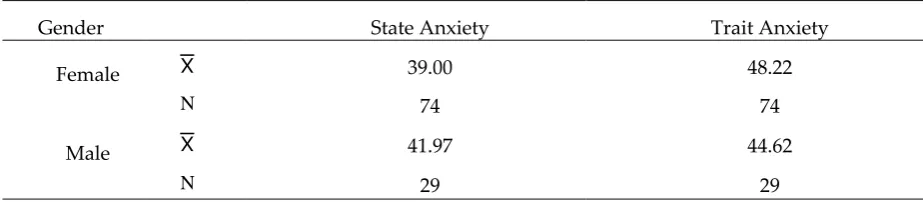
Table 2. Distribution of state and trait anxiety average scores of the implementation group by gender
Min. Max.
State Anxiety 39.83 30.00 53.00
Trait Anxiety 47.20 34.00 75.00
Gender State Anxiety Trait Anxiety
Female 39.00 48.22
N 74 74
Male 41.97 44.62
Considering Table 2, the state anxiety score of females was calculated as 39.00 (= 39.00), and the trait anxiety score as 48.22 (= 48.22) in average. The state anxiety score of males was found as 41.97 (=41.97) and trait anxiety score 44.62 (= 44.62) in average. Consequently, males’ state anxiety scores are higher than those of females while females’ trait anxiety scores are higher than those of males.
Table 3. Control group state-trait anxiety pre-test-displays post-test average scores
N Std.
Control Group State Anxiety Pre-test 41.87 15 5.58
Control Group State Anxiety Post-test 41.80 15 4.09
Control Group Trait Anxiety Pre-test 49.20 15 5.81
Control Group Trait Anxiety Post-test 46.34 15 6.25
According to Table 3, the average pretest score of control groups for state anxiety was calculated as 41.87 (=41.87), and the posttest average as 41.80 (=41.80). The average pretest score of control groups for trait anxiety was found as 49.20 (=49.20) and the posttest average as 46.34 (=46.34). As a result, no change is observed in state anxiety average, while a partial decrease in trait anxiety average was detected.
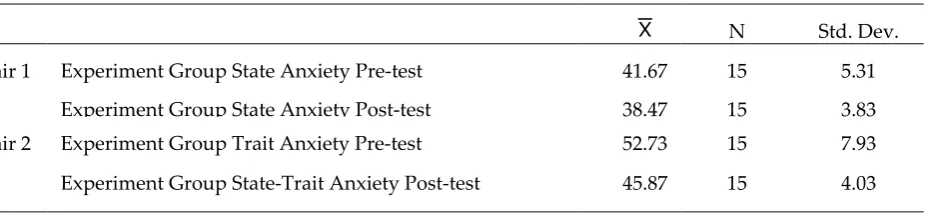
Table 4. Experiment group state-trait anxiety pre-test-displays post-test average points.
According to Table 4, the average score of control group in state anxiety pretest was calculated as 41.67 (=41.67), and the posttest average as 52.73 (=52.73). The average score of experimental group in state anxiety posttest was found as 38.47 (=38.47), and the average score of control group in trait anxiety posttest as 45.87 (=45.87). Consequently, a significant decrease was identified in the average scores of those practicing istighfar for both two anxiety types.
4. Conclusion
In Islam, tawbah is considered to be the most powerful practice in protecting human’s moral health. A careful treatment with the antidote tawbah does not only ameliorate the souls poisoned by sins, but also increases the required vivacity for a good life (Syed, 1969). The extension of anxiety duration leads human to not know what to do with future and to not be able to decide what to do. As a result of this, human may enter into the process of have groundless feelings as in getting in trouble (Çakmak & Hevedanlı, 2005). If
istighfar is made a habit, in other words it is performed as a pray repeated constantly and regularly, it can transform various negative states and emotions into positive ones. Also, performing constantly istighfar may facilitate to do tawbah.
In this study, it was observed that istighfar reduced partially the state anxiety of experimental group, and to a significant extent the trait anxiety of experimental group. Any experimental study addressing directly the association between istighfar and anxiety is not found. Yet, there are several studies examining the relationship between state-trait anxiety and various variables.
N Std. Dev.
Pair 1 Experiment Group State Anxiety Pre-test 41.67 15 5.31
Experiment Group State Anxiety Post-test 38.47 15 3.83
Pair 2 Experiment Group Trait Anxiety Pre-test 52.73 15 7.93
As the anxiety level of students was examined with regard to sex, it was detected that the trait anxiety level of female students is higher than that of male students. A study concluded that students give “disease and death of someone so close” and “not finding a job and unemployment” as the most substantial anxiety reasons (Kaya & Varol, 2004). Istighfar has a healing effect. In hadith, it was uttered that: “Shall I say what are your sickness and cure? Do not forget that your sickness is sin and the cure istighfar” (El-Mervân, 2010). Multiple hospitalized people express in several places that they ameliorated miraculously after they confessed their sin (Alaohuru, 2012).
Although any change did not observed in the state anxiety level in the comparison of pretest and posttest results of control group, a partial decrease in the trait anxiety level was found. On the contrary, the comparison of pretest and posttest scores of experimental group indicated that the state and trait anxiety level decreased significantly. In order to enhance more the reducing effect of istighfar, the latter should be done constantly. Indeed, in the hadith, it was stated that if istighfar is performed constantly, the distress will be removed and a way out of anxieties will be appointed. As the experimental study we carried out is limited to one month, the relaxation level is such that shown in the Table 4. Pursuant to Herbert Benson’s (1997) findings, a pray repeated constantly encourages to escape disturbing thoughts and the physical changes prompting to remove tension. According to the findings, such kind of pray is a good support in treating low to mid-level depression (Bahadır, 2008).
Mental illnesses arise as human conscious will deviates to a considerable extent from God’s will (Aksöz, 2015). This deviation is that human is bored with the narrow existence area he is in, and the tension of not experiencing metaphysics due to not being able to advance to the higher layer (Merter, 2011).
Furthermore, it was observed in certain studies that post-surgery pain and anxiety levels decrease by practicing dhikr (remembering God) program for 30 minutes (Soliman & Mohamed, 2013; Sitepu, 2009).
References
Aksöz, T. (2015). İnsan benliğinin arınması. Sakarya Üniversitesi İlahiyat Fakültesi Dergisi, 17(31), 81-101. Alaohuru, C. C. (2012). Benefits of repentance. Culture & Religion Review Journal, 2012(1), 72-78.
Bahadır. A. (2008). Din Psikolojisi Araştırmaları ve Terapik Manevi Yardım Uygulamaları. Journal of Selçuk
University Faculty of Teology, 25,169-180.
Baynal, F. (2015). Yetişkinlerde dindarlık ve ruh sağlığı ilişkisinin çeşitli değişkenlere göre incelenmesi. İnsan
ve Toplum Bilimleri Araştırmaları Dergisi, [Religion and mental health in adults. Journal of the Human and Social
Science Researches], 4(1), 206-231. doi: 10.15869/itobiad.96269
Budak, S. (2000). Psikoloji sözlüğü Ankara. Ankara: Bilim ve Sanat Yayınları. Cüceloğlu, D. (1991). İnsan ve davranışı. İstanbul, Remzi Publishing.
Çakmak , Ö., & Hevedanlı, M. (2005). Eğitim ve fen edebiyat fakülteleri biyoloji bölümü öğrencilerinin kaygı
düzeylerinin çeşitli değişkenler açısından incelenmesi [The examination of concern levels of biology
student’s class by various variables]. Elektronik Sosyal Bilimler Dergisi, 4(14), 115-127.
El-Mervân, E. (2010). El- Mücâlesetü ve cevâhiru'l ilmi. Bahreyn: Cem'ıyetüt-terbiyeti'l İslamiye.
Gençtan, E. (1998). Psikanaliz ve sonrası. İstanbul: Remzi Publishing.
Kaner, S. (1993). Kontrol kuramı(control theory) ve gerçeklik terapisi(reality therapy). Ankara Üniversitesi
Eğitim Bilimleri Fakültesi Dergisi, 26(2), 569-585. doi: 10.1501/Egifak_0000000486
Karagöz, İ. (2009). Dualar. Ankara: Diyanet İşleri Başkanlığı Yayınları.
Kaya, M., & Varol, K. (2004). ilahiyat fakültesi öğrencilerinin durumluksürekli kaygi düzeyleri ve kaygi
nedenleri (Samsun örneği). Ondokuz Mayıs Üniversitesi İlahiyat Fakültesi Dergisi, 17, 31-63. Köknel, Ö. (1988). Zorlanan insan - Kaygı çağında stres. İstanbul: Altın Kitaplar.
Manav, F. (2011). Kaygı kavramı. Toplum Bilimleri Dergisi, 5(9), 201-211. Merter, M. (2011). Dokuz yüz katlı insan . İstanbul: Kaknüs Yayınları.
Öner, N., & Le Compte, A. (1983). Durumluk ve sürekli kaygı envanteri el kitabı. İstanbul: Boğaziçi Üniversitesi Yayınları.
Özel, İ. (2012). Mahkumların Dindarlık ve Süreki Kaygı Düzeylerinin Çeşitli Değişkenler Açısından
İncelenmesi. Akademik Araştırmalar Dergisi, 54, 163-192.
Özgüven, İ. E. (2017). Psikolojik Testler. Ankara, Nobel Yayınları.
Sertbaş, G. (1998). Gebelerde doğum öncesi ve doğum sonrası dönemlerde durumluk-sürekli kaygı
düzeylerinin incelenmesi ( Unpublished Doctoral Thesis). İzmir: Ege Üniversitesi Sağlık Bilimleri Enstitüsü.
Sitepu, N. (2009). Effect of zikr meditation on post-operative pain among muslim patients undergoing abdominal surgery (Unpublishing Master Thesis). Medan: Songkla University.
Snyder, C. (2000). Handbook of hope: Theory, measures and applications. San Diego: CA: Academic Press. Soliman, H., & Mohamed, S. (2013). Effects of zikr meditation and jaw relaxation on postoperative pain, anxiety and physiologic response of patients undergoing abdominal surgery. Journal of Biology, Agriculture and Healthcare, 3(2), 23-38.
Syed, M. H. (1969). Effect of tauba ( repentance) on penalty in Islam. Islamic Studies, 8(3), 189-198.
Tirmidhi, M. (1975). Sunan al-Tirmidhi, (2 ed.). Egypt, Mustafa Al-Babi Al-Halabi Library and Printing Co.
Yalçınkaya, V. (2010). Kur'an'da istiğfar kavramı. Unpublishing Master Thesis. Kayseri, Erciyes Üniversitesi
Sosyal Bilimler Enstitüsü.
Yapıcı, A. (1997). İslam'da tövbe ve dini yaşantıdaki rolü. İstanbul:Beyan Yayınları.
Yıldız, M. (2007). Çocuklarda tanrı tasavvurunun gelişimi. İzmir: İzmir İlahiyat Vakfı Yayınları.
Yıldız, M., Sezen, A., &Yenen, İ. (2007). İlahiyat fakültesi öğrencilerinde durumluk-sürekli kaygi düzeyleri