AMERICAN ACADEMY OF PEDIATRICS
Committee on Injury and Poison Prevention and Committee on Sports Medicine and Fitness
Trampolines at Home, School, and Recreational Centers
ABSTRACT. The latest available data indicate that an estimated 83 400 trampoline-related injuries occurred in 1996 in the United States. This represents an annual rate 140% higher than was reported in 1990. Most injuries were sustained on home trampolines. In addition, 30% of trampoline-related injuries treated in an emergency de-partment were fractures often resulting in hospitaliza-tion and surgery. These data support the American Acad-emy of Pediatrics’ reaffirmation of its recommendation that trampolines should never be used in the home en-vironment, in routine physical education classes, or in outdoor playgrounds. Design and behavioral recommen-dations are made for the limited use of trampolines in supervised training programs.
ABBREVIATIONS. CPSC, Consumer Product Safety Commission; NEISS, National Electronic Injury Surveillance System; NPTR, National Pediatric Trauma Registry.
R
eview of the literature and the previous policy statements by the American Academy of Pe-diatrics—“Trampolines” and “Trampolines II”—were critical in placing the currently available data on trampoline-related injuries and deaths in perspective.1,2 Injuries have been reported ontram-polines ranging from 3 feet in diameter to running or tumbling trampolines that may be as long as 30 feet.3
Previous data have shown that injuries are likely to occur equally on large or small trampolines.4
Access to accurate longitudinal data about the in-cidence and severity of injuries resulting from tram-poline use is critical in making sound policy recom-mendations. Although a variety of articles about trampoline-related injuries have been published,4 –16
many lack consistent data sources, overlap in report-ing of case series, lack an accurate measure of expo-sure to trampolines, and often lack detail on the circumstances of injury. Two data sources are avail-able to help guide the present policy statement: 1) the Consumer Product Safety Commission (CPSC) Na-tional Electronic Injury Surveillance System (NEISS) and other files of product-related incidents; and 2) the National Pediatric Trauma Registry (NPTR).
TRAMPOLINE INJURIES
In 1996, an estimated 83 400 trampoline-related injuries were treated in US hospital emergency de-partments, a rate of 31.5 injuries per 100 000
popula-tion (Tables 1 and 2).3The figures represent a 140%
increase over the 1990 rate of injury (13/100 000). The NEISS data showed that for all years (1991– 1996), incidents were about evenly divided between boys and girls. In 1996, more than 66% of victims were ages 5 through 14 years; about 16% were 15 through 24 years; and about 10% were 4 years or younger (Table 2). Children younger than 5 years had the second highest rate of injury. Strain/sprain was the most common diagnosis, and was involved in 40% of the injuries. Fractures accounted for 30% of injuries; contusions/abrasions, 13%; lacerations, 11%; and other, 6%. Of the estimated injuries, 45% occurred to the lower extremity (leg or foot) and 30% to the upper extremity (arm or hand); 14% were head or face injuries. The majority of injuries to the leg or foot were strains or sprains (58%), whereas the ma-jority of injuries to the arm or hand were fractures (58%). Most injuries to the head or face were lacera-tions (61%). Fractures, concussions, and internal in-juries to the head accounted for about 15% of all head injuries. For the most severe injuries resulting in hospitalization, fractures (most frequently to the arm and leg) were diagnosed in almost 90%. Two percent of trampoline-related injuries treated in the emer-gency department resulted in hospitalization, com-pared with 4% for other product-related injuries re-ported to NEISS. Table 1 summarizes the number of cases of trampoline-related injuries, the number of hospitalizations, and the number of head and neck injuries for the years 1991 through 1996. The CPSC data indicate that in 1996, head (excluding face) and neck injuries accounted for 9.8% of trampoline-related injuries, 7.2% of skateboard-trampoline-related injuries, and 4.9% of in-line skating-related injuries.3
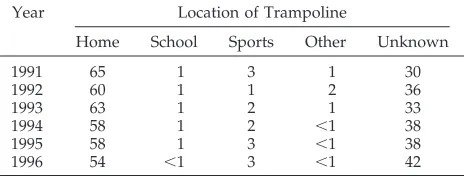
Most trampoline-related injuries have occurred on home trampolines (Table 3). The proportion of inju-ries for which the location was unknown increased from 1991 to 1996 and deserves further study. Re-view of NEISS 1996 descriptive comments showed that victims were injured when they landed incor-rectly while jumping or while performing stunts. Other injuries occurred when the victims fell from the trampoline to the surface below or collided with another person on the equipment. Victims also were injured when they contacted the frame and/or springs while near the edge of the jumping surface. A limited NEISS in-depth study of people in hospital emergency departments in September 1995 revealed that in 57% of cases, the victims were on the tram-poline with one or more other persons when they were injured.3Many of these multiple-user incidents
seemed to result from contact with another user.
The recommendations in this statement do not indicate an exclusive course of treatment or serve as a standard of medical care. Variations, taking into account individual circumstances, may be appropriate.
Most injuries involved relatively new full-size tram-polines in residential yards. Most tramtram-polines were at least 2 feet high.
The NPTR is a database of trauma cases treated in a set of pediatric trauma centers or in children’s hospitals with a pediatric trauma unit. In October 1996, there were 78 participating hospitals. During the period July 13, 1988, to June 30, 1996, 149 tram-poline-related injuries were reported to the NPTR (unpublished data, 1996). About 50% of these pa-tients were transported directly to the operating room. The leading diagnosis was fracture of an ex-tremity. In 16% of cases, the head and neck were involved. One spinal cord lesion without vertebral injury was reported, and one fracture of the vertebral column occurred without spinal cord injury. The majority of head and neck injuries were skull frac-tures with intracranial injury or concussion.
A recent epidemiologic study of trampoline-related injuries in New Zealand, during a 10-year period 1979 through 1988, revealed an increase in
incidence of hospitalization rate from 3.1 to 9.3 per 100 000.4Of hospitalized victims, 71% were injured
on home trampolines, and in contrast to other stud-ies, 80% fell from the trampoline to the surrounding surface. Fractures were the most common type of injury, and the incidence of severe head and neck injuries was low. Two deaths and 2098 hospitaliza-tions occurred. Most injuries occurred when the vic-tims fell from the trampoline and sustained injury on impact with the surface below.
A recent review of trampoline-related injuries to children in the United States from 1990 through 1995 provided a retrospective analysis of data from the NEISS. The data indicated that an estimated 1400 children, or 2.0 per 100 000, required hospital admis-sion or interhospital transfer because of a trampo-line-related injury. This represented 3.3% of all chil-dren with a trampoline-related injury.16
TRAMPOLINE DEATHS
Since 1990, the CPSC has received reports of six deaths involving trampolines. Victims ranged in age from 3 years through 21 years, although the 21-year-old died 6 years after being injured on a trampoline. Most deaths occurred when victims fell from the trampolines, and most involved the cervical spinal cord.
CONCLUSIONS
The following conclusions may be drawn from the data and literature review:
1. In the United States, the largest proportion of trampoline-related injuries has occurred on home trampolines.
2. Most trampoline-related injuries occur from falls sustained on and off the trampoline.
3. Many trampoline-related injuries occur when there are simultaneous multiple users.
4. The most likely injuries resulting in hospitaliza-tion sustained while using a trampoline are frac-tures to the upper and lower extremities; these injuries may be severe, often resulting in surgery. 5. Catastrophic cervical spine injuries are rare. How-ever, head and neck injuries constitute a notable number of the more serious injuries requiring hos-pitalization.
6. More data are needed about the incidence, cir-cumstances, and mechanism of catastrophic inju-ries, such as those to the cervical spine.
TABLE 1. Trampoline-Related Injuries*
Years Actual No. of Cases Estimated No. of Injuries* Rate per 100 000 Actual No. Hospitalized
No. of Patients With Head and Neck Injuries Hospitalized† Total ,15 y
1991 651 38 800 15.4 19 12 1
1992 780 44 700 17.1 24 16 4
1993 873 46 200 17.9 18 17 4
1994 1065 52 900 20.3 29 20 2
1995 1383 66 200 25.2 25 21 5
1996 1728 83 400 31.5 43 34 2
* From the US Consumer Product Safety Commission, National Electronic Injury Surveillance System, which gives a probability sample. Each injury case has a statistical weight.
† The number of cervical spine injuries in children were 6 for the years 1991–1995.
TABLE 2. Estimated Injuries and Injury Rates From Trampo-lines, by Age of Victim (1996)*
Age of Victim, y Estimated No. of Injuries Percentage of Total Rate per 100 000
Total 83 400 100 31.5
0–4 8470 10 43.5
5–14 55 400 66 143.7
15–24 13 270 16 37.0
25–44 5740 7 6.9
45–64 520 ,1 1.0
651 0 — —
* From the National Electronic Injury Surveillance System; US Census Population Estimates; US Consumer Product Safety Com-mission.
TABLE 3. Percentage of Trampoline-Related Injuries by Lo-cation of Trampoline*
Year Location of Trampoline
Home School Sports Other Unknown
1991 65 1 3 1 30
1992 60 1 1 2 36
1993 63 1 2 1 33
1994 58 1 2 ,1 38
1995 58 1 3 ,1 38
1996 54 ,1 3 ,1 42
* From the US Consumer Product Safety Commission, National Electronic Injury Surveillance System.
RECOMMENDATIONS
Despite all currently available measures to prevent injury, the potential for serious injury while using a trampoline remains. The need for supervision and trained personnel at all times makes home use ex-tremely unwise.
1. The trampoline should not be used at home, in-side or outin-side. During anticipatory guidance, pe-diatricians should advise parents never to pur-chase a home trampoline or allow children to use home trampolines.
2. The trampoline should not be part of routine physical education classes in schools.
3. The trampoline has no place in outdoor play-grounds and should never be regarded as play equipment.
The limited use of trampolines under direct su-pervision of physical therapists, athletic trainers, or other appropriately trained individuals for spe-cific medical conditions, including conditioning and/or rehabilitation of injuries, is not addressed in this statement. The limited use of trampolines in supervised training programs (eg, gymnastics, div-ing, and other competitive sports), should include the design and behavioral recommendations that follow.
DESIGN
• A safety pad should cover all portions of the steel frame and springs.
• The surface around the trampoline should have an impact-absorbing safety surface material.17
• The condition of the trampoline should be regu-larly checked for tears, rust, and detachments. • Safety harnesses and spotting belts, when
ap-propriately used, may offer added protection for athletes learning or practicing more challenging skills on the trampoline.
• Setting the trampoline in a pit so the mat is at ground level should be considered.
• Ladders may provide unintended access to the trampoline by small children and should not be used.
BEHAVIOR
• Only one person should use the trampoline at a time.
• In supervised settings, the user of the trampoline should be at the center of the mat. The user of the trampoline should not attempt maneuvers beyond capability or training, thereby putting them at risk for injury.
• Personnel trained in trampoline safety and com-petent spotters should be present whenever the trampoline is in use.
• Even in supervised training programs, the use of trampolines for children younger than 6 years of age should be prohibited.18
• The trampoline must be secured and not accessible when not in use.
Committee on Injury and Poison Prevention, 1998 –1999
Murray L. Katcher, MD, PhD, Chairperson Phyllis Agran, MD, MPH
Danielle Laraque, MD Susan H. Pollack, MD Barbara L. Smith, MD Gary A. Smith, MD, DrPH Howard R. Spivak, MD Milton Tenenbein, MD Susan B. Tully, MD
Liaison Representatives
Ruth A. Brenner, MD, MPH
National Institute for Child Health and Development
Stephanie Bryn, MPH
Maternal and Child Health Bureau Cheryl Neverman, MS
National Highway Traffic Safety Administration Richard A. Schieber, MD, MPH
Centers for Disease Control and Prevention Richard Stanwick, MD
Canadian Paediatric Society Deborah Tinsworth
United States Consumer Product Safety Commission
William P. Tully, MD
Pediatric Orthopaedic Society of North America
Section Liaisons
Marilyn Bull, MD
Section on Injury and Poison Prevention Victor Garcia, MD
Section on Surgery
Committee on Sports Medicine and Fitness, 1998 – 1999
Steven J. Anderson, MD, Chairperson Bernard A. Griesemer, MD
Miriam D. Johnson, MD Thomas J. Martin, MD Larry G. McLain, MD Thomas W. Rowland, MD Eric Small, MD
Liaison Representatives
Claire LeBlanc, MD
Canadian Paediatric Society Carl Krein, ATC, PT
National Athletic Trainers Association Judith C. Young, PhD
National Association for Sport and Physical Education
Section Liaisons
Frederick E. Reed, MD Section on Orthopaedics Reginald L. Washington, MD
Section on Cardiology
REFERENCES
1. American Academy of Pediatrics, Committee on Accident and Poison Prevention. Trampolines.News and Comment.September 1977 2. American Academy of Pediatrics, Committee on Accident and Poison
Prevention and Committee on Pediatric Aspects of Physical Fitness, Recreation and Sports. Trampolines II.Pediatrics.1981;67:438 – 439 3. Cassidy SP. United States Consumer Product Safety Commission (US
CPSC). Trampolines. Memorandum, May 15, 1996, and National Elec-tronic Injury Surveillance System (NEISS) data, 1991–1995; 1996 4. Chalmers DJ, Hume P, Wilson FD. Trampolines in New Zealand: a
decade of injuries.Br J Sports Med.1994;28:234 –238
statement.Pediatrics.1984;74:804 – 812
6. Hume PA, Chalmers DJ, Wilson BD. Trampoline injury in New Zealand: emergency care.Br J Sports Med.1996;30:327–330
7. Torg JS. Trampoline-induced quadriplegia. Clin Sports Med. 1987;6: 73– 85
8. Torg JS. Epidemiology, pathomechanics, and prevention of athletic injuries to the cervical spine.Med Sci Sports Exerc.1985;17:295–303 9. Silver JR. Spinal injuries in sports in the UK.Br J Sports Med.1993;27:
115–120
10. Woodward GA, Furnival R, Schunk JE. Trampolines revisited: a review of 114 pediatric recreational trampoline injuries. Pediatrics. 1992;89: 849 – 854
11. Larson BJ, Davis JW. Trampoline-related injuries.J Bone Joint Surg Am.
1995;77:1174 –1178
12. Hammer A, Schwartzbach AL, Paulev PH. Some risk factors in tram-polining illustrated by six serious injuries.Br J Sports Med.1982;16:27–32 13. Hammer A, Schwartzbach AL, Paulev PH. Trampoline training injuries: one hundred and ninety-five cases.Br J Sports Med.1981;15:151–158 14. Routley V. Trampoline injuries.Hazard.1992;13:1
15. Clarke KS. A survey of sports-related spinal cord injuries in schools and colleges, 1973–1975.J Safety Res.1977;9:140 –146
16. Smith GA. Injuries to children in the United States related to trampo-lines, 1990 –1995: a national epidemic.Pediatrics.1998;101:406 – 412 17. American Society for Testing and Materials, ASTM Subcommittee
F15–29. F1487–95 Standard Consumer Safety Performance Specification for Playground Equipment for Public Use. West Conshohocken, PA; 1997 18. Consumer Product Safety Alert. Trampoline Safety Alert. Washington,
DC: US Consumer Product Safety Commission; June 1997
DOI: 10.1542/peds.103.5.1053
1999;103;1053
Pediatrics
Fitness
Committee on Injury and Poison Prevention and Committee on Sports Medicine and
Trampolines at Home, School, and Recreational Centers
Services
Updated Information &
http://pediatrics.aappublications.org/content/103/5/1053
including high resolution figures, can be found at:
References
http://pediatrics.aappublications.org/content/103/5/1053#BIBL
This article cites 14 articles, 9 of which you can access for free at:
Subspecialty Collections
on_prevention_sub
http://www.aappublications.org/cgi/collection/injury_violence_-_pois
Injury, Violence & Poison Prevention
http://www.aappublications.org/cgi/collection/for_your_benefit
For Your Benefit
violence_and_poison_prevention
http://www.aappublications.org/cgi/collection/committee_on_injury_
Council on Injury, Violence, and Poison Prevention
following collection(s):
This article, along with others on similar topics, appears in the
Permissions & Licensing
http://www.aappublications.org/site/misc/Permissions.xhtml
in its entirety can be found online at:
Information about reproducing this article in parts (figures, tables) or
Reprints
http://www.aappublications.org/site/misc/reprints.xhtml
DOI: 10.1542/peds.103.5.1053
1999;103;1053
Pediatrics
Fitness
Committee on Injury and Poison Prevention and Committee on Sports Medicine and
Trampolines at Home, School, and Recreational Centers
http://pediatrics.aappublications.org/content/103/5/1053
located on the World Wide Web at:
The online version of this article, along with updated information and services, is
by the American Academy of Pediatrics. All rights reserved. Print ISSN: 1073-0397.
the American Academy of Pediatrics, 345 Park Avenue, Itasca, Illinois, 60143. Copyright © 1999 has been published continuously since 1948. Pediatrics is owned, published, and trademarked by Pediatrics is the official journal of the American Academy of Pediatrics. A monthly publication, it
at Viet Nam:AAP Sponsored on August 30, 2020 www.aappublications.org/news