Volume 1, Issue 2, October 2012
Page 176
A
BSTRACTIn recent years, Orthogonal Frequency Division Multiplexing (OFDM) has gained significant attention and is preferred for transmission over a dispersive channel. It is because of its several advantages such as high spectral efficiency, low implementation complexity, less vulnerability to echoes and non–linear distortion. However, it has few limitations such as peak-to-average-power ratio (PAPR) and bit error rate (BER), which determines the system’s power efficiency. High PAPR is one of the major drawbacks in OFDM systems, which causes a significant level of signal distortions, when the modulated signals are amplified through high power amplifiers (HPAs). Also, a high PAPR and, in addition, high noise (e.g. AWGN) may significantly distort the signal, resulting in high BER on demodulation of the received signal. Therefore, PAPR & BER reduction is very essential. For this purpose, the research reported in this paper is focused on providing a solution to the same problem. More specifically, the proposed research focuses on developing a predistortion based algorithm. For this purpose, a non-linear polynomial based function is used. The signal is normalized to a scale of + 1 before feeding to this non-linear polynomial function. In this research, it is aimed to implement this approach and investigate the effect of various coefficients of the non-linear polynomial for reducing the PAPR in OFDM systems. From the analysis, it is inferred that the selection of value of coefficients of non-linear polynomial and constellation size depends upon the level of PAPR reduction required. Here in this paper, it is preferred to choose a fifth order non-linear polynomial with a small value of coefficients of higher order term.
Keywords: Non-linear polynomial function; OFDM conventional; Peak to Average Power Ratio and BER.
1.
INTRODUCTION
Over the last few years, the demand for OFDM has been significantly increased and this is why it becomes a key multicarrier modulation technique [1]. Some of the key advantages of OFDM include providing high spectral efficiency, low implementation complexity [2], less vulnerability to echoes and non–linear distortion [3]. Due to these advantages of OFDM system, it is vastly used in various modern communication systems. However, it has few practical limitations such as high PAPR and bit error rate [4]. A large PAPR increases the complexity of the analog–to–digital and digital–to–analog converter and reduces the efficiency of the radio – frequency (RF) high power amplifiers [5]. There are a number of techniques dealing with the problem of BER & PAPR. Some of these include: constellation shaping, nonlinear companding transforms [6], tone reservation [7] and tone injection (TI), clipping and filtering [8], partial transmit sequence [9] and precoding based techniques. Among these, the precoding based techniques is very efficient method to reduce the PAPR; however, only for a small number of subcarriers and is inefficient for a large number of subcarriers. In case of amplitude clipping and filtering techniques, a threshold value of the amplitude is set in this process and any sub-carrier having amplitude more than that value is clipped or that sub-carrier is filtered to bring out a lower PAPR value. In selected mapping approach, a set of sufficiently different data blocks representing the information same as the original data blocks are selected. Selection of data blocks with low PAPR value makes it suitable for transmission. In partial transmit sequence approach, part of data of varying sub-carriers is transmitted which covers all the information to be sent in the signal as a whole.
However, these techniques do PAPR reduction at the expense of increase in transmit signal power, bit error rate [7], data rate loss and computational complexity. The reduction in PAPR & BER is very essential. Therefore, the research reported in this paper is focused on providing a solution to the same problem. More specifically, the proposed research focuses on developing a predistortion based algorithm. For this purpose, a non-linear polynomial based function is used. The signal is normalized to a scale of + 1 before feeding to this non-linear polynomial function. In this paper, it is aimed to implement this approach and investigate the effect of various coefficients of the non-linear polynomial for reducing the PAPR in OFDM systems.
Performance Enhancement of OFDM Systems
using non-linear polynomial Technique
Sakshi Babbar1 and Abhijeet Kumar2
1,2 Department of Electronics & Communication Engineering,
Volume 1, Issue 2, October 2012
Page 177
2.
SYSTEM
MODEL
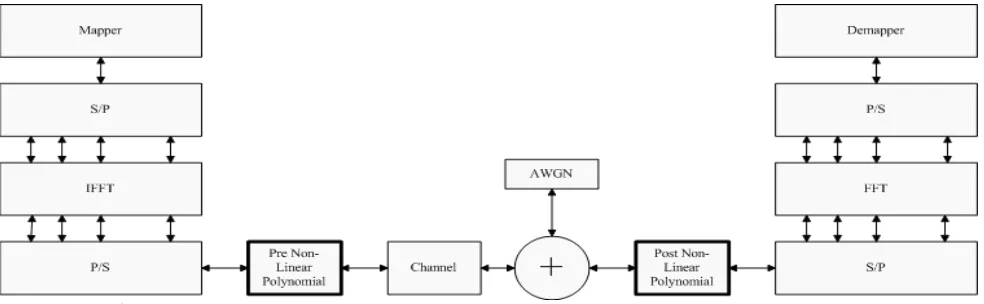
This paper presents a novel non-linear polynomial function for reducing PAPR in OFDM system. The idea is to pass the OFDM signal through a pre non-linear polynomial function as shown in Figures 1 & 2, which will reduce the high peaks of the OFDM signals. On the receiver side, the received signal is again passed through another non-linear polynomial; which is phase of the first non-linear polynomial. The characteristics of two polynomials are anti-phase in a manner that they both nullify the effect of each other and the overall input-output transfer function is linear (Figures 1 & 2). Thus, the final output is same as input; however, simultaneously the PAPR is also reduced.
Figure 1: The non-linear polynomial function based approach for reducing PAPR in OFDM systems.
From Figures 1 & 2, it can be interpreted that the required polynomial functions will not have the even order terms (as these does not reach saturation) except the zero order term which represents DC shifting in the output curve. Also, in this case the coefficients of each of the alternate terms after the third order terms change the sign alternatively for the pre non-linear function in order to bend downwards the transfer characteristics. Therefore, the desired characteristics of the required non-linear polynomial can be represented as:
n i i i n nx
w
w
x
w
x
w
x
w
x
w
w
x
Y
0 ) 1 * 2 ( ) 1 * 2 ( 0 ) 1 * 2 ( ) 1 * 2 ( 5 5 3 3 1 0...
)
(
(1)To design the proposed non-linear polynomial functions based approach for reducing PAPR, consider the block diagram of an OFDM system shown in Figure 2. In Figure 2, an OFDM signal consists of N subcarriers that are modulated by N complex symbols selected from a particular QAM constellation.
Figure 2: Block diagram of OFDM system with pre and post non-linear polynomial function.
In Figure 2, the baseband modulated symbols are passed through serial to parallel converter which generates complex vector of size N. This complex vector of size N can be mathematically expressed as
(2)
Volume 1, Issue 2, October 2012
Page 178
(3) Where, W is the N × NIFFT matrix. Thus, the complex baseband OFDM signal with N subcarriers can be written asn = 0, 1, . . . , N −1. (4)
After parallel-to-serial conversion, a cyclic prefix (CP) with a length of Ngsamples is appended before the IFFT output
to form the time-domain OFDM symbol, s = [s0,...,sN+Ng−1], where, and
. The useful part of OFDM symbol does not include the Ng prefix samples and has duration of Tu
seconds. The samples (s) are then passed through a pre non-linear polynomial function before amplification. The amplifier characteristics are given by function F.The output of amplifier produces a set of samples given by:
y = [y0, y1, . . . , yN+Ng−1] (5)
At the receiver front end, the received signal is applied to a matched filter and then sampled at a rate Ts= Tu/N. After
passing through the post non-linear function, the CP samples (Ng) are dropped. The received sequence z, assuming an
additive white Gaussian noise (AWGN) channel, can then be expressed as
z = F(Wd) + η (6)
Where, the noise vector η consists of N independent and normally distributed complex random variables with zero mean and variance σn2= E{|ηn|2}. Subsequently, the sequence z is fed to the fast Fourier transform (FFT), which
produces the frequency-domain sequence r as
r =WH z (7)
Where, kth element of r is given by
k=0, 1, 2,…, N-1 (8)
Finally, the estimated symbols vector can be obtained from r. It is to be noted that in ideal cases, the demodulation is performed based on the assumption of perfect symbol timing, carrier frequency, and phase synchronization. One of the main disadvantages of OFDM systems is the high PAPR of transmitted signal due to the combination of N modulated subcarriers. The PAPR for a continuous time signal x(t) is defined as:
(9)
The PAPR for discrete time signals can be estimated by oversampling the vector d by a factor L and computing NL -point IFFT. The PAPR in this case is defined as:
(10)
PAPR, in quantitative terms, is usually expressed in terms of Complementary Cumulative Distribution function (CCDF) for an OFDM signal, and is mathematically given by
(11) Where, PAPR0 is the clipping level. This equation can also be read as the probability that the PAPR of a symbol block
exceeds some clip level PAPR0. The implementation part is presented below.
3.
IMPLEMENTATION
To do the PAPR analysis and to evaluate performance of the pre and post non-linear polynomial function based OFDM systems, the proposed algorithm is implemented using MATLAB by undertaking the following steps:
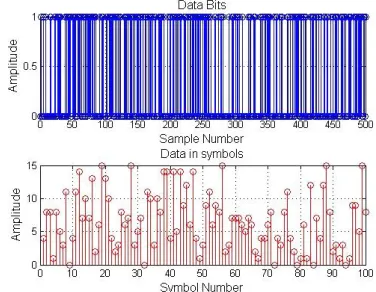
1.To do the PAPR analysis of OFDM system with the proposed non-linear polynomial based function, firstly binary data is generated randomly.
2.The generated binary data is then converted into symbols and is then modulated by M-QAM (where M=4, 16, 64, 256).
3.The serial data is then converted into parallel data and IFFT is performed as normal in OFDM procedure.
4.The parallel signal is then converted to serial data and a non-linear polynomial function is applied to reduce the PAPR. The PAPR is then calculated and the serial OFDM signal is then passed through a multipath channel with AWGN noise added.
5.The received signal is again passed through the post non-linear polynomial to recover the original signal. This signal is then converted from serial to parallel data. The final demodulated signal is parallel data, which is then converted into serial data. The serial data is then demodulated to retrieve back the signal. The BER is calculated by taking the difference of the demodulated data and the input data.
4.
RESULT
&
DISCUSSION
Volume 1, Issue 2, October 2012
Page 179
noted that the polynomial is taken only up to fifth order. It is because there is little effect of higher order terms as the signal is normalized to a maximum scale of +1. To do the PAPR analysis of the proposed non-linear polynomial based OFDM systems, data is generated randomly and then modulated by M-QAM (where M = 16, 64). The order of FFT and IFFT is taken as 64. The results obtained are shown in Figures 3 to 17 for various combinations of coefficients of non-linear polynomial. The polynomial used is given by:5 5 3 3 1 0
)
(
x
w
w
x
w
x
w
x
Y
(12)The key conclusions drawn from the results are discussed below:
1.From Figures 3 to 13, it can be interpreted that the results obtained for different coefficients of non-linear polynomial are different. The PAPR is more reduced in case of higher degree of non-linearity of the polynomial function. 2.From Figures 3 to 13, the degree of non-linearity increases when the value of
w
3increases from 0.3076 to 0.5076. Itis because this coefficient has negative sign and it results in bending the transfer characteristics of non-linear polynomial. However, the coefficient
w
5bends the transfer characteristics in opposite direction as it has positive sign. When its value increases from 0.0725 to 0.1725, it bends the transfer characteristics towards linearity. 3.The increase in constellation size, i.e., from M = 4, 16, 64 has not significant effect of change in PAPR for anyparticular values of coefficients of the non-linear polynomial. It may be because in the proposed scheme, the input OFDM signal is normalized to a scale of + 1 before feeding to the non-linear polynomial. This is clearly observed in Figures 3 to 13.
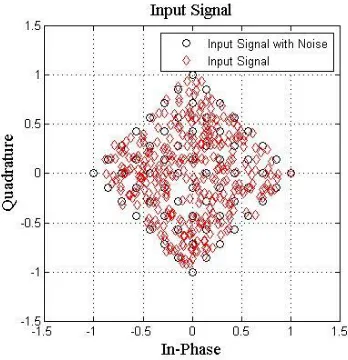
4.From Figures 10 to 13, it can be interpreted that with the inclusion of AWGN noise in the signal, the proposed scheme is still capable of decreasing the PAPR for the same values of coefficients of non-linear polynomial. It is because the input signal is normalized to a scale of + 1 before feeding to the non-linear polynomial.
5.It can be also seen that for same cases, the variation of probability P (PAPR >PAPR0) is flat and is not changing
smoothly. It is because as the signal is normalized to a scale of + 1; so for small changes in input signal will not result into much change in overall output of non-linear polynomial and so the value obtained are much closer, which on logarithmic scale appears to be same.
6.It can also be seen that for higher constellation size (e.g. M=64), there is a sharp roll off in PAPR. However, there is more irregularity than the lower constellation size. It is because higher constellation size OFDM systems have more number of signals and on normalization, these are very closer to each other.
From the above discussion, the proposed non-linear polynomial system significantly decreases the PAPR, when the signals are normalized and passed through this non-linear polynomial. The value of coefficients significantly changes the characteristics of non-linear polynomial. It is found that as the OFDM signals needs normalization in this case, so the effect of higher order terms is very less on the characteristics of non-linear polynomial. Therefore, a non-linear polynomial up to fifth order is appropriate for the proposed model. It is also found that the coefficients of the polynomial should be in decreasing order with increase in the power of corresponding terms of non-linear polynomial. Also, for same values of coefficients of non-linear polynomial, the variation in constellation order also significantly changes the PAPR. Therefore, the selection of value of coefficients of non-linear polynomial and constellation size depends upon the level of PAPR reduction required. Here in this paper, it is preferred to choose a fifth order non-linear polynomial with a small value of coefficients of higher order term.
Volume 1, Issue 2, October 2012
Page 180
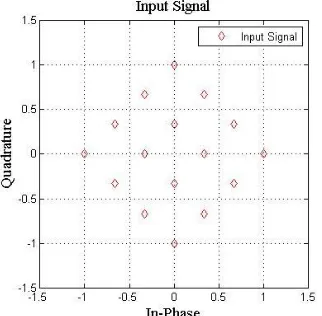
Figure 5: QAM modulated input signal with constellation size 16. Figure 6: CCDF plots of PAPR of OFDM with QAM modulation for constellation size 16.
Figure 7: QAM modulated input signal with constellation size 64 Figure 8: CCDF plots of PAPR of OFDM with QAM modulation for constellation size 64.
Volume 1, Issue 2, October 2012
Page 181
Figure 11: CCDF plots of PAPR of OFDM with QAM Figure 12: QAM modulated noisy input signal modulation for constellation size 16. with constellation size 64.
Figure 13: CCDF plots of PAPR of OFDM with QAM modulation for constellation size 64.
5.
CONCLUSION
This paper presented the results obtained on applying a non-linear polynomial on OFDM system for reducing PAPR in OFDM systems with M-QAM modulation, where as M=16 and 64. It is observed from the graphs that the proposed non-linear polynomial system significantly decreases the PAPR, when the signals are normalized and passed through the designed non-linear polynomial. The value of coefficients significantly changes the characteristics of non-linear polynomial. It is found that as the OFDM signals needs normalization in this case, so the effect of higher order terms is very less on the characteristics of non-linear polynomial. Therefore, a non-linear polynomial up to fifth order is appropriate for the proposed model. It is also found that the coefficients of the polynomial should be in decreasing order with increase in the power of corresponding terms of non-linear polynomial. Therefore, the selection of value of coefficients of non-linear polynomial and constellation size depends upon the level of PAPR reduction required. Here in this paper, it is preferred to choose a fifth order non-linear polynomial with a small value of coefficients of higher order term.
REFERENCES
[1] E. A.-Dalakta, A. A.-Dweik & C. Tsimenidis, “Efficient BER Reduction Technique for Nonlinear OFDM Transmission Using Distortion Prediction”. IEEE Transactions On Vehicular Technology. Vol. 61, NO. 5, pp. 2330-36, June 2012.
[2] H.-B. Jeon, J. S. and D. J. Shin, “A Low-Complexity SLM Scheme Using Additive Mapping Sequences for PAPR Reduction of OFDM Signals”. IEEE Transactions On Broadcasting. Vol. 57, NO. 4, pp. 866-75, Dec 2011. [3] Ghassemi and T A. Gulliver, “SLM-Based Radix FFT for PAPR Reduction in OFDM Systems”. IEEE
Volume 1, Issue 2, October 2012
Page 182
[4] C. P. Li, S. H. Wang and C. L. Wang , “Novel Low-Complexity SLM Schemes for PAPR Reduction in OFDMSystems”. IEEE Transactions On Signal Processing. Vol. 58, NO. 5, pp 2916-21, May 2010
[5] I. Baig and V. Jeoti. “PAPR Reduction in OFDM Systems: Zadoff-Chu Matrix Transform Based Pre/Post-Coding Techniques”. Second International Conference on Computational Intelligence, Communication Systems and Networks. July 2010. pp 373-77.
[6] H. Liang, Y. R. Chen, Y. F. Huang, C. H. Cheng . “A Modified Genetic Algorithm PTS Technique for PAPR Reduction in OFDM Systems”. Proceedings of the 15th Asia-Pacific Conference on Communications (APCC). Aug 2009, pp 182-185.
[7] H. Li, T. Jiang and Y. Zhou. “An Improved Tone Reservation Scheme With Fast Convergence for PAPR Reduction in OFDM Systems”. IEEE Transactions on Broadcasting. Vol. 57, No. 4, pp. 902-06, Dec 2011 [8] L. Wang and C. Tellambura. “A Simplified Clipping and Filtering Technique for PAPR Reduction in OFDM
Systems”. Signal Processing Letters, IEEE. Vol.12, No.6, pp. 453-456, June 2005.